Category Archives: Coaching
College softball not always the Valhalla you imagine

There is a belief by many in the fastpitch softball world that making it to play in college gives you entry into a virtual Valhalla where the coaching is top-notch, the players are dedicated to and fully supportive of one another, and all the problems of school or travel ball disintegrate into the rarefied air of collegiate competition.
I’m here to tell you that’s not actually the case. At least not everywhere all the time. I was reminded of that yesterday while watching a collegiate game.
It was a well-played contest between two very competitive teams, each battling to the last out for the win. The weather conditions were hardly ideal, which made the competitive spirit of the players stand out that much more.
Yet sitting in the stands, I once again noticed how it isn’t all that much different from 10U travel ball. I’ve seen games at all levels, and talked to players and coaches as well. Here are a few of my observations on the similarities from yesterday and the past that will hopefully bring a measure of reality to your hoped-for college experience.
Parents still live and die with their daughters’ performances.
I’m sure this never goes away. But you can generally tell whose daughter is at the plate by the way the parents react. When it’s someone else’s kid, they’re relaxed and enjoying the game. When their kid comes to bat, they suddenly tense up.
Many bring out the smartphone to video the at-bat, probably to go over it later in great detail. I’ve heard tales about this or that dad who is pretty brutal on his daughter’s performance. (Moms not so much, although I’m sure it happens.)
Pitchers’ parents have it worse. They have to sit on the seat cushion of nails for the entire half inning. If their daughter struggles, they either tense up visibly or deflate like a balloon. Not all of them – many actually just sit and watch the game, supporting their daughters with the sheer force of their will as best they can – but there are those who definitely go too far with it.
Yelling at the umpires
Another surprising thing. Although it happens at pro games too so I guess I shouldn’t be too surprised.
But still, do parents really think they’re helping their cause by riding the home plate umpire? In the best care scenario, the plate ump will be a professional and ignore the peanut gallery. That’s usually what happens.
Below the best case, he/she might start giving a little more leeway to the opposing team just to prove a point. Umpires are human beings too (despite what some of you think) and subject to the same human reactions as the rest of us.
There is probably less yelling at and complaining about umpires overall than at a 10U game. But by the time the parents who do it have players of college age, they’ve had a lot of practice at it.
Complaining about the coaches
Pretty much the same thing as with umpires, only different topics. It’s all the usual complaints – playing time, coaching strategy, lineups (why would they put so-and-so in the 5 spot? She hasn’t had a hit since the Democrats controlled Congress!).
They’ll also critique every decision on the field, especially if it goes south. Stealing bases is a great idea until a runner gets thrown out. Then it’s “What were they thinking?” Why are we bunting, or why are we not bunting, is another popular question.
Even the pitch calling gets questioned on a case-by-case basis. Particularly if it results in a home run. Hey, it’s possible the right pitch was called but not thrown. Or the right pitch was called and thrown, but the hitter just did a heckuva job hitting it. That happens too.
Honestly, the parents or fans who do this are in the minority. Versus 10U ball where everyone is an expert and the score doesn’t matter. But it does go on. Why do you think coaches pretty much tell parents at the beginning of the season please come out and support us, but we don’t want to hear from you ever?
Players sniping at one another
I am pretty sure there are some college coaches who are good at keeping a lid on this sort of thing. But softball players are human, and not all humans are good at handling personal responsibility. So when something goes bad on the field, their instinct is to blame others instead of owning their own mistakes.
For example, a player who makes a bad throw might blame the receiver for not moving fast enough to catch it. Or a player who lets a spinner drop in front of her might blame another player for causing confusion by going after the ball – even though every team drills who has priority over who into their players’ heads from day one.
On offense, players might blame one another for lack of production at the plate in a give situation. Especially if the player who struck out with runners in scoring position isn’t a star.
These are the kinds of things losing teams do, even when they’re winning. It happens at 10U, 12U, 14U, etc. And it can happen in college.
Coaches having favorites – and non-favorites
It’s a pretty safe bet that all college coaches have favorites – the kids they count on more than others. The better ones at least make an effort to hide it. But many others make it pretty obvious.
One of the easiest ways to tell is by how long a leash each player has. For example, if player A makes an error, she gets yanked out of the game right away, benched so she can think about her egregious transgression and her sabotaging of the coach’s goal of joining the 500 wins club. If player B makes the same error, however, nothing. “Shake it off,” she’s told. Pretty easy to see who is the favorite.
The problem with this thinking, of course, is that should Player A get back on the field, she will be that much more uptight and cautious. She will be playing not to make an error instead of to make a play. That usually becomes a self-fulfilling prophecy.
Still, not every coach gets that. And the more they play favorites, the more they create the sorts of divisions in their teams that will prevent them from losing.
Focusing on one play as the reason for a loss
Yes, this still goes on in college too, unfortunately. I’ve written in the past about how it’s never just one thing that causes a loss. But not everyone understands that, even in college. Where they should.
That play at the plate where the runner was called safe when she was clearly out. That bad pitch that ended up in the outfield bleachers. That mishandled ground ball that let the winning run on base. And so forth.
All of these are but single incidents over the entire course of the game. In college there are no time limits, so the minimum length is 6.5 innings. That means the visitors have 21 outs to work with. The home team has either 18 or 21 depending on whether they are winning or losing after 6.5.
So yes, that play at home was costly. But how much would you care if your team had scored 6 more runs? A little argument, then you’d be laughing about it. Same for that error, or that meatball served up like you went to Olive Garden. They’re all meaningless if the team scores more runs, or plays better defense overall.
No game turns on just one play. There are ample opportunities to win throughout. But that instinct to make it all about one event can be strong. Even at the college level.
It’s still fastpitch softball
Just as the game itself doesn’t really change from 10U to college, the things around it don’t change much either. If you don’t believe me, try hanging out at a college game – the closer to home plate the better.
Then just listen to and watch what’s happening around you. Playing in college is still a worthwhile goal. Just be realistic about your expectations once you (or your daughter) get there.
It’s fun – but it’s not Valhalla.
Fastpitch coaches: when you’re offering instructions, be specific

One of the challenges of coaching fastpitch softball, or any sport for that matter, is offering directions that are meaningful to the player. While there are several elements that go into meaningful directions, I find that being specific is definitely key.
What does that mean, be specific? Here’s an example I heard today. A student told me she was working on fielding ground balls, and one of her coaches told her she had to get lower. That was probably correct – I wasn’t there so I don’t know, but let’s assume it was.
The problem with saying “get lower” is it leaves out an important element: how to get lower. If you’re bending at the waist, does that mean bend more at the waist? No, that would be silly.
The proper direction would be to lower your hips as you go down to the ball. That makes it easier to get to the ball while remaining in an athletic position where you can make the play.
Non-specific instruction reminds me of a joke that was making the rounds a few years ago. A group of people are in a helicopter in Seattle, checking out the sights, when a sudden fog rolls in.Not only are they having trouble seeing but the instruments go all haywire.
Now they’re lost, and need directions to get back to the airport. The pilot decides to hover next to a building where he sees some lights on. He sees there are people inside, so he quickly writes up a sign that says “Where are we?” and holds up it for the people inside to see.
They see the message, and take a minute to write up their own sign. When they hold it up it says, “You are in a helicopter.” The pilot immediately says “Right” and heads straight for the airport. When the helicopter lands, all the passengers are amazed. “How did you know from their sign where we were?” one asks.
“Easy,” said the pilot. “The information they gave us was completely accurate and completely useless. I knew we were by Microsoft.”
That’s the thing about directions. It’s easy to say do this or do that, but is what you’re saying actually helpful? Or is the message simply, “Play better!” – which I actually used once in a post-game speech to break the tension when the team was down.
For the most part, players don’t need you to tell them they’re doing poorly. If they have any experience at all they can tell they’re having problems. What they need is help fixing them. The more you can give them the “how” instead of just the “what,” the faster they’ll likely be able to address the issue and get it corrected.
Telling a hitter she’s pulling her front shoulder out is true, but useless. Telling her how to keep her front shoulder in, by leaving it strong and driving her back side around it, is helpful. (By the way, telling her she’s pulling her head out is neither accurate nor helpful, because it’s not the head that’s getting pulled out, it’s the front shoulder.)
Telling a pitcher she’s throwing high is useless. Even the least experienced pitcher can see that on her own. Telling her to whip through the release and fire the ball at the plate instead of getting the hand ahead of the elbow and pushing it up through release will help her correct it.
If you don’t know the “why” of common issues, find out. There’s plenty of great information out there. Search around on Life in the Fastpitch Lane (this blog) for ideas. Go to the Discuss Fastpitch Forum (if you didn’t come from there already) and poke around for hours. Search on YouTube – although be careful because there’s a lot of bad information out there too. Buy books and videos. Observe what great players do. Ask a more experienced coach. Attend coaching clinics and/or the NFCA Coaches College.
The more you know, the more specific directions you’ll be able to give them. And the better you’ll be able to help your players perform at the level you want them to.
5 Tips for dealing with difficult parents as a youth softball coach
In the mockumentary All Stars, at one point the frustrated coach of a girls 10U fastpitch softball team tells his wife “The ideal team is one where all the parents are dead.” While that may be a bit extreme, it can be challenging for youth coaches – especially volunteer coaches – to deal with parents. In this guest post, writer Jessica Kane of SteelLocker Sports offers some advice on how coaches can deal with parents more successfully. 
In this day in age, fastpitch softball and other youth sports coaches struggle with so many different components that are not necessarily associated with the game. Emotional health of their athletes, physical health and abilities of their athletes, but most of all, parent interactions. Generally speaking, these youth coaches are volunteers who are also likely parents of a child on the team themselves who have minimal formal coach training and are trying to give the athletes the best experience they can. Here are a few tips for dealing with difficult parents.
1. Ask the parents what they want.
More often than not, these coaches are volunteer parents who are out there to pass on knowledge of past playing greatness they once had. As a result, most of these coaches have other professions and are not there to be a sounding board for the parent group. They are there for the kids first and foremost. When interacting with parents, it is essential that coaches establish quickly what the issue is and what the parent hopes to get out of the discussion. Setting boundaries about what coaches will and will not discuss with parents helps guide both parties during conversations. Asking the question, “what is it that you want to see as a result of this conversation?” helps establish an end goal and thus creates a working platform for both parties.
2. Let the kids speak for themselves.
It is important for athletes to learn life skills. Having a conversation with an authority figure (who is not their parent) allows for young athletes to practice many skills they will use throughout life. If a player is unhappy about their playing time, it is crucial to allow them to attempt to communicate with their coach first before parent involvement. Encourage the athlete to discuss their concern about play time, team dynamics, injuries, timing, etc. with their coach independently first so they can practice asking questions and listening and responding appropriately to questions, developing trust between coach and athlete, dealing with disappointment appropriately, and other extremely valuable life skills.
3. Trust the coach to know the sport.
Coaches now are heavily screened and required to know the rules of the game and what that means for their athletes. Trust the coach to develop practice plans, game plans, and outside activities that will benefit the team on and off the competitive area. As parents, you know your child, but as coaches, they know the game. Trust them to do their job effectively.
4. Set a good example.
As a parent it is critical that you set a good example for your child. Screaming at them from the sidelines rarely yields desired results. Typically, this type of behavior embarrasses the athlete and may cause their development to falter as they are constantly worried about what their parent will say in the car or yell from the sidelines. Encourage your athlete. Let them start the conversation on the way home and don’t try to over coach them.
5. Don’t live vicariously through your child.
Many parents today work so hard to afford to put their child into a sports activity. Once they do, they feel very tied to each event. Keep in mind that while as a parent you help fund these activities, they are for fun and for the benefit of the child. Less than 1% of youth athletes are able to make a strong living from athletics as a profession. Allow your child to develop a long love of the game by encouraging them rather than pushing them into burn out.
Jessica Kane is a writer for SteelLocker Sports. A leading provider of sporting goods, softball equipment and training programs for coaches, players, parents and institutions with a primary focus on youth sports.
Yes, there can be such a thing as winning too much
Let’s face it. Whether your activity of choice is fastpitch softball, soccer, basketball, auto racing, marching band competitions, tiddlywinks or something else, everyone loves winning. As Nuke LaLoosh says in Bull Durham, “I love winning. It’s so much better than losing.” (Warning: the full quote is NSFW so turn down the volume.)
Yet there can be a thing as winning too much. This is something a lot of parents (and some coaches) don’t seem to understand.
In America in particular, we tend to measure success in terms of wins and losses. The more you win, the better you are, right?
Not necessarily, because there’s another factor that comes into play – the level of competition. Think about it this way: how much satisfaction do you get out of winning a game of tic-tac-toe? Probably not much, because once you learn a few basic moves is only possible if your opponent makes a really, really stupid mistake.
Or if you are an adult, how much satisfaction would you get out of beating a 6 year old at one-on-one basketball, or chess, or ping pong, or pretty much anything else? Not much, because there’s no challenge.
And that’s the key to what I’m saying. If your team wins every tournament it goes to, especially if it goes undefeated every weekend (or even worse dominates every game) it’s not that the team is so great. It’s that you’re not playing the right level of competition.
You don’t get better if you’re not challenged. Winning a tournament shouldn’t be easy. It should be really hard. If you’re winning more than 60% of your games, 75% at most, you’re playing the wrong teams.
Sure, it’s fun to get those shiny plastic trophies, or medals, or t-shirts, or whatever they’re handing out these days as prizes. You have the big ceremony at the end, everyone takes pictures and maybe goes out for dinner afterward. But how special is it if it happens every weekend? Not very.
Keep in mind that iron is forged in fire. That’s what shapes it into something useful. Fastpitch softball players are the same way.
In order for them to get better, they need to play competition that is either at their skill level or better. It’s what will challenge them and force them to go beyond their current skill level. It’s also what keeps it interesting and makes the wins when they come extra satisfying.
Because you’ll know you didn’t just beat up on some lesser team. Instead, you put something on the line – the very real possibility of losing – and came out the other side on top. Your players probably learned a little something along the way, too.
The same goes for making it to every championship game, by the way, even if you don’t win. That just means one other team was probably in the wrong tournament too.
It can be tough to lose. Another of my favorite baseball movie quotes comes from Moneyball: “I hate losing. I hate losing even more than I wanna win.”
But that’s a good thing. If you’re concerned about losing, you will work harder to make sure it doesn’t happen. And you will get better. If losing isn’t a real concern, however, you’ll probably let up and your skills won’t develop. And that will catch up with you one day.
Parents, especially today’s parents, like to see their children succeed. But that doesn’t mean they should shelter them from losing, which is what you’re doing when winning becomes so important that failure to win every game at every tournament means you start looking for a new team that will.
Again, shoot for that 60-75% winning percentage and you can be pretty sure your favorite player is being challenged and growing as player. It will also mean that the fruits of victory will taste ever so much sweeter.
The long road to fastpitch excellence
The other night, as I was finishing up the paperwork for that night’s lessons, one of the baseball pitching instructors (who coincidentally also happens to be named Ken) walked into the office area sighing and shaking his head. The reason for his consternation was the expectations of some of the players he’d just finished working with. 
“These guys are ridiculous,” Ken said (more or less, and perhaps a bit more colorfully). “They walk in here and expect to be throwing 20 mph faster in three weeks. It just doesn’t work that way.”
Amen, brother, I told him. I know the feeling.
The problem is we live in a microwave popcorn, instant oatmeal, 24-hour news cycle world. That has set an unrealistic expectation in many people’s minds of the way everything should work.
All too often kids will walk in and expect (or their parents will expect) that if they take a handful of lessons that suddenly they will be stars. More likely that’s just enough time to mess them up pretty good, especially if they had a lot of bad habits before.
Bobby Simpson has the mantra “Getting better every day.” That’s a great way to think about it. The goal isn’t to take a few lessons and solve every issue. The goal is to be better walking out than when you walked in, whether that’s at a lesson or at practice.
The goal after that is to walk into the next lesson or practice either better than the last one, or at least picking up where you left off.
The old cliche “it’s a marathon, not a sprint” definitely applies. Whether you take the 10,000 hour rule as gospel or more as an allegory, the reality is it takes some length of time and constant work to see meaningful results.
Think about learning to play the piano. How good do you think you will be after four lessons? Maybe you’ll be able to play a credible version of “Mary Had A Little Lamb,” but you won’t be taking Chopin on anytime soon.
Or what about ballroom dancing lessons? Do you think four half hour sessions spent on the Foxtrot will have you dancing like Fred Astaire or Ginger Rogers? (Kids, follow the link to see who they were. They set the standard for dance in Hollywood musicals.)
Even if you’re not coming in with zero experience, if you’ve had a long layoff from practicing you’re not going to see a huge jump in three or four weeks. It takes time. Lots of time.
Typically, I find once I get a hitter mechanically sound that it takes about a year for them to see the real benefits. There is so much going on with hitting that it’s easy to be hesitant or get knocked off-track, especially in a game. With a year’s worth of using those mechanics and seeing live pitching, hitters start to get to the point where they can just go with it subconsciously, allowing them to spend their conscious brainpower on where the ball is and when it will arrive.
Fastpitch pitchers often have the same timeline. It’s one thing to be zinging the ball to your spots in practice. It’s another to do it when there are live hitters, umpires, coaches, teammates, opponents, parents and other spectators around and you’re playing for something meaningful.
As I always tell my pitching students, the circle looks bright and shiny from the outside, but it can be a cold, dark place on the inside.
None of that happens, however, without first putting in the work up-front. If it could, i.e., if some coach or instructor could add 20 mph or otherwise reach some great goal in three sessions, those sessions would cost $1,000 apiece or more, and there would be a line a mile long to get some of it.
That’s the dream. But it’s not reality. I wish there was a shortcut, but as far as I and everyone else I’ve ever met knows there isn’t one.
Instead, the key is to set realistic expectations and work on little improvements that add up over time. Approach it any other way and you’re sure to be disappointed. And guys like poor Ken will continue to pull their hair out.
Return of the Indiana United Fastpitch Elite/Rick Pauly Clinics
Earlier this year I blogged about a fantastic fastpitch pitching event held, of all places, in Southeastern Indiana. Put on by Rick Pauly, hosted by Indiana United Elite Fastpitch and Coach James Clark, and featuring an array of top-level pitching coaches, it was an incredible learning experience for players, parents and coaches alike.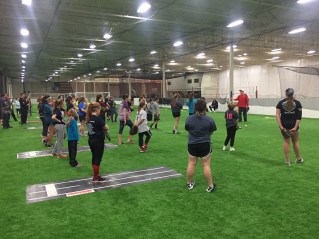
Never one to be content to rest on his laurels, Coach James has outdone himself with the latest iteration. The 2017 clinic, again in Richmond, Indiana, has expanded in its scope to not only offer top-level pitching instruction but also clinics on hitting, catching, the short game/slapping and defense.
This year’s instructor lineup is impressive once again, with college coaches and former college and NPF players offering hands-on instruction. The nice thing about these clinics is they’re not like so many, where they show a big name who is the “face” but then have very little interaction. The faces you see on the flyer will all be actively participating in or leading the instruction.
Throughout the weekend there will be plenty of time for discussions and questions too. One of the highlights for me last time was many of the instructors gathered together in a room tossing around ideas and opinions until the wee hours of the morning – all part of an impromptu session that began with a simple question. Those little side conversations alone are worth the price of admission.
Coach James promises it will be bigger and better than ever, and I believe it! The clinic runs the weekend of January 6,7 and 8, 2017 – timed this time to both make sure it didn’t interfere with high school and college seasons and to give players time to lock down what they learn before tryouts begin for spring high school ball.
Click here to register, and here to schedule the sessions you want and to pay. Most sessions are $70 each and run an hour and 15 minutes. The exceptions are the recruiting discussion that costs $25, and the beginning and advanced pitching sessions with Rick and Sara Pauly which cost $150 and are scheduled for 3 hours, although last year Rick was having such a great time he ran a bit long on both sessions.
Download the flyer for complete information, and then be sure you sign up now. Slots are filling fast. I’m sure you’ll find it’s a great investment in your softball future.
My fastpitch learning by osmosis theory

I have always been a big believer in the ability of kids, at least certain kids, to learn the nuances of softball through osmosis. I certainly saw it with my own daughters, who were eight years apart.
When my older daughter Stefanie was playing, we dragged all the other kids out to her games. We had to – she was the oldest, and we couldn’t leave the others at home.
When Stefanie was playing 14U, my youngest child Kim was 6. I was coaching, so I mostly remember seeing her heading off to a playground or just sitting in the grass. We never talked to her much about what was going on.
But somewhere along the way it must’ve stuck in her brain, because by the time she started playing she had a pretty high level of innate knowledge about what to do when. For example, I never had to teach Kim about going after the lead runner on comebacker to the pitcher. She just knew.
I am convinced that’s because she saw so many games. Even if she wasn’t constantly thinking about what was going on, she picked up a lot of it by osmosis. I think that’s the benefit the younger sister (or brother) gets.
I bring this up because of something that happened last night that just tickled me. I have been working with a 12U pitcher named Jenna for a little over a year now. (I refuse to say anyone is 11, 13, 15 or any other odd number of U. Old school.)
Anyway, I started with Jenna when she was 10U, and she’s made the transition to 12U pretty easily. It’s fun to see how far she’s come in a short period of time, and how she can take command of a game.
This summer, her dad Gary decided it would be a good time to get his younger daughter Sammie started. She was 8 when we started, playing rec league, but I know Gary has aspirations for her future. 🙂 She turned 9 not long ago.
At first she had all the challenges 8/9 year olds typically have. Like being so literal about her form that she looked all stiff and robotic.
But she’s determined, and has been working hard. The last couple of lessons the light bulb has started coming on and she’s been throwing more relaxed. Her strikes are going up, and she’s definitely throwing hard. So last night I thought it might be a good time to get her started on the basics of a changeup.
When I said that, Gary told me, “Sammie’s already gotten started on it.” Apparently she’d been watching Jenna and thought it looked pretty cool, so she decided to start working on it on her own.
I asked her to show me, and darned if she didn’t do a nice job! The pitch was really high, but it was straight, and more importantly it was the right speed without slowing her arm down. She did a couple more and it was the same thing.
Honestly, I was impressed. I asked Gary if he had been working with her and he said no. Sammie had just picked it up by watching Jenna.
I think what knocked me out was that she was maintaining her arm speed. Normally, when a new pitcher is trying a change on her own she’ll slow down to make the ball go slower. (Which, by the way, is the opposite of what you really want to do.) Not Sammie, though. She just cranked it right out there and let the design of the mechanics do the job.
Of course, it helps that she has a great example to model herself after. Jenna throws a killer change that is quite effective in games. But still. Sammie just sort of figured it out by watching.
We did some quick work and got Sammie throwing it for a strike at least part of the time. But it sure was nice to start from a solid foundation!
So there you go. Learning the game, or even parts of it, doesn’t always require a formal setting. Sometimes, if you’re fortunate, it just happens. Gotta love osmosis.
Getting fastpitch players to display the right stuff
Recently I had the opportunity to see the movie “The Right Stuff,” about the start of the U.S. astronaut program, again. (If you haven’t seen it, it’s really worth checking out.)
Early in the movie they show the efforts to break the sound barrier. Test pilots had gotten  close before, but there were real concerns that if you actually got up to the speed of sound (Mach 1) that the vibrations would tear the plane apart and the pilot would die. For that reason many believed it couldn’t be done.
One who didn’t was test pilot Chuck Yeager. When he sees a new X-1 jet come in he decides he wants to go “chase that demon” that lives out at Mach 1 and see what really happens. The next morning he hops in the plane and becomes the first person to break the sound barrier.
Interesting, you say, but what does all that have to do with softball? Simple. Like then-Col. Yeager, nothing great happens for players when they stay in their comfort zone. It’s only when they get out to the edge of their abilities, where the “demon” of errors lives, that they can truly advance their skills and become the players they’re meant to be.
For pitchers, that means trying new pitches in games. Often times, pitchers will work and work to learn a new pitch. But then when game time comes they’re afraid to throw it for fear of looking bad, or the softball equivalent of the plane breaking apart, happening.
But here’s a little secret: No matter how poorly you throw a pitch, it’s only worth one ball on the hitter. That’s right! Whether you miss by an inch or chuck it over the backstop, the hitter is awarded only one ball. You don’t avoid throwing your fastball if you throw a ball, so why should it be different for any other pitch you’ve prepared. Get out there, keep throwing the pitch and get comfortable with it.
For fielders it’s pretty obvious. They only go after balls they’re sure they can get to. Or they make soft throws because they’re afraid if they really crank it up and throw hard it won’t go where it should.
Again, here’s a hint: if you’re worried your hard throw won’t go where it should, you need to practice throwing hard more. Even if that means you throw some balls away in practice. Find out what you can do. Get out there on the edge. On the fielding side, start diving for the ball instead of watching it go by or drop in front of you. Stretch yourself, try that new technique. You may just find it works.
Hitters often make it even worse. They either try not to strike out by only swinging at perfect pitches (never a good approach), or they fall back on just trying to make contact instead of trying to make hard contact. Quit playing it safe! Work on driving the ball and helping your team win.
Coaches can help in this regard. Yes, we all want our teams to play perfect softball. But if you’re always yelling at your team about mistakes they’ll play not to make mistakes (and get yelled at) rather than to win. They won’t develop their full skill sets, and each year they’ll fall further behind.
While you don’t want to see mental mistakes due to lack of focus, physical errors are going to happen when players get out of their comfort zones. Instead of yelling at them or giving them a hard time, praise them for making that extra effort. Even if they came up short. Perhaps in a couple of more tries that extraordinary effort will become more routine, and you’ll win more ballgames in the long run.
When Col. Yeager chased the demon he didn’t know if he would get it or it would get him. But he didn’t let the fear of failure (which had much higher consequences than losing a softball game) keep him from finding out. Thanks to that spirit, incidentally, the world’s fastest jet, the SR-71 Blackbird, flies at 3 times the speed of sound. That’s 2,193.2 mph.
Softball players need to do the same. Chase your demons and play to the edge of your abilities to see if you have the right stuff.
It’s not only the way to make yourself better. It’s a lot more fun.
A different and fun approach to team building
Any time you have a group of people from different backgrounds, skill levels, experience levels, etc. trying to achieve a single goal, one of the staples has been team building. Whether you’re a corporation, charitable organization or girls fastpitch softball team, a little team building can go a long way.
Some of you may remember how the USA National softball team approached it during their run-up to the 2004 Olympics. They worked with the Navy SEALs to get some strength-building as well as military-style lessons in teamwork and bonding. 
Sounds cool doesn’t it? Maybe you’re thinking you’d like to do something like that with your team – put them through military-style training to help them learn how to work together, overcome obstacles and learn to function as a tighter unit. But of course the SEALs have more important things to do than work with every youth fastpitch softball team that wants to give it a try.
Luckily, at least if you’re in the Chicago area, there’s now an alternative: Hot Ground Gym. Currently located in Northbrook (with a second location set to open in the next few months in Buffalo Grove), it offers that kind of military-style training to kids and teams. They also have a mobile option that will come to you if you have an organization that would like to do it. (FULL DISCLOSURE: My son Adam is one of the trainers, which is how I learned about what they do. This is not a paid advertisement, just an FYI for coaches looking for something different to do with their teams.)
Hot Ground Gym was started by two military veterans, one a former U.S. Marine and the other Israeli Special Forces, to help kids build confidence, discipline, problem-solving and leadership skills in a fun, supervised environment. A lot of what they do is regular classes where kids come almost every day. But they also have birthday party and team-building options where they will do a 1.5 hour or 2 hour program for a specific group.
The core of the Hot Ground Gym program is obstacles. They have all sorts of them, most of which they built themselves, to challenge kids and teach them how to work together. If the trainers see the kids aren’t challenged, they rearrange or alter the course to get them out of their comfort zones and working hard to improvise, adapt and overcome.
The nice thing about this is it’s both mental and physical. Your team parents will likely love it if you do it because their kids will probably pretty sleep pretty well afterwards. The kids are kept moving constantly, running through, around and over obstacles, climbing, crawling, swinging from ropes and so forth.
At the end of the session you can either just go home, or you can have a little celebration (bring your own food and drinks) to talk about what the team learned and enjoy their successes. And maybe have a few laughs about their failures.
The video on the website home page provides a pretty good idea of what they do, although it’s constantly changing. And don’t be discouraged by the fact it’s mostly boys in the video. Adam says they have a lot of girls do their programs, and those are some of their best performers.
If you’re looking for a way for a fairly new team to get to know each other, or for a cliquish team to break down some barriers, or just a way for your team to learn a little more about how to push past their personal boundaries to do more than they thought they could, it’s worth checking out.
You might even ask that Adam be one of the trainers. He’s an Illinois Army National Guard veteran who did a tour of combat duty in Afghanistan so he knows the whole military aspect. And he earned a couple of medals during training for his leadership skills so he knows how to get groups of people working together for a common goal. He also has a wicked sense of humor, so your players will be entertained as well as challenged.
The Neverending Softball Story

I was talking with a couple of fastpitch hitting and pitching students this week about their schedules for the next couple of weeks. They were explaining that they probably wouldn’t be coming out for lessons because “we have Nationals next week, then tryouts when we get back.”
That just seems crazy to me. I know it’s the way things are but I can’t help but think they shouldn’t be.
Why couldn’t there be a couple of weeks at least between the end of this season and the beginning of the next? What is so all-fired important about getting started on next season that it has to happen before players have had a chance to clean the dust off their equipment from the last one? Especially since many schools start classes around the middle of August now. Not much of a chance for the family of a softball player to take a week off for a little R&R that doesn’t involve getting to a field at 7:00 am on a Saturday.
Where it really gets crazy is how all the different alphabet soup of organizations have their so-called Nationals. Some are done already. Some are going on right now. Some will happen next week. Programs that went to one of the early ones often have their tryouts going on while some of the players who might like to play for them are away at other Nationals.
I guess it’s all about the race to capture the best players before someone else gets to them. When players go to these early tryouts, there is a lot of pressure (especially on the better players) to make a decision now – sometimes before they leave the first day of tryouts. They’re told if they don’t decide RIGHT NOW there may not be a roster spot available to them later.
Again, that seems crazy when the actual, important season for these teams doesn’t start for another 8-10 months (depending on their age). But of course, if you can secure those players now your team is set, and there’s no risk of some other team, especially a close rival, getting them instead.
The problem is the solution is the same as early recruiting for colleges. Programs would have to bring some sanity to the process by voluntarily holding off on tryouts until at least mid-August, and preferably a little later. But who wants to be the first?
If it’s going to work, it would have to start with the most desirable teams – the ones everyone would love to play for. If they didn’t start until later (secure in the knowledge players would join their teams (even if they had “committed” under pressure elsewhere first) there would be less incentive for the next tier to be early, and perhaps then it would trickle all the way down.
I don’t think the world would come to an end if tryouts didn’t happen until mid- or late August. So what do you say top tier teams? Will you be the first to start bringing a little sanity to the process, and give committed softball families a window to take a non-softball vacation before school starts (assuming they can afford one after all the travel)?






 Life in the Fastpitch Lane