Why Fastpitch Softball Pitching Is So Danged Difficult

You hear it all the time from coaches, parents, and others sitting safely on the sidelines at fastpitch softball games: Just throw strikes! As if that idea hadn’t occurred to the poor pitcher while she’s sweating out a delightful inning of walks and hit by pitches.
Ah, if only it were that easy. I mean, it doesn’t look that difficult from the outside.
You step or jump or ninja leap your way forward, swing your arm over your head, bring it down, and let go of the ball. What could be more basic than that?
Plenty, to be honest. Because pitching in fastpitch is like a fine Swiss watch.
On the surface, you see the hands going around a disk. But underneath, there’s a complex set of gears creating individual movements that all have to be perfectly in synch to keep the correct time.
Let one little piece of a gear wear down, or get knocked askew, or take on a spec of dirt that slows it down by a microsecond, and suddenly the whole operation is no longer functioning properly.

Think I’m exaggerating? Take a good look at any video or sensor-based analysis of the pitching motion.
You have to be concerned about how the legs work in relation to the arms at launch. You have to look at where the body goes when it drives out – is it relatively straight or going off line?
When the arms go back on a backswing or forward on the first phase of the pitch are they working together and moving toward the plate in an efficient manner or are the wandering all over the place, creating timing and balance issues?
What’s happening with the muscles underneath? Are they loose and flexible the way they need to be in order to move quickly, or are they stiff and locked out?
What’s happening in the shoulder as the arm goes over the top? How is the upper arm positioned relative to the shoulder and the lower arm?
Where is the upper arm positioned when the front foot lands? What is the hand doing at this point?
As the pitcher goes into delivery are her shoulders stable and locked into position or are they swinging around like one of those carnival rides? Does she have good, upright posture, or is she collapsing like a cheap folding chair?

There’s more to consider but you get the idea. Lots of moving parts that all have to work properly, and in synch, in order to “just throw strikes.”
Now add in the idea that this sport is called FASTpitch. So it’s not enough to get the movements correct.
You have to do it while putting every ounce of energy you have into every pitch. All in the space of a couple of seconds start to finish, with a lot of the critical movements occurring in a matter of milliseconds before the pitcher has to move on to the next one.
Anything in that process gets slightly off and suddenly the ball is heading into the dirt, or into the backstop, or into the side of the hitter. And when that happens, the pitcher has to know how to make a micro-adjustment here or there to get everything back on track in an effort to make sure it doesn’t happen again on the next pitch.
What usually happens, especially with younger or beginning pitchers, is that they over-correct instead of understanding they should just relax, trust their training, and allow the gears to get back in line. That’s why one pitch goes into the dirt and the next one hits the field number sign at the top of the backstop.
When you see that issue occurring, the worst thing you can yell is “just throw strikes.” That’s what she’s trying to do.
But a gear has slipped and she’s probably not sure which one or how to fix it. Telling her to “just throw strikes” will only encourage her to try to force the ball over the plate, abandoning all mechanics.
That would be like trying to fix your watch by hitting it with a hammer. You might get lucky, and get it running again, but the odds are you’re just going to ruin the watch.
A better approach is to call time if you can and go out and talk to her. Remind her to trust the work she’s put in and let her body do what it does best, focusing on the process instead of the outcome.
In other words, let her get all her gears back in order. And if that still doesn’t work, tell her it’s just not her day and you’re going to give someone else a try now, and you’ll come back to her another game.
If you’re a non-coaching parent and can’t go out for that circle visit, just be encouraging and supportive. I know it’s difficult to watch your daughter struggle – I’ve been there – but she’ll be able to handle the adversity a lot better if she knows you’ve got her back instead of thinking you are judging or criticizing her in the moment.
If she’s not able to correct things on her own, the time for those corrections is in her next practice session, not under pressure in the middle of a game. Trying to do it in-game will likely only make it worse.
Yes, pitchers like Tegan Kavan, Nijaree Canady, Sam Landry, Emma Lemley, and so many others you see on TV or at live games often make fastpitch pitching look easy.. But it’s anything but – even for them.
Understanding just how complex the individual movements are, and how intricate the timing of each movement is in relationship to all the others, should help you cut your pitcher(s) a little slack when things aren’t going quite the way you or she wants. It ain’t easy.
But like that fine Swiss watch, it’s a thing of beauty when you get it all working the way it should.
Pitching Coach Bill Hillhouse Extraordinaire Could Use Your Help

Yesterday Jay Bolden and I had the privilege of talking with pitching coach Bill Hillhouse for an upcoming From the Coach’s Mouth podcast. If you’re not familiar with him, Bill was the youngest pitcher ever to play for the Team USA Men’s National Team when he joined it in 1993, and was an outstanding player who competed all over the world, winning wherever he went.
(If you’re interested in learning more about his softball resume, I’ve included more facts below.)
Bill then started giving lessons, mostly to female players, as his playing career was winding down. He saw the terrible hello elbow mechanics that were being taught widely at the time and became a very vocal advocate for learning to pitch the way the body moves naturally and the way all the top-level pitchers actually threw – what we today call internal rotation, although he’s not a fan of that description either for various reasons.
He named his business the House of Pitching, and he put out a series of DVDs to help spread his teachings more broadly than he could one-on-one. My guess is thousands of pitchers benefitted from the work he did in explaining everything from basic to advanced pitching mechanics in his lessons, clinics, and DVDs.
It was a business that again took him all over the world and afforded him a comfortable although not lavish living. He was also a columnist for Softball Magazine at the same time I was, which is where we met and became friends.

Then in July of 2025 Bill got the news no one wants to hear: he was diagnosed with stage 4 pancreatic cancer. In typical Bill fashion he didn’t make a big deal about it, not wanting to burden others with his issues, but as we all know getting sick here in the good ol’ USA isn’t cheap.
Suddenly, not only did he have all these medicals bills but he was also cut off from his only source of income – giving lessons.
Which brings me to the point of today’s post. After all the years of helping others (including many who were indirectly assisted by his influence on other pitching coaches like me), Bill could use a little help himself.
His girlfriend set up a GoFundMe page to help him with his expenses while he does his best to battle this disease. He knows it’s not a winnable fight – there is no “cure” for pancreatic cancer – but as a competitor he’s not just sitting around waiting for the inevitable.

In fact, he told us he’s been giving lessons again on a limited basis, and while it’s bringing in some revenue it’s less than he needs to live a normal life. So here’s my ask today.
I know times are tough right now, but if you can please go to https://www.gofundme.com/f/help-bill-hillhouse-through-his-cancer-battle and leave a donation. Even $5 or $10 will help, especially if a lot of people choose to do it.
So maybe instead of your morning Starbuck’s or those McDonald’s Diet Cokes you enjoy, take one day and dedicate that money to Bill. The big corporations won’t miss it, but it will sure make a difference to a guy who has made a difference to so many of us in the fastpitch softball world – including many who don’t even know it.
Thanks for considering it. And keep an eye out for our conversation with Bill coming up in a couple of weeks over at the From the Coach’s Mouth podcast. It was a lot of fun and I’m sure you will enjoy it.
Bill Hillhouse Mini-Bio
Bill Hillhouse was a star pitcher in international men’s softball, playing all over the world including eight seasons competing in New Zealand. He was not only a two-time member of the USA Men’s National Team but was the youngest pitcher ever to play for that team when he joined it in 1993. Among his accomplishments are being named the Pan American Games M-V-P, winning the Men’s Major National Championship three times, earning a gold medal at the U-S Olympic Festival, and being inducted into the USA Softball of Pennsylvania Hall of Fame in 2022.
Bill’s coaching career is equally stellar. After stints as a pitching coach consultant for division 1 Drexel University and the University of Georgia, in 2018 he joined the staff at Providence College in Rhode Island. A strong advocate of men’s fastpitch, he also served the sport as a commissioner for the International Softball Congress from 1997 to 2013.
He is probably best known, however, as a private coach. Operating under the House of Pitching moniker, Bill gave individual lessons and conducted group clinics all over the US and the world. While he coached many high-level softball pitchers to successful college careers, including 2025 WCWS winner Tegan Kavan, he never really publicized his association with any of them. As he told Jay and me, “Their accomplishments were theirs, not mine, the result of a lot of hard work and dedication. I teach everyone the same things but get varying results, so the difference is really in them.”
The Hero’s Journey Always Includes Trials and Tribulations

The so-called hero’s journey is one of the most fundamental tropes in storytelling. In fact, if you line them up in a chart the stories are all pretty similar.
One of the key points, whether you’re talking about Ulysses or Hercules from ancient mythology or more contemporary heroes such as Frodo Baggins, Dorothy Gale (from The Wizard of Oz), Anna and Elsa, or Luke Skywalker, the path the hero must walk is never smooth or easy. It’s filled with trials and tribulations, setbacks and betrayals, dark moments of doubt, and other challenges before the hero ultimately (and often barely) triumphs.
So it’s amazing to me how people think their or their daughter’s softball journey should be filled with nothing but sunshine and unicorns, one success after another without any setbacks or suffering whatsoever. Sorry, it doesn’t work that way.

Even those who turn out to be the highest-level players often tell stories about how they were the fourth or fifth pitcher on their travel team for years, or how they could barely crack the lineup in pool play or their first couple of years of high school ball before they became the player we all came to know. In fact, in real life as in fiction, it’s the trials and tribulations they go through that make them capable of being heroes when the moment arises.
Rather than fearing or avoiding adversity, it’s important to embrace it. It’s a lot easier to weather the next storm (and there’s always a next storm) when you’ve already gotten through the last one.
Besides, if there weren’t challenges and obstacles to overcome that softball journey would be pretty danged boring. There is no triumph with challenge.
In other words, if Frodo could just take a casual stroll into Mordor without all those evil forces pursuing him and putting his life at risk, it wouldn’t be much of a story. It certainly wouldn’t be one that has become beloved and retold many times since it was first released in 1954.

The same with Ulysses and Hercules, which are many centuries older. If they just did what they needed to do without the trials and tribulations no one would be interested in either of them.
It’s the obstacles that make us who we are. For many (me included, by the way), it’s the people who told us we couldn’t do something or weren’t good enough that kept us working harder to prove them wrong.
It’s the times we failed to reach a goal we really wanted that caused us to double down on our efforts and keep working until we got there.
They say that each of us are the heroes of our own stories. Or at least we should be.
If that’s true, remember that your hero’s journey won’t be nearly as interesting or powerful if it’s all sunshine and puppy dogs. While I’m not advising that you seek out problems, I will say they’re going to find you whether you want them or not.
The key is not to be afraid of them or let them take over your life. Even in the biggest slump or lowest points of your life or softball career, remember that you have the ability to overcome whatever difficulties come your way.
Also remember that heroes rarely do it alone. Anna and Elsa had Kristoff and Olaf. Frodo had the Fellowship of the Ring. Dorothy had the Scarecrow, Tin Man, and Cowardly Lion, Luke had Han and Leia, among others.
Let those around you help you through the tough times and keep your spirits up when you feel like giving up. And in the end, remember when you do triumph over all that adversity, the success will be that much sweeter.
Today’s problems will pass. No one can say exactly when, but they will pass.
When they do, you’ll come back stronger than eve, ready to complete your own hero’s journey, whatever that may be. And you’ll have a great story to go with it.
Photo by Alex Kinkate on Pexels.com
Product Review: Portolite Signature Spiked Practice Mat
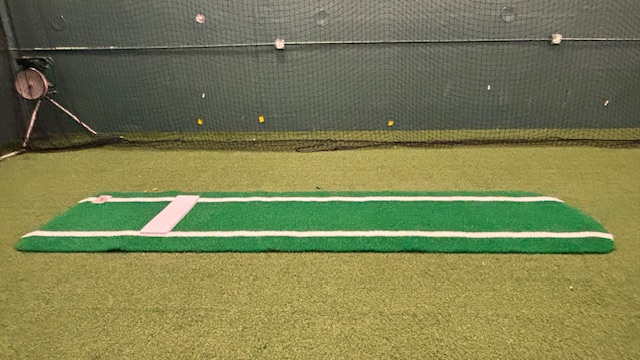
Having a good-quality practice mat for indoor pitching practice is an essential to me. It helps cut down on “gym stepping” (taking a step forward with the pivot foot before launch) and gives some good feedback about the direction the pitcher is going and distance the she is covering in the drive phase of the pitch.
For years I have used a mat designed for use on turf. It was good for two of the facilities I work at, both of which have very low-pile, carpet-like turf. But at the third, which has turf that is a little more grass-like, I found that the mat would slide forward and turn toward the throwing hand-side after two or three pitches for all but the smallest girls. Which meant that I would have to stop the lesson and readjust the mat pretty frequently.
The solution I came up with was to turn the mat backwards so the pitcher could use the pitching rubber to push off of but would then land on the regular turf. It solved the problem of the turning mat, but made it kind of pointless to have an 8 foot long mat since most of the mat would be in the opposite direction to which she was going.
Finally, I decided to do what we all do in these frustrating situations – search the Internet for a solution. I finally found one I thought would work: the Portolite Signature Spiked Practice Mat. I have used and liked Portolite products before, so it definitely caught my interest.
But the cost was a little high, which caused me to hesitate before pulling the trigger (more on that later). Finally, I saw a Black Friday sale and decided to roll the dice.

I’m glad I did, because it is definitely up to the task of staying in place on higher turf, even with the biggest/strongest/heaviest pitchers. No more turning, no more sliding forward, no more resetting the mat every few pitches.
You just lay it down wherever you want it and it stays there for hours or even days without having to touch it. Here’s a little more in-depth look.
(NOTE: There are no promotional considerations for this review. I purchased the mat as a consumer and am not being paid to write this review. Just thought you should know.)
Basic construction
The mat definitely features high-quality construction. The turf side is thick and built to hold up to heavy use, and the back side appears to be made of heavy-duty rubber. The two are attached seamlessly and look like they will hold up for years without splitting apart.
(For contrast, the turf and backing on my Jennie Finch mats began separating at the front edge shortly after I got them, and I occasionally have to glue them back together to reduce the chances of them coming apart completely or having a pitcher trip over them.)
The pitching rubber isn’t just glued to the mat – it is bolted on with four bolt and nut combinations that are incorporated somehow into the rubber then stick out of the bottom.
I don’t think that pitching rubber is going anywhere. This construction also means (according to the manufacturer) that you can replace the pitching rubber at a later date if it gets too worn or damaged.
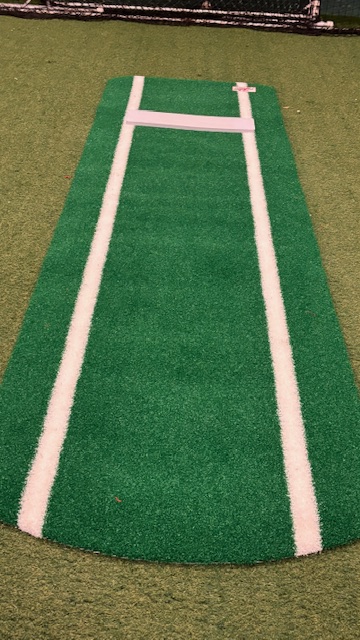
The overall length of the mat is 3 feet wide by 11 feet long, with 8 feet from the rubber to the end of the mat. That should be sufficient for most pitchers, while also leaving a generous 3 feet on the back side so both feet can start on the mat, even with a deep drop back.

The lines appear to be deeply sublimated or otherwise embedded into the turf so I don’t think you I have to worry about them wearing away any time soon. I wish there was a center line instead of (or in addition to) the two lines extending down either side from the pitching rubber, since I think that makes a good reference for pitchers.
But it’s not a deal-breaker, and I suppose I’ll get used to it. You can also order the mat with no lines if you prefer.
The turf comes in three colors – green, red, and clay – so you can choose the one that suits you best. I’ve always had and liked green mats so that’s what I went with. It’s a bright green right now, but we’ll see how it holds up after hundreds of shoes have slid across it.
I can’t speak to the durability yet since I’ve only been using it a few weeks. But it looks like it ought to hold up for years.
One other thing that takes a little getting used to is that it feels a little spongier than the other mats when you walk or land on it. That’s probably good for young backs and knees versus landing on hard concrete with just a thin piece of carpet over it.
The Spiked Side
Here’s where the real magic happens, at least for me. As I said, the whole reason I purchased the mat was to try to solve the problem of the mat slipping on the turf. It has definitely done that.
The key is the 1,200 little spikes on the bottom side. They are molded as a part of the heavy-duty rubber backing, creating a plethora of individual grip points.
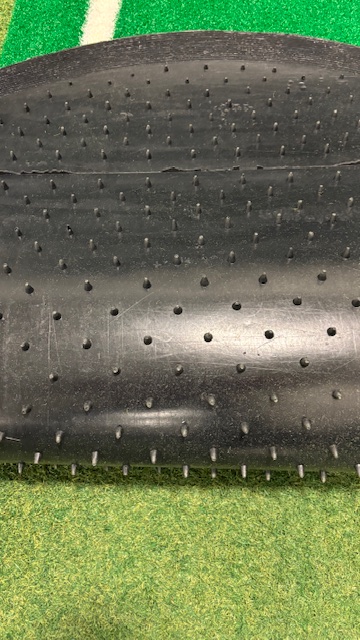
As pitching people know, the goal is to land into the front foot like an airplane rather than on top of it like a helicopter. That momentum is what can cause the mat to twist or slide forward.
With the Portolite mat, though, all those little spikes distribute the landing load throughout the mat so it stays in place easily. I have yet to have to make any adjustments, other than to change the distance for different age pitchers.
But once it’s down, it’s down until you pick it up and move it. So yes, total success for the goal I had.
And in case you were wondering, while it does leave a pattern of little indentations when you first pull it up to move it or put it away, those indentations go away quickly, leaving the base turf looking like it did before you laid the mat down. That’s important if you’re in a shared space like I am.
Heavy weight
Another reason I think it stays in place so well is that the mat itself is heavy – probably due to the molded rubber backing. It weighs 30 lbs., which is roughly 50% more than my other mats that clock in at 23 lbs.
That’s great for functional use, but it can be a challenge if you have to carry the mat for any distance. I’m a pretty big guy so I can handle it, but it’s definitely something to consider if you are on the smaller side or not particularly strong. It will give you a workout.

I wish it came with a little carrying pouch like other brands do, which I think would make it easier to transport. Then again, because of the construction the Portolite mat doesn’t roll up as tight without great effort so maybe it would be difficult to get one in an appropriate size.
Either way, right now I have to roll it up and grab it by either end to move it around the facility, It’s the one time when I miss the other mat.
The cost
Earlier on I mentioned that it’s not cheap. The current price on the Portolite website (as of January, 2026) is $999 USD.
When I first saw that I decided to roll the dice and see if there might be a Black Friday sale since it was getting close to the holidays. My gamble was rewarded, and I was able to purchase it for $799.. Add in the tax and shipping and it was $935 out the door – still expensive but every little bit helps.
Assuming it lasts for several years (as it appears it will), it’s not so bad. For example, at 5 years of use that $935 works out to $187 per year. Add in the savings on chiropractors for not having to constantly bend over to reset the mat and it’s a pretty good bargain.
More options
Portolite has some other mat options in addition to the one I purchased, including a shorter throw-down mat for $299 and their Pro Spiked Game Mat for $1,899. The short mat would be great, I suppose, if you don’t need the full length for your pitcher to land on (or you don’t want to carry a 40 lb. mat around).
The game mat is similar to the practice mat but I believe the turf is even heavier duty, it includes 1,700 spikes (versus 1,200 for the practice mat), and it weighs 60 lbs. Clearly it is made to hold up to heavy use and abuse, even on outdoor surfaces.
I know of at least one program that is planning to purchase a couple to use on dirt to try to eliminate the dreaded “pitcher’s trough” that happens after multiple games in a day.
The bottom line
When I was first looking at this mat I was concerned because it was a lot of money to pay for something that I wasn’t 100% sure would solve the issue. But I am happy to report that it did solve the sliding/turning problem, and my pitchers like using it.
So if you’re having similar issues, know that you can purchase this pitching mat with confidence. Time will tell how well it holds up (maybe I’ll share a report on that sometime in the future) but I can definitely recommend it as a solution for the immediate need.
The Effect Changing Bodies Can Have on Athletic Performance

No, this isn’t a “Freaky Friday” type of post, although I suppose that type of body changing could be an interesting topic. This is about physical changes with a player’s body.
Back around the fifth grade, most of us learned in health class that as we pass from childhood to adolescence, the hormones in our bodies start to go crazy and major changes begin to manifest themselves. One of the most visible and significant is rapid growth.
A girl who was once a cute little butterball suddenly shoots up 4, 5, 6 inches and becomes a lanky young woman. Another goes from a scrawny flyweight to a muscular middleweight.

Or maybe one day you look and realize the girl who used to have to look up at you now has a significant height advantage over you. (I was going to say looks down on you but, while that is also part of the deal, it’s a separate conversation for another day.)
Sometimes it happens gradually, but more often it seems like it happens overnight. And when those rapid changes do occur, they can have a significant impact on things like balance, proprioception, and coordination – all essential requirements for athletic performance, especially in a precision sport such as fastpitch softball.
Take hitting for example. We all know (or should know, at least) that a big contributor to good hitting is timing. You need to get your foot down on time and your body parts moving in a proper sequence in order to take a round bat to a round ball and hit it square while it’s traveling toward you at a rapid speed and moving (intentionally or unintentionally) in two planes simultaneously.
Sounds complicated doesn’t it? Well, it is.

Now imagine trying to do all that while standing on 4 inch high stilts while having the bat strapped to 3 inch long boards at the end of your wrists. It would be pretty awkward, don’t you think?
Yet that’s what kids who experience rapid growth spurts are going through every time they swing the bat. They used to know where their entire body was in space, including their limbs (which are the most difficult to manage), but surprise! those body parts suddenly aren’t where they used to be anymore.
The result is that hitter has to figure out how to manage this new, sometimes oddly proportioned body in order to achieve the level of performance she was achieving before. And worse yet, those body parts may still be growing, which means she’s trying to adjust to a moving target with runners on base and the game on the line.
And you wonder why she’s struggling some.
The same is true for pitchers and fielders. Things aren’t where they used to be anymore, and until they figure it out performing smoothly and confidently may be off the table for a while.
Another complicating factor is some of this growth may come with what we call “growing pains.” That’s not just a euphemism for the socially awkward teenage years.
It’s a real phenomenon causing physical pain every time they move. One place it shows up a lot is in the legs, or more specifically the knees, with a little gift from nature called Osgood-Schlatter Disease (OSD).
OSD causes pain just below the knee due to an irritation where the tendon from the kneecap attaches to the tibia, one of the bones in the shin. It can cause pain during activities such as running and jumping – or squatting.
Many a young catcher has had to find a new position thanks to a visit from the OSD fairly. And while it will eventually go away as the body settles in to its new configuration, it can take a while. In the meantime many movements that used to be pain-free now come with a cost.
Another thing that can happen during this time of development is what might be characterized as a “thickening” of the body. While your adolescent girl may not gain a great deal more height, especially if she’s not genetically disposed to being tall (thanks mom and dad), her body change from being a little twig to being more, um, stout.
While that will help her in certain ways – thicker muscles will add strength that can make up for a lack of overall size – she’ll still have to learn how to manage that newfound strength so she doesn’t fall into a habit of “muscling up” where she should be remaining loose and flexible. If that thickening happens rapidly it could throw her off considerably until she gets used to her new body.
Then, of course, there’s the elephant in the room for many young women – the development of breasts. That alone can have a serious effect on her movement patterns overall, how her back feels, her posture, her core strength, her flexibility in certain positions and more. And, of course, the larger they are the greater impact they will have on her physically.
All of which explains why your daughter’s or your players’ performance may suddenly go in the toilet for a little while. It’s not that she’s forgotten how to run, or hit, or pitch, or throw overhand, or field a ball.
It’s that what used to work for her body no longer works with the proportions she now has. And until she figures it out her performance may suffer for a little while.
So what can you do as a parent or coach? First of all, understand that his is going on and be a little more forgiving of any performance downgrades.
It’s not that she’s not trying, or is screwing up on purpose. It’s that she honestly doesn’t know how to overcome the situation right now.
Second, you can help her understand what’s happening to her as well. Explain that this is a normal, natural part of growing up, and encourage her to keep working hard. The coordination or balance that has temporarily abandoned her will come back once she gets used to playing as who she is now.
Once you have those parts understood, find devices or exercises or routines that can address the issues she’s having and help her get back on track faster. For example, if she is having trouble with balance get a balance cushion or pad and have her stand on one foot, first with her eyes open and then with her eyes closed, so she can feel her body in space. (The link will take you to a Google search results page.)
Seek out other exercises from professionals as well that can help her. Or you can hire a professional trainer to work with her while she’s having these issues.
If she’s having problems with feeling her body in space, especially her limbs, look into proprioception exercises. A new device from PantherTec called the Kinesthetic Awareness Training (KAT) module can also provide helpful feedback to bring the brain and body back into alignment. (Watch this space for a future product review.)
If she’s complaining about pain, especially in or around her knees, don’t just dismiss it as being soft. Get to your pediatrician have her checked out for OSD or other physical issues. Playing sports can take a toll on the body, and not all problems are the result of a specific injury.
Sometimes it’s cumulative wear and tear, and sometimes it’s something more serious. No matter what, get it checked out and addressed before the body’s instinct to avoid pain starts creating patterns in her movements that are less than ideal.
Finally, don’t assume this is just a preteen/early teen problem. The effects of puberty can last into young adulthood, and many of them can go up and down at different times.
Before you hit the panic button, try to recognize what’s happening physically with your daughter’s or your players’ body and help her address those changes. Because the sooner she is able to deal with how her body feels now, the sooner she’ll get back to performing the way you and she want.
It’s a Short Walk from the Bench to the Stands

Today’s post is primarily aimed at softball players and their parents, although coaches could also learn a thing or two. Especially those who wonder why they keep having trouble filling their rosters.
The basic premise is that whether you’re talking travel ball or even college ball, when you pick a team to play on it’s important to choose one where you might actually play. (High school ball is a separate animal because in most cases where you play is determined by where you live.)
Sounds obvious, doesn’t it? Yet when you look around even casually you’ll see it’s not as obvious as it might seem.

All too often parents will choose teams for their players, or players will make their college decisions, based on the perceived prestige of being there rather than considerations such as “Can I/my daughter actually get on the field?”
Yes, you can enjoy bragging rights for a while. You can get heads to turn when you wear the jersey or other spirit wear and walk into a room of softball people.
But ultimately the shine will wear off (see what I did there?) if you’re not actually on the field playing the game.
Ok, you say, but my goal is to get recruited to a P4 school, and to do that you have to be seen by those coaches. So I need to be on a team that’s playing at (and preferably winning) the tournaments those coaches are watching.
Sure, that’s true. But if you’re not on the field, all the coaches are learning about you is that you’re apparently not good enough to play, particularly when it matters. Do you think that helps or hurts your recruiting chances?
Not playing on Sundays not only means the P4 coaches don’t get a chance to see what you can do. It also means a whole lot of other coaches on other college teams that might have a wonderful opportunity available for you to play and to shine aren’t getting that look either.
No matter what level you’re talking, no college coach wants to take a player sight unseen because their jobs are on the line with every selection they make. They’re not going to make an offer simply because you were on a “name” team, no matter how big the name. If you’re not playing they’re going to figure there must be a reason for it and move on.
At which point you take that short walk from the bench to the next logical step – sitting in the stands while others play the game.
The same is true for playing in college – maybe even moreso. College athletics is about winning, because winning attracts money.

You may dream of playing at the University of Wherever, but if you don’t have a realistic chance of getting on the field, or at least playing an important role, you’re probably not going to be happy with that decision for very long. You need to at least be able to compete for a position.
If you’re simply outclassed by the other players at your position it’s likely your passion for the sport will fade and you’ll be taking that short walk before long.
So what can you do to avoid ending up in the stands before you’re ready for that to happen? There are a couple of things.
To begin with, choose your team wisely and realistically. Take off the rose-colored glasses and do you best to objectively determine whether you can compete for a spot on the field. That includes not only skill level but how set the coach seems to be on his/her lineup. If the same nine are always playing when it counts, regardless of whether they’re performing well or not, you might be better off somewhere else.
If you’re already on a team and you’re not playing, you have two options: get better or get moving.
The first thing you need to do is to look inward and ask if you’re giving everything you have every minute you’re there.
That starts with practice. Are you hustling and working your butt off at practice all the time, or do you take reps off or sleepwalk through certain drills/activities? Are you vocal and enthusiastic, even when you don’t feel like it, or do you it and sulk if you’re not playing regularly?
Coaches notice who wants to be there and who doesn’t, who works hard and who doesn’t. Your effort and enthusiasm are totally within your control, so make sure yours is saying you really want to be there contributing.
You can also keep working to improve your skills. Ask what you need to do to earn more playing time, then work on whatever you’re told until it meets the standard that’s required.
And if you do get that opportunity, be sure you make the most of it to show why you should get more. Otherwise you’re simply reinforcing the coach’s previous decision to keep you on the bench.
The other situation you might face is the realization that for whatever reason this is not the right team for you. At that point, it’s time to start looking at where you might be a better fit.
It could be that your skill level doesn’t match the other players – and never will. It could be that the coach simply doesn’t like you for whatever reason (it happens). It could be any number of things.
If it’s something you can’t change no matter how hard you work, though, there’s no sense staying where you are. Find a place where the team actually needs what you have to offer and then take advantage of that opportunity.
You’ll be happier, and your old team will have the opportunity to replace your roster spot with someone they feel is a better fit for them as well. Everybody wins.
Even great players can find themselves on a team where the path to the stands is shorter than the path to the field. If you’re in that position, don’t sit around waiting for things to get better.
There’s a place in this sport for everyone. Find yours and you’ll be a lot more satisfied with the outcomes.
Bleachers photo by Julion Santos on Pexels.com
Lessons from the Great Wall of China

Pretty much everyone knows or at least has heard about the Great Wall of China. It’s quite the construction feat, running 13,170 miles using materials such as earth, stone, and brick.
While we think of it as one cohesive structure, it’s actually a series of fortifications built by multiple dynasties. While there are no receipts from Lowe’s to tell us exactly how many bricks were used to build it, researchers have estimated it took anywhere from 3.8 to 42 billion bricks/stones to create the incredible wall we marvel at today.
Now think about this: The Great Wall of China wasn’t just plopped in place whole. Each of those 3.8 to 42 billion bricks was laid in place, one at a time, over a period of 2,000 years. All without the help of any modern powered equipment – just hard, backbreaking manual labor from slaves, convicts, soldiers, and random peasants who couldn’t run away fast enough.

And before they could lay the top parts that people walk along and ooh and aah over, they first had to put the ones along the ground in place. And then the layer above that, and the layer above that, and so on.
The same is true for building skills in fastpitch softball (or anything else for that matter, but hey, we’re talkin’ softball here). All too often I see posts on social media from parents or coaches looking to help a player “add 4-5 mph to their pitching speed” or “give a hitter an extra 50 feet of distance on their hits” in the next couple of months.
Sorry folks, it doesn’t work that way, unless their overall mechanics are so bad that any type of guidance will help them overcome some seriously limiting flaws.
The reality is improvement often comes in unnoticeable-to-the-naked-eye increments on a player who is already pretty good. Maybe it’s a slight relaxation of critical muscles that enable a little extra acceleration or a little better positioning of body parts than was achievable before.
Maybe it’s a little extra strength from workouts that doesn’t show up on a force plate or a radar. But it enables a quicker deceleration or a little more efficient transfer of energy from one segment to another or a little faster spin than was happening before that sets a player up for future success.
Stack enough of those little improvements together, one-by-one, and suddenly, before you know it, you have built them into something that will make people say “wow.”

Where it’s different, of course, is that fastpitch softball players can’t bring in a phalanx of slaves, convicts, soldiers, and peasants to do the work for them while they collect all the glory. They have to do the work themselves, repetition after repetition, whether it’s skill work, lifting, speed and agility, or whatever else they need.
The tough part is being patient throughout this process. We all want to see instant results – coaches as much as players and parents.
Again, though, it doesn’t work that way (at least 99.999% of the time). It would be like carrying a bunch of bricks over to where you’re building your wall and trying to stack them all at once.
The result is probably not going to last for nearly 3,000 years and draw visitors from all over the world. In fact, it probably won’t last a day and the only visitor it will draw is the local building inspector telling you to tear it down and try again.
There are no miracle cures or programs that will instantly take a player from zero to hero. What it does take is time and focused work, doing what you’re supposed to do to the best of your abilities each so that over time those individual efforts pay off into a larger, more effective, and more satisfying whole.
So keep stacking those bricks. And be sure to appreciate and celebrate even the smallest victories – even if they’re just a movement feeling better than it did before.
The journey will be worth it when you see the incredible structure you’ve built.
Great wall photo by Ella Wei on Pexels.com
Product Review: pitchLogic Softball

For those who have been hiding under a softball-shaped rock over the last few years, data has become an increasingly important part of our sport. Whether it’s statistics about on-base percentages, whiff percentages by pitch location, how much external rotation is being achieved, or other detailed metrics, coaches at all levels are looking to quantify what their athletes are doing to help improve performance.
This obsession also applies to what happens when a pitcher throws a specific type of pitch. Speed is obviously one important metric that has been easily measurable for a number of years, whether it was with a Stalker or Jugs radar gun or more recently with the advent of the PocketRadar.
The other two parameters that are normally listed along with speed are spin and spot, i.e., how the ball is spinning and whether it goes to the location it was supposed to. Spot is fairly easy to determine with your eyes alone; if you know where the ball was supposed to go you should be able to see whether it went there.

That leaves spin. One simple way to determine whether a ball had the correct spin is to mark a stripe or color the seams to make it easier to see the spin direction, then compare that to what is expected for that pitch.
For example, if you’re throwing a curve ball was the spin direction going around the ball at the “equator” (middle of the ball), going from pole to pole (top to bottom or bottom to top), or some variation in between? You also want to see where the spin axis (the point the ball spins around) was, because an improperly oriented spin axis will generally have a negative effect on the quality of the movement.
You can see all of that with your eyes, but it’s still difficult to quantify. And you totally miss another important factor in ball movement: how fast the ball was spinning. You can see if it’s fast or slow, but not HOW fast or HOW slow, which also affects how sharply the ball will break, thus making it harder to hit.
A Rapodo system will give you those types of answers, but those cost thousands of dollars which puts them out of the reach of most individual coaches and bucket parents. You pretty much have to go to a camp, clinic, or measurement event to capture that data, and even then it’s only a single snapshot in time.
In the past, you had the RevFire ball or the Diamond Kinetics ball, which were far more affordable to the average user. But both of those have been long been relegated to the ash heap of history; you can probably still find one on eBay somewhere but all technology has a “best by” date and both of those are long past it.
Fortunately, a new entry into this category was introduced in 2025: the pitchLogic softball. F5 Sports, the manufacturer of pitchLogic balls, has had a baseball version for several years that has become quite popular.
They have now taken that same technology and applied it to fastpitch softball. But is it worth the investment, i.e., does it do the job? The short answer is yes.
If you’re serious about measuring spin direction, spin rate, spin efficiency, and a whole bunch of other parameters and don’t want to break the bank (or your marriage) to do it, you’re going to want to look into this innovative product. Let’s break it down in more detail.
What’s In the Box
This part is pretty simple. It comes with one pitchLogic softball, a Qi-type platform charger, and a short USB A to USB micro cable to connect the charger to a power source. The charger has a small indent in it to keep the ball in place while charging – no O ring necessary (DK ball users know what I’m talking about).
How It Works: The Basics
The pitchLogic softball system consists of two components: a ball with a microchip or some other technological magic inside of it and a free companion app, which you can download from the Apple App Store or Google Play once the ball arrives. The two are connected via Bluetooth, which means you don’t have to have a WiFi signal available to use it.
There are two versions to the app: a player version and a coach version. If you’re a bucket parent who wants to measure your own daughter’s performance and progress, the player version will do you just fine.
It will capture the data from each throw and store it in the cloud for you so you can review it later or even share it with college (or other) coaches. Since you’re only using it with one pitcher it’s really all you need.
The coach version allows you to create a roster so you can track the performance of multiple players, separating them into individual sessions so you can access them as-needed. You just have to remember to select the correct player before you start the session – nota difficult skill but one I’ve already failed on once.
Setting up a player on a roster is easy to do, too. You click on the roster button at the top of the app, click Manage, then click on the plus sign (+) and fill in the requested data. If you want to remove someone from the roster later you click on the minus (-) sign and they are deleted.
The player management section also gives you the ability to share all the data with the pitcher automatically by inputting her (or her parent’s) email address. They will then receive a link that enables them to check it all out themselves whenever they want.
When I purchased the ball it came with five roster spots. If you’re a team coach that’s probably plenty; if you’re an instructor like me it’s not nearly enough, but fortunately you can purchase additional roster spots for an added cost.
Capturing Pitches
Whichever version you have, once the proper player is selected and the ball has been paired to your device, you click on the start session button and then select which type of pitch the pitcher is throwing so it can be tagged in the records. You don’t have to tag the pitches, but it’s definitely helpful, especially when you go back a few days later to review the data or if you want to send it to someone else. Helps to know what type of pitch was being thrown.
The pitcher then throws the pitch and the data immediately shows up on your device’s screen. I generally just use my iPhone because it’s handy, and the key information is pretty readable even to my old eyes.

Hopefully in the future they will add the ability to zoom in by pinching the screen, which would make it even easier while helping the pitcher focus on the right information.
The only caution is that the pitcher has to keep the ball still before she throws the pitch or the app won’t read it. If you have someone who likes to twizzle the ball or spin it in her glove before she throws she’s going to have to remember not to do that for the duration of the session.
So far, I have found that the pitchLogic softball records most, but not all, of the pitches thrown. I’d say it’s around 95% success. Every now and then it will miss one, but it usually captures the next one.
If you have a few missed pitches in a row, stopping the session and then restarting it usually solves the problem. Worst case you can close the app and restart it to reset everything. So far I have not had it totally shut down.
The Data
Ok, here’s where it gets fun. It starts with the clock face, which appears on the top or top left depending on whether you orient your device in portrait or landscape mode. For simplicity I am going to refer to everything’s position in landscape mode.

The clock face gives you three important pieces of data at a glance: the spin direction in blue (including the orientation of the ball), the arm slot in oranage (where the arm was at release), and the last touch on the bal in a darker orange or rust colorl. If your pitcher is having trouble with her spin orientation, that last touch info can be helpful in diagnosing it.
The blue arrow shows the direction in which the ball was spinning. For example, a “perfect” riseball will point to 12:00, a “perfect” drop ball will point to 6:00, and so on. The blue ring shows the orientation of the ball as it is spinning.
So let’s say a right-hander throws a curveball and the arrow points to 9:00, which is the perfect spin for left-to-right. But instead of the ring part being pretty much flat it is a near-perfect circle. That tells you that even though the spin direction was good, the spin axis is tipped either too far forward (most likely) or backward toward the pitcher (unlikely but you never know).
You now know that even though the spin direction was good, you still need to make adjustments to get better, tighter break on the ball. This relationship is also shown under “spin efficiency” at the bottom.
The closer the arrow and ring are being aligned, the higher the efficiency and again the better the pitch will break. Honestly, even though I’d heard that explanation it took me a little time to truly understand. Good news is once you get it it’s pretty easy to understand from then on.
Other metrics that appear along the bottom include pitch speed, total spin or spin rate in revolutions per minute, vertical movement, horizontal movement, spin efficiency (see above), and spin/velocity ratio. Here’s a quick explanation/evaluation of those metrics:
- Speed – How fast the ball is moving. Most people I know who use the pitchLogic softball tend to disregard this reading as it can vary from what a dedicated radar will read. The explanation I’ve heard is that it measures the speed immediately out of the hand whereas a radar gun takes multiple measurements along the ball’s flight path and averages them. The speed readings are sometimes fun to look at but I wouldn’t personally use those as the official measurement because it’s not repeatable when a radar gun is being used.
- Total spin – Super important reading. The faster the ball is spinning the better the pitch will perform, providing it’s thrown well to begin with. You want to push those spin speeds up high, so definitely want to pay attention here. For those who still think in terms of RevFire’s revolutions per second, you can use a little math to draw up a correlation chart.
- Vertical movement – A prediction of how far up or down the ball will deviate from a straight line out if thrown on a straight line out. Upward movement is shown as a positive number, downward as a negative number. Be aware, though, that it doesn’t record the actual movement, just the expectation. I’ve seen riseballs that went straight down with great spin get shown to have pretty significant upward movement so use with caution.
- Horizontal movement – Same as vertical movement, but left to right, with left movement shown as a negative umber right movement as a positive number.
- Spin efficiency – As noted above, this is how much the spin direction and orientation of the ball align with each other. For a curveball, a 9:00 reading with a flat ring would be 100%. You want to shoot for 90% and above. Realistically, you may be surprised how low the efficiency is in the beginning, even on pitches that appear to move well.
- Spin/velo ratio – I haven’t used this one much. I think you have to establish a baseline of speed with a fastball first. Then you’ll see with this reading how close other pitches are to the fastball’s maximum velocity. If that’s not correct hopefully someone will clarify but at this point that’s my understanding.
Those are the home screen parameters. But as they say on the TV commercials, wait! There’s more!

Tucked behind the home screen tabs are additional tabs. For example, in addition to the clock reading you can also see a scatter chart of all pitches for that session (based on the predictions, not actual performance), video if you shot some video (more on that later), and a 3D representation of actual ball trajectory that you can view from different angles by dragging the picture with your finger.

The section on the right, besides showing the basic input screen, also has tabs that let you review specific sessions for that pitcher, each pitch that was recorded, and a more detailed metrics page that shows more in-depth data than the home screen. In portrait view, the “All Metrics” tab appears next to the focus metrics listed in the bullets above.
Reporting

As cool as the in-app data is, the pitchLogic softball can also generate a web-based report that shows you graphs and scatter charts for the entire session that make it easy to see how well the pitcher performed that day. You can also share this information with the pitcher, her parents, or other coaches by copying and pasting the web link into a standard email, text, or other type of message.
Video capabilities included
Another nice feature is the ability to shoot video of the pitch and have it embedded with the rest of the information. I find this very helpful for when a pitcher is struggling to get the correct spin.
For example, one girl was getting good apparent movement on her curve but the metrics said she had more of a dropball release. After shooting video we saw that her wrist was extended back instead of flexed upward going into release.
That visual helped her correct the issue and improve her metrics almost instantly. Seeing, in this case, was definitely believing.
Durability
We all know a tool like this can take a beating, especially if you use it a lot. So far, mine has held up well despite hitting concrete floors barely covered by turf, catcher’s equipment, metal backstops, and whatever else is around for an errant ball to hit.
A nice additional perk is that the manufacturer offers you the option of replacing the cover of the ball every six months on-demand and at no charge. No need to worry if it gets nicked, or if the cover starts to show wear or get slick. They literally have you covered.
Customer Service
This is another area where the pitchLogic softball manufacturer F5 Sports excels. I bought one of the “first run” balls, which had some issues. When I contacted them the people at F5 immediately acknowledged they were having some issues and said they would replace the ball as soon as they had worked out the kinks.
They were as good as their word. The new ball has sat in the trunk of my car through blistering heat and below-freezing temperatures and continues to work great.
That said, their website could use some improvement. For example, there is no place to purchase extra player accounts on the website – you have to contact them to do it. Being able to place an order like that online, with no human interaction, would be much more efficient.
Cost
By now you’re probably wondering what does all this wonderfulness cost? It’s not cheap, but i’s not crazy either.
An individual one-year membership, which includes the ball, the app, and the re-covering option, costs $300. You can save a little money with the two-year membership, which costs $495. Both options require you to pay the full amount up-front.
The website doesn’t list a price for the Coach option that allows for multiple players (and coaches), but I believe the annual subscription is $500. At least that’s what I recall them saying, although the final price depends on how many roster spots you need to include.
Again, not cheap, but when compared to the other options for capturing this type of information it’s a bargain. Especially when you realize it’s much simpler to operate and not fussy at all about how you set it up.
Recommended
The bottom line is that the pitchLogic softball is a tremendous tool for training pitchers to learn how to spin the ball properly in order to maximize their effectiveness in this important parameter.
Whether you want to help just your own daughters/players or you’re helping multiple students, the pitchLogic softball is a smart, high-value investment. If you have the means, I highly recommend purchasing one sooner rather than later. You’ll be glad you did.
Person First. Student Second. Player Third.

Today’s post was actually written by my partner in podcasting Coach Jay Bolden of Be Bold Fastpitch LLC. As many of you know Jay and i do the From the Coach’s Mouth podcast, where we interview coaches and talk amongst ourselves about all sorts of fastpitch softball and general coaching topics.
You can find it on all your favorite podcast platforms, including Spotify and Apple Podcasts. Ok, commercial over.

A couple of days ago, though, I saw Jay put up a great post on his Be Bold Fastpitch LLC Facebook page, talking about how he approaches working with his students. It was very heartfelt and great advice for all of us to remember so I asked him if I could reprint it here. He, of course, is a great guy so he said yes.
So here’s what he had to say on the topic. He has a lot of great content like this so I highly recommend that if you are on Facebook you give him a follow. And if you’re not, get on Facebook and then follow him. It will be well worth it.

Without further ado, here’s the post:
Let me say this loud and clear…
Person first. Student second. Player third.
Somewhere along the way, youth sports flipped that order — and we’re seeing the damage every single day. Kids tied up in performance anxiety. Kids terrified to make a mistake. Kids who think their value comes from stat sheets, exit velos, strike percentages, and trophy photos.
That’s on us as adults.
If a kid thinks her worth depends on how she plays on Saturday, then we failed long before the first pitch.
Because softball is a chapter in her life — not her entire identity.
Before I care about her curveball, her batting average, or where she hits in the lineup… I care about what kind of person she’s becoming.
Is she kind? Coachable? Honest? Does she show up for others?
That matters more than any tournament ring.
Then comes the student.
Grades, habits, responsibility, learning how to manage real life — those are the things that carry her long after her last at-bat.
Player is last on purpose.
Not because the game doesn’t matter — it does.
But because the game is the platform, not the identity.
We’re not just coaching softball.
We’re developing strong, confident young women who can handle life.
Person first.
Student second.
Player third.
And when we get that right?
The softball takes care of itself.
Train Hard. Play Bold. Chase Greatness.
Changing Bodies: a Big X Factor to Performance

I have written many times about how as much as we would like it to be, performance improvement does not always follow the neat, linear “hockey stick” pattern. In fact, it is often messy, filled with gains and losses, ups and downs, little wins and little defeats.
Or as Dire Straits so wisely put it, sometimes you’re the windshield, sometimes you’re the bug.
There can be a lot of reasons for this phenomenon. A player may be physically tired from a lack of sleep or a poor diet, may have a nagging injury you don’t know about, may be under mental stress that isn’t being shared, may feel overwhelmed by the moment, may be trying too hard to compete and tying herself up in knots, may feel un- or under-appreciated, may just be having an overall bad day, etc.
One I think a lot of people fail to take into account, however, is something that youth athletes and even young adults into their early 20s all are facing: their bodies are changing. Sometimes in obvious ways, sometimes subtly.

And every time their bodies change in some way they have to re-learn how to move them in a way that is conducive to good performance.
Think about the last time you were surprised when you saw that a young person who had been a cute little butterball a couple of months ago has suddenly sprouted up to become lanky and lean. Or how the scrawny little kid you remember has filled out and now looks like she could kick your butt in a wrestling match.
The passage of time, even as little as a month, allows you to see these differences because you remember who they were and now see who they are. You are far less likely to notice these same types of changes in someone you see every day because your frame of reference for the differences is hours instead of weeks or months. But they’re still there.
When those types of major body changes occur, they can throw off the entire the movement mechanism. Especially if the entire body hasn’t grown at the same rate.
Picture a young lady whose arms and legs have grown at a faster rate than her torso. Eventually her torso will catch up, but right now there’s an imbalance she isn’t used to.
Her body is still trying to move relative to her old proportions but that method doesn’t work anymore. Longer levers they’re not used to may make it more difficult to throw or pitch a ball or swing a bat because the way they used to feel those movements is not the way they feel it NOW.
We’ve all heard the expression “growing pains.” For those who experience a rapid, sudden growth spurt, those pains are very real.
Osgood-Schlatter disease is a great example. Rapid growth of the bones, muscles, tendons, and ligaments around the knee can create tremendous stress, causing anywhere from some to extensive knee pain, especially during athletic movements. It is difficult for young athletes to deal with it, and the old adage of “Rub a little dirt on it” doesn’t help much when your body is in revolt.
Changing bodies can also affect athletes’ balance and coordination. Their center of gravity can change, or the way they perceive their bodies in space can change, affecting athletic performance until they internalize those changes.
And this doesn’t happen just once. It can happen over and over until they make it out of that phase of their lives.
That means there will be a lot of ups and downs in performance and progress until they reach the point of who they’re meant to be.
So when you’re wondering why your favorite player is putting in the work and paying attention to the details but not seeing the results she desires, keep the X factor of body changes in mind. It might help you weather the ups and downs more easily.
Main photo by Willians_photography on Pexels.com






 Life in the Fastpitch Lane