Chutes and Ladders…and Softball

Not too long ago I talked about how I love this time of the year because you have the ability to make big changes without the pressure of performing in games.
Pitchers can work on speed without worrying about accuracy. Hitters can work on driving the ball without worrying about striking out. Catchers can work on pop times without worrying about throwing the ball to the center field fence. And so on.
What’s not to like, right? With all that unfettered ability to go full bore at improvement you should be able to make tremendous improvement in a short time. Right?
Well, not exactly. The thing is, improvement isn’t always a straight line up. In softball, as in most sports, it’s more like the old children’s board game Chutes and Ladders.
You remember that one. You roll the die and move your piece the number of spaces shown on the space.
Sometimes it results in nothing. You just move forward that many spaces.
Sometimes it brings you to a ladder, and you get to skip a whole bunch of spaces by climbing the ladder. That’s great progress, and a quick shortcut to winning.
But sometimes, your roll of the die brings you to a chute. When that happens, you fall back down the board, a little or a lot, and then have to claw your way back to where you were before you can continue moving toward a win.
The same can happen with softball skills, especially if you’re trying to improve something fundamental.
Whether your mechanics are right or wrong, when you get comfortable with them you can use all your athletic ability to execute them. You’re at maximum energy and maximum speed.
All that goes out the window when you start making a fundamental change. You have to think about what you’re doing and it slows you down.
It probably feels a bit awkward too. Because if what you were doing before didn’t feel natural you probably would not have been doing it.
The result is your performance may go down the chute temporarily. If you’re a pitcher you may lose a little speed, or a pitch that was working pretty well may not work as well anymore.
If you’re a hitter you may swing and miss a little more, or might lose some bat speed.
But that’s ok. It’s normal and natural. You need to be patient and trust the plan.
Because one day, when you have internalized the changes, the payoff will be there. If you’re pursuing the right changes all the chutes you have to endure will be worth it. Because eventually you will hit a ladder and get that much closer to your goals.
Take the Time to Grind

Take a look at any list of what champions supposedly do (such as this one) and somewhere on there you’ll see something about how they do the things others aren’t willing to do. What those lists don’t tell you, however, is a lot of those things they’re referencing fall into the category of “grinding.”
This isn’t the flashy stuff. They’re not spending hours on the Hit Trax machine, playing more games, participating in fancy clinics, etc.
Instead, they are working over and over to correct even the tiniest flaws, perfect their mechanics, and learn to get everything they can out of themselves.
If that sounds boring it’s because it is. That’s why most players don’t do it – especially if they are already experiencing success.
A player who is the best hitter on her team, or maybe even in her league or conference, may hear that she needs to work on improving her sequencing. But she also wonders why bother since she’s already leading in most offensive categories.
Sure, there’s always that story that it won’t work at “the next level.” But there’s no guarantee that’s actually true, so until she experiences failure she may decide that’s just the softball version of the Krampus – a myth created to scare people into doing what you want.

True champions, however, don’t do things because they’re afraid of failing at the proverbial “next level.” They do them because they want to be the best they can be, at which point everything else will take care of itself.
Here’s an example. A typical pitcher will look at her speed numbers, and as long as they are where they need to be they’re happy. Someone willing to grind, however, will actually allow her speed to slip a little to improve her drive mechanics or her arm circle. That way, when she has internalize the change she will be even faster and more accurate.
For a field player, it could be learning to throw better by learning a better throwing pattern.
For a hitter it could be reworking the structure of her arms to prevent her back elbow from getting ahead of her arms. That’s not sexy, and it’s certainly nothing most people would notice if they weren’t watching high-speed video.
But the champion knows she’ll hit the ball a little harder, and with greater consistency, if she makes the change so she spends the time to do it. As opposed to average player who tries it a few times, gets bored with it, and goes back to trying to hit bombs off the tee.
And there’s the key difference. Grinding on mechanics can be mind-numbingly boring. It can also be incredibly different, especially as the things you’re grinding on become more nuanced.
It can also feel risky, because there’s a good chance that you will get worse before you get better – especially if what you’re changing is a fundamental process. If you’re in the middle of your season, that’s a huge risk to take (if you’re already experiencing success; if you’re failing, not so much).
That’s what makes the months between fall ball and the new year the perfect time to take on a grinding effort.
Early in the learning process you’re probably looking to make big changes that have a profound effect on your success in a game. It’s a bit easier to stay with it when that happens.
In other words, if you’re used to hitting weak ground balls and pop-ups in-between strikeouts, you have a lot of incentive to work at improvements. When you start hitting line drives to the outfield on a consistent basis it can be downright inspiring.
But if you’re already hitting line drives to the outfield, and you are now trying to hit more of them, it doesn’t feel quite as rewarding. Going from hitting .110 to .330 is a lot more noticeable than going from .400 to .440. Going from hitting zero doubles in three tournaments to four in one tournament is a lot more remarkable than going from four to six in one tournament.
That, however, is what those who are willing to grind do, because their reward is internal instead of external. For many, their goal is to be perfect. They want an extra base hit on every at bat, or a shutout for every game they pitch.
They know that goal is unrealistic, but they go for it anyway because they are driven to contribute as much as they can to the team and deliver the best results of which they’re capable.
The funny thing is, this is an individual decision. There are 100 ways to fake it, or to make it look like you’re grinding when you’re really not.
But for those who want to be the best they can be there’s no substitute for the grind. They make the effort to make smallest and even seemingly most insignificant improvements, because if they can gain an edge that will help them perform better and win more ballgames, they’re going to take it.
It’s really up to you. With a lot of teams shut down right now, either deliberately to give their players some time away or as a result of state orders, it’s the perfect time to grind away at something that will make you better.
Find something and put in the effort. You never know where it will lead you.

Helping Young Players Get Away from Bow & Arrow Throwing

Anyone who has been around fastpitch softball, even for a little while, has seen it – what I call the “bow and arrow” or “Katniss” style of throwing. (Although I will admit the Katniss reference used to work a lot better a few years ago.)
The player will bring glove and throwing hand together, then draw the ball and her elbow straight back, like she is pulling back on a bow string, and finally bring the hand forward, essentially pushing the ball out of her hand.
Over a short distance that can work. But if you want to throw hard, or over a long distance, or both, that throwing pattern is not the way to go.
At some point the hand and ball need to continue moving backward past the elbow before it reverses course and comes forward. For some players, that can be a challenge.
So, I came up with the little drill you see here.
Instead of trying to throw the ball forward, the player focuses on trying to throw it backward instead. In order to do that she can’t just draw the ball back like a bowstring. She has to let the hand pass the elbow before flicking the ball away.
It’s all about finding a way to give the player the “feel” of what you want her to do in a way that breaks ingrained patterns. Giving her something different to work on – especially something she’s unlikely to do otherwise – helps overcome those previous patterns.
One thing to be careful of is not to let the player toss it backward like you would do a backhand toss from the ground. That’s not going to set up a repeatable pattern either, and could end up replacing one bad habit with another.
Instead, you want the new pattern to resemble the desired outcome as closely as possible. The backward flip will do it.
If you have a player who is having trouble learning to take the ball back properly give this a try. If you have a team full of them you can even have them try playing catch this way.
Either way, you’ll start them on the road to better throwing patterns.

The “Whack-A-Mole” Approach to Coaching

The other night as I was setting up for lessons at an indoor facility where I teach, there was what I presume was a dad and his son in the next cage over. The dad was pitching to his son, who appeared to be about 10 years old, and chucking them fairly hard at him.
Dad was kind of loud in his instruction – not a crime in my book because the place was pretty noisy and you had to talk loud to be heard – but because of that I couldn’t help but overhear what he was telling the boy.
With each pitch, Dad offered some helpful critique. “You dropped your hands.” “Your front foot stepped out.” “You’re dropping your shoulder.” “You were late.” “Gotta get your hips through.” And so on. You get the picture.
I felt bad for the poor kid because while all the things Dad was saying may have been true (I didn’t stop to watch because I had other things to do) I doubt the boy could make much sense of them.
The problem was there was so much scattered information coming at him at once it’s unlikely any of it was getting through. The kid probably felt like this.

It was a prime example of what I call the “Whack-a-Mole” style of coaching. (It could also be called the “Magic Pill” style. My friend and pitching coach extraordinaire Anna Nickel from ElevatePitching calls it “Firefighter Coaching” because you’re constantly running from issue to issue trying to put out fires.)
You see an issue come up and you point it out, although you may or may not say how to correct it. On the next repetition, while the player is trying to fix whatever issue you pointed out, something else crops up so you immediately jump on that.
This pattern continues until the session comes to a merciful end. At which point the player is no further along, and perhaps even behind, where she was before.
There’s no doubt this is an easy pattern to fall into, especially if you’re personally invested in the player’s success. You see a problem and you want to fix it.
That’s human nature. I know I can be guilty of it myself (just ask my students), and constantly have to tell myself not to do it.

The problem with this approach is that even though everything being said is true, it’s not like you can fix an issue with one attempt. That’s where the magic pill concept comes in.
Just because a coach points out a flaw doesn’t mean a player can fix it right away. It takes many, many focused repetitions to replace an old habit with a new, better one.
Yet when you’re playing Whack-A-Mole, that whole focus thing goes right out the window. If you tell a player she’s dropping her hands, on the next swing she will (hopefully) work on keeping them up. Whack!
But then if you tell her she was late on her next swing (Whack!), her focus will switch to her timing. Since she hasn’t had time to fix the first issue, however, her hands will drop again as she concentrates on her timing (Whack!). Introduce a few more issues (Whack! Whack! Whack!) and her mind is probably somewhere else – quite possibly thinking she must be awful because there are so many things wrong with her, and maybe she should just give up the sport entirely. It happens.
A better approach is to choose one thing and work on that. Then, after the player gets the hang of it, you can try moving on to something else. But if the first issue crops up again immediately, you need to go back to working on that instead.
If you’re already aware of what needs to be fixed you can game plan ahead of time. Take the thing you believe to be the most glaring flaw, i.e., the one that is most likely to keep the player from having success, and work on that.
Only when it seems like the player can execute the new skill without having to hyper-focus on it should you try moving to the next one on the list.
If you don’t know the player that well, you’ll have to do the prioritizing on the fly. In that case, you should know what the most important issues are in general, in descending order, and just work through the checklist until you find what needs to be done.
For a pitcher, for example, you may see she has a very stiff arm from trying to make the circle too big. You might have her work on learning to loosen up the arm to allow it to work the way it should.
That approach will be much better than trying to have her learn to loosen up her arm, improve her drive mechanics and learn to hit her spots reliably.
The good news is, if you choose your priorities correctly, often fixing one issue will help with others as well. In the pitching example, loosening up the arm will enable the arm to whip, which will increase speed. It will also allow the momentum generated in the pitch to help guide the arm, impacting accuracy as well.
One other thing to keep in mind is that fixing skills such as hitting or pitching properly and permanently often requires you to focus on pieces rather than the full skill.
In the case of hitters, that might mean putting the player on a tee for a while rather than taking full swings. For a pitcher that may mean having her move up close and throwing into a wall or net rather than performing full pitches. The same with players who need to work on throwing.
For fielders, it could mean having balls sitting on the floor or ground, or rolling balls to them rather than hitting them. Some players may have a tough time with that approach at first, but they will benefit far more from it in the long run versus trying to fix problems within the full skill.
Whack-A-Mole may be a fun game to play at a carnival – especially if you have some pent-up aggression to work out, as we all seem to these days. But as a coaching approach it isn’t very effective.
Pick one thing to focus on and give your players time to learn it before moving on to something else. You’ll find you generate much better results – in far less time.
Outfield Is Not a Punishment

Let’s play a little fastpitch Jeopardy! Here’s the answer: the Eastern Front, Siberia, and the outfield. What’s the question?
Name three things no one wants to get banished to.
During WWII, the Eastern Front (the losing war in a horrible winter in Russia) was the threat used to keep German soldiers and officers in line. At least it was on Hogan’s Heroes.
Throughout much of the tenure of the Soviet Union, Siberia was a place dissidents were “disappeared” to when the government didn’t want to outright kill them.
And to many in fastpitch softball, the outfield serves a similar function. They believe it’s where players are sent when they’re either judged (incorrectly) as not being not good enough for the infield, or they’re not part of the “in” crowd.
Sometimes that may be true. I won’t pretend there isn’t favoritism in where players are assigned on some teams, or that coaches don’t think some kids have the skillset to play the infield and have to put them somewhere else.
But there are a whole lot of reasons a perfectly good infielder may get assigned to the outfield instead. Beginning with the fact that she can actually catch a fly ball.
For those who have only observed it, catching a fly ball may seem like a pretty simple skill. It isn’t a quick reaction time thing like a sharp ground ball, and you have plenty of time to get into position – even if you have to run for the ball. How hard could it be?
Actually, plenty hard. It’s sort of like doing instant geometry.
You have to judge how hard the ball was hit, where its trajectory will take it, allow for the winds aloft as well as on the ground, avoid looking into the sun or lights for too long, and make your way through all the little divots and moguls no one has ever bothered to clean up. Not to mention the drainage grates and other knee-and ankle-destroying obstacles field designers who have obviously never played outfield might build in to keep the grass looking nice.
Then, quite frankly, there is the attention factor. With a top-quality pitcher in the circle, an outfielder may not see a ball hit her way for three or four innings. Sure, she has responsibilities to back up a base on every batted ball, but on many infield plays she can mentally be on a beach in Maui and still have time to realize something is happening in the game and then run to her spot.
Not saying she should, but she can. But then when the ball does come her way, she has to make all the calculations we just discussed and get there in time to make the play. It can be tougher than you think.
While the story about Gen Z’s attention span being shorter than a goldfish’s may be just a myth, it is definitely difficult to remain highly focused when A) not much happens around you for a long time and B) when it does happen it’s not likely to cause a significant injury (like a hot line drive in the infield will). An outfielder’s Spidey-sense just doesn’t need to be that acute.

Here’s the thing, though. Hits to the outfield tend to have larger consequences when they get through. You have no doubt heard of an “infield single,” which is either defined as A) a ball hit so sharply that even though it was fielded in time the runner made it to base safely or B) an error by the scorekeeper’s daughter.
But you never hear about an infield double, triple or home run. The fact is, a ball between infielders, or just over their heads, causes only minimal damage. A ball between outfielders, or just over their heads, often results in extra bases.
You also have the factor that a ball that gets by an infielder can and should be backed up by an outfielder, at least in most cases. A ball that gets by an outfielder is generally backed up by a fence – or a whole lot more grass on a fenceless field.
Then there’s the fact that outfielders have a much greater area of responsibility just in terms of square footage. An infielder overall is responsible for about three feet to either side for the most part, anywhere from five to about 60 feet forward, and maybe 20 feet backward. In most cases it’s more like a 3′ x 5′ box.
Outfielders, on the other hand, have their areas of responsibility measured in square yards. They could have a good 80-100 feet from the fence (real or imaginary) to the edge of the infield grass, and roughly 1/3 of the total area of the outfield. More if you count backing up other outfielders and balls that land fair and roll into the far corners of the field.
That’s a lot of open space to cover. Oh, and no one goes out and grooms the outfield before or between games. You’re lucky if someone picks up the poop left behind when the ballfield was used as a doggy park or as a rest stop for the local goose population.
You see where I’m going. While infielders may get more action throughout the course of a game, it doesn’t mean they are more important. In fact, I would argue just as many if not more games probably turn on poor outfield play than infield play.
I can think of a particular case in point. I remember watching the Olympics all those years ago when softball was still in it. Team USA and Japan were playing in the Gold Medal game, and it was a tight contest.
Late in the game, with runners on base, a Team USA player lofted a lazy fly ball to left field. The Japanese left fielder – who in all fairness probably played shortstop normally on whatever other team she played for – started backpedaling, tripped over her feet and fell down, allowing what would be the winning run to score. Had there been an actual outfielder out there, the outcome may have been different.
I also remember one of my students, who was playing at a D3 university in the Midwest, complaining about the lack of outfield play on her team. She would induce an easy fly ball that a semi-competent 14U travel ball outfielder could have caught and it would end up falling for a double. She couldn’t believe that a college softball player couldn’t handle a fly ball hit directly to her, but there you are.
The point of all this is that, outside of 10U travel and probably most rec league ball, the outfield isn’t simply the equivalent of the reject couch in the first scene in Animal House.
It’s a valuable position that requires speed, agility, mental acuity, mental toughness and a willingness to lay yourself out when the game is on the line.
Being put in the outfield doesn’t mean you’re bad. It actually means, as Liam Neeson would say, you possess a particular set of skills.
Any coach who has ever experienced a major, heartbreaking loss because of poor outfield play, which is pretty much every high-level coach, knows just how important that position is. Instead of lamenting that you’re not in the infield, embrace your role in the outfield and give it all you’ve got.
You may just find that you love it. And even if you don’t, it could end up being your portal to where you want to go.
Goldfish photo by Chait Goli on Pexels.com
My Favorite Time of the Year

We are now in the process of entering my favorite time of the year. Not because the leaves are turning, pumpkin spice-everything is available and hoodies and sweaters can once again hide the fact that I didn’t achieve any of my summer weight loss goals.
Instead it’s because this is the time of year when fastpitch softball players are free to focus on making the major structural changes that will set them up for future success.
During most of the year, at least with the current obsession with playing more games more of the time, you have to be careful about making fundamental changes – at least with players who are already experiencing success. If you try to change the way a pitcher pitches, or a hitter hits, or a fielder throws, etc. there is always the risk that you might make the player worse before you make her better.
That is true even if the change is for the player’s long-term good. Let’s take a pitcher, for example.
She is doing well, racking up a K an inning and doing a good job of getting hitters out. She doesn’t give up many runs or walks, and overall is considered successful.
At the same time, however, you notice that her drive mechanics are weak. If she had a better push-off she’d be more stable when she lands, with better posture, giving her better control while enabling her to throw harder. All good things.
But you also realize that if you spend your time working on drive mechanics, two things will happen. First is she will probably lose a little speed and accuracy because now she has to think about pitching rather than just doing it, and there’s a good chance it will throw off the timing of the rest of her pitch because she’s not used to it. In other words, you will likely make her worse before you make her better.
Second is while you’re working on drive mechanics you’re not looking at the pitches (change-up, drop, rise, etc.) that enable her to mix things up and keep hitters off-balance. If anything is a little off on those pitches you won’t have the opportunity to tweak them and get them back on track – which means she could have some unusual trouble on game day.
That’s why I love this time of the year. With no pressure to perform tomorrow, or this weekend, you have the opportunity to flip the risk/reward ratio.
In-season, with a player who is already performing well, the risk of taking her off-track is significant while the reward is off in the distance since the types of changes I am talking about don’t happen overnight for the most part.
At this time of the year, however, the risk is pretty much non-existent while the potential for a long-term reward is huge.
Of course, the exception to all of the above is the player who is not performing too well to begin with. If you have a hitter who is leading the team in striking out, and whose “best” contacts don’t get out of the infield, there is really no risk in making big changes.
She really can’t get any worse. But if you can turn that around and help her start making more consistent, hard contact and getting on base, the reward is huge – and often paid in smiles and confidence that will serve her well in the future.
For everyone else, however, making changes in-season (and make no mistake, fall ball is now considered by most as a legitimate season instead of an add-on to the summer) must be done thoughtfully. In our instant gratification world, taking a player who is performing well and degrading that performance temporarily, even if it’s for her long-term good, will be a tough sell for everyone.
Which brings us back to now. The next few weeks are an opportune time to get started on the types of major changes that will pay off HUGE next spring.
So grab a pumpkin spice latte, take a few pictures of the fall colors, and get to work. Your future self will be happy you put in the effort now.
Fall leaves Photo by Pixabay on Pexels.com
“Palm Eye” Helps Hand Orientation for the Curve

It seems like these days for me the “eyes” have it. (Sorry, couldn’t resist.)
Over the past few weeks I have talked about the use of the shoulder eye and the hip eye for hitting. But now I have a new one – this time for pitchers.
Unfortunately, given the nature of pitching my little stickers don’t work so well, I had to resort to a hand-drawn eye using a Sharpie. But it still got the point across. Here’s the story behind it.

Makayla is working on developing a curve ball, but was having trouble getting the proper spin orientation. (For those who don’t know, the spin axis should be on top, with the seams revolving around the ball horizontally, like a globe.)

Both the spin she was getting and the video I shot showed the palm of her hand was pointed out toward third base going into release rather than being cupped under the ball and pointing to the sky. She would try to get her hand into the proper position right before release but by then it was too late, and the ball would either have a bullet spin or the spin axis would be severely tilted. Either way, not good.
So, I brought out my trusty Sharpie, drew the eye on her hand, and told her to make sure as she approached release that the eye was pointed to the sky.
This is going to sound like I am making it up for the sake of the story, but I swear the very next pitch not only had the proper spin direction but a much faster, tighter rotation that it had previously. She proceeded to throw several in a row that were in the right range before I had to remind her again to keep the eye pointed toward the sky.
The smile on her face was beaming as she got good spin. I then asked her if the palm eye had helped and she said yes, absolutely. She didn’t know why (and neither did I), but that simple cue registered in her brain and helped her get into the position she needed to get the right spin.
The curve is still a work in progress for Makayla, but it took a giant leap forward that evening. So if you have a pitcher struggling to her hand under the ball, give your artistic skills a try and draw a palm eye. It just may work for her too.
Young Coaches: Asking Questions Is A Good Thing

One of the things I have been most fortunate in throughout my coaching career has been exposure to other knowledgeable, successful coaches. They are the kind of people who have accomplished enough that you’d be tempted to think they have all the answers.
Yet if there is one core characteristic they all share it’s that they are always hungry to learn more. No matter what success they may have achieved, or helped the players they work with achieve, they’re always on the hunt for more information.
They’ll talk to anyone, or read any article or watch any video or attend any lecture if they think it might help them become a better coach. If they find a better way to do something than what they’ve been teaching, they will change how they teach.
There is a very important lesson here for young coaches – especially those who are still in college or who have just graduated. All too often, I see and here about young coaches basically repeating whatever they have been told as players rather than doing the heavy lifting to learn what the latest state of the game is.
I get it. These coaches were successful as players, so why wouldn’t what they did work for those who are coming up?
Except that a lot of times these players succeeded in spite of what they were taught. If you look at videos of them as players, they didn’t do anything like what they are now repeating. Instead, their bodies naturally found the most efficient way to throw, hit, pitch, etc. a ball.
So why wouldn’t they want to question what they were taught to see if there is a better way?
That’s a question I’ve always wondered. But I actually heard a good answer from Anna Miller Nickel, an excellent pitching coach and former D1 and pro pitcher herself. (For more from Anna, you can follow her on Instagram at ElevatePitching.)
“In college, you’re coming into a new programs and trying to learn the ropes,” Anna said. “You are working on fitting into the program and aren’t really questioning what your coaches are instructing you to do.
“Each coach has a certain philosophy and for a team to succeed, everyone needs to buy in. After your career is over, you realize how much you still have to learn and may not know where to start. The amount I’ve learned after I stopped playing makes me wish I could go back and have asked better questions.”
That is fascinating to me. I would think coaches would want to encourage players to ask questions, because if you’re asking questions you’re engaged.
But that’s not always the case. Often coaches say and players do as a matter of efficiency, so there really isn’t a mindset of wondering why they’re being told to do things a certain way, or whether what they’ve always been told is the best way to do things.
This is an important mentality for you young coaches to break. The reality is questioning what you were taught, and even comparing it closely to what you actually do, is critical if you are going to improve as a coach do right by your players.
That’s what Anna told me she did. When she got out of school and started coaching, she started with the basics as they were taught to her when she was young.
But the more she thought about it, and looked into it, the more they didn’t make sense. She sought out help, did the heavy lifting to learn, and changed many of the things she was doing.
You young coaches can do the same. Don’t take it for granted that what you’ve been told in the past is correct, or even good mechanics.
Take what you’ve been told and compare it to what they best players in the world at a given position do. If the two don’t line up, there is probably a better way to do things than what you were taught.
Also, don’t be afraid to get involved in different groups and to seek out information from coaches who are respected for their knowledge of the game or various aspects of it. I have found that most good coaches are more than happy to share what they know because they didn’t get to that point by themselves either.
Find a mentor or mentors with whom you feel comfortable asking their advice or bouncing ideas off of. I’m certainly willing to help anyone who is interested, and I know there are many coaches out there who feel the same.
The sooner you get past the “don’t ask questions” or “just repeat what I was told” mindset and really start putting your brain to work, the sooner you will achieve success -and the faster you will move up the ranks.
To close this one out, I will share a great parable about the need to understand why you’re doing something:
Take five monkeys, put them in a cage where there is a staircase, and at the top of the staircase hang a banana. Every time one of the monkeys starts to climb the staircase to get the banana, spray them all with icy cold water.
Pretty soon, any time the monkeys see one of their number starting to climb the staircase they will jump on him and beat him up to avoid getting sprayed with water. At that point you stop spraying them with water.
Once that’s established, remove one of the monkeys and replace him with a new one. That one doesn’t know about the water and will start to go for the banana, but the others will grab him. Pretty soon, the new monkey will also grab any monkey that tries to go up the staircase.
Continue to replace the monkeys one-by-one until none of the original monkeys are left. You will see that they will still grab and beat up any monkey that tries to climb the staircase – even though none of them have ever been sprayed with water or know why climbing the stairs is bad.
They’re not sure why they’re doing it. That’s just the way things are done around here.
Photo by Pixabay on Pexels.com
Austin Wasserman High Level Throwing Clinic in Chicago Area
Good news for my readers who live in the general north suburban area of Chicago – or are willing to get there from further away. The Pro Player Hurricanes are sponsoring a High Level Throwing clinic with Austin Wasserman November 14-15 in McHenry, Illinois. It’s at the Pro-Player Consultants facility, 5112 Prime Parkway, which is a great place for a clinic. I should know, because I teach lessons there.
There are two three-hour sessions each day that break down as follows:
Saturday, November 14
- Session 1: 10:00 am – 1 pm (10U-12U players)
- Session 2: 2:00 – 5:00 pm (13U-18U players
Sunday, November 15
- Session 1: 12:00 – 3:00 pm (10U-12U player)
- Session 2: 3:00 – 6:00 pm (13U-18U players)
The cost for a session is $150 per player. This is a rare opportunity to learn how to throw more powerfully – and safer – from one of the leading experts in the world.
Full information is available on the flyer (click the download button. If you want to up your daughter’s game with the overhand throw, be sure to get signed up by going to https://www.wassermanstrengthfl.com/high-level-throwing-clinic-mchenry-il/
Social Distancing Adds New Complications to Fastpitch Pitching
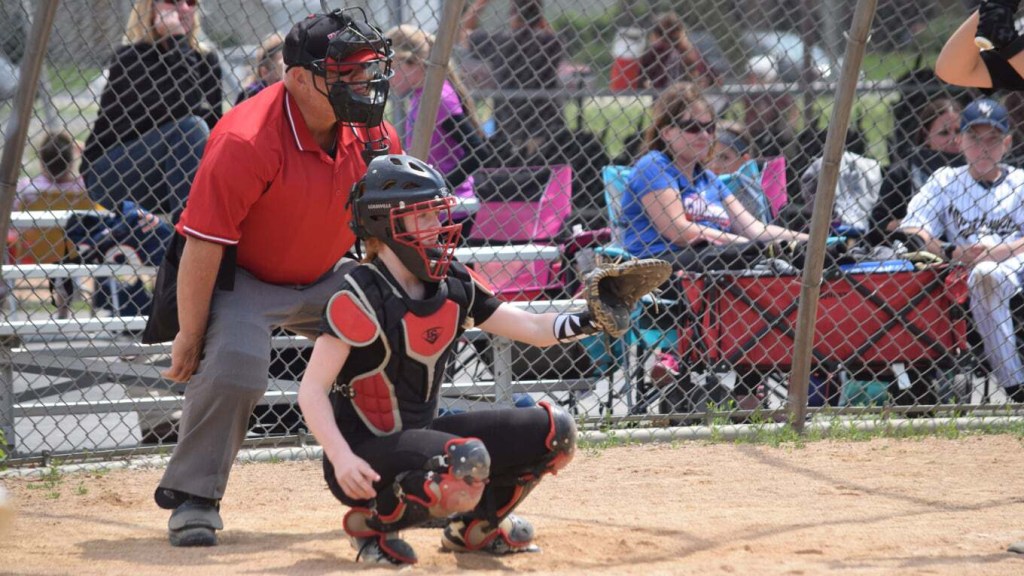
One of the keys to success in pitching in fastpitch softball or baseball is figuring out the umpire’s strike zone. While the rulebook offers certain parameters that should be universal (armpits to top of the knees, any part of the ball crosses any part of the plate, etc.) we all know even under the best of conditions it doesn’t always work out that way.
One of the keys to success in pitching in fastpitch softball or baseball is figuring out the umpire’s strike zone. While the rulebook offers certain parameters that should be universal (armpits to top of the knees, any part of the ball crosses any part of the plate, etc.) we all know even under the best of conditions it doesn’t always work out that way.
Many a pitcher (and a pitcher’s parent) has complained about umpires having a strike zone the size of a shoebox. And that shoebox is rarely in an area that contributes to pitchers keeping their ERAs low.

Instead, it’s far more likely to have the zero point on its X and Y axes about belt high, in the center of the plate. You know, that area that pitchers are taught they should see a red circle with a line through it.

Of course, these are anything but ordinary times. Here in the fall of 2020, in the midst of the worst pandemic in 100 years and with no relief in sight, teams, tournament directors and sanctioning bodies have had to take extraordinary steps to get games in. One of those is to place umpires behind the pitcher instead of behind the catcher in order to maintain social distancing.
It sounds good in theory, I’m sure. Many rec leagues using volunteer parents for umpires have had said Blues stand behind the pitcher. Sure beats spending money on gear.
But while it does allow games to be played, the practical realities have created a whole new issue when it comes to balls and strikes.
When the umpire is behind the plate, he/she is very close to that plate and thus has a pretty good view of where the ball crosses it. Not saying they always get it right, but they’re at least in a position to do so.
When they are behind the pitcher it’s an entirely different view. Especially in the older divisions where the pitchers throw harder and their balls presumably move more.
For one thing, the ball is moving away from the umpire instead of toward him/her. That alone offers a very different perception.
But the real key is that by the time the ball gets to the plate, exactly where it crosses on the plate and the hitter is much more difficult to determine. I don’t know this for a fact, but I’m sure the effects of parallax on vision has something to do with the perception.
Because it is more difficult to distinguish precisely, what many umpires end up doing is relying more on where the ball finishes in the catcher’s glove than where it actually crosses the plate. Not that they do it on purpose, but from that distance, at that speed, there just isn’t a whole lot of other frames of reference.
If an umpire isn’t sure, he/she will make a decision based on the most obvious facts at hand. And the most obvious is where the glove ends up.
This can be frustrating for pitchers – especially those who rely more on movement than raw power to get outs. They’re probably going to see their strikeouts go down and their ERAs go up as they are forced to ensure more of the ball crosses the plate so the catcher’s glove is close to the strike zone.
There’s not a whole lot we can do about it right now. As umpires gain more experience from that view I’m sure the best of them will make some adjustments and call more pitches that end up off the plate in the catcher’s glove. Most will likely open their strike zones a bit, especially if they realize what they’re seeing from in front of the plate isn’t the same thing they’d see from behind it.
Until that time, however, pitchers, coaches and parents will need to dial down their expectations in these situations. It’s simply a fact of life that hopefully will go away sooner rather than later.
In the meantime, my top suggestion is for coaches to work with their catchers to ensure their framing, especially side-to-side, is top-notch. Catching the outside of the ball and turning it in with a wrist turn instead of an arm pull may help bring a bit more balance to the balls-and-strikes count.
Pitchers will have to work on the placement of their pitches as well, at least as they start. This is a good time to work on tunneling – the technique where all pitches start out on the same path (like they’re going through a tunnel) and then break in different directions.
The closer the tunnel can start to the middle while leaving the pitches effective, the more likely they are to be called strikes if the hitter doesn’t swing.
On the other side of things, it’s more important than ever for hitters to learn where the umpire’s strike zone is and how he/she is calling certain pitches. If it’s based on where the catcher’s glove ends up, stand at the back of the box, which makes pitches that may have missed by a little at the plate seem like they missed by much more when they’re caught by the catcher.
If the umpire isn’t calling the edges, you may want to take a few more pitches than you would ordinarily. Just be prepared to swing if a fat one comes rushing in. On the other hand, if the umpire has widened up the zone, you’d best be prepared to swing at pitches you might ordinarily let go.
Things aren’t exactly ideal right now, but at least you’re playing ball. At least in most parts of the country.
Softball has always been a game that will break your heart. This is just one more hammer in the toolbox.
Accept it for what it is and develop a strategy to deal with it – at least until the Blues are able to get back to their natural habitat. You’ll find the game is a lot more enjoyable that way.
Shoes photo by Karolina Grabowska on Pexels.com






