Category Archives: Instruction
The long road to fastpitch excellence
The other night, as I was finishing up the paperwork for that night’s lessons, one of the baseball pitching instructors (who coincidentally also happens to be named Ken) walked into the office area sighing and shaking his head. The reason for his consternation was the expectations of some of the players he’d just finished working with. 
“These guys are ridiculous,” Ken said (more or less, and perhaps a bit more colorfully). “They walk in here and expect to be throwing 20 mph faster in three weeks. It just doesn’t work that way.”
Amen, brother, I told him. I know the feeling.
The problem is we live in a microwave popcorn, instant oatmeal, 24-hour news cycle world. That has set an unrealistic expectation in many people’s minds of the way everything should work.
All too often kids will walk in and expect (or their parents will expect) that if they take a handful of lessons that suddenly they will be stars. More likely that’s just enough time to mess them up pretty good, especially if they had a lot of bad habits before.
Bobby Simpson has the mantra “Getting better every day.” That’s a great way to think about it. The goal isn’t to take a few lessons and solve every issue. The goal is to be better walking out than when you walked in, whether that’s at a lesson or at practice.
The goal after that is to walk into the next lesson or practice either better than the last one, or at least picking up where you left off.
The old cliche “it’s a marathon, not a sprint” definitely applies. Whether you take the 10,000 hour rule as gospel or more as an allegory, the reality is it takes some length of time and constant work to see meaningful results.
Think about learning to play the piano. How good do you think you will be after four lessons? Maybe you’ll be able to play a credible version of “Mary Had A Little Lamb,” but you won’t be taking Chopin on anytime soon.
Or what about ballroom dancing lessons? Do you think four half hour sessions spent on the Foxtrot will have you dancing like Fred Astaire or Ginger Rogers? (Kids, follow the link to see who they were. They set the standard for dance in Hollywood musicals.)
Even if you’re not coming in with zero experience, if you’ve had a long layoff from practicing you’re not going to see a huge jump in three or four weeks. It takes time. Lots of time.
Typically, I find once I get a hitter mechanically sound that it takes about a year for them to see the real benefits. There is so much going on with hitting that it’s easy to be hesitant or get knocked off-track, especially in a game. With a year’s worth of using those mechanics and seeing live pitching, hitters start to get to the point where they can just go with it subconsciously, allowing them to spend their conscious brainpower on where the ball is and when it will arrive.
Fastpitch pitchers often have the same timeline. It’s one thing to be zinging the ball to your spots in practice. It’s another to do it when there are live hitters, umpires, coaches, teammates, opponents, parents and other spectators around and you’re playing for something meaningful.
As I always tell my pitching students, the circle looks bright and shiny from the outside, but it can be a cold, dark place on the inside.
None of that happens, however, without first putting in the work up-front. If it could, i.e., if some coach or instructor could add 20 mph or otherwise reach some great goal in three sessions, those sessions would cost $1,000 apiece or more, and there would be a line a mile long to get some of it.
That’s the dream. But it’s not reality. I wish there was a shortcut, but as far as I and everyone else I’ve ever met knows there isn’t one.
Instead, the key is to set realistic expectations and work on little improvements that add up over time. Approach it any other way and you’re sure to be disappointed. And guys like poor Ken will continue to pull their hair out.
Keeping fastpitch pitchers on the straight and narrow
One of the keys to maximizing both speed and control for fastpitch pitchers is driving straight down the powerline (more or less). That is the direct line that starts at the middle of the pitcher’s rubber and continues straight until it intersects the center of home plate.
Wander too far off the line and your power will be spread across too wide an area to be effective. Think about a laser versus a flashlight. Both send light out from the source. One (the flashlight) spreads its energy across a wide area; the other (the laser, obviously) focuses all its energy in one direction, and on a very small area. Which is powerful enough to cut through metal?
Still, it’s one thing to tell a pitcher to go straight down the powerline, even when there is one drawn right in front of them. It’s another to get them to do it, especially when they’re working hard to maximize their leg drive.
If you’re indoors and using a pitching mat, here’s a way to help pitchers learn to take a more direct route. Either move the mat or the pitcher so she is standing with her throwing-side foot next to the mat as Jenna is here. Then have her execute the pitch.
She will receive instant feedback as to whether she stayed straight, and the long line of the pitching mat will serve as a visual guide as to where her foot should go.It seems to be more effective than the simple drawn line, because there is dimension to it. And it’s safer than using a larger obstacle such as a bat bag – just in case the pitcher makes a mistake.
As a bonus, the long line of the mat will also give her a guide for her throwing-side foot, helping pitchers who tend to let that foot swing too much out behind their glove-side foot. If your goal is for the throwing-side foot to drive straight down the line, she can just trace the side of the mat with that foot to get the feel.
For those who are outside, a narrow roll of foam from the hardware store will serve a similar purpose. Just be sure to anchor it down so it doesn’t blow away.
If you have a pitcher who’s having trouble staying on the straight and narrow, give this a try. And as always, let me know how it works for you.
How many pitches should a fastpitch pitcher have?
I know the title sounds like a tongue twister (how much wood can a woodchuck chuck), but the question of how many pitches a fastpitch pitcher should have is an important one. Mostly because it determines how pitchers will be spending their valuable practice time.
The “old school” approach is that a pitcher only needs three pitches – drop, changeup and riseball. And that approach has served many pitchers well for a lot of years.
That may be outdated thinking, however. Over the weekend I again was one of the supporting instructors at the Indiana United Fastpitch Elite clinic, which was led by Rick and Sarah Pauly. On Friday night, Rick presented a PowerPoint talking about the overall mechanics of pitching, and then took questions both during and after the presentation.
One of the questions, from my friend Mike Borelli, was how many pitches should a pitcher have. Rick turned to Sarah, the winningest pitcher in National Pro Fastpitch history, and asked her how many she had.
Her reply wasn’t three. It was seven. As I recall she named drop, change, rise, two curves, backdoor curve and a screwball.
Rick and Sarah then went on to talk about how with today’s hitters you need to have more weapons.
Think about why that is. In the old days in women’s fastpitch, the ball was white, with white seams, and pitchers even at the international level stood 40 feet away. Pitchers put in way more time learning their craft in the off-season than hitters did. That might have been a good thing because what most people were teaching about hitting was pretty bad. Hitters are smarter, too, spending more time studying pitchers and looking for patterns. Also, there is no doubt today’s bats are much hotter than those back in the day.
You put all that together and having more than three ways to attack a hitter starts to make sense. (FULL DISCLOSURE: I have quite a bit of confirmation bias in this way of thinking because I’ve been saying it for years.)
If all you have is three pitches, even if they’re great ones, you become more predictable. And predictability is deadly. Just ask any pitcher who has a coach who likes to favor certain pitches. It’s a lot easier to dig in and hit if you know what’s coming.
Now, no doubt some of your pitches will be better than others. No doubt you will throw them more than others. But if that’s all you throw, it’s easier to prepare to hit against you. Throwing in something a little different, even now and then, keeps hitters off balance and uncomfortable, which is the key to great pitching.
It was great to hear this philosophy confirmed by someone who has been around the women’s game, and played the men’s game, for a long time. If you’ve been restricting yourself/your daughter/your students to three pitches, you might want to give this a little thought. Perhaps it’s time to add a new pitch.
Trick for helping fastpitch hitters adjust their timing
As important as it is, timing is one of the most challenging things for fastpitch hitters to work on. You can build your swing on the tee all day every day. But it isn’t until you have to actually face a moving ball that it really becomes game-like hitting.
What you’re really trying to do with timing is find the ball in space. What I mean is that you have to deliver the bat not only to the right height, as you do on the tee, but also in a plane that extends from where the pitcher releases the ball to the optimal (hopefully) point near you that yields the best contact.
For many hitters, figuring out where that point is can be difficult. Many tend to wait too long, letting the ball get too deep. When that happens they may make contact, but it probably won’t be strong contact.
At best, especially if the pitch is on the outside half of the plate, they make get a sharp ground ball to the opposite field. But even then they won’t really be driving it. And forget about crushing an inside pitch over the fence on their pull side, no matter how strong they may be.
The problem isn’t a lack of conscious understanding. I’ve worked with plenty of hitters who understood exactly where they needed to make contact. If you asked them they could quickly give you the right answer. But put them up against a moving ball and they just can’t pull the trigger on time to do what they just told you they should do.
Speed doesn’t matter either. They get the same results whether they’re facing a 60+ mph fireballer in a game or a coach lobbing meatballs in front toss. It’s not a question of when so much as where.
If you have (or are) one of those, here’s a trick to try. Place a second plate immediately out in front of the one you’ve been using. (It helps if the two plates are different colors.)
Tell the hitter to line up with the back plate, but base her hitting off the front one. Then have her take a few swings.
What you will probably find is that she is suddenly able to get the bat to the ball on time. Honestly, I’m not sure why that is; perhaps a psychologist could explain it.Then again, I never saw a pitch I didn’t like. The simple act of placing that second visual seems to help. It certainly did with Emma, who is pictured here. (In case you’re wondering, that’s her dad Mike lurking in the background. :-))
Once that second plate went down she not only started hitting the ball better, but actually started pulling front toss pitches that were inside. The visual helped break whatever was locked into her mind so she could cut loose and attack the ball instead of taking a more defensive, don’t let the ball get through approach.
The next step is to take the front plate away to see if she can maintain the “hit it out-front” mindset. If not, put it back and keep working. Then try it again next practice. Eventually her brain will re-calibrate and associate that space just in front of her with where the contact point should be.
I prefer the “all or nothing” approach with the second plate to moving it back slowly. I’m just afraid with most hitters, if you move the front plate back a little, you’ll drag the hitting zone back along with it because the front of that plate will still be a reference point. Better to take it away entirely and see whether it has translated yet or not.
By the way, I have my theories as to why hitters get into the mindset of waiting until the ball is practically on top of them to swing. One idea is that when they are playing rec ball early in their careers, they’re not sure of where the strike zone is (or if the pitcher can hit it), so they wait until they’re absolutely sure they know where the ball is.
Since most kids don’t hit the ball particularly hard at that age, the bad placement isn’t really noticeable. But as they progress in the game and hitting gets better, those who don’t make the adjustment get left behind. .
My other thought has to do with tee placement. How many times have you seen a player (or a well-meaning but under-informed coach) plop the tee right in the center of the plate, which places the ball right about at their bellybutton? Those ubiquitous tees with the plate for a base certainly help reinforce that concept.
So after hours of practicing that way, where do you think a hitter is going to expect to hit the ball? And once that mindset is locked in, it can be tough to break.
So give the second plate idea a try and see if it helps. Then let me know your results in the comments below. Also, if you’ve found other successful tricks to help hitters understand how to hit the ball in the proper space as it’s moving, please be sure to share them with everyone here.
Helping fastpitch catchers learn to throw to bases faster
In fastpitch softball, as in baseball, catchers tend to make their bones in two areas above all else. One is their ability to block pitches in the dirt. The other is their ability to throw out baserunners, either on steals or pickoffs.
Key to the latter is the ability to make a quick throw. While having a strong arm is important, a strong arm can be offset by requiring a slow, deliberate release. And for  catchers whose arms are not the strongest, having a quick release becomes even more critical.
One of the ways you can speed up a catcher’s release is by getting rid of the need to “find” the base first. In other words, when the catcher goes to throw the ball – either on a steal or a pick – she shouldn’t have to look at where the base is and process the information.
Instead, she should just know instinctively where it is. The tenth of a second or two she saves by not having to “find” the base first can make the difference between safe and out.
Even the runner is safe, if it’s just by a hair it will serve as a warning to the other team’s coach not to get too adventurous on the basepaths. After all, coaches generally don’t test the catcher’s arm/release with their slowest runners – they use their fastest. If you can make it a photo finish with the fastest runner, it’s unlikely the coach will be anxious to send the rest.
So how do you get catchers to throw with more instinct? One of my favorite methods is by using a blindfold. Here’s how it works.
First, you must have already trained your catchers on proper technique, including the need for urgency. If you haven’t done that first, stop now and do that, then come back to this idea.
If you have, however, then it’s time to bring out the blindfold. The catcher starts with the ball in her glove and the blindfold in place. Make sure she’s in line with where she would normally set up, then have her get into her runners on base stance. Tell her to visualize where the base you’re throwing to is. I usually like to start with throws to second.
When she’s ready, either blow a whistle or yell “she’s going.” At that point the catcher pops to her feet (or drops to her knees if she can throw that way) and executes the throw as quickly as possible.
If she has a good feel for where the base is without seeing it, and good technique, she should be able to make the throw reasonably close. If she doesn’t, it could go anywhere and you’ll know you have some work to do.
If the throw goes offline, be sure to tell the catcher where it went so she can get a feeling for the difference between where she thinks it is and where it actually is. Also be sure to watch as she makes her throw for mechanical flaws (such as not pointing the front shoulder at the target) that can throw her off.
One way to make it more interesting is to offer a prize. This is particularly effective if you’re working with multiple catchers at once, since once one of them is successful it will spur the others. I’ve used a stick of Chapstick, a pack of gum or a roll of Mentos as prizes. You can select whatever you want.
Having a competition for a prize is a great way to end a training session, by the way. I like using this type because everyone has a shot at it (versus having only one winner) if they execute properly.
To add a degree of difficulty, have the receiver sit on a bucket or a chair. That cuts the adjustability of the receiver, so the throws really have to be spot-on. If you’re working with multiple catchers, you can add in some conditioning by having one be the thrower, one the receiver, and another chasing down errant throws. Give the thrower one shot, then she sprints down to become the receiver, carrying the ball with her. The running not only helps them build their legs but also fatigues them, helping simulate the feeling of having played a couple of games already.
This drill/game can be used for any base. It can be particularly interesting for right-handed catchers to learn to throw to first base on a pickoff attempt since the moves will have to be stealthy and they must rotate beyond the 90 degrees required to throw to second. It can get pretty random, especially outdoors, so your “chaser” will get a good workout in.
Throwing to bases blindfolded can be pretty challenging at first, so keep them encouraged. Let them know there is a degree of difficulty involved, and there’s no shame in not being able to do it at first.
But if they CAN learn to throw to bases instinctively, without seeing, the whole process will become a whole lot easier when they’re not blindfolded.
Don’t be surprised, by the way, if this quickly becomes your catchers’ favorite drill/game. The ones I’ve used it with usually will ask if they can do it, or will select it if given a choice of how to close out practice.
Truth is it’s not only challenging – it’s fun. And a point of pride when they’re able to make the throw.
Tossing out baserunners takes a lot of instinctual play. This is a great way of helping to build those instincts.
My fastpitch learning by osmosis theory

I have always been a big believer in the ability of kids, at least certain kids, to learn the nuances of softball through osmosis. I certainly saw it with my own daughters, who were eight years apart.
When my older daughter Stefanie was playing, we dragged all the other kids out to her games. We had to – she was the oldest, and we couldn’t leave the others at home.
When Stefanie was playing 14U, my youngest child Kim was 6. I was coaching, so I mostly remember seeing her heading off to a playground or just sitting in the grass. We never talked to her much about what was going on.
But somewhere along the way it must’ve stuck in her brain, because by the time she started playing she had a pretty high level of innate knowledge about what to do when. For example, I never had to teach Kim about going after the lead runner on comebacker to the pitcher. She just knew.
I am convinced that’s because she saw so many games. Even if she wasn’t constantly thinking about what was going on, she picked up a lot of it by osmosis. I think that’s the benefit the younger sister (or brother) gets.
I bring this up because of something that happened last night that just tickled me. I have been working with a 12U pitcher named Jenna for a little over a year now. (I refuse to say anyone is 11, 13, 15 or any other odd number of U. Old school.)
Anyway, I started with Jenna when she was 10U, and she’s made the transition to 12U pretty easily. It’s fun to see how far she’s come in a short period of time, and how she can take command of a game.
This summer, her dad Gary decided it would be a good time to get his younger daughter Sammie started. She was 8 when we started, playing rec league, but I know Gary has aspirations for her future. 🙂 She turned 9 not long ago.
At first she had all the challenges 8/9 year olds typically have. Like being so literal about her form that she looked all stiff and robotic.
But she’s determined, and has been working hard. The last couple of lessons the light bulb has started coming on and she’s been throwing more relaxed. Her strikes are going up, and she’s definitely throwing hard. So last night I thought it might be a good time to get her started on the basics of a changeup.
When I said that, Gary told me, “Sammie’s already gotten started on it.” Apparently she’d been watching Jenna and thought it looked pretty cool, so she decided to start working on it on her own.
I asked her to show me, and darned if she didn’t do a nice job! The pitch was really high, but it was straight, and more importantly it was the right speed without slowing her arm down. She did a couple more and it was the same thing.
Honestly, I was impressed. I asked Gary if he had been working with her and he said no. Sammie had just picked it up by watching Jenna.
I think what knocked me out was that she was maintaining her arm speed. Normally, when a new pitcher is trying a change on her own she’ll slow down to make the ball go slower. (Which, by the way, is the opposite of what you really want to do.) Not Sammie, though. She just cranked it right out there and let the design of the mechanics do the job.
Of course, it helps that she has a great example to model herself after. Jenna throws a killer change that is quite effective in games. But still. Sammie just sort of figured it out by watching.
We did some quick work and got Sammie throwing it for a strike at least part of the time. But it sure was nice to start from a solid foundation!
So there you go. Learning the game, or even parts of it, doesn’t always require a formal setting. Sometimes, if you’re fortunate, it just happens. Gotta love osmosis.
A different and fun approach to team building
Any time you have a group of people from different backgrounds, skill levels, experience levels, etc. trying to achieve a single goal, one of the staples has been team building. Whether you’re a corporation, charitable organization or girls fastpitch softball team, a little team building can go a long way.
Some of you may remember how the USA National softball team approached it during their run-up to the 2004 Olympics. They worked with the Navy SEALs to get some strength-building as well as military-style lessons in teamwork and bonding. 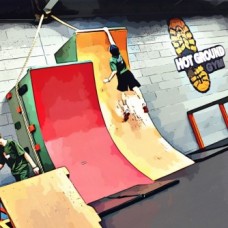
Sounds cool doesn’t it? Maybe you’re thinking you’d like to do something like that with your team – put them through military-style training to help them learn how to work together, overcome obstacles and learn to function as a tighter unit. But of course the SEALs have more important things to do than work with every youth fastpitch softball team that wants to give it a try.
Luckily, at least if you’re in the Chicago area, there’s now an alternative: Hot Ground Gym. Currently located in Northbrook (with a second location set to open in the next few months in Buffalo Grove), it offers that kind of military-style training to kids and teams. They also have a mobile option that will come to you if you have an organization that would like to do it. (FULL DISCLOSURE: My son Adam is one of the trainers, which is how I learned about what they do. This is not a paid advertisement, just an FYI for coaches looking for something different to do with their teams.)
Hot Ground Gym was started by two military veterans, one a former U.S. Marine and the other Israeli Special Forces, to help kids build confidence, discipline, problem-solving and leadership skills in a fun, supervised environment. A lot of what they do is regular classes where kids come almost every day. But they also have birthday party and team-building options where they will do a 1.5 hour or 2 hour program for a specific group.
The core of the Hot Ground Gym program is obstacles. They have all sorts of them, most of which they built themselves, to challenge kids and teach them how to work together. If the trainers see the kids aren’t challenged, they rearrange or alter the course to get them out of their comfort zones and working hard to improvise, adapt and overcome.
The nice thing about this is it’s both mental and physical. Your team parents will likely love it if you do it because their kids will probably pretty sleep pretty well afterwards. The kids are kept moving constantly, running through, around and over obstacles, climbing, crawling, swinging from ropes and so forth.
At the end of the session you can either just go home, or you can have a little celebration (bring your own food and drinks) to talk about what the team learned and enjoy their successes. And maybe have a few laughs about their failures.
The video on the website home page provides a pretty good idea of what they do, although it’s constantly changing. And don’t be discouraged by the fact it’s mostly boys in the video. Adam says they have a lot of girls do their programs, and those are some of their best performers.
If you’re looking for a way for a fairly new team to get to know each other, or for a cliquish team to break down some barriers, or just a way for your team to learn a little more about how to push past their personal boundaries to do more than they thought they could, it’s worth checking out.
You might even ask that Adam be one of the trainers. He’s an Illinois Army National Guard veteran who did a tour of combat duty in Afghanistan so he knows the whole military aspect. And he earned a couple of medals during training for his leadership skills so he knows how to get groups of people working together for a common goal. He also has a wicked sense of humor, so your players will be entertained as well as challenged.
Sometimes you just gotta go with what you’ve got
As both a fastpitch softball instructor and general fanatic for the sport, I have to admit I spend an inordinate amount of my waking hours looking at information and analyzing techniques to try to become as educated as I possibly can. Hi, I’m Ken, and I’m a softball technique-aholic
It’s well-intentioned to be sure. I firmly believe, based on roughly 20 years in the sport that the better-trained a player is, the higher the chance she has for success. And the less raw athletic ability she has, the more specific training she requires.
But I also believe (again based on experience) that there is a Law of Diminishing Returns when it comes to trying to perfect technique. While it’s true that optimal technique should yield the best results, that’s also only true if it’s implemented with optimal effort or enthusiasm.
This is where a lot of players seem to get hung up. Especially the most dedicated. They are focused so much on trying to achieve the optimal mechanics that they get in their own way.
Hitters become tentative trying to achieve the best bat path and as a result slow their swings down. Or they focus so much on one part of the swing that they let the rest fall apart.
Pitchers work so hard on getting just the right launch technique, or keeping the arm circle exactly where it should be, that they get all tight and don’t let their bodies work for them. Catchers worry so much about how they’re making the transfer on a steal that they become over-conscious and thus too slow.
Every part of the game can be affected, regardless of position, or whether you’re on offense or defense.
So here’s my advice: as they say in auto racing world, sometimes you gotta run with the one that brung you. Or in the case, go with what you’ve got.
If you’re a hitter still reworking her swing, do the best you can to use what you’re learning. But don’t focus on doing it perfectly. Do it the best you can while still coming at it with full energy.
After all, the ball doesn’t care how you hit it. A strong contact with an ugly-as-sin swing will beat a soft contact with a perfect swing every time. A strong swing with much-improved mechanics will generally yield better results than a tentative swing that looks good only on slow-motion video.
The same goes for the rest of the game. You may not have perfected that backhand or rake technique on ground balls, but if you go after them like you mean it you may just surprise yourself. Pitchers who continue to try to throw hard will be much more effective than those who again look like they’re trying to make the perfect video instead of getting hitters out.
Believe me, I’m all for perfect mechanics. But they should never be a conscious effort, at least in a game situation. When you’re in the game, go with what you’ve got. You can always work on perfecting it at the next practice.
Private softball instructors level the playing field
As someone who has a broad interest in the state of youth sports in general as well as fastpitch softball specifically, I’m always interested to read articles on the topic. There’s no doubt that the U.S. (along with more and more other countries) has become sports-crazy, to the point where it is having a negative effect on young players. 
There is one aspect that always strikes me as missing the mark, however, which is their description of instructors. Maybe it’s because I’m a private softball instructor myself, but I don’t think it’s just me taking it personally.
When they talk about how crazy parents have gotten, sooner or later the articles will refer to how on top of everything else parents “then drag their kids to an instructor to spend even more time on their sport, usually in the hopes of acquiring that D1 scholarship.” Or something to that effect. It’s not an actual quote, just a sort of paraphrase of what I’ve seen.
That may be true in some cases. But for the most part I see the role as being somewhat different.
In the good old days these pundits like to talk about, they say kids just showed up at the field and learned to play there. They didn’t need all these adults around.
Well, the reality is that was wonderful for the kids with great athletic ability. You know the ones I’m talking about – you give them a ball, or a stick or some other piece of athletic equipment and they’ll instinctively know what to do with it. But maybe not so much for the kids for whom it didn’t come naturally, or who hadn’t grown into their bodies yet, or who were a little slower in developing their motor skills.
Basically what happened was they got left behind quickly and never had the opportunities to advance in a sport they may have loved but weren’t particularly good at yet. They got weeded out early.
That’s why I say a good instructor can level the playing field. He or she can take a player who may not be the greatest athlete and teach him or her to be competitive and find success on the field, court, rink or whatever. Success being defined by the player and his or her family.
I’ve worked with a lot of kids who had no ambition of playing in college – not just at the D1 level but at any level. Some just wanted to be successful in high school, or on their travel team, or in their rec league. They wanted to get off the bench and become important to their teams.
Is there something wrong with that? I don’t think so, and if I can help them achieve that goal where they might not have otherwise it’s terrific.
Not everyone was blessed with great DNA or grew up in a family that played sports all the time. A good instructor can help make up for those “disadvantages” and level the playing field, giving them opportunities they may not have had otherwise and helping them to achieve all they can achieve.
Of course, even the best athletes can use a little help along the way to shortcut their learning curve, and they’re fun to work with too. My point is that most of the parents who take their kids somewhere for instruction aren’t the ones you see in TV documentaries and NY Times ads, relentlessly trying to drive their kids to sports success they themselves never achieved. They’re just trying to help their kids feel good about themselves and build some great sports memories.
Drills for the sake of drills
Check out any fastpitch softball flyer or website offering instructional materials and you will find tons of books and DVDs focused on drills, drills, DRILLS! It almost seems like an arms race sometimes to see who knows the most drills.
Don’t get me wrong – drills can be very helpful. But like anything else they need to be used strategically.
Drills are only valuable when they answer an actual need (other than keeping some players occupied while you work with others). Here’s what I mean.
Take a hitting drill that focuses on extension after contact. Seems like a worthwhile way to spend your time. But if the player already has good extension after contact, it can actually be wasting time that would be better spent on another aspect that isn’t as strong.
The same goes for pitching drills focused on the arm circle. While it can always be a little better, players only have so much time to practice. That circle drill might have already hit the point of diminishing returns, where time spent increases sharply while actual gains don’t rise much at all.
The other issue with doing drills for the sake of drills is that softball skills typically require multiple combinations of movements, whereas drills are designed to isolate movements. As such, drills are great for working on isolated issues.
Sooner or later, however, those individual pieces need to be rolled back into the full skill. Spend too much time on the drills and you won’t have enough time to develop the actual skill that’s required. Sort of like spending the bulk of your time cleaning your boat instead of taking it out on the water.
Once the player has learned the basics, my recommendation is to spend as much time as possible practicing the full skill, end-to-end, and then use drills to address problems you’ve identified within them. As opposed to just running through a set of drills because you saw them on the DVD.
It will be a much more efficient use of time, and will help you turn out more game-ready players.






 Life in the Fastpitch Lane