Blog Archives
Help for Pitchers Who Are Banging Their Elbows Into Their Hips

It’s more common than you might think: pitchers, especially those who are trying to keep their pitching arms in close to their bodies (as they should) suddenly start feeling slight to intense pain as they go into release. Once it catches their attention, they realize their elbows are hitting their hips. HARD.
Well-meaning coaches, other pitcher parents, and even some random people will tell them to solve the issue they should clear their hip out of the way or bend out more so their arm totally misses their body as they go into release. While yes, that will solve the immediate issue, it will also create less-than-ideal mechanics that will ultimately limit most pitchers’ ability to compete at a high level.
That’s because compression of the upper arm against the ribcage and light brush contact of the forearm are both essential to stabilizing the shoulder complex to prevent a more serious injury, transfer more energy into the ball to improve speed, and sure consistency of release to improve pitch accuracy/command.
By now you may be asking if that’s the case, why is my pitcher/daughter getting giant bruises on her elbow area and/or hip area while other pitchers are not? The simple answer is because those who are not raising those ugly bruises are making contact differently than those who are.
The bruises are coming from the position the arm and hip are in going into release.
When the bruises are happening, the elbow are is making direct contact with the pelvis (hip bone), crashing into it in a bone-on-bone manner. When they’re not happening, the pitcher is making contact with with the soft tissue (muscle) on the forearm just below the elbow into the muscle (soft tissue) on the side of the hip, interrupting the acceleration of the arm enough to transfer the energy without stopping it completely.
So what causes the elbow to slam into the hip instead of passing by it? I find that typically there are two causes, which can happen either independently or in the worst cases at the same time. Correct those and the problem usually goes away,
Cause #1: Staying Too Open
Every pitcher needs to open her shoulders and hips (externally rotate) to some extent to create an aligned, powerful arm circle. The shoulder in particular is important because when you are facing straight ahead, the arm can only come back so far before it has to deviate off-line.
This deviation stresses the shoulder, leading to injury, and takes the arm out of its ideal movement around the shoulder, affecting both speed and accuracy. Opening the shoulders makes in possible for the arm to move around at incredible speed while using the shoulder the way it’s designed to be used.
The problem occurs when the hips and shoulders don’t come back forward to an area around 35-50 degrees going into delivery. The body then starts blocking the arm, and the pitcher either has to then go around it or slam her elbow into her hip.

Think about where your elbow is when you are just standing normally. It sits squarely on your hips. If it does that while you’re standing still, what makes you think it won’t do that when you’re aggressively trying to throw a pitch.

The cure for this is to move into that 35-50 degree angled range we mentioned earlier. When you are in this position, even standing, your elbow is clear of your hip while allowing your forearm to still make light brush contact with the side of your hip as it passes the hip.
To learn that, have the pitcher do a ton of easy walk-ins, where she starts out facing the plate, then takes an easy step with her throwing-side foot before going into the pitching motion. She should do this slowly, with no leg drive at all, and focus on moving her body open with good external rotation of the shoulders and then back into a roughly 45 degree position.
On the field you can throw a regular ball from a short distance. But at home, have her look into a mirror as she does the movements without a ball, paying attention to how her body is moving and coming back to the finish position.
Ideally, her hips will move a little ahead of her shoulders as she comes down the back side. Once she can do it without a ball, have her throw a rolled up pair of socks or a lightweight foam ball into the mirror, again paying attention to how her body is moving.
You get all the benefits of brush contact while maintaining solid posture (no contorting to move the hips out of the way or throw the shoulders too far off) so the pitcher can pitch pain-free.
Cause #2: Keeping an Arch in Your Back
The second major cause of banging the elbow into the hip in a way that causes injury is having your back arched backwards going into release. This can happen even if you are getting to the 35-50 degree position we talked about above.
At the top of the circle, it is desirable for a pitcher to have her back arched back at least 15 degrees toward first if the pitcher is right-handed or toward third if the pitcher is left-handed. It’s a movement that helps load the muscles in the back so they can help accelerate the arm on the way down. It also helps getting proper external rotation and keeping the arm on-path.
After the peak of the circle, however, the arch should come out and the pitcher should be in some level of flexion by the time she is going into release. In other words, she will be slightly bent toward third if right-handed or toward first if left-handed.
If the arch doesn’t come out, however, it pulls the pitching elbow backwards instead of letting it flow freely through its natural path. When that occurs the pitcher will either bang her elbow into the side or even back of her hip.
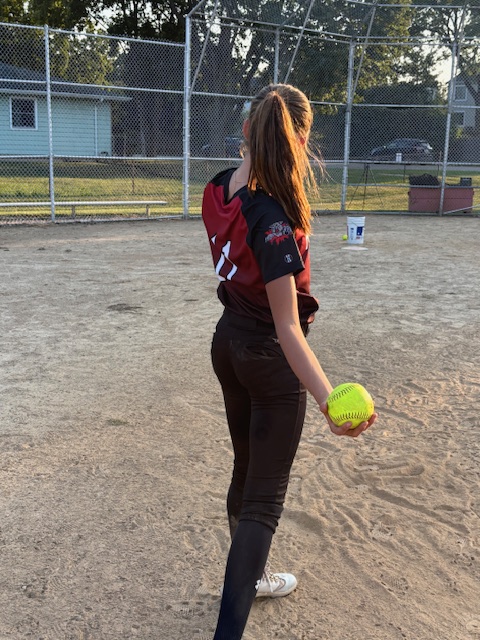
She may also try to compensate for this bad position by trying to move her elbow away from that area, causing her to throw low and very inside, which will make pitching even more difficult than it already is.
To solve this issue, the pitcher needs to learn how to come out of the arch as her arm comes down the circle. One way to do that is to have her practice throwing a pair of rolled up socks into a mirror, watching herself to see what position her body is in when overhead and then when releasing the socks.
She should see herself arching at the top then flexing in at the bottom. You can even put a piece of tape on the mirror to help her see it. Have her start slowly, then build her speed until she can execute it without thinking.
Another way to address this issue is a drill I got from Rick Pauly of PaulyGirl Fastpitch called the Bow-Flex-Bow. For this one you will need a piece of Theraband that is at least as long as the pitcher’s arm.
Have her grab both ends of the Theraband and stand at a 45 degree angle, as if getting ready to do a pitching drill. She then takes the Therabad up and into a pitching motion, with both hands moving forward toward the “plate” before starting to separate overhead.
When she is at the top of the circle her back will need to arch to get the Theraband behind her head. As she comes down, make sure she bows back in to come to the finish so instead of arching/flexing back she is now flexing forward.
Baby and Bathwater
No question that banging your elbow into your hip is not only unpleasant but counter-productive for achieving both speed and accuracy. But totally avoiding any contact between the body and the arm isn’t the way to go either.
The issues listed here aren’t the only reason it can happen but they are the two most common. By making the corrections to achieve proper upper arm compression and light brush contact you can stop the pain while improving performance.
Vlog: Absolutes v Core Principles in Fastpitch Pitching

Today we’re starting the new year with something a little different.
Recently Rick Pauly of Pauly Girl Fastpitch and the High Performance Pitching certification program and I got together for a video discussion about several topics related to fastpitch pitching. The driving topic behind it was the difference between absolutes and core principles in athletic movement generally, and how we view each relative to fastpitch pitching.
The discussion then branched out to a few other related topics, including the importance of posture, the effect of motor preferences when determining what’s optimal for performance, and the often-overlooked significance of deceleration as part of the overall kinetic chain.

So what are absolutes v core principles? We go into it more in detail in the video but briefly it’s the idea of whether there’s one “correct” way to do things – basically a hard line – or if there is a more of a range into which good pitching mechanics can fall.
In other words, do you want your pitchers doing certain things exactly the same way or does fastpitch pitching allow more room for deviation based on a number of factors? And even within that are there exceptions, i.e., pitchers who don’t necessarily do things the way they “should” but are successful anyway?
Which ultimately leads to when do you make corrections/changes and when do you just let them do what they do?
I think you’ll find it to be a pretty interesting discussion that covers a lot of ground. To check it out, follow this link to the Pauly Girl Fastpitch blog.

Happy new year to all! Or happy whatever holiday is close if you’re reading this sometime in the future.
Efficiency Is the Secret Sauce to Improving Performance

Everyone is always looking for that one magical drill, or technique, or exercise, or something else that will help them improve their level of performance in games.
Building strength is often where players and coaches turn when they don’t know what else to do. And yes, you can definitely drive some level of improvement through strength or speed and agility training. But often the results don’t match the expectations – or at least the hopes.
That’s because there’s another element to the whole process: efficiency, or the ability to improve output without increasing the level of input.
Take a look at these two illustrations. The first one shows a player whose mechanics are inefficient, such as a hitter who only uses her arms or a pitcher who pushes the ball through release with a forced wrist snap.

Let’s say she is working hard but not seeing the results. Increasing her input is only going to raise her performance slightly, because the rather flat relationship between input and output remains the same.
When you have high efficiency, however, as seen in this chart, the difference between input and output is much greater

Both players are putting in the same level of effort. But the second is getting much more out of it. In fact, while the first player’s performance is below the midline of the chart, the second player’s performance is already above it.
Which means if player one wants to reach the same level she is going to have to somehow double her input. Yet if player two only increases her input a little more, her output goes to the top of the chart.
Now, all of the objects and their placement here are arbitrary; they’re not based on a specific set of numbers but rather just an illustration of the principle. But the correlation is real.
It’s essentially a great example of the coaching phrase “Work smarter, not harder.”
When you are inefficient, increasing your effort (strength building, practice time, and so forth) even to a significant level often only results in a small, incremental improvement in overall performance. If you are highly efficient, however, the effect of putting in even a little extra effort is multiplied and you can make significant gains toward your performance goals.
Think of it this way: if you were running a 100 meter dash race with a prize of the latest, greatest smartphone would you rather be on the starting line with everyone else or 10 meters ahead of the pack? I know which one I’d choose.
Being more efficient through mechanics that are proven to be superior gives you that head start on the race to the top. It doesn’t guarantee you’ll stay there – you still have to keep working or the less efficient players could pass you eventually – but having a head start is definitely a significant advantage in anything where there’s competition for success.
That’s why it’s important for players, coaches, and parents to understand what efficient mechanics are for every skill – hitting, pitching, throwing, fielding, base running. There are plenty of great resources out there that can point the way, starting with where you are right now on Life in the Fastpitch Lane.
For pitchers you might want to also check out Rick Pauly’s Pauly Girl Fastpitch website as well as Keeley Byrnes’ Key Fundamentals Softball blog. The Discuss Fastpitch Forum is also a great resource for a wide variety of topics.
Social media sites such as Facebook, Instagram, and YouTube have some great content (along with a lot of not-so-great content so you need to be discerning about who and what you follow).
If you’re not sure if you’re using efficient mechanics right now, a great way to check is to watch high-level college and pro games to see what those players do, and compare it to what you (or your daughter/player) is being taught. If you don’t see the same things, you’re probably not learning efficient mechanics.
All you need is a smartphone and a TV and you can capture your own clips. Throw them in some sort of video analysis software and you are ready to spend hours upon hours going down the rabbit hole. But at least you’ll be informed.
The bottom line is working harder always works better when you work smarter too. Focus on improving your efficiency rather than just your input and you’ll see your output rise dramatically.
Coaches and Parents: Getting Past Self-Imposed Obstacles

Years ago there was a book titled, “All I Really Need to Know I Learned in Kindergarten.” It took the premise that a lot of the world’s problems could be solved if we went back to the basic values most of us were taught as children.
That’s a great idea from a basic, being a good human being standpoint. But it’s not such a good philosophy for helping our players or daughter learn the skills required to play fastpitch softball at a high level.
The key issue there is that our level of knowledge of the optimal way to execute various skills is constantly expanding and evolving. New research, often driven by new technologies such as high speed video (your basic mobile phone or tablet), tools that measure ball spin rates and direction (Rapsodo, Diamond Kinetics), and wearable sensors that measure parameters such as the kinetic sequence and angular velocities of various limbs (4D Motion), help us look deeper under the hood to gain a greater understanding of the biomechanics of movement, i.e., how various body part interact with one another.
In other words, there is a wealth of hard data available that can help us lift the veil of guessing to truly understand which ways of executing skills will produce the best results.
You would think this news would create a Renaissance of enlightenment that would have coaches and parents scurrying to absorb all they can as quickly as they can and incorporate it into the way they coach their players/daughters. But you would be wrong.
You see, the human mind is a funny thing. It doesn’t like to be “wrong,” so it sets up defense mechanisms to protect itself against that possibility.
Of course, overcoming these self-imposed limitations first requires recognizing that they exist. Today’s post discusses a few of the most common.
Understand that these issues are often not mutually exclusive. In fact, many of them feed into each other to help create an even stronger barrier to keep new information out. But with a little self-examination you can figure out whether you are falling victim to them so you can put in the work to get past them and open your mind to all the great information that’s out there.
Oh, and this doesn’t apply only to softball by the way. It can be applied to other areas of your life as well since we all find it easy to fall into these traps.
Commitment Bias
This is probably one of the most common issues coaches and parents encounter when faced with information, or even hard evidence, that contradicts what they currently believe to be true.
The basic idea of commitment bias is that you’ve spent a considerable amount of time and effort, and probably invested a significant amount of money, in acquiring the knowledge you have now. (In financial terms it’s called a “sunk cost.”)
To make a change, you would not only have to throw away all or at least some of what you’ve spent your time and treasure acquiring, you would have to <gasp!> admit that you were “wrong” about it.

Or at least that’s how our minds think.
We see this a lot when coaches fall back on the “I’ve been teaching it this way for 20 years and been successful…” argument.
There is an element of truth in that. They have been teaching it that way for 20 years, and they have had players who have been successful during that time.
But there’s a pretty good chance that those players were successful in spite of what they were taught rather than because of it. The world is full of pitchers who were taught “hello elbow” mechanics but, if you watch high-speed video of them actually pitching, don’t pitch that way at all.
Parents can get caught in this trap as well. They spent good money for their daughter to go to a skills clinic, or a private coach, or they bought a bunch of books and videos so they could teach their daughter themselves.
Now they’re confronted with evidence-based information that contradicts those investments. Can they really bring themselves to set all that aside and have their daughters start over? That can be a tough call for some people, especially those who like to believe they’re always right.
But it’s a necessary step. As pitching guru Rick Pauly said on a recent “Transcending Sports” podcast with hitting expert Rob Crews, “If you’re not willing to learn new things you should probably get out of coaching.”
That doesn’t mean believe every new thing you see or hear, especially on the Internet. But be open to it, and if it makes sense be willing to change.
Confirmation Bias
This one is often the next step after commitment bias kicks in.
You heard something that contradicts your world view so you go out seeking more information about the topic. But rather than performing objective research, you instead go out seeking points of view that will back up (confirm) your current position.
This is kind of like a person being told they have a horrible disease and deciding to get a second opinion. But they keep on seeing doctors until they find one that tells them what they want to hear.
Doesn’t matter if it’s 100-1 in favor of the original diagnosis. They’re going with the one.
The Internet makes this issue particularly dangerous, because whatever is posted there is posted forever. Or as they say in The Social Network, “the Internet is written in ink.” Gotta love Aaron Sorkin.

The problem with that is even those sincerely trying to perform unbiased research can end up watching a grainy video from 1998 that doesn’t take into account the progress that’s been made in understanding how to optimize softball skills over the last 20+ years. Instead, since it reinforces their beliefs they stop right there and never check out newer, better information.
Of course, those who hold their beliefs tight to their chests will purposely seek out information that supports their views and ignore whatever does not. At that point the loop is closed and no new information will be admitted. Kind of like the way a dungeon blocks out all the sunlight.
When you hear something new, the better approach is to seek out as much information about it and see if it makes sense. Look at the evidence behind it. See if it lines up with what the best players in the world are doing.
And you can console yourself with the fact that this new information may also be replaced someday by even better data – which you’ll also be able to take advantage of since your mind is open.
By the way, the good news is changing today doesn’t invalidate what you did before. I’ve changed the way I teach a lot as I’ve learned more and gained more experience. But none of my former players have had to give back a single hit or strikeout or great play in the field as a result. It’s all good.
Dunning-Kruger Effect
This trap is essentially a phenomenon where people with limited knowledge or expertise on a subject overestimate their knowledge or competence on that subject versus others in their field.
Take a recently graduated player who is making the transition to coaching. She hasn’t put in a lot of study on the biomechanics of a particular skill, but instead assumes because she played she knows how to teach it. So she goes back and repeats what she was taught without looking to see if that was actually the way she hit, pitched, threw, etc.
If anyone questions her, or points to a different set of information, she immediately falls back on “I was a college pitcher so I know what I’m doing.”
That may or may not be true. I know several excellent pitching coaches who were college pitchers who can tell you today they didn’t know what they were doing, and in fact had no real clue how to teach pitching. Fortunately, each of them put in the work to learn all they could (and still do), and are now some of the biggest evangelists for the need for others to do the same.
The Dunning-Kruger Effect can also be seen in parents who played softball (or baseball) in high school or college and assume that qualifies them to teach various softball skills. Spoiler alert:

Some of what you know may transfer. But if you really want to help your daughter, it’s worth looking into the latest thinking and learning the techniques that are currently being taught rather than passing along ancient knowledge.
Think of it this way: Would you really like to go back to using the same mobile phone you used 10 or 15 or 20 years ago? Doubtful. So why rely on old information when so much progress has been made since then.
Then, like the “I’ve been doing it this way for 20 years” people, there are those who believe that whatever success they’ve achieved on the local level validates that they’re right, and therefore there is no need to look further. They have a false sense of their own expertise.
These folks can learn a lesson from former UCLA head coach and NFCA Hall of Famer Sue Enquist. A few years ago she was doing a presentation on hitting at a coaches clinic.
During her presentation one of the attendees raised his hand and said, “But Coach Enquist, I have your hitting videos and they don’t talk about this at all. In fact, they say the opposite.”
Coach Enquist turned to the man and said, “Throw those videos away. They’re five years old. I’ve learned a lot about hitting since then.”
If a legend like Sue Enquist is humble enough to throw away what she “knew” when she finds new, better, more effective information, shouldn’t the rest of us be as well?
Wrapping Up
It’s easy to fall into these and other traps. It doesn’t make us bad – it just makes us human.
Hopefully by being aware of them, and the issues they can cause, you can avoid them to ensure you’re bringing the best possible information to your players and/or daughters to help them become the players they’re meant to be. And isn’t that what coaching is all about?
Photo by Jan van der Wolf on Pexels.com
Fastpitch Player’s Holiday Gift Guide

Ok, I know I’m a little late on this for Hanukkah but who knew it would be so early this year? I guess just bookmark it and have it ready for next year.
For those with holidays still coming up, however, here are a few ideas for gifts that I think will not only be good for immediate satisfaction but could potentially have an impact on your favorite player’s entire career. I am not including gloves or bats since you probably have already thought of those. I wanted to go a little outside the box.
And in case you’re wondering, no, I’m not being compensated by any of the companies mentioned or linked to for including them (or anything else for that matter). These are just products or services I’ve found to be valuable and think you will do.
Enough preamble. Let’s go shopping.
High-quality batting tee
This is an essential piece of equipment for any player. Even non-hitting pitchers can use it to practice locations as I showed in this post.
The typical use, of course, is for hitting. Tee hitting is for working on mechanics without the challenges of timing a moving ball. If you’re trying to get the proper sequence (hips-shoulders-bat), fix your bat path, learn to tilt properly or solve any other mechanics issues a tee is your best friend.
That said, there are a lot of choices for tees out there. I prefer one that doesn’t have a base that looks like home plate, because when it does look like home plate hitters tend to line up on the tee in a way that is not conducive to great hitting.
Tanner Tees were the original to develop the particular design I favor, although for durability (and resistance to getting easily knocked over) I really like the Jugs T. For younger players, or older players who have trouble with low pitches, the Jugs Short T is also a great choice. You can read more about the Short T in my product review here.
Jugs is also apparently coming out with a combo package that includes both heights. Doesn’t look like it will be available until next year, though, so maybe save it for a birthday or graduation gift.
Large, easy-to-set-up net
If you are getting a tee you’ll probably want to get a net to hit into. That way you can hit in the back yard, basement, garage, or other space without damaging your home or having to chase after the balls.
Bownet is probably the best-known brand at this point. You see their distinctive orange nets at pretty much every game and tournament (although they have a variety of colors available now). But Tanner, Jugs and others also have nets that will do just fine.
Of course, it’s not just hitters who can use a net like this. Pitchers can use one to practice their mechanics from a short distance. Field players and catchers can use them to develop their overhand throw velocity. And so on.
A net like this will pay for itself many times over. And when you’re done with it, if you’ve bought a good quality one you’ll be able to sell it and recoup part of your investment in cash. Pretty good deal overall.
Quality softballs
There’s something about working with nice, bright, shiny new softballs that helps players feel better about their practice time. After all, it’s a lot easier to take pride in your practice time if you’re not using crappy old, beat-up, dirty softballs.
That said, there are all kinds of softballs from many different manufacturers, from the really cheap to the really nice. It’s hard to know which ones to purchase.
My ball of choice right now is the Mark One NFHS 12″ softball. They are real leather balls with a .47 COR and raised seams, among other features.
What I like about them is they are comparable in quality to Worth Dream Seams but generally cost less. I use them for hours a day, nearly every day (including having hitters beat them into metal backstops on a regular basis) and they hold up well. They also have great grip so pitchers like to use them.
But check around the Internet and you can find several high-quality softballs to make your favorite player happy.
Video analysis app
I recently did an extensive product review on a video analysis app called OnForm. It has a lot of great features, including an auto-detect function that would allow a player to set up a device on a tripod and then have it record pitches, swings, throws, etc. when it sees motion.
But there are others out there as well. Kinovea is one that comes to mind, although you can only use it with a computer, not a phone or tablet.
With this type of software a player can record herself and scrub through it to see if what she’s doing is what she thinks she’s doing. Or she can send the video to a coach who can help her with it.
The value of being able to see yourself in slow or stop motion cannot be overestimated. In fact, high speed video analysis has been crucial to busting many myths and mis-teachings that grew up over the years.
If you can’t find a free version, find something you can afford. It’s worth it.
Polyballs
These are the pliable balls with different weights that you can use for a variety of different types of arm training. They’re great for pitchers, catchers and field players to help develop safe throwing mechanics and improve overall arm and shoulder strength.
Polyballs have grown in popularity over the last couple of years so there are a variety of sources from which you can obtain them. I personally use the balls from Velolab Softball, which comes with a free training program. Austin Wasserman’s High Level Throwing is another source, where they are called Lightning Balls.
One of the great things about them is you can throw them into concrete walls, or plywood, or pretty much any solid wall without damaging the wall or the balls. They make an audible “slam” sound too, so the harder you throw the more satisfying the sound. The lighter ones might even be able to be thrown into drywall, although I would test that theory in an out-of-the-way place first before tossing one in the living room.
Radar device
In my opinion, having some way to measure speed is critical to the development of pitchers, extremely helpful for overhand throwing, and even has some benefits for hitters. I like to call the radar the “pitcher’s accountability meter” because if she takes a pitch or two off, or goes the other way and tries to over-throw/over-muscle the ball, the radar calls her out immediately.
I am personally a huge fan of PocketRadar devices. The Ball Coach is good, but the Smart Coach is worth the extra money if you can swing it because it will not only capture the speed but enable you to embed it in a video capture at the same time. You can read my review of the Smart Coach here.
(If you use your PocketRadar often you’ll also probably make up for the cost difference pretty quickly with the money you’ll save using power blocks instead of alkaline batteries.)
Whatever brand you decide to get, however, my suggestion is to do it often rather than just bringing the radar out now and then.
If you only use it occasionally it becomes a big deal and the pitcher tends to tense up. If it’s part of a regular routine she will not be as intimidated and you’ll ultimately get better readings. I learned that lesson the hard way!
Pitching mat
There are a few good reasons to give your pitcher a good quality pitching mat for the holidays. One of which is saving wear-and-tear on your floors, especially if your pitcher has a heavy drag.
But beyond that, a pitching mat with a built-in pitchers plate can help pitchers learn to use the plate as part of their launch. A center white stripe can help them feel whether they’re going straight or striding out to the side.
If you do decide to get a mat one thing to check into is the type of backing it has. Some are better than others for different types of surfaces.
For example, a rubber backing will be great on a gym floor or other wood floor but may tend slip on turf. There are mats specifically designed for turf surfaces (although not all turf will hold the mat equally well), but they don’t translate too well to a fieldhouse or gym floor.
They have varying lengths as well. Some will extend roughly eight feel in front, pretty much covering the whole stride, while others are just designed to hold the pitcher’s plate itself. A little Internet research will turn up many options and sellers at various price points.
And for outdoors or long turf, the Portolite Mat with the spike backing will hold in conditions where other won’t. You can read my review of this product here.
Pitcher launch aids
One of the greatest challenges many pitchers face is getting a strong launch/leg drive. While some come by it naturally, most have to have it trained into them at some level.
The key is to get pitchers to get their hips moving out in front of the pitching rubber as they go into launch rather than sitting down on it. Three devices I’ve used to help them feel it are the Power Pod, the Softball Power Drive, and the Queen of the Hill.
Each of these goes about it in different ways. The Power Pod from Softball Excellence adds a little springiness to the initial move to go out, helping get away from “dead leg syndrome.” As a bonus, I also find it pretty handy for helping pitchers learn how to spin the curve and rise (although it wasn’t designed for that) and for teaching hitters to stride straight instead of away from the plate.
The Softball Power Drive, which is endorsed by Amanda Scarborough, helps pitchers feel the sprinter’s lean and forward angle of the body rather than sitting straight down on the pitching rubber. If they’re dragging the drive leg like an anchor they’ll feel it pretty quickly.
Then there’s the Queen of the Hill, which I’ve reviewed previously. Its sliding plate is great for teaching pitchers to drive their drive foot back instead of just running past it. If you push into it you’ll hear a “click-click” which tells you you did it right. If you don’t, no click.
You can also use these devices in combination. For example, put the Queen of the Hill behind the stride foot to encourage that foot to engage the ground before moving forward, and then the Softball Power Drive or Power Pod on the drive foot to encourage more drive as you come through.
Generating forward energy is critical to maximizing pitch speed. These devices can help.
PaulyGirl Fastpitch/High Performance Pitching online program
So, this is probably more of a secondary gift. I’d guess 99% of pitchers wouldn’t be interested in doing the training themselves, but if a parent or coach did the worked through the High Performance Pitching training program he/she could convey the information to the pitcher – at which point she would benefit greatly in my opinion.
Renowned pitching coach Rick Pauly has put together an extensive, detailed program broken into Beginner, Intermediate, Elite, and Professional levels. It’s all video-based and self-paced, which means you can go as slowly or as quickly as your time budget allow.
You can also pick and choose what you want. So if you just want help with the curveball you can take that module without having to go through the entire Elite level course.
If you’re interested in more information you can read this blog post which goes into much greater detail.
That’s a wrap
So there you have it – fairly exhaustive list. I could probably do more but if you’ve made it this far you’re already made of stern stuff. Have to stop somewhere.
Of course, for other ideas, you can use the search function in the left column and put in “Product Review.” You’ll no doubt find a few other ideas.
In any case, happy holiday shopping! Just remember, no matter what you buy it’s the archer, not the arrow, that really makes the difference.
8 Tips for Getting the Most Out of Skill-Specific Clinics

I recently had the privilege of working with Rick and Sarah Pauly (Pauly Girl Fastpitch), along with several of the top pitching coaches in the U.S., at a pitching clinic hosted by Jay Bolden. There were two sessions: the first for beginning/intermediate pitchers that focused on the fundamentals of good mechanics, and a second for more advanced pitchers where we did a lot of data measurement using various technologies such as 4DMotion for overall mechanics and kinetic sequence, Diamond Kinetic Balls for spin direction and rates, Pocket Radar for speed, as well as stations that focused on improving the rise and drop.
It was quite an opportunity for the participants to learn about pitching. Yet when it was all over a few of us had a discussion about how some of them had squandered that opportunity.
So that’s what today’s blog post is about: some tips that will help future campers ensure they get the most from the time they spend. And their parents get the most from their investment.
Tip #1: Come with an open mind
Perhaps the most frustrating comment any instructor in a situation like that can hear is “I don’t do it that way.” Basically that says “I have my way of pitching, hitting, etc. and I don’t want to make any changes.”
Ok fine, but then don’t bother signing up for the clinic. If you’re already doing what you want to do you and have no interest in hearing other perspectives, or perhaps finding a better approach, then there’s no point in driving all that way and taking up three hours of your time.
Stay home and play like you want, and leave the spot open for someone else.
But really the value in a clinic like this is hearing perspectives and learning techniques that could help you become better than you already are. If you listen with an open mind, and try new things even if they’re different from what you’ve done before, you may find you like the new things better. And that they work better for you.
The more open you are to different techniques, or even different cues, than you’ve heard in the past, the more likely you are to find what works best for you.
Tip #2: Sign up for the right level
This one comes from my friend Shaun Walker, an innovative pitching coach with Next Level Softball in Bruno, West Virginia. When you’re signing up at a clinic that offers different levels, it’s important to be honest about your level of accomplishment in the skill being taught.
It’s not just about age. It’s also about what you can do with the ball in your hand. If you’re a 14U pitcher throwing 45 mph who has trouble hitting her spots even though you’ve been pitching for four years, the beginner/intermediate clinic will likely suit you better.
Because pitchers who struggle with control on their fastballs or can’t at least reach the average speeds for their age levels probably don’t need advanced instruction on the rise and drop. They need to improve their fundamentals first.
If you’re going to sign up for an advanced clinic, you should be able to throw decently hard (55+ mph), have a reliable offspeed pitch, and at least have a start on a movement pitch or two. You need a fairly high degree of proprioception (fancy word for body awareness) because the subtle adjustment required to spin the ball in different directions will be tough to accomplish without it.
If you sign up for an advanced clinic and are completely lost and unable to do the things that are required you’ve just wasted three hours of time (plus travel) along with the money you invested. Take that same time and money and invest it in the beginning/intermediate session and you’ll get a lot more out of it.
Tip #3: Use it to see if you/your daughter likes pitching
Becoming a fastpitch pitcher requires a lot of time and effort, and in most cases a significant investment in pitching lessons. Why go down that road if it turns out the player doesn’t actually like it?
Keeley Byrnes, a great pitching coach with Key Fundamentals in Oviedo, Florida says that the beginning clinics are a great way to find out if the player likes and wants to become a pitcher. You can go through some instruction, find out just how challenging it can be to become a pitcher, and determine if it’s a path you want to try without the huge time and money investment of private lessons.
The clinic structure is also more conducive to “sampling” because with multiple players there isn’t as much direct one-on-one contact – particularly important to those kids who are a little more shy. They can give it a try and see if it’s for them without drawing too much attention to themselves.
Tip #4: Pace yourself
The structure of a three-hour clinic is unlike most typical practices. I have seen so many kids come out like a bright comet in the sky, only to burn themselves out quickly and have nothing left by the end.
It gets even worse if you’ve signed up for both sessions at a multi-level clinic like the one last weekend. That’s six hours of pitching. Who does that on a regular basis?
Don’t feel the need to get as many reps in early as you can. Take your time and pace yourself. Your future (six hours from now) self will thank you.
Tip #5: Understand it’s ok to fail
We all hate to fail, especially when standing in a room filled with our peers (or competitors). Yet a clinic is the place to try out new things.
The problem with new things is we’re not good at them, so you’re probably going to fail more often than you’re used to.
That’s ok. This is the place to do it.

If the clinic is any good at all, the instructors will understand and will try to help you get better. They will love your willingness to put yourself out there and do the hard work required to change.
Do that, and the most likely result is that you walk out knowing how to become a better pitcher than you were when you walked in. And you’ll be more ready to try new things as they come along.
Tip #6: Parents should be curious – but resist the urge to interfere
We get it. It’s tough for parents to watch their kids struggle, and it’s tough to resist the urge to step in when it happens.
But don’t.
Shaun says the ideal parents at clinics are those who listen so they can help their kids later, but who don’t get in the way of the learning process during the clinics. They certainly don’t say, “Ah, don’t listen to her, just keep doing it the way I showed you after searching on “fastpitch pitching” on the Internet.
Instructors at a quality clinic will not only tell you what to do but why it’s important. I know Rick Pauly is a master at this.
How much to participate can be a challenge, especially for some parents. You’re going to know your kids better than the instructors do, and will spend a lot more time with them than the clinic instructors will.

But land the helicopter anyway. Listen and learn along with your player, ask questions if you don’t understand something, but otherwise stay out of the way. It’s the best value for your entertainment dollar.
Tip #7: Embrace the different ways of teaching from different instructors
Keeley correctly states that one of the challenges of one-on-one instruction is that they player is only hearing things from one person. That instructor has his or her way of teaching things, but there are many ways to say the same thing.
One of the advantages of a clinic with multiple instructors is the opportunity to hear different explanations for the same thing. While one may not resonate with a particular player, the next one might.
And even if none of them is exactly on the mark for how that player needs to learn, the combination of statements, as long as they’re all basically saying the same thing in different ways, will help the player translate the instruction into a form she can use.
The other advantage of the clinic setting is learning from other players.
The participants are likely to be broken into groups. If there is a group of three, for example, and only one of them understands the instruction, she can also help explain or demonstrate it to the other two.
I’ve seen plenty of great examples of one clinic participant helping another to learn. Both of them benefit.
Tip #8: Gain more exposure to new things
While this sounds similar to Tip #1, it’s more about learning about things or taking in feedback you’ve never received before.
A good case in point is the technology we used at the last pitching clinic. You may think you have a great rise or curve. But the Diamond Kinetics ball will measure and show exactly what spin speed and direction you have.
If your rise is working pretty well but you discover you have a 10:00 spin, you’ll know you have more work to do to get it closer to a 12:00 spin. Make that change and it will be even more effective.
The 4DMotion technology is also incredible. It can measure all types of parameters from simple sequences (are you decelerating Hips-Chest-Arm?) to the speed at which your forearm is decelerating as you release the ball (which indicates the efficiency of your energy transfer).
With hard data in hand you can make improvements that may not have shown up to the naked eye, or even on high speed video. All of which will lead you to becoming the best pitcher you can be.
Get the most out of it
Attending a quality clinic can be great, or even a game-changer, if you approach it with the right mindset. But it can also be a giant waste of everyone’s time and energy if you don’t.
In other words, you’ll want to do more than simply get the t-shirt as Ken Bergren, a pitching coach in Oregon says.
Follow these tips and you’re far more likely to walk out thinking “That was fantastic.” And inspired to go out and work even harder.
Great New Resource for Learning Pitch Movement

I’ve spoken in the past about Rick and Sarah Pauly’s High Performance Pitching courses. They have put together a great series of Beginner, Intermediate and Elite-level online training courses that give professional instructors and bucket parents alike the ability to learn from two of the best in fastpitch softball pitching.
Recently they released a brand new course for the Elite program called “Tips for Making a Ball Move.” (Click on the Elite tab to find it.)
In his usual friendly and accessible way, Rick walks through topics such as what order to learn movement (i.e., non-fastball) pitches, increasing spin rates on pitches and how to be effective with grips. Lots of great information, and best of all it’s FREE!
But there was a three-part set of lessons in there I thought would be particularly helpful for bucket parents. Two of the lessons cover different types of training balls, and the other one talks about other types of gadgets.
I think these are some very valuable lessons for a couple of reasons. One is that we all look at those things hoping to find a shortcut to helping our daughters/players/students pitch more effectively.
As Rick shows his personal collection I felt like a kid again going through baseball cards with my friends – got that, got that, got that, hmmm, that looks interesting. As much as I say I’m not a gadget guy I’ve certainly spent my fair share of money checking things out.
Rick walks through each of them, talking honestly about what he uses regularly and which balls or devices mostly collect dust on his shelf. Before you hit the “submit” button on Amazon or an individual website I highly recommend you check out this series of videos.
The good thing is Rick isn’t really passing judgment on the balls or devices as much as he is sharing his experience. Why that’s important is that while a ball or device may not have worked for him, it might be just the thing you need. After watching the videos you’ll get a better idea of whether they’re worth checking out.
For example, he talks about SpinForm softballs. They are great for helping pitchers learn the curve or rise. But in my experience they’re also great for teaching the overhand throw – especially for a player who tends to get side spin instead of 12-6 spin on her overhand throw.
It’s hard to miss whether the ball is being thrown properly or not, especially if you play catch with someone who does throw properly. That visual helps players figure out what they need to do to improve. If you pair up a pitcher working on her curve with a catcher who needs some spin help it’s a win-win.
And honestly, that’s the thing about these various balls and devices. None of them are necessarily good or bad. Just like drills, using them to achieve success has a lot to do with the coach and the student.
If you have a specific need and use the device properly, it may be valuable to you – even if it wasn’t to me. But if you don’t put in the work with it, or use it as intended, you’re probably going to find it one day covered in dirt and grime when you go to clean out your garage.
The nice thing about Rick’s videos is they give you an unbiased head start on determining whether whatever you’re thinking about purchasing will help solve the issue you’re trying to solve. And again, that course is free so even if you don’t watch the rest of the lessons you can pop in and get what you need.

So before you go off chasing the latest softball device rainbow, give those videos a look. It might just save you a few bucks you can use to pay for your next hotel stay.
P.S. Just FYI, no matter what device or tool you buy, they tend to work better when you use them regularly.
More Evidence that Wrist Snaps Are a Waste of Time

You see it on fields and in cages everywhere you go: one or more pitchers lined up five feet in front of their catchers (or a wall) forcibly pushing a ball out of their hands by snapping their wrists up. Meanwhile, the pitching coach talks about how important a hard wrist snap is to maximizing the speed of the pitch.
As I have discussed before, this way of thinking is a holdover from the days before high-speed video enabled us to see what was really going on during the release phase of the pitch. What people perceive as a hard wrist snap is really a reaction to other things happening in the pitching motion, especially the sudden deceleration of forearm due to internal rotation and brush contact.
Giving up old beliefs, however, is difficult. I know it, because I’ve had to do it numerous times and it didn’t come easily. Most of us hate to admit when we’re wrong about something (some more than others), so we fight tooth and nail to justify what we’ve been doing or teaching.
Heck, I taught wrist snaps for a few years too before I saw the truth, and it wasn’t like I flipped the light switch one day and stopped. But when I realized that at best they were a waste of time and at worst they were preventing my students from maximizing their speed I stopped.
Of course, it helps to have evidence of what you’re promoting. That’s why I was excited to see this video experiment pitching guru (and personal friend) Rick Pauly created. Rick is driving force behind High Performance Pitching (full disclosure: I am an Elite Level certified coach at HPP) as well as the father of a pretty darned good pitcher who has had a long and distinguished career, first in college and then as a pro in the U.S. and Japan.
In this experiment, Rick place a bowler’s wrist brace on the pitching hand of a pitcher. If you’re not familiar with them, these braces are used to prevent the wrist from moving during the delivery of a bowling ball. They basically freeze it in place, preventing any kind of a forward snapping motion to protect bowlers from injury.
Here’s a video of the pitcher throwing with the wrist brace in place:
Within four pitches, using the wrist brace for the first time, this pitcher was able to throw within a half mile per hour of her top speed for that lesson. My guess is with a little more time to get used to it, the brace would have had zero effect on her speed.
This is an experiment you may want to try yourself. Have your daughter or other pitcher throw a few pitches as she normally does, and get a speed reading with a reliable radar gun on a tripod.
Then put the wrist brace on and have her throw a few more pitches. If she’s trying to throw hard at all you will likely find the same results.
By the way, if you do perform this experiment let us know how it comes out. I plan to pick up a wrist brace and try it as well.
The state of knowledge is evolving all the time, so it’s important to keep up. You wouldn’t want your doctor to automatically bring out the leeches no matter what you went in for, would you?
The same is true for pitching. The more you seek out the latest information, such as the effect a hard, forced wrist snap really has on pitch speeds, the better you’ll be able to serve your pitchers.
Re-thinking How to Use a Radar Unit

I am going to admit right up-front that I have always had a somewhat tenuous relationship with radar guns/units for pitchers.
At first it wasn’t too bad. I bought a Glove Radar and attached it to my catcher’s glove to check my own daughter’s speed. It was fine for that purpose, especially since we weren’t really caught up in the absolute number but rather just looking to see whether she was making progress.
Once I started teaching pitching lessons and was no longer catching, I purchased a series of other units, including an early Bushnell (which I ultimately gave away) a Jugs Gun (an earlier model than the one in the link, which I still own) and then all the iterations of the Pocket Radar.
I tended not to use the radar units much, however, because of one simple phenomenon. Whenever I would pull out the unit, no matter which one it was, the pitcher would tighten up and start throwing visibly slower than she had before.
Inevitably the readings were disappointing and what had started out as an energetic lesson would kind of fall into a sort of funk. Consequently, while I had all this technology at my disposal I didn’t really take advantage of it.
That changed after I took the High Performance Pitching certification courses from Paulygirl Fastpitch and had a chance to observe how Rick Pauly was doing it. He had a radar unit permanently set up in the cage he uses for lessons, with a big readout the pitcher could see after every pitch.
As you would watch him teach lessons in the course, the speed was always there in the background. As a result, it no longer became a “thing” to be trotted out. It was just part of the background, like the net or the posters he has hung up.
That brought me to my epiphany. If every pitch is measured, the pitcher just might learn to get over her fear of being measured.
Of course, one of the differences between my situation and Rick’s is that all his students come to him at a single location, sometimes from hundreds of miles away, while I work out of at least three different facilities on a regular basis, plus some other locations when I am working with several pitchers on a team. I am a softball gypsy.
So I started thinking how I could duplicate that experience when it hit me. I have a Pocket Radar Smart Coach unit. I could mount it to a tripod, place it behind the catcher, and pull up the readings on my iPhone.
Good idea in theory, except it became a problem when I wanted to video a student to point out something to work on. Luckily technology again came to the rescue and in a better way.
I still set up the Smart Coach on the tripod in Continuous mode. But then I connect it via Bluetooth to my iPad, which sits on the floor, off to the side, in front of the pitcher. Every pitch gets registered in big numbers that we both can see, and my phone remains free for video.
From a logistic standpoint, this setup has worked out well. I also quickly discovered that an evening’s worth of lessons will drain the batteries pretty quickly. But luckily the Smart Coach has a port that lets you connect a power block to it.
The power block I have lasts for several hours. When I get home I recharge it and it’s ready for the next evening’s lessons.
The big question, of course, would be the effect it had on the students. Would they tense up and freak out over having every pitch measured?
Not at all. In fact, the opposite has happened. I find that the big, red numbers inspire them to work harder to increase their speed.
There’s no slacking off in a lesson, because it becomes obvious. The numbers don’t lie. And they all want to do a little better than they did before, so they keep working at it.
But rather than tensing up they kind of find their own way to relaxing and throwing better.
Since I’ve started using it, I think every pitcher who has done it has achieved at least one person best if not more. By personal best I mean her highest reading on my set-up.
It also gives me a way to push them that’s fun for them. If a girl throws 51, I’ll ask her to throw 52. It’s just one mph more, but stack up enough of those and you get a nice speed increase.
The setup I use isn’t perfect. Pocket Radar says the unit works best when it’s a few feet away and directly behind the catcher/in line with the pitch. The cages I use don’t allow for that type of setup; I usually have to put it a foot or two to the side of the catcher, sometimes right behind him or her.
No matter, however. The objective isn’t to get an absolute speed measurement. It’s to track (and encourage) progress.
Having a pitcher improve speed during a drill, or work to get to a new high speed from the pitching plate, gets us where we want to go. We can always get the more accurate measurement when we can set it up properly.
So if your experience has been like mine, where bringing out the radar unit becomes a momentum killer, try making it “part of the furniture” instead. You will probably like what you discover.
Helping Pitchers Cure Monkey Butt/Ninja Position

Photo by Pixabay on Pexels.com
One of the common flaws you will see even in otherwise strong pitchers is a tendency to stick their butts out toward first base (right handed pitcher) or third base (left handed pitcher) after they land. I call it monkey butt, since that’s how many primates “present,” while Rick Pauly calls it the “ninja” position.
No matter what you call it, what you end up with is a posture issue where the shoulders are not stacked up on top of the hips. Instead, the hips are cleared out of the way so the arm can come through the release zone unimpeded rather than making brush contact.
You can tell pitchers they need to stay stacked, hips under shoulders, but they can’t always feel what that means. In other words, they don’t realize they are sticking their butts back; that makes it pretty tough to correct.
One description I’ve heard of how to encourage them to keep the hips under the shoulder is to imagine cracking a walnut between the butt cheeks. If you do that, you will tend to bring the hips/butt in rather than sticking it out.
The problem with that is younger pitchers in particular may not have much experience cracking a walnut with their hands. So while they may nod and say ok, they may not quite be able to understand what you actually want them to do or how much pressure they need to apply.
The other night, however, I found a good cue that not only relates to a fairly common human experience; it also has the benefit of being one of those funny things you don’t ordinarily talk about, especially in a pitching lesson. It feels like you’re conspiring on a secret.
What I told a couple of pitchers with this issue was “Imagine you have a little gas getting ready to come out, but you don’t want to let it out. As you land, do what you need to do to hold it in.”
The pitchers immediately got the concept, and went from monkey butt to upright posture immediately.
I won’t say it’s a miracle cure. After a while they would get back into monkey butt position again. But by saying “hold the gas in” they’d immediately get back to better posture. I expect as they gain more experience they will learn to get the right position automatically – just like anything else.
If you have a pitcher who just can’t seem to avoid pushing her hips/butt back, give this cue a try. You may get some strange looks at first, but I’m pretty sure you’ll get the results you’re looking for quickly.






 Life in the Fastpitch Lane