Patience the Key to Making Fundamental Changes
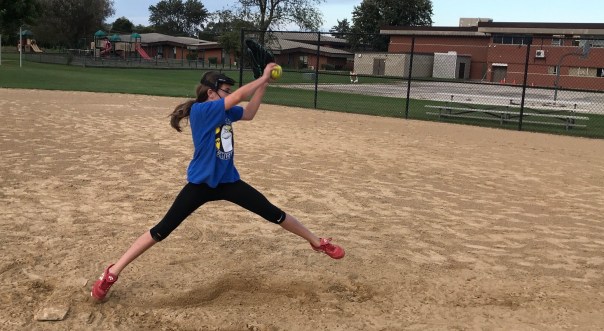 I know I’ve talked about this many times before but one of the problems fastpitch softball players face in our “instant-everything” world is an expectation that they can fix major issues, or go from good to great, with just a few repetitions.
I see it all the time. The coach or instructor explains what needs to change in order to improve, the player tries it a few times, and then is disappointed when whatever it is doesn’t work right away.
The reality is it’s just like healing from an injury – it requires patience. Anyone who has ever been hurt (which I imagine includes everyone on the planet) knows what it’s like.
First comes the injury and usually a lot of pain. But as the constant pain begins to subside the player starts testing the injured part to see if it’s ok now, even though the doctor said it would take four weeks to heal completely. Then, by constantly stressing it to see if it still hurts, the recovery period is extended out even further.
Making a change, especially a fundamental change in mechanics takes time – along with many steps and missteps.
A good way to think about it is how you go from home to first. Anyone who tries to get there in a single bound (unless they are from Krypton) is going to be disappointed. No matter how hard you try, or how long you work at it, you’re never going to go 60 feet in a single bound.
Instead, it takes many, many steps. There’s simply no way around it. You can do things to minimize the number of steps, or accelerate the time it takes to go from home to first. But it’s still going to take many steps.
And that takes patience. Replacing old habits with new ones usually requires following a process where you master the first step (or at least become pretty competent with it) before you move on to the next one. Otherwise it’s too easy to slide right back into the old habits.
Take learning to throw overhand properly, for example. Many girls will tend to drop their elbows to their ribcage when they throw, creating more of a pushing motion. That’s a huge issue that will limit both velocity and distance, and needs to be corrected.
Usually that means breaking down the throwing motion and focusing on getting the arm to slot properly. There are many different ways to do it, and programs that can help.
But what often happens is after a few repetitions the player immediately wants to go back to full throws. And what happens? The elbow starts dropping back down again, which means all the work that was put in before takes a couple of steps back. That desire to jump right to the finish now means it will take even longer to get to a real finish.
Patience may be a virtue, but it’s one that can be tough to come by. Especially in today’s world where everyone wants results now. And feels they have to get results now because there’s always another game coming up.
Still, patience is something that’s worth developing. If players (and their parents) can take their time to truly replace old habits with new ones rather than just trying to get to the finish line right away, or going straight back into full reps, they’ll find it actually takes less time overall – and the results will be more permanent.
So the next time you’re working with a player who wants to try to get from home to first in one bound – or even two, three, or four – help her put on the brakes and stick to the plan. The results will be worth the effort.
Another Approach to Improving Pitchers’ Ability to Hit Spots
A few months ago I put up a post that showed a way to help fastpitch softball pitchers who were struggling with hitting their inside and outside spots by exaggerating the locations. The idea is that by making the adjustments larger you can help them get a feel for what it takes to move the ball from side-to-side.
Here’s another way to do it, using kind of the polar opposite approach. This is more for fine-tuning, when the pitcher is already pretty good at going inside/outside but you want to make it more precise and reliable.
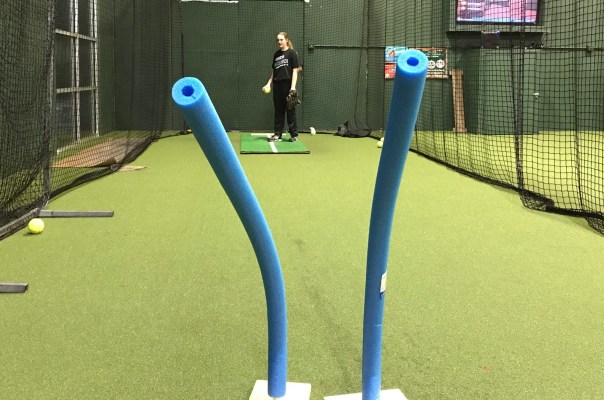
All it takes is some scrap wood and a couple of pool noodles. What you want to do is create two narrow barriers, then have the pitcher attempt to throw the ball between them. Here’s how it looks from the back side:
What you’re trying to do is create a visual that helps the pitcher home in on exactly where the ball needs to go. Sometimes, when they’re looking at a catcher against a background, it’s hard to focus on that small spot. This setup helps narrow the field so to speak.

Pretty fancy, huh?
The holders for the pool noodles were a couple of scraps of 1×6 pine board with a hole drilled partially through them. The holes should be just slightly larger than the diameter of the dowel rod.
Once you cut the dowel rod to size, glue it in place and then drive a screw in from the underside. That should hold it securely.
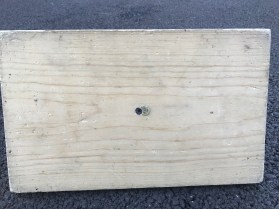
This side looks even better.
As you can see in the photo and the video, I didn’t use a very long dowel rod, which means the pool noodles aren’t very straight. I could have gone longer, but if the pitcher hits the noodle (as she is likely to do) and it is rigid the deflection could hurt whoever is catching if they’re not wearing equipment.
Besides, when they’re hanging over like this you can create some interesting holes to throw through, such as having the tops touch to work on keeping the ball low as well as on the corner.
You can do it from a 45 degree angle, like Juliana is doing here (due to a sore knee) or from a full pitch position. You may want to start with the former just to get the feel down before moving on to the latter, which will be more challenging.
Once the pitcher is becoming more consistent you can even make a game out of it, challenging her to make 7 out of 10 to win a prize or suffer a consequence – whichever fits your coaching style. That will add a little more game pressure too.
Or, if you have two or more pitchers there have them compete for who can do the most.
The overall idea is to aim small and miss small. So if you have a pitcher who needs to gain more precision in hitting her spots, give this drill a try.
Practice the Key to Reaching Your Destination Faster

For those who are also geography-challenged, Los Angeles is roughly in the circle on the left, and New York is roughly in the circle on the right.
Sometimes getting a player to understand the value of practice can be difficult. Those who aren’t the most dedicated to fastpitch softball can find a hundred excuses not to practice. So here’s a fun way of explaining how they will benefit.
Whenever I start lessons with a new student, toward the end I like to ask them if they know where New York City and Los Angeles are on a map. Most the time they do – or at least say they do. I hear today’s students are a bit geography-challenged.
Anyway, once we’ve established they know where each is, I will ask them how many different ways there are to get from New York to LA. The student will then start naming off various modes of travel – plane, train, car, bicycle, jog, walk, etc. Some will even suggest a boat, which is possible but certainly not easy.
I then ask them which is the fastest way to make the trip, at which point they will almost always answer “plane.” Which is correct, at least until Star Trek transporters become a reality.
I will then explain if they practice regularly, and with their minds on what they’re doing, that’s like going from New York to Los Angeles in a plane. But if they only pick up a ball, bat, glove, etc. when they’re at a lesson, it’s like walking from New York to LA. You can still get there, but it’s going to take a whole lot longer and be a lot more painful.
At some point or another, if they want to be successful players must put in the time. There’s no way around that. They can either do it in a concentrated way, such as practicing 3-4 times per week, or they can stretch the same amount of practice over many weeks.
The thing is, if they choose the latter they may find they haven’t quite gotten to where they want to be by the time the season starts. At which point it will be difficult to make up the rest of the ground that was lost.
There’s also the retention issue. The more time that passes between attempts at a new skill, the more likely players are to forget exactly what they’re supposed to do or how they’re supposed to do it. That means at least part of the time of their next attempt is going to be spent trying to regain ground they’d already covered.
As General Patton says (at least in the movie) “I don’t like to pay for the same real estate twice.” But that’s exactly what you’re doing if you have to keep relearning things you already should know.
Whether you’re in-season or in the off-season, it’s in the player’s best interest to work regularly on learning whatever it is she’s trying to learn. Otherwise she should probably make sure she has a good pair of walking shoes – and a nice cushion for sitting on the bench.
Map graphic Copyright (C) 2000,2001,2002 Free Software Foundation, Inc.51 Franklin St, Fifth Floor, Boston, MA 02110-1301 USA
Applying Occam’s Razor to Teaching Fastpitch Softball

At some point in your life outside of fastpitch softball you’ve probably heard the term “Occam’s Razor.” No, it’s not a brand of shaving utensil.
Instead, it’s a way of approaching problems. Essentially it says that all else being equal, if there is a simple approach to something and a complex one, the simple one is usually better.
If you want the full explanation, follow the link above. But a big part of it has to do with variables. The more variables you introduce (thereby making it more complicated), the more chances there are to get it wrong.
That has certainly been my experience coaching girls fastpitch softball for lo these many years. (Had to say that – how often do you get a chance to use “lo” in a sentence?)
I remember watching pitching instructors take pitchers through their 10-step or 15-step warm-up process, where every single piece is broken down into the most minute movements. I’ve seen the same with other aspects as well – hitting, throwing, catching a fly ball, you name it.
On the Internet it gets even worse. It’s almost like a contest to see who can make their explanation the most detailed and confusing.
Really what it is is a game of “one-upmanship.” Kind of like the old “he who dies with the most toys wins.” But in this case it’s “he who is the most unintelligible must be the smartest.”
I disagree with that philosophy. Instead I ascribe to the idea (often mis-attributed to Albert Einstein) that if you can’t explain something simply you don’t truly understand it.
When you’re coaching someone in a skill, your goal should be to help them learn to execute the skill in the context it will be used as quickly as possible. You can’t get that from a 15-step approach.
A player may get good at each of the 15 steps, but she will likely still struggle to put them all together and execute them under the pressure of a game. Too many variables to worry about, and too much thinking trying to get all of that right.
If you can break it down into a few easily digestible steps that naturally flow into one another, however, I find that players not only learn faster – they learn it deeper too, because it has context.
Hitting is a great example, because it’s probably one of the most over-analyzed skills in all of sports. It’s also interesting because a lot of the analysis will talk about why so-and-so hit a home run with their swing, but will never mention when that same swing resulted in a weak pop-up or ground ball. Which means there’s more to it than just the mechanics.
That said, as a coach or instructor, there is definitely a certain base knowledge you need in order to understand what is going on throughout the swing, and why some movements/angles/timing/etc. work better than others.
Once you get that, however, it’s time to start peeling away everything that isn’t essential to teaching someone how to hit. Especially since certain parts of the swing are going to naturally result from other parts anyway.
Teach the critical parts, such as leading with the hips, separating the hips from the shoulders during rotation, keeping the hands up and letting the bat head down, etc. Then turn your hitters lose to fill in the blanks on their own – without having to think about them.
It’s like the old KISS acronym – Keep It Simple, Stupid. Give them what them what they need to know in a way they can understand it instead of trying to show how smart you are or how much research you’ve done.
Oh, and while it’s tempting to say this approach is more important for younger players, the reality is it’s important for players at all levels. The real difference with older players if you keep it simple is they’ll pick it up faster and get to success sooner.
The more you follow Occam’s Razor, the more success your players will have, and the more games you’ll win. Isn’t that really what it’s all about?
Why the Short Leash May Not Be As Effective As You Think

First of all, for those of you who are wondering, yes. This is my dog Swayze. (I didn’t name him; he was a rescue and that was already his name.)
He’s a lucky boy, because I couldn’t very well put a leash on him for a photo without taking him for a walk. But that’s not the topic of today’s blog post.
The actual reason for the photo is to discuss a coaching style that can best be described as the “short leash.” Basically, what it entails is if a player makes a mistake on the field, such as a physical error or watching a third strike go by, she is immediately yanked out of the game and made to sit the bench – I suppose so she has time to think about what she’s done. Perhaps it’s the softball equivalent of a “time out” for a young child.
Normally, this type of “correction” is accompanied by a few loud words from the coach, such as “I told you you need to keep your head down. Grab some bench!” Although not always.
It often tends to be applied unevenly as well. In other words, if you’re the star shortstop and you make an error, it might not result in your being relieved of your position. But if you’re more of a utility player or a reserve trying to earn a starting spot, you’ll probably be one-and-done.
The goal of this type of coaching is to make players better and sharper. At least that’s the theory. But what I find, more often than not, is it makes them fearful of making mistakes, which not only makes them more prone to making mistakes but tends to stunt their overall development as well.
Imagine this type of coaching in another setting. Let’s start with school. You’re at the white board in math class (apparently schools don’t use blackboards anymore), doing your best to solve an equation, but you get the answer wrong.
Instead of just pointing out the mistake and giving you a chance to correct it, the teacher calls you out in front of the class in an exasperated voice, tells you to just go sit down, then ignores you for the rest of class. How motivated are you at that point to learn more math – or to be called up to the board again? Or even to pay attention to the rest of the class?
If you do go up to the board again, will you be more focused on the problem (even though focus wasn’t the issue the last time – it was that you didn’t know the concept)? Or will you be thinking “I hope I don’t make another mistake and have to go through that again?
Now think about work. Have you ever worked for a boss who would berate and belittle you if he/she didn’t like something you’d done? I sure have. In fact, I had one boss that would love something I did one day then hate the exact same work the next day.
Not only was I at risk of getting whiplash from those Mercurial moods, I started to doubt my own abilities. Then, instead of trying to do the best work I could, I started focusing on trying to figure out what wouldn’t get me berated. They are two different things.
It wasn’t until I did a little side work for someone else that I realized the problem wasn’t me – it was my boss and his up and down moods. I moved on from there and discovered I was actually pretty darned good at what I did.
Coaching by fear and intimidation is very old school. The problem is it’s a lot like torturing someone to get information. After a while, they will say whatever they need to say to get the pain to stop, whether it’s true or not.
The same goes for the short leash. If players are constantly worried that one error, or one looking strikeout, or one bad decision on the bases, or a few missed spots on one batter is going to get them yanked out of the game in the middle of an inning, their focus will no longer be on becoming the best player they can be. It will be on doing what they need to so they don’t get yanked.
Fielders will become uptight, and maybe not try for balls they’re not sure they can field cleanly. Hitters will swing at any potential third strike, even if it’s high or in the dirt, rather than learn the strike zone.
Base runners will be hesitant and not take advantage of opportunities that could have contributed to a win. Pitchers will start trying to guide the ball instead of learning to throw hard and maximize their speed.
And what do you end up with? A talented team that can’t win the big games because they’re too busy hiding in their shells.
I’m not saying never replace a player who isn’t performing. If pitchers don’t have it they need to come out. But not necessarily after throwing a handful of pitches. Even MLB and college softball pitchers get more time than that.
A fielder who makes three errors in an inning is probably cooked and needs to come out – not as punishment but just to get their heads and bodies out of a bad situation. And so forth.
But that should be situational, not an automatic “If you make a mistake you’re done.”
Of course there will be those who claim “being ‘tough’ like this will get them ready to play in college.” Nonsense.
First of all, if you’re coaching a younger team there’s no guarantee any of those kids will even want to play in college by the time they’re eligible. But if you make the experience miserable enough for them you can ensure they won’t, because they’ll quit the sport.
But even when you look at college teams, you rarely (if ever) see a D1 college coach (who is being paid big bucks and who is giving her players big bucks to come to the school in terms of a scholarship) yank a player off the field for making an error or walking one hitter. A coach like that wouldn’t last very long, especially at the big schools, because no one wants to be embarrassed on national TV.
So you’re not really preparing your players for the next level. You’re just using that as an excuse to justify your approach.
What you should be focused on instead is developing players so they learn how to work through adversity and overcome errors, etc. rather than fear making them. Support and a positive approach will go much farther than fear.
We all make mistakes. Often that’s how we learn. And making mistakes is critical to the kind of growth that ultimately wins games – especially those in tense situations – as well as championship.
So put the short leash away and give your players some room to breathe. You may just find happy, relaxed players make fewer mistakes – and give you more of themselves with every play.
Take Your Effort to 11

The other day I was reading an article’in the NFCA’s Fastpitch Delivery newspaper. It was written by Megan Brown, Ph.D., an assistant coach at Brown University, talking about what softball players can learn from UConn basketball.
Basically, it talked about an approach they use to improve pitching performance during practice, which improves performance during games. While the article was about pitching, it can be applied to other areas as well. I’ve been playing around with it a bit this week, and I think it’s pretty effective so I thought I’d share.
The crux of it is to ask the player to rate her effort on a scale of 1-10, with 1 being standing around talking about it (as you will be doing at that time) and 10 being putting every fiber of your being into the pitch, hit, throw, whatever.
The typical answer will be 5 or 6. If she says 6, you then ask the player what it will take to get that effort level up to a 7. How do you go that little bit harder?
Once she gets to 7, ask what it will take to get to 8, and so on. It really seems to help players loosen up a bit and worry a little less about “perfect” mechanics and a little more about going hard.
Of course, being a movie fan and a music fan, the whole idea of “turning it up” couldn’t help but remind me of this great scene from the classic movie “This Is Spinal Tap.” Sorry about the commercial in the front, but it’s worth waiting it out:
It’s very easy for players to slip into their comfort zone when they’re practicing or playing. Unfortunately, for many that comfort zone may be far less than they’re capable of achieving when pushed.
Maximum performance requires maximum effort. To help players get there, ask them to rate themselves on a scale of 1 to 10, and then see if you can get them to make turning it up to 11 a habit.
Product Review: Pocket Radar Smart Coach Radar Device and App
The Pocket Radar company has made a great name for itself in the fastpitch softball (and baseball) worlds over the last few years.
Its original model (previously called Pocket Radar as I recall but now called Classic) was the first reasonably priced radar that could fit in your pocket yet give you readings as accurate as a traditional radar gun costing 4X to 6X as much. Its form factor was also great for coaches and parents at tournaments who wanted to check out the competition surreptitiously because it looked more like a cell phone than a radar device.
Then came the next great upgrade – the Ball Coach RadarTM. The beauty of this product was it was much easier to use. Rather than having to time the pitch, any dummy (even me) could just point the device, push and hold the button, and get a super accurate reading. There were other advantages as well but that one sticks out.
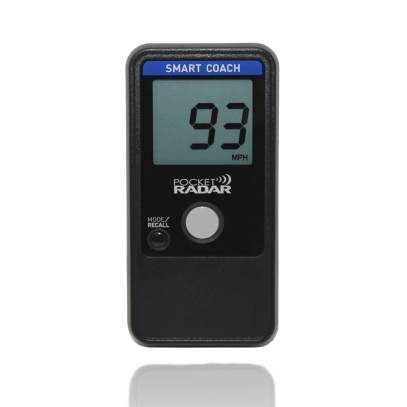
Now Pocket Radar has come out with an even newer and better version of its flagship product – the Smart Coach RadarTM. This one really ups the game (so to speak) because it’s no longer a stand-alone device to capture radar speeds, although it can also be used that way.
No, its real advantage is that there is a free companion app (currently only available for iPhones and iPads, although Android versions are coming so be patient) that greatly extends how you can use it for training. The Pocket Radar app allows you to do a number of things you couldn’t before, but most notably shoot video of the player and have the recorded speed embedded in the video. Like this:
That’s perfect not only for training but for sharing with college coaches. Because rather than taking a separate reading (which may or may not be of that actual pitch) and then holding it up to the camera, the speed reading comes from a trusted source. After all, plenty of college coaches use it themselves.
Easy set-up
The Smart Coach Radar is very easy to use from the start. After downloading the app, you’re asked to pair it to your Smart Coach via Bluetooth. Now, if you’ve ever tried to connect a Bluetooth device like a set of wireless speakers you know how cumbersome and difficult that can be, especially if you’re not technology-savvy. (I am, actually, but I know plenty who aren’t.)
The Smart Coach Radar takes care of all of that for you. You don’t even have to go into your iPhone or iPad’s settings. The Smart Coach Radar takes care of everything under the hood. You just hold down two buttons when the app tells you to, answer a few questions about how you plan to use it (such as for which sport) and you’re ready to roll. Nice!
Oh, and after that first time it automatically pairs so you never have to do that again. And it keeps the connection for 30 minutes even if there is no activity and the radar turns itself off to save batteries. As soon as you hit Start on the app it will come back on.
Once you’re in, you have the ability to set up some parameters. For example, you can narrow down the range of speeds you want to measure. The default is 25 to 130, except for softball which is 30-130. But if you know the player you want to measure throws between 40 and 60 mph, you can narrow that range so you’re not capturing passing vehicles or whatever else might wander in the path of the radar. I set mine to 35 to 65 for now.
There is also an option for auto-stop versus continuous capture. It comes with auto-stop enabled right now, but based on user feedback Pocket Radar will be changing that to continuous. If you’re planning to capture multiple pitches, hits, throws, etc. you’re better off on continuous so you don’t have to manually trigger each reading from the app. The Smart Coach Radar will detect it and capture it automatically.
You don’t have to worry about long videos clogging up your phone’s memory either. In the Auto-Edit mode the Smart Coach Radar will automatically edit each video you capture into 8 second bites – 6 before the reading is captured and 2 after as I recall – so you have all the good stuff without the time in-between.
Another setting allows you to decide whether to have your device audibly announce the speed that was captured, which is great if you’re an athlete using it by yourself. I turned it off, because I find if players don’t like the reading they got on one pitch they tend to try to muscle up and make it even worse on the next.
There’s also a Dual Mode which is again great for those working by themselves. Normally when you capture video that’s what you see on your phone’s screen. If someone else is shooting it that’s fine. But if you want to capture the video for later study but want to see the speed now that would be difficult. In dual mode, the full screen shows the speed reading (making it much more visible) while still enabling the video to be captured.
The final major setting allows you to preview speeds while you’re in video mode without actually capturing the video. According to Pocket Radar, this feature was added at the request of scouts who wanted to have the app ready to capture a video when they saw something they liked, but otherwise just wanted to take speed readings. That way they wouldn’t fill their phone’s memory with video they didn’t want.
Finally, in the Advanced Settings window you can select whether to measure miles or kilometers per hour, and whether your phone should use cellular data.
Video capture
This is the cool thing. You have two options in the main capture screen. The default is just the pitch/hit/throw/whatever speed as you would typically expect with a radar device. I’m just going to say pitch speed going forward, but what I say will apply to all.
If you’re in that mode, after you hit the start button and the speed is captured it will show in the Smart Coach Radar’s LCD window as well as in large red numbers on the iPhone/iPad screen for a few seconds. That’s great if you’re just trying to see speeds. For players working by themselves it’s particularly handy. Just set up an iPad off to the side and you’ll get instant feedback.
When you use the icon to select video mode, you can capture actual video of the event as well as the speed. What you’ll do here is mount the Smart Coach Radar to a tripod or fence using an optional holder, directly behind the pitcher or catcher at the height of the ball when it’s released and at least 15-20 feet away from the pitcher if that’s possible to get the best readings. Like its predecessors it will capture speeds from up to 120 feet away. Then you can stand anywhere you want to capture whatever video you need.
The video is captured using your iPhone/iPad’s camera, and is stored in your regular video folder. That makes it easy to sort through, review and delete without having to open the Pocket Radar app.
As I mentioned earlier, the speed that’s captured will automatically be embedded in the video. You can then run through it, either at normal speed or stepping through it by scrubbing, to look at the technique (good or bad) that created that speed, just as you would in an analysis app such as Coach’s Eye or RightViewPro.
What it doesn’t allow you to do, at least at the moment is draw on the video to illustrate certain points of emphasis like you can in those other apps. That’s the beauty of having an app, though. I’ve talked to the manufacturer and it’s likely a couple of basic drawing tools will be added in the future.
Even if they’re not, though, it’s no big deal. You can share the Smart Coach Radar video to one of those other apps literally in seconds, and then draw to your heart’s content as though the video was captured in that app. Although it has the added bonus of the speed reading being embedded too.
Viewing the history
As each video or speed reading is captured it is added to the history, which you can access by tapping the clock-like icon on the left side of the screen or the icon with the horizontal lines in the upper right hand corner. The data that’s captured is organized by day, and indicates whether there is video or just a speed reading. You can expand or collapse the days, making it easier to scroll through many readings to find the ones you want.
When used with an individual player that level of organization is no big deal. All readings relate to her. When you’re using it across multiple players like I do, however, that’s not ideal. Fortunately, there is a workaround for that. You have the ability to add or edit as many tags as you like.
To do so, you can tap the tag at the top center of the screen that reads whatever you set it too originally. Presumably that’s Softball since this is a softball blog.
That action will take you to a screen with a button that says Edit List. Tap the button and you can add whatever tag you like. Submit it and save, and that tag is now there, and will show up to the right of the main Softball tag. Tap the new tag and you can continue to add more so you can see which readings apply to which players.
The only issue right now is you have to remember to do all of that before you take the reading – you can’t go back and add a tag retroactively to the history. Pocket Radar also says they’re adding a more advanced tagging feature to the app to make this entire process even easier, and retroactive tagging in the history is expected to be a part of it. If you do need to keep tabs on who did what when, however, you can always export your history into an Excel spreadsheet, then add names or otherwise manipulate it however you want.
As with previous versions, there is also a mode/recall button on the Smart Coach Radar itself that allows you to quickly scroll through past readings if you’re not using the app.
More power
Here’s another clever addition Pocket Radar has made to the Smart Coach Radar. There’s nothing worse than being set up on a field or in a cage only to find that your radar device’s batteries have run out.
The Smart Coach Radar has a port that lets you plug in one of those outboard batteries people often use when their cell phone batteries run low. It uses the same micro USB connection that comes standard on the charger cables. If your battery is running low (as 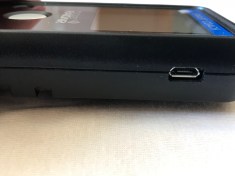 shown by the battery indicator in the lower left corner of the Smart Coach Radar’s screen) just plug in the outboard unit and you’re good to go for another few hours.
By the way, that same USB port can be used to connect the Smart Coach Radar with their new Smart Display, a large-number readout that is visible from more than 100 feet away even in bright sunlight. If you’re a training facility, or a college, or someone who runs camps, that’s a nice added bonus.
Trade-in deal
The Smart Coach Radar isn’t cheap. As of this writing it’s $399, which is still anywhere from 2/3 to less than half of the cost of more traditional high-quality radar guns. As in the past, though, if you already own a previous Pocket Radar Classic or Ball Coach and want to trade it in for a Smart Coach Radar, Pocket Radar will take $100 off the price. That’s a great deal no matter who you are, and one you won’t find too many manufacturers in any field equallng.
But then, the company has always been great about customer service. Where else do you find a CEO who will answer customer inquiries and walk you through any technical issues himself?
Bottom line
After having tried it, I can definitely recommend the Smart Coach Radar, especially for any coaches, parents, or players who want video tied to their speed readings. It’s a great, durable product with a lot of great features, backed by a company that has proven the quality and accuracy of its technology time after time.
My Advice to Softball Parents: Lighten Up, Francis

Anyone who has seen the movie “Stripes” knows the reference in the headline. If you’re not familiar with it, it’s a great scene where the new recruits are just getting to know each other, and one of the guys starts a serious rant about what he’ll do to the others if they call him Francis instead of Psycho, or do some other stuff. His drill sergeant, Sgt. Hulka, is not impressed. You can see a condensed version of this very funny scene here:
So why am I bringing up this random movie reference? Because it seems like there are more and more parents these days who could use Sgt. Hulka’s advice.
While it doesn’t always hold true, it does seem like the craziness of parents today is in inverse proportion to the age of the players. In other words, if you really want to see crazy, check out a 10U game.
Not sure why that is. Maybe by the time players get to 18U the parents have figured out that the outcome of a softball game isn’t worth risking a potential heart attack and have mellowed out. Or maybe all the players with crazy parents have been weeded out, or have told their parents, “Hey, I’ll drive myself to the game, why don’t you see if you can find a hobby that makes you less likely to find you sitting in the parking lot dashing off angry emails to whoever will listen?”
Of course, that’s not to say you don’t see that behavior at the older ages. I have been at D1 college games at major schools where parents are yelling things from the stands at the umpires, and the coaches, as though there were still back playing rec ball. But that’s more the exception.
Here’s the thing, though. All that crazy yelling and stomping around and getting into fistfights is really a waste of energy.
I know all this stuff seems critically important at the time. Especially today, when so many parents believe their daughter is D1 athletic scholarship material and don’t want any idiot umpire/coach/league administrator/whoever screwing up her chances.
Really, though, it’s not. I’ve been involved in fastpitch softball for more than 20 years. I had two daughters play at some level from the time they were 10 until they left high school. I’m sure I got worked up pretty well from time to time myself, although I did manage to keep my crazy in check as I recall.
But whether things went well or not during a game, none of it really mattered in the big scheme of things. My daughters played, then they didn’t, then they want on to become fine human beings and productive members of society. Even if some blue was occasionally squeezing the zone on them.
If you really want to see how crazy it is to let the crazy out, try this experiment. At your next tournament, go watch two teams you couldn’t care less about play. Sit or stand somewhere you can hear the parents and watch the same game they’re watching. Then count how many times people get angry about something that just makes you shrug your shoulders.
The reality is, a softball player’s career is short, which means your time to enjoy watching your player(s) as a parent is short. It’s not life-or-death. It’s just a game.
Next time you feel your blood beginning to boil and the urge to express yourself loudly, just remember the immortal wisdom of Sgt. Hulka: Lighten up, Francis.
The Importance of Consistency When Learning Fastpitch Skills

The once-funny and now just more generally creepy comedian and filmmaker Woody Allen has been quoted as saying “80% of success is just showing up” or something to that effect.
While most times ol’ Woody isn’t the person you want to take advice from in anything having to do with kids, in this statement he is most definitely correct. Especially when it comes to the early stages of learning fastpitch softball skills.
Let’s take hitting for example. Hitting even a decently fast pitch in fastpitch softball requires a series of movements that must be performed correctly individually, sequenced correctly, and timed correctly. Some of those movements and sequences aren’t necessarily intuitive.
Since the object of the skill is to hit the ball with the bat, it’s easy for young hitters to assume that they should focus on taking the bat to the ball first. If their body turns afterward, so much the better.
But that’s actually the opposite of what they should be doing. The proper sequence is hips-shoulders-bat. A good instructor will teach that sequence, which not only maximizes power but the time the hitter has to see the ball before committing to the swing and the ability to hit the ball in the proper zone.
If that young hitter who’s still learning only comes to lessons once every few weeks, however, there’s a very good chance she will forget all about the proper sequence and spend her time practicing a bat-first swing. Then her distraught parents will wonder why they’re paying all this money for lessons and not getting better.
It becomes even more important with windmill pitching because in my opinion there is so much that can go wrong – and failure is more obvious. If you have a bad swing but still manage to make contact with the bat you can get on base.
But if you’re not throwing strikes, or you’re throwing easy-to-hit strikes, you’re going to have a tough day. As I tell my students, the circle looks bright and shiny from the outside, but it can be a cold, dark place on the inside.
Again, with windmill pitching some of the movements aren’t necessarily intuitive. If they were, you’d see more rec league pitchers using good form.
But instead, most untrained pitchers tend to stay facing forward, take a short step off the pitching rubber, and proceed to push/guide the ball toward the plate. THAT is what feels natural and intuitive. But it’s not what great pitchers do.
If a newbie pitcher only goes to lessons now and then and then gets put into a game before she’s ready, she will likely find herself like Luke Skywalker in the cave on Dagobah.
To really get the maximum value out of lessons in the early stages, it’s important to receive consistent training. That’s because you’re setting the foundation for all that is to come.
My recommendation is once per week – no more, no less – although you can do it going every other week if necessary. It will just likely take a bit longer to get where you want to go.
That regularity – and the short time between reviews by the instructor – helps keep players from veering too far off the path to success. It’s easier to do a reset when the training is consistent.
Going sporadically, however, gives the illusion of training without the benefits. Too much can go wrong in the meantime, and we all know it’s a lot easier to develop bad habits than to break them.
Instruction always works better when you apply it properly. In the early stages especially, that requires consistency. Make the commitment, even when it’s challenging, and you’ll see the rewards a whole lot faster.
Don’t Take Everything You Hear or See At Face Value

Every week I receive an email that links to pieces of instructional videos for fastpitch softball. And almost every week I end up shaking my head at what I see in them – especially because the company that sends the videos out is charging people good money for such poor instruction.
This week held yet another perfect example. A college coach (from a big name D1 school as I recall) was talking about flaws in loading when hitting. He had a young player, maybe 12U or 14U, there with him helping him demonstrate.
And what was his big advice? Don’t let the head and the front foot move in the same direction at the same time during the “load.’
First of all, he seems to be confused between the load and stride. He kept saying load but most of the discussion was about the stride. So he might want to check that out first.
But regardless of the terminology, he was basically saying that the front foot should move first, then the head should follow afterward. All I could think was “that poor girl.”
Let’s see if this coach’s advice passes the evidence test. Here’s a video of some MLB hitters taken from the side. Watch them as they stride and see if their head moves with the foot or not.
If the camera is steady you can place your cursor on the hitter’s head and see if the head stays there. If not, compare the head position to the background throughout the stride.
What do you see? I know what I see. The head and the center of gravity are moving forward as these hitters stride.
Of course, maybe these are just extraordinary athletes. And they’re men. So let’s look at former Michigan star Sierra Romero, who did pretty well for herself this year with the NPF’s USSSA Pride. Advance the video to about 2:14 to see the stride, and again what do you see her head doing as her front foot moves forward?
The point here isn’t to take on the specific video I watched, although hopefully by now you’re ready to disregard that particular piece of advice. It’s more to say that parents and players should be careful about what they accept as good instruction.
You would think a college coach, presumably a hitting coach, would understand the swing and how it works. But clearly that isn’t necessarily true.
It’s the same thing with taking advice from a former player because she was/is a star in college, or high school. Often times players and former players just repeat what they were told when they were growing up, even if it’s not what they actually did/do, because they haven’t put the time in to study the mechanics.
The best thing you can do is educate yourself. Before you blindly accept advice or training from anyone – and that includes me, by the way – take what they’re saying and see if that’s what the top current players do. If not, you should find someone who will teach you those mechanics and approaches.
Hitting is easier to compare, because you not only have top college, NPF, and National Team players to compare what’s said to what’s done, but you also have MLB hitters. Hitting is hitting after all, and anyone who tells you softball has a different swing needs to throw out their VHS tapes and at least buy a DVD or two from this millennium.
Or there’s this new thing out called YouTube that all the kids are talking about. Maybe those instructors want to check it out.
The hitting exception is slapping. They don’t do that in MLB, so you’ll need to look at softball only.
The same goes for pitching, because videos of MLB players will be of little use. But there’s plenty of good video of top pitchers in game action, which is where you want to check them out. See what makes them successful in games and compare that to what you’re being told. Here’s a good starting point for you.
Catching, fielding, throwing, base running, all of those are similar skills between fastpitch softball and baseball, so you have plenty of source material there. Sure, there are nuances, mostly driven by the difference in the length of the basepaths and size of the field overall, but anyone with even a little experience watching both should be able to adjust for that.
It’s easy to buy into a reputation, or a great set of credentials. But neither of those will help you on the field.
Be a smart consumer. Make sure what you’re being taught, no matter who is teaching it, matches up with what great players do. Otherwise, save your money on lessons or DVDs until you’ve confirmed your investment will take you where you need to go.






