To Hit Rockets, Be Like A Rocket

Photo by Pixabay on Pexels.com
Players, coaches, parents and fans all love them – those hits that take off like rockets. There’s nothing like seeing a well-struck, majestic line drive rising into the distance, especially if it clears a fence.
Learning to hit those awesome rockets, however, can be counter-intuitive. As I have pointed out before, because you want to hit the ball with the bat there is a natural tendency to focus on yanking the bat into the hitting zone with the shoulders and arms.
Players seem to believe (understandably) that the faster they pull the bat through with their arms, the farther the ball will go. This belief is often reinforced, incidentally, by the improper use of ball exit speed measurements that focus only on the numbers rather than looking at the technique as well. You can get better numbers off the tee, but that won’t necessarily translate into rockets off of live pitching for a variety of reasons.
During a lesson this week I was trying to explain how each of the body sections contributes to the swing when a thought occurred to me. To hit a rocket, a player should be like a rocket.
Think about it. Where does the power in a rocket come from? The bottom section. That has to fire first, with a lot of effort, to get the rocket going.
If you put all that power into the middle section, the rocket wouldn’t go anywhere because it needs to thrust against the ground to break free. Instead, it would just blow up on the launch pad.
Once you have things going, the secondary stage kicks in. It builds on the momentum created by the first stage to really start driving the rocket toward its destination.
Finally, there’s the payload section. That’s the part that carries the astronauts, or the satellite, or the exploratory vehicle, or the communications array that will alert our eventual alien overlords that we are here, we are too primitive to get to them, and thus we are ripe for exploitation and eventual elimination.
In hitting, the lower body is the first stage of the rocket. It initiates the swing and supplies the bulk of the power that will be applied.
The shoulders and upper torso are the middle stage, adding on to the power of the first stage and providing guidance on where the rocket should go.
The bat is the payload stage – the point of the whole process. It takes advantage of everything that has gone before to deliver the final result, which is the hit.
Stick to that sequence and you will hit well. Do them out of order and the result will likely be a huge, fiery crash and burn.
So as you’re working with hitters, trying to explain how to properly sequence the swing, give this analogy a try. Maybe even show them this video:
Then send them out on the field for their own rocket launch.
Tryouts aren’t just about skills

Time to bring back an “oldie but goodie” post because the advice is still relevant, and the topic is definitely timely with so many players (and coaches) in the midst of the tryout season.
Showing well at a tryout isn’t just about having great skills. It’s also about looking like you’d be a great fit on a team. Or as Herb Brooks says in Miracle:
Keep all of this in mind as you go through the tryout process. It may be a grind. But bringing your very best every time may just be the difference-maker.
It’s that time of year again. We’re in the midst of tryout season – that time when players try to show coaches what a great addition they would be to the team(s) of their choice.
While there’s no doubt it’s important to show your skills, there’s more to a tryout than skills alone. That’s coming from a coach who participated in tryouts for more than 15 years.
The reality is there are many very skilled players out there. In fact, if your skills are far above everyone else at that tryout, you’re probably trying out for the wrong team. So how do coaches make their decision?
Much of it comes down to character. One of the tests I used to give players I was interested in was to offer a bit of advice on how to do something.
Maybe they were having a bit of trouble hitting or fielding. I’d offer a suggestion on how to improve. But it wasn’t about whether they’d do better the next time. It was about seeing how they reacted. Were they coachable? Did they give it a try, or did they give me attitude instead?
I’d look at who was hustling. Not just during the drills but between the drills when they’d transition from one area to another. Also who seemed like they were enjoying playing as opposed to some who looked like they were forced to be there.
I’d also listen to them, especially those who sounded like they could be potential team leaders. Did they encourage others? Did they cheer for those who made good plays, such as diving for a ball? (Pssst – if you get the chance, definitely dive for a ball; it always makes a good impression.)
I loved watching what would happen after a player made a mistake. If she booted a ground ball, or missed a few pitches during a hitting session, did she put it behind her or have a meltdown?
Mistakes are a huge part of fastpitch softball, so you’d better have the mental toughness to deal with it. The last thing a coach wants in a tight game is a player who is so upset over an error or a strikeout in the previous inning that she isn’t focused on this one. That’s a sure recipe for disaster.
If we gathered the group together and one of the other coaches was talking, I’d take a look to see who was listening and who was looking off into the distance, or otherwise spacing out. It’s not that hard to pick out.
Here’s the thing. Tryouts are like a job interview. Theoretically everyone is on their best behavior, showing their best selves. If the self I’m seeing at a tryout doesn’t seem like what I’m looking for, it’s unlikely it’s going to get better once you’re on the team. In fact it’s probably going to get worse.
It’s pretty rare that a player’s skill level is so awesome that it can make up for a lot of poor character. Again, if you do stand out that much you’re probably not at the right tryouts.
These days teams are together for a long time – essentially 12 months. As a result, chemistry means more than ever.
If you want to increase your chances of making your first choice team, make sure you have your act together and can show the coaches you’re more than your ability to throw, catch, pitch, hit, run, etc. You’re the kind of quality person they want to be around – and who can perform no matter what the circumstances are.
Photo credit: Elizabeth Prata via Foter.com / CC BY-NC
A Tale of Persistence

First of all, congratulations to the Crush Tidal Waves (CTW) 18U JS team for taking it all in the recent USA Softball (formerly ASA for you old die-hards) Chicago Metro. The Metro is always a tough tournament with strong teams, so winning it is definitely an accomplishment.
But it’s the way they won it this year that makes this story worth sharing, in my opinion. And since Life in the Fastpitch Lane is my blog, I get all the votes. No pretense here.
Basically, the CTW did it the hard way. First, it was a very hot and humid weekend in the Chicago area. Temperatures were in the mid-90s for most of it, and with the sun beating down it felt even hotter. I know, because I was outside for much of it.
CTW started out with two wins in pool play on Friday before beginning bracket play Saturday. They won their first game, then fell 5-2 in their second game of the day. That put them in the loser’s bracket in the double-elimination tournament, with a long way to go to get back to the championship game.
Still, they persisted. The challenge now was to win 7 games in a row – two more on Saturday in the brutal heat, then three on Sunday to get into the championship game. After that, they’d have to face a team that hadn’t lost in bracket play and was well-rested as they waited for all the other teams to beat each other up. And, of course, they had to win twice.
The first of those two games was a real nail-biter, with CTW leaving it all on the field to gain a 3-2 victory. You would think they’d have felt pretty good by then, having taken the top team to the what-if game after all that. No one would have blamed them if they had come out a little flat for the final match-up.
But again, they persisted, and instead they came out strong and took the final game (and the trophy) 5-1. Not sure where they found the reserves of strength after all of that, but they did.
Battered but not broken, exhausted but elated, and probably ready to jump head first into the nearest swimming pool, the CTW 18U JS team came out victorious.
So it does go to show that if you’re determined enough, and persistent enough, and just not willing to lose you can come back to win a big tournament like that.
Congratulations to the players, coaches, parents and fans. But mostly to the players and coaches for never giving up.
(A special shout-out goes to Katie Armstrong, a long-time player for CTW and one of my  pitching and hitting students. Savvy readers may recognize Katie from my vlog on hitting off a pitching machine, among other mentions. Katie did all this with a hip injury that will require surgery after the season, which has limited her pitching time this year. But I think you’ll agree she thought it was worth it.)
I imagine for a lot of the players this season is the end of their travel ball careers, and for those who aren’t playing in college it’s the end of their entire softball careers. But what a memory they gained!
It’s also the kind of story they can tell future employers who say “Tell me about a time when you faced incredible difficulties but managed to succeed.”
Product Review: The Softball Rope Trainer

It doesn’t take too much time going through Life in the Fastpitch Lane to see that I am pretty fanatical about good throwing mechanics. I definitely feel overhand throwing is one of the most under-taught skills in the game, which is a shame because it’s such a big part of the game (unless you have a pitcher who strikes out 18 hitters a game, every game).
So that’s why I was excited to receive a new (to me) product to test – The Softball ROPE Trainer by Perfect Pitch and Throw. According to the manufacturer it is designed to help softball (and baseball) players learn the proper mechanics for a powerful, strong and safe throw by unlocking the joints in the proper sequence. From their website:
“Using The ROPE Trainer allows players to work the throwing muscles in all parts of the kinetic chain. Using The ROPE Trainer optimizes the mechanics of the throwing sequence by building the muscles and joints used during the throwing process. Over time, using The ROPE Trainer will allow for better muscle memory, improved strength and endurance without the excessive stress caused by releasing the ball.”
You can read more about the theory behind it and how it helps prevent injuries here.
The basic design is fairly straightforward. It’s basically a softball with a plug system that lets you attach one or two sets of ropes. By focusing on getting the ropes to work  properly (and not smack the player on the head, legs or other body parts), The Rope Trainer helps players find the right path to slot their arms and follow-through properly.
You can add more resistance by using both sets of ropes to create more of a strength workout, although the grip will then not be the four-seam grip most players are used to. No worries, though. You’re not actually going to throw the ball anyway.
The manufacturer positions it as an upgrade over the old “towel drill,” where a player holds a small towel and goes through the throwing motion with the same goal in mind. In fact, here’s an article that tests The ROPE Trainer versus the towel drill. They tested the baseball version rather than the softball version, but I’m sure it’s the same.
One of the big differences in my eyes is that the ropes can swing around more than a towel, so the player has to be more precise in her arm and hand path to get the right results.
Ok, sounds good in theory. How did it work in practice?
The first girl I had try it was a terrific 14U catcher named Liv. She wanted to learn how to throw from her knees, so it seemed like the perfect opportunity to check it out.
One of the big issues with catchers, especially young ones, learning to throw from their knees is that they tend to only use their arms. They don’t get into a good position to use their shoulders, torsos, glutes, and other big muscles, and they have a big tendency not to follow through after throwing.
So I put on one of the sets of ropes, handed Liv the ball, and had her get into a runners on base stance. When I said “go” she reacted, getting into position and using The Rope Trainer as if she was actually making the throw.
As I said, Liv is awesome so after a couple of attempts she got the hang of getting the ropes to whip through to her left side at the end. Here’s a video of her as she’s using it:
Then we switched her to an actual ball. She immediately was able to make the throw with good juice on the ball, and with great accuracy too. Most important, she was using a strong throwing motion that will protect her arm and shoulder.
To give you an idea of how strong her throw was, this is what happened to her mom’s wedding ring after receiving a few at second then at first. Oops. 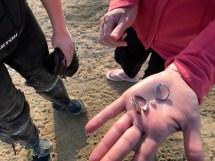
Of course, it’s easy to get something to work when you have an excellent player using it. So for another test I went the other way.
I took a younger girl (who shall remain nameless) who did not have a particularly good throwing motion and had her try The Softball ROPE Trainer as well. While the results weren’t quite as instantaneous, she also showed improvement.
This particular girl was doing the classic “throw like a girl” of dropping her elbow below her shoulder and just sort of shoving the ball forward with her arm.
(NOTE: Don’t even bother telling me how horrible I am to use the phrase “throw like a girl” and wonder how such a nasty misogynist could ever work with female athletes. I encourage my students to throw like softball players, and will put them up against any male player their age – or any dad who doesn’t think girls can throw hard. So chill.)
After working with The Softball ROPE Trainer for about five minutes she was doing better with her overhand throws. I doubt that little session was permanent, but I wanted to see if it would make a difference.
I believe it did, and that with repetition at home and/or practice someone with poor throwing mechanics could re-learn how to throw properly, most likely within 2-4 weeks with regular work.
The other nice thing about The Softball ROPE Trainer is that it doesn’t cost very much. You can purchase it direct from the manufacturer for just $67.49. I know, weird price, right?
For that money you get the ball, two rope sets (I think – the website says one but mine came with two), instructions and a nice drawstring bag to hold it all. If you wear out the ball or one of the rope sets you can purchase new ones as well, which is always nice.
If you have or know players with poor throwing mechanics, or have someone with good mechanics who want to get better, give The Softball ROPE Trainer a try.
Oh, and in case you’re wondering, I don’t know how it is for fastpitch pitching yet. That’s next on my list to try. Seems like if you have mechanics that focus on whipping the ball through the release zone instead of pushing it The Softball ROPE Trainer might work. We’ll see.
If it works, I’ll do another post on that. If not, I’ll update this one.
Helping Fastpitch Pitchers Feel Their Legs Working Together

One of the most common flaws with fastpitch pitchers is a tendency to reach out aggressively with their front leg instead of getting both legs involved. Essentially, the front leg is active and ends up pulling the rest of the body along.
The problem, however, isn’t just in the legs. It’s really that the center of the body – the center of gravity if you will – never gets driven off the pitcher’s plate, so when the pitcher lands her front leg (left leg on a right-handed pitcher) there isn’t a whole lot of momentum to stop.
In fact, you’ll see many of these pitchers wasting a lot of energy trying to drag that back leg forward instead of having it glide effortlessly. That lack of power from the right side often results in bad (forward posture), a tendency to want to over-use the throwing shoulder (the power has to come from somewhere) and a host of other problems.
You can tell players to keep their legs under them, and have them work together. But I find that’s more difficult for some than others. So I came up with a little drill for the former group, to help them learn to use their legs together instead of one at a time.
All you need is one of those workout rubber bands like the one in this photo that you can find at pretty much any sporting goods store. Or at your house in the pile of exercise equipment you bought with all good intentions of using but is now just gathering dust in a corner of the rec room or bedroom.
Of course, it will be way too big to be of much use, so double it up and then have the pitcher slide it up until it is about midway up her thighs. Then have her pitch.
What she’ll find, as Paige here did the first time she tried it, is if don’t use your “push” leg it gets yanked forward by the effort of your front leg anyway. (She’s better at it now.)
The goal is for the pitcher to be able to drive out with full force and energy while feeling like she’s gliding on her back leg, with her knee pretty close to being underneath her hip. When she lands, she should have a lot more energy going into her firm front side. Maybe so much she can’t quite contain it all at first.
But she should feel how much less effort it takes to get into a good, strong, upright position. And how easy it is for the pitching arm to whip through the zone because the whole body is working more as a unit instead of a collection of independent pieces.
Of course, the real test comes when she takes off the rubber band and tries it without the tactile aid. It may require a bit of rinse and repeat at first. But I’ve found it’s pretty effective helping those who tend to run away from the back leg to keep the legs working together.
So if you have a pitcher with this issue, give it a try and see if it helps. Either way, be sure to leave a comment down below!
Remember, They’re Still Kids
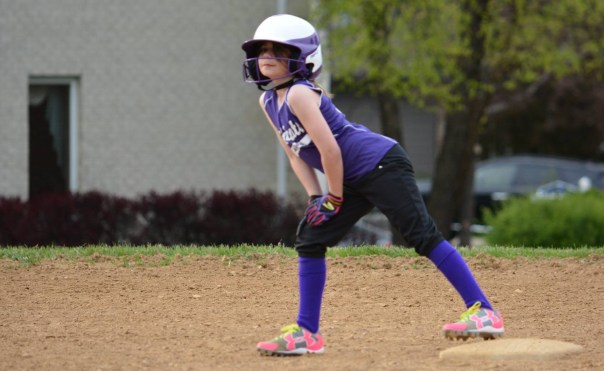
I am sometimes shocked at the expectations coaches (and parents) seem to have these days for their youth fastpitch softball players. I’m talking pretty much everyone below college players.
You’ll hear coaches rail to 14 year old pitchers about the importance of pitchers hitting spots – by which they mean not ever missing them, not even by a couple of inches, or only missing two or three in a game. You’ll hear coaches telling 12 year olds about the importance of bat control and being able to hit behind the runner. You’ll see coaches yank a 16 year old out of a game in the middle of an inning for misplaying a hard-hit ground ball. And so forth.
Yes, it’s definitely easier to coach if all you have to do is turn in your lineup card and sit back while all your players execute everything perfectly. You can look like a real genius that way.
But the reality is, those players out on the field are still kids. Which means they’re subject to the kind of mistakes kids make.
It’s unrealistic to expect a team of young players to execute the game at the speed and skill level of the players you see on TV. Especially during the Women’s College World Series, when presumably the best of the best are playing.
(Of course, even those players make mistakes – sometimes on what seems like very routine plays. Oddly enough, their coaches don’t scream at them or yank them out in the middle of an inning. But I digress.)
I really think the key is we get so caught up in trying to win games that we forget those players we see are on the field are just kids. So to put it into perspective, I thought it might help to make a list of OTHER things a college-age person might do, or be allowed to do and then ask: would you let your young child do this? For example:
- Drink alcohol (given that the legal drinking age is 21)
- Rent a car (the minimum rental age is 25)
- Drive an Uber/Lyft/Taxi, even with a valid driver’s license
- Buy a new car without a co-signer
- Vote
- Rent an apartment or office space
- Buy a house
- Sell real estate
- Purchase airline tickets
- Purchase lottery tickets
- Gamble in a casino
- Fly an airplane
- Get a safe deposit box
Many of the things on this list are simple, mundane things adults do every day and take for granted. But there is no way you’d want your 12 or 14 year old doing any of them, and probably wouldn’t even want an 18 year old doing most of them.
Why not? Because they’re kids, and as such they don’t think like adults or act like adults so they’re not ready for adult responsibilities. They still have growing and learning to do before they can be held to the standards required to do those things on a regular basis.
So what would make you think they’re ready to play fastpitch softball at the same level as the upper half of 1% of college players you see on TV?
Kids make mistakes. That’s often how they learn. Some kids develop slower than others and may not quite have the hand/eye coordination of their peers, much less players who are 6, 10 or more years older.
Kids mature at different rates too, and while any kid should have some measure of self-control, it’s harder for some than others not to have a mental meltdown when they feel they’ve let themselves, their parents, their coaches, and their teammates down. They just may not have the experience with failure yet to be able to “just shake it off” and bounce right back.
So as you watch (or coach) youth games this weekend, keep in mind all the things you wouldn’t want the players on the field doing outside of softball. Then remember why – because they’re kids.
Maybe it’ll help you lower your blood pressure a bit and enjoy the games a little more.
Congratulations to Grace Bradley – All State

Just wanted to take a moment (or two) for a shout-out to one of my students, Grace Bradley, who just graduated from Grayslake Central High School, on the accolades she’s received in the last couple of weeks to cap out her high school career. In addition to being named Northern Lake County All-Conference and to the Daily Herald Lake County All-Area Softball team, we found out this week that Grace was also named to Illinois Coaches Association Class 3A All-State Softball Team for the second year in a row.
It couldn’t happen to a nicer or more deserving player. I have known and worked with Grace on her hitting since she was in 7th or 8th grade. At the time she was the scrawny little teammate of another one of my students, who was about the same size, and when she saw how that girl was doing she said “I gotta get me some of that.” At least I presume that’s what she said.
Grace has worked very hard since then, putting in hour after hour in the off-season with me during lessons and with her dad Greg in-between lessons to learn how to drive the ball with authority. It paid off this year, as she batted .404 hitting cleanup, with an OBP of .475, OPS of 1.158, and slugging percentage of .683. She had 42 hits, with 6 doubles (including a high-pressure walk-off to secure a double header sweep), 1 triple and 7 home runs (8 if you count the one she hit in an “unofficial” game) while helping to lead her team to a Regional title.
She is also high on the all-time list in several offensive categories at GCHS, including being tied for 5th in total hits, 5th in runs scored, 2nd in career batting average, slugging percentage, and RBIs, and 3rd in home runs. This was in a school that opened in 1946, and while they probably didn’t have fastpitch softball as a varsity sport until much later, there were still a lot of players who came before her.
Interestingly, the leader in each of those categories was her friend, teammate and catcher Elisa Koshy. Imagine having that duo in your lineup!
There are two other remarkable things about Grace’s accomplishments in her career. One is that she did most of that in just two years. She didn’t even make varsity until her sophomore year, and then she only played a little bit. I can only imagine what she would have done with another full season under her belt.
(That should also be encouraging to all those young players who don’t go to varsity immediately as a freshman, or don’t get an opportunity to play immediately. You can still do great things if you persist.)
The other amazing thing about Grace’s offensive production is that she did it all while also being her team’s #1 pitcher for the last two years. (I take no credit for that part – she has a different pitching coach who clearly did a great job with her.)
That sort of performance reminds me of what they used to say about Ginger Rogers: She did everything Fred Astaire did, except backwards and in high heels. (For those who don’t know who they were, here’s a video. Check it out.)
Many pitchers don’t hit at all in softball because of the amount of time it takes to become good at that one critical skill. Those who do often hit fairly low in the lineup. But as I said, Grace not only pitched but hit cleanup this year after spending most of last year hitting in the two-slot. I think most players would be happy to accomplish what she did either pitching or hitting, much less doing both.
I think what makes me happiest about all of this is that Grace is such a quality human being. She is nice, sweet, friendly, and humble – the type who will probably blush if she reads this blog post. If you were casting the All-American female lead for your movie, Grace would get the part as soon as you met her.
Kudos to her parents, Greg and Barb, for raising someone who could accomplish so much and yet remain so down-to-earth. I doubt Grace ever checked her stats once. She didn’t do it for recognition. She did it to help her team.
Now it’s a summer of post-graduation ball with the Illinois Impact, then it’s on to Carroll College to continue her career. I have no doubt she will continue to impress at the next level.
The Unintended Consequences of Time Limits

Long-time readers (and those who dig in beyond the first post they came to read) know that I am no fan of time limits for fastpitch softball games. Especially some of the ridiculously short time limits that have been imposed over the last few years.
An hour and 15 minutes drop dead? Puh-leeze! One hour? Most games are just getting interesting at that point.
I get why tournaments have gone that route. If we want to be positive, it’s easier to keep things running on-time so teams know when they’re playing and it’s easier to adjust for events such as rain delays or an umpire crew that’s temporarily MIA. It also helps more teams get an opportunity to play in a particular tournament.
If we want to be cynical, it’s greedy tournament directors trying to squeeze as much money as they can out of teams by over-booking the venue.
No matter which side you come down on, however, they have become a fact of life. In any game where there is a decent amount of offense, especially on both side, you’re unlikely to play a 7-inning game.
That phenomenon has created an unintended consequence that could become more troublesome in the future: today’s youth players often seem to lack the mental stamina to play a full 7-inning game.
I don’t think it’s a physical thing. Honestly, physical conditioning is better and more pervasive than ever. Most travel players work hard in practice, practice more often, and do other conditioning exercises (or speed and agility training) outside of formal team practices.
Mentally, however, it seems to be a different story.
First of all, you have the issue of short attention spans. Humans naturally have short attention spans, but some research by Microsoft suggests that our attention spans have decreased considerably since 2000.
But I also believe that players who spend most of their time playing games that are an hour and 15 minutes long or so become conditioned to expect that’s how long a game should be. When placed into a situation where the time limit is longer, or where the game ends when seven innings are completed, they have a difficult time staying in the game mentally once that 1:15 point is reached.
Does it happen all the time, and with every player? Certainly not. When there is something at stake, such as a tournament championship, players can often manage to remain more invested in the game. Especially if it’s a close one.
Even then, however, you’ll often see a drop-off in the quality of play around the fifth inning or so. Suddenly two teams that seemed to be on top of it throughout the contest are suddenly making errors on simple plays, pitchers are having trouble finding the strike zone, and hitters are not managing the quality at-bats they did earlier.
And, since a lot of tournaments will remove the time limit for the finals (and even semi-finals), players’ time limit-conditioned internal clock will tend to take them out of a game before it’s actually over.
Where you’re most likely to see it, however, is in non-tournament play where there is no immediate end goal. Or maybe no end goal at all.
If you’re playing scrimmages or friendlies, it won’t be uncommon to see the level of play drop as the game gets past (or in some cases drags past) the typical time limit your team plays. You begin to wonder at what point the alien ship landed and the pod people took over your team’s bodies.
So what can you do? Being aware of this phenomenon is one thing. Keep an eye on the time, and when you’re getting close to your typical time limit find ways to give your players a mental energy boost:
- If you’re good at pep talks, now might be a good time to give one. Try to re-light the pilot light.
- You can remind your team that you still have 1,2,3 or whatever innings left to go before the game is over. Maybe suggest you focus on winning the next inning if you aren’t doing at already to keep the time horizon short.
- Send the team off for a quick jog up the sidelines to clear their heads.
- Tell them to re-set their mental clocks as if it’s a new game; maybe even do a pre-game cheer at that point if your team normally does one.
- Try to get the lead domino excited about the next few innings so she can get her teammates excited.
We are all products of our conditioning. And right now, many players are being conditioned that fastpitch softball has a time limit, which means they only need to remain mentally focused during that time period.
Don’t let your players fall into that trap. Help them to remain on top of their game no matter how long the game is. It’ll be better for your team’s success. And it will be better for your players when they start (or continue) playing in situations where time limits aren’t a factor.
So what do you think? Is there some validity to these thoughts about time limits, or do your players not have any problems making the adjustment when the game goes longer? Leave your thoughts in the comments below.
You Can’t Hurry Love – Or Softball Skills

Those of you of a certain age (and you know what that age is) probably remember this great song from the ultimate 60s Motown girl group, The Supremes:
If you’re not familiar with the song, be sure to check it out. If you listen closely you’ll hear a lot of the foundational elements that today’s pop music is built on.
But what you’ll also hear is a message that also pertains to fastpitch softball players. Not to mention their coaches and parents.
We live in a world where we want what we want when we want it. We don’t like to wait – we want results NOW!!!! And we’re afraid if we don’t get them NOW!!!! we’re going to miss out on important opportunities.
Now, if you’re 16 years old or above, there is a bit of hurry up involved. If you’re planning to play college softball you don’t have much time to develop the skills required to be invited onto a team. If you’re not planning on playing beyond high school, the end of your career is looming.
The thing is, however, is that softball skills take time to develop. And repetition. Lots and lots of good repetition.
No matter how much you want to be successful, or how much you wish the time element wasn’t true, it is.
Now, a good coach or private instructor can help you shortcut some of that time. Back in the days when The Supremes were cranking out hit song after hit song, most softball skill learning happened through trial and error, and emulation of successful older players.
You looked at what those players were doing and you tried to copy it. Eventually, you figured out what worked best for you and you were ready to rock and roll.
A good coach or instructor will already have a pretty strong idea of what works and what doesn’t, and will be able to look at what you’re doing and help you throw out the stuff that doesn’t work faster.
Still, it’s a process. It may not take as much time as doing it yourself, but it will still take time. Lots and lots of time.
The more you practice with intention and a goal in mind, the more you’ll be able to shave off some of that time. But it will still take time. There is no getting around that.
It takes time to replace old habits with new ones. Here’s a great article that explains why. The short version is that you’re actually making physiological changes under the hood, rewriting what has been hard wired into your brain so you can do things differently/better. Here’s some additional information on it from a past post too.
It would be nice if that weren’t the case – if there was some secret shortcut that would get you to the destination immediately like a transporter on Star Trek. But there isn’t.
In fact, when I start with a new student I will usually place my hand on her head or helmet and tell her if I could just do that, say “Be healed” and instantly turn her into a great player I would.
Of course, I also point out that if I could do that lessons would be $1,000 each and there would be a line down the street a mile long to get some of that, because that’s the dream.
But I can’t. No one can. Each of us learns in our own way, and in our own time.
Put 10 players in front of any coach, have them all receive the same instruction at the same time, and guess what? The results you get will vary.
Some will get it right away, some will get it somewhat, and some may not get it at all and will need it explained differently.
It’s the same for the long-term. Learning anything, especially if you want to do it at a high level, takes time.
It would be nice if coaches could just show a player what to do and she’d be instantly perfect at it, but it doesn’t work that way. And thinking it could is likely to lead to disappointment, which leads to discouragement, which leads to players deciding softball isn’t for them anymore.
Don’t fall into that trap. Instead, follow the Stockdale Paradox. When you’re facing a challenge, like learning a new skill or a new position, know that you will succeed. But don’t put a timeframe or other limitations on it.
Instead, believe in yourself and just keep plugging away at it. Do the right things and you’ll get there. And what a story you’ll have to tell ESPN when they come to interview you.
Fastpitch Skills: Like Riding A Bike

Photo by Lgh_9 on Pexels.com
You would probably be hard-pressed to find anyone who hasn’t heard the expression “It’s like riding a bike – once you learn how you never forget.” This expression is often used to refer to going back to something difficult after years of not doing it, implying that it shouldn’t be difficult to pick up where you left off.
As anyone who has actually ridden a bike after not riding one for 20 years can attest, it’s not quite as simple as it sounds. There is definitely a bit of uncertainty at first, and it’s unlikely you’re going to go flying around like you did as a kid right away.
What people often forget, however, is how difficult learning to ride a bike actually is. Those of us who can ride one take it for granted. But it wasn’t always so simple.
At first, our parents (or some other adult) probably raised the training wheels some so we could get a sense of what it was like without the actual danger of falling off.
Eventually, though, the training wheels came off, and an adult held onto the back of the seat, running along behind us as we got the hang of balancing ourselves while churning our legs to make it go. Most of those adults also probably let go without telling us, despite our admonitions not to, to prove to us that we now had all the skills required to ride successfully. And oh, how we rode!
I bring these sometimes painful yet exhilarating memories up because learning fastpitch softball skills is no different.
At first, players are a bit tentative. Whether they’re pitching, hitting, throwing, fielding, etc. they’re not quite sure how to move and manage all the various pieces, and they do the fastpitch equivalent of falling off a lot.
As they learn, they have to focus on what they’re doing, and most have to think through the various pieces as their brains learn to process the skill. But then at some point it all clicks, and they’re able to do whatever it is they’re trying to do, which enables them to advance as a player.
Just as with riding a bike, it happens at different points for different players. The seemingly lucky ones get it right away. I say “seemingly” because sometimes when things come too easily it can hold players back from developing their skills at a deeper level. Especially when coaches, parents, teammates, etc. are more focused on winning today than helping players become the best they can be. There is value in the struggle.
For most, the skills will come more slowly, with plenty of bumps, bruises and scrapes acting as battle scars as they learn. But eventually they will come.
The goal, of course, is to make fastpitch skills like riding a bike – something players can execute without thinking.
Assuming you can already ride a bike, consider how you do it. The odds are very high that you just hop and do it. Your body knows how to move, how to balance, and what to do when. It feels instinctual, even though it is actually a learned skill.
That’s where you want players to get to on the softball field. They don’t need to “remember” to raise their elbow to shoulder height when throwing. They just do it.
They don’t need to remember to lead the swing with their hips instead of their bats. They just do it. They don’t need to remember to relax their arms and whip through the release zone when they’re pitching. They just do it. It’s like one big Nike ad.
That’s the goal. But it’s important to remember that it takes time. Again, some kids learn to ride their bikes on their own right away, while others can take weeks – especially if they’re afraid of falling off. But they all will learn.
And it takes good repetitions. The more players (and coaches/parents) concentrate on doing it right from the start, i.e., focusing on the process rather than the outcomes, the easier it becomes to do it right under game pressure.
Finally, it takes patience to understand about it taking time and good repetitions. It’s easy to get caught up in wanting everything to be perfect right away, like the players you see on TV.
But I can guarantee you the players you see on TV didn’t look like that when they were younger. In fact, they may have looked more awkward than the player(s) you’re working with right now, as this video of a certain well-known left-handed pitcher shows.
But they persisted and found their “bicycle moment” when it all clicked and they were just able to ride.
You wouldn’t expect any child to simply hop onto a bike and start pedaling away – much less do the complex BMX tricks you see on TV. There’s a progression, and it all starts with those first shaky feet.
It’s the same with fastpitch softball skills. They may need a lot of help at first. But eventually, with persistence, they will find their way, and those skills will be a part of their game forever.






 Life in the Fastpitch Lane