Category Archives: Instruction
New Year, New You

Photo by Pixabay on Pexels.com
I know the headline sounds like an ad for a diet product or a health club, but there really is something to taking advantage of the turn of the calendar to start making improvements in our lives.
As humans we tend to like to have a clean break from the old when we start something new. The most obvious example is most people like to take a little time off between the time they end their old jobs and the time they start new ones. That little space in-between, even if it’s just a couple of days, helps us decompress and let go of the past so we can focus on the present – and the future.
That’s what’s often magical about the start of a new year. While in reality it’s just another day on the calendar, it feels like the start of something different.
So how can you take advantage of this artificially imposed fresh start? By (dare I say it?) resolving to do one or more things differently this year.
If you’re a coach, spend some time studying new techniques or approaches to the game. Challenge yourself by looking into information that conflicts with your current beliefs – especially if you’ve held those beliefs for a while.
Attend a coaching clinic with an open mind. Watch a current video or read a new book. Not just on fastpitch softball specifically, but also on coaching principles in general. In short, look for ways to be better than you are now.
If you’re a player, think about what a great year would be for you, then think about whether you can get there with what you’re doing now. A good way to do that is to write a letter to your future self describing the awesome season you just had.
If the season you want to have isn’t achievable with your current approach, figure out what you need to change to make it achievable. It could be something as simple as practicing for five more minutes during a session, or finding ways to sneak in an extra 5-10 minutes of practice per week when you can’t get to a field.
It could also mean being willing to change something you’ve been doing for a long time to see if the new way will work better. After all, no one ever created an innovation by continuing to do the same old thing.
If you’re a parent, think about how you can be more supportive, both to your player and to the team. Hopefully you’re already one who cheers in a positive way. But if you’re not sure, maybe set up a video camera and record yourself during your child’s next game to see what you think. Would you want to sit next to you? Or be with you on the ride home?
You might even want to do the same for someone else you may know, assuming they would take the information in the spirit it is intended. Learning to relax and enjoy the game makes it a lot more pleasurable for everyone – including the person who usually gets so upset.
You can also try watching a game where you have no stake to see what you think of how the spectators are reacting. The compare that to how you feel during your child’s game. It can be an interesting perspective.
One other thing you can do as a parent is to educate yourself on what the latest thinking is regarding various skills and see if that matches up with what your player is being taught. Don’t just assume a coach or instructor knows what he/she is doing, or is keeping up with the sport. Learn what to look for so you know whether you’re investing your hard-earned money in the best way possible.
It’s a new year. Why settle for the same old same old?
Take advantage of the energy that comes with a fresh start and use it to create a new, even better you. Best of luck for the upcoming year!
Practice Doesn’t Always Have to Mean Going to a Field or Facility
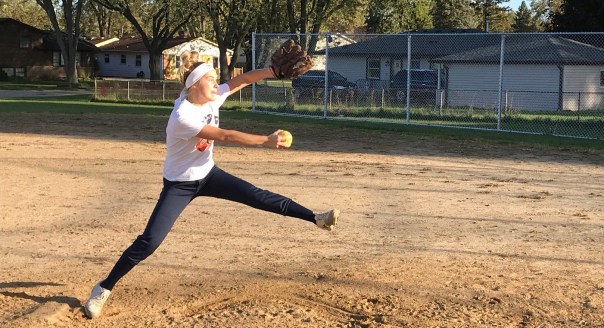
When someone says “it’s time to practice” what’s the first thing that springs to mind? For most of us involved in fastpitch softball the answer is probably grabbing some equipment, running out to a field or facility, and then spending the next 30, 60, or more minutes hard at work (as Paige is doing in the photo above).
While that approach is generally a good thing, it also has a downside (doesn’t everything?). When we’re in that mindset, we tend to think if we can’t do those things (get to a field or facility, spend 30-60 minutes) then we are unable to practice. In fact, “practice” kind of becomes an activity unto itself that requires special effort.
That’s unfortunate because for some players it could mean going a week or more without making any progress to get better. For others, especially those who are trying to learn new skills, it could even mean they get worse, or regress all the way back to step one.
It doesn’t have to be that way, however. Practice doesn’t have to involve going somewhere or making a special effort. And it certainly doesn’t have to be tied to a set amount of time.
Working on fastpitch softball skills anytime, anywhere, for any length of time can help players get better (or at least maintain their gains) versus doing nothing at all. The key is for players to know what they need to focus on and work those movements.
Take pitching, for example. Perhaps a player is having a tough time learning to relax the arm in the circle so she can whip the hand through at the end. In a full practice session with a catcher, she may be too focused on throwing strikes – double if the catcher is her dad. in that case she may continue to lock out the elbow and “guide” the ball to the plate.
But at home in her bedroom, or standing outside waiting for the bus, or marching through the house she can make arm circles and focus on staying relaxed throughout. No ball, field, facility, or catcher required. Learning to make the proper arm movement will help her know what it feels like when she’s actually pitching so she can carry the improvement forward there.
She doesn’t need to spend a half hour doing it either. If she takes 5 or 10 minutes it will help. Do that three random times during the day and she’ll have put in 15-30 minutes without even realizing it.
The same goes for hitters. Maybe the hitter is having trouble learning to lead with her hips, or is having a problem with barring out her front arm during the swing. She can practice the correct movements wherever she happens to be standing, whenever she has the chance.
The more she makes those movements the more natural they will become – and the easier they will be to execute when she’s actually up to bat.
Practicing in small increments may even have some benefits over longer sessions, especially if the longer sessions are focused on one thing. It’s similar to block practice v randomized practice.
In block practice you focus on one thing for a long time. With randomized practice you don’t linger on a single skill for any length of time. You essentially go from skill to skill. Studies have shown that the skills transfer better in game situations when practice is more randomized, at least in part because you get too used to doing the same thing over and over – an opportunity you don’t have in a game.
The other benefit to the shorter sessions in random locations is it lets players concentrate on the specific movements they need to improve on rather than the outcomes of those movements. And as we all know, in the end if you do the right things in the right way the outcomes will take care of themselves.
This isn’t to say longer, more formal practice sessions aren’t necessary. They absolutely are. But they’re not the only way to practice.
Taking advantage of whatever time and space is available is a great way to ensure players continue to improve. And it definitely beats using “I don’t have the time/I can’t get to the field or gym” as an excuse to do nothing.
Another Approach to Improving Pitchers’ Ability to Hit Spots
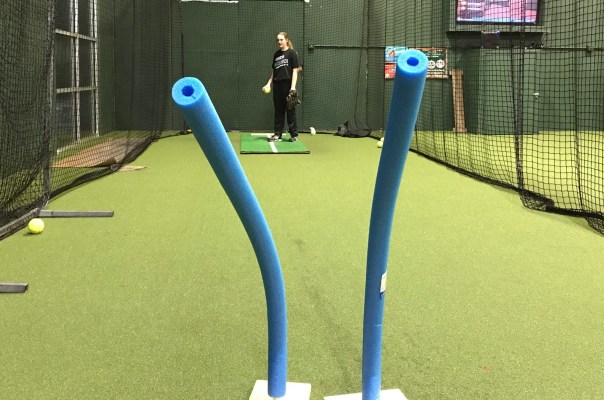
A few months ago I put up a post that showed a way to help fastpitch softball pitchers who were struggling with hitting their inside and outside spots by exaggerating the locations. The idea is that by making the adjustments larger you can help them get a feel for what it takes to move the ball from side-to-side.
Here’s another way to do it, using kind of the polar opposite approach. This is more for fine-tuning, when the pitcher is already pretty good at going inside/outside but you want to make it more precise and reliable.
All it takes is some scrap wood and a couple of pool noodles. What you want to do is create two narrow barriers, then have the pitcher attempt to throw the ball between them. Here’s how it looks from the back side:
What you’re trying to do is create a visual that helps the pitcher home in on exactly where the ball needs to go. Sometimes, when they’re looking at a catcher against a background, it’s hard to focus on that small spot. This setup helps narrow the field so to speak.

Pretty fancy, huh?
The holders for the pool noodles were a couple of scraps of 1×6 pine board with a hole drilled partially through them. The holes should be just slightly larger than the diameter of the dowel rod.
Once you cut the dowel rod to size, glue it in place and then drive a screw in from the underside. That should hold it securely.
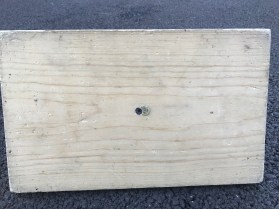
This side looks even better.
As you can see in the photo and the video, I didn’t use a very long dowel rod, which means the pool noodles aren’t very straight. I could have gone longer, but if the pitcher hits the noodle (as she is likely to do) and it is rigid the deflection could hurt whoever is catching if they’re not wearing equipment.
Besides, when they’re hanging over like this you can create some interesting holes to throw through, such as having the tops touch to work on keeping the ball low as well as on the corner.
You can do it from a 45 degree angle, like Juliana is doing here (due to a sore knee) or from a full pitch position. You may want to start with the former just to get the feel down before moving on to the latter, which will be more challenging.
Once the pitcher is becoming more consistent you can even make a game out of it, challenging her to make 7 out of 10 to win a prize or suffer a consequence – whichever fits your coaching style. That will add a little more game pressure too.
Or, if you have two or more pitchers there have them compete for who can do the most.
The overall idea is to aim small and miss small. So if you have a pitcher who needs to gain more precision in hitting her spots, give this drill a try.
Practice the Key to Reaching Your Destination Faster

For those who are also geography-challenged, Los Angeles is roughly in the circle on the left, and New York is roughly in the circle on the right.
Sometimes getting a player to understand the value of practice can be difficult. Those who aren’t the most dedicated to fastpitch softball can find a hundred excuses not to practice. So here’s a fun way of explaining how they will benefit.
Whenever I start lessons with a new student, toward the end I like to ask them if they know where New York City and Los Angeles are on a map. Most the time they do – or at least say they do. I hear today’s students are a bit geography-challenged.
Anyway, once we’ve established they know where each is, I will ask them how many different ways there are to get from New York to LA. The student will then start naming off various modes of travel – plane, train, car, bicycle, jog, walk, etc. Some will even suggest a boat, which is possible but certainly not easy.
I then ask them which is the fastest way to make the trip, at which point they will almost always answer “plane.” Which is correct, at least until Star Trek transporters become a reality.
I will then explain if they practice regularly, and with their minds on what they’re doing, that’s like going from New York to Los Angeles in a plane. But if they only pick up a ball, bat, glove, etc. when they’re at a lesson, it’s like walking from New York to LA. You can still get there, but it’s going to take a whole lot longer and be a lot more painful.
At some point or another, if they want to be successful players must put in the time. There’s no way around that. They can either do it in a concentrated way, such as practicing 3-4 times per week, or they can stretch the same amount of practice over many weeks.
The thing is, if they choose the latter they may find they haven’t quite gotten to where they want to be by the time the season starts. At which point it will be difficult to make up the rest of the ground that was lost.
There’s also the retention issue. The more time that passes between attempts at a new skill, the more likely players are to forget exactly what they’re supposed to do or how they’re supposed to do it. That means at least part of the time of their next attempt is going to be spent trying to regain ground they’d already covered.
As General Patton says (at least in the movie) “I don’t like to pay for the same real estate twice.” But that’s exactly what you’re doing if you have to keep relearning things you already should know.
Whether you’re in-season or in the off-season, it’s in the player’s best interest to work regularly on learning whatever it is she’s trying to learn. Otherwise she should probably make sure she has a good pair of walking shoes – and a nice cushion for sitting on the bench.
Map graphic Copyright (C) 2000,2001,2002 Free Software Foundation, Inc.51 Franklin St, Fifth Floor, Boston, MA 02110-1301 USA
Applying Occam’s Razor to Teaching Fastpitch Softball

At some point in your life outside of fastpitch softball you’ve probably heard the term “Occam’s Razor.” No, it’s not a brand of shaving utensil.
Instead, it’s a way of approaching problems. Essentially it says that all else being equal, if there is a simple approach to something and a complex one, the simple one is usually better.
If you want the full explanation, follow the link above. But a big part of it has to do with variables. The more variables you introduce (thereby making it more complicated), the more chances there are to get it wrong.
That has certainly been my experience coaching girls fastpitch softball for lo these many years. (Had to say that – how often do you get a chance to use “lo” in a sentence?)
I remember watching pitching instructors take pitchers through their 10-step or 15-step warm-up process, where every single piece is broken down into the most minute movements. I’ve seen the same with other aspects as well – hitting, throwing, catching a fly ball, you name it.
On the Internet it gets even worse. It’s almost like a contest to see who can make their explanation the most detailed and confusing.
Really what it is is a game of “one-upmanship.” Kind of like the old “he who dies with the most toys wins.” But in this case it’s “he who is the most unintelligible must be the smartest.”
I disagree with that philosophy. Instead I ascribe to the idea (often mis-attributed to Albert Einstein) that if you can’t explain something simply you don’t truly understand it.
When you’re coaching someone in a skill, your goal should be to help them learn to execute the skill in the context it will be used as quickly as possible. You can’t get that from a 15-step approach.
A player may get good at each of the 15 steps, but she will likely still struggle to put them all together and execute them under the pressure of a game. Too many variables to worry about, and too much thinking trying to get all of that right.
If you can break it down into a few easily digestible steps that naturally flow into one another, however, I find that players not only learn faster – they learn it deeper too, because it has context.
Hitting is a great example, because it’s probably one of the most over-analyzed skills in all of sports. It’s also interesting because a lot of the analysis will talk about why so-and-so hit a home run with their swing, but will never mention when that same swing resulted in a weak pop-up or ground ball. Which means there’s more to it than just the mechanics.
That said, as a coach or instructor, there is definitely a certain base knowledge you need in order to understand what is going on throughout the swing, and why some movements/angles/timing/etc. work better than others.
Once you get that, however, it’s time to start peeling away everything that isn’t essential to teaching someone how to hit. Especially since certain parts of the swing are going to naturally result from other parts anyway.
Teach the critical parts, such as leading with the hips, separating the hips from the shoulders during rotation, keeping the hands up and letting the bat head down, etc. Then turn your hitters lose to fill in the blanks on their own – without having to think about them.
It’s like the old KISS acronym – Keep It Simple, Stupid. Give them what them what they need to know in a way they can understand it instead of trying to show how smart you are or how much research you’ve done.
Oh, and while it’s tempting to say this approach is more important for younger players, the reality is it’s important for players at all levels. The real difference with older players if you keep it simple is they’ll pick it up faster and get to success sooner.
The more you follow Occam’s Razor, the more success your players will have, and the more games you’ll win. Isn’t that really what it’s all about?
Take Your Effort to 11

The other day I was reading an article’in the NFCA’s Fastpitch Delivery newspaper. It was written by Megan Brown, Ph.D., an assistant coach at Brown University, talking about what softball players can learn from UConn basketball.
Basically, it talked about an approach they use to improve pitching performance during practice, which improves performance during games. While the article was about pitching, it can be applied to other areas as well. I’ve been playing around with it a bit this week, and I think it’s pretty effective so I thought I’d share.
The crux of it is to ask the player to rate her effort on a scale of 1-10, with 1 being standing around talking about it (as you will be doing at that time) and 10 being putting every fiber of your being into the pitch, hit, throw, whatever.
The typical answer will be 5 or 6. If she says 6, you then ask the player what it will take to get that effort level up to a 7. How do you go that little bit harder?
Once she gets to 7, ask what it will take to get to 8, and so on. It really seems to help players loosen up a bit and worry a little less about “perfect” mechanics and a little more about going hard.
Of course, being a movie fan and a music fan, the whole idea of “turning it up” couldn’t help but remind me of this great scene from the classic movie “This Is Spinal Tap.” Sorry about the commercial in the front, but it’s worth waiting it out:
It’s very easy for players to slip into their comfort zone when they’re practicing or playing. Unfortunately, for many that comfort zone may be far less than they’re capable of achieving when pushed.
Maximum performance requires maximum effort. To help players get there, ask them to rate themselves on a scale of 1 to 10, and then see if you can get them to make turning it up to 11 a habit.
The Importance of Consistency When Learning Fastpitch Skills

The once-funny and now just more generally creepy comedian and filmmaker Woody Allen has been quoted as saying “80% of success is just showing up” or something to that effect.
While most times ol’ Woody isn’t the person you want to take advice from in anything having to do with kids, in this statement he is most definitely correct. Especially when it comes to the early stages of learning fastpitch softball skills.
Let’s take hitting for example. Hitting even a decently fast pitch in fastpitch softball requires a series of movements that must be performed correctly individually, sequenced correctly, and timed correctly. Some of those movements and sequences aren’t necessarily intuitive.
Since the object of the skill is to hit the ball with the bat, it’s easy for young hitters to assume that they should focus on taking the bat to the ball first. If their body turns afterward, so much the better.
But that’s actually the opposite of what they should be doing. The proper sequence is hips-shoulders-bat. A good instructor will teach that sequence, which not only maximizes power but the time the hitter has to see the ball before committing to the swing and the ability to hit the ball in the proper zone.
If that young hitter who’s still learning only comes to lessons once every few weeks, however, there’s a very good chance she will forget all about the proper sequence and spend her time practicing a bat-first swing. Then her distraught parents will wonder why they’re paying all this money for lessons and not getting better.
It becomes even more important with windmill pitching because in my opinion there is so much that can go wrong – and failure is more obvious. If you have a bad swing but still manage to make contact with the bat you can get on base.
But if you’re not throwing strikes, or you’re throwing easy-to-hit strikes, you’re going to have a tough day. As I tell my students, the circle looks bright and shiny from the outside, but it can be a cold, dark place on the inside.
Again, with windmill pitching some of the movements aren’t necessarily intuitive. If they were, you’d see more rec league pitchers using good form.
But instead, most untrained pitchers tend to stay facing forward, take a short step off the pitching rubber, and proceed to push/guide the ball toward the plate. THAT is what feels natural and intuitive. But it’s not what great pitchers do.
If a newbie pitcher only goes to lessons now and then and then gets put into a game before she’s ready, she will likely find herself like Luke Skywalker in the cave on Dagobah.
To really get the maximum value out of lessons in the early stages, it’s important to receive consistent training. That’s because you’re setting the foundation for all that is to come.
My recommendation is once per week – no more, no less – although you can do it going every other week if necessary. It will just likely take a bit longer to get where you want to go.
That regularity – and the short time between reviews by the instructor – helps keep players from veering too far off the path to success. It’s easier to do a reset when the training is consistent.
Going sporadically, however, gives the illusion of training without the benefits. Too much can go wrong in the meantime, and we all know it’s a lot easier to develop bad habits than to break them.
Instruction always works better when you apply it properly. In the early stages especially, that requires consistency. Make the commitment, even when it’s challenging, and you’ll see the rewards a whole lot faster.
Don’t Take Everything You Hear or See At Face Value

Every week I receive an email that links to pieces of instructional videos for fastpitch softball. And almost every week I end up shaking my head at what I see in them – especially because the company that sends the videos out is charging people good money for such poor instruction.
This week held yet another perfect example. A college coach (from a big name D1 school as I recall) was talking about flaws in loading when hitting. He had a young player, maybe 12U or 14U, there with him helping him demonstrate.
And what was his big advice? Don’t let the head and the front foot move in the same direction at the same time during the “load.’
First of all, he seems to be confused between the load and stride. He kept saying load but most of the discussion was about the stride. So he might want to check that out first.
But regardless of the terminology, he was basically saying that the front foot should move first, then the head should follow afterward. All I could think was “that poor girl.”
Let’s see if this coach’s advice passes the evidence test. Here’s a video of some MLB hitters taken from the side. Watch them as they stride and see if their head moves with the foot or not.
If the camera is steady you can place your cursor on the hitter’s head and see if the head stays there. If not, compare the head position to the background throughout the stride.
What do you see? I know what I see. The head and the center of gravity are moving forward as these hitters stride.
Of course, maybe these are just extraordinary athletes. And they’re men. So let’s look at former Michigan star Sierra Romero, who did pretty well for herself this year with the NPF’s USSSA Pride. Advance the video to about 2:14 to see the stride, and again what do you see her head doing as her front foot moves forward?
The point here isn’t to take on the specific video I watched, although hopefully by now you’re ready to disregard that particular piece of advice. It’s more to say that parents and players should be careful about what they accept as good instruction.
You would think a college coach, presumably a hitting coach, would understand the swing and how it works. But clearly that isn’t necessarily true.
It’s the same thing with taking advice from a former player because she was/is a star in college, or high school. Often times players and former players just repeat what they were told when they were growing up, even if it’s not what they actually did/do, because they haven’t put the time in to study the mechanics.
The best thing you can do is educate yourself. Before you blindly accept advice or training from anyone – and that includes me, by the way – take what they’re saying and see if that’s what the top current players do. If not, you should find someone who will teach you those mechanics and approaches.
Hitting is easier to compare, because you not only have top college, NPF, and National Team players to compare what’s said to what’s done, but you also have MLB hitters. Hitting is hitting after all, and anyone who tells you softball has a different swing needs to throw out their VHS tapes and at least buy a DVD or two from this millennium.
Or there’s this new thing out called YouTube that all the kids are talking about. Maybe those instructors want to check it out.
The hitting exception is slapping. They don’t do that in MLB, so you’ll need to look at softball only.
The same goes for pitching, because videos of MLB players will be of little use. But there’s plenty of good video of top pitchers in game action, which is where you want to check them out. See what makes them successful in games and compare that to what you’re being told. Here’s a good starting point for you.
Catching, fielding, throwing, base running, all of those are similar skills between fastpitch softball and baseball, so you have plenty of source material there. Sure, there are nuances, mostly driven by the difference in the length of the basepaths and size of the field overall, but anyone with even a little experience watching both should be able to adjust for that.
It’s easy to buy into a reputation, or a great set of credentials. But neither of those will help you on the field.
Be a smart consumer. Make sure what you’re being taught, no matter who is teaching it, matches up with what great players do. Otherwise, save your money on lessons or DVDs until you’ve confirmed your investment will take you where you need to go.
Turn, Turn, Turn? Not Anymore

It’s a pretty safe bet that “Turn, Turn, Turn” is the best-known songs by the 60s folk-rock band The Byrds. It’s either that or “Mr. Tambourine Man,” but I personally think the former is the better song. After all, tough to beat having your lyrics written by folk legend Pete Seeger by way of The Bible.
Even if you never listen to an oldies station you’ve no doubt heard it. It’s pretty much required in any movie about the 60s, or that references the 60s in some way. But just in case you’ve somehow managed to avoid it all these years, here’s a video. Enjoy!
The key point of the song (and why I bring it up, other than my love of jangly 60s music) is it says there’s a “time for every purpose under heaven.”
While that may be mostly true, in the softball world today it seems like there isn’t time for one thing – stepping back and making major corrections in mechanics without the pressure of an upcoming game.
I know Bill Hillhouse says there’s never a bad time to fix mechanics. But it sure is a lot tougher to make a significant change when there is a tournament coming up in a few days.
Once upon a time, the post-season was a great time to make those fixes. You finish up with Nationals at the beginning of August, then take a couple of months off to rest and recuperate before starting up again.
There might be a game or even a tournament here or there, but nothing like we see today. The way things work right now, players are often trying out for their next team before they’ve finished with the current one. Then it’s straight to practice to get ready for a two-month schedule of tournaments every weekend.
Of course, player performance in those early games sets the tone for how they’ll be perceived, especially if they’re on a new team where they’re not known. So rather than taking a step back to maybe fix things that could be better, players are more likely to continue down the path of what’s worked so far. Even if it’s not optimal.
The problem is certain mechanical fixes are likely to make a player worse before they make her better. Now, for some it doesn’t matter. If your mechanics are bad and you’re not performing, there’s little risk in making changes. Nowhere to go but up and all of that.
For others who have had success already but want to get better, however, it can be a problem. They were comfortable with where they were, and they were doing well, so making changes gets them out of that comfort zone, creating a risk of failure where there used to be success. And failure is an important part of the overall learning curve.
A pitcher maybe slower or less accurate until she resets her timing or gets all the body parts working together properly. A hitter may be tentative rather than aggressive until she’s had a chance to figure everything out. You get the idea.
The long-term benefits are there. It’s just hard to keep that in mind when you’re in the circle, in the batter’s box, on the field, etc. No one wants to look bad, especially in front of a new team (and coach). So they’ll tend to fall back on what they always did rather than forging ahead into new territory.
I don’t blame the players (or their parents). You gotta do what you gotta do. But with our 12-months a year season there’s little time available to fail for a little while to succeed in the future.
There has to be a better way. Somehow or another, there needs to be a season where pitchers can take the time to focus on changes that will help them increase speed without having to keep their change, drop, or other pitches sharp. Or hitters can focus on getting their sequence right instead of worrying about making contact with the ball. You get the drift.
What’s the solution? One idea is to play fewer tournaments, or maybe even fewer games overall in the fall. I know that won’t be a popular idea but it would definitely create some headroom for experimentation.
If you can’t do that, maybe teams can set aside a month or two during the winter months to work on reaching some specific goal or making a major change. Recognize that your player may not look like your player for a little while, but ultimately she will be better.
Maybe you have other ideas. If so, please share them in the comments.
All I know is there really needs to be a time for everything – including getting away from the pressure to perform so players can take the time they need to get better. It may be tough to accept at first. But the results will be worth it.
Bring a Little Fun to Corrections By Playing HORSE

Being a coach sometimes can feel like you’re stuck in the movie Groundhog Day. You offer a correction, the player makes it for a repetition or two, then goes back to what she was doing before. So you offer the correction again and the cycle repeats.
This pattern particularly shows up with younger players, but it can happen to anyone anytime. Obviously, two good repetitions followed by a few incorrect ones isn’t going to get anyone anywhere.
So how do you provide a little extra incentive to focus on doing it right every time? This is where taking advantage of the competitive nature of fastpitch softball players can come in handy.
Fastpitch softball is a tough sport full of difficulties and disappointments, so players really have to have some competitive fire to keep going with it. They also have to love a challenge. As soon as you press the “compete” button you almost always have their full and undivided attention.
One way I’ve done this is to borrow from the playground basketball game of HORSE. You know the one. You take a shot, then the player after you has to take the same shot. If he/she doesn’t make it, he/she gets a letter. You keep going until only one player hasn’t spelled out HORSE.
For Katie, the girl in the photo at the top of the post, the challenge was getting her to bring her back leg into her front leg to finish the pitch. She had the very common tendency of throwing the front leg out without using the back leg. As a result, the back leg was more of an anchor dragging behind her and cutting back on her speed and accuracy.
So I challenged her to a game of HORSE. The rules were simple. If her back leg finished by closing into her front leg (more or less) no letter was assigned. If, however, she finished with her legs spread apart (which usually caused her to bend forward as well) she received a letter.
Once we established those simple rules, it was game on! Suddenly, instead of the Groundhog Day loop of me telling her to finish, she was more on top of it. She still ended up getting an H-O, as I recall, but that was all in the 10 minutes we spent on it.
That was pretty good improvement, because it meant in all the pitches she threw she only failed twice. More importantly, rather than me telling her to fix the issue she was now dedicated to fixing it herself – because she didn’t want to lose the game!
I knew it really got through to her, though, when at her next lesson she asked if we could play HORSE again. I think she wanted to play because she knew she could win; she’d worked on it between lessons to gain the advantage.
But that’s ok with me – I want her to win, because then she’s improving her mechanics and using her body more effectively. By the way, there was no prize for winning or avoiding getting HORSE, although there certainly could’ve been. The game simply appealed to her competitive nature and got her attention.
In reality, this is a game/technique you can use to drive improvement for all kinds of techniques. Have a hitter who is dropping her hands or swinging bat-first? Play HORSE.
Have a fielder who isn’t getting her glove down on ground balls, or a catcher who isn’t keeping her glove on the ground while blocking? Play HORSE.
(I’m not just saying this to you, by the way. I am also making this as notes to myself, as I am definitely under-utilizing this idea.)
The one thing I would caution is focus the game on the process/skills, not the results. So use it to help a first baseman learn to scoop a ball in the dirt properly, but not to keep track of whether she actually got it or not. Or use it to help a hitter learn to swing hips-first rather than giving her a letter if she swings and misses.
If she learns the skill, the results will take care of themselves. But if you focus on the outcomes, you won’t drive the skills. Instead, you’ll probably reinforce bad habits as the player tries to avoid the error/failure instead of learning and internalizing the technique.
In any case, if you find yourself in a Groundhog Day-like loop, give HORSE a try. And if you do, or you’ve done the same thing yourself, let me know how it works for you in the comments below.






 Life in the Fastpitch Lane