NFCA to NCAA: Make us stop!

By now you’ve probably heard that at the recent National Fastpitch Coaches Association (NFCA) convention, D1 softball coaches finally stepped up to take a stand against early recruiting.
It wasn’t quite as strong as those coaches saying “For the good of our sport and the prospective student athletes we hereby all agree to VOLUNTARILY stop offering verbal commitments to 7th graders.” But it was a start.
If you don’t feel like following the link, essentially the D1 softball coaches have asked the NCAA to impose a rule that says they can have zero recruiting contact with any player until September 1 of that player’s junior year. That would mean the coaches can’t have any recruiting contact at tournaments, at their own camps, or anywhere else.
If a player calls or email the coach, the first question should be “What grade are you in?” If the answer isn’t “I’m a junior,” the coach should respond that he/she isn’t allowed to talk to that player. A snapshot of the changes can be found here.
In my opinion, this is a tremendous step forward. As I (and many, many others) have stated in the past, asking a 7th or 8th grader to make such a momentous decision as where she will attend college is ridiculous, and a huge disservice to the player.
Your choice of college should be based first on what you plan to do for the rest of your life. Especially since a post-college playing career is generally less lucrative than working the overnight shift at the local mini-mart. A player should be choosing a college with the thought that if she got hurt and could no longer play softball, that would still be the school she wants to attend.
What 7th or 8th grader is prepared to make that decision? Few, if any in my experience. They are going through tremendous changes at that age – physical, mental, social – and most are doing all they can to just manage that.
Freshmen and sophomores are a little more mature, but they too are just really beginning to discover what their likes and aptitudes are – factors that will have a huge effect on their ultimate choice of a career, and thus of a college.
They’re also getting a better idea of their academic acumen, as the change from middle school/junior high school to high school can be huge in terms of academics. By their junior years, they should have a better idea of the type of school that fits their academic capabilities.
I know a lot of people (including myself) who didn’t choose their college until their senior year. It’s a tough decision even at that age, much less a much younger one.
Then there’s the “youth sports” aspect of fastpitch softball. In the last few years, it feels like it’s become less about the “human drama of athletic competition” and more about nailing down the almighty verbal offer. Perhaps a change in the recruiting rules will let the girls enjoy the sport a little longer before they have to start sweating whether Coach So-and-so saw them and liked their performance.
This is definitely a good thing, and heading in the right direction. It’s unfortunate that the coaches, or the institutions, couldn’t just agree to do it themselves. But I suppose all it takes is one to disregard the voluntary rules and the whole structure comes down like a giant game of Jenga.
Making it an edict from the NCAA puts the threat of punishment in place, so maybe it will hold up for a while. At least until certain programs figure out what the loopholes are, because there are always loopholes.
Perhaps it will also put an end to jokes about D1 coaches following tall pregnant women around Walmart, handing out business cards and saying “If you have a girl and she plays softball, especially as a pitcher, call me.”
One thing to keep in mind, of course, is that as I read it a new ruling would only apply to D1 colleges. What about the D2 schools? If they are not included, might they start sweeping in to grab some of those top-tier players whose parents are more concerned with the scholarship than the specific school?
D3 schools aren’t allowed to offer athletic scholarships, of course, but they always seem to find academic money for athletes they like. I wonder how a D1-only ruling would affect them? Probably not an issue right now, but you never know how the law of unintended consequences will affect things.
Still not convinced? Here’s a link to another page on the NFCA website that shows some research on some outcomes that affect early commits, such as coaches leaving or the fact that 60% of players had no idea about what they wanted to major in at the time they committed.
So there you have it. Perhaps some sanity will finally come to recruiting. And perhaps by the time the late bloomers bloom, there will still be a place for them to go play. Most importantly, girls who aren’t even sure which backpack to buy for the new school year won’t be getting pressured to choose what college to attend in a few years.
What do you think? Are you glad early recruiting is potentially ending? Or were you in favor of it? Let’s get a discussion going in the comments below.
Another hitting myth: Keeping the head steady
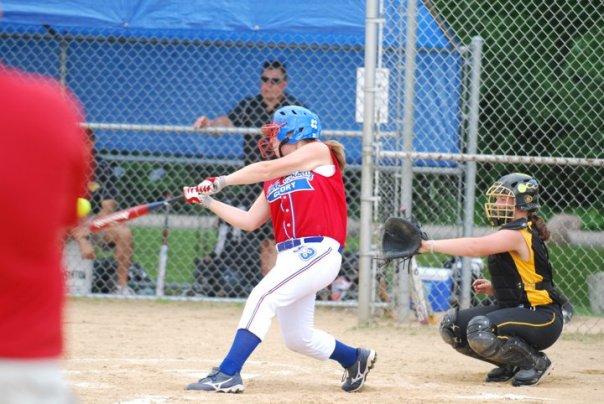
When you spend as much time as I do around batting cages, one of the things you’re bound to hear is a coach telling a hitter about the importance of keeping his/her head steady. What the coach means by this is that you should set your body in a position, and then the head should stay there throughout the entire swing.
The rationale is that if the head is moving then the eyes are moving, and it’s too hard to see the ball that way. With a steady head – presumably one where if you had a video and put your cursor on the head it stays in one place throughout the swing – you should get a better look at the ball and be able to hit it.
Only one problem with that theory. That’s now how high-level hitters hit, as this video shows. While in some cases the camera is moving and therefore you can’t really mark it and watch, in others it’s rock steady. If you place your cursor on the starting position you’ll see a couple of things.
First, in most cases the head moves from back to front. That’s because as the hitter strides there is a linear movement forward with the core of the body, carrying the head (and eyes) along with it. Unless you stand still and spin for the swing, which is not a good idea, the head is going to have to move forward.
The other thing you’ll see on lower pitches is that the head moves downward as the hitter follows the ball down. That makes sense.
You don’t want to stand upright and drop your hands to hit a lower pitch. You want to go down with it, both to get a better look at the ball and to be able to use your entire body to hit it.
If you stand up tall, with your head frozen in place, you’re far more likely to hit a weak ground ball. But if you let your body (and head) move, you can lift that low pitch into the outfield – and perhaps even over the fence.
Think about this, too. In the rest of our lives, our head and eyes are moving all the time. If you’re driving, your head is moving forward, perhaps being bounced around by the road, and maybe even bobbing to the music. But you can still see just fine.
Tennis players are constantly on the move, returning sometimes high speed volleys with a ball that’s substantially smaller than a softball. They can see it just fine.
Infielders have to move left or right, up or back, to field hard grounders and pop-ups. Doesn’t seem to hurt their ability to see.
The fact is our eyes (and brains) have an amazing ability to adjust to our surroundings, and to take in and process information while we are on the move. If they didn’t our species would have died off a long time ago.
Clearly you don’t want the head swinging all over the place for no reason. But trying to force the head to stay “steady” is attempting to solve a problem that doesn’t exist. To hit well, the body needs to adjust, and the head with it. Otherwise you’ll wind up with a disconnected swing – and a stiff hitter. And no one wants that.
Thanks for hanging out

Just wanted to take a moment here before the end of the year to thank everyone who has chosen to be a part of the Life in the Fastpitch Lane community this year.
Whether you’ve been around awhile or have just come across this blog recently, I truly appreciate your interest in hearing what I have to say. Hopefully you’ve found the posts to be helpful, informative, and entertaining.
A special thank you goes to those of you who have made the effort to subscribe so you don’t miss any posts. For those who aren’t aware, you can enter your email in the above left box to receive an email notification every time a new post goes up.
I don’t have anything to sell, so you don’t have to worry about adding to the metric ton of spam you receive each month. All you get is an alert when a new post goes up. Also, I will never, ever sell your email address to anyone.
Also a special thank you to those of you who commented on various posts throughout the year. Always love to hear the feedback, and to hear your stories.
Finally, I want to thank those of you who share these blog posts with your social media contacts, friends, teams, and programs. I appreciate you going out of your way to help Life in the Fastpitch Lane reach a wider audience than it could on its own. Please keep sharing content you find valuable so it can helps others.
The changeover in the calendar means the new season is coming fast. College teams will start practicing soon, and high school tryouts for spring softball will be here before you know it. Same with rec league tryouts.
Travel teams have been practicing all winter, of course, but despite the arctic chill right now in much of the country it won’t be that long until those teams are hitting the field too.
Whatever level captures your interest, I hope 2018 is the best year ever for your favorite player(s). I’ll do my best to help you make that happen by providing you with (hopefully) valuable information and inspirational stories.
And if there’s a topic you’d like to see covered this year, definitely be sure to let me know in the comments below.
Have a happy and successful 2018!
NOTE: This post was edited on 12/29/17 to add a thank you to those who share the content with others.
Image by Ashashyou (Own work) [CC BY-SA 4.0 (https://creativecommons.org/licenses/by-sa/4.0)%5D, via Wikimedia Commons
Why I’m ok with participation trophies

Thought that might get your attention! Although it is a topic that seems to get a lot of attention these days – most of it bad.
It’s not unusual to see people disparaging participation trophies online. They blame participation trophies for kids being soft, whiny, and lacking in effort. The term “snowflake” is often used in connection with participation trophies, and they don’t mean it in a nice “White Christmas” or “let’s go skiing” sort of way.
From what I’ve seen, the people who complain the loudest about participation trophies tend to fall into two categories. One is the “Internet tough guy” who likes to voice his/her opinion on what’s wrong with everyone else.
Usually they’re not actually talking about sports, but more about how entire groups of people (Millennials, Liberals, Millennial Liberals, etc.) just don’t measure up to how wonderful they think they were/are.
The second, more sports-specific group, is parents whose kids are great athletes and would accumulate a bedroom full of trophies no matter what. They seem to think that giving a trophy to a kid who tried hard but maybe hasn’t quite found her coordination somehow takes away from the awesomeness of their own daughters. After all, what’s the good of getting a trophy if you can’t use it to show your friends, family, and neighbors how much better your kid is than theirs?
I am of the mind that it’s okay to give kids participation trophies at younger ages – maybe up to 10 or so in rec ball. As I see it, it’s the Tony Soprano model. You want to give the kids a taste of getting trophies so they learn they want them. Then once they’ve acquired a taste for them you take away the freebies so they have to “pay” for them.
A kid who has never had a trophy may not believe it’s within her reach. But if she had them before, and now the conditions change, she’s more likely (in my opinion and experience) to want to do what she needs to get another one.
It’s also a good way to encourage kids to stay with a sport, especially in the early stages. Outright winning a trophy may not be within the realm of possibility for a young player, or a group of young players, whose athletic skills are developing a little slower than others their age.
Getting a trophy at the end of the year might be enough to encourage them to hang in there a little longer. We’ve all seen kids who were weak in their early years blossom later. But to do that they still have to be playing when they’re ready to blossom.
Giving everyone a trophy also removes a lot of the risk of the crazy parent/coaches who take a “win at all costs” approach to coaching young kids just to get that plastic trophy at the end. Anyone who has been around the sport of fastpitch softball (or pretty much any other sport for that matter) knows a lot of the craziest coaches and parents are found at the youngest ages. If the goal is to keep kids participating, removing the need to trophy hunt helps address that goal.
Now, I know what people say. If you give everyone a trophy the kids don’t learn how to compete. Funny thing is, I’ve heard plenty of college coaches talk about how showcase tournaments also seem to be hurting players’ ability to compete, yet it seems like there are more and more of them every year.
Fastpitch softball used to be about getting better so you could win this weekend’s tournament, or the league championship, or whatever. Now it seems to be more about getting the almighty scholarship. So the “not learning to be competitive” argument doesn’t really hold water.
Of course, as I mentioned earlier, at some point the “free ride” needs to end. By the time kids are 11 or 12, they all should have matured enough to understand that now if you want to get a trophy you need to work for it. If you’re playing travel ball – not just a team that “travels” but one that is looking to be competitive – the cutoff is probably more like 9 or 10.
But up until that time, what’s so bad about making kids feel good about themselves? Give them a taste of success and maybe they’ll develop an appetite for it.
Training catchers with the Roman Empire drill

Anyone who has seen a gladiator movie, or a movie with gladiators in it, is familiar with this scenario: Two warriors do battle until one bests the other. The victor stands over the fallen loser, weapon at the ready, and looks to the Emperor (or highest-ranking official in attendance). The Emperor holds out his hand with his thumb extended sideways, then either turns it up to spare the fallen warrior or down to indicate he should be killed.
Never mind that this is just a dramatic fiction of the movies. In reality, gladiators were too expensive to acquire and train to be wasted in such a manner. The idea of the thumbs-up/thumbs down creates a scenario to help fastpitch softball as well as baseball catchers.
Like hitters moving from the cage to games, catchers often have a tough time making the transition from practice to the field. They may be great at blocking in practice, when they know it’s coming, or scrambling to their feet to chase a popup. But in an actual game, all that training sometimes seems to go out the window.
That’s where we can borrow from the Roman Empire of the movies, and have some fun besides.
Line your catchers up in front of you, with your arm extended and your thumb to the side. They should all be in their runners on base stance.
Then either turn your thumb up for them to react to an imaginary popup or base stealer, or down to block a pitch in the dirt. 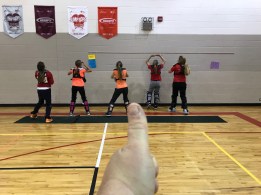
The key is that they don’t know which they’re going to have to do, so they’re going to have to read and react quickly and appropriately.
For added challenge, you can tell anyone who goes the wrong way that they have to sit out. You can also tell the catchers that the last one up or down is out as well. That creates a little competition and gives them some skin in the game.
 When the catchers go into a blocking position, check to make sure they are in the position you want and not just flopping onto the ground. They should be up and over the imaginary ball, with their shoulders further forward than their knees and their chins tucked in – as opposed to the ones who sit on their calves like they’re getting ready to watch TV.
For the popup position, first tell them where the ball will be – in front of them or behind them. Then emphasize getting their backs turned to the infield so the imaginary ball doesn’t drift away from them.
If you want to go with steals, make sure they’re coming up into a good throwing position rather than just getting to their feet. If you have the space, you can even have them make the throw. Just be aware of a stray ball or two.
The objective, again, is getting them to read the situation and react more quickly.
Here’s the last part to making a successful transition. Your catchers may get good at Roman Empire, but that doesn’t necessarily guarantee they’ll carry it with them onto the field. What you want to tell them is when they’re in a game, they need to approach it like they’re doing the Roman Empire drill.
They need to get themselves ready to read and react, rather than not thinking about it at all and then reacting too late. By being mentally ready on the field they’ll put themselves in a position to use all that training and find greater success.
Product Review: Decker Weighted Softballs

Once a pitcher’s mechanics are strong, one of the most effective ways to improve speed is through long toss. The pitcher starts at her normal pitching distance, then moves back 5-8 feet and throws another pitch.
She keeps doing that until she can’t make it to the plate anymore, at which point she starts working her way back in. The goal, of course, is to get as far out as you can – eventually to the outfield grass. You need to be strong, with a quick, aggressive motion, to get there.
Of course, to perform long toss effectively you need to have the distance to throw it. Easy enough on the field, but not so easy when you’re in a 50′ batting cage or a gym with other players – as many of us in the Northern part of the world are right now.
That’s where having a set of properly weighted balls can come in very handy. With weighted balls, and a quality training program, you can work on both arm strength and arm speed where space is limited.
The key is having balls of the proper weight. In particular, you want to be sure the weighted ball isn’t too heavy – no more than 1.5 ounces more than a normal ball, which is roughly 6.5 ounces. Anything heavier and you risk putting undue stress on the shoulder.
That’s why I’ve come to like Decker Weighted Softballs from Decker Sports. The overload/underload variance is relatively small: 7.8 oz. for the heavy ball, 5.2 oz. for the light ball, plus a “normal” 6.5 oz. ball. Each ball is very clearly marked, with large numbers and color coding, so there is no risk of using the wrong ball for the particular purpose.
Another thing I like about the balls is they come with a line around the circumference going across the four seams, so you can easily see the spin on the ball. That will give you an idea of whether you’re maintaining good mechanics as you work with them.
I also like the feel of the balls. They have good “tack” on them with good seams. The previous set of weighted balls I had never had very good tack, and by now are positively shiny. It was definitely time to retire them. The Decker Sports balls feel more natural to the pitchers, helping them focus on what they’re doing rather than wondering whether the balls will slip out of their hands.
Decker Sports does more than sell you a product, however. The balls come with an off-season and in-season training program. You can see a preview here. There are also other training programs out there, so you can find one that fits your needs and time constraints.
That’s another good point to make. Working with weighted balls can take some time. In lessons, where we only have a half hour once a week, I will often expose players (and parents) to weighted balls but won’t continue to use them on a regular basis.
That’s the sort of thing that’s best done on your own. I feel the time spent with me can best be spent on other aspects – you don’t need a coach for that.
Studies have shown that using a good weighted ball protocol can help increase speed. If you’re looking to help your pitch pick up some velocity (and who isn’t), give these weighted balls a try. You may even want to carry on with them once you go back outside.
Tips for executing a successful rundown

In my last blog post I talked about the value of practicing rundowns, and all the good it can do. But I didn’t get into the details of how to execute them successfully from a defensive point of view. So guess what we’re going over today?
Step one is to understand what makes for a good rundown. When you watch a rundown on a TV show or in the movies, you see a lot of running back and forth, faking throws, and actual throws.
While that makes for good drama, it’s pretty bad technique for a rundown. Here’s how to do it better.
Limit throws
The first rule of rundowns is the fewer the throws, the better. In fact, as I mentioned last time when I am working with teams I will ask them how many throws in the ideal rundown. The correct answer is zero.
When you make a throw, especially on the run, there are all sorts of things that can go wrong. You can throw the ball away (obviously) – high or wide. You can throw the ball into the runner. You can lose your grip on the ball and send it rolling or even behind you. You can throw too early or too late.
The better bet is to do what the technique says – run down the runner and apply the tag.
Run hard at the runner
The best explanation I’ve heard is when you run at the runner, you should put the “fear of God” in her. The mistake most defensive players make is running at the same pace as the runner. Why?
You want to put the tag on her if you can, so run at her as hard as you can. I used to love demonstrating this part. I’d take one side of a rundown, get the ball, and start chasing the runner like a monster in a horror movie – crazy eyes and a maniacal look on my face. The runner would usually freak out while the others laughed, but the point was made.
Leave no doubt. Make the runner think your plan is to tackle her before you tag her and she will start running full speed to get away. That’s a good thing because it takes a lot more effort, and a lot longer, to turn and run the other way if you’re running full speed.
Keep a Line of sight
Sometimes the speed mismatch doesn’t lend itself to just a run and tag. If you do have to make a throw or two, be sure you can see the person you’re throwing to, i.e., keep a line of sight to the other side.
Rather than running right behind the runner, run a bit off to your throwing-hand side. If the runner moves, you should move too. It’s a lot easier to make good throws if you’re not trying to throw over or around someone.
Use dart throws
Everyone says to use dart throws, but what does it really mean? To understand, get a dartboard and some darts and try to hit the bullseye.
Odds are you’re not going to wind up as throw as hard as you can. Instead, you will use more of a pushing motion, with no wrist snap.
It’s the same for rundowns. If you wind up and throw hard, especially as you get closer, there’s probably a better chance that the receiver will flinch than you will execute a successful throw and catch. Use that more direct push-type throw and you’ll put the ball where you want it.
Oh, and if you have to use more arm to make the throw, you’re not doing it right. Or you’re not in a rundown.
Pinch in
Another mistake teams will make is standing at the two bases and running back and forth between them. That’s a disaster waiting to happen.
Instead, both sides should start pinching in to shorten the distance the runner has to work with. If you run hard at the runner and get her to commit, as we said above, it will take her a little time to stop and reverse direction.
If the receiver on the other side is close, she can get the ball, run up, and make the tag before the runner has a chance to change direction. That’s way better than trying to run 60 feet back and forth each time.
Run the runner back
Whenever possible, get the ball ahead of the runner and try to run her back toward the base she’s coming from. While not as good as getting the out, keeping the runner at the base she started at is better than having her advance a base.
Time your throws
To make sure you’re running the runner back, anytime she gets more than halfway to the next base make the throw and get it in front of the runner. It’s not a hard and fast rule, but more of a rule of thumb.
The closer you let her get to the next base the more chance the runner has of advancing. So try to make sure you’re only working within the 30 feet between the last base and the next one whenever possible.
Peel off after the throw
Again, if you do have to make a throw, it’s important to know what to do next. Start by getting out of the way. Peel off to the side so you don’t interfere with the play going on. Then keep going and get in line on the other side, just in case you’re called on again. Although hopefully you won’t be.
Watch the trail runner
If there is more than one runner on base, don’t forget about the trail runner. As soon as you get the out on the lead runner, start looking for the trail runner.
High five
When you get the runner, and the play is over, don’t forget to celebrate! You just got a free out.
Practice these techniques until they become automatic and you’ll win your unfair share of rundowns.
A quick rundown on why you should regularly practice rundowns

A few years ago, when I was still coaching teams, I heard through the grapevine that one of the parents was griping about how much we practiced rundowns. He was a “baseball guy,” and as such was of the belief that rundowns didn’t happen very often. He couldn’t figure out why we would spend so much time on them.
Forget about the fact that if he’s opened his eyes a little more he would’ve seen that in fastpitch softball, rundowns tend to happen a little more often. It’s a faster game than baseball, with shorter distances between bases (60 feet v 90 feet for those who don’t know) and a smaller field overall.
As a result, baserunning tends to be somewhat more aggressive, and runners (as well as coaches) are more likely to take chances. Especially if they’re not sure they’re going to have many opportunities to score.
But even if that wasn’t the case, there are a lot of other things your team can gain from practicing rundowns other than the specific skill of handling rundowns. Here are a few.
Precision
Rundowns occur over shorter distances overall, and they tend to squeeze in more as they go on. That means there isn’t a lot of room for error. Throwers learn to throw to a specific spot instead of a general direction, and receivers learn to focus intensely – especially when the throw may be coming from an odd angle because the thrower didn’t maintain a good line of sight.
Grace under pressure
This goes along with precision. Things happen quickly in a rundown, and they can go wrong very quickly. If you panic, you’re likely to pull the glove down early and miss a throw, or make a throw you don’t need to make, or hold the ball too long. Rundowns help players learn to handle pressure and stay focused on the task instead of the outcome. By the way, that goes for the person running too. Their job is to stay alive until the defense makes a mistake. Can’t do that if you’re in panic mode.
Communication and teamwork
The ideal rundown has zero throws: the ball gets ahead of the runner, and the fielder chases her down until she makes the tag. But that doesn’t happen too often, so fielders need to be able to communicate effectively to coordinate their efforts. I’m not a believer in the receiver calling “ball” and the thrower holding the ball until they hear that, but if one side isn’t doing their job the other side needs to be able to tell them. Or if the thrower is running with the runner between her and the receiver, blocking the line of site, one of them needs to tell the other to move over so she can see. Or think about a first-and-third situation, with a runner caught between first and second. The team needs to know how to communicate effectively if the runner on third starts heading for home, so the team can break off the rundown on the trail runner and get the lead runner. So much going on!
Conditioning and agility
Yeah, you could have your team line up on the baseline and run a bunch of sprints to build up their speed and recovery time. But why not have them practice rundowns instead? They can get the same level of conditioning – especially if you limit the number of runners who can sub in – and you don’t have to listen to all the complaining. Create a little competition with a prize at the end and they’ll practically kill themselves trying to win. They’ll also learn how to change directions quicker – a valuable skill in several aspects of the game.
It’s fun
When I was a kid, we used to call it “running bases.” Others call it “pickle,” and I’m sure there are other names. But the basic rundown was something we used to do for fun when there weren’t enough kids around or we didn’t have enough time to play a regular game. All you need is a couple of gloves, a ball, something to use for bases, and some space. Instead of treating it like a drill, treat it like a reward – something fun to do at the end of practice.
The beautiful thing is if your team gets really, really good at executing rundowns, they can generate more outs in the field. They’ll look for opportunities, and will be more confident in going after the lead runner in tag situations. On the offensive side, they’ll be more comfortable if they do wind up in one, helping you avoid some outs on the basepaths.
Don’t take rundowns for granted. Make them a regular part of your practice routine and watch the difference they make.
Now it’s your turn. How often do you practice rundowns? How good is your team at executing them? And if you played running bases/pickle as a kid, what did you call it?
Where have all the officials gone?

If you’ve been thinking lately that it’s a tough time for officials in a number of sports including fastpitch softball, you’d be right. As this infographic from Ohio University demonstrates, the number of officials nationwide is on a steady decline.
That’s bad news for everyone involved in youth sports, because even though you may not always like their calls, and in some cases may think they are biased/blind/complete idiots, umpires and referees are still essential for competitive sports. You could play without them, I suppose, but if you’re counting on all the coaches and players to be completely honest about close calls you’re bound to be sorely disappointed.
Where are they all going? Well, like the rest of the workforce, older officials are retiring. Unfortunately, not enough people are stepping up to replace them. It seems that players who are either finishing or have finished their playing careers aren’t exactly stepping up to stay involved in softball by becoming umpires. Although there are some exceptions.
The opportunities to advance from high school to college officiating aren’t exactly abundant either, which may discourage some. The pay isn’t exactly great, the hours can be long and inconvenient, and so forth.
Then there is the issue of the hostile environment these days. More and more, youth sports contests are beginning to sound like political debates on Facebook. This has led more than 85% of current officials to “consider terminating their services if (the) environment worsens.”
What’s the consequence? According to the infographic, potentially it could mean fewer games, fewer opportunities at the lower levels in high school, and perhaps some sports being dropped altogether at some schools.
While the infographic doesn’t get into travel/club ball, fewer officials could mean even shorter games in an effort to cover the same number of games, or perhaps bringing in unqualified or untrained volunteers to pick up the slack. Yes, I know there are some bad umpires out there even with training, but the situation could get a whole lot worse.
So what’s the solution? I can think of a couple of things.
One is to be sure coaches, parents, and players treat officials with respect rather than imitating the bad behavior they see on TV. That not only gives current officials a reason to stay in it; it also encourages current players to stay in the game by officiating when their careers are done.
As part of that, coaches and players should shake the officials’ hands after every game – even if you think they blew a call that cost you the game. Just that act alone can mean a lot.
Stiffer penalties for those who verbally or especially physically abuse or threaten officials should be put in place and enforced vigorously. No official should ever have to wonder if he/she will be confronted by an angry coach or parent after a game.
Officiating organizations should also make an effort to reach out to high school and college players (and their parents, for that matter), encouraging them to sign up when they’re done playing. Sometimes all it takes is asking someone. They should do more than send an email. They should actually show up in person and present, in my opinion.
Those are just a few ideas I had. What about you? What do you think we can do to turn the tide and swell the ranks of quality officials?
Getting the feel of dragging the changeup
I could have sworn I have posted this before, but I just ran a bunch of searches and couldn’t find it so just in case here it goes again.
One of the keys to throwing an effective backhand change is to pull or drag the ball through the release zone knuckles-first rather than pushing it ball first. Or snapping it like a fastball.
Sometimes, though, it can be difficult for pitchers to get that feeling. That’s what the drill shown at the top of this post is for, demonstrated by a former student of mine named Tayler Janda (helped by her mom Jennie) back when she was in high school.
Essentially, you set the pitcher up with her feet apart so they won’t move. Then have her grasp a swim noodle with her knuckles facing forward. When you say go, she pulls the noodle out of your hand and flings it forward. (NOTE: have her try to do it without spinning her shoulders like Tayler is doing in the video.)
The goal of this drill is to get the pitcher to feel what it’s like to hold onto the ball until she reaches forward as far as she can go before releasing, and to maintain speed all the way through.
A few repetitions and she should start to get the feel. The nice thing about this drill is you can do it indoors on a rainy day just as easily as you can on a field or in a cage.
If you have (or are) a pitcher who is having trouble finding the proper release on your change, give this one a try.






