Author Archives: Ken Krause
Taking personal responsibility for your playing time

Truthfully, these players gave 100% all the time. I just needed a shot of players on the bench!
My friend Tim Boivin sent this article to me a couple of weeks ago. Tim’s been around the block as a youth leader with the Boy Scouts, and as a soccer coach. He even coached a recent Winter Olympian (although not in the sport for which he went to the Olympics, however).
The article addresses a topic that is a concern to many players and parents these days – playing time. Or perhaps more accurately a lack of playing time and how to deal with it.
In today’s world the typical reaction to a lack of playing time is to complain to your parents (if you’re a player), other parents (if you’re a parent), eventually the coach, and anyone else who will listen. It can become pretty toxic pretty fast.
Now, there are some legitimate cases where playing time decisions are based more on who the coach likes, or who raised the most sponsor money, or whose parents are on the Board, or which players babysit the coach’s kids for free, or other factors like that. In those instances, the complaints are justified.
But as the article points out, there is another common cause – the amount of effort the player puts in to improve her skills, both during practice and on her own. As the old saying goes, you can’t control the outcome but you can control your effort.
The easiest thing to do is complain when things aren’t going your way. Especially if you’re used to having everything handed to you.
If you’re not getting playing time, however, the first place you should look is in the mirror.
Do you hustle in practice – really, truly hustle, running from station to station and giving 100% in every drill and activity? Or do you try to skate through practice breaking as little of sweat as possible?
Coaches make a lot of their game day decisions before the actual game day. Good coaches look at who wants it, and who is willing to run through a wall to get it. Especially at the upper levels.
Often the difference in skills isn’t that great, so what coaches are looking for are competitors. They want players on the field who won’t quit no matter the circumstances, who will dive for balls or look to take the extra base or even take a pitch in the backside if it will help their team win the game.
Another thing to look at is the type of teammate you are. Are you supportive of others, or do you sulk if things aren’t going your way no matter how the rest of the team is doing? Team chemistry is critical, so those who create positive chemistry are going to tend to be given preference over those who don’t.
The good news is all of this is controllable. There are really only two things you can control – yourself, and how you react to everything you can’t control.
Did you strike out or make an error? Suck it up Buttercup and do better next time. Did the umpire call ball four when she clearly should have said strike three? Shake it off and get the next hitter.
Is the air cold or the ground wet? Increase your focus on the task at hand and you won’t be bothered by it. Having a bad day off the field? Don’t let it affect your performance on the field.
The more you take command of yourself and give maximum effort, the more likely you are to find yourself on the field.
At the very young levels, the goal should be equal playing time to help players find their love for the game. But along the way – often around 14U – that starts to change, and it becomes about performing.
If you want to get on the field, give your coach a reason (or multiple reasons) to put you on the field. And keep you there.
Next week I’ll share an example of a college player who has done just that – to the benefit of both herself and her team.
Another good reason to hit hips-first

When I work with fastpitch softball hitters, one of the things I will drill into them (incessantly, if you listen to some) is the sequence “hips-shoulders-bat.” It’s the order in which body parts should be fired if you’re going to be successful.
(Yes, I know “bat” isn’t a body part but I try to distinguish that from the “hands to the ball” teaching that used to be so prevalent.)
It’s basically a mantra we use. If the hitter only gives a partial turn, or leads with her hands, or swings everything at once like a gate, I will ask her “What’s your sequence?”
The correct answer is “hips-shoulders-bat.” Repeating it over and over helps drill the point across.
There are several reasons “hips-shoulders-bat” is the optimal sequence. For one, it allows the largest, strongest muscles to get the body moving and create the power that will drive the ball into gaps and over fences.
Another is that it gives the hitter more time to see the ball before committing her bat. If you swing hands/bat-first, you have to start moving the bat into the hitting zone before you know where it will be, or how it’s spinning (for more advanced hitters).
But if you drive the hips first, then add on the shoulders, then finally launch the bat, you will have a couple tenths of a second more time to gather information about the pitch and recognize patterns. Doesn’t sound like much, but to a hitter in fastpitch, where the pitcher is throwing at high speeds anywhere from 35-43 feet away as a starting point, it’s an eternity.
Working hips-shoulders-bat also makes it easier to avoid the dreaded “dropping of the hands.” If you swing hands-first, it’s much easier to take the hands down to your waist and swing level to the ground rather than keeping a good bat path.
Getting to the optimal hitting zone
One important reason that doesn’t seem to be talked about as much, however, is the effect a good hips-shoulders-bat sequence has making contact in the optimal hitting zone.
The photo at the top of the post illustrates what I mean. The red, green, and yellow bars represent the quality of contact you can expect to achieve if you hit the ball in each of those areas. (It’s a general illustration, so don’t hold me to the exact placement of each color.)
If Kayleigh started the swing with her hands, her bat would have a long way to travel from the load position to where it will make contact with the ball. This gives her the opportunity to make contact somewhere in the red zone. In fact, there is a pretty good likelihood she will because of the issues of time and distance.
The red zone is red for a reason – which is, you don’t want to make contact there if you can avoid it. The swing hasn’t fully developed yet, and you’re only using the smaller muscles of the arms to move the bat, so you’re probably not going to hit the ball very hard. Your more likely outcome is a popup or a weak ground ball.
If you turn your hips first, then add your shoulders onto that turn before you launch the bat, you will have done a couple of things. One is you will have recruited the big muscles of the legs, butt/glutes, abdominals, chest and shoulders to create power. Now your bat can jump on that moving train and be accelerated into the pitch.
The other is that you will have carried the bat further forward before launch. Now you can’t help but make contact in the green zone (or the yellow zone if you’re a little early) because your bat has effectively bypassed the red zone in the pre-launch phase.
Like Kayleigh here, you will be a great position to take the bat to the ball and give it a ride.
Adjusting inside-out
Of course, like other things relating to softball hitting there are always exceptions. For example, the optimal hitting zone changes depending on how close the pitch is to the hitter.
The more inside the pitch, the further out-front it needs to be hit in order to drive it. Looking from the top, the optimal hitting zone will tend to look more like the photo inset (for a right-handed hitter). Again, this is an approximation; your mileage may vary.

Exact placement of the hitting zone depends on where the hitter stands in the box, height, and other factors. This is just a general idea.
But for a basic concept, I think this works pretty well.
If you are a hitter, the more you understand where you need to make contact with the ball the more likely you will be to adopt a hips-shoulders-bat sequence.
If you are a coach, use the photo at the top of the post to help your hitters understand where they want to contact the ball – and why. Many of us are visual learners, so a picture will be worth the proverbial thousand words.
Either way, it’s one more incentive to learn the body sequence for hitting that will drive greater success. Give it a try, and let me know how it goes in the comments.
Getting Your Money’s Worth Out of Softball Private Instruction
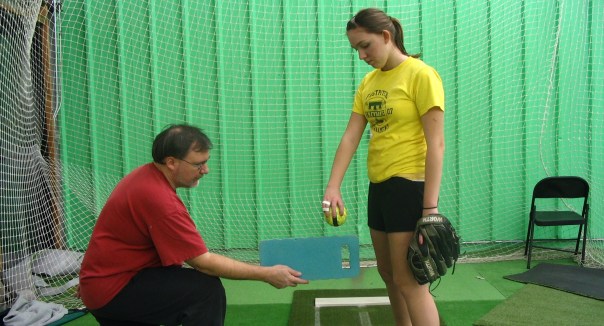
If there’s one thing I think nearly everyone in the softball world can agree on these days it’s that softball private instruction isn’t cheap. Especially in areas where you have to be indoors for at least part of the year.
The facility costs alone can get quite expensive. Then add in the cost for the instructor and it’s definitely not for the faint of heart – or wallet.
A dedicated family can easily spend hundreds or even thousands of dollars by the time it’s all added up, particularly if the instruction goes on for a few years.
That’s why it often shocks me how little effort so many parents seem to put into the decision. If they were buying a new lawn mower, or a refrigerator, or a set of tires for their car they’d probably do tons of research.
They’d look for professional reviews, they’d look for user ratings, they’d compare specs, and maybe even go to a store and look the item over.
That’s why items in this price range (and above) are called “considered purchases.” You don’t just buy them on a whim. You put some thought into the decision because it’s going to put a dent into your wallet and you’re probably going to have to live with whatever you choose for a while.
The cost of softball private instruction can easily surpass all of those items. You’re just doing it on a per-lesson “payment plan.” Yet based on what I’ve seen so many people accept, it seems they go into that expensive purchase that can have so much impact on their daughter’s softball career blind.
Here in the digital age, with a world of knowledge just a few clicks away at most, there’s simply no reason to get anything less than a full return on your softball investment. Here are some ways to make sure you do.
Do your homework on what is good
This is probably the easiest and yet most-ignored piece of advice. I think many parents start out by looking for an instructor who is close to them. To me, that’s putting the cart before the horse.
Before you go looking for instructors, do some homework on what you want your daughter’s instructor to teach. Put in some time to learn what is currently considered the state of the art for hitting, pitching, catching, throwing, fielding, etc.
See what well-known, high-level instructors and coaches are saying. Many of them generously share their knowledge on YouTube, or on sites such as the Discuss Fastpitch Forum. (FULL DISCLOSURE: I am also the administrator at the Discuss Fastpitch Forum, but it is a free resource with open discussions, not a selling site.)
There are plenty of quality paid sites as well, and some with a mixture of free and paid information such as Cindy Bristow’s Softball Excellence, and (hopefully soon) Fastpitch Foundations for pitching.
Once you start getting your feet wet into it, the other thing you can do is look at what high-level players do and see how that lines up with what you’re reading/watching in the instructional materials. You’d be amazed at how many people, even the players themselves, don’t actually understand how high-level players execute their skills.
Check them out on YouTube and other sites, and watch as many high-level games on TV as you can. You’ll start to see the similarities.
Many myths abound, so it’s important to gain as much understanding as you can before you go into it. That way, when you’re evaluating instructors you’ll have a better chance of selecting one who is teaching the techniques actually being used by high-level players.
Watch other local players
Once you have a decent understanding of the instruction you’re looking for, it’s time to start investigating your options. A good way to do that is to observe players, either in games or a practice session, who look to have the techniques you want your daughter to acquire. Then ask them (or their parents) who their instructor is.
Be careful, however, not to confuse “good” with “well-trained.” A gifted athlete – one loaded with lots of fast-twitch muscles and/or exceptional hand/eye coordination, for example – can be successful with no training or even poor training.
(In the latter case, they usually end up not doing anything they instructor says because their body just figures out what do. But they still think they’re doing what they’ve been told.)
That, incidentally, is why looking at an instructor’s record of developing high-level players (think: college) isn’t always an accurate indicator of his/her quality. It’s tough to know how many of them would have succeeded without that coach – or did succeed in spite of him/her. It takes a lot more than “the right instructor” to reach that level.
What you’re looking for instead are players who execute the skills properly, as you understand them from your research. If they don’t appear to be the greatest natural athletes so much the better, because then you know their success is due to their training and dedication.
Last summer I had a perfect case study of how this works. I received a call out of the blue from a father whose daughter is a catcher. They live about an hour’s drive away (with traffic), so it wasn’t a decision he was entering into lightly.
But he said he’d seen a really outstanding catcher in one of their tournament games and he asked where she learned her skills. The parents referred him to me, and I’ve been working with his daughter ever since.
I’m sure he passes a whole host of instructors to get to me, but it doesn’t matter. Because he knows his daughter is being trained in a way that matches his expectations.
Have a conversation
Once you think you’re on the right track, have a conversation with any potential instructors. Get a feel for their knowledge level and what they teach.
One thing you want to determine is whether they take a “cookie cutter” approach, using the same drills and progressions for everyone, or whether they customize the instruction to the student.
It will take some players longer to grasp certain concepts or movements. A good instructor will keep them working to become at least competent at those skills before moving them on to the next one.
Others will grasp the concepts or movements right away. In those cases there is no sense in lingering on them because the stock lesson plan says “on lesson 7 we do this.” Move on.
Do what you can to determine how much the instructor customizes the instruction. Again, a good instructor will teach the same things to all of his/her students. But he/she will do it differently for each.
That conversation is also the time to ask questions. If you know you don’t want your daughter learning certain techniques, such as “hello elbow” for pitching or “squish the bug” for hitting, ask the instructor about it. An informed parent is a smart parent.
Also, don’t be afraid to ask for the “why” behind what the instructor teaches. If there isn’t a “why,” I suggest you politely excuse yourself and move on to the next instructor. Everything should have a purpose.
Do a chemistry test
So you think you’ve found an instructor who has the knowledge and experience to train your daughter properly. The last test is to see what the chemistry is like between the instructor and your daughter.
We all have different personalities and ways of learning. And sometimes people just rub us the wrong way for no apparent reason. That’s life.
If there is a chemistry mismatch, lessons are going to be a drudge for both the instructor and student. You and your daughter will presumably be spending a lot of time working with this instructor, so you want to be sure they are working together as a team.
Also, you know your daughter better than the instructor ever will. You should be able to read her body language and enthusiasm level. A good coach will inspire her to do her best and help her feel good about the learning process.
If that’s not what you’re seeing in a conversation between the instructor and your daughter, or a sample lesson, you may want to continue your search.
Monitor success
Once you’ve made a selection, you’re not done. Keep monitoring to see how things are going.
Is your daughter getting better? Is her technique moving toward what you saw on TV from those high-level players? Is she gaining confidence in herself and her abilities?
The change is unlikely to be instant. It’s more likely to be incremental, with some frustrations and setbacks along the way. But over time you should be seeing speed and accuracy increases in pitcher, better blocking from catchers, stronger and more frequent hits from hitters, etc.
And perhaps someday some random parent will come up to you at a game or tournament and say, “Your daughter is really good. Do you mind telling me who her instructor is?”
Ultimately, however, the best ROI is the smile on your daughter’s face when she is successful and feeling good about herself. That’s when you’ll know it’s all been worthwhile.
Softball Pitchers: Be A Queen, Not A Servant

One of the challenges of working with younger fastpitch softball pitchers is getting them to understand the importance of maintaining good posture during the pitch.
You want them to be upright, with a firm, straight posture and plenty of front side resistance. But what you get instead is more of a hunched over look.
There can be a variety of reasons for it. One is that they don’t have the core strength to maintain good posture, especially at the younger ages.
More often than not, though, it’s either inexperience or a desire to keep the pitch from going high. They figure if they schlump their shoulders down, or bend at the waist, that will help them keep the ball down.
Unfortunately, the opposite will most likely occur due to Coach Ken’s law of opposites, i.e., to make a ball go down you must first go up.
Now, you can tell them to stay up straight, but the words alone aren’t always meaningful. Sometimes you need to illustrate it more for them.


To do that I will tell the pitcher that she has the choice of being a servant or a queen. A servant stands with her shoulders bowed and head down. A queen stands up straight, with her head up. Then I ask her – which would you rather be, a servant or a queen?
I have yet to have anyone answer servant. So I tell them if you want to be a queen, finish like one. If they bend over while pitching, I can then ask them if they were a servant or a queen? That’s something they understand.
(Another way to make the same point, by the way, is to compare a chimpanzee or baboon to a giraffe. The primate hunches over. The giraffe stands tall.)
So if you’re having trouble getting a pitcher to stay up straight, give this idea a try.
Product Review: Softball Bound app makes the college search easier

Unless you are one of those incredibly talented players who has famous softball coaches going out of their way to plan their weekends around watching your 12U/14U games, you’re probably going to have to devote a considerable amount of time researching potential opportunities and looking up the contact information for the coaches at schools you’re interested in.
Now a new app called Softball Bound, which is available for the iOS and Android platforms, has made that part of the process a whole lot easier. Rather than having to spend hours looking up each school individually, and then clicking through to gather information about it and the softball program, Softball Bound puts all that information right at your fingertips. In fact, according to the counters on its website, it provides info on 996 NCAA and 196 NAIA 4-year institutions.
Finding the right schools
The interface is simplicity itself. The default view takes you to an address book-like listing of colleges, starting with the As of course.
Down the right hand side is the entire alphabet, so you can click on a letter, based on the first letter in its name, and be taken right to all the schools that begin with that letter. So if you want to look up Baylor, you click on B and scroll down. For University of Whoever you click on U, which is probably more intuitive in the long run.
That’s not your only option, however. A little filter icon in the upper right hand corner lets you narrow down your choices by Division (NCAA 1,2, and 3, plus NAIA 1 and 2), Conference, State, or any combination of all three. If you have your heart set on  playing NCAA Division 1 in Tennessee, you can find all the schools that meet those criteria.
If you know exactly the school you want to look up, there’s also a search function. (You can only look up colleges, not coaches or conferences; use the filters for that.) The search function is intuitive, so as you type in your choice it starts showing suggestions.
Core information
Once you’re into a specific school there is a tremendous amount of information. The topic section offers the school’s name, address, and general website. The second section provides the name of the coach (usually the head coach, but sometimes an assistant who is involved in recruiting), along with the coach’s email address and phone number.
These are active links, so clicking on the email address or phone number will start an email or make a call, respectively. You will want to handle that with care. On the other hand, think of how impressed a college coach will be if 10 minutes after a game is over you send a messaging thanking him/her for stopping by to see you.
There is also a link to the softball team’s website so you can easily learn more about the program or do your homework before you contact the coach. Never hurts to start an email or a call by congratulating a coach on a recent win, conference championship, or personal milestone.
Deeper details about the institution
Where Softball Bound really shines, however, is the additional information it gathers. The bottom section offers a wealth of statistics about the school, such as undergrad enrollment, the average yearly cost, graduation rate, and average salary after graduation. It also helps you determine whether you have the academics to qualify by offering the average SAT and ACT scores for students at that institution.
Be aware you have to scroll down to see all of the information. The basic school and coach information stay on the screen permanently, but you can scroll through the bottom section to get the rest.
The only negative I found was that I couldn’t read some of the information on my iPhone. If the line is too long it just disappears. Hopefully the developers will be fixing that, because knowing how much money the average salary after graduation or the freshman return rates could be very valuable in helping you narrow your choices.
Carrying relationships forward
Once you’ve made your selections, you can “favorite” them. They then appear on a short list so you don’t have to go through the entire search process each time. As you refine your list further you can remove schools with a click of button as well.
As you build the relationship with different college coaches you can also ask Softball Bound to add them to your regular contact list so you can call or email the coach without having to go into the app. That’s also a very handy feature.
One of the other advantages of the Softball Bound app is they are constantly updating the contact and other information, which means you don’t have to worry about working from an outdated list.
On the website, they also offer the option of purchasing their list for $250. Not sure why you’d want to do that, especially since college coaches frown greatly upon mass mailings. It’s much easier to just purchase the app for a few dollars – especially because if you buy the list it’s up to you to maintain it. Sounds like a lot of unnecessary work to me.
A wealth of helpful, additional information
Speaking of the Softball Bound website, they have more than just product information there. They also have a list of camps you may want to attend, as well as information about the academic side and how to get ready for college. Plenty of links to info on testing (SAT and ACT), creating a skills video, eligibility and so forth. It’s all freely available to anyone and worth checking out.
If you’re actively pursuing playing fastpitch softball in college, or even thinking you might want to, this app is definitely worth it. Especially at $3.99 in both the Apple App Store and Google Play. It can save you a lot of time and effort, and give you a tremendous advantage in your recruiting efforts.
Softball tryouts – hitting off the pitching machine
In my last post, I offered up some general tips for a successful tryout. While it was aimed at high school softball tryouts, the truth is those tips apply to all types of tryouts – and most to more than just fastpitch softball.
Included in the post was a brief mention about getting used to hitting off a pitching machine if that’s what will be used during your tryouts. This is an issue a lot of players face.
They will crush it against front toss and even live pitching. But stand them up in front of a machine and they struggle.
So for all of you who are in that boat, or know someone who is, I’m reprising this video blog to help you make sure you’re ready when it’s time to show your stuff. Follow these tips and you should have much greater success in showing what you can really do.
6 Tips for a More Successful Softball Tryout

For most of the fastpitch players in the country, the end of February means one thing – high school team tryouts. Whether you consider high school ball the pinnacle of your year or merely something to do until travel ball season starts, it’s an opportunity to show your school spirit and make a contribution to community pride. But before you get there, you first have to make the team.
The best way to assure your spot, of course, is to choose your parents wisely and be born dripping with talent. High school pitchers who throw 65 mph, hitters who can crush a softball 250 feet, and shortstops who can go into the hole, turn and fire for the out, generally don’t have much to sweat.
Neither do those who have older sisters who could do those things. Every high school has its legendary family, and the assumption is the gene pool runs deep enough to cover everybody, whether it really does or not.
But if you’re in the other 99 percent of the players out there, it’s important to make the best impression you can during tryouts. (Hopefully, the legend’s sister doesn’t play your position. That’s often tougher to overcome than actual talent.)
Remember that the amount of time the coach sees you follows a simple formula: your time = the total amount of time for tryouts ÷ the number of players trying out. In other words, if tryouts take a total of six hours and there are 60 girls trying out, you have six minutes to get noticed. Here’s how you can use that time wisely.
- Hustle, hustle, hustle. There’s no substitute for it, and it’s one of the key factors coaches look for. Desire is an important attribute coaches look for in prospective players, and hustle is a great indicator of desire. Hustle is also an indicator of coachability. With hustle and at least one strength, most coaches will figure a player can possibly be developed into a good or great softball player. When you’re moving from station to station during tryouts, don’t walk. Run. If you’re fielding ground balls, don’t go through the motions – act like the state championship is on the line, and dive if you have the opportunity. The more effort and enthusiasm you show, the better your chance of tipping the scales in your favor.
- Be friendly. In her book Coaching Fastpitch Softball Successfully, one of Kathy Veroni’s “unwritten rules” is to say hello to the coach. That’s great advice for tryouts too. It shows confidence, and helps you stand out immediately. Remember, it’s a long season, and there are a lot of bus rides ahead. Having people around he or she likes makes the rides go faster.
- Make sure you’re in good shape. It’s likely the coach will put you through conditioning drills. My friend Bob Dirkes, a former scholarship nose guard at Northwestern University, says you never want to show you’re tired during conditioning drills. Being in good shape will make that happen. Being in shape also shows a level of commitment that might tip the scales between you and a comparable player. It’s like that old deodorant commercial said– never let ‘em see you sweat.
- Be fundamentally sound. If you have a few weeks before tryouts, get in the gym now and work your fundamentals. Catch with two hands – every time. (Unless you are a catcher or a position player reaching for a ball.) Look the ball into the glove – every time. Get on the batting tee and make sure you’re using a good hips-shoulders-bat sequence. If you mess up a chance or two but show good fundamentals, you’ll still look solid. If you make the plays but your technique is poor, you’ll look chancy. Chris Simenson, a former HS coach in Iowa, says, “The game is still a matter of learning fundamentals and execution. A player willing to practice and learn will advance beyond a talented athlete who does not.” Coaches want players they can count on game after game to make the plays they should make. Show you’re one of them.
- Show all your skills. If you have something special, don’t assume the coach knows it – and don’t wait until the coach asks, because he or she probably won’t. If you’re in the batting cage and you’re a slapper, be sure you show it. Just about every knowledgeable coach wants a slapper or two in the lineup. If you’re a pitcher, don’t just throw fastballs. At the minimum, show your change. If the coach goes to the catcher’s end and you have pitches that move (drop, curve, rise, screwball), be sure to throw them. You just added a dimension to the coach’s game plan.
- Practice under the conditions you’ll use in tryouts. If you’ll be hitting off a pitching machine, you’d best start practicing hitting off of one, even if you don’t particularly like it. If you can, use the same type of machine, and find out how fast they set it. If you will be indoors, try practicing fielding on a similar type of surface. The ball bounces differently on a wood gym floor v. a tile gym floor v. a concrete surface v. a turf surface v. an actual field. If you don’t know, ask if they use actual softballs or the rubbery ones. Pitchers should try to find out what types of balls the team uses, because different balls feel different and you’ll need to be comfortable with the balls you’re throwing. Even the lighting conditions can make a difference. The more you get the feel for what the tryouts will be like, the better you’re likely to perform.
The last piece of advice is to relax and just show your stuff. Don’t think of it as being judged – think of it as your time to shine!
Remember, softball is a game, and games are supposed to be fun. Approach it that way, and you’ll be successful. Good luck!
Just Like Novacaine
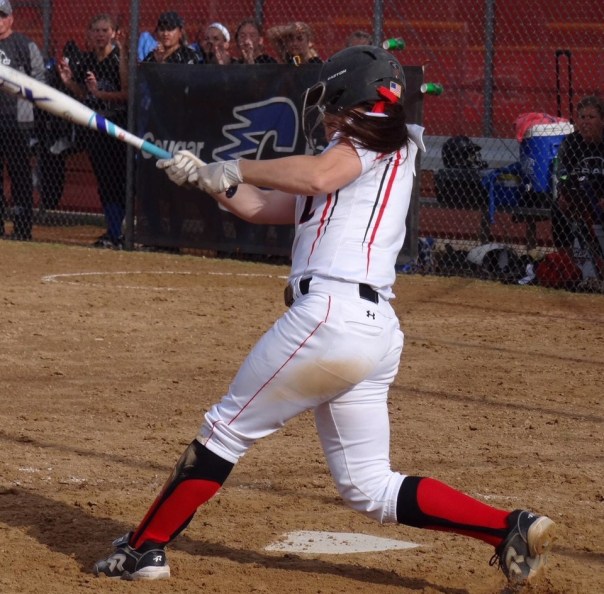
One of my favorite lines in the movie “Remember the Titans” is the one where Coach Boone (Denzel Washington) is describing his offense. “I run six plays, split veer” he says, “It’s like Novacaine. Just give it time, it always works.”
Here’s the actual scene, just for fun.
That’s the way it is when you’re working on developing good fastpitch softball mechanics.
Sometimes it may not seem like you’re headed in the right direction. It’s rarely an instant fix – nice as that would be.
But if you’ve done your homework and know you’re trying to learn the mechanics top players use, there’s no need to panic. Give it sufficient time and it will work.
That’s often a problem for players, parents, and even coaches these days, however. They don’t want to give it time. They want it to work now.
One of the challenges, of course, is that they usually need those skills right away. There isn’t much of an off-season these days, even up in the frozen north, so it seems like there’s always a game coming up.
It could take weeks or months before a player is comfortable with new mechanics after a significant change, and can execute them without thinking (or over-thinking) about them. In the meantime, she’ll have some success and some failure.
Pitchers will struggle with control and consistency. Hitters will miss balls they might have otherwise hit. Catchers will drop a ball or two when trying to throw a runner out on a steal, fielders will overthrow bases, and so on. It can be frustrating, and everyone will wonder if maybe the player wasn’t better off before.
But again, if she’s learning the right mechanics the answer is yes. Once she locks them in, she’ll be a far better player than she was before.
So keep that in mind. Learning new things takes time. But if you’re learning the right things, there’s no doubt about it. It always works. Just like Novacaine.
Great story about character

For me, one of the best parts about coaching fastpitch softball is the opportunity to meet (and work with) so many girls I would have never otherwise known. Today I’d like to share one of those stories since I think we could all use some good news right about now.
It’s about a wonderful young lady named Emma Borrelli. Emma is an 8th grader, and just one of the nicest and most upbeat people you’ll ever want to meet. I work with her on both pitching and hitting, and it’s always fun because I can say the meanest, most insulting things to her to make a point (all in jest) and she just smiles or laughs. She’s also one of the hardest-working girls I’ve ever worked with.
Anyway, her dad Mike forward an email that her homeroom teacher sent to him a few weeks back telling a kind of “under the radar” story that describes her character perfectly.
It seems that in her homeroom class there is a boy with special needs. Every day, on her own, she helps the boy at his locker, walks him to his homeroom, and says goodbye to him after homeroom.
No one asked her to do it. She’s not doing it to try to win an award or add something to player resume. She just does it because she is a good person. Or maybe there’s just something in the name Emma.
What makes this so interesting is that Emma is not an outcast or a fringe kid. From what I understand she is pretty popular in the school, with a large circle of friends. She could easily walk right past this boy and no one would think twice about it.
Yet she passes on hanging out with them before school to be with this boy instead, which her teacher says makes his day.
Sometimes us older folks shake our heads at the younger generation and wonder what’s going to happen when the world is in their hands. Based on what I see and hear about Emma, as well as so many others, the world is going to be just fine. Maybe even better.
Overcoming the urge to aim in fastpitch pitching

One of the most common problems I see when trying to teach fastpitch pitchers to learn to whip the arm through the release zone is overcoming the urge to aim.
They’ll be doing a good job of bending at the elbow and letting the upper arm lead through the back of the circle (rather than pushing the ball down with their hands). But then, right before they get to that critical moment where the upper arm slows down naturally and the lower arm passes it to create the whipping action, they will instead let the ball get ahead too early and defeat the whip.
I’m pretty convinced the reason they do this is they’re trying to make sure they throw a strike. So what do they do? They tighten up and try to direct the ball at the plate rather than allowing the arm to finish its natural motion.
Not only is this a speed killer, it actually works against their original goal of throwing a strike. If you stay relaxed and let the joints in the shoulder and arm do their job, it’s actually fairly easy to throw a strike.
As long as you direct the momentum that’s been built up toward the plate, the ball will go there. Like I often say, the ball doesn’t care where it goes, so it will go anywhere you tell it to go.
But when you tighten up before the whip can happen, now you’re pushing the ball through the release zone. Momentum is no longer helping you, so it’s very easy for the arm to get off-course and send the ball in the wrong direction. If you’re off even just a few degrees from where you want to go, or you twist your hand funny, suddenly the ball is not going where you want it to.
For pitchers with this issue, a pattern usually develops. Say she throws low and way inside on the first pitch. On the next one, she will try to correct and direct the ball toward the outside, often going high and well out. Then you’re on Mr. Toad’s Wild Ride, with balls careening all over the place.
So while the goal was to “just throw strikes” (a phrase I really dislike, by the way), instead control becomes more difficult than ever.
Making the fix
How do you overcome this tendency? First, the pitcher has to understand that strikes are a result, not a goal. Consciously focusing on the far end rather than herself is the wrong thing to do.
With that in mind, have her move up close and just work on the finishing action to get the feel of the whip. As Rick Pauly says, if you can’t hit the target from close up you won’t hit it from far away. A good place to start that motion is with the ball about shoulder high, with the palm facing up.
One of the things the pitcher should focus on is feeling her upper arm pull all the way into her ribcage, with the ball trailing behind the whole way. If needed, you can even isolate that motion, i.e., eliminate the actual throw until she gets the feel of the upper arm leading.
Once she has that down, have her continue through and throw. The goal is to feel relaxed and let it happen naturally. Check to be sure she isn’t trying to throw the ball too early. There should be a definite pendulum (or two-piece) movement rather than the whole arm coming through at once.
As the pitcher gets the feel of it from that starting point, work your way back, first starting at 12:00 and then making a full arm circle, but still without a full windup or much leg drive. Only when she can execute the full circle and get the whip should she be allowed to pitch from a windup position.
The catcher dilemma
One other thing you may need to do is have the pitcher throw into a screen or net rather than to a catcher. The reason is psychological.
If there is a catcher there, the pitcher will focus on throwing the ball to her rather than on what her arm is doing. Double that if the catcher is Dad or Mom. That defeats the purpose of what you’re trying to do. So if the pitcher isn’t willing to make mistakes when there’s a catcher involved, remove the catcher so it’s no longer an issue.
Use video
Admittedly, sometimes it’s tough to see whether the pitcher is getting the ball ahead a little too early with the naked eye. That’s where video is so helpful.
There are plenty of inexpensive mobile apps that will help you capture and analyze video to see what’s happening in “the last mile” of the pitch. Even regular high-speed video on a smartphone or tablet will do in a pinch. Not only does capturing the motion on video let you see it. It also lets the pitcher see it, which is often very helpful in encouraging her to correct it.
Aim not to aim
It’s easy for pitchers, especially those who are just developing their mechanics, to want to measure their success in terms of balls and strikes. After all, that’s how it’s often measured in a game.
Yet real development comes when pitchers are able to stop consciously aiming the ball and learn to use a proper whipping motion instead. It will lead to far greater success in the long run.






 Life in the Fastpitch Lane