Blog Archives
Fastpitch pitchers: getting the feel of the whip
One of the things that keeps being a fastpitch softball instructor fun and interesting is that there is always some new puzzle to solve. That was certainly the case with a girl named Kate and her pitching.
I started working with Kate on her pitching late in the summer last year. Once the weather turned cold I didn’t see her for a while – schedules just didn’t match up – but she continued to work on her own.
When we did get together earlier in the year her speed just wasn’t quite where it should have been. She was working hard, and putting in plenty of effort, but when the ball came out it sort of floated toward the plate. It was almost as if every pitch was a changeup.
That just didn’t sit well with me, of course. Kate is a terrific girl, always smiling and very polite. If I say “good job” she invariably says “thank you.” I’ve actually told her she doesn’t have to thank me every time I say something nice, but it’s tough to overcome good upbringing.
Anyway, I knew here was more speed in Kate, but we were having trouble finding it. It just didn’t seem like she was driving her arm/hand through release.
I tried a couple of different drills, and even gave her a Jugs Lite Flite ball to practice with, thinking the lighter weight might help her feel acceleration into release a little better. The light ball helped a little, but there was still something not working in her delivery.
The other night she came in for a lesson, and I could see during warmups she still wasn’t getting the ball out properly. So I decided to try the towel drill. This is a drill where the player holds a towel, goes into a K position, then whips the towel through. If you do it right you’ll it snap forward somewhat.
Well, that wasn’t working either. After a couple of attempts I wasn’t seeing what I wanted. Then I had an inspiration. I told Kate rather than holding onto the towel she should bring it down and throw it to her dad, Mark, who was about 10 feet in front of her.
The first time she tried it the towel didn’t go anywhere. The second time it went straight to the top of the cage we were working in. But then she started to get it, and the towel went forward. A few more reps and she was easily throwing it quickly to her dad.
So I backed her up and put a ball in her hand. Sure enough, there was a visible speed jump from before. She did it again and had the same result. We finished normal warm-ups and went into full pitches and whaddya know? Suddenly the ball was hitting the catcher’s glove with a nice “thwack!”
She was a bit wild, but I told her don’t worry about that right now. Let’s just focus on your newfound speed. She was able to maintain it throughout the lesson and we were all happy about the breakthrough.
Still, you never know. Sometimes these gains are only temporary. That’s why I was so delighted to receive this text from Mark a couple of days later:
“(W)e can hardly contain our excitement!!!! We just finished our team practice and Kate absolutely rocked it. IT being the pitching part. Her speed is nearly matching the other girl. Perhaps just a few mph difference, and that’s negligible in pitching speak.
On the way home Kate said the sweetest thing to a dad’s ear. ‘I’m so happy.’ I asked her ‘about what, Kate?’ ‘That you found our coach, Ken.'”
I believe what was happening with Kate was that she was twisting her wrist as she released – probably the result of all those wrist flips she used to do before starting with me. Once I had her throw the towel she couldn’t do that anymore if she wanted it to go anywhere, and that gave her the feeling of how to get the ball through the release zone properly.
So if you have a pitcher who is struggling with speed – especially if it looks like she’s in permanent changeup mode relative to her effort level – give this drill a try. Maybe you’ll get a nice text too!
Getting the feel of the push off in fastpitch pitching

Getting a strong push-off is essential to maximizing speed for fastpitch pitchers. You need to develop a lot of forward momentum so that when your front foot comes down the stop is very sudden, which helps accelerate or sling the lower arm through the release zone.
Unfortunately, young pitchers often have trouble getting the timing down to create an early push. Instead, they will kick the stride leg forward while just sitting on the drive leg, and then try to push at the end, which is too late.
I’ve had pitchers skip before, because that mimics the sequence, i.e., push off first then reach with the leg. It works for some but not others. So if you or someone you know is still having trouble getting the feel, here’s something to try.


Place an obstacle out in front of her, very low to the ground like the swim noodle Alyssa’s father Tony is holding here. Then have the pitcher jump over it, using a normal forward jumping motion rather than thinking about pitching.
When she does it, ask her what she feels. If she isn’t sure, have her do it again. What she should feel is the drive leg pushing first, then the stride leg reaching out. If she does it correctly you’ll see it, as shown in the photos here.
Yes, this motion would be illegal for a pitch – big time illegal – but that’s not what you’re going for right now. Because if she could get the push legally you wouldn’t be doing this drill.
You just want her to feel the push first. After she does it a few times, have her go back and now try to copy that feeling with an actual pitching motion. If she’s gained the feel, and is driving her body forward first, the back foot should pretty much take care of itself.
So far, every pitcher I’ve tried this with has made an immediate improvement in her drive mechanics. I’m not quite ready to pronounce it foolproof yet, but it’s looking good.
If you’re facing this issue give it a try, and let me know in the comments how it works out. And if you’ve done this before, share your experience and whether it worked for you too.
Congratulations to Wisconsin pitcher Kirsten Stevens
Huge congratulations are in order for University of Wisconsin – Madison pitcher Kirsten Stevens on being named the Big Ten Pitcher of the Week. Can’t say it comes as a surprise, though, after the weekend she had. 
Kirsten toss not one but two shutouts in earning her third and fourth wins on the season. And this after being sidelined for most of the off-season with a broken foot.
When the accident first occurred it looked like the Badger might miss the first part of the season. But with a strong work ethic and help from the Wisconsin coaching staff and trainers, she beat the prognostications and is back on the field.
And what a pre-season it’s been. Kirsten is currently sporting a miniscule ERA of 0.28, which is what happens when you’ve only allowed one run for the season so far. Over the weekend she also had a personal best 11 strikeouts against Hofstra, continuing the blistering pace for Ks she set as a goal before the year.
And the best part? Kirsten is one of the nicest human beings you’ll ever meet. Always with a smile on her face, always remembering to have fun, and always making time to speak with and encourage the young players who look up to her (literally as well as figuratively) when she meets them.
All we can say here is keep up the good work! And again, congratulations to both you and the team who helped you achieve a well-earned honor.
Keeping fastpitch pitchers on the straight and narrow
One of the keys to maximizing both speed and control for fastpitch pitchers is driving straight down the powerline (more or less). That is the direct line that starts at the middle of the pitcher’s rubber and continues straight until it intersects the center of home plate.
Wander too far off the line and your power will be spread across too wide an area to be effective. Think about a laser versus a flashlight. Both send light out from the source. One (the flashlight) spreads its energy across a wide area; the other (the laser, obviously) focuses all its energy in one direction, and on a very small area. Which is powerful enough to cut through metal?
Still, it’s one thing to tell a pitcher to go straight down the powerline, even when there is one drawn right in front of them. It’s another to get them to do it, especially when they’re working hard to maximize their leg drive.
If you’re indoors and using a pitching mat, here’s a way to help pitchers learn to take a more direct route. Either move the mat or the pitcher so she is standing with her throwing-side foot next to the mat as Jenna is here. Then have her execute the pitch.
She will receive instant feedback as to whether she stayed straight, and the long line of the pitching mat will serve as a visual guide as to where her foot should go.It seems to be more effective than the simple drawn line, because there is dimension to it. And it’s safer than using a larger obstacle such as a bat bag – just in case the pitcher makes a mistake.
As a bonus, the long line of the mat will also give her a guide for her throwing-side foot, helping pitchers who tend to let that foot swing too much out behind their glove-side foot. If your goal is for the throwing-side foot to drive straight down the line, she can just trace the side of the mat with that foot to get the feel.
For those who are outside, a narrow roll of foam from the hardware store will serve a similar purpose. Just be sure to anchor it down so it doesn’t blow away.
If you have a pitcher who’s having trouble staying on the straight and narrow, give this a try. And as always, let me know how it works for you.
Helping pitchers understand pulling the ball through release whipping instead of pushing
The other night I was working with a very young pitcher named Kaitlyn on her basic mechanics. She’d been off pitching for a few weeks and was just getting back into it.
As we were working I noticed she was cutting her arm circle off toward the bottom, with the result that she was pushing the ball through release. As you can imagine, the result was the pitches were slower and rather erratic.
I wanted to help her get back on track and get into a position to whip the ball through release as she should. But one of the challenges of working with pitchers who are 8 or 9 years old is figuring out a way to communicate what you want (and why) to them.
As I and others have said before, young children are not just short adults. They think differently and have a different frame of references than adults. So it’s important to come up with ways of explaining things to them that make sense.
In this case, saying “you need to whip the ball through the zone” wouldn’t have meant much. So I thought, “what would help her understand?” That’s when I came up with this idea. 
I knelt down in front of her, held my hand out, and told her to punch my hand. (That’s not me in the photo, obviously. That’s her mom, who is much more photogenic than I am. You’re welcome.) She made a fist and pushed her hand into my hand.
I then told her to pull her hand back again, and this time slap my hand instead of punching it. This time she used a motion that was more like whipping the ball. 
After one more punch and a few more repetitions of slapping, we went back to pitching. Bingo! She started coming through with a whip, and the ball started coming faster and more accurately.
So if you have a pitcher who struggling to feel that acceleration of the lower arm past the upper arm, give this one a try. And if you do, let me know how it works in the comments below.
Return of the Indiana United Fastpitch Elite/Rick Pauly Clinics
Earlier this year I blogged about a fantastic fastpitch pitching event held, of all places, in Southeastern Indiana. Put on by Rick Pauly, hosted by Indiana United Elite Fastpitch and Coach James Clark, and featuring an array of top-level pitching coaches, it was an incredible learning experience for players, parents and coaches alike.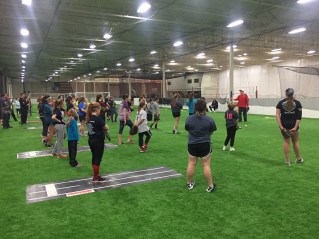
Never one to be content to rest on his laurels, Coach James has outdone himself with the latest iteration. The 2017 clinic, again in Richmond, Indiana, has expanded in its scope to not only offer top-level pitching instruction but also clinics on hitting, catching, the short game/slapping and defense.
This year’s instructor lineup is impressive once again, with college coaches and former college and NPF players offering hands-on instruction. The nice thing about these clinics is they’re not like so many, where they show a big name who is the “face” but then have very little interaction. The faces you see on the flyer will all be actively participating in or leading the instruction.
Throughout the weekend there will be plenty of time for discussions and questions too. One of the highlights for me last time was many of the instructors gathered together in a room tossing around ideas and opinions until the wee hours of the morning – all part of an impromptu session that began with a simple question. Those little side conversations alone are worth the price of admission.
Coach James promises it will be bigger and better than ever, and I believe it! The clinic runs the weekend of January 6,7 and 8, 2017 – timed this time to both make sure it didn’t interfere with high school and college seasons and to give players time to lock down what they learn before tryouts begin for spring high school ball.
Click here to register, and here to schedule the sessions you want and to pay. Most sessions are $70 each and run an hour and 15 minutes. The exceptions are the recruiting discussion that costs $25, and the beginning and advanced pitching sessions with Rick and Sara Pauly which cost $150 and are scheduled for 3 hours, although last year Rick was having such a great time he ran a bit long on both sessions.
Download the flyer for complete information, and then be sure you sign up now. Slots are filling fast. I’m sure you’ll find it’s a great investment in your softball future.
Fastpitch tip for learning the finish of a backhand changeup
One of the most important pitches in fastpitch softball is an effective changeup. By effective I mean one where the pitcher can go through her motion and appear to throw it hard while having the ball come out much slower than expected.
This is as opposed to a changeup where the only thing that changes from the fastball is the grip, or one where in order to get the ball to go slower the pitcher slows her arm down. Those aren’t changeups. Those are just bad fastballs.
While I teach a few different types depending on the pitcher, the one I teach most often is  the backhand change. Essentially, that is one where the back side of the hand leads the ball through the release zone.
Note that this is not a “flip” change. There is no flipping of the wrist at the end; I want the pitch to be dragged throw the release zone and thrown in a way that still has 12 to 6 forward spin. Flipping it puts backward spin on the ball, and often results in a pitch that comes in around belt high before traveling about 220 feet in the opposite direction.
The key to the finish of the backhand change as I teach it is to bend the elbow slightly and (again) drag the ball forward through the release zone until the pitcher’s arm is fully extended. After a momentary stop the ball comes out about hip high, immediately loses a bit of altitude to thigh high and then tails down around the plate. To do that the pitcher has to keep her hand moving forward and low until release rather than pulling it up as many like to do.
One cue I’ve used before is “punch your catcher in the nose.” In other words, go straight out instead up up and out. It’s worked pretty well, but it still requires the pitcher to do a little visualization.
So here’s another option. Have the pitcher line up sideways to a backstop with stride foot (left foot for a righty) right against the bottom of the screen. Then have her get her arm in the proper position (without the ball), pick out a spot on the screen that’s the right height and have her stab her fingers straight into the chain link fencing.
You might not want to have her go full speed, especially at first, to avoid jammed fingers.If you can’t get to a field, you can also do it into a tarp or even a shower curtain at home, as long as there is something specific to move the fingers toward.
Have the pitcher do it multiple times, until she starts to get the feel of what it’s like to go out straight instead of up. Then you can back her off the screen a bit and try the finish, or go back out to the pitching plate and see if there is improvement.
It’s simple yet effective. I only came up with this idea recently and so far it’s helped every pitcher I’ve tried it with.
If you have a pitcher who is struggling to keep her hand going out directly instead of bending the elbow or otherwise pulling up, give this a try. It just might work.
What are some other ideas you’ve tried to accomplish the same thing? How effective have they been? Anything you’ve tried that failed horribly? Go ahead and share – you’re among friends.
Sometimes you just gotta go with what you’ve got
As both a fastpitch softball instructor and general fanatic for the sport, I have to admit I spend an inordinate amount of my waking hours looking at information and analyzing techniques to try to become as educated as I possibly can. Hi, I’m Ken, and I’m a softball technique-aholic
It’s well-intentioned to be sure. I firmly believe, based on roughly 20 years in the sport that the better-trained a player is, the higher the chance she has for success. And the less raw athletic ability she has, the more specific training she requires.
But I also believe (again based on experience) that there is a Law of Diminishing Returns when it comes to trying to perfect technique. While it’s true that optimal technique should yield the best results, that’s also only true if it’s implemented with optimal effort or enthusiasm.
This is where a lot of players seem to get hung up. Especially the most dedicated. They are focused so much on trying to achieve the optimal mechanics that they get in their own way.
Hitters become tentative trying to achieve the best bat path and as a result slow their swings down. Or they focus so much on one part of the swing that they let the rest fall apart.
Pitchers work so hard on getting just the right launch technique, or keeping the arm circle exactly where it should be, that they get all tight and don’t let their bodies work for them. Catchers worry so much about how they’re making the transfer on a steal that they become over-conscious and thus too slow.
Every part of the game can be affected, regardless of position, or whether you’re on offense or defense.
So here’s my advice: as they say in auto racing world, sometimes you gotta run with the one that brung you. Or in the case, go with what you’ve got.
If you’re a hitter still reworking her swing, do the best you can to use what you’re learning. But don’t focus on doing it perfectly. Do it the best you can while still coming at it with full energy.
After all, the ball doesn’t care how you hit it. A strong contact with an ugly-as-sin swing will beat a soft contact with a perfect swing every time. A strong swing with much-improved mechanics will generally yield better results than a tentative swing that looks good only on slow-motion video.
The same goes for the rest of the game. You may not have perfected that backhand or rake technique on ground balls, but if you go after them like you mean it you may just surprise yourself. Pitchers who continue to try to throw hard will be much more effective than those who again look like they’re trying to make the perfect video instead of getting hitters out.
Believe me, I’m all for perfect mechanics. But they should never be a conscious effort, at least in a game situation. When you’re in the game, go with what you’ve got. You can always work on perfecting it at the next practice.
Sticking with the change
Regular Life in the Fastpitch Lane readers know that I am a huge fan of the changeup. I believe it’s essential if a pitcher is going to keep hitters off balance instead of getting comfortable in the batter’s box. 
Still, it can be tough for a pitcher to stick with it when it’s not working. If she doesn’t throw if for a strike the first time there is a temptation to just abandon it in favor of other pitches.
What’s odd is that if the other pitches don’t work she usually doesn’t abandon them. It seems peculiar to the change.
That’s what made what I observed tonight so interesting. I was watching a high school sectional game between two very good teams. The pitcher for the team I was rooting for was definitely having trouble with her change. Not just a little trouble either.
She was throwing them high – catcher has to jump up for them high. And she was throwing them low – as in rolling into the plate. In fact, I only remember her throwing one for a strike, called or swinging. Even on her best day it’s not her best pitch, but it’s usually more effective than it was today.
Yet she kept throwing it. Whether it was the pitcher, the catcher or the coach, when the situation called for a change they called it.
And darned if it didn’t help. As the hitters were getting on to her other pitches, the change would give them a different look. Even if it rolled in, it was enough to throw off the rhythm.
The team I was rooting for won. And as I recall there were only two or three well-hit balls all day. It was a great illustration of why you want to keep throwing the change, no matter what the outcome of the pitch is.
Calling pitches: Make the pitcher’s strengths a priority
Maybe it’s because I’ve been watching a lot of fastpitch games on TV and in-person lately, but it seems like it’s time for my semi-annual rant on pitch calling. I never cease to be amazed at how often pitch selection seems to be based more on arbitrary rules or expectations about hitters than what the pitcher is good at throwing. 
Here’s an example. Watching a college game last night, a pitcher who is ok at best with her drop but a natural riseball pitcher had the bulk of the pitches called low. It didn’t take long for the other team to adjust and start hitting her hard.
Now, I’m sure those complex and detailed charts in the dugout showed that the opponents had a history of struggling with drop balls. But what the charts didn’t explain was they had trouble with GOOD drop balls – the kind that come in thigh-high and flat, then fall off the table.
Clearly, they had no trouble with drop balls that started low and didn’t move much. A better strategy might have been to at least mix in more up pitches, if for no other reason than to keep the hitters from looking low. And if the pitcher had her rise working (as her replacement did), she could have used her strength to better advantage, and her team would have advanced in the conference tournament.
This sort of thing seems to happen at levels. A coach will fall in love with a particular pitch, or a pitch location, and want the pitcher to throw their constantly. That isn’t really a good idea under any circumstances – you want to mix it up and keep hitters guessing. But when the pitch or location the coach loves happens to also be a weakness for the pitcher, no one should be surprised when it doesn’t go so well.
Part of this also has to do with a pitcher’s psyche. To be successful, pitchers must feel confident overall, as well as in the immediate pitch they’re about to throw. The situation may call for a rise, or a change, but if the pitcher isn’t feeling good about her rise or change that day she probably won’t give it all she’s got. And on those two pitches in particular, a mistake can quickly turn into a disaster (aka a home run).
Personally, I’m an advocate of catchers calling games. Especially in travel ball where you’re unlikely to have any extensive history on a particular hitter and her tendencies. Catchers are right there close to the hitters, and have a bird’s eye view of what’s working for the pitcher, what isn’t, and what her mindset is.
If a catcher sees fear in the pitcher’s eyes when a change is called in a non-pressure situation, she likely will know best to steer clear of that pitch when the pressure is on. You can’t see that from the dugout.
But if coaches are going to call pitches, they need to understand as much as they can about their pitchers overall, as well as what’s happening with them today.
Coaches calling pitches should really make an effort to understand what each pitcher does well, and develop their game plans accordingly. If your pitcher has a strong rise and a weak drop, you’re probably better off planning on more riseballs even if the opponent is a good riseball hitting team. Or better yet, throw a pitcher who has a strong drop. (Hopefully the staff’s strengths are more complementary than matchy-matchy.)
On game day, watch the pitchers warm up, and talk to them and the catchers. The pitchers will tell you what they feel confident in, and the catchers will give you another data point/reality check based on the knowledge of that pitcher they have accumulated through hours of working together. Those things should also be factored in to the game plan.
Once the game is on, pay attention and make adjustments. If the drop is working and the screw is not breaking at all, work the drop in and out and put the screw in your pocket for that day. Or use it as an offspeed fastball instead of expecting it to miraculously start breaking. If the screw is running in too much, use it as a waste pitch when ahead in the count rather than when you need a strike. That can be particularly effective when a right handed pitcher is facing a lefty slapper.
All of this reminds me of a story from the classic book Ball Four, one of my all-time favorites. In one part, the pitching staff is talking about how to pitch to a particular hitter when one of them offers that when he was with the LA Dodgers, Sandy Koufax used to get him out by smoking him inside. To which the author, Jim Bouton, comments, “Which is great if you could throw fastballs like Sandy Koufax.” In other words, what worked for one of the greatest pitchers of all time may not work for ordinary mortals.
Charts and such, whether they are general guidelines or specific to that team, can be helpful. But they’re not the last word.
Call pitchers to your pitchers’ strengths – overall and that day – and you’ll have a much greater likelihood of success.






 Life in the Fastpitch Lane