Blog Archives
Why Fastpitch Softball Pitching Is So Danged Difficult

You hear it all the time from coaches, parents, and others sitting safely on the sidelines at fastpitch softball games: Just throw strikes! As if that idea hadn’t occurred to the poor pitcher while she’s sweating out a delightful inning of walks and hit by pitches.
Ah, if only it were that easy. I mean, it doesn’t look that difficult from the outside.
You step or jump or ninja leap your way forward, swing your arm over your head, bring it down, and let go of the ball. What could be more basic than that?
Plenty, to be honest. Because pitching in fastpitch is like a fine Swiss watch.
On the surface, you see the hands going around a disk. But underneath, there’s a complex set of gears creating individual movements that all have to be perfectly in synch to keep the correct time.
Let one little piece of a gear wear down, or get knocked askew, or take on a spec of dirt that slows it down by a microsecond, and suddenly the whole operation is no longer functioning properly.

Think I’m exaggerating? Take a good look at any video or sensor-based analysis of the pitching motion.
You have to be concerned about how the legs work in relation to the arms at launch. You have to look at where the body goes when it drives out – is it relatively straight or going off line?
When the arms go back on a backswing or forward on the first phase of the pitch are they working together and moving toward the plate in an efficient manner or are the wandering all over the place, creating timing and balance issues?
What’s happening with the muscles underneath? Are they loose and flexible the way they need to be in order to move quickly, or are they stiff and locked out?
What’s happening in the shoulder as the arm goes over the top? How is the upper arm positioned relative to the shoulder and the lower arm?
Where is the upper arm positioned when the front foot lands? What is the hand doing at this point?
As the pitcher goes into delivery are her shoulders stable and locked into position or are they swinging around like one of those carnival rides? Does she have good, upright posture, or is she collapsing like a cheap folding chair?

There’s more to consider but you get the idea. Lots of moving parts that all have to work properly, and in synch, in order to “just throw strikes.”
Now add in the idea that this sport is called FASTpitch. So it’s not enough to get the movements correct.
You have to do it while putting every ounce of energy you have into every pitch. All in the space of a couple of seconds start to finish, with a lot of the critical movements occurring in a matter of milliseconds before the pitcher has to move on to the next one.
Anything in that process gets slightly off and suddenly the ball is heading into the dirt, or into the backstop, or into the side of the hitter. And when that happens, the pitcher has to know how to make a micro-adjustment here or there to get everything back on track in an effort to make sure it doesn’t happen again on the next pitch.
What usually happens, especially with younger or beginning pitchers, is that they over-correct instead of understanding they should just relax, trust their training, and allow the gears to get back in line. That’s why one pitch goes into the dirt and the next one hits the field number sign at the top of the backstop.
When you see that issue occurring, the worst thing you can yell is “just throw strikes.” That’s what she’s trying to do.
But a gear has slipped and she’s probably not sure which one or how to fix it. Telling her to “just throw strikes” will only encourage her to try to force the ball over the plate, abandoning all mechanics.
That would be like trying to fix your watch by hitting it with a hammer. You might get lucky, and get it running again, but the odds are you’re just going to ruin the watch.
A better approach is to call time if you can and go out and talk to her. Remind her to trust the work she’s put in and let her body do what it does best, focusing on the process instead of the outcome.
In other words, let her get all her gears back in order. And if that still doesn’t work, tell her it’s just not her day and you’re going to give someone else a try now, and you’ll come back to her another game.
If you’re a non-coaching parent and can’t go out for that circle visit, just be encouraging and supportive. I know it’s difficult to watch your daughter struggle – I’ve been there – but she’ll be able to handle the adversity a lot better if she knows you’ve got her back instead of thinking you are judging or criticizing her in the moment.
If she’s not able to correct things on her own, the time for those corrections is in her next practice session, not under pressure in the middle of a game. Trying to do it in-game will likely only make it worse.
Yes, pitchers like Tegan Kavan, Nijaree Canady, Sam Landry, Emma Lemley, and so many others you see on TV or at live games often make fastpitch pitching look easy.. But it’s anything but – even for them.
Understanding just how complex the individual movements are, and how intricate the timing of each movement is in relationship to all the others, should help you cut your pitcher(s) a little slack when things aren’t going quite the way you or she wants. It ain’t easy.
But like that fine Swiss watch, it’s a thing of beauty when you get it all working the way it should.
Beware the Slow, Hidden Erosion of Skills

Most people in the fastpitch softball world are believers that practicing is essential to building, maintaining, and improving skills. Whether you’re a pitcher, catcher, fielder, or hitter, it’s important to get those practice reps in.
What they don’t often realize, however, is how even with the best dedication to practice there is another factor that can erode those skills – a lack of gametime experience.
Let’s take pitchers for example. You can get individual instruction, do bullpens two, three, four times per week, and even do the lonely practices on your own. But if you’re not getting in-game opportunities, your ability to hit speed, spin, and spot is going to deteriorate.
It doesn’t happen quickly, as it would if you’re not practicing at all. But the fewer innings you get in the circle, the less likely you are to perform well when you do get an opportunity.
Instead of earning 7-10 Ks, throwing 1-2 Ws, and giving up a couple of hits, suddenly you’re only striking out 4, walking 4, and letting up 4 hits. As a result, teams are scoring more runs against you (earned or unearned).
At that point you coach begins to lose a little confidence in you and gives even fewer innings, maybe waiting for “safe” situations (translation: being well in front or well behind). Your skills deteriorate a little more, and the downward spiral continues.

Yet that reduction in quality probably has less to do with physical skills than it does with mental factors.
If you’re getting a decent number of innings, you’re far more likely to feel confident in what you’re doing, which means you’ll be more aggressive and more mentally positive in your approach. You’ll perform better, and look like a good choice when it’s time to make playing time decisions
If your innings are being reduced, however, you’ll probably feel more pressure to perform. You’ll become more conscious of what you’re doing, and will focus more on outcomes than on the process.
That misplaced focus will make you tighter and will likely cause you to try to force the outcomes (for example, trying to force strikes instead of letting them happen). The net result is you won’t perform as well, leading your coach to feel like using you is taking too much of a risk, which means your innings will be reduced, which means you’ll feel even more pressure to produce and probably do even worse.
It’s a vicious cycle.
The same is true for anything on the field. Hitters who are confident are far more likely to make good contact than hitters who are worried that if they don’t get a hit on the next at-bat they will be benched.
Fielders who are worried about making a throwing error are likely to tighten up their throw, ruining their mechanics and throwing the ball away anyway. Baserunners who are unsure of whether to take the extra base may stop rather than take a chance, or hesitate and then get thrown out because they made their decision too late.
So what can you do about all this? It depends on the situation.
You can start by controlling the controllables. Do as much physical and mental preparation as you can, and then make sure when you get an opportunity you keep your emotions and mental approach in check.
Confidence is king, so pump up yours any way you can before you take the field and then keep those little demons of self-doubt off your shoulder. Believe in yourself and you’re likely to relieve a lot of the internal pressure.

From there you have to evaluate your situation. If your coach is supportive of you and encouraging you even when you’re not at your best, and continues to give you opportunities even when your current performance level may not always recommend it, count yourself fortunate and give it your all.
If you feel like you’ve lost your coach and that your opportunities are continuing to shrink even when your performance is improving, it might be time to look for another situation where you can start fresh. Professional athletes do that all the time across all sports.
How many times has a bust on one team gone on to become a star (or at least a solid contributor) on another? More than you can count for sure.
It’s fairly easy to do in travel ball (in most areas anyway), and now college athletics has made it easier as well. In high school it’s tougher – you may have to move or attend a school that will be more of a financial burden – so salvaging the current situation is probably the better choice. But if it’s not salvageable, there are options as difficult or as unpleasant as they might be.
The reality is, to achieve their potential players need in-game playing time. Otherwise, their skills will erode the way the water erodes the rock until there is very little left.
If you’re in that situation, be sure you’re honest with yourself and then choose wisely. It will save you a lot of heartache in the long term.
Lead photo by Nadtochiy Photography on Pexels.com
Fastpitch Players: Adopt the Confidence of a Cat

Anyone who has a cat, or who hangs out at the home of someone who has a cat, knows this scenario: The cat is walking along a precarious path, such as the back of a couch or a very thing shelf. Suddenly, the cat loses its footing and lands on the next surface below.
No matter how ridiculous the cat looked when it was falling, or how awkwardly it landed, it will always have the same reaction: it will get up (if it didn’t land on its feet as they usually do), straighten itself out, and look around the room with an expression that says, “I meant to do that.”
Fastpitch softball players can learn a lot from that reaction. All too often, when a player makes a mistake (such as a pitcher sailing a pitch into the backstop or a hitter swinging at a pitch that, um, went sailing into the backstop), the player will react as though she just accidentally published her most private thoughts on her Instagram account.

Once she’s had that reaction it gets into her head. Sometimes it affects the next few pitches or plays; sometimes it affects the rest of the game, the day, or the weekend.
This doesn’t just happen at the youth levels either. College players can suffer from this debilitating reaction as well.
Once it starts it’s hard to stop. And it can also have a ripple effect, especially if it’s a pitcher who does it. The rest of the team usually takes its cue from the pitcher, so if the pitcher is freaking out you can bet that at some level the rest of the team is freaking out as well.
So what to do about it? You have to train it, like anything else.
Because while cats react with a superior air instinctively; athletes generally do not.
Coaches and parents can help their athletes overcome those tendencies by not overreacting themselves. Remember that no one sails a pitch or bobbles a grounder or drops a popup or swings at a bad pitch on purpose.
It just happens. Staying positive in the moment, or at least not going nuclear, can help players move past a mistake faster so one issue doesn’t turn into multiple issues.
Ultimately, though, it’s up to the players themselves to take on this attitude. While it may come naturally to some, most will probably worry too much about letting down their team, their coaches, their parents, as well as looking bad generally.
They have to learn that errors or other miscues happen to everyone, and have to have the confidence to keep going even when they want to shrink or crawl into a hole.
In my opinion this attitude is particularly important for pitchers, because the rest of the team often takes its emotional cues from the girl in the circle. If she gets frustrated, or upset, or off her game in any way, it’s very likely she’ll take most if not all of the team down with her.
Which means the team behind her will under-perform just when she needs them to be better to pick her up.
Anyone in a captain’s or other leadership role also must take on that cat-like attitude. Remember that the characteristic that makes you a leader is that people will follow you. So you have to decide where you want to lead your followers – into a deeper hole or beyond any problems.
Taking on an “I meant to do that” attitude, even when everyone knows they didn’t, will give everyone else the confidence that everything is fine so they can play without fear of failure. Isn’t that the definition of what leaders do?
For those who don’t have access to a cat themselves, the Internet is filled with cat videos that demonstrate this behavior. Check some out and see how they react to the biggest miscues.

Then have your favorite players adopt that attitude for themselves. You’ll be amazed at the difference it makes.
Offseason Games: The Perfect Time to Try New Skills

Fall ball 2023 is now behind us for most teams, or will be after this weekend.
For many that will mean a welcome break from organized team activities (OTAs), at least until after the first of the year. For the rest, it will probably mean more of a maintenance schedule (e.g., once a week instead of three times) to give everyone (including coaches) a chance to unwind and refresh themselves for 2024.
Of course, that doesn’t mean that the game schedule will come to a complete halt until the summer, or until high school ball kicks in for those who play in the spring. These days, the proliferation of domes and other large structures in the northern climes means teams still have an opportunity to get some games in once or twice a month. (Southern states just carry on as usual.)
So for those who will be playing throughout the cold, dark months of winter, I have a suggestion on how to get more benefit from these essentially meaningless games. Are you ready for it? Here it is:
Try something new.
Brilliant in its simplicity, isn’t it?
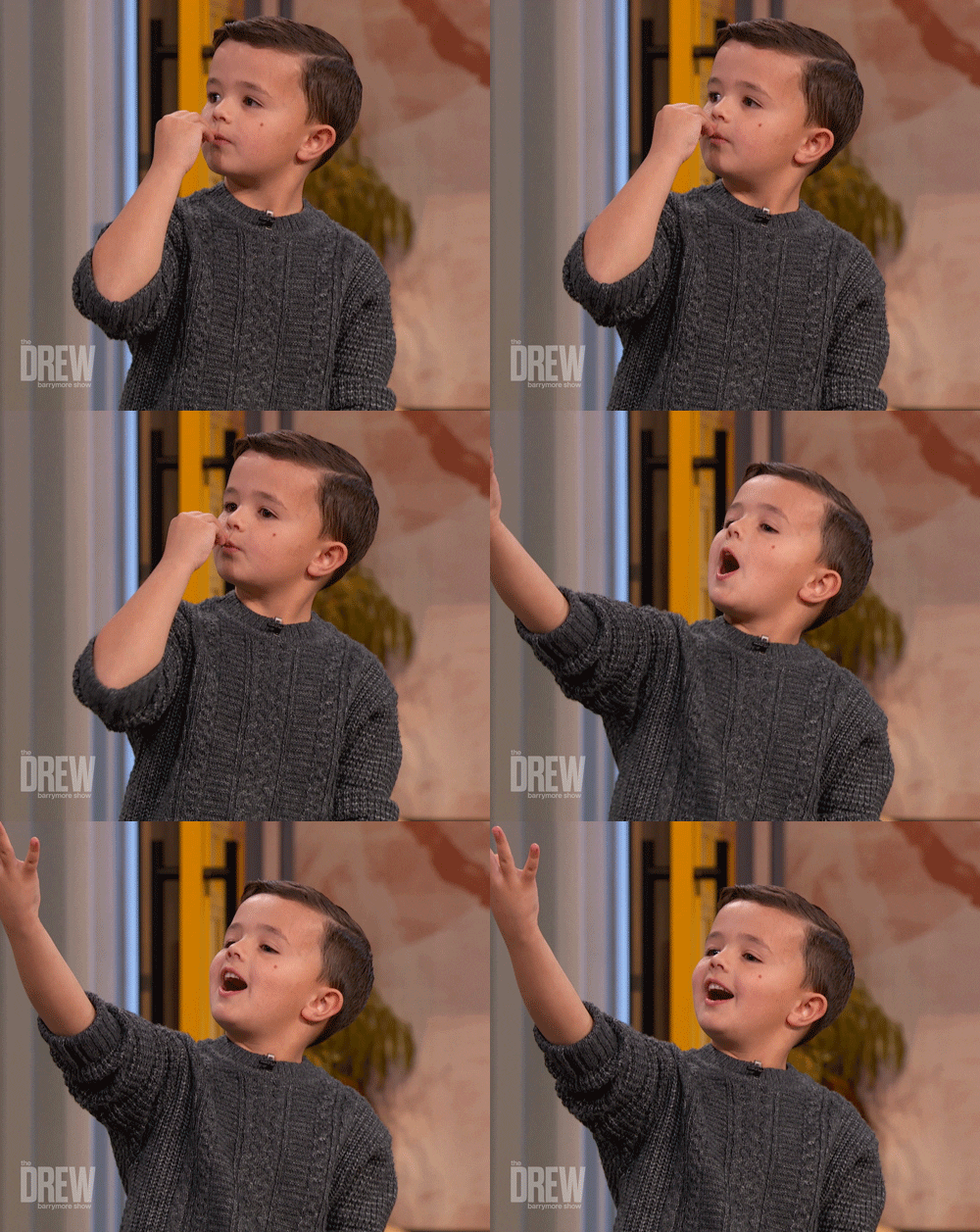
Wait, you don’t understand what I mean?
During the offseason many players work on new developing new skills. For example, a naturally left-handed hitter may learn how to slap in addition to swinging for power. Or a right-handed hitter may get turned around to the left side to take advantage of her speed.
A pitcher may learn a new pitch. An infielder may learn how to throw sidearm from a crouch on a bang-bang play.
A catcher may learn how to throw from her knees. A coach may attend a coaching clinic, such as the ones offered by the National Fastpitch Coaches Association, and learn a new offensive strategy or defensive sets.
But then when they actually play in an offseason game, the slap, the new pitch, the new throwing motion, the new strategies, etc., get stuck in the back pocket in favor of what the player or coach is most comfortable with.
That’s a missed opportunity in my mind. What better time to experiment with something that could be very valuable next summer than when you’re basically just playing for fun or to break up the boredom of practice?
Back when I was coaching teams, that was actually fall ball. You’d basically scrape a few double headers or round robins together on a Sunday, or maybe if you were lucky you’d find a local tournament or two that would give you a chance to play beyond the summer.
Today, fall ball is basically equivalent in importance to the summer. If you’re of recruiting age it may even be more important due to all the college showcase events around the country.
No one wants to risk looking bad in that atmosphere. So even if they’re learning new things they’re reluctant to trot them out on a stage where they could embarrass themselves mightily.
Winter/offseason ball doesn’t have that same level of risk. It’s perhaps the last bastion of “who cares about the outcome?” left in our sport.
So again, what better time to put on the big girl (or big boy in the case of coaches) pants and try something you’ve been working on but haven’t executed in a game yet?

Sure, it could be disastrous. A slapper could end up striking out every at-bat, including in a situation that causes her team to lose.
A pitcher could try out her new riseball and watch as it sails into the upper reaches of the net, scoring not just the runner on third but the runner on second as well. A coach could try a suicide squeeze only to watch in agony as the bunt is missed and the runner is hung out to dry.
Again I say unto you, so the heck what?
Yes, it would be temporarily sad. But it would also break the seal on using those skills or strategies in a game situation.
It would become a learning experience as well, helping the player or coach do better with them the next time. Do it a few times over the course of the offseason and the player or coach just might have the experience – and confidence – to execute them effectively and subsequently become better than they were before.
Remember, if you do what you always did you get what you always got. You’re spending considerable time, and perhaps money, to learn new things. Those new things don’t do you any good if they never get out of your back pocket.
Take full advantage of games without real pressure or consequences to try out new things and get more comfortable with them. If you’re a coach, find out what your players are learning and make them give it a try.
Because that little pebble you toss now may have a significant, positive ripple effect for you next year.
How A Can of Marking Paint Can Help Hitters Hit Better

There is no shortage of companies out there that manufacture a variety of devices to help hitters hit better. Some are worth the money, others may be well-meaning but detrimental, and still others may be just another ploy to separate you from your money.
One thing I have found to be both helpful and affordable, however, is a $5-$7 can of plain old white marking paint. (You may even be able to find it for less.)
Here’s how I came about this amazing discovery.
I was working with a couple of college players last summer on a large field with no fences. They were hitting bombs off front toss, but both felt like they were just popping it up because their hits weren’t getting all that far from the infield. Or at least that’s what they thought.
The problem was it as a HUGE open field with a lot of grass in the outfield. Enough to put a full-size soccer field behind it.
So when they hit the ball, it was a lot closer to them than it was to the other side of the field. Hence their thought that it didn’t go far.
It was at that point I decide to go to the local hardware store and pick up a can of line marking paint. With the can in hand, I paced off 200 feet from home plate and marked a line. I chose 200 feet because that is the typical fence distance in high schools and colleges, so a fly ball past the line would be a home run just about everywhere.

I did this once to left, once to center, and once to right. I then marked lines in-between just to make them easier to spot depending on where you stood.
(I followed this up by measuring with a 100 foot measuring tape. Proud to say I was within one foot of the tape measure thanks to skills I learned in marching band.)
The next time we did a hitting session I was able to show those hitters that those little can-of-corn fly balls they thought they were hitting were actually traveling 210, 230, sometimes 270 feet. That certainly helped them gain a whole different feeling about what they were doing!
I now try to mark those lines on any field I use. Even if a hitter doesn’t hit anything “over,” just getting close can be quite the confidence-booster. Line drives that fall short but roll past are now seen as getting to the fence, which is a whole different feeling as well.
The only downside, of course, is when whoever owns the field cuts the grass. You then have to re-mark the lines or you will lose them. Worst case you simply have to measure again. (PRO Trick: Try to find landmarks out to the sides, like a shed or a permanent sign, to help you find your markers when they fade.)
I have done this with multiple girls and it has produced tremendous results for me. Knowing the lines are out there gives them a goal, keeping them accountable and encouraging them to give their all on every repetition – kind of like using a radar gun on a pitcher.
As great as it is physically, however, I think the best effect is psychological. When a girl sees she is CAPABLE of hitting the ball to or over a fence it changes her entire approach at the plate.
Rather than just hoping to make weak contact she will then intentionally start trying to hit the ball hard. When that happens, the results tend to improve.
If you have a hitter who needs a little perspective like this, try stopping by your local hardware store or home center and picking up a can of line marking paint. It could pay huge dividends for you.
Softball tryouts – hitting off the pitching machine
In my last post, I offered up some general tips for a successful tryout. While it was aimed at high school softball tryouts, the truth is those tips apply to all types of tryouts – and most to more than just fastpitch softball.
Included in the post was a brief mention about getting used to hitting off a pitching machine if that’s what will be used during your tryouts. This is an issue a lot of players face.
They will crush it against front toss and even live pitching. But stand them up in front of a machine and they struggle.
So for all of you who are in that boat, or know someone who is, I’m reprising this video blog to help you make sure you’re ready when it’s time to show your stuff. Follow these tips and you should have much greater success in showing what you can really do.
It’s not where you start the race…
One of my favorite sayings is “It’s not where you start the race that counts, but where you finish.” I will say it to players who didn’t make a team they wanted, or who start the season riding the bench, or otherwise find themselves in a less than desirable position.
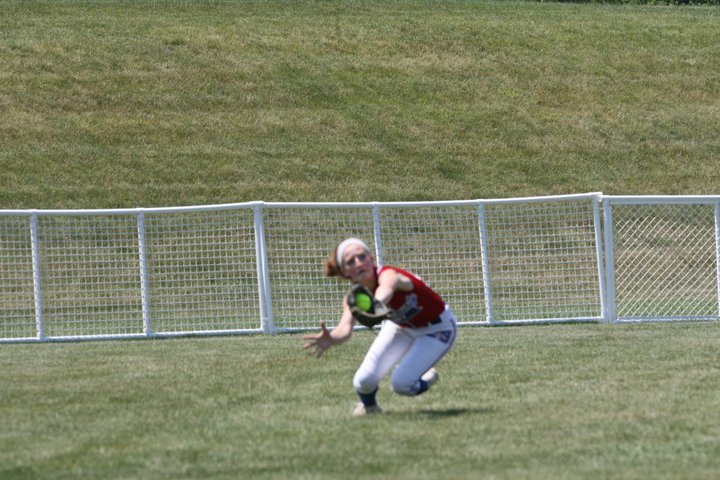
One of my favorite pictures of Erin Yazel. A far cry from the girl who could barely catch a ball hit to her.
Of course, it’s easy to say things like that; platitudes come easily. So I thought I’d share one of my favorite success stories today – one that proves that saying is more than words.
I first met Erin Yazel when she was a first-year 14U player. (I’m old school, so I only recognize even number team levels.) As I understand it, Erin had joined an A-level fastpitch team after coming from rec ball. Not on the basis of her skills as much as the team needed players and Erin tried out.
To put a little more perspective on it, I came to that team as an assistant coach after it was already formed, about midway through the offseason. When you’re working indoors in a small gym it’s tough to get a real read on things.
Once we were outside, however, it became apparent that even though she was an outfielder Erin’s outfield skills were not quite at the level that was expected. That was a potential problem since the team had a few legitimate A-level players and some of their parents were vocal about who could cut it and who couldn’t.
Erin was a hard worker, though, and a good kid, so I went to the head coach and asked her if I could work with Erin separately at practice to help her learn to track fly balls better. The head coach agreed, and off we went. I also suggested to Erin that I could meet her before practice, or stay after, to help her hone her skills some more. She was more than willing since she wanted to be a full-fledged contributor and she, her dad Steve and I spent a lot of time together.
Over the course of that first season she got better and more reliable, although she did end up breaking her nose in a game when she lost track of a fly ball in center. That one was ugly to see and hear, but it didn’t stop her. After a couple of weeks off she was back on the field, more determined than ever.
One of the qualities Erin brought with her was that she was fast – like 2.7 home to first fast. So naturally I suggested she spend the off-season becoming a lefty slapper.
We worked on that the entire winter, along with bunting and swinging away, and by the next spring she was a different player. She took naturally to slapping and soon had earned the leadoff spot in the lineup for our travel team. She also made her JV team as a freshman, and likely would’ve gone straight to varsity if the head coach hadn’t come straight from baseball and didn’t understand the importance of speed and the short game (a deficiency he fixed the following year, by the way).
Erin went on to have a great high school career as well as a travel ball career, and actually came back to me a couple of years later to play on my IOMT Castaways team. I encouraged her to try college softball, and even helped her make a recruiting video, but in the end she decided it wasn’t for her.

Erin’s ISU club team. She is first row, second from the right.
But that doesn’t mean it was the end of her fastpitch career. Instead, she became involved in the Illinois State University club team. If you’re not familiar with the concept, club teams are groups of girls who form their own teams and play against similar teams from other schools. It’s fun and competitive, without the bigtime commitment and time sink of playing at the college varsity level.
This past year was Erin’s second playing for the Redbirds, and it’s clear she’s still loving the game. Her mom Judy sent me her stats.
For the season she had a batting average of .488, with an OBP of .533 and slugging percentage of .537. In 41 at bats she had just 4 strikeouts, and her OPS was a healthy 1.090. You can check out her whole line here.
That’s pretty impressive for a girl who had trouble even getting on the field her first year of travel ball. But it shows what you can do when you have a love for the game, the determination to improve, and the support of great parents. Not to mention self confidence, which Erin always had boatloads of despite some of the outcomes.
So if you’re not quite where you want to be, take a lesson from Erin. Don’t let anyone else define you, and don’t define yourself by where you start. Because that doesn’t matter. The most important consideration is where you finish.
Be the you they already like
This one is for all the fastpitch softball players (and other athletes as well) who are having trouble with being nervous because you’re afraid of failing or letting the team down. In other words, facing a lack of confidence. 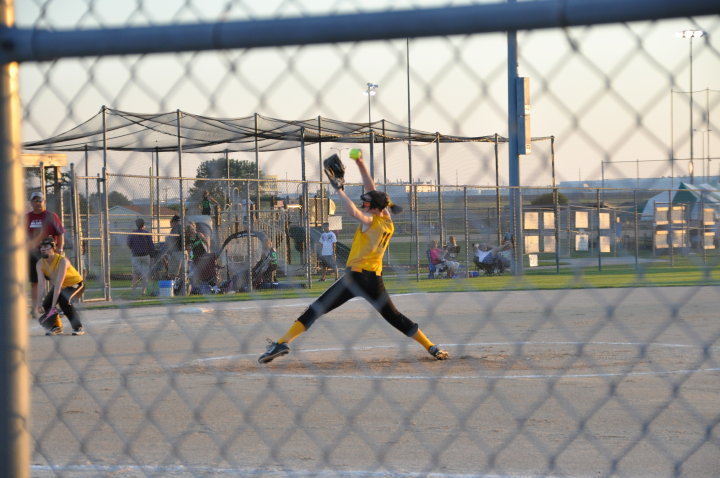
First off, know that everyone goes through this now and then in every walk of life. Even the professionals who are being paid millions of dollars (thousands of dollars in the case of pro softball, but that’s a story for a different day) to play.
The best thing you can do for yourself is to forget about trying to live up to some ideal you think you have to meet and remember that your coach put you on this team for a reason. He or she thought you had something that would help the team win, whether it’s a game, a tournament, a conference championship or some other prize. All you have to be is who the coach already saw and you’ll be fine.
So if you’re a hitter, instead of hesitating until the last possible split second before you get into your swing, start early and slow so you can be aggressive in putting the bat on the ball. She who hesitates tends to hit pop-ups and grounders. But hitters who take their practice swings into the batter’s box and make a plan to hit the ball hard usually do.
If you’re a pitcher who has put the work in, there’s no need to worry about whether you can throw strikes. If you did it in practice you’ll do it in a game. Quit focusing on outcomes and instead just relax and pitch your game. If you’ve been handed the ball the coach clearly thinks you can get the job done. Why would you argue with the coach? 🙂
It’s the same for fielders too. Unless you’re a super great hitter who the coach is trying to hide on defense, you know what to do when the ball comes to you. Just do it. (No, this is not a paid placement.)
Look, everyone makes an error now and then. Everyone has a bad day at the plate, or in the circle, or on the basepaths. That’s what makes the game of softball so hard – and so good when it goes well.
You don’t have to be the next Cat Osterman or Sarah Pauly or Lauren Chamberlain or anyone else. You just have to be you. Just do the things that got you into this position and you’ll have all the success you could ever imagine.
Now go get ’em!






 Life in the Fastpitch Lane