Blog Archives

Little Things That Make a Big Difference
It seems like softball coaches, players, and especially parents are always in search of the “silver bullet” – that one technique or piece of knowledge or magic adjustment that will take an average (or below-average) player and turn her into a superstar.
That desire is actually what keeps a lot of what I would call charlatans – people who claim to have a “secret sauce” when really what they have is a knack for hyping otherwise very ordinary solutions – in business. It’s also what drives some of the incredibly crazy drills or controversial posts you see on social media.
Well, that and a need to constantly feed things into the social media machine so they can keep getting those clicks.
In my experience there is no single silver bullet or secret sauce drill that can turn an average player into a superstar overnight. There is no “next big thing” either.
But there are a lot of little things that can make a huge difference in your game if you learn to execute them properly. Here’s a little collection of some of them.
Pitching a rise ball
The rise ball is often the toughest pitch to learn. That’s because getting true backspin on a 12 inch softball (versus the typical bullet spin) requires the pitcher to do some things that work against the body’s natural tendencies.
One of the biggest has to do with what the hand and forearm do at release.
The natural movement for the hand and forearm as they pass the back leg is to pronate, i.e., turn inward. If you hold your arm up and let it just drop behind you, you’ll see that inward turn when you get to the bottom of the circle.
Try it for yourself, right now. Go ahead, I’ll wait.
When you’re throwing a rise ball, however, you have to keep the hand and forearm in supination, i.e., pointed outward, as you go into release if you want to be able to cut under the ball and achieve backspin. Otherwise you’re throwing a drop ball.
What often happens, however, is that in trying to keep the forearm and hand pointed out, the pitcher will cup her hand under the ball so the palm is pointed toward the sky or ceiling. That may work to impart backspin when doing drills from a short distance away, but it will also create a “big dot” spin instead of a more efficient and active “small dot” spin when thrown full-out.
So, to throw a true backspin rise the pitcher needs to learn to keep the palm of her hand pointed mostly out to the side, with just a slight cupping of the fingers. In other words, throw with more of a fastball-type orientation (fingers down) going into release, then angle the hand back up slightly so the fingertips are under the ball instead of to the side.
Do that and you have a much better chance of getting 6 to 12 backspin. (For those unfamiliar with that term, think of an analog clock, with the spin direction moving from the bottom at 6:00 to the top at 12:00.)

Another key is to freeze the fingers at release rather than trying to twist the ball out like a doorknob.
Again, twisting or “twizzling” the ball (as Rick Pauly calls it) will work when you’re self-spinning or throwing at a short distance. But once you try to put any energy into the ball, your hand’s natural tendency to pronate or turn in (remember that from a few minutes ago?) will cause you to turn the palm forward and create bullet spin.
Now, if you can throw the ball 70 mph or more, I suppose it doesn’t matter how your rise ball is spinning so you can get away with that. But if you’re not, forget the twizzling and make sure your hand simply cuts under the ball like a 9 iron hitting a golf ball onto the green and you’ll have a lot more success with it.
Bend in slightly to the curve ball
The curve ball tends to have the opposite problem. Here, you want your hand to be palm-up (if you’re throwing a cut-under curve) so the spin axis is on top of the ball.
The problem is many pitchers will tend to extend their spines a little as they go to throw the curve, which will naturally make the hand tend to sag down, turning the palm more out and away rather than up.
To avoid that issue, try bending in slightly over your bellybutton (on the sagittal plan for those who love the technical terms). That slight bowing in makes it easier to maintain a palm-up orientation, placing the spin axis on the top of the ball and creating a better chance for the fast, tight spin that enables a late break.
Get hitting power from your hips, not your arms
Look, I get it. You hold your bat in your hands, which are at the ends of your arms. So logically you would think to hit the ball harder you should use your arms more if you want to swing the bat harder.
And yes, that will work if you’re on a tee, where the ball isn’t moving. But if you’re not 7 years old, it won’t work so well when the ball is moving.
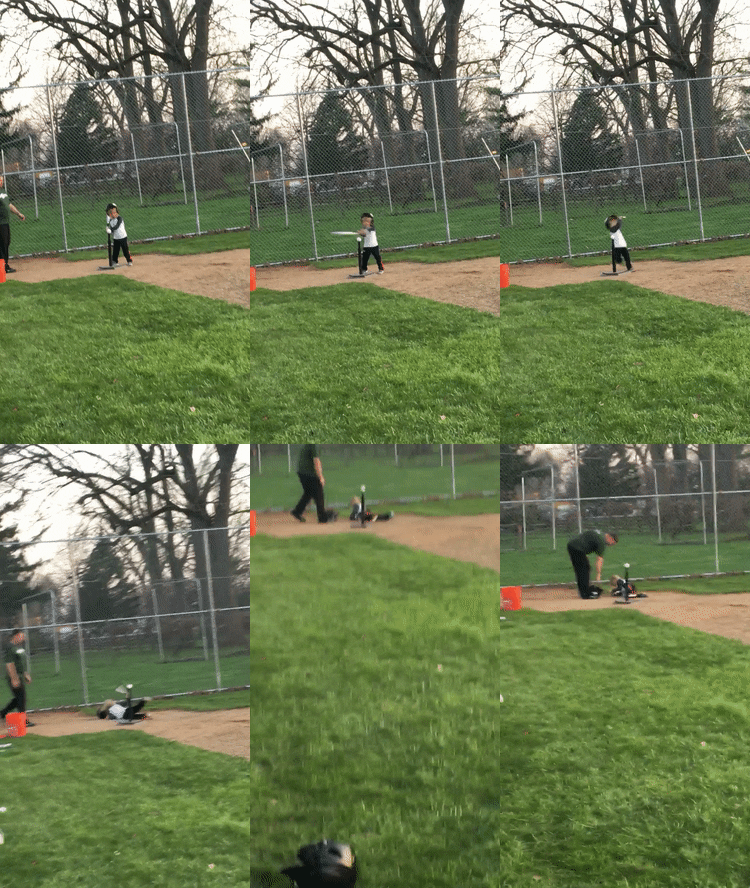
The reason is when you use the arms to create power, you give up control of the bat. You’re just yanking it wildly and hoping something good would happen.
The better approach is to use your hips (and core) to generate energy through body rotation. More energy, in fact, than you can create with your arms.
Then use the arms to easily direct that energy toward the ball. Approaching it this way will give you the adjustability you need to take the bat to where the ball is going instead of where it was when you first started the swing.
Generating power from the hips first also gives you more time to see the ball before you have to commit the bat, further allowing you to fine-tune the path of the bat to where the ball will be when it gets close to the plate.
Remember, the difference between a great contact and a weak one, or no contact for that matter, can be measured in centimeters (fractions of an inch for those who don’t remember the metric system from school). The ability to make fine adjustments during the swing is often the difference between a great hit and a poor one. Or none at all.
Shoulder tilt creates bat angle
While we’re talking hitting, another small adjustment has to do with the angle of the shoulders at contact.
We’ve all heard the instruction to “swing level” at some point or another. Many of you may have even said it, or say it now.
But if by swing level you mean having the bat parallel to the ground you’re just asking for a season filled with pop-ups and ground balls.
If you look at great hitters at the point of contact, you’ll see that 99 times out of 100 they have an angle on the bat that slopes down from the handle to the barrel. If you look a little further, you’ll see that the angle of the bat usually matches the angle of the shoulders.
So…if you want to get a great bat angle to hit rising line drives and other powerful hits, you don’t really need to manipulate the bat. You just need to let the back shoulder tilt downwards toward the ball. This preferably happens about halfway through the turn rather than dropping the shoulder first and then turning.
Think of the back shoulder as an aiming device. Once you see where the ball is headed, take the back shoulder in that direction and swing on a plane that matches the shoulder angle.
Before you can say “Bob’s your uncle” (always wanted to use that one) you’re crushing the ball deep – without having to do any crazy manipulations.
A better way to put on your glove or mitt
Given the power of the Internet to spread information I’m surprised that this little trick isn’t more well-known.
When most people put on a softball glove or mitt, they tend to put it on as they do a regular glove, i.e., one finger in each slot. I mean, it makes sense, right?
But that’s now how the pros do it. The problem with the one finger, one slot approach is that you ring and little fingers are your two weakest fingers. Far weaker than the index and middle fingers.
So when you go to catch the ball, your weakest (little) finger is trying to close at least half, if not more, of the glove by itself while the strongest part of your hand is closing the other half. You don’t have to be an anatomy expert to figure out why that can contribute to a lot more dropped or mis-handled balls.
Here’s a trick that can solve that issue: Take your ring and little finger, hold them together, and then slide them into the loop in the last finger stall. Then move each of the other fingers over one toward that end, leaving the area for the first finger open.
Now your two weakest fingers have combined to create one stronger finger, better balancing the closing power between the thumb and other side of your hand. You middle finger also gives somewhat of an assist to the other two.

And bonus, you no longer have to leave your index finger out of the glove to keep it from hurting when the ball hits the palm of the glove because it’s not in that spot anymore!
It’s going to feel awkward at first, especially because your hand won’t go into the glove quite as deeply. But try it for a month. You’ll never go back to the old way.
Little things mean a lot
None of these little tips are earth-shaking or revolutionary. But each of them can make a significant difference in your performance.
If you’re struggling with any of these issues, give these tips a try. It’s amazing the difference a slight adjustment can make.
Champions Take Their Warm-ups Seriously

You see it before a game or practice everywhere there’s a ballfield.
Teams positioned in two opposing lines, randomly throwing balls in the general direction of the other line. And then chasing said balls behind them.
Hitters casually knocking balls off tees into the bottom of nets – or over the top. Pitchers sleepwalking through a reps of a K drill or slowly strolling through a walk-through instead of going full speed.
Not just youngling rec teams either. The same behavior can be seen with high school teams, travel ball teams, even college teams.
It’s players sleepwalking through warmups as if they are something to be (barely) tolerated before the “real thing” begins.
That’s unfortunate on many levels, but mostly for what it says about those players’ dedication and desire to play like champions.
You see, champions realize that we are a product of our habits. They also realize the importance of paying attention to details.
Warm-up drills should be about more than just getting your body moving and your muscles loose. They should also be preparing you to play or practice at your highest level.
So if you’re just going through the motions, waiting for practice or the game to start, you’re missing a real opportunity to get better.
Take that hitter who is basically just knocking balls off the tee before a game. Hopefully she knows what she needs to do to hit to her full potential, and what she needs to work on to get there.
So if she’s just taking any old swing to satisfy the requirement of working at that station she could actually be making herself worse instead of better because she’s building habits (such as arm swinging, dropping her hands, or pulling her front side out) that may let her get the ball off the tee but won’t translate into powerful hits in the game.
Or take the pitcher who is sleepwalking through her K drills instead of using that time to focus on whether her arm slot is correct, she is leading her elbow through the back half of the circle, and she is allowing her forearm to whip and pronate into release. She shouldn’t be surprised if her speed is down, her accuracy is off, and her movement pitches aren’t behaving as they should when she goes into a full pitch.
Even the throwing drills that often come right after stretching require more than a half-hearted effort. Consider this: as we have discussed before, 80% of all errors are throwing errors.
Which means if your team can throw better, you can eliminate the source of 8 out of 10 errors. Cutting your errors down from 10 to 2 ought to help you win a few more ballgames, wouldn’t you think? That’s just math.

Yet how many times have you seen initial throwing warmups look more like two firing squads with the worst aim ever lined up opposite of each other?
That would be a great time to be working on throwing mechanics instead of just sharing gossip. Not that there’s anything wrong with talking while you throw. But you have to be able to keep yourself focused on your movements while you chat.
Even stretching needs to be taken seriously if it’s going to help players get ready to play and avoid injury. How many times have you seen players who are supposed to be stretching their hamstrings by kicking their legs straight out and up as high as they can go take three or four steps, raise their legs about hip-high, take another three or four steps, then do the same with the other leg.
Every step should result in a leg raise, not every fourth step. And if young softball players can’t raise their feet any higher than their hips they have some major work to do on their overall conditioning.
Because that’s just pathetic. Maybe less screen time and more time spent moving their bodies would give them more flexibility than a typical 50 year old.

The bottom line is many players seem to think warm-ups are something you do BEFORE you practice or play. But that’s wrong.
Warm-ups are actually a very important part of preparing players to play at the highest level and should be treated as such. If you don’t believe it, just watch any champion warm up.
Don’t Just Put In the Time – Put In the Effort

One of the most common questions coaches get at the end of a lesson or practice session is, “How long and how often should my daughter practice?”
While it’s a legitimate concern – parents want to their daughters get the full benefit and they get a better return on their investment – I tend to think they’re asking the wrong question. Here’s the reason: practicing is not actual time-based; it’s quality-based.
Take two players who are at the same skill level and have been assigned the same drill(s) as “homework:”
- One diligently does the homework, being mindful of her movements and attempting to execute the skill the way she has been taught. She does this for 20 minutes three times before she has her next lesson.
- The other goes out to practice for a half hour three days a week between lessons. But she doesn’t like doing drills because it’s “boring,” so she instead just decides to pitch from full distance or take full swings or field ground balls hit by a partner etc. the whole time.
Which one do you think will show improvement in the aspect that needs the most help as well as in the overall skill?
Player two put in more time – an extra half hour to be exact. If time were the only factor that counted she should do better at the next lesson.
But I will tell you from experience, and bet you dollars to donuts, that player two will be the one who is most likely ready to advance further at the next lesson. She may not have put in as much time, but she put in more effort to solve her biggest issues – the one that is most limiting her.

So if she’s a pitcher who was straightening out her arm on the back side of the circle, she is now far more likely to have a nice elbow bend or “hook” as her arm gets ready to throw the ball. If she is a hitter who was dropping her hands straight to her waist before swinging, she’s far more likely to be keeping them up and turning the bat over to get the ball.
That’s because she mindfully worked at changing what she was doing. She is serious about improving so she put in the effort to make those changes.
Player two, on the other hand, actually put herself further away from her goals by practicing as she did, because all she did was reinforce the poor mechanics she should be trying to move away from.
Yes, she put in the time and could mark it down on a practice sheet, but she didn’t put in the effort. Without the effort to improve, the time is pretty much meaningless.
She would have ended up in exactly the same place at best if she hadn’t practiced at all. And she may have ended up further behind because now those extra reps with the wrong techniques will make it that much more difficult to get her to the right path.
If your daughter is going to spend her valuable time on practicing her softball skills, or anything else for that matter, make sure it’s on something that will help her advance her abilities forward.
Have her make the effort to concentrate specifically on the areas that need improvement rather than spending all her time making full pitches, full swings, etc. and you’ll see faster progress that leads to greater softball success.
P.S. For any parents of my students who may think I’m talking about their daughter, don’t worry. I’m not. It’s a big club. But do keep it in mind as you work with your daughter anyway!
10U Coaches: You Have One Job – Player Development

Last night I was speaking with one of my 10U pitching students during her lesson. I knew from GameChanger (and a text with her mom) that she had pitched two innings the previous weekend, facing six batters and striking them all out. Not a bad performance overall.
I asked what pitches she threw. She said one drop and the rest fastballs. “What about your changeup?” I asked.
“My coach doesn’t want me to throw changeups,” she replied. “He says he only wants strikes.”
My blood immediately started to boil as I’m sure you can imagine. Statements like that, in my opinion, demonstrate world-class ignorance, both about pitching generally and the mission of a 10U coach.
For those who don’t quite get this, I will type it slowly. As a 10U coach your primary job is not to rack up a great win-loss record.
YOUR JOB IS TO DEVELOP YOUR PLAYERS. Period, hard stop.
If that means you give up a few walks, or a few runs, while your pitchers gain experience throwing more than a basic fastball, so be it. In the long term you will benefit, because as hitters get older pitchers can’t just blow the ball by them anymore and need to have other pitches available to them if they’re going to get outs.
If that means you have a few more strikeouts at the plate because your hitters are swinging the bat instead of just standing there waiting for walks, so be it. Instructing your players to wait for walks so you can score more runs benefits no one.
Because if they don’t learn to be aggressive and go after pitches when they’re young they’re very likely to stand there and watch strike after strike go by when the pitching gets better. And then where are you?
If that means you don’t throw out as many runners stealing bases because you’re having your catchers throw before the fielder reaches the base, or you’re teaching your infielders to cover the base instead of having your outfielders do it, so be it. Down the road you won’t be able to play your outfield that close to the infield so somebody better know how to get over there. And get over there on time to get a runner out.
The same goes for trying to get the lead runner on defense instead of making the “safe” play to first – or worse just trying to rush the ball back to the pitcher. If a few more runners advance and eventually right now, so be it.
As your players get older and stronger and presumably more capable they will be able to make those plays – and will have the confidence to attempt them.
I get it. We all like to win. As they say in Bull Durham, winning is more fun than losing.
But again, at 10U (and even at 12U or 14U to a large extent) your focus should be on developing your players and teaching them to love the game rather than massaging your own ego. You should be playing teams of comparable quality and should be teaching your players to play the game the right way.
You shouldn’t hold them back or prevent them from trying new things they’ve been working on. Instead you should be encouraging them to grow, and giving them the opportunity to gain higher-level experience rather than simply playing it safe.
Does that mean go crazy with it? Of course not.
If a pitcher tries a particular pitch and doesn’t have it that day then yes, stop throwing it that day. But don’t not throw it at all because it might not work.
If a girl has been working at pitching and wants an opportunity to pitch in a game put her in. She may just surprise you.
But even if she struggles she will either learn what to work on to get better or she’ll decide it’s not for her. Which is a win either way.
If your hitters are swinging at balls over their heads or balls in the dirt, call them together and give them a narrower range to go after. But don’t take the bats out of their hands completely, just in case that wild pitcher manages to throw a few strikes.
So how do you strike that balance? Here’s an approach for that pitcher who wants to try a new pitch.
Pick a safe count like 1-1 and have her throw it. Even if she chucks it over the backstop the count is only 2-1. And since she’s already demonstrated an ability to strike out the side anyway you know she’ll come back.
But what if she throws it for a strike (which in this case we all know she probably will)? Now the count is 1-2 and she’s gained more experience throwing it in a game.
That experience will come in handy down the road when she faces a team that can hit her heat and thus needs to knock them off-balance. Hitting is about timing, and pitching is about upsetting that timing. Plain and simple.
If that isn’t enough incentive, here’s something to consider. Coaches who hold back players who are driven enough to want to throw changeups or swing the bat or make advanced fielding plays don’t keep those players for very long.
Instead, those players seek out teams where they can grow and learn and be encouraged to expand their skillset instead of being put into a tight little box so their coaches can win more meaningless games. And in the big picture, ALL 10U games are meaningless.
Every coach and every program likes to proclaim that they are “in it for the girls.” But talk is cheap.
If you’re really in it for the girls, give them the space to grow and improve – even if it costs you a few wins today. Your players, and your team, will be much better off in the long run.
Tip for Learning to Feel the Separation of Hips and Shoulders When Hitting

One of the most critical moves in fastpitch (or baseball for that matter) hitting is learning to separate the hips and shoulders. By allowing the hips to lead, the hitter can:
- Generate more power by enabling the big muscles to generate tremendous energy (much more than the arms or shoulders alone can do)
- See the ball longer
- Shorten the distance the bat has to travel to make contact with the ball
- Enable themselves to adjust to pitch speed and location more easily than with an arms-driven or one-piece gate swing
- Carry the bat forward so you’re hitting out front instead of across the body
Yet while that makes logical sense, and can be seen in the swings of high-level players, learning to actually do it can be difficult for many players. They tend to want to bring everything forward at once.
What I usually tell them is they need to counter-rotate their upper body when the hips start to fire. In other words, when the front foot lands and the hips start to rotate forward, the shoulders should pull back a little against them. The hips will then pull the shoulders around so they can launch the bat.
Sounds simple, right? But hitters can’t always visualize that move, or feel it. So here’s a way to help them get it.
Take a piece of elastic, the type you can easily find at a fabric store or big box retailer, and tie a loop in one end. Then slip the front foot into the loop, and wrap the other end around the bat handle.
Now, when the hitter lands and the hips start to rotate, tell her to use her hands and shoulders to stretch the elastic further. Bam, you have separation and sequence. Simple!
Here’s how that looks:
You can see the stretch of the elastic as she makes the first move. She does it again as she goes into the swing.
The question then is does it translate? Here’s a video of the swing after the elastic has been removed.
Now, swinging off a tee isn’t the same as swinging at a live pitch. It’s still going to take some practice to lock it in.
But at least she has a great start on it.
If you’re looking for a tactile way to help hitters learn this important move, stop by your local fabric store and pick up some elastic. It help shortcut the learning process.
Fixing Timing Problems In Live Hitting

Tell me if you’ve seen (or personally experienced) this before. A hitter looks great on the tee. All her mechanics are correct and her movements are correctly sequenced. She’s pounding the ball so hard you’re afraid it’s going to break the back of the cage.
Then you move her into a live hitting situation – doesn’t have to be a full pitch, it could be easy front toss from a short distance – and suddenly that potential game-winning swing all falls apart.
Instead of driving the ball, the hitter is popping up, especially to the opposite field, or hitting weak dribblers back to the pitcher. What the heck happened?
Odds are she’s late getting to the bat to the ball. And no matter how soon she starts, she continues to be late.
You’ve probably heard it said on many occasions that hitting is all about timing. Well, that’s true, but not always in the way you think.
It’s not just about the start time. It’s really about where the hitter’s front foot is when it’s time to swing.
The front foot landing should be the trigger for the swing (i.e., the launch of the hips) to begin. Which means it has to be down on time. If it’s not, there’s no time to execute the rest of the swing and what you’ll end up with is essentially an arm swing, with the body following afterwards.
Ok, you understand this can help when the hitter doesn’t get going on time. But your hitter, if anything, was early and yet she still was behind the actual pitch.
I call this syndrome “early to be late.” What happens is the hitter sees the pitcher go into her motion and she begins her load. Then she realizes she started too early, so she stays back in the loaded position and waits for the pitcher to release the ball.
At that point it’s game over, advantage pitcher. There is simply not going to be enough time to stride/weight shift properly, launch the hips (without the shoulders), turn the shoulders, and bring the bat to the ball.
Getting stuck on the back side during the load is deadly to hitters. What they need to do instead is “bounce off” of it. In other words, they need to “load and go” right away rather than sitting and waiting for the pitch to be thrown.
Ideally, they will adjust their start time to make that happen. But if they can’t break the habit of being early they should learn to eat up the time difference by striding/weight shifting slower to be sure the front foot is down on time so the rest of the swing can be executed.
I’ve personally seen the difference this seemingly slight change makes. Rather than struggling to get to the ball (and feeling overwhelmed, which leads to arm swings), hitters suddenly feel more in command.
They get to that “oh yeah moment,” where the ball looks like a beach ball and they’re ready to jump on it, more consistently. And avoid that “oh crap moment” where they realize right before the swing that nothing good is going to happen.
How do you get there? Same way you get to Carnegie Hall.
Ok, seriously, hitters have to train themselves to overcome their basic instincts to wait on the pitch and start striding/weight shifting, even if they feel like it’s too soon. Once they can get to that point, and see the results, they’ll be more inclined to replace the old habit with a new one.
On the tee, or even at home in a bedroom, have hitters consciously work on their “load and go” mindset. Then do front toss and look for that hesitation.
If they still can’t break the habit, stand in front of them without the ball and go through the motion, encouraging them to get off that back side and start their forward movement at the right time. Then go back to front toss, and finally to full-length pitching.
It may take some time – the mind is a powerful thing, and once it latches onto something it doesn’t always like to let go. But sooner or later a willing hitter can overcome it.
Once she does, she’ll be well on her way to becoming the hitter she wants to be. And that you want her to be.
The “Dummkopf” Drill for Fastpitch Hitters

Ok, before anyone gets their undies in a grundy, I’m not calling players name or saying this fastpitch hitting drill is only for stupid people. It’s merely a device I’m using to make what could otherwise be boring a little more fun.
The purpose of the drill is to teach hitters to lead with their hips, then release the hands. All too often hitters will either start the swing with their hands, or will start with their hips but then let the hands take over too early.
Ideally, you’ll want a sequence of hips-shoulders-bat/hands, where the hips start a powerful rotation, then you add on the shoulders, then you finally get the hands involved. When you go in that order you use the big muscles to develop more power and batspeed so when you do make contact you hit the ball harder/farther.
Going hips-first also gives the hitter more time to see the ball before she commits, enables a shorter swing to the ball, and puts the bat into the green zone at contact. Lots of great reasons to go hips-first.
While that may be easy to say it can be tougher to execute. You want to hit the ball with the bat, and the bat is held in the hands, so for many hitters (especially young ones) it makes more sense to lead with the bat. They may try to hold it back, but it’s just so tempting.
So I came up with the “dummkopf drill.” Here’s how it works:
The reason for the name of the drill is it’s based on WWII movies where one of the German soldiers is asked a question, answers it, and then is slapped in the head and called “dummkopf” by his superior. (SIDE NOTE: All the German I know comes from WWII movies, so it’s a pretty limited vocabulary. And not very useful in everyday conversation unless I were to find myself in a WWII prison camp.)
In this case, there were two purposes. One was to get the sequence right. The other was to help Abbey, who is pictured here, get the feeling of transferring her weight into the front leg instead of spinning on the back leg. As you can see, it accomplished both missions.
We could have done the drill without adding the callout “dummkopf” at the end. But it wouldn’t be as much fun. Using the word also helped her focus more on the point of contact, since she was trying to slap the rubber part of the tee upside its virtual head.
So if you have a hitter who is having trouble leading with her hips instead of her bat, give this one a try. And be sure to leave a comment below letting me know how it goes.
Congratulations to Grace Bradley on Making All-State

This is a quick one today. Earlier this week I received a very happy text from my student Grace Bradley’s dad Greg. The text told me they just found out Grace was voted to the Class 3A All-State third team by the Illinois Coaches Association.
My guess is that Grace made it based on her contributions both as a hitter and a pitcher. (I only work with her on hitting, so I’ll claim half my usual 10% credit.)
Grace definitely had a breakout year at the plate in high school ball, playing for Grayslake Central. She hit .451, with a total of 46 hits, one shy of tying the single-season record, including 9 HRs 1 triple, and 5 doubles. Had one of her long balls not been erroneously called foul by an umpire in one of their early games (according to several who witnessed it), Grace would not only have that record but she would owe me ice cream. Instead, I’m buying.
The rest of her hitting stats were great too. Batting second most of the season she had 34 RBIs and scored 38 runs. She had an OBP of .517, a slugging percentage of .784, and an OPS of 1.302.
That’s a darned fine season in anyone’s book. Even better, she was only a junior this past season, so she has another off-season to work and maybe grab a couple of those records!
The best part, though, is Grace is a quality human being. There are plenty of great players who you tolerate for their abilities but don’t especially think much of personally. That’s not Grace at all.
She is kind and humble, with a great attitude and work ethic. She always says “thank you” after every lesson, even if things didn’t go as well as she’d like. I think most of us like to see good things happen for good people, and in this case it did.
Obviously, she’s a hard worker too.
In the past she has always hit for contact, but we agreed there was more to her. She really worked hard this past off-season on adding power to her swing, and the results speak for themselves.
So congratulations on adding All-State to her All-Conference and All-Area honors. Now it’s time to take that success to the summer season!
Another hitting myth: Keeping the head steady

When you spend as much time as I do around batting cages, one of the things you’re bound to hear is a coach telling a hitter about the importance of keeping his/her head steady. What the coach means by this is that you should set your body in a position, and then the head should stay there throughout the entire swing.
The rationale is that if the head is moving then the eyes are moving, and it’s too hard to see the ball that way. With a steady head – presumably one where if you had a video and put your cursor on the head it stays in one place throughout the swing – you should get a better look at the ball and be able to hit it.
Only one problem with that theory. That’s now how high-level hitters hit, as this video shows. While in some cases the camera is moving and therefore you can’t really mark it and watch, in others it’s rock steady. If you place your cursor on the starting position you’ll see a couple of things.
First, in most cases the head moves from back to front. That’s because as the hitter strides there is a linear movement forward with the core of the body, carrying the head (and eyes) along with it. Unless you stand still and spin for the swing, which is not a good idea, the head is going to have to move forward.
The other thing you’ll see on lower pitches is that the head moves downward as the hitter follows the ball down. That makes sense.
You don’t want to stand upright and drop your hands to hit a lower pitch. You want to go down with it, both to get a better look at the ball and to be able to use your entire body to hit it.
If you stand up tall, with your head frozen in place, you’re far more likely to hit a weak ground ball. But if you let your body (and head) move, you can lift that low pitch into the outfield – and perhaps even over the fence.
Think about this, too. In the rest of our lives, our head and eyes are moving all the time. If you’re driving, your head is moving forward, perhaps being bounced around by the road, and maybe even bobbing to the music. But you can still see just fine.
Tennis players are constantly on the move, returning sometimes high speed volleys with a ball that’s substantially smaller than a softball. They can see it just fine.
Infielders have to move left or right, up or back, to field hard grounders and pop-ups. Doesn’t seem to hurt their ability to see.
The fact is our eyes (and brains) have an amazing ability to adjust to our surroundings, and to take in and process information while we are on the move. If they didn’t our species would have died off a long time ago.
Clearly you don’t want the head swinging all over the place for no reason. But trying to force the head to stay “steady” is attempting to solve a problem that doesn’t exist. To hit well, the body needs to adjust, and the head with it. Otherwise you’ll wind up with a disconnected swing – and a stiff hitter. And no one wants that.
For all those who have struggled with a pitching machine
Over the last few years there has been a lot of debate over whether pitching machines are helpful or useless. Some say they’re not very realistic, while others realize it’s often the only means at their disposal to simulate a pitch coming in at full speed and distance.
Players also have their problems, saying they can’t hit off the machine, despite hitting well otherwise.
What I have found, however, is like anything else, the pitching machine is just a tool. It’s how you use it that’s the problem. This video goes into detail on where the issues arise and how to deal with them so you can incorporate machines into your practice – or if you’re a player, how you can get past the flaws.
This is my first vlog, by the way. In the future I’ll work on carrying a bit more friendly of a facial expression. 🙂






 Life in the Fastpitch Lane