IHSA softball pages
For those of you from Illinois, I just have to wonder how old the photos are of the players on the IHSA’s softball pages. From what I’ve seen it looks like all of them on both teams are wearing shorts.
Everybody pretty much went to pants about five years ago. Maybe it’s time to take a few photos at this year’s championship and third place games and do some upgrades. 🙂
Lesson learned from the WCWS
So another WCWS is behind us. Have to admit there was some terrific play and some incredible games to watch. Auburn came darned close to completing their Cinderella run, and all the teams competed well – even those that went out in two straight.
There were some bad plays as well – simple errors such as a ball going through a shortstop’s legs, misjudged fly balls, poor baserunning – all the things we yell at our 12U and 14U players for. Even the big girls get it wrong sometimes.
But the thing that struck me most were the smiles on the players’ faces – even when something went wrong. It’s not that they were taking the game lightly. But they had an appreciation for where they were and what they were doing.
Here they were, on one of the biggest stages in the country, playing on TV before millions of viewers. Despite the fact they made an error or hit a batter with a pitch, or popped up in a crucial situation, those players kept on smiling.
That’s some pretty amazing coaching, to create an atmosphere like that where they could not only play for the love of the game but show that love outright. To me that was the biggest lesson we all can learn.
While it may seem like life or death in the heat of the moment, it’s really not. Teams with players who can smile through adversity and move on to make the next play will always do well. Those who dwell on their mistakes instead of enjoying the moment are likely to implode.
Be the team that smiles.
The fun of working with younger players
Sometimes when you’re used to working with older players (high school age or close to it), going back to working with younger girls can take some adjustment. They don’t have as much body awareness, and attention spans can be a bit short. It can also take them a bit longer to truly retain everything you’re working on. But there are also some upsides.
I experienced one of those tonight. I was doing a hitting lesson with a 10U player named Isabella. We’ve been working on the basics, and she’s coming along. Her father mentioned that in her tournament over the weekend she’d been backing out of the box some, and seemed reluctant to try out her new swing.
So, I figured that after we did some tee hitting I would try pitching some Whiffle balls to her instead of regular balls.
Good idea on my part. Isabella started getting the hang of it and taking more aggressive swings. She started hitting those Whiffles hard too.
But the best part was what happened when the bucket emptied. I said “let’s pick ’em up” and she immediately asked “Can we do it again?” We still had time so of course I said “sure.” When we finished that bucket she asked if we could do another. Clearly she was having fun – and building confidence in her swing.
Honestly, I think if I hadn’t finally called it we’d still be out there.
You have to love that enthusiasm. And that’s the fun of it. Certain aspects may take more work, but when the light bulb comes on and the excitement is there it makes it all worthwhile.
Infographic on injuries in youth sports
A new infographic from Ohio University’s Masters in Athletic Administration program provides some very interesting information regarding injuries in youth sports. While not softball-specific – in fact, fastpitch softball is fortunately NOT called out as one of the top sports for injuries – it does provide some eye-open statistics regarding injuries generally. 
For example, it says 62% of organized sports related-injuries occur during practice. That may come as a surprise to some. You would think that the intensity of games would be more likely to lead to injuries than the more relaxed atmosphere of practice – even if the practice does have a level of urgency to it. But not so.
For me, one of the more interesting stats is that 66% of high schools have access to athletic training services. That seems low to me. My high school had a trainer, and all the high schools in my area have them. But apparently one out of three high schools in America do not. It also says that all but 13 spent less in 2013-2014 than they did five years previously.
The most common types of injuries are sprains and strains – 43% in practice, 41% in competition. The next highest is concussions at 16% in practice and 26% in competition.
With the summer season coming up, there’s also some great information about recognizing and preventing heat stroke. I’ll just add that athletes aren’t the only ones at risk for heat stroke at weekend-long tournaments. Coaches, umpires and even parents should be aware of the risks and take preventive measures. Heat stroke can make you very ill, and in extreme instances it can kill.
There’s plenty more great information on the infographic, and worth a look not just for your softball players but for any athletes you know. You can view it at http://athleticadminonline.ohio.edu/resources/infographics/player-safety/.
Congratulations to Kirsten Stevens on her record-setting win
Saw this little news item as I was checking some scores tonight and couldn’t let it go by without a special shout-out. Congratulations to Kirsten Stevens on not only opening the SoCon tourney with a 9-0 shutout, but also for setting the Mercer University all-time record for wins in a season at 24. My guess is 24 isn’t going to hold up any longer than it takes 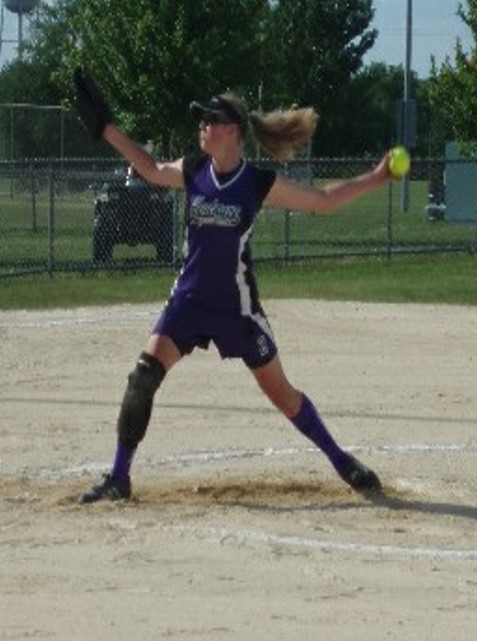 Kirsten to pitch her next game.
I’m excited about this because Kirsten was a former student of mine. I’m pretty sure she was in 8th grade when I first started working with her. She came to me through the recommendation of her coach Rick Cartright (I was also teaching his daughter Stephanie at the time).
I had a feeling she’d do well from the first time I saw her. Her technique was raw, but you didn’t have to be an expert to see there was thunder in her left arm. I remember catching for her a couple of times and she was definitely the poster child for throwing a “heavy” ball – the kind of pitch that when it hits the glove you feel it.
More important, though, Kirsten is a quality human being – kind, humble and funny. We always had a good time in our lessons. But of course she also worked hard in and out of them. I’m sure that has carried on to make her the outstanding pitcher she is today.
So congrats Kirsten and keep up the good work! Maybe we’ll finally have that lunch this summer when you get back. Oh, and sorry about the photo – it was the only one I had!
Update 5/7/15: I was right about that record. She added another shutout today. The record is now 25!
Beware of an over-reliance on gimmicks
You see them everywhere – in magazines, on websites, in YouTube videos and everywhere else fastpitch softball folks look for information. “They” are all the devices that promise to make your players better.
I call them “gimmicks” because often times that’s how they’re presented. The impression you’re given is that for $29.95 (plus shipping & handling), or $79.95 or $249.95 you can buy better performance. Gang, I can tell you that it just ain’t so.
I’m not saying these devices can’t help. Many of them can be useful in the right hands. But in order for yours to be the right hands, you first need to understand how a particular skill needs to be performed, and to a reasonably deep level.
A favorite example of mine comes from tryouts a few years ago. Three other coaches and I were observing pitching tryouts for a 16U team. One of the other coaches had a device that measures the spin rate of the ball and was using it to measure the revolutions per second of a pitcher’s curve ball.
“Ooooh” one of them exclaimed as a pitcher threw a pitch. “21.” “22.” And so on. They were all so focused on the device and what it supposedly told them that not a single one of them was watching the actual pitch. If they had, they would’ve noticed that the “curve ball” was spinning pretty close to 12 to 6 (fastball or drop ball spin) and wasn’t moving at all. Even down.
By the standards of the device, this pitcher was throwing an awesome curve. But in the real world, she wasn’t even throwing a decent one. And last time I checked, hitters hit pitches thrown in the real world.
As an instructor I see this all the time. Some coaches have an entire bag full of gimmicks, and they just move from one to the next. Especially hitting coaches for some reason. Some I’ve seen just love to bring out the devices.
But if you don’t understand what you’re trying to achieve, the effectiveness of the device is pretty much wasted at worst, or randomly effective at best. It’s like plopping down $300 for the world’s best hammer when what you really need is a $3 screwdriver.
If you really want to help your players/daughter(s) improve you don’t need a duffel bag full of stuff. At least not right away. Instead, first take the time to learn how those skills should be performed. Study college games on TV. Look for video on the Internet. Invest in DVDs and books. Attend training seminars/coaches clinics where an accomplished coach with a history of success breaks down the skill in detail. Go to http://www.discussfastpitch.com and read the discussions there. In other words, first seek out information.
Once you have a feel for what the skill should look like, and how it should be executed, you’ll be in a better position to decide which devices can really help you teach those skills and make improvements in your players and which ones will end up sitting on a shelf on in a duffel bag in your garage collecting dust.
What makes me say that? I have my own collection of devices that I bought when I started coaching, hoping to find the magic one. Some were worthwhile, many were not. The more I learned, the better I was able to see which ones might be helpful and which ones would be relegated to the Island of Misfit Softball Toys.
That goes for choosing a coach too, whether it’s a private instructor or a team coach. Someone who’s pulling out gimmick after gimmick instead of having your daughter work on actual pitching, hitting, fielding, throwing or whatever skill it is she’s trying to learn may not be your best choice. Devices are no substitute for knowledge.
Ultimately the value of a device goes up in direct proportion to your understanding what you’re trying to accomplish with it. Become competent at that first and you’ll make better decisions on how to spend the rest of your cash.
A lesson for softball pitchers everywhere
Today after teaching some lessons I came home and settled in front of the TV to watch a couple of college games. First was Arizona and Oregon State, followed by UCLA and Oregon. (Gotta love the PAC12 network.)
Anytime I have a chance to watch college teams on TV is a good day. But this day was particularly interesting, and not just for the games themselves. It had to do with the number of pitchers I had a chance to watch.
You see, when I first got involved in softball, the standard was pretty much each team had an Ace, and they road that arm for better or for worse. I’m sure top teams had other pitchers, but you rarely saw them or even heard their names mentioned.
Today, however, there was an opportunity to see several pitchers. In the first game Arizona ended up winning 22-2. Oregon State went to the bullpen a couple of times trying to put a stop to the pain. Then in the second game, both UCLA and Oregon used three different pitchers (and UCLA brought back their starter) in a game Oregon finally won 6-4.
Entertaining as it was, it also provided a good lesson to young pitchers (and their parents): everyone has a tough day now and then.
It’s easy to forget that sometimes. A young pitcher walks a couple of hitters, or gives up a few hits, and it’s easy for her to get discouraged. Or for her parents to get upset with her. (You hear parents yelling “c’mon!” at youth games all the time.) I’ve seen pitchers reduced to tears as a result of a tough outing.
Then you watch today’s games. Plenty of walks (including runs walked in), a couple of hit by pitches, and some pretty big hits. Arizona alone hit two grand slams, and hit for the home run cycle – solo, 2-run and 3-run on top of the grand slams. The second game had plenty of struggles on both sides as well.
I’m pretty sure every pitcher who took the circle is getting all or at least much of her college education at major institutions paid for. Theoretically they’re among the best in the country. Yet there they were – walking hitters, hitting batters, serving up meatballs.
And there’s the lesson. It happens to everyone. While you never want to be in that position, sooner or later you probably will. You just need to pick yourself up and remember it’s not the end of the world. Instead, go back out the next time and do better.
And if you’re a parent, try not to live and die by every pitch. You could end up dying a thousand times. Instead, remember your daughter is still learning, and will have bad days now and then. Keep today’s pitchers in mind and give your daughter a break. As long as she keeps working she’ll be okay. The faster you can help her put it behind her, the better off she’ll be.
Best wishes to Bobby Simpson on a speedy recovery
Just wanted to take a moment to wish a speedy recovery to Bobby Simpson following successful open heart bypass surgery. Word has it that he came through the surgery well, and hopefully will be back on the field at Higher Ground helping players learn to play fastpitch softball the right way soon.
I met Bobby many years ago when he was a speaker at the National Sports Clinics. I had a chance to speak with him later and found him to be a very nice as well as knowledgeable man. We’ve kept in touch through the years through our mutual connection to Softball Magazine. I also get his weekly newsletter and find it to be both enjoyable and informative.
Bobby, if you’re reading this, follow the doctor’s instructions – he/she is the coach now. Best wishes for a fast and full recovery.
You have to take opportunities when they come
Last night I was watching Texas and Arkansas on the SEC network. It was a good game, with great plays and the lead changing a few times. I got to see an Arkansas home run record set and two teams playing all out.
Also saw a pitcher get her first-ever start for Arkansas. I didn’t catch the back story, but apparently she’s is normally an outfielder. But due to some sort of circumstances she was pressed into action. I think she’d been a high school or travel ball pitcher, but at Arkansas she’s an outfielder. Good for her for stepping up when the team needed her.
The thing that struck me, though, was what happened in the bottom of the 7th. Arkansas, the home team, was down a run. The leadoff batter went to first after being hit by pitch, and the next hitter – a power slapper – drove a ball just out of reach of the center fielder. The runner on first scored and the batter ended up on third.
So Arkansas was in a tie game with a runner on third an no outs. Oh, and all-important momentum on their side too. I thought for sure they were going to pull off a victory. All they needed was a ground ball with eyes, or a sac fly. Statistically, the run expectancy in this situation is at least one run for the inning.
Of course, that’s why they still have to play the game. The next hitter popped up. The one after that grounded out weakly to the pitcher, who held the runner at third. The next batter struck out, stranding the runner on third. Texas scored in the top of the eighth and held on to win the game.
Which brings me to my point. In this sport, especially when you’re the underdog, you have to find a way to capitalize on your opportunities. I’m sure the three hitters on Arkansas didn’t purposely try to make outs, but make outs they did. By not scoring that one more run they made it more difficult on themselves.
Maybe they were nervous, or trying too hard. Maybe they were thinking too much about outcomes (or the result of messing up) and took themselves out of it. Or maybe the Texas pitcher, faced with a tough situation, rose to the occasion. All I know is Arkansas had a great chance to pull off an upset but couldn’t quite get it done.
If you’re in that situation, it’s important to focus on the task at hand. If you’re the hitter, do your best to relax and just try to hit the ball hard – same as you always do. Because you may not get that chance again next inning, which means you have to take your opportunities when they come.
Very proud of one of my students
A rare double post from me today, but this is worth calling out. Tonight I had a lesson with one of my hitting students, a high school junior named Emma. We had a great session – she ought to have an amazing season crushing the ball – and after I got home I texted her mom to let her know how well Emma was doing. That’s when I heard a story that trumped softball.
After her lesson, Emma stopped at Starbuck’s before heading home. While she was there an elderly woman pulled in and parked in the middle of the parking lot. She seemed confused, so Emma stopped to talk to her.
Emma quickly recognized the woman was having trouble, and contacted the police to get some help. Turns out the woman suffers from Alzheimer’s and didn’t know where she was – or how to get home. Emma stayed with her until the police came, talking with her and comforting her.
We hear a lot about what’s wrong with the younger generation. We sometimes focus too much on how well a kid can hit or pitch a yellow ball. Tonight shows the world is going to be alright as long as there are people like Emma in the world. She’s a winner no matter what she does on the field this season.






