My fastpitch learning by osmosis theory

I have always been a big believer in the ability of kids, at least certain kids, to learn the nuances of softball through osmosis. I certainly saw it with my own daughters, who were eight years apart.
When my older daughter Stefanie was playing, we dragged all the other kids out to her games. We had to – she was the oldest, and we couldn’t leave the others at home.
When Stefanie was playing 14U, my youngest child Kim was 6. I was coaching, so I mostly remember seeing her heading off to a playground or just sitting in the grass. We never talked to her much about what was going on.
But somewhere along the way it must’ve stuck in her brain, because by the time she started playing she had a pretty high level of innate knowledge about what to do when. For example, I never had to teach Kim about going after the lead runner on comebacker to the pitcher. She just knew.
I am convinced that’s because she saw so many games. Even if she wasn’t constantly thinking about what was going on, she picked up a lot of it by osmosis. I think that’s the benefit the younger sister (or brother) gets.
I bring this up because of something that happened last night that just tickled me. I have been working with a 12U pitcher named Jenna for a little over a year now. (I refuse to say anyone is 11, 13, 15 or any other odd number of U. Old school.)
Anyway, I started with Jenna when she was 10U, and she’s made the transition to 12U pretty easily. It’s fun to see how far she’s come in a short period of time, and how she can take command of a game.
This summer, her dad Gary decided it would be a good time to get his younger daughter Sammie started. She was 8 when we started, playing rec league, but I know Gary has aspirations for her future. 🙂 She turned 9 not long ago.
At first she had all the challenges 8/9 year olds typically have. Like being so literal about her form that she looked all stiff and robotic.
But she’s determined, and has been working hard. The last couple of lessons the light bulb has started coming on and she’s been throwing more relaxed. Her strikes are going up, and she’s definitely throwing hard. So last night I thought it might be a good time to get her started on the basics of a changeup.
When I said that, Gary told me, “Sammie’s already gotten started on it.” Apparently she’d been watching Jenna and thought it looked pretty cool, so she decided to start working on it on her own.
I asked her to show me, and darned if she didn’t do a nice job! The pitch was really high, but it was straight, and more importantly it was the right speed without slowing her arm down. She did a couple more and it was the same thing.
Honestly, I was impressed. I asked Gary if he had been working with her and he said no. Sammie had just picked it up by watching Jenna.
I think what knocked me out was that she was maintaining her arm speed. Normally, when a new pitcher is trying a change on her own she’ll slow down to make the ball go slower. (Which, by the way, is the opposite of what you really want to do.) Not Sammie, though. She just cranked it right out there and let the design of the mechanics do the job.
Of course, it helps that she has a great example to model herself after. Jenna throws a killer change that is quite effective in games. But still. Sammie just sort of figured it out by watching.
We did some quick work and got Sammie throwing it for a strike at least part of the time. But it sure was nice to start from a solid foundation!
So there you go. Learning the game, or even parts of it, doesn’t always require a formal setting. Sometimes, if you’re fortunate, it just happens. Gotta love osmosis.
Getting fastpitch players to display the right stuff
Recently I had the opportunity to see the movie “The Right Stuff,” about the start of the U.S. astronaut program, again. (If you haven’t seen it, it’s really worth checking out.)
Early in the movie they show the efforts to break the sound barrier. Test pilots had gotten  close before, but there were real concerns that if you actually got up to the speed of sound (Mach 1) that the vibrations would tear the plane apart and the pilot would die. For that reason many believed it couldn’t be done.
One who didn’t was test pilot Chuck Yeager. When he sees a new X-1 jet come in he decides he wants to go “chase that demon” that lives out at Mach 1 and see what really happens. The next morning he hops in the plane and becomes the first person to break the sound barrier.
Interesting, you say, but what does all that have to do with softball? Simple. Like then-Col. Yeager, nothing great happens for players when they stay in their comfort zone. It’s only when they get out to the edge of their abilities, where the “demon” of errors lives, that they can truly advance their skills and become the players they’re meant to be.
For pitchers, that means trying new pitches in games. Often times, pitchers will work and work to learn a new pitch. But then when game time comes they’re afraid to throw it for fear of looking bad, or the softball equivalent of the plane breaking apart, happening.
But here’s a little secret: No matter how poorly you throw a pitch, it’s only worth one ball on the hitter. That’s right! Whether you miss by an inch or chuck it over the backstop, the hitter is awarded only one ball. You don’t avoid throwing your fastball if you throw a ball, so why should it be different for any other pitch you’ve prepared. Get out there, keep throwing the pitch and get comfortable with it.
For fielders it’s pretty obvious. They only go after balls they’re sure they can get to. Or they make soft throws because they’re afraid if they really crank it up and throw hard it won’t go where it should.
Again, here’s a hint: if you’re worried your hard throw won’t go where it should, you need to practice throwing hard more. Even if that means you throw some balls away in practice. Find out what you can do. Get out there on the edge. On the fielding side, start diving for the ball instead of watching it go by or drop in front of you. Stretch yourself, try that new technique. You may just find it works.
Hitters often make it even worse. They either try not to strike out by only swinging at perfect pitches (never a good approach), or they fall back on just trying to make contact instead of trying to make hard contact. Quit playing it safe! Work on driving the ball and helping your team win.
Coaches can help in this regard. Yes, we all want our teams to play perfect softball. But if you’re always yelling at your team about mistakes they’ll play not to make mistakes (and get yelled at) rather than to win. They won’t develop their full skill sets, and each year they’ll fall further behind.
While you don’t want to see mental mistakes due to lack of focus, physical errors are going to happen when players get out of their comfort zones. Instead of yelling at them or giving them a hard time, praise them for making that extra effort. Even if they came up short. Perhaps in a couple of more tries that extraordinary effort will become more routine, and you’ll win more ballgames in the long run.
When Col. Yeager chased the demon he didn’t know if he would get it or it would get him. But he didn’t let the fear of failure (which had much higher consequences than losing a softball game) keep him from finding out. Thanks to that spirit, incidentally, the world’s fastest jet, the SR-71 Blackbird, flies at 3 times the speed of sound. That’s 2,193.2 mph.
Softball players need to do the same. Chase your demons and play to the edge of your abilities to see if you have the right stuff.
It’s not only the way to make yourself better. It’s a lot more fun.
Getting hitters started on time
Getting hitters started on time is often a challenge. You work, and work, and work on developing proper hitting mechanics. You hit off the tee, soft toss, front toss and everything else you can think of. 
Then the next game comes along and it seems like it all falls apart. That hitter that was bombing balls in practice stands there frozen at the plate until the ball is on top of her, then quickly executes what I can only call a “panic swing” – one that says “Oh crap, I better swing.”
There can be reasons for it, although most tend to lead back to fear of making a mistake. So the hitter waits and waits and waits, then realizes she ought to be swinging. At which point it’s too late to hit the ball well.
One long-standing way of attempting to overcome this was of thinking is to say you should be thinking “Yes, yes yes” and then either yes or no. In other words plan on swinging until you see otherwise.
Another common way of expressing it is the pitch is a strike until you see otherwise. In other words, plan on it being good, and then hold up if it’s not.
Here’s a little different way of approaching it. When the hitter is taking too long to decide, she is essentially trying to determine if she should start her swing. Of course, by the time she starts it she is already too late. So tell her she shouldn’t be thinking about whether to start the swing. She should start it every time, and then while she is in her swing decide whether to continue or stop.
If the hitter is using good mechanics, i.e., starting the swing with her hips, followed by her shoulders and then her bat, she’ll have plenty of time to hold up before committing the bat to the swing. In the meantime, she has her body in motion, developing power and preparing to apply it to the ball. Her eyes are also gathering information about the speed, location and spin of the ball, helping her to decide whether to take the swing.
So if she’s started her swing, the only thought should be whether to stop if the pitch is a bad one.
Give it a try, and let me know if it works for your hitters.
Make throwing priority one in the fall
This is the time of year when hope springs eternal. The long, hot summer is behind us (more or less), and with it the urgency of performance in games.
Yes, there are games going on right now, but for the most part they’re either college showcases, scrimmages, round robins, or friendlies. So with that in mind, coaches have a chance for a fresh start with their teams, to do what needs to be done to prepare for next summer. 
There is always plenty to work on – hitting, pitching, fielding, baserunning and so forth. As a result, it’s easy to rush through throwing warmups to get to the “more important stuff.”
If you do that, however, it’s an opportunity lost. Because few things will make more of a difference to your team next summer than improving the way your players throw.
Why is that? Simple. There is evidence that 80% of all errors in a game are throwing errors. Whether it’s because of poor technique, or being rushed (especially after bobbling a ball) or some other reason, it’s the throwing errors more than fielding errors that will hurt your team’s chances of winning when it counts.
Think about it. If a fielder doesn’t field a ball cleanly on a ground ball, the batter/runner gets first base. But if she throws the ball away, the same batter runner could end up on second base. She will definitely end up there if the ball goes out of play. So that poor throw after a bobble turns one error into two, and one base into two as well.
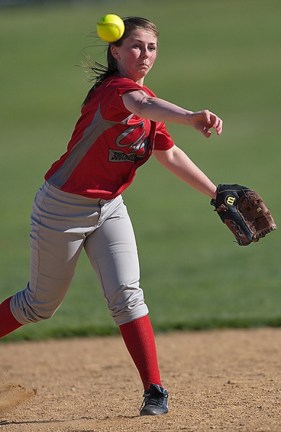 On the other hand, if you can eliminate throwing errors that means you’ll eliminate 80 percent of all the errors your team will make. Making that many fewer errors than your opponents should put you in a much better position to win.
That’s great in theory. But how do you go about it?
Start by planning to spend quality team teaching your players how to throw. Even older players often need this instruction. Give them strong mechanics, and make sure they’re repeatable. This could end up taking up a half hour to an hour, by the way.
After going through the basics, challenge them. One of my favorite drills is one I call the One Minute Drill. Here’s how it works.
Line your players up across from each other (partner position). Hold a stopwatch and tell your team that all you want them to do is throw and catch without a throw away or a drop for one minute. There is no requirement for how many, they just must keep throwing and catching. Then tell them you will keep time on the stopwatch, and call out the time remaining.
Sounds easy, doesn’t it? Actually it’s not. It’s almost a certainty that there will be a drop or throw away in the first round, probably within the first 20-30 seconds. When it happens, call a stop and when everyone is ready have them start again.
Keep them going, and be sure to call out the time loudly. I usually go in 15 second increments. The pressure of having to perform perfectly for a minute will generally affect their nerves, which leads to mistakes that re-start the clock.
If they continue to struggle after several attempts, call the team together and ask them why something so seemingly simple is so difficult to execute. They’ll usually come to the realization it’s pressure and focus. Tell them to relax and work on throwing well. Eventually they will get it. Then let them know how long it took to get just one minute’s worth of perfect throws and catches.
If you do this every practice, eventually your team will be able to complete the exercise in one or two attempts. When that happens, you’ll no doubt find your team’s throwing in games has improved as well. Because you’ve spent a lot of time on throwing, but in a way that is challenging rather than boring.
Give the One Minute Drill a try. It definitely works.
A different and fun approach to team building
Any time you have a group of people from different backgrounds, skill levels, experience levels, etc. trying to achieve a single goal, one of the staples has been team building. Whether you’re a corporation, charitable organization or girls fastpitch softball team, a little team building can go a long way.
Some of you may remember how the USA National softball team approached it during their run-up to the 2004 Olympics. They worked with the Navy SEALs to get some strength-building as well as military-style lessons in teamwork and bonding. 
Sounds cool doesn’t it? Maybe you’re thinking you’d like to do something like that with your team – put them through military-style training to help them learn how to work together, overcome obstacles and learn to function as a tighter unit. But of course the SEALs have more important things to do than work with every youth fastpitch softball team that wants to give it a try.
Luckily, at least if you’re in the Chicago area, there’s now an alternative: Hot Ground Gym. Currently located in Northbrook (with a second location set to open in the next few months in Buffalo Grove), it offers that kind of military-style training to kids and teams. They also have a mobile option that will come to you if you have an organization that would like to do it. (FULL DISCLOSURE: My son Adam is one of the trainers, which is how I learned about what they do. This is not a paid advertisement, just an FYI for coaches looking for something different to do with their teams.)
Hot Ground Gym was started by two military veterans, one a former U.S. Marine and the other Israeli Special Forces, to help kids build confidence, discipline, problem-solving and leadership skills in a fun, supervised environment. A lot of what they do is regular classes where kids come almost every day. But they also have birthday party and team-building options where they will do a 1.5 hour or 2 hour program for a specific group.
The core of the Hot Ground Gym program is obstacles. They have all sorts of them, most of which they built themselves, to challenge kids and teach them how to work together. If the trainers see the kids aren’t challenged, they rearrange or alter the course to get them out of their comfort zones and working hard to improvise, adapt and overcome.
The nice thing about this is it’s both mental and physical. Your team parents will likely love it if you do it because their kids will probably pretty sleep pretty well afterwards. The kids are kept moving constantly, running through, around and over obstacles, climbing, crawling, swinging from ropes and so forth.
At the end of the session you can either just go home, or you can have a little celebration (bring your own food and drinks) to talk about what the team learned and enjoy their successes. And maybe have a few laughs about their failures.
The video on the website home page provides a pretty good idea of what they do, although it’s constantly changing. And don’t be discouraged by the fact it’s mostly boys in the video. Adam says they have a lot of girls do their programs, and those are some of their best performers.
If you’re looking for a way for a fairly new team to get to know each other, or for a cliquish team to break down some barriers, or just a way for your team to learn a little more about how to push past their personal boundaries to do more than they thought they could, it’s worth checking out.
You might even ask that Adam be one of the trainers. He’s an Illinois Army National Guard veteran who did a tour of combat duty in Afghanistan so he knows the whole military aspect. And he earned a couple of medals during training for his leadership skills so he knows how to get groups of people working together for a common goal. He also has a wicked sense of humor, so your players will be entertained as well as challenged.
Defense can make a fastpitch pitcher look good – or bad
While it may same rather obvious on the surface, after watching the National Pro Fastpitch (NPF) championship game on TV I thought it might be worthwhile to bring it up again. It, of course, being the effect defense has on making a fastpitch pitcher look good or bad.
(By the way, kudos to my hometown team, the Chicago Bandits, for taking the title for the second year in a row.)
Normally at the NPF level you expect to see a lot of dominant pitching. While the pitching was good in this game, I wouldn’t call it dominant. The definition of dominant being a lot of strikeouts or weak infield hits. 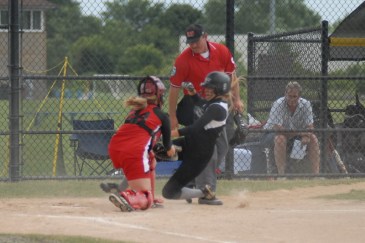
There were some of each, but there were also plenty of balls that got tagged pretty well; all three runs came off of solo home runs.
So in the absence of huge numbers of Ks, it becomes pretty obvious that the other 7 players who are not part of the battery had to step up to keep this a 2-1 game. If you watched the game you certainly saw that.
Which brings me to my point. The game ended 2-1, but the score could have easily been much higher were it not for some spectacular plays on both sides, both in the infield and outfield.
Those defenders made their pitchers look awfully good. And that’s ok, because I really believe the pitcher’s job isn’t to strike everyone out. That’s just fortunate when it happens. Instead, a pitcher’s job is to induce weak contacts that are easy to field.
In other words, the perfect inning isn’t 9 pitches for three Ks. It’s 3 pitches, all easy popups to 1st base so the first baseman can just pick up the ball and step on the bag if she drops it.
So contrast that defensive performance with others I’ve seen or heard about over the years, where the pitcher does her job. But instead of weak grounders or popups resulting in outs, they result in runners on base because of errors or lack of effort on the fielders’ part.
And what happens after a few of those? The coach calls time, heads out to the circle, and replaces the pitcher (who hasn’t made an error yet). It’s clearly not the pitcher’s fault, but I guess it’s easier to replace one pitcher than four defensive players.
So in the stats as well as in live action the pitcher ends up looking bad. Especially if those errors get marked as hits. (Anyone ever seen a box score that showed one error when you know there were at least 6? I sure have, especially in high school games.)
The thing is, having a porous defense doesn’t just have a short-term effect on the team, i.e., losing a game or a tournament. It also has a long-term effect. Because good pitchers don’t want to look bad, or have to work overtime every game to get three outs. So what happens? Good pitchers will leave, and tell other good pitchers why. Then it gets tough to get good pitchers, so the team has to settle for lesser pitchers, who give up more contacts that turn into even more baserunners. Then you’re in the death spiral.
Here’s another way to think of it. What coach would sign up for a tournament where the rules stated certain teams would be given 6 offensive outs per inning while theirs only got 3? You’d have to be crazy to agree to that. But that’s what happens when the team can’t play good defense behind their pitcher. And that makes it tough to win.
So while it’s easy to blame the pitcher, or give too much credit for that matter, the reality is the better your defense is the better your pitching will look. Just ask the world champion Bandits.
The definition of sportsmanship – and class
This isn’t a fastpitch softball story, but it’s still one I found worth sharing because it demonstrates everything great about sports and what they teach you. Full disclosure: I am friends with Abbey D’Agostino’s uncle Tim and Aunt Janet Boivin so the story has a little extra impact for me.
If you haven’t heard, this happened during the women’s 5000 meter race at the Olympics. Everyone was running in a pack when Nikki (no relation to Hillary) Hamblin of New Zealand tripped, and the USA’s Abbey D’Agostino fell over her.
Understand that Abbey has waited a long time for this opportunity. If I recall correctly she just missed the cut for the 2012 Olympics while she was still in college, so making the team and having the opportunity to go for the gold was the fulfillment of a dream.
After falling like that, many runners would have just gotten up and tried to make up the time. That’s what being a competitor is supposedly all about. But Abbey saw that Nikki was hurt, and instead of taking off she stopped to help Nikki up off the ground and start running again.
Then, in an interesting turn, after both ran a few meters Abbey went down again. (Later we would discover she tore her ACL and meniscus when she fell originally. Nikki stopped to help her up, and the two of them proceeded to help each other finish the race. (Shades of Cool Runnings, eh?)
The other thing to understand is they weren’t friends before. They didn’t know each other at all. But they are bound together for life now.
We see a lot of negative things out there in the world. At softball parks we see all kinds of bad behavior from players, coaches, parents and fans. But this story is a reminder, on the biggest stage of all for most sports, of what it’s really all about.
If you’d like to learn more, here’s one of the many stories that have come out of this incident, complete with an interview of both runners.
Hopefully Abbey will be back on the track sooner rather than later and will have another shot at a medal. But if she never runs competitively again, she’s set an amazing standard for all athletes. Watch for the Disney movie in about five years. 🙂
Softball back in for the 2020 Olympics
Just saw the news that softball (and baseball) have officially been voted back in for the 2020 Olympics. Not too surprised given where they will be held.
Japan is as fanatical about fastpitch softball as the U.S. – maybe more. And they have a gold medal to defend, despite the fact that it’s likely most of the players on that last team probably won’t be on the 2020 team.
I know a lot of people are really ecstatic about it. For me, I’m more “meh.”
Don’t get me wrong. I love watching the games on TV, especially the medal games. It’s exciting to see the best players in the world going head-to-head, and even though the Olympic rings have lost some of their luster it’s still a pretty big stage. And for me personally at least there’s now something interesting to watch.
But many of those who are so excited have a belief that having softball in the Olympics will drive participation and give female softball players something to dream about. For whatever it’s worth I disagree.
I don’t think young female softball players, as a whole, care that much about the national team. Just ask any you know who is on the national team right now. You’ll probably get a blank stare. Or ask who was ever on the Olympic team for the U.S. You might get a couple of good guesses, but beyond the high-visibility pitchers most probably won’t know.
When I’m doing lessons I will often ask students if they have heard of this top-level college player or that high-profile pro. Most have not. They just don’t care. They’re more focused on their own performance.
If participation overall is down I don’t think it’s because there was no Olympic team to aspire to. I would say cost is much more of a factor now. It used to be you could join a team and play all summer for around $500. Now it’s more like $1,500 to $2,000 on the low end, and $20,000+ on the high end for a bigtime exposure team that travels around the country.
That puts softball out of the reach of a lot of families, especially in the current economy. They’ll either find a cheaper sport, or they’ll find another activity that doesn’t cost them as much.
As far as the hopes and dreams go, let’s be honest. There are precious few spots on the Olympic roster to being with. You have to be a top-level college player (current or former) to have any hopes of making it (Crystal Bustos excepted).
It may be an incentive for a precious few. And good for them. But for most, reality will likely set in at a young age as they realize they’re not destined to become one of the greatest fastpitch softball players in the U.S.
I’m glad it’s back in, and I’m glad our sport will get more exposure. But is it a game changer? I don’t think so.
Fastpitch tip for learning the finish of a backhand changeup
One of the most important pitches in fastpitch softball is an effective changeup. By effective I mean one where the pitcher can go through her motion and appear to throw it hard while having the ball come out much slower than expected.
This is as opposed to a changeup where the only thing that changes from the fastball is the grip, or one where in order to get the ball to go slower the pitcher slows her arm down. Those aren’t changeups. Those are just bad fastballs.
While I teach a few different types depending on the pitcher, the one I teach most often is  the backhand change. Essentially, that is one where the back side of the hand leads the ball through the release zone.
Note that this is not a “flip” change. There is no flipping of the wrist at the end; I want the pitch to be dragged throw the release zone and thrown in a way that still has 12 to 6 forward spin. Flipping it puts backward spin on the ball, and often results in a pitch that comes in around belt high before traveling about 220 feet in the opposite direction.
The key to the finish of the backhand change as I teach it is to bend the elbow slightly and (again) drag the ball forward through the release zone until the pitcher’s arm is fully extended. After a momentary stop the ball comes out about hip high, immediately loses a bit of altitude to thigh high and then tails down around the plate. To do that the pitcher has to keep her hand moving forward and low until release rather than pulling it up as many like to do.
One cue I’ve used before is “punch your catcher in the nose.” In other words, go straight out instead up up and out. It’s worked pretty well, but it still requires the pitcher to do a little visualization.
So here’s another option. Have the pitcher line up sideways to a backstop with stride foot (left foot for a righty) right against the bottom of the screen. Then have her get her arm in the proper position (without the ball), pick out a spot on the screen that’s the right height and have her stab her fingers straight into the chain link fencing.
You might not want to have her go full speed, especially at first, to avoid jammed fingers.If you can’t get to a field, you can also do it into a tarp or even a shower curtain at home, as long as there is something specific to move the fingers toward.
Have the pitcher do it multiple times, until she starts to get the feel of what it’s like to go out straight instead of up. Then you can back her off the screen a bit and try the finish, or go back out to the pitching plate and see if there is improvement.
It’s simple yet effective. I only came up with this idea recently and so far it’s helped every pitcher I’ve tried it with.
If you have a pitcher who is struggling to keep her hand going out directly instead of bending the elbow or otherwise pulling up, give this a try. It just might work.
What are some other ideas you’ve tried to accomplish the same thing? How effective have they been? Anything you’ve tried that failed horribly? Go ahead and share – you’re among friends.
The Neverending Softball Story

I was talking with a couple of fastpitch hitting and pitching students this week about their schedules for the next couple of weeks. They were explaining that they probably wouldn’t be coming out for lessons because “we have Nationals next week, then tryouts when we get back.”
That just seems crazy to me. I know it’s the way things are but I can’t help but think they shouldn’t be.
Why couldn’t there be a couple of weeks at least between the end of this season and the beginning of the next? What is so all-fired important about getting started on next season that it has to happen before players have had a chance to clean the dust off their equipment from the last one? Especially since many schools start classes around the middle of August now. Not much of a chance for the family of a softball player to take a week off for a little R&R that doesn’t involve getting to a field at 7:00 am on a Saturday.
Where it really gets crazy is how all the different alphabet soup of organizations have their so-called Nationals. Some are done already. Some are going on right now. Some will happen next week. Programs that went to one of the early ones often have their tryouts going on while some of the players who might like to play for them are away at other Nationals.
I guess it’s all about the race to capture the best players before someone else gets to them. When players go to these early tryouts, there is a lot of pressure (especially on the better players) to make a decision now – sometimes before they leave the first day of tryouts. They’re told if they don’t decide RIGHT NOW there may not be a roster spot available to them later.
Again, that seems crazy when the actual, important season for these teams doesn’t start for another 8-10 months (depending on their age). But of course, if you can secure those players now your team is set, and there’s no risk of some other team, especially a close rival, getting them instead.
The problem is the solution is the same as early recruiting for colleges. Programs would have to bring some sanity to the process by voluntarily holding off on tryouts until at least mid-August, and preferably a little later. But who wants to be the first?
If it’s going to work, it would have to start with the most desirable teams – the ones everyone would love to play for. If they didn’t start until later (secure in the knowledge players would join their teams (even if they had “committed” under pressure elsewhere first) there would be less incentive for the next tier to be early, and perhaps then it would trickle all the way down.
I don’t think the world would come to an end if tryouts didn’t happen until mid- or late August. So what do you say top tier teams? Will you be the first to start bringing a little sanity to the process, and give committed softball families a window to take a non-softball vacation before school starts (assuming they can afford one after all the travel)?






