Don’t Take Everything You Hear or See At Face Value

Every week I receive an email that links to pieces of instructional videos for fastpitch softball. And almost every week I end up shaking my head at what I see in them – especially because the company that sends the videos out is charging people good money for such poor instruction.
This week held yet another perfect example. A college coach (from a big name D1 school as I recall) was talking about flaws in loading when hitting. He had a young player, maybe 12U or 14U, there with him helping him demonstrate.
And what was his big advice? Don’t let the head and the front foot move in the same direction at the same time during the “load.’
First of all, he seems to be confused between the load and stride. He kept saying load but most of the discussion was about the stride. So he might want to check that out first.
But regardless of the terminology, he was basically saying that the front foot should move first, then the head should follow afterward. All I could think was “that poor girl.”
Let’s see if this coach’s advice passes the evidence test. Here’s a video of some MLB hitters taken from the side. Watch them as they stride and see if their head moves with the foot or not.
If the camera is steady you can place your cursor on the hitter’s head and see if the head stays there. If not, compare the head position to the background throughout the stride.
What do you see? I know what I see. The head and the center of gravity are moving forward as these hitters stride.
Of course, maybe these are just extraordinary athletes. And they’re men. So let’s look at former Michigan star Sierra Romero, who did pretty well for herself this year with the NPF’s USSSA Pride. Advance the video to about 2:14 to see the stride, and again what do you see her head doing as her front foot moves forward?
The point here isn’t to take on the specific video I watched, although hopefully by now you’re ready to disregard that particular piece of advice. It’s more to say that parents and players should be careful about what they accept as good instruction.
You would think a college coach, presumably a hitting coach, would understand the swing and how it works. But clearly that isn’t necessarily true.
It’s the same thing with taking advice from a former player because she was/is a star in college, or high school. Often times players and former players just repeat what they were told when they were growing up, even if it’s not what they actually did/do, because they haven’t put the time in to study the mechanics.
The best thing you can do is educate yourself. Before you blindly accept advice or training from anyone – and that includes me, by the way – take what they’re saying and see if that’s what the top current players do. If not, you should find someone who will teach you those mechanics and approaches.
Hitting is easier to compare, because you not only have top college, NPF, and National Team players to compare what’s said to what’s done, but you also have MLB hitters. Hitting is hitting after all, and anyone who tells you softball has a different swing needs to throw out their VHS tapes and at least buy a DVD or two from this millennium.
Or there’s this new thing out called YouTube that all the kids are talking about. Maybe those instructors want to check it out.
The hitting exception is slapping. They don’t do that in MLB, so you’ll need to look at softball only.
The same goes for pitching, because videos of MLB players will be of little use. But there’s plenty of good video of top pitchers in game action, which is where you want to check them out. See what makes them successful in games and compare that to what you’re being told. Here’s a good starting point for you.
Catching, fielding, throwing, base running, all of those are similar skills between fastpitch softball and baseball, so you have plenty of source material there. Sure, there are nuances, mostly driven by the difference in the length of the basepaths and size of the field overall, but anyone with even a little experience watching both should be able to adjust for that.
It’s easy to buy into a reputation, or a great set of credentials. But neither of those will help you on the field.
Be a smart consumer. Make sure what you’re being taught, no matter who is teaching it, matches up with what great players do. Otherwise, save your money on lessons or DVDs until you’ve confirmed your investment will take you where you need to go.
Playing Softball Can Actually Help You Live Longer

While it may not seem like it sometimes given the behavior of parents and coaches these days, there’s new evidence that playing team sports like fastpitch softball can actually help you live longer than participating in solitary sports like jogging, cycling, and swimming.
While the study, published in Mayo Clinic Proceedings, doesn’t name fastpitch softball specifically, and admits that the evidence is observational, it’s still worth noting. Especially given the emphasis in schools today on “fitness for life” activities that are primarily solo endeavors. Perhaps a return to team sports might yield better long-term results?
According to the study, the difference-maker is the social aspect involved in team sports, or any sorts of activities you can’t do alone such as tennis. Getting out and being active with others may create more of an uplift than slogging through a health club workout alone.
It makes sense. There is something about the shared experience that tends to get our juices flowing. Not to mention the sense of competition.
For most of us, while attempting to better our last score is certainly a challenge, it’s nothing compared to the idea of trying to best another person. Our primitive brains still tend to think in black/white, win/lose terms, so there’s more incentive to push ourselves to gain a better outcome.
At the same time, we all have this deep-seated desire for social interaction. Not the kind you get online, which is still pretty much a solo activity, but just getting out and being with people. Even if you don’t interact with anyone else, going to a coffee shop or even walking around on a crowded street satisfies a sense of belonging we all have at some level.
But mostly I think one of the values of fastpitch softball is the shared experience of trying to reach a goal, whether it’s win this inning, win this game, win this tournament, or win this season. Knowing you depend on others, and others depend on you, just strikes a chord in us as humans that working out by yourself just can’t match.
How does all of that help us live longer? Maybe it encourages us to keep going when we might otherwise stop, giving us more exercise. Maybe it releases chemicals in our brain or bodies that aren’t otherwise stimulated. Maybe it changes our attitude in some subtle way. Or maybe it’s none of the above.
Whatever the reason, there’s now one more benefit to add to the list of why fastpitch softball is a great sport to play. As if you needed one.
Turn, Turn, Turn? Not Anymore

It’s a pretty safe bet that “Turn, Turn, Turn” is the best-known songs by the 60s folk-rock band The Byrds. It’s either that or “Mr. Tambourine Man,” but I personally think the former is the better song. After all, tough to beat having your lyrics written by folk legend Pete Seeger by way of The Bible.
Even if you never listen to an oldies station you’ve no doubt heard it. It’s pretty much required in any movie about the 60s, or that references the 60s in some way. But just in case you’ve somehow managed to avoid it all these years, here’s a video. Enjoy!
The key point of the song (and why I bring it up, other than my love of jangly 60s music) is it says there’s a “time for every purpose under heaven.”
While that may be mostly true, in the softball world today it seems like there isn’t time for one thing – stepping back and making major corrections in mechanics without the pressure of an upcoming game.
I know Bill Hillhouse says there’s never a bad time to fix mechanics. But it sure is a lot tougher to make a significant change when there is a tournament coming up in a few days.
Once upon a time, the post-season was a great time to make those fixes. You finish up with Nationals at the beginning of August, then take a couple of months off to rest and recuperate before starting up again.
There might be a game or even a tournament here or there, but nothing like we see today. The way things work right now, players are often trying out for their next team before they’ve finished with the current one. Then it’s straight to practice to get ready for a two-month schedule of tournaments every weekend.
Of course, player performance in those early games sets the tone for how they’ll be perceived, especially if they’re on a new team where they’re not known. So rather than taking a step back to maybe fix things that could be better, players are more likely to continue down the path of what’s worked so far. Even if it’s not optimal.
The problem is certain mechanical fixes are likely to make a player worse before they make her better. Now, for some it doesn’t matter. If your mechanics are bad and you’re not performing, there’s little risk in making changes. Nowhere to go but up and all of that.
For others who have had success already but want to get better, however, it can be a problem. They were comfortable with where they were, and they were doing well, so making changes gets them out of that comfort zone, creating a risk of failure where there used to be success. And failure is an important part of the overall learning curve.
A pitcher maybe slower or less accurate until she resets her timing or gets all the body parts working together properly. A hitter may be tentative rather than aggressive until she’s had a chance to figure everything out. You get the idea.
The long-term benefits are there. It’s just hard to keep that in mind when you’re in the circle, in the batter’s box, on the field, etc. No one wants to look bad, especially in front of a new team (and coach). So they’ll tend to fall back on what they always did rather than forging ahead into new territory.
I don’t blame the players (or their parents). You gotta do what you gotta do. But with our 12-months a year season there’s little time available to fail for a little while to succeed in the future.
There has to be a better way. Somehow or another, there needs to be a season where pitchers can take the time to focus on changes that will help them increase speed without having to keep their change, drop, or other pitches sharp. Or hitters can focus on getting their sequence right instead of worrying about making contact with the ball. You get the drift.
What’s the solution? One idea is to play fewer tournaments, or maybe even fewer games overall in the fall. I know that won’t be a popular idea but it would definitely create some headroom for experimentation.
If you can’t do that, maybe teams can set aside a month or two during the winter months to work on reaching some specific goal or making a major change. Recognize that your player may not look like your player for a little while, but ultimately she will be better.
Maybe you have other ideas. If so, please share them in the comments.
All I know is there really needs to be a time for everything – including getting away from the pressure to perform so players can take the time they need to get better. It may be tough to accept at first. But the results will be worth it.
Bring a Little Fun to Corrections By Playing HORSE

Being a coach sometimes can feel like you’re stuck in the movie Groundhog Day. You offer a correction, the player makes it for a repetition or two, then goes back to what she was doing before. So you offer the correction again and the cycle repeats.
This pattern particularly shows up with younger players, but it can happen to anyone anytime. Obviously, two good repetitions followed by a few incorrect ones isn’t going to get anyone anywhere.
So how do you provide a little extra incentive to focus on doing it right every time? This is where taking advantage of the competitive nature of fastpitch softball players can come in handy.
Fastpitch softball is a tough sport full of difficulties and disappointments, so players really have to have some competitive fire to keep going with it. They also have to love a challenge. As soon as you press the “compete” button you almost always have their full and undivided attention.
One way I’ve done this is to borrow from the playground basketball game of HORSE. You know the one. You take a shot, then the player after you has to take the same shot. If he/she doesn’t make it, he/she gets a letter. You keep going until only one player hasn’t spelled out HORSE.
For Katie, the girl in the photo at the top of the post, the challenge was getting her to bring her back leg into her front leg to finish the pitch. She had the very common tendency of throwing the front leg out without using the back leg. As a result, the back leg was more of an anchor dragging behind her and cutting back on her speed and accuracy.
So I challenged her to a game of HORSE. The rules were simple. If her back leg finished by closing into her front leg (more or less) no letter was assigned. If, however, she finished with her legs spread apart (which usually caused her to bend forward as well) she received a letter.
Once we established those simple rules, it was game on! Suddenly, instead of the Groundhog Day loop of me telling her to finish, she was more on top of it. She still ended up getting an H-O, as I recall, but that was all in the 10 minutes we spent on it.
That was pretty good improvement, because it meant in all the pitches she threw she only failed twice. More importantly, rather than me telling her to fix the issue she was now dedicated to fixing it herself – because she didn’t want to lose the game!
I knew it really got through to her, though, when at her next lesson she asked if we could play HORSE again. I think she wanted to play because she knew she could win; she’d worked on it between lessons to gain the advantage.
But that’s ok with me – I want her to win, because then she’s improving her mechanics and using her body more effectively. By the way, there was no prize for winning or avoiding getting HORSE, although there certainly could’ve been. The game simply appealed to her competitive nature and got her attention.
In reality, this is a game/technique you can use to drive improvement for all kinds of techniques. Have a hitter who is dropping her hands or swinging bat-first? Play HORSE.
Have a fielder who isn’t getting her glove down on ground balls, or a catcher who isn’t keeping her glove on the ground while blocking? Play HORSE.
(I’m not just saying this to you, by the way. I am also making this as notes to myself, as I am definitely under-utilizing this idea.)
The one thing I would caution is focus the game on the process/skills, not the results. So use it to help a first baseman learn to scoop a ball in the dirt properly, but not to keep track of whether she actually got it or not. Or use it to help a hitter learn to swing hips-first rather than giving her a letter if she swings and misses.
If she learns the skill, the results will take care of themselves. But if you focus on the outcomes, you won’t drive the skills. Instead, you’ll probably reinforce bad habits as the player tries to avoid the error/failure instead of learning and internalizing the technique.
In any case, if you find yourself in a Groundhog Day-like loop, give HORSE a try. And if you do, or you’ve done the same thing yourself, let me know how it works for you in the comments below.
The importance of being coachable

A few days ago my friend Tim Boivin sent me this article about NBA star (and future Hall of Famer) Tim Duncan. The article quotes an open letter from Tony Parker, who explains that the San Antonio Spurs’ winning culture was largely driven by the coachability of Duncan.
The article talks about how Duncan’s success meant he didn’t really have to listen to anyone, as many stars in various sports choose to do. Instead, Duncan took coaching like he was trying to make the team as the last player rather than leading it as its top player.
That attitude permeated the rest of the team. You can imagine the players who were just barely hanging on seeing how coachable Duncan was, and telling themselves “I’d better fall in line too.”
That’s a lesson softball players can and should learn as well. You work hard, and you reach a certain level of accomplish. Maybe everyone tells you you’re the best player on the team/in the conference/in the tournament/at the camp. You start feeling pretty good about yourself, and suddenly you don’t think you need much coaching anymore.
Honestly, that’s the fast track to failure, or at least not achieving your dreams. You stop listening, start slacking off, and before you know it you’re now looking at the backs of players you used to be ahead of.
I’ve spoken to coaches who have worked with the top players in fastpitch softball, and they’ve all said the same thing about the best players they’ve coached. They were all hungry for information, and would do whatever it took to gain even a small edge or make a small improvement.
They didn’t resist coaching. They soaked it in the way a sponge soaks up water.
Being coachable isn’t that tough. You just have to be willing to learn, and willing to accept that however good you are you can always be better. You have to actively listen and try to understand what’s being taught rather than merely going through the motions.
If you don’t understand something you have to be willing to ask questions – even if you think it makes you look foolish. You can bet if you don’t understand something there’s someone else who also doesn’t understand but is too afraid to ask.
The great thing about being coachable is that it’s a choice. You can’t choose how tall you are, or whether your body is loaded with fast twitch muscles. You can’t choose how much raw athleticism you have. You can’t choose your core body type, i.e., to be long and lean if your DNA says you will be short and stout.
But you can choose how willing you are to listen and learn. The more open you are to new information that can help you, the more likely you are to reach your goals.
The final part of being coachable is being willing to do whatever is needed to help the team at the time. Sometimes that means playing a position other than the one you prefer until you get your shot at the one you really want. (Of course if you never get that shot it’s a different story for another blog post, but in this case we’re talking about a temporary change.)
And hey, you never know. By being coachable you might set a standard and create a culture for a team that lasts long after your playing days are done. That’s how you go from being a great player to a legend.
Beginner’s Guide to Calling Pitches

This came up recently when the mom of one of my students asked me for a little help in learning how to call pitches for her daughter. Makayla worked very hard through the off-season, pre-season, and then the season itself to learn to throw a good, reliable fastball, a strong change, and the beginnings of a drop ball.
The thing is, knowing how to throw those pitches isn’t enough. You also need to know when. Sarah wanted to use the pitches strategically but wasn’t sure how.
Now, you can search for fastpitch pitch calling guides on the Internet, but most of them assume a much older, more experienced pitcher with a variety of pitches at their disposal. Yes, it’s great to say “throw a curve followed by a rise” to this type of hitter. But what if you don’t have either?
To help her out, I put together the guide below. You can either copy and print it out, from this post or you can download the attachment which contains the same information.
The guide essentially speaks to how to use “just” a fastball and a change to get ahead of hitters and keep them off-balance so they either strike out or make weak contact. It goes through what to throw different types of hitters as well as some core strategies.
This information has been vetted, too. I checked in with Sarah after Makayla’s last tournament and she said it worked great. So if you’re just getting into the whole cat-and-mouse game between pitchers and hitters, this guide should give you a good start.
Basic Pitch Calling Guide
This guide assumes the pitcher has a fastball and changeup, and can locate her fastball reasonably well. Keep in mind that you also have to pay attention to what the pitcher has that day. If she can’t throw to the outside corner this day, you won’t want to do that as often and so on.
Good hitter (1-5 in lineup most likely)
- Start low and out. Most hitters don’t like that pitch and will let it go by for a free strike. “When in doubt, throw low and out.”
- When ahead in the count (0-2 or 1-2), don’t throw strikes trying to go for the “quick kill.” Try throwing a high pitch, or well outside.
- Mix it up. If you threw two outside pitches in a row, come back inside. But don’t do it every time. Having a set pattern will come back to haunt you.
- If the changeup is working, try starting a strong hitter with a change. They’re usually looking to rock a fastball so a change will throw them off – maybe for the entire at bat.
Power hitter
- Keep the ball low. You want ground balls, not fly balls.
- Again, try starting with a changeup.
- If the first change worked, don’t be afraid to throw another one right away. Hitters rarely expect back-to-back changeups.
- Depending on the situation, a walk may not be a bad option. Better to give up one base than four. Especially with runners on base.
- With an 0-1 count, try coming inside. Let her crush a pitch foul down the left field line (right handed batter). It’s just a long strike, but it provides an overblown sense of self-confidence. Then go back outside, or throw a change.
Weaker hitter
- If you can blow the ball by them, do it. Don’t try to get too fancy until they prove they can catch up to the fastball. A changeup may be the only pitch they can hit.
- Don’t worry as much about inside/outside either. If you’re overpowering them, just rear back and rock it in there.
- If they look nervous at the plate, come inside for a strike. One inside pitch ought to be enough to freeze their bats.
Slappers (if you see any)
- Watch how they run toward the front of the box
- If they go directly at the pitcher, throw inside to try and jam them; throwing low and out just helps them by putting the ball where they want it
- If they try to run to first base right away, throw outside
- Throw changeups to take away the advantage of a running start
- Throw high to try to get them to pop up
Good times to throw a changeup
- First pitch to a good hitter (but not all the time).
- Right after pulling the ball far down the line foul. She’s ahead of the fastball. She’ll REALLY be ahead of the change.
- When she fouls a pitch straight back.
- Right after she missed a changeup.
- When she’s been fouling off several pitches. She has the timing down, just hasn’t quite gotten the bat on the ball. Throw the change, even if it’s for a ball. The change in speed will upset her timing.
Hitter location at the plate
- Standing close to the plate – throw inside (but be careful – some hitters like inside and not inside; I teach hitters like that to crowd the plate on purpose to turn outside pitches into middle pitches and to try to draw inside pitches)
- Standing away from the plate – throw outside; they won’t be able to reach the pitch, and are probably scared of being hit
Proposing A New Stat for Slappers

This is a proposal I think has been a long time coming, and one that is sure to be cheered by every lefty slapper and her parents. It’s a new stat that helps measure the effectiveness of slappers at doing their job – getting on base.
The problem slappers have always had with the current scoring system is that it doesn’t accurately reflect their ability to get on base. Under the current system, if a slapper reaches base every at bat by hitting the ball in a way that it bounces off the shortstop’s or third baseman’s glove each time, and that contact is scored as an error, her batting average and on-base percentage will be .000.
That’s correct. It’s .000. That just doesn’t seem right.
Reaching base on an error doesn’t help either statistic. So when you’re looking at who should be where in the lineup, and using stats to make your decision (as so many coaches are wont to do these days), that poor slapper doesn’t show very well.
That’s why I’m proposing a new stat called GOBA – Got On Base Anyway. GOBA would count the number of times the slapper reached based because she hit a ball that was too tough to handle and either beat the throw or there was no throw.
Think about it in terms of our poor girl with a BA and OPB of .000. If you look at her GOBA, it would be 1.000. That tells you she belongs at the top of the lineup rather than lurking somewhere in the low-middle.
You want her getting more at bats because she gets on base. Every. Single. Time.
Now, there would have to be some training and qualifications to make GOBA work. For example, everything a slapper hits doesn’t count as GOBA, otherwise the stat is useless. For example, if she hits a soft ground ball or easy popup that should have been fielded for an out with normal effort, it’s still an out.
With a hard ground ball, especially to the side, a little more judgment would be involved. But still. What you’d be looking for is those contacts that would have been an out with anyone else, but ended up with the hitter on base due to her speed.
In other words, even if a fielder had a little trouble once the ball in was play a right-handed hitter, or a lefty with normal speed, would have been out. But this particular hitter, as a result of the wonders of slapping, managed to be safe. She Got On Base Anyway.
What do you think? Does this idea have merit? Would it make for a more fair assessment of the effectiveness of slappers than simply relying on BA and OBP? If so, let’s get a movement going!
No matter which side you’re on, if you have some thoughts about this idea leave them in the comments below. Just remember to be kind to others.
To Track the Ball, Think Video Not Photo

While the ready availability of modern technology (think: screens) has given us many marvelous advantages, it has also created some issues. One of the most profound is our increasingly short attention span.
You see it all the time – especially us coaches as we try to explain something important to our players even as we watch their eyes glaze over or pay attention to everything but us after about a minute. (Still, we persist in talking for 10, 15, 20 minutes anyway, especially if we just lost a game.)
That’s bad enough, because of course we’re imparting not just tremendous softball instruction but also life wisdom. 🙂 But where this short attention span can really hurt players is in how they track the ball during the game.
Often it seems like player tend to view the ball (and make decisions) based on a point in time. It’s like their brains take a photograph of where the ball is at a particular moment, then their movements and reactions are based on what they see in that moment.
The problem, of course, is that one point in time doesn’t give us enough information about what will happen going forward. For example, a photo of a player diving for a ball doesn’t necessarily tell us whether she successfully made the catch or not.

The ball may be in her glove, but will it stay there?
What they need instead is to take more of a video approach, i.e., see the flight of the ball as a series of points moving through space. (For those who don’t know, video is made up of a series of individual photos that play rapidly in succession, creating the illusion of motion. You learned something today.)
This “photographic” approach to seeing where the ball is going hurts several areas. Take catchers, for example.
They see the ball is going down and will need to be blocked. But they don’t wait long enough to see the flight of the ball in space, they just react to wherever it is 10 feet in front of the pitcher.
So they drop to block, only to watch the ball careen past their right shoulders. A little more information and they could’ve centered their bodies on the flight of the ball. Instead, it gets by and a run scores.
Hitters also need that type of spatial information. In fact, they need to track the ball as long as they can to get a feel for whether it will be inside or outside, high or low, and whether it may have some movement to it. All of that information can have a huge impact on when they bring the bat to the ball as well as where they take it to.
If they just take a mental photo they’re unlikely to take the bat to where it needs to go unless they’ve been specifically trained to recognize the ball’s flight earlier. But by tracking the ball through space the way they would watch it come in on video, hitters can make the adjustments they need to achieve greater success.
This principle also applies to fielding ground balls and fly balls. Ground balls can take detours due to field conditions (rock, divots, a lost helmet) and fly balls can go all over the place due to spin and wind. Using a “mental photo” to judge where they’re headed, and then checking out, is a fast track to an error. Seeing the whole travel of the ball, including where it’s going, will be much more effective.
Yes, in our short attention span theater world it gets increasingly difficult for players to learn to focus for more than a few seconds at a time. But if they can learn to watch the video instead of looking at the photo, they’ll be a lot more successful.
The “Dummkopf” Drill for Fastpitch Hitters
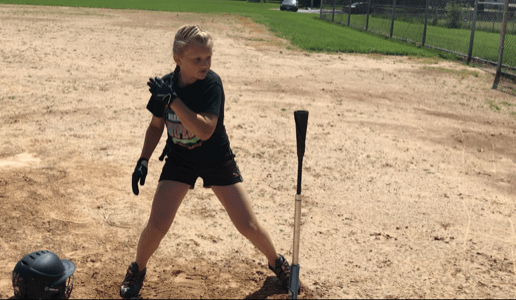
Ok, before anyone gets their undies in a grundy, I’m not calling players name or saying this fastpitch hitting drill is only for stupid people. It’s merely a device I’m using to make what could otherwise be boring a little more fun.
The purpose of the drill is to teach hitters to lead with their hips, then release the hands. All too often hitters will either start the swing with their hands, or will start with their hips but then let the hands take over too early.
Ideally, you’ll want a sequence of hips-shoulders-bat/hands, where the hips start a powerful rotation, then you add on the shoulders, then you finally get the hands involved. When you go in that order you use the big muscles to develop more power and batspeed so when you do make contact you hit the ball harder/farther.
Going hips-first also gives the hitter more time to see the ball before she commits, enables a shorter swing to the ball, and puts the bat into the green zone at contact. Lots of great reasons to go hips-first.
While that may be easy to say it can be tougher to execute. You want to hit the ball with the bat, and the bat is held in the hands, so for many hitters (especially young ones) it makes more sense to lead with the bat. They may try to hold it back, but it’s just so tempting.
So I came up with the “dummkopf drill.” Here’s how it works:
The reason for the name of the drill is it’s based on WWII movies where one of the German soldiers is asked a question, answers it, and then is slapped in the head and called “dummkopf” by his superior. (SIDE NOTE: All the German I know comes from WWII movies, so it’s a pretty limited vocabulary. And not very useful in everyday conversation unless I were to find myself in a WWII prison camp.)
In this case, there were two purposes. One was to get the sequence right. The other was to help Abbey, who is pictured here, get the feeling of transferring her weight into the front leg instead of spinning on the back leg. As you can see, it accomplished both missions.
We could have done the drill without adding the callout “dummkopf” at the end. But it wouldn’t be as much fun. Using the word also helped her focus more on the point of contact, since she was trying to slap the rubber part of the tee upside its virtual head.
So if you have a hitter who is having trouble leading with her hips instead of her bat, give this one a try. And be sure to leave a comment below letting me know how it goes.
For A Proper Fastpitch Softball Warmup, Get Dynamic!
Just about everyone knows how important it is to warm up before undertaking any athletic activity, both to prepare for the best performance and to reduce the risk of injury. (I would say “everyone,” but I still hear horror stories of players being thrown into games or or having their pitch/overhand throw speed measured at camps without any warmups at all.)
What apparently isn’t as well-known is that the type of warmup you do can have a significant impact on both performance and injury prevention.
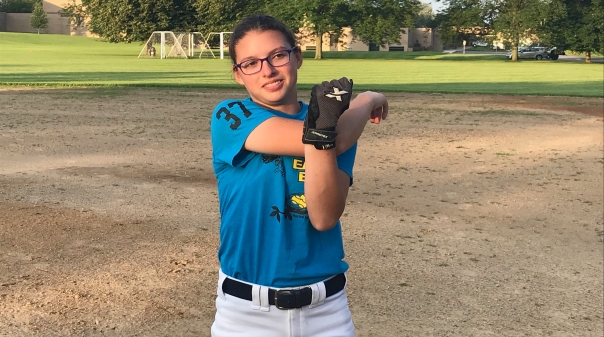
There are basically two types of warm-ups: static and dynamic. Static warmups involve standing still and pulling on muscles. One example is shown in the (staged) photo at the top of this post, where a player lays her arm across her chest, places her wrist just above the elbow of that arm, and either presses on the arm or tries to pull it a bit. (This, by the way, is one of the most useless “stretches” you can do because it really doesn’t stretch anything.)
Other examples include all the players sitting in a circle with their legs stretched out in front of them, attempting to grab their toes while they sit and chit chat about their day, rolling up on your back and trying to touch the ground behind your head with your toes, and the ever-popular point your elbow to the sky and try to pull it past your head with the other hand.
Dynamic warmups involve stretching the muscles by increasing the range of motion as you make different movements. A few examples are butt kicks, cherry pickers, torso rolls, and shoulder circles. You can see a few more examples in this video from Jason Domnanovich, a trainer for the Chicago Bandits (courtesy of the NFCA):
What’s the difference? Probably the most important is that static stretching actually turns off your nervous system, making it more difficult to perform at a high level. In other words, instead of preparing you for competition it hurts your preparation. This process of turning off the connection between the mind and muscles also makes you more prone to injury.
Dynamic warmups do the opposite. They activate the muscles so they’re ready to perform. Muscles that are activated can run faster, throw harder, more laterally more quickly, rotate more powerfully – all the things we want do on a softball field. Warming up dynamically also prepares the muscles for the stresses they will face during a game or practice session, helping reduce the chance of injury.
I know from personal experience the difference dynamic stretches can make. When I was still coaching teams, we moved from static to dynamic stretching before all activities and rarely experienced an injury. Not that we had a lot to begin with, but the number of injuries fell even further. That’s good, because healthy players will contribute a lot more to your success than injured ones.
Does that mean you should never perform static stretches? No, not at all. They’re fine after the game or practice to help the muscles relax after being taxed and prevent them from tightening up as they recover. In fact, it’s recommended. Just don’t do it before the game or practice.
So how do you go about making the transition to dynamic warmups? What exercises/activities should you do?
This video provides an excellent, softball-specific resource. It’s the one I used to learn more about it, and to build a dynamic warmup routine. (No, I have no financial stake in you buying the video, I just know it’s good.)
There are plenty of others as well. Just search on “dynamic stretching softball” and you’ll find a wealth of resources that will help you build a warmup that will actually help your team gain a little extra edge while preventing injuries.
If you (or your team) is still standing motionless, tugging on muscles before the game, stop it! Make the transition to dynamic warmups. You’ll be glad you did.
Oh, and if you have any stories to share about dynamic versus static warmups, be sure to add them in the comments below. While you’re at it, be sure to hit the Like and Share buttons, and take some time to subscribe to Life in the Fastpitch Lane so you never miss a post again.






