Blog Archives
Pitchers Don’t Need to Be Strikeout Queens to Win
Everybody loves to watch a strikeout queen do her thing. Well, not everybody – I’m sure hitters and their parents are less enthralled – but pretty much everyone else is enamored by the ability for pitchers to get hitters out all by their lonesomes instead of relying on their defense.
I get it too. As a pitching coach, when I check the stats for one of my students on GameChanger the first thing I’m going to look at is A) if she pitched that game, followed by B) how many strikeouts she got. It’s an easy way to measure how well your pitcher did against opposing hitters.

But I think sometimes coaches get a little too enamored of that stat, to the point where they tremendously under-value other pitchers on their staffs that may not get the big K stats but are equally effective, game after game, at getting hitters out. Maybe even more effective in a way, because it takes them fewer pitches to do it.
This whole discussion came up after I read a Facebook post by Kassie Rhodes, a former collegiate pitcher and now a pitching coach herself. (You’ll have to scroll down a bit to read her post at the link because I couldn’t figure out a way to link directly to it. My bad.)
In it she argues that a pitcher who can get her team out of an inning and off the field quickly by inducing weak contact and easy to field balls is every bit as valuable as one who can strike out the side on a regular basis. It’s just not as dramatic.
I agree. In fact, I’d say that pitcher who can produce a 7-pitch inning on a regular basis is probably more valuable to her team on a sunny 95 degree day with 95% humidity when you’re playing on turf than the pitcher who takes 9-15 pitches to strike out the side. Especially if you have a misting fan waiting in the dugout.
Now, I understand the other side of the argument. When your pitcher can get you a strikeout, it removes some of the risk in getting an out.

All you need is a catcher who can avoid dropping the ball on strike three versus a popup/fly ball where one other player will have to touch the ball, or a ground ball where you need a clean field, a good, on-time throw, and a good catch to get the out. More touches equals higher risk.
But if your team is capable of making the plays they’re supposed to make, the risk factor of extra touches should be extremely low. At which point you can say an out is an out no matter how you get it.
And if it’s not, you have some work to do as a coach to get it that way.
Another advantage to the team with a pitcher who doesn’t accumulate a high number of strikeouts per game is that your defense gets more practice. I don’t know about you, but I’ve seen plenty of teams that failed in big games because they were used to their pitcher carrying most of the load.
When she ended up facing a team that actually could hit off of her, the defense was often under-prepared to field the ball and make the play, especially when the heat was on. There’s a difference between doing it in practice and doing it in games.
Teams that regularly have to make those plays often fare better. Repetition in games conditions is valuable.
Here’s another thing to consider. It’s easy to assume that it’s easier to win a championship when you have a high-strikeout pitcher.
But if you look at this list of the top 10 all-time strikeout leaders in NCAA Division 1 play, only three of them won a WCWS, and the top three have zero WCWS championships between them. That’s right, you have to wait until #4 (Danielle Lawrie) before you find one whose team won the last game of the season.
This is to take nothing away from the other 7 in the top 10. They were all outstanding pitchers who won a lot of games and other tournaments with their teams.
But as good as they were, it still takes a team to win.
Oh, and in case you were wondering, the #1 pitchers for the two teams who faced each other in the 2026 WCWS championship series came in at #6 (Tegan Kavan) and #7 (NiJaree Canady) for this season.
The bottom line is, in a standard game each teams gets 21 outs (or 18 if the home team is ahead by the middle of the 7th). They are the currency of the game, and should be treated like gold, because once you’re out of them (no pun intended) your chances of winning are zero.
So the faster you can take away your opponent’s outs, the faster you can get to a victory celebration. And the game doesn’t care how you get those outs.
So if you have a pitcher who is capable of inducing easy outs on a regular basis by getting hitters to pop up, or hit “can of corn” fly balls or weak ground balls, along with the occasional K when you need it, who cares how they got out – as long as they’re out? Instead of considering her as being “less than” your big strikeout stud, take advantage of her abilities and give her the fair share of circle time she’s earned.
Not only will it help you get the wins you desire. It will save some wear and tear on your stud pitcher’s arm for when you really need someone who can blow the ball by the opposing hitters.
Training catchers with the Roman Empire drill

Anyone who has seen a gladiator movie, or a movie with gladiators in it, is familiar with this scenario: Two warriors do battle until one bests the other. The victor stands over the fallen loser, weapon at the ready, and looks to the Emperor (or highest-ranking official in attendance). The Emperor holds out his hand with his thumb extended sideways, then either turns it up to spare the fallen warrior or down to indicate he should be killed.
Never mind that this is just a dramatic fiction of the movies. In reality, gladiators were too expensive to acquire and train to be wasted in such a manner. The idea of the thumbs-up/thumbs down creates a scenario to help fastpitch softball as well as baseball catchers.
Like hitters moving from the cage to games, catchers often have a tough time making the transition from practice to the field. They may be great at blocking in practice, when they know it’s coming, or scrambling to their feet to chase a popup. But in an actual game, all that training sometimes seems to go out the window.
That’s where we can borrow from the Roman Empire of the movies, and have some fun besides.
Line your catchers up in front of you, with your arm extended and your thumb to the side. They should all be in their runners on base stance.
Then either turn your thumb up for them to react to an imaginary popup or base stealer, or down to block a pitch in the dirt. 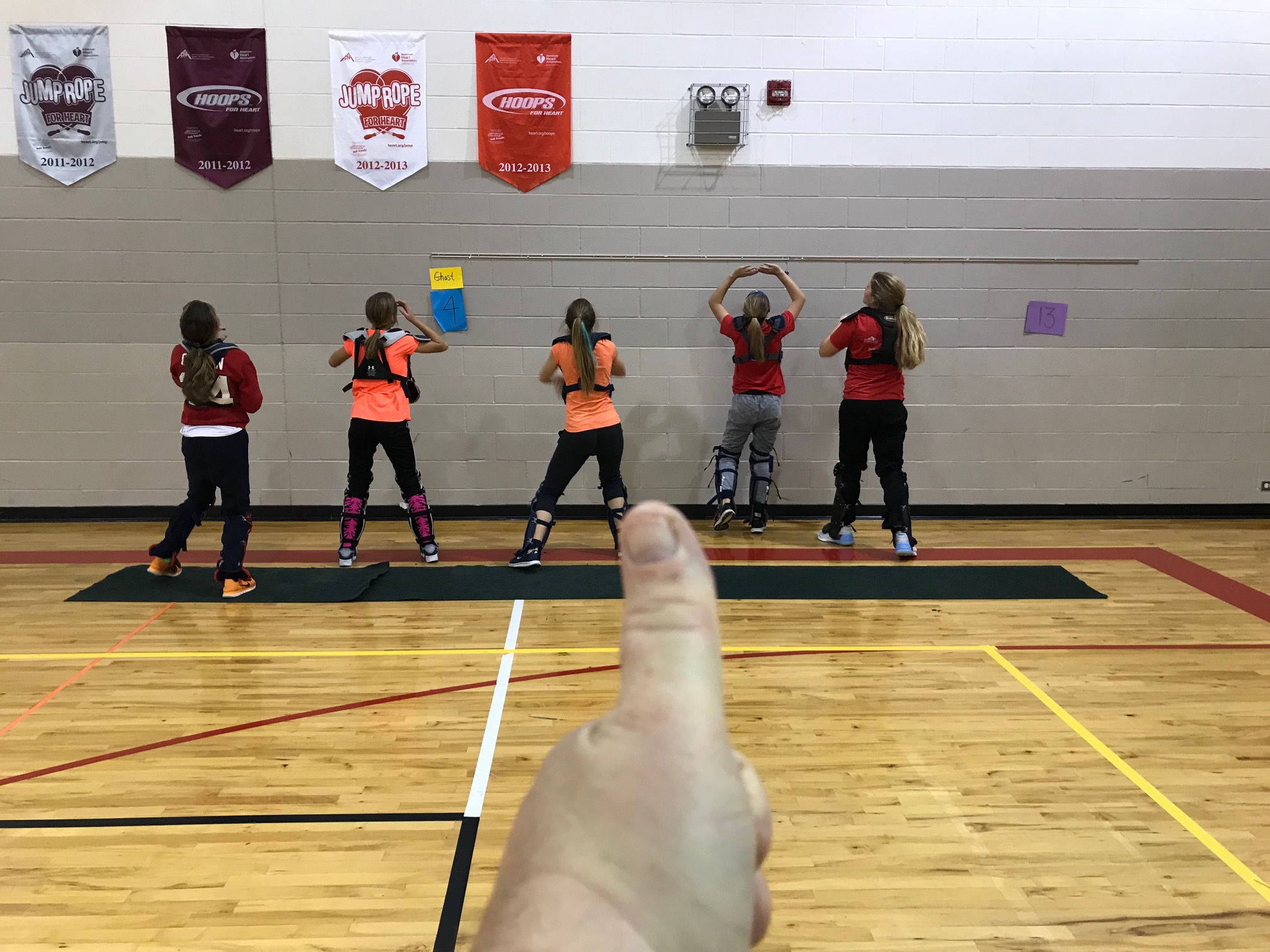
The key is that they don’t know which they’re going to have to do, so they’re going to have to read and react quickly and appropriately.
For added challenge, you can tell anyone who goes the wrong way that they have to sit out. You can also tell the catchers that the last one up or down is out as well. That creates a little competition and gives them some skin in the game.
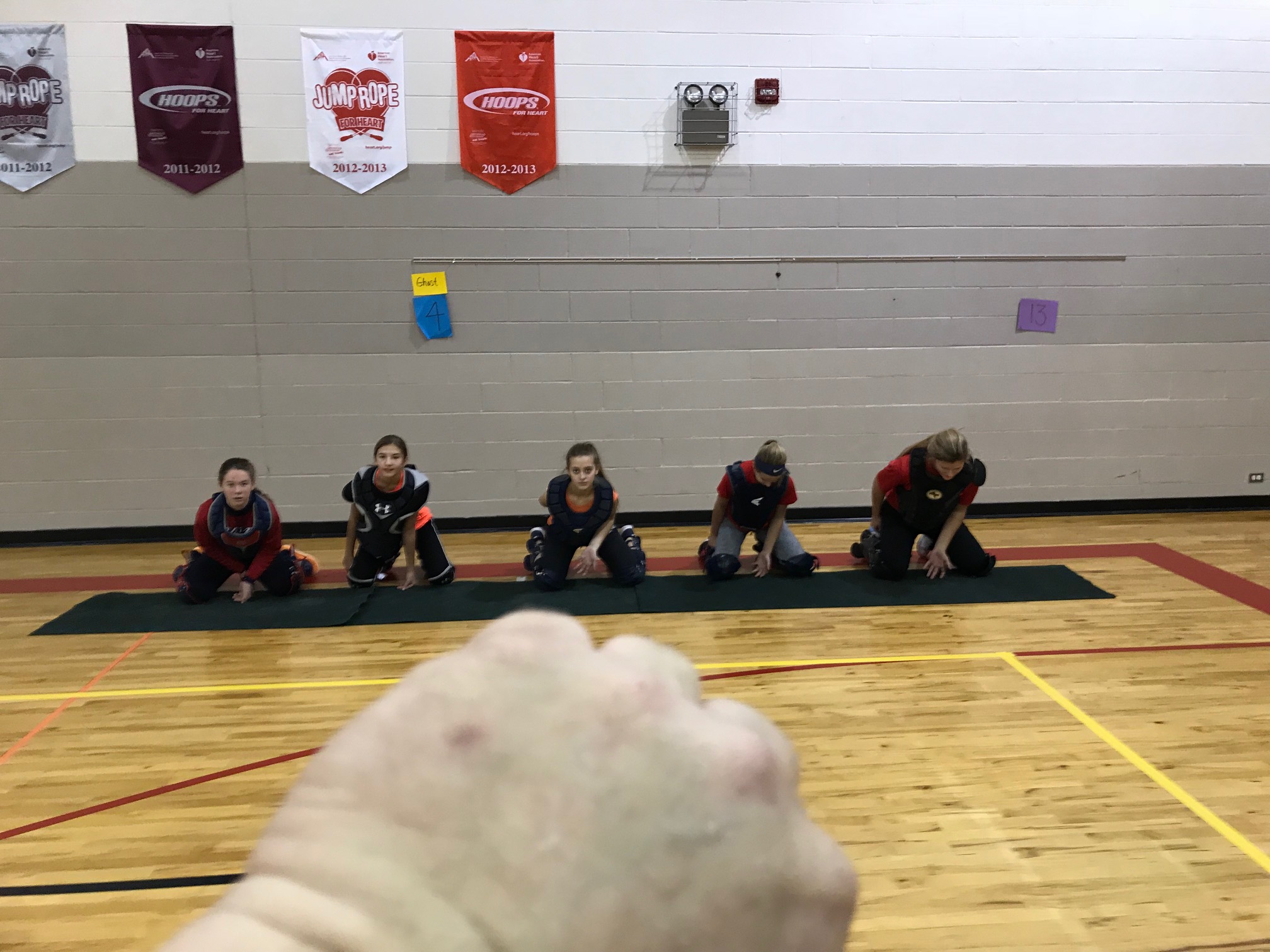 When the catchers go into a blocking position, check to make sure they are in the position you want and not just flopping onto the ground. They should be up and over the imaginary ball, with their shoulders further forward than their knees and their chins tucked in – as opposed to the ones who sit on their calves like they’re getting ready to watch TV.
For the popup position, first tell them where the ball will be – in front of them or behind them. Then emphasize getting their backs turned to the infield so the imaginary ball doesn’t drift away from them.
If you want to go with steals, make sure they’re coming up into a good throwing position rather than just getting to their feet. If you have the space, you can even have them make the throw. Just be aware of a stray ball or two.
The objective, again, is getting them to read the situation and react more quickly.
Here’s the last part to making a successful transition. Your catchers may get good at Roman Empire, but that doesn’t necessarily guarantee they’ll carry it with them onto the field. What you want to tell them is when they’re in a game, they need to approach it like they’re doing the Roman Empire drill.
They need to get themselves ready to read and react, rather than not thinking about it at all and then reacting too late. By being mentally ready on the field they’ll put themselves in a position to use all that training and find greater success.






