Category Archives: Hitting
What to Watch for In the Olympic Softball Games

As you may have possibly heard as a fastpitch softball fanatic, our sport is back in the Olympics for the first time since 2008! This is a rare moment to watch the best players in the world compete on a huge stage with presentation budget of a major network production.
It’s also the last time for the next eight years as the sport is not included in the 2024 Paris Olympics. It is expected to return in 2028 and 2032 when the games flip to the U.S. and Australia. Who knows what will happen after that?
So since this is such an unusual opportunity you’ll want to make the most of it. Not just to sit back and enjoy the games (although that’s great) but also to learn all you can while you have the opportunity.
So to help with that, here are a few pointers on some things to pay closer attention to. The Speed of Play.
The Speed of Play
I’m not talking about pitch speeds, although they are incredible too. I’m talking about what happens when a ball is put in play.
Look at what happens on a ground ball. It is scooped up and on its way to first in a “blink and you’ll miss it” fashion. There is no double-clutching, no calmly standing up and then casually firing it over. It’s there and gone.
Or look at the baserunners. Even the ones you would think are more powerful than fleet are incredibly fast. If a ball is hit between two fielders in the outfield there’s a good chance the runner on first is going to third. Bobble it at all and she’s heading for home.
Everything is amazingly fast. If you want to know what to work on in your/your daughter’s/you players’ games, work on that.
For example, don’t just hit them ground balls. Run a stopwatch and challenge them to make the play in less than three seconds. I find blowing an air horn when the stopwatch hits three seconds provides a pretty good indicator of whether they were successful enough.
Work on just pure running too. I know most people get into softball because they don’t like all the running in other sports, but it’s something that does need to be addressed.
While you can’t make everyone fast you can help them get faster. The faster your team is the more pressure it puts on the defense and the more runs you can score when you need them.
Here you can start by making sure your players are running on their toes instead of heels or flat feet. Then do a lot of short, quick sprints.
Run down a hill. Have two or more players run against each other, perhaps letting one player start in front of the other. Have them play tag around the basepaths. Anything to get the feet and arms moving faster.
Watch the Pitching Mechanics
The coverage I have seen so far has been amazing at showing pitching mechanics. We are getting great closeup shots of what is happening at release on great pitchers such as Cat Osterman, Monica Abbott, and Yukiko Ueno.
Notice how close they are to their bodies at release, to the point where their forearms brush against their hips. Note how on a curve ball the hand kind of wraps around the back hip instead of being out and away.
Watch how they release the ball with a smooth, whipping motion. Note that they are vertical or leaning slightly back instead of being bent forward.
Also watch how they seem to glide on their back leg, like they’re riding a skateboard, until the front foot lands. Then they go into whip and release.
While you’re watching that, also note that they don’t drag their back legs behind them like zombies. The leg stays under them, which is what allows that skateboard-like movement.
It’s really a Master Class on pitching, happening pitch after pitch.
Listen to the Communication
With no crowd noise to speak of you can hear what’s going on down on the field more clearly. While at first you may list to the description of the play, maybe watch a second time and listen to what’s happening on the field.
They’re not down there keeping to themselves. Those players are communicating.
They’re talking before the play to make sure everyone knows their responsibilities. They’re talking during the play to help direct throws and avoid confusion. And they’re talking afterward to clean up any issues and pick up their teammates if something went wrong.
The more you communicate the better you’ll play as a team. Learn from the best.
What Happens Away from the Ball
The initial camera work is going to follow the ball. That makes sense because that’s where the main action is.
But during replays from other angles, look at what other players are doing. Who is backing up at a base? What is the right fielder doing on a throw from center to third?
If there is a steal or a bunt, who is fielding it and what are the other players doing?
For example, with a runner on first, if the third baseman fields the ball who goes to cover third in her place when the ball is bunted? Is it the shortstop, leaving second uncovered?
Unlikely since they may want to go for the lead runner. So is it the catcher? Pitcher? Left fielder?
The more you see how Olympic teams operate in particular situations the better idea you’ll have of what your team/daughter should be doing. Or at least learning.
How Tough Hitting Is Against Great Pitching
So far there hasn’t been a ton of offense in most of the games. That’s to be expected with such great pitchers.
Maybe it will change as the tournament goes on and the hitters get used to the high level of pitching they’re seeing. But right now it does demonstrate how challenging hitting can be – even for the best players in the world.
That’s something to keep in mind when your daughter goes 0 for 8 on a Saturday, or your team hits a collective .225. No matter how hard you work, a lot of good things have to happen to succeed at hitting.
That said, practicing properly (and often) gives you your best chance to succeed. Each of the players you’re watching works incredibly hard to do what she does.
Imagine where those hitters would be without all that hard work.
Softball is a game built on failure. It’s those who can push past it who will ultimately succeed.
They Make Mistakes Too
I think this is an important lesson for parents (and some coaches) to learn. These are the very best players in the world, presumably. But at some key moments, usually when their team can afford it the least, you will see a player here or there make an error.
It happens. It’s unfortunate but it does, even to the best. Especially in a pressure situation.
What parents (and some coaches) need to take away from that is these things are going to happen occasionally so you can’t freak out or get down on your daughter/player or scream at her in a way that makes her feel bad about herself.
This applies not to just physical errors but mental errors. If you’re a coach, make the correction in a non-judgmental way and move on. Believe me, she didn’t do it just to make you look bad or ruin your day.
If you’re a parent, be supportive. She’s probably already feeling horrible about it. Instead of making it worse help her learn from the experience so she doesn’t repeat it.
Realizing even the best players in the world make mistakes now and then will help you enjoy your daughter’s/players’ playing more and avoid turning one bad play into a bad inning – or a bad game.
Anyway, those are a few of the things I think you should be watching for as you enjoy softball in the Olympics. Any other thoughts? Leave them in the comments below,
Photo by Anthony on Pexels.com
The Back Leg Can Be a Propeller – or an Anchor

As I write this we are in the middle of summer vacation time here in the U.S. Families all over America are packing themselves up from wherever they live and traveling to a different area, state, time zone, etc. in search of a little R&R.
Even softball families are in that process. Some have already finished their seasons, while others are fitting in a little vacation time before or after tournaments.
For me, when I think of vacations I am reminded of taking my family to a lake for some serious downtime. Originally that meant the North Woods of Wisconsin, where we and various members of my wife’s family would rent cabins.
As part of the rental, we would get motorized row boats that we could use to go fishing. I’ve never been much of a fisherman, and didn’t grow up rowing boats so I found that a bit of a challenge at first, but when in Rome…
Now years later I’ve come to realize that those motorized row boats are the perfect analogy for the role of the back leg in pitching and hitting. Because it can either be a propeller or an anchor when you’re trying to be explosive.
A propeller will help you get where you’re going faster. Being fairly incompetent at rowing a boat, at least at first, I found the propeller to be a much easier way to get from point A to point B, even if those two points weren’t that far apart.
As long as you can fire up the motor (not always easy in a free rental), you can open the throttle and steer your way there while relaxing. That’s a lot easier than using oars to move through the water, especially if you’re using one oar more than the other, in which case you tend to make more of a circle than a straight line.
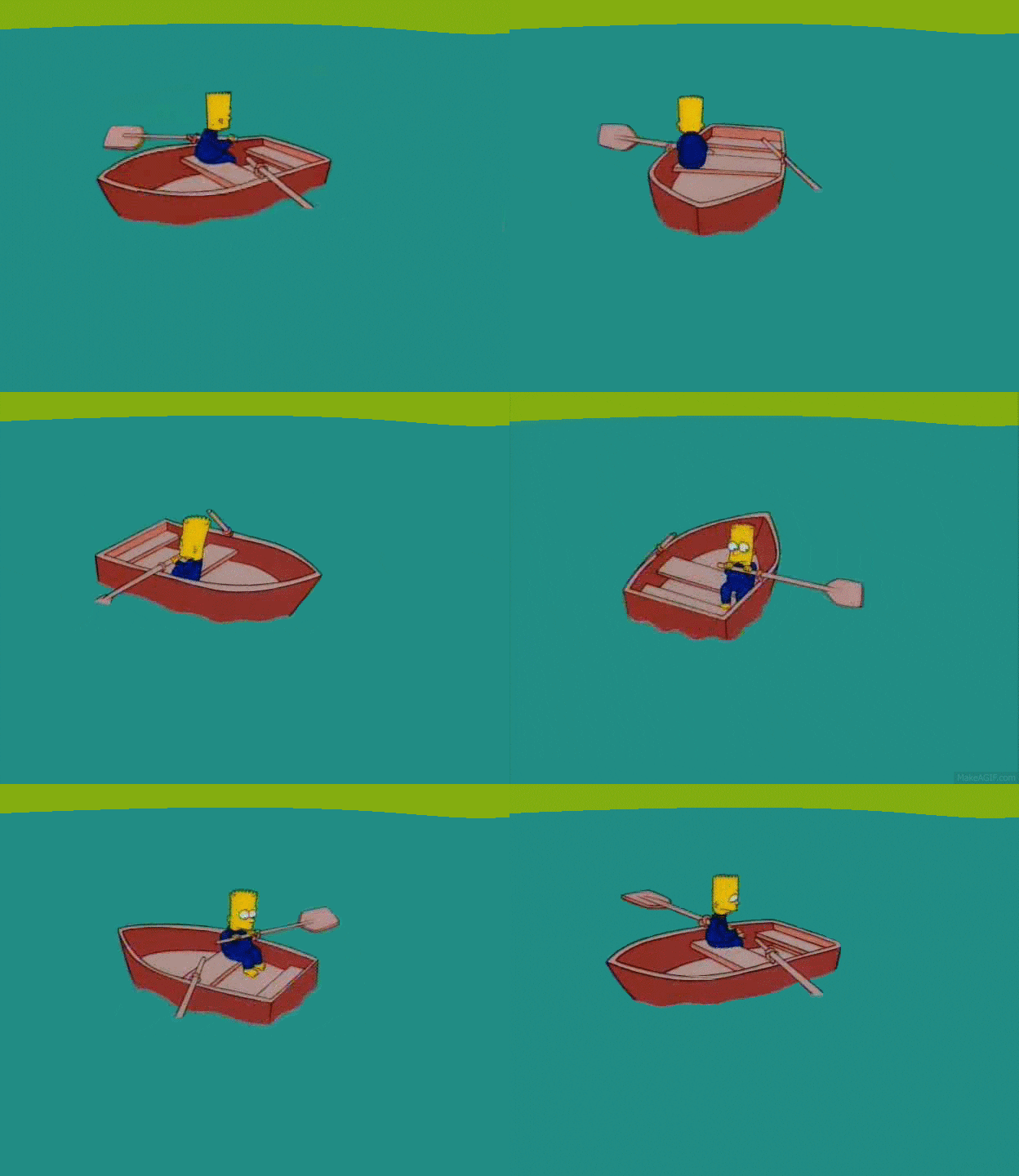
An anchor, on the other hand, is designed to hold you in place once you get to where you’re going. If you leave the anchor down, even with a motor, it will be much hard to get to your destination.
So it is in softball. In pitching, you want the “drive” leg to propel your center forward, enabling you to glide lightly along the ground until your front leg lands. Do it quick and powerfully enough and the sudden stop will help sling/whip your arm through the release zone.
But if you don’t engage your drive leg, and instead just run past it with your stride leg, the drive leg will turn into an anchor, lifelessly dragging behind you and slowing you down. When that happens, the drive leg doesn’t drive at all, but instead gets pulled along in the classic zombie walk. This is why it’s often called “zombie leg.”
Clearly one is better and more effective than the other in creating speed and enabling stability at release. Hopefully I don’t have to tell you which one that is.

While not quite as obvious or debilitating, the same effect occurs in overhand throwing. If the throwing side isn’t engaged actively as a propeller it becomes an anchor, which affects both speed and accuracy.
What about hitting? The same is true, although in a different way.
In hitting, you want the lower body to create the power. While that is really more of the core than the legs themselves, the rear leg contributes by having its knee start pulling toward the front knee, unweighting the leg so the hips can fire forward at maximum velocity.
If the hitter doesn’t get off the back foot the hips are unable to rotate rapidly or fully, and you wind up with more of an upper body swing that pulls the contact point further back. You’re then not hitting in the green zone.
The bottom line (no pun intended) is the back leg can either be an aid or a hindrance in making athletic movements in softball. Which it is depends entirely on the player.
Get it actively engaged, doing what it should do, and it becomes a propeller that helps drive better performance. Leave it behind and it will be an anchor, slowing the player down and creating a huge drag on performance.
Photo by Mount Polley on Pexels.com
To Improve Your Hitting Think Like a Predator

One of the things that probably holds more hitters back than anything is having a tentative approach at the plate. They stand nervously in the batter’s box, shifting from foot to foot, death grip on the bat as they await the next pitch.
Then it comes and they wait until they can wait no longer, then finally flail at the ball as it goes whizzing by them.
It isn’t that they don’t know how to hit, or that they haven’t practiced the physical act of hitting. The problem is that they don’t have the right mindset.
They may be worried that they will strike out, looking bad in the process. Or that they will pop up, or hit a weak ground ball, particularly if they have been doing that a lot lately.
They may also be looking at how many runners are on base and thinking about the possibility of stranding them. They may be thinking if they screw up the coach will yell at them or take them out of the game.
Whatever it is, they’re thinking about the possibility of negative outcomes and therefore not focusing on the task at hand – which is to see the ball and hit it.
What they should be doing instead is adopting the mindset of a predator. A predator doesn’t worry about what might happen if it doesn’t catch the prey. It simply goes for the prize.
In fact, as my friend and fellow coach Heather Cole once told me, the predator loves the hunt more than it loves the kill.
In softball terms, that means the hitter shouldn’t be so focused on the outcome. Great hitters are all about the process of the at-bat.
They are not trying to defend themselves or the plate against the pitch. They are there to attack the pitch.
They are on the hunt, and every pitch is an opportunity to drive the ball into a gap or over the fence. They don’t worry about whether it will happen or not. They place all their focus on making it happen.
The funny thing is when you approach every plate appearance like a predator you start walking to the plate with a bit of a swagger. When you have that swagger you have more confidence in your abilities, which lets you get even more aggressive.
Before you know it all those outcomes you were worried about start taking care of themselves.
In this world there are two options. You can either be the prey or the predator.
If you want to be a great hitter, start thinking (and acting) like a predator.
How A Can of Marking Paint Can Help Hitters Hit Better

There is no shortage of companies out there that manufacture a variety of devices to help hitters hit better. Some are worth the money, others may be well-meaning but detrimental, and still others may be just another ploy to separate you from your money.
One thing I have found to be both helpful and affordable, however, is a $5-$7 can of plain old white marking paint. (You may even be able to find it for less.)
Here’s how I came about this amazing discovery.
I was working with a couple of college players last summer on a large field with no fences. They were hitting bombs off front toss, but both felt like they were just popping it up because their hits weren’t getting all that far from the infield. Or at least that’s what they thought.
The problem was it as a HUGE open field with a lot of grass in the outfield. Enough to put a full-size soccer field behind it.
So when they hit the ball, it was a lot closer to them than it was to the other side of the field. Hence their thought that it didn’t go far.
It was at that point I decide to go to the local hardware store and pick up a can of line marking paint. With the can in hand, I paced off 200 feet from home plate and marked a line. I chose 200 feet because that is the typical fence distance in high schools and colleges, so a fly ball past the line would be a home run just about everywhere.

I did this once to left, once to center, and once to right. I then marked lines in-between just to make them easier to spot depending on where you stood.
(I followed this up by measuring with a 100 foot measuring tape. Proud to say I was within one foot of the tape measure thanks to skills I learned in marching band.)
The next time we did a hitting session I was able to show those hitters that those little can-of-corn fly balls they thought they were hitting were actually traveling 210, 230, sometimes 270 feet. That certainly helped them gain a whole different feeling about what they were doing!
I now try to mark those lines on any field I use. Even if a hitter doesn’t hit anything “over,” just getting close can be quite the confidence-booster. Line drives that fall short but roll past are now seen as getting to the fence, which is a whole different feeling as well.
The only downside, of course, is when whoever owns the field cuts the grass. You then have to re-mark the lines or you will lose them. Worst case you simply have to measure again. (PRO Trick: Try to find landmarks out to the sides, like a shed or a permanent sign, to help you find your markers when they fade.)
I have done this with multiple girls and it has produced tremendous results for me. Knowing the lines are out there gives them a goal, keeping them accountable and encouraging them to give their all on every repetition – kind of like using a radar gun on a pitcher.
As great as it is physically, however, I think the best effect is psychological. When a girl sees she is CAPABLE of hitting the ball to or over a fence it changes her entire approach at the plate.
Rather than just hoping to make weak contact she will then intentionally start trying to hit the ball hard. When that happens, the results tend to improve.
If you have a hitter who needs a little perspective like this, try stopping by your local hardware store or home center and picking up a can of line marking paint. It could pay huge dividends for you.
My Favorite Time of the Year

We are now in the process of entering my favorite time of the year. Not because the leaves are turning, pumpkin spice-everything is available and hoodies and sweaters can once again hide the fact that I didn’t achieve any of my summer weight loss goals.
Instead it’s because this is the time of year when fastpitch softball players are free to focus on making the major structural changes that will set them up for future success.
During most of the year, at least with the current obsession with playing more games more of the time, you have to be careful about making fundamental changes – at least with players who are already experiencing success. If you try to change the way a pitcher pitches, or a hitter hits, or a fielder throws, etc. there is always the risk that you might make the player worse before you make her better.
That is true even if the change is for the player’s long-term good. Let’s take a pitcher, for example.
She is doing well, racking up a K an inning and doing a good job of getting hitters out. She doesn’t give up many runs or walks, and overall is considered successful.
At the same time, however, you notice that her drive mechanics are weak. If she had a better push-off she’d be more stable when she lands, with better posture, giving her better control while enabling her to throw harder. All good things.
But you also realize that if you spend your time working on drive mechanics, two things will happen. First is she will probably lose a little speed and accuracy because now she has to think about pitching rather than just doing it, and there’s a good chance it will throw off the timing of the rest of her pitch because she’s not used to it. In other words, you will likely make her worse before you make her better.
Second is while you’re working on drive mechanics you’re not looking at the pitches (change-up, drop, rise, etc.) that enable her to mix things up and keep hitters off-balance. If anything is a little off on those pitches you won’t have the opportunity to tweak them and get them back on track – which means she could have some unusual trouble on game day.
That’s why I love this time of the year. With no pressure to perform tomorrow, or this weekend, you have the opportunity to flip the risk/reward ratio.
In-season, with a player who is already performing well, the risk of taking her off-track is significant while the reward is off in the distance since the types of changes I am talking about don’t happen overnight for the most part.
At this time of the year, however, the risk is pretty much non-existent while the potential for a long-term reward is huge.
Of course, the exception to all of the above is the player who is not performing too well to begin with. If you have a hitter who is leading the team in striking out, and whose “best” contacts don’t get out of the infield, there is really no risk in making big changes.
She really can’t get any worse. But if you can turn that around and help her start making more consistent, hard contact and getting on base, the reward is huge – and often paid in smiles and confidence that will serve her well in the future.
For everyone else, however, making changes in-season (and make no mistake, fall ball is now considered by most as a legitimate season instead of an add-on to the summer) must be done thoughtfully. In our instant gratification world, taking a player who is performing well and degrading that performance temporarily, even if it’s for her long-term good, will be a tough sell for everyone.
Which brings us back to now. The next few weeks are an opportune time to get started on the types of major changes that will pay off HUGE next spring.
So grab a pumpkin spice latte, take a few pictures of the fall colors, and get to work. Your future self will be happy you put in the effort now.
Fall leaves Photo by Pixabay on Pexels.com
“Hip Eye” Helps Encourage Driving the Back Side When Hitting

A few weeks ago I wrote about a cue I’d developed called “shoulder eye.” It’s worth reading the full post, but if you’re pressed for time the core concept is placing an eye sticker on the shoulder, then making sure the shoulder comes forward to see the ball before it tilts in.
Then last week I ran into another issue where the eye stickers came in handy.
In this case it was a fairly new student who was having some challenges getting the hang of driving her back hip around the front side to initiate her swing. She’d done fine off the tee, but when we moved to front toss she just couldn’t help but lead with her hands as she has since she started playing.
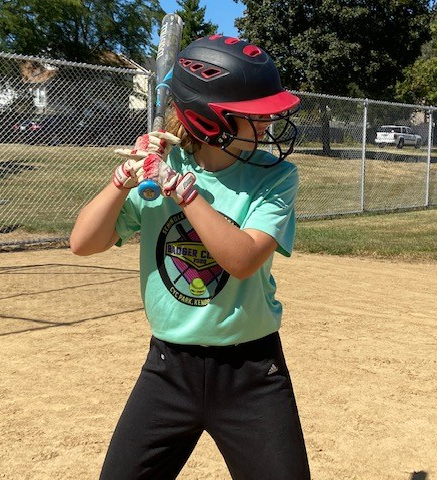
So… off to my bag of tricks I went, and I came back with an eye sticker. I told her to place it on her back (in this case right) hip. (If you look closely at the top or the full-length photo you can see it.)
I then told her that in order to hit the ball, she had to make sure her “hip eye” came around to get a good look at the ball before starting her hands.
As with shoulder eye I’m not 100% of why this works. But I’m happy to report that it does.
My guess is that placing the eye on the hip (or shoulder) creates more of a, pardon the pun, visual for the hitter. Perhaps “bring your hip around” is too vague, whereas point this eye toward the ball first is more specific.
Or it could just be goofy enough to break well-established, unconscious thought patterns to enable new information to take over.
In any case, it seems to work. I’ve used it a couple of times since that first one and the difference was immediate.
The hitter wasn’t necessarily perfect – I like a lot of drive out of the back side. But it definitely set her down the right path.
So if you have a hitter who is having trouble latching onto the proper sequences of hips-shoulders-bat, or who isn’t using her hips at all, get some eyeball stickers and have her place it on her back hip. It might be just what she needs to start hitting with authority.
For Better Hitting, Use Your Shoulder Eye


While it might sound like this is a post specifically for mutants, “shoulder eye” is a concept I came up with to help hitters stop dropping their back shoulders toward the catcher before they begin to rotate their hips to fire the swing. The premise is you want the imaginary eye on your shoulder to turn and get a look at the ball before you start to tilt into the swing.
This is an issue I see all the time, especially on low pitches. As soon as a hitter spots that the pitch is low, he/she will start dropping the shoulder to get down to the ball. That’s just wrong on so many levels.
For example, if you drop the shoulder back and down instead of bringing it forward first you lose the ability to fully adjust to pitch locations. You’re kind of locked into a zone, and if you guessed wrong there isn’t much you can do about it except swing and miss or hit a weak ground ball or popup.
If you turn first, keeping the shoulder up, you can then take a little more time (even if it’s just a couple hundredths of a second, everything helps) to see where the ball is, then tilt only as much as is needed. You can work from high to low, enabling you to cover more of the strike zone AND get a better bat angle.
Another issue with dropping back is that it tends to restrict your ability to move the hips forward effectively. All your weight is pressing down on your back side making it difficult rotate quickly and efficiently. Even if you get your hips to turn you won’t be generating much power out of them.
If you turn your shoulder eye forward first, you can unweight your back side so it can drive quickly around your front side and generate power. You can then get a proper hips-shoulders-bat swing that will help you drive balls into the gap or over the fence rather than seeing most of your contacts end up staying in the infield.
The idea of not dropping the back shoulder toward the catcher before rotation isn’t new, by the way. It’s a fairly standard instruction.
Hitters are told to land with their front shoulder lower than the back, turn a certain way, and do all sorts of other things. But they don’t always understand the instruction in a way that makes it easy to execute.
The shoulder eye concept does. Telling a hitter he/she has an eye on the shoulder, and it has to look forward before the shoulder drops, is visual (no pun intended) and easy to understand.
Originally I would tell hitters just to visualize the shoulder eye. But then one day it occurred to me – why not give them an actual shoulder eye?
A few bucks on Amazon later I had enough stickers to teach a small army of hitters. With 4,000 of them I’m guessing it’s a lifetime supply, even with my habit of giving a few to hitters who want to use them at home or at practice as well.
And why not? It’s fun and effective. Even my students who are college players like the stickers and find the concept valuable in helping them hit bombs.
So if you have a hitter who just loves to drop that back shoulder and sit on the back side, open his/her eyes to the shoulder eye. In my experience it’s a real difference-maker.
Announcing a New Softball Success Service

For the past 20+ years (can I really be that old?) I have been a private coach, primarily working with pitchers, hitters and catchers. During that time I have had an opportunity to teach many wonderful young women, helping them to achieve success and realize their dreams – whatever those dreams may be.
But through that time I have also come to recognize that there is an under-served constituency out there that is aching for someone to fill their needs. So today I am proud to announce a new service through Softball Success that I am calling “Parent and Player Validation,” or PPV for short.
The way it works is you bring your daughter to me, but rather than trying to teach her anything I just stand there for a half hour and tell you how awesome she is.
I will walk around and view her from different angles, put my hand on my chin, look serious, nod a few times, maybe whistle or say “whoa!” (although that costs extra) and even shoot a video or two and use it to show you why she’s so great. What I won’t do, however, is offer any of those bothersome suggestions or critiques because if you’re coming for this service I know you’re not interested in any of that claptrap. You just want to hear she’s perfect the way she is.
Now, I know this service won’t be of interest to any of my current students or their parents because they are all on-board with working hard and trying to improve themselves. I’m actually fortunate to work with an outstanding group of students.
Still, I realize there are people out there who can use this new service. I’ve run into them in the past.
I could tell because when I would tell a pitcher she needs to lock her shoulders in at release, or relax and whip her arm, or stay more upright instead of leaning forward the only reaction I would get is a stinkeye from both the parent and the student.
Or if I told a hitter she needed to lead with her hips, or keep her hands from dropping to her ribcage, or drive her back shoulder around the front instead of pulling the front shoulder out both parent and daughter look at me like I told them they smelled of elderberries.
Clearly, they weren’t interested in my honest opinion, or in changing anything. They simply wanted me, as a professional softball instructor, to validate what they already believed.
Of course, the core of great customer service is to give the people what they want (to paraphrase Marshall Field). So rather than fighting the tide, I’ve decided this could be a tremendous money-making opportunity.
With that in mind, I am thinking of a fee structure along the lines of:
- Saying she is perfect and I wouldn’t change a thing – $100/half hour
- Saying she is an incredible talent and one of the best I have ever seen – $200/half hour
- Saying she is without a doubt the best I have ever seen in-person – $500/half hour
- Saying she could possibly be the greatest player who ever played the game – $1,000/half hour
I haven’t locked into the actual dollar amount, but I’m figuring with as desperate as some people are for this type of validation this is probably a good starting point. I may also offer a discount if you just want to come in and have me say it without actually having to watch the player do anything since I would be able to squeeze another actual lesson in during the rest of the time. Or if you want to send me a 30 second video and have me email my effusive praise back to you.
I can see where this could lead to other services as well. For example, I can set aside a radar gun with a series of impressively high readings and let you take a picture with your daughter showing whatever reading matches what you think she’s throwing. I’m thinking $50 for that, at least to start. The possibilities are endless.
So let me know. If you’re looking for someone to tell you how awesome your daughter is without all the inconvenience of being told she needs to work on this or that, this new service should fit the bill.
Just remember that being told what you want to hear doesn’t mean she’ll perform well on the field, especially when she faces competition of equal or better ability. That actually takes work.
But if you just want to have your ego, and your daughter’s ego, stroked I am prepared to accommodate. All lines are now open…
Hitters: Never Get Stuck on Your Back Foot

You see this all the time working with fastpitch hitters. They look great on the tee – good load and stride, good sequence of hips-shoulders-bat, and a powerful outcome.
Then you start front tossing to them, or having them hit off a pitching machine, and it’s as though some alien who has never swung a bat in its life has somehow possessed your hitters while you were setting up. They make short, jerky moves to stride and wildly swing their arms with barely any hip movement at all. You wonder what happened, and why they’ve lost everything you just spent so much time working on.
Actually, your hitters haven’t forgotten about all that hard work. They just don’t have time to execute that swing. Here’s what happens.
The “pitcher” gets ready to throw and the hitter loads. Then, since the pitch isn’t coming yet, she feels like she loaded too soon so she stops and stands on the back leg.
Then the ball comes and she starts to stride. But because the ball is coming from 20 feet away (on front toss) or at a high speed (since everyone cranks up the pitching machine to the max setting) it’s on her faster than she realized. So she just abandons all the body movement and just tries to get the bat to the ball any way she can, which usually produces some pretty poor results.
What really makes it tough is when the hitter realizes she was late getting to the ball so she starts even earlier! All that does is get her stuck on her back foot sooner, which only makes things worse.
Continuous motion
To truly be effective, hitters must remain in continuous motion. That means once the load happens, they must keep on going until that pitch reaches its conclusion with either a swing or take.
There is no hitting the pause button in the middle of the swing for everything to line up. Mostly because it won’t line up.
That pause on the back leg breaks the momentum that was being gathered with the load/negative move and essentially causes the hitter to have to break inertia all over again. That takes time, and when you’re dealing in hundredths of a second there is no time to waste trying to get the body going.
Hitting is about rhythm and timing. Putting in a pause in the middle of the swing throws that rhythm and timing out the window. You want to keep going in one smooth motion from beginning to end so you can reach that oh yeah moment.
Trust the swing
So, with that in mind, how do you break this vicious cycle of early-wait-late? It starts with getting the hitter to trust the swing, and the process of the swing.
I will usually tell a hitter that she needs to start her stride BEFORE I release the ball in front toss. (For machines it’s a little different, but I have some good tips on dealing with that in another blog post.)
Of course, just because I said it doesn’t mean it will happen. So I encourage her to trust the process, i.e., try to get that stride going early.
After a couple of attempts, she will usually start to get her front foot down on time, with enough time to fire the hips, bring the shoulders around and then launch the bat with confidence. She will find that anticipating the release, and trusting that it will happen, rather than waiting for visual confirmation that the ball is released enables her to execute the swing as we practiced it on the tee.
Verbal cue
While the above strategy works with most hitters it doesn’t necessarily work with everyone. Younger hitters especially may still have trouble figuring out when to start their positive move forward.
For them I have a simple solution: I just yell “Go!” as my arm comes down the back side of the circle. (I always use a full circle – because I can.)
They may be startled at first, but they’re usually obedient so they get started when I say. Again, after a couple of attempts they start gaining confidence in their approach, so when I say go they start attacking the ball.
Of course, I do like to point out to them that an actual pitcher isn’t going to tell them when to start their stride so they will have to learn to do it without the verbal cue. But if it helps them understand the concept and gain some experience with striding before the ball is released, I’m more than happy to do it for a little while.
Translating to an actual pitch
Right now there are probably some hitting fanatics who are saying “but high-level hitters don’t get their foot down before release.” That’s true.
But high-level hitters are also not hitting a pitch thrown from 20 feet away. Even with the new pitching rules.
When you’re throwing that short distance pitch to them, it’s the equivalent of the ball having traveled about 1/3 to 1/2 the distance from the pitching rubber to the plate. And that IS about the time high-level hitters get their front foot (feet?) down.
So once again, the idea of starting the stride before the pitch has been released is valid. You want to go calm-calm-explosion (aka load-stride-swing).
When exactly it happens depends on the pitcher, the hitter, and the hitter’s athletic ability. That last part is something to keep in mind too when you watch video of high-level hitters. The reason they’re high-level is they just might be able to do things, and get away with things, us ordinary mortals can’t do.
Keep it moving
Getting stuck on the back foot in the middle of the swing is just asking for trouble. It takes discipline and trust to break that habit but it can be done.
The more your hitters keep themselves in motion, from beginning to end, the more often -and the farther – they will hit the ball. Keep an eye out for the deadly pause and you’ll help your hitters succeed.
Be As Water

Photo by Pixabay on Pexels.com
One of the most well-known pieces of advice from the late, great Bruce Lee was a simple three-word statement: be as water. For those interested in more of what he meant, or who are just wondering who the heck Bruce Lee was, here’s a video:
While Lee’s advice was ostensibly meant to encourage martial artists to give up their old, rigid approach to movement in favor of one that was more free-flowing, I find it’s also great advice for fastpitch softball players. Here are a few examples.
Pitchers
When pitchers want to throw harder, they tend to tighten up their muscles and become very stiff. They also do it when they’re trying to guide the ball to a location (even if it’s just the general strike zone). Yet that’s the worst possible thing to do in each situation.
If you’re trying to gain speed, remember tight muscles are slow muscles. You can swing your arm around much faster if you relax and let it go versus trying to force it around.
Being stiff when trying to gain better control also works against you, and actually makes it more difficult. If you are tight and off-line somewhere in your circle, you will stay there and the ball will go somewhere you don’t want it to.
But if you are loose, a gentle nudge is all it takes to get back on-line. Plus, you have momentum working for you, because if you are loose and using good mechanics (i.e., those that follow the natural way the body moves) it’s a lot easier to follow the natural line.
To improve as a pitcher, be as water.
Hitters
The same things about tight versus loose apply to hitters. If you try to muscle up on the ball you’ll lose the whipping action of the bat into the hitting zone, costing you valuable bat speed.
Being tight also makes it difficult to react and adjust to pitch speeds, spins and locations. A rigid swing will tend to continue going wherever it started to go; a relaxed swing allows you to make adjustments without losing bat speed.
Then there’s the mental aspect. If you are uptight generally (aka in your own head) you are going to be worried about far too many outside factors, such as your last at bat or the fight you had with your mother before the game, to bring your swing thought down to “see ball, hit ball.”
There will be no flow to your swing, just a sort of panicked flail as the ball comes in. You may even start seeing things that aren’t there, or lose your perspective on exactly where the strike zone is. Much can happen.
To improve as a hitter, be as water.
Fielders
As a fielder, you want to be able to move smoothly to the ball. You want your throws to be easy and sure.
That’s going to be tough if you are tight and rigid. The word “flow” is frequently used to describe a great fielder. And what water does.
Being rigid or mechanical in your movements is a sure ticket to many more errors than you should be making. And if you are that way because you are AFRAID of making errors and being pulled out of the game, it only gets worse. Forget about all that.
To improve as a fielder, be as water.
Approach to the Game
Perhaps the area Bruce Lee’s advice applied to most is your general approach to the game. In the video, he says that if you pour water into a cup it becomes the cup. If you pour it into a teapot, it becomes the teapot.
Fastpitch softball players need that type of flexibility as well. You may be asked to play a position that isn’t your usual one. You can either resist or go with it.
Yes, playing outfield rather than catcher or shortstop may not be your preference. But if you go with it and prove yourself in the role you were asked to play you are far more likely to get the opportunity to show what you can do in the position you want to play. I’ve seen it happen.
You may not like your coach’s coaching style. Understood – there are some bad coaches out there. But often it’s not a matter of good or bad, it’s just different than you prefer.
Rather than bracing yourself against it like a rock, be as water. Adjust your expectations and get as much as you can out of the experience. Everyone has something to teach – even if it’s just not to be like they are in the future.
You may not be getting the playing time you want or feel you deserve. That may be true. But before you just blame the coach and jump ship, ask yourself if you’re doing all you can do to earn the spot you want.
Are you diving for balls in practice? Are you displaying a positive attitude? Do you go to the weight room, take extra batting practice or bullpen work, ask for one more ground ball if you pooch one in practice, help clean up team equipment at the end of practice or a game, etc.?
Maybe the answer is yes and you’re just not getting a fair shot. It happens. But before you decide that, determine whether you have been trying to shape yourself to the program the way water shapes itself to the cup or wishing the program would shape itself to you.
Final Question
So after all of this, if I were to ask you which is stronger, the rock or the water, what would you answer?
Many would say the rock. Not a bad answer on the surface, because if you place a rock in a stream or river, the water will be forced to go around it.
Over time, however, the water will wear away the rock and any other obstacle in its path until it can once again flow smoothly.
So I ask you again: which is stronger, the rock or the water?
Be as water, my friend.






 Life in the Fastpitch Lane