Category Archives: Hitting
Efficiency Is the Secret Sauce to Improving Performance
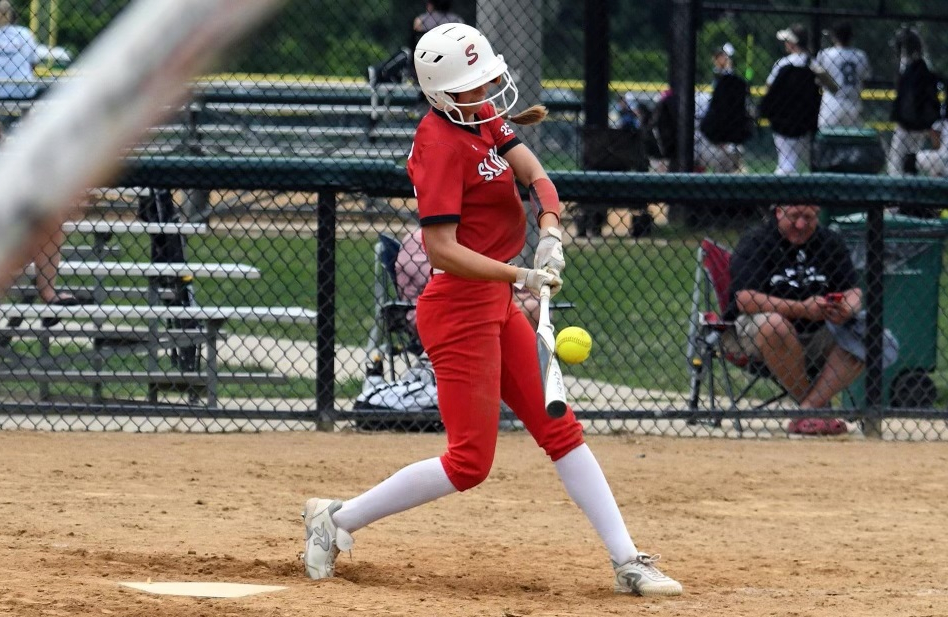
Everyone is always looking for that one magical drill, or technique, or exercise, or something else that will help them improve their level of performance in games.
Building strength is often where players and coaches turn when they don’t know what else to do. And yes, you can definitely drive some level of improvement through strength or speed and agility training. But often the results don’t match the expectations – or at least the hopes.
That’s because there’s another element to the whole process: efficiency, or the ability to improve output without increasing the level of input.
Take a look at these two illustrations. The first one shows a player whose mechanics are inefficient, such as a hitter who only uses her arms or a pitcher who pushes the ball through release with a forced wrist snap.

Let’s say she is working hard but not seeing the results. Increasing her input is only going to raise her performance slightly, because the rather flat relationship between input and output remains the same.
When you have high efficiency, however, as seen in this chart, the difference between input and output is much greater

Both players are putting in the same level of effort. But the second is getting much more out of it. In fact, while the first player’s performance is below the midline of the chart, the second player’s performance is already above it.
Which means if player one wants to reach the same level she is going to have to somehow double her input. Yet if player two only increases her input a little more, her output goes to the top of the chart.
Now, all of the objects and their placement here are arbitrary; they’re not based on a specific set of numbers but rather just an illustration of the principle. But the correlation is real.
It’s essentially a great example of the coaching phrase “Work smarter, not harder.”
When you are inefficient, increasing your effort (strength building, practice time, and so forth) even to a significant level often only results in a small, incremental improvement in overall performance. If you are highly efficient, however, the effect of putting in even a little extra effort is multiplied and you can make significant gains toward your performance goals.
Think of it this way: if you were running a 100 meter dash race with a prize of the latest, greatest smartphone would you rather be on the starting line with everyone else or 10 meters ahead of the pack? I know which one I’d choose.
Being more efficient through mechanics that are proven to be superior gives you that head start on the race to the top. It doesn’t guarantee you’ll stay there – you still have to keep working or the less efficient players could pass you eventually – but having a head start is definitely a significant advantage in anything where there’s competition for success.
That’s why it’s important for players, coaches, and parents to understand what efficient mechanics are for every skill – hitting, pitching, throwing, fielding, base running. There are plenty of great resources out there that can point the way, starting with where you are right now on Life in the Fastpitch Lane.
For pitchers you might want to also check out Rick Pauly’s Pauly Girl Fastpitch website as well as Keeley Byrnes’ Key Fundamentals Softball blog. The Discuss Fastpitch Forum is also a great resource for a wide variety of topics.
Social media sites such as Facebook, Instagram, and YouTube have some great content (along with a lot of not-so-great content so you need to be discerning about who and what you follow).
If you’re not sure if you’re using efficient mechanics right now, a great way to check is to watch high-level college and pro games to see what those players do, and compare it to what you (or your daughter/player) is being taught. If you don’t see the same things, you’re probably not learning efficient mechanics.
All you need is a smartphone and a TV and you can capture your own clips. Throw them in some sort of video analysis software and you are ready to spend hours upon hours going down the rabbit hole. But at least you’ll be informed.
The bottom line is working harder always works better when you work smarter too. Focus on improving your efficiency rather than just your input and you’ll see your output rise dramatically.
Teaching Hitters to Track the Ball More Effectively

Go to any facility where there are teams or individuals hitting in batting cages and sooner or later you’re likely to hear the phrase, “Track the ball all the way into the catcher’s glove.” While it’s doubtful that hitters can actually see the ball hit the bat at the point of contact, the idea of trying to track the ball as long as you can is a good one.
The problem most coaches face when trying to get their hitters to track the ball longer (instead of getting a glimpse then swinging) is that there are no consequences for not doing it. Well, other than not hitting well. But as soon as the coach’s back is turned, hitters are likely to go back to not following the ball all the way to the catcher’s glove.
But, dear blog follower, I have a solution for the dilemma. It actually came up by accident, but I noticed how the pattern had changed so I’m taking credit!

All you need is a batting cage with a tight protective net at the back of it.
For the past few months I’ve been throwing front toss to hitters in a cage that has a very tight net at the back. When one of my errant pitches (and there are many of them) would hit the net, it would bounce back at the hitter with enough velocity to be annoying.

What I noticed was a lot of the hitters would watch the ball all the way to that net so they could get out of the way when the ball bounced back. Some of them then made a game of trying to catch the ball when it popped up off the net, and they got pretty good at it.
Since their first priority was hitting any good pitches I managed to throw, it took some effort to see the ball coming back and catch it.
But today I was in a different cage that didn’t have such a tight net. And that’s where I saw the effect take place.
One of the hitters who liked to catch the ball was still following it to the back screen, even though it wasn’t going to bounce back. She’d built a habit of it in the other cage to the point where she now automatically watches the ball all the way back.
Between that and the Reynaldo drill, which she has become very good at, she is seeing the ball much better – and hitting the heck out of it.
So I guess the lesson here is if you want to encourage your hitters to watch the ball longer, find a nice, tight net and put it behind the plate when you front toss to them. They’ll definitely learn to keep an eye on it all the way in.
(And yes, I know the hitter in the top photo is hitting off a tee. It’s tough to throw front toss and take a picture at the same time. Deal with it.)
Brrrr It’s Cold; Take Advantage of It

As I write this we are not only in the beginning of the Christmas/New Year holiday vortex but also an actual polar vortex. Winter Storm Elliott is hammering much of the U.S., including parts that aren’t used to it, with snow, gale force winds, and bitter cold of the type that makes you run right back inside as soon as you feel it.
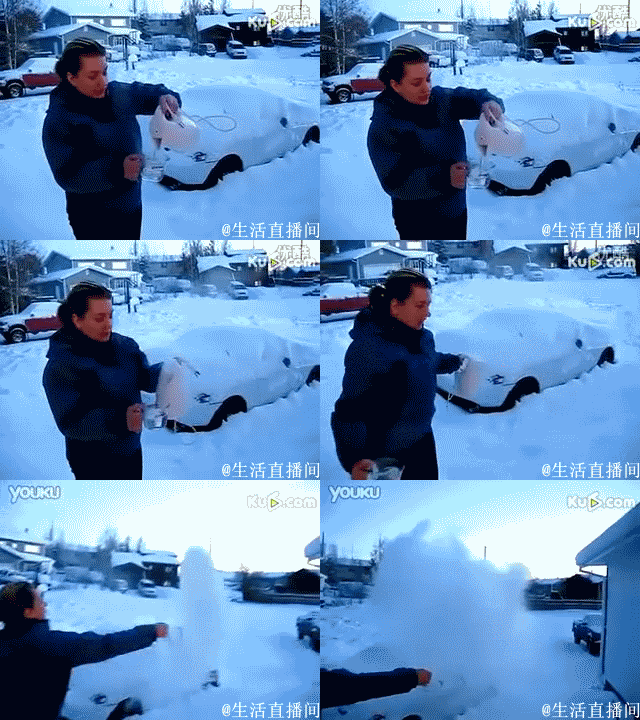
It’s so bad where I live that the facility I usually work out of has been closed for the last couple of days. No sense having people risk their health and/or their lives just to come to a lesson when there are no important games on the immediate horizon.
So does that mean all softball-related activities must come to a dead stop? Hardly.
In fact, times like this offer the perfect opportunity to really dig into mechanics and the mental game to work on the little things that can make a huge difference in a player’s overall performance.
It’s like when a player comes to a lesson and says they are feeling a little ill, or tired, or have an injury. I light up – not at their misfortune but at the chance to go deeper in aspects of the game that they might not want to spend so much time on ordinarily.
Not because it’s not necessary, but because it can be really boring to them. When it’s all they can do, however, those things become a lot more interesting.
So while it’s bitterly cold or snowy and you’re stuck at home (or even if it’s bright, sunny, and balmy for that matter) here are a few things to work on that don’t require a cage, a bat, a regular softball, or even much space.
Quick Pitching Release
I have yet to meet a pitcher who doesn’t want to be faster (including a few pretty famous ones). While speed alone isn’t everything, the more you have the better everything else seems to go. And the better you can get by until you can improve other aspects of your game.
One of the keys to speed is the ability to transfer as much of the energy the pitcher has generated through leg drive as possible into the ball. That requires a lightning-quick yet relaxed pronation of the forearm at release.
Building that pronation doesn’t require a lot of space or fancy equipment. You can:
- Throw a rolled up pair of socks into a wall or mirror
- Throw a plyo ball, foam ball, or regular ball into a net
- Walk around the house practicing releases, Ks, and full circles with nothing in your hand
- Perform various exercises (such as squeezing a stress ball) to build your grip strength
Focusing on that one little bit can pay huge dividends the next time you go to pitch at a full distance.
Leg/Body Drive and Timing Off the Rubber
Don’t worry non-pitchers, we’re getting to you. But this is another area that’s often under-trained when pitchers are left on their own.
A lot of pitchers have trouble generating effective leg/body drive off the pitching rubber. After they load they will start to reach forward with their stride (glove-side) leg while essentially standing on the drive (throwing-side) leg.
This type of movement is inefficient, even if it’s done quickly. To generate the kind of energy needed to throw hard you have to get the hips driving forward before the stride leg has gone out fully.
In other words, pitchers have to learn to use their legs together instead of one at a time. Fortunately, this is the same type of leg action used when you skip (or for you multi-sport athletes go for a layup).

Find a few feet of space and skip. Feel how the legs are working. Then try doing the same thing but adding a pitching motion to it.
Take video so you can see if you’re truly getting some spring in your step or if you’re just standing on the pitching rubber as the stride leg goes out.
You can also just stand on the ball of the foot of your drive leg, push forward, then “catch” yourself with your stride leg. This should all occur in a quick, short motion rather than trying to get out far.
Feel the legs working together, then start extending it until you can do it full speed, just as you would in a game.
Swing Mechanics
You probably know from endless hours of lessons what you’re supposed to do at each phase of the swing. But are you actually doing those things?
Here’s a way to find out. Set yourself up in front of a full-length mirror and watch yourself take a swing. If space is limited substitute a curling iron or a short pool noodle for the bat.
Go through it slowly and see what position your body is in at each phase. Check to see that you are:
- Getting positive movement forward
- Leading with your hips
- Getting separation between your hips and shoulders
- Keeping your hands up instead of dropping them to launch the bat
- Driving your back side around your front side
Do it slowly, over and over, checking each aspect. Then do it a little faster, then a little faster, each time checking all those aspects.
While this doesn’t do much for your timing, it ensures that if you are on time you’ll greatly increase your chances of hitting the ball hard.
Ball Transfers
While this applies to any position, it especially applies to catchers. The faster you can transfer the ball from your glove to your throwing hand, the sooner you can get the ball on its way so you can throw out even the fastest of rabbits.

This is a skill that can be practiced in a bedroom or living room.
Start out barehanded, with the ball in your glove hand. Then transfer it to your throwing hand by slamming it from one to the other.
Then add a glove, doing the same thing. Do it over and over, each time trying to go a little faster.
Before you know it you’ll be able to move that ball from one hand to the other with the best of them.
Mental Game
Ask any coach or player how important the mental game is and they’ll likely tell you it’s hugely important. Then ask them what percentage of their practice time is spent on the mental game and, if they’re honest, they will probably tell you little or none.
That’s because physical practice seems like practice. Mental game practice feels like you missed something you should have been working on.
This is your chance. While you’re stuck inside, do some visualization, seeing yourself making great plays or slamming great hits.
Work on your positive self-talk. A kind word from yourself at the right time can work wonders.
Look online for various stress-relieving techniques you can use during a game. Examples include:
- Squeezing a stress ball or other device
- Grabbing a handful of dirt, squeezing it tightly, then throwing it away
- Inhaling deeply through your nose and blowing the air out slowly through your mouth
- Washing your hands with water
- Creating a pre-pitch routine or ritual
Turn on loud music or a talking podcast then try to do something unrelated such as a reading or math problems. It’s amazing what this exercise can do for your ability to focus.
Time invested now in your mental game can pay big dividends when it’s actually time to play.
No Justification Needed
Really, these things aren’t just for bad weather. They are things you should be doing any time if you want to get better.
But bad weather provides the perfect opportunity because there is little else you can do.
Don’t waste this chance. Get on it now and you’ll find you’re than much farther ahead in your goals once you hit the field again.
Photo by Ir Solyanaya on Pexels.com
6 Tips for More Successful Bunts

Most of my time as a fastpitch softball hitting instructor is spent teaching hitters how to drive the ball to – or over – the fence. Yet at some point I will also have each hitter work on laying down bunts.
Now, you might be surprised at that statement given some of my past post about bunting. But those relate to the sacrifice bunt, especially the sac bunts many teams lay down automatically with a runner on first and no outs. (The short version, if you don’t want to follow the link, is it’s a waste of an out.)
The reality is bunting, especially bunting for a hit, still has an important place in our sport. Which means when you’re called upon to do it, you’d better be able to get the bunt down.
That’s why I am so surprised at how poorly it seems to be taught these days. When I ask a hitting student to bunt I see all sorts of easily correctable flaws that are going to prevent success.
Since I doubt any coaches or parents are purposely training their players to fail, I can only conclude that they simply don’t know any better. I’m also pretty sure that, as often happens, they are simply passing along whatever bad techniques they were taught 20 or more years ago.
So to help with this issue I’ve put together this little guide. Follow these tips and you’ll find your players will be better equipped to lay one down when the time comes.
Stance (and getting into it)
A good bunt starts with a stable platform. After all, it’s a lot easier to hit a rapidly moving object if you’re not fighting to maintain your balance.
The mistake many young hitters make (and coaches don’t correct) is how hitters get into their bunting stance. As in the hitters will pivot on the balls of both feet to get turned forward.
The problem with that is the feet will then be in a straight line, one behind the other, instead of spread out side-to-side. To correct that issue, have the hitters pivot on the ball of the back foot and the HEEL of the front foot.
Now there is a little space between them, giving hitters the stability they need to work the bat more effectively.
BONUS TIP: If you are bunting for a hit, do not tell the hitter to move to the front of the box. That’s a dead giveaway as to what your strategy is, which really takes away the element of surprise you’re probably counting on.
Yes, I know moving up in the box improves the angles and gives the bunt a better chance of staying fair. But you don’t have to be Hall of Fame coach Margie Wright to figure out if the hitter moves up she’s bunting. At which point the defense should move their third baseman to 10 feet away from the plate so she can try to catch the ball in the air for the out – or a double play.
Grip
The most commonly taught grip for bunting seems to be to move the top hand up to the top of the handle and then have hitters pinch the bat between their thumb and index finger. This is a grip that comes from baseball – especially old-time Major League Baseball.
There are several problems with this grip, not the least of which there is a huge disparity in the hand strength between a 25 to 40 year old man and an 8 to 22 year old girl. Plus, -3 wood bats are much heavier and denser than -10 composite or aluminum bats, so they can absorb the impact of the ball more effectively.
Then there’s the issue of a softball weighing at least 30% more than a baseball (6.5 to 7 oz. versus 5 to 5.25 oz.). Combine a weaker hand, a lighter, less dense bat, and a heavier ball and you’re going to end up with a lot more balls that get deflect foul.
A better, more effective grip is to grab the bat with all the fingers – the same way you hold it to swing for the fences, just further up the bat. Actually, I prefer both hands up the bat, but the bottom hand can be as close or far away as the hitter is comfortable.
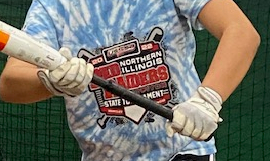
To prove its effectiveness, have a hitter hold the bat in the pinch grip and then use your hand to smack the barrel of the bat. It moves back a lot.
Now try the same thing with a full-on grip. You’re more in danger of hurting your hand than moving the bat much.
But doesn’t that put the fingers at risk of getting smashed by an inside pitch you ask? Not really, as you’ll see in the next sections.
Contact area
Another common mistake I see with hitters is that they try to use the sweet spot of the bat to make contact with the ball when they bunt.
I get it. That’s where they’re taught to hit the ball when they swing away so it’s a natural assumption.
Yet as I tell them, if their bat costs $400, $350 of that cost is in the sweet spot. It’s designed to send the ball as far as it can, and a lot of research and development money goes into making that happen.
But you don’t want the bunt going far. You want it to roll a few feet away from the catcher and then stop so it’s harder for the pitcher and/or infielders to field.
To get that effect, you want to use the $10 part of the bat, i.e., the end of the bat. That’s a major dead spot (as anyone who has felt the bees in their hands after making contact there on a full swing can tell you).

Hit it off the end of the bat – all things being equal – and the ball won’t go nearly as far. It’s also the point that’s farthest away from the top hand’s fingers, so if you’re using the end of the bat the top hand is in no danger of being hit. It’s a win-win.
Contact technique
Then there is the issue of how to make contact with the ball.
Many fastpitch softball hitters, even good ones, tend to punch at the ball with the bat as it comes in. Again, you don’t have to be Hall of Famer Margie Wright to figure out that punching at the ball will add to the power of the impact, making the ball go farther – even if you hit it with the dead end.
Instead of punching at it, hitters should pull back slightly to “receive the ball.” By giving a little they soften the impact and cause the ball to come off the bat gently.
You can explain this to players who play other sports by talking about how they receive a pass. Soccer players pull their foot back; hockey players pull their sticks back; basketball players pull their hands back as the ball comes in. At least they should.
Of course, this is easier said than done with bunting. Everything players have been taught with hitting to this point revolves around driving the bat into contact.
Pulling it away as the ball comes in will be very foreign to them. But with practice they can learn to do it.
One of the best ways to practice this is to draw a circle in the dirt, or lay down some ribbon or a Hula Hoop a few feet away from them and have them try to get the ball to go into (and stay) in the circle. They’ll figure out how to soften it really quickly.
Bat placement in the zone
Untrained hitters will often try to cover the entire width of the plate with their bats. That’s fine if the pitch is outside. But if it’s inside it’s going to be really tough to hit an inside pitch with the end of the bat.
Instead, have them cover roughly half the plate. That way if it’s inside they can pull the hands in a little. And if it’s outside they can stab the bat out to get the outside pitch, with the added benefit they will probably put it up the first base line instead of hitting it at the charging third baseman.
It also helps keep their top hand safer. As you can see, in this set-up if the ball is coming for the top hand it’s also coming for the torso, so the hitter has extra incentive to get out of the way.
You’ll also notice the bat head is higher than the handle. That’s to help hitters hit the top of the ball.
A flat bat, or worse one where the barrel is lower than the handle, is most likely to end up in a pop-up. You don’t want that, especially if you have a bunt-and-run on with a runner on base.
An upward angle, even a slight one, will make it more likely your hitters will get the ball on the ground quickly when it’s hit, and will make it easier for hitters to control where it goes.
Where to direct the bunt
Some of this is a matter of the level of play you’re facing. If your team’s opponents are not particularly skilled, any sort of bunt anywhere is likely to result in success.
A bunt up the third base line may be most effective, too, because it’s the longest throw. (A tip of the cap to Coach JD Koziarski for reminding me of that.)
At higher levels of play, however, the third base line is the worst place to drop the bunt. Third baseman make their bones on their ability to field a bunt and throw out the runner, and they practice that skill constantly.
Pitchers and first basement do not usually spend that kind of time practicing to field bunts, however. So the better strategy is to bunt either at the pitcher (and hope she chucks the throw into right field) or up the first base line where no one may get to it – especially if the first baseman is playing back.
Bunting is still necessary
Yes, all the emphasis for hitting these days is on exit speeds and launch angles. But there is still a place for bunting in our sport, so it’s important to teach optimal technique.
And that’s not just for the rabbits or average hitters either. EVERY hitter, even the big boppers, should know how to bunt well.
You don’t want to find out in the middle of a tight game that your best hitters are a disaster at bunting. And for their sake, someday they may be at a practice where the team is divided into two groups and they compete against each other to see which one gets the most bunts down. You don’t want any of them to drag their teams down.
So teach them all how to bunt properly. It’ll open up new offensive possibilities.
Want to Get Better? Try Doing Nothing!

Ok yes, today’s title was purposely click baity. Because I don’t mean literally to sit around all day on the couch staring at a screen or eating Cheetohs (or doing both; I’m not here to judge).
Sorry all you players who hoped to use my blog to justify telling your parents to chill, or whatever you say nowadays.
What I’m actually talking about is learning to use your body the way it’s meant to be used rather than trying to do too much and getting in the way of your best performance.
A great example, and one I’ve talked about many times here, is using “hello elbow” (HE) mechanics for pitching.
With HE, you push the ball down the back side of the circle and try to get your hand behind the ball early going into the release zone. You then pull your arm through the release zone with your bicep while (supposedly) snapping your wrist hard as you let go of the ball, finishing with your elbow pointing at your catcher.
While this may seem like a way to add energy into the ball in theory, in practice the opposite is true. It actually slows down your arm, because your using the small bicep muscle instead of the larger back muscles to bring the arm down, and gets in the way of your arm’s natural movements as it passes your hip.

It’s also an unnatural movement pattern. To prove it, stand up, let your arms hang at your sides, and see which way your hand is facing. Unless you have something very odd going on your palm is in toward your thigh, not turned face-forward.
Your arm wants to turn in that way when you’re pitching too. In order for that to happen, all you have to do is NOTHING – don’t force it out, don’t force a follow through, really don’t do anything. The ball will come out as your hand turns and you will transfer way more energy into the ball than you would have if your tried to do something.

This, incidentally, is something I often use to help pitchers whose arms are naturally trying to do internal rotation (IR) but are also using an HE finish because that’s what has been drilled into them for the last three years gain a quick speed boost. They start out using their HE mechanics from the K position and we look at the speed reading.
I then have them lose the forced finish and just let the arm naturally pronate at it reaches the bottom of the circle. They can usually add 2-3 mph immediately just by doing nothing.
Or let’s look at hitting. Many young and inexperienced hitters will try to over-use their arms and shoulders when bringing the bat to the ball.
It makes sense on some level because the bat is in your hands and you want to hit the ball hard.
Yet that is the one of the worst things you can do. When you pull the bat with your arms and shoulders you have to start your swing before you know where the ball is going to be (never a good idea).
You will also lose your ability to adjust your swing to where the ball is going because you’ve built up so much momentum in whatever direction your started. Not to mention that muscles get smaller and weaker as you move away from your core so you’re not generating nearly as much energy as your body is capable of producing.
Again, the better choice is to do nothing with your arms early in the swing, and instead let your lower body and core muscles generate energy and start moving the bat toward the ball (while the bat is still near your shoulder). Then, once you’re well into your turn and you see where the ball is headed you can let the bat head launch, resulting in a much better hit, and a more reliable process.
Does doing nothing work for overhand throwing as well?

How many times have you seen players lined up across from each other, throwing arm elbow in their glove and wrists snapping furiously while their forearms don’t move? Probably more times than you can count.
This is a completely pointless drill because no one, and I mean NO ONE, purposely snaps their wrists when they throw overhand. Instead, they relax their wrists and allow the whipping action to snap their wrists for them – which is far more powerful.
To prove it, close your fingers up and try to fan yourself by snapping your wrist. Not much air there, right?

Now relax your wrist and move your forearm back and forth quickly. Ahh, that’s the stuff. That breeze you now feel is more energy being generated, which moves more air into your face.
So if that’s the case, why would you ever try to do something when you’re releasing the ball rather than doing nothing and letting biomechanics produce better results for you?
There are countless other examples but you get the picture. The point is, forcing unnatural movements onto your body, while they might make you “feel” like you’re working harder, are actually very inefficient.
If you want to maximize your performance, make sure the energy you’re producing is delivering the results you’re going for. Just doing nothing and watch your numbers climb.
Photo by Oleksandr Pidvalnyi on Pexels.com
Applying Deep Practice to Overcome Stumbling Blocks

Anyone who has read the book The Talent Code by Daniel Coyle has heard of the concept of “deep practice.” You may have blown right by it but you’ve heard of it.
Part of the key to deep practice is repeating movements over and over in ultra-slow motion. As I recall Coyle says movements should be so slow that someone passing by casually can’t tell what you’re trying to do.
This week I had a chance to test this idea out on several pitching students to see how much it would help. The short version (and spoiler alert): quite a bit.
Each of these students, whose ages varied from 10 to 16, was having trouble throwing her changeup. Specifically they were all having trouble getting their hand into the proper position at the right time to make it work.
When it happened the first time I remembered The Talent Code and told the pitcher to work through how to get her hand turned the right way at the right time going ultra-slowly. After about a dozen reps at that speed I told her to go back to the pitching rubber and throw it.
The pitch was spot-on. Not just once but every time she threw it.

Hmmm, I thought, that worked pretty well. But of course “one” is not a valid sample.
So, the next student who had trouble with her change was advised to do the same. And we got the same results!
As I recall I did this with half a dozen students and it worked every time. Not just a little bit but to the point where if the pitcher threw that pitch in a game it most likely would have resulted in either a swing and miss or a hitter frozen mid-swing.
Of course, six isn’t really a valid sample either so I plan to continue the experiment with students who are having trouble with the mechanics of any pitch. I fully expect I will get similar results regardless of the pitch.
I hesitate to say it’s a magic bullet. But so far, it’s about as close as I’ve found.

The good news is this technique isn’t just for pitchers. It can be applied to any skill where an athlete knows what to do at some level but isn’t quite able to do it.
Have a hitter who is having trouble keeping the bat head up until she turns the corner and then turning the bat over? Have her do it properly, very, very slowly, over and over.
Have a fielder who keeps dropping her elbow instead of getting into a good throwing position? Have her work on the proper technique, very, very slowly, over and over.
Have a catcher who is sitting back on her heels when she blocks instead of getting her shoulders out in front of her knees? Have shortstop who is having trouble transferring the ball for a double play? You get the idea.
Just one caution. I’m fairly certain the benefits we achieved so far were temporary. That’s why I’ve told the girls who did it to keep practicing that way, 20-50 times per day.
The beauty is they don’t need a field, or a ball, or a tee, or a catcher, or anything else. Just enough space to work on the proper movement patterns until they’re locked in – however long it takes.
If you have a player who is struggling to do something, especially something she’s shown she can do before, give the ultra-slow movement approach a try. And if you do, let us all know how it works out in the comments below!
When Timing Pitches, Focus on the Future

One of the things that makes hitting so difficult is you not only have to develop great swing mechanics; you also have to time them to the speed, direction, and movement of the pitch.
Since there are no style points in softball (i.e., no judges holding up cards reading 9.5 for a beautiful swing) the only thing that matters is how well you hit the pitch. Yes, having great mechanics contributes to being able to hit the pitch well, but they have to be timed properly to get the best effect.
And that’s something many hitters struggle with. One of the big reasons, at least in my experience, has nothing to do with athleticism or ability.
Instead, it’s a fear of looking bad, or of being yelled at otherwise chastised for swinging at a bad pitch. So, those hitters will wait too long to ensure the pitch is good, putting themselves behind and thus letting the ball get too deep on them before they initiate their swings.

How do you overcome that fear? One way is to teach hitters to think “yes-yes-yes-no.”
In other words, they’re always swinging until they actually see it’s a bad pitch instead of waiting to swing until they see it’s a good pitch.
Still, if they’re really worried about looking bad they may still hesitate. So here’s another way to explain it to them.
Ask them whether they can affect things in the past, present, or future. Unless they’ve skipped every science class ever they will likely tell you the present and future.
Then take a ball and hold it either even with their bodies or a little behind. Explain to them that this ball is in the past.
Therefore swinging at it is pointless because they can’t change the outcome. It’s by them and it’s done.
Then hold the ball at the proper contact point and tell them this pitch is in the present and they can do a lot with it. Then hold it further in front and say it’s in the future.
Now, if they start swinging at the future ball (too early) can they still make an adjustment and get on-time? It may not be easy depending on HOW early they are, but it is possible, especially if you have a ell-sequenced swing.
So with that in mind, is it better to be a little too early or a little too late? Too early, of course, because you can still change it. Once you’re late it’s all over – unless you happen to have a time machine handy, in which case quit playing softball and go back in time to buy some Microsoft, Apple, and Amazon stock.

It’s all about keeping it simple. Hitters may not understand some of the complexities of proper timing, but pretty much everyone can relate to the idea of past-present-future.
Get them focused on affecting the present and future and they’ll spend a lot less time regretting their decisions in the past.
Photo by Pixabay on Pexels.com
Hitting and Timing: Going From Sunday Morning to Monday Morning

One of the greatest challenges fastpitch hitters face is understanding how to time the various stages of their swings.
Some will tend to rush the entire swing, especially if they are concerned about the pitcher’s speed. As a result, they never build a rhythm and while they may make contact it won’t be good, solid contact.
Some will be lethargic throughout. Those hitters are never going to get to the ball on time and will be easily overpowered even by mediocre pitchers.
And some with just be unmade beds, with no rhyme or reason to what they’re doing at all. It hurts just to watch them.

Now, you can talk all you want about proper timing and having proprioception (body awareness for those about to do a Google search) but often that conversation goes has little meaning to players. These habits are often ingrained, so you need to find a way to explain what’s needed in a way hitters can understand.
That’s where the concept of Sunday morning v. Monday morning comes in. It’s an analogy pretty much anyone I’ve worked with on hitting will recognize.
The reason I use it a lot is that it works. It gives hitters a frame of reference for how their bodies should move that they can understand.
I will start by asking them what Sunday morning is like, at least on a non-tournament morning. The answer I usually get is slow and easy, relaxed, laid back.
Many (most?) people like to sleep in a little later than usual on Sunday mornings – even the church goers. They take their time getting ready and getting out into the day.
Then I ask them what Monday morning is like. The words they use to describe it are things like rushed, frantic, panicked, or hurried.
They have to get up, get cleaned up and dressed, find their homework, pack a lunch or get lunch money, get to the bus or the car pool or start riding their bikes or walking. Most people on Monday morning don’t leave enough time for these activities so it’s always a race to get them done.
And that’s how the swing goes.
The phase from load to toe touch is Sunday morning. It’s relaxed, slow and easy.
You want to get your weight/center of gravity moving forward and your body prepared to swing, but it’s not the actual swing itself. The key point here is moving in a way that your front foot gets down on time.
Once the heel drops it’s Monday morning. The jets turn on and everything is high-energy. Not out of control, but fast and powerful nonetheless.
Following this Sunday morning/Monday morning process enables hitters to get to where they need to be on time so they can deliver the bat with maximum power, efficiency, and control.
Of course, as a coach you can’t always use the same analogy for everyone. For example, in some households it’s chaos all the time so the players might not see a difference between Sunday and Monday morning.
In that case, you can tell them that the prep phase is like smooth jazz – cool, laid back, relaxed – and the actual swing phase is heavy metal. Even if they are a fan of neither they will get what you’re saying.

Or you can tell them the prep phase is like the start of the Indy 500 where the pace car leads the way, and the swing phase is like the rest, where the drivers dart in and out like maniacs at 200 mph. Whatever it takes.
The point is you need to find some way of helping them understand what should be slow, and how it should feel, as well as what should happen when it’s time to put the hammer down.
Ge them to understand that and you’ll find your hitters are making better, more consistent contact with every at bat. Almost regardless of the quality of the pitching.
So how do you explain this concept to your hitters? Leave your thoughts in the comments below.
Bed photo by Ksenia Chernaya on Pexels.com
Sax player photo by Victor Freitas on Pexels.com
Why Focusing on Energy Transfer Is Critical
Whether the goal is hitting farther, throwing harder, pitching faster or executing some other movement at a higher level, the first place many of us go is energy generation. Let’s take pitching, for example.
Pitchers will be encouraged to spend a lot of time on improving their drive mechanics. They’ll be told to do endless box jumps, lunges, dead lifts and other exercises to build more explosiveness into their legs. They’ll be put on devices such as the Queen of the Hill to help them learn to drive out even harder.
Yet improving the amount of drive is only half the battle. What often gets ignored in all this heavy lifting is the importance of being able to transfer the energy they’re generating into the ball efficiently, i.e., with as little energy loss as possible.
Here’s why that’s important. Imagine you need to move 20 gallons of water from point A to point B, but all you have available is a one gallon bucket. It’s going to take a lot of little trips to move all that water.
Not very efficient.
Now imagine you have a 10 gallon bucket instead. You’ll be able to take a lot more water in each trip while minimizing the number of trips you need to make to accomplish the same task.

The same is true for fastpitch softball skills. No matter how much energy you generate on the front end, that energy is only as useful as your ability to transfer/apply it to the skill you’re performing.
Of course in softball it’s not just about how much energy you can transfer but how quickly you can do it. A sudden transfer will delivery more of the energy into the ball versus a slow one. That’s just physics.
In hitting that means a quick swing that rapidly accelerates the bat to meet the ball at the optimum contact point. In throwing and pitching, that means a rapid series of accelerations and decelerations into the release point.
This, by the way, is one of several reasons why “hello elbow” pitching prevents pitchers from reaching their maximum levels of velocity.
Hello elbow finishes, where you try to muscle the ball through release by straightening out the arm as it goes around the circle, deliberately snap the wrist and then yank up on the arm (mostly after the ball is already gone), are slow, forced movements.
There is no sudden acceleration and deceleration sequence that enables the upper and lower arms, as well as the wrist, to move at different speeds at different times. It’s all one big forced movement, which prevents energy from being transferred – as opposed to internal rotation which accelerates and decelerates the upper and lower arm in sequence and allows the wrist to react to what the arm is doing, amplifying the energy instead of limiting it.
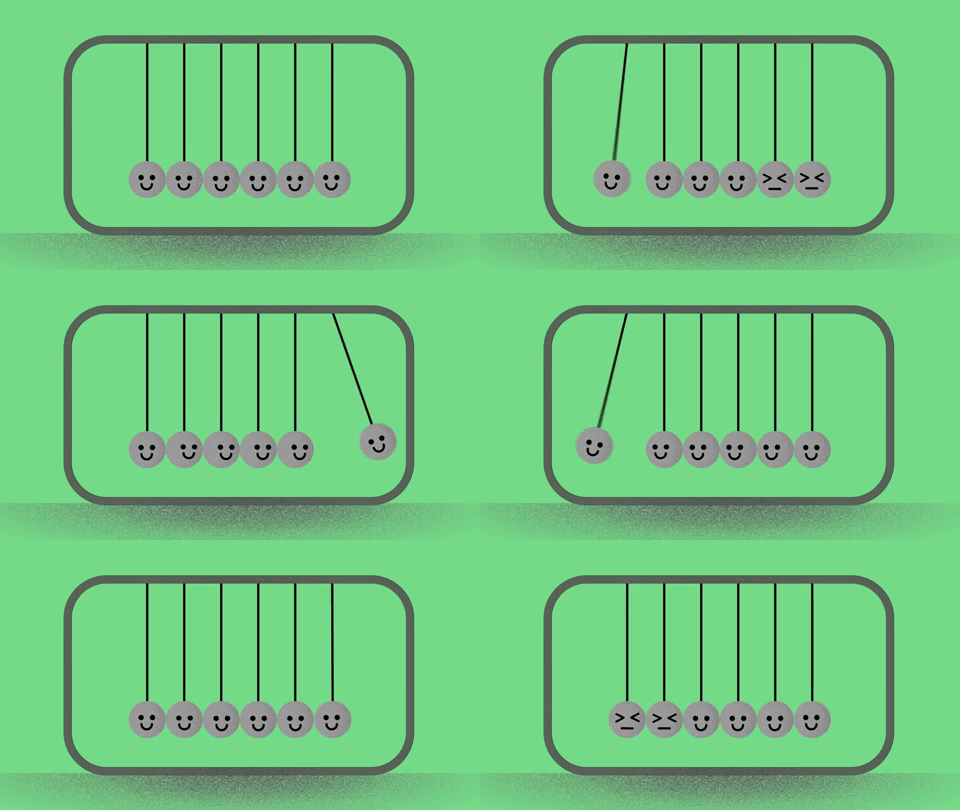
The point is spending all your time on learning how to generate maximum energy isn’t enough. You need to spend an equal amount of time, or maybe even more, on learning how to transfer that energy you’re generating efficiently. Otherwise it’s a lot of wasted effort.
Build yourself a bigger energy “bucket” and you’ll maximize your results with whatever your bring to the table today – and tomorrow.
Photo by Karolina Grabowska on Pexels.com
Drill to Help Achieve Better Bat Angle
One of the enduring myths in hitting, both in fastpitch softball and in baseball, is the concept of a “level swing.” And by level, most people mean making the bat parallel to the ground.
This is a myth I have attempted to dispel many times, dating all the way back to 2006. Yet still it persists.
In case you don’t feel like following the link, I will briefly go into the problems with this instruction before offering a way to address it. The admonition to swing level causes several issues.
One is that it leaves you very little surface with which to contact the ball and achieve a good hit. If you strike it dead-on in the right spot you can get a rising line. But be off by just a smidge either way and you’ll end up with a popup or a ground ball – neither of which is a great outcome.
If you’re really trying to swing level, you’ll only be able to do that until about waist-high, or however low your arms reach. After that, you’ll either have to bend down awkwardly, killing any chance you have of hitting the ball hard, or you’ll have to lower the bat head anyway.
Not to mention attempting to swing level often leads to casting, or stiffly pulling the bat across the strike zone instead of getting a powerful, sequenced swing.
Swinging level also means you don’t have much adjustability in your swing. You kind of set a bat height early and have little range of motion up or down.

There’s more, but you get the idea.
Of course, players who have had the concept of “swing level” beaten into them for so many years often have trouble developing a new, better swing pattern that results in a good bat angle. They can’t feel what they’re supposed to do so they continue to drop their hands and try to cut across.
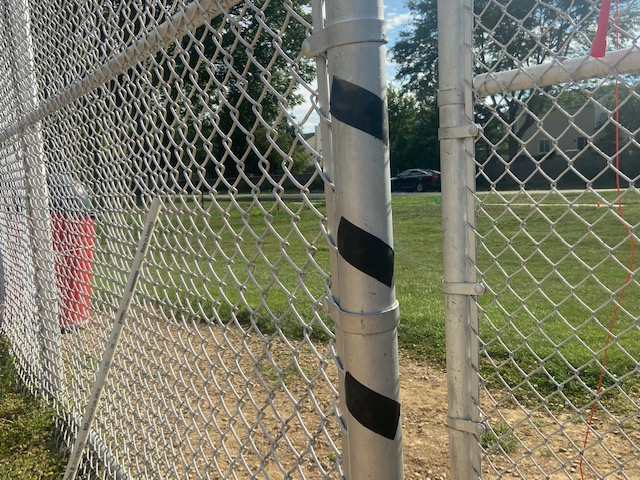
So here’s a way to help them develop that feel by using their eyes. Take a roll of duct tape and place a few strips on a convenient poll, tree, or other vertical object at the desired angle at contact at several different heights. In the photo above I just did it on one of the poles on a backstop.
Then have the hitter go through the swing motion and try to match the bat angle at various heights. As she works on matching that angle, the hands naturally stay up and the barrel goes down.
Rinse and repeat as-needed until the hitter can achieve the proper angle without thinking about it or putting in any extraordinary effort.
If you’re worried about the hitter losing control of that $500 bat you just bought, substituted a piece of PVC pipe or a broom handle or any other object that simulates a bat but won’t break your heart if it gets smashed into the pole.

This drill works, and it works pretty quickly -if the hitter does it frequently at home. You’re not going to get instant results at a practice or an individual lesson, but if she does it at home on a daily basis for about a week the pattern will set in and she’ll start to go from popups and grounders to more well-hit, rising line drives.
The best part is it’s very cheap and doesn’t require a lot of supervision. Just make the marks using whatever tape or even paint you have lying around and have the hitter have at it.
If you have a hitter who can’t seem to get the ball out of the infield, take a look at her bat at contact. If it’s flat/level, give this drill a whirl. I think you’ll like the results.






 Life in the Fastpitch Lane