Blog Archives

8 Valuable Lessons from the 2026 WCWS

The Division 1 Women’s College World Series (WCWS) has come and gone – a little sooner than some would have liked, and not the outcome everyone was looking for depending on which team (or player) was their favorite. But it was definitely entertaining throughout and a great showcase for our sport.
According to Yahoo! Sports, the first five days saw an average of 1.5 million TV viewers per game, an increase of 33 percent year-over-year before the final series. Some games got more than 2 million viewers, with the peak being 2.6 million. No word yet on the final series, but I wouldn’t be surprised if they topped 3 million.
For me, though, one of the best things to come out of it for rec league, travel ball, and high school players, parents, and coaches is to see the approach to the game used at such a high level. There are, as always, several lessons that can be learned and applied if people are willing to do so.
Here are a few of the big ones from my perspective
Lesson #1 – Even the Best Players Make Mistakes
And sometimes at critical moments. Coaches and parents of youth players tend to get very upset or even angry when their fielders make errors in the field, catchers don’t block properly and a ball gets away from them, pitchers throw a pitch straight down the pipe that gets blasted for a game-changing home run, etc. Yet if you watched the WCWS for any length of time you saw at least some if not all of those things happen – and often to some pretty big-name players.
I didn’t get to see all the games (although I have the ones I missed on the DVR for later viewing), but I did see two fielding errors made on ground balls in the 7th inning of an elimination game. You wouldn’t expect that since they were fairly simple plays but there you go.
What I didn’t see is the coach of that team charge angrily out of the dugout and scream at those players, or even worse yank them out of the game in the middle of the inning yelling about how they have “expectations” and all that. Instead, the team just moved on, played the game, and ended up winning anyway.
The same with critical home runs. There were some big-name pitchers who have won many accolades and accomplished much during their collegiate careers who unfortunately didn’t quite throw the pitch they were going for and watched as their WCWS run – and in some cases their careers – essentially ended.
I saw fielders attempting to place a tag before fully catching the ball and instead knocking it away from them, allowing another run to score instead of killing the play. I saw fielders throw balls away on relatively routine plays, and catchers let pitches in the dirt get by them because they tried to pick the ball instead of blocking with their bodies.
None of them set out to make those mistakes. They just happened. unfortunately with 1-2 million people watching. Keep that in mind the next time you’re mad that your daughter or your player(s) made a mistake.
It happens.
Lesson #2 – The Changeup Is An Important Pitch
Not really a lesson for me – I’m quite aware of it, honestly – but it was probably a good lesson for many.
It’s easy to get caught up in speed, speed, speed. We all love it when we have pitchers who can throw harder than the competition can handle.
But speed alone is not enough. If you watched for any length of time you saw the top pitchers using their changeups liberally.
It may be a cliche to say that hitting is about timing and pitching is about upsetting that timing, but that doesn’t mean it isn’t true. Keeping hitters off-balance by changing speeds is critical when the hitting is that good.

Two things to note about changeups too:
- The speed differential between their fastest pitches and the changeup was generally in the 10-15 mph range. No one was taking 4 or 5 mph off and calling it a changeup. You need to commit to a big enough difference to make a difference.
- No one was slowing their arms or their bodies down to get that speed differential. To be effective you need to be able to go as hard, move your arm as fast, and generally look like you’re going to throw the fastest pitch you’re going to throw all day while having it be slower due to the design of the pitch. If you have to slow down any part of your body to throw a changeup I’m sorry, you’re not throwing a changeup. Just a more hittable version of your fastball.
Lesson #3 – Pitchers Need Time to Warm Up
I’ve seen multiple people point this out, and I have talked about it before as well, so I won’t belabor it too much here. But at no time did you see a coach make a pitching substitution by pulling a player out of a field position and just have her go in and throw cold.
The best example here was Texas Tech. When Coach Glasco decided to pull NiJaree Canady in favor of Kaitlyn Terry, who was already in the game in a field position, he didn’t just call time and bring her in from the field. He took her off the field, sent her to the bullpen, and had her do a proper warm-up.
The lesson here is if one of the best and most experienced pitchers in the world can’t just walk in and be effective, there is no reason for you to expect your 12, 14, 16, even 18 year old pitcher to be able to do it. Give them time to warm up and you’ll like the results much better.
Lesson #4 – Coach Your Players the Way That Works for Them
Coaches often like to talk about their coaching style. Some are proud of being tough. Others hang their livelihoods on being empathetic.
But the reality is, if you’re going to be effective you can’t have just one coaching style. You have to be able to adjust what you’re doing to what is most effective for each player, i.e., you need about as many coaching styles as you have players.

Some players need to be coached hard. If you’re not doing that for them they feel like you don’t care about them.
Others would crumble under that style. They need to feel like you understand them and have their backs; they need support not screaming.
As a coach, it’s your job to figure out what your players need and deliver it to them in a way that helps them play their best.
What makes it even more complicated is that some players may require different coaching styles depending on the situation. If you come down hard when they need empathy, or tell them “that’s ok” when they need you to be firm so they get out of their own heads, you won’t get what you want.
If you take the time to get to know the person first and then the player, you’ll stand a much better chance of giving them what they need when they need it. And getting their very best performance out of them.
Lesson #5 – The Short Game Is Still Important
Sure, no doubt about it, ESPN loves the long ball. You get a couple of hitters going yard and it’s going to show up in the between-innings highlights, and maybe even later on SportsCenter.
Bunting and slapping may be less glamorous, but if you work at them they can be more reliable.
No matter what it seems like on TV, it’s still difficult to hit the ball out of the park. A lot of things have to go right in order for that to happen, and you generally need a certain set of skills and mindset to do it regularly.
Bunting in particular, however, is a skill that every player can and should have. Now, I’m definitely not a fan of the automatic sacrifice bunt of a runner on first to second, especially early in the game.
But there are times when a well-placed, well-timed bunt can be a game changer.
Slapping seems to be making more of a comeback as well. As former Arizona coach Mike Candrea always said, speed never has a slump.
Put it in play, make the defense rush, and you can make something good happen. Especially in the postseason.
Lesson #6 – Be Ready When Your Opportunity Comes
Everybody wants to be a starter. If you don’t at some level you’re not much of a competitor.
But there are only 9 positions on the field, and teams usually have more than 9 players. That means some of them will be sitting out.
I can remember two instances offhand, however, where a pinch hitter came in off the bench and turned a game around with one swing. That doesn’t happen if she hasn’t mentally prepared herself to be ready if and when her number is called.
If you’re a bench player you have a tough job. But remember you’re there to do more than just cheer for the others.
Prepare yourself mentally and physically to go into the game at a moment’s notice to ensure that when your number is called you get the job done. And perhaps set yourself up for a more regular role in the future.
Lesson #7 – There’s No One Right Way to Do Everything
As we watched the 8 teams in the WCWS, not to mention all the others in the lead-up to it, if there’s one thing all the players had in common it’s that they were all at least a little different from each other.
Yes, there certainly are some core principles for various skills such as throwing, pitching, fielding, hitting, etc. But you could hardly say everyone doing each skill looked exactly the same.
Jordy Frahm, Karlyn Pickens, NiJaree Canady, Kaitlyn Terry, Tegan Kavan, and Citlaly Guitierrez were all great pitchers, but you could definitely pick out one from another. They shared some similarities, sure, but not enough to say if you clone this you will be successful.
So as you’re working with players, keep that in mind. Realize your 5’10” 155 lb. hitter is not going to have the same swing as your 5’0″ 95 lb. hitter.
Even the things they do have in common will probably look a little different from one another due to different muscular structures, levels of balance, injury history, conditioning and a whole bunch of other factors. So don’t try to get them all to look like each other – or like someone you saw on TV.
Instead, work within their own frameworks in a way that gets the best out of each individual and you will be a lot more satisfied with the results.
Lesson #8 – Sportsmanship Still Matters
The WCWS has become more of a high-stakes event than ever, which means any problems that were present in past years, or are present now at the lower levels, are far more magnified. No one wants to lose with all the NIL money at stake and/or in front of millions of fans.
Still, we saw plenty of examples of good sportsmanship, whether it was a baserunner and a fielder having a quick laugh between pitches, losing teams setting aside their sadness long enough to shake hands, or opposing coaches crediting the other team for its good play.
We also saw some questionable examples but there’s no need to go into those here. Just remember that while things can get tough in the heat of the moment, the moment will pass but how you conduct yourself will be remembered forever. Be a good person and a good example and you will never go wrong.
Plenty More
These were not the only lessons, but I think they were some key ones from the biggest stage in the fastpitch softball world. At least in terms of audience reach.
Keep them in mind and you’re likely to be a whole lot happier when you watch your own kids/players play.
Now it’s your turn. What lessons did you take away from the 2026 WCWS? Leave your thoughts in the comments please so we can all learn from them.
6 Tips for More Successful Bunts

Most of my time as a fastpitch softball hitting instructor is spent teaching hitters how to drive the ball to – or over – the fence. Yet at some point I will also have each hitter work on laying down bunts.
Now, you might be surprised at that statement given some of my past post about bunting. But those relate to the sacrifice bunt, especially the sac bunts many teams lay down automatically with a runner on first and no outs. (The short version, if you don’t want to follow the link, is it’s a waste of an out.)
The reality is bunting, especially bunting for a hit, still has an important place in our sport. Which means when you’re called upon to do it, you’d better be able to get the bunt down.
That’s why I am so surprised at how poorly it seems to be taught these days. When I ask a hitting student to bunt I see all sorts of easily correctable flaws that are going to prevent success.
Since I doubt any coaches or parents are purposely training their players to fail, I can only conclude that they simply don’t know any better. I’m also pretty sure that, as often happens, they are simply passing along whatever bad techniques they were taught 20 or more years ago.
So to help with this issue I’ve put together this little guide. Follow these tips and you’ll find your players will be better equipped to lay one down when the time comes.
Stance (and getting into it)
A good bunt starts with a stable platform. After all, it’s a lot easier to hit a rapidly moving object if you’re not fighting to maintain your balance.
The mistake many young hitters make (and coaches don’t correct) is how hitters get into their bunting stance. As in the hitters will pivot on the balls of both feet to get turned forward.
The problem with that is the feet will then be in a straight line, one behind the other, instead of spread out side-to-side. To correct that issue, have the hitters pivot on the ball of the back foot and the HEEL of the front foot.
Now there is a little space between them, giving hitters the stability they need to work the bat more effectively.
BONUS TIP: If you are bunting for a hit, do not tell the hitter to move to the front of the box. That’s a dead giveaway as to what your strategy is, which really takes away the element of surprise you’re probably counting on.
Yes, I know moving up in the box improves the angles and gives the bunt a better chance of staying fair. But you don’t have to be Hall of Fame coach Margie Wright to figure out if the hitter moves up she’s bunting. At which point the defense should move their third baseman to 10 feet away from the plate so she can try to catch the ball in the air for the out – or a double play.
Grip
The most commonly taught grip for bunting seems to be to move the top hand up to the top of the handle and then have hitters pinch the bat between their thumb and index finger. This is a grip that comes from baseball – especially old-time Major League Baseball.
There are several problems with this grip, not the least of which there is a huge disparity in the hand strength between a 25 to 40 year old man and an 8 to 22 year old girl. Plus, -3 wood bats are much heavier and denser than -10 composite or aluminum bats, so they can absorb the impact of the ball more effectively.
Then there’s the issue of a softball weighing at least 30% more than a baseball (6.5 to 7 oz. versus 5 to 5.25 oz.). Combine a weaker hand, a lighter, less dense bat, and a heavier ball and you’re going to end up with a lot more balls that get deflect foul.
A better, more effective grip is to grab the bat with all the fingers – the same way you hold it to swing for the fences, just further up the bat. Actually, I prefer both hands up the bat, but the bottom hand can be as close or far away as the hitter is comfortable.
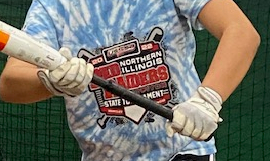
To prove its effectiveness, have a hitter hold the bat in the pinch grip and then use your hand to smack the barrel of the bat. It moves back a lot.
Now try the same thing with a full-on grip. You’re more in danger of hurting your hand than moving the bat much.
But doesn’t that put the fingers at risk of getting smashed by an inside pitch you ask? Not really, as you’ll see in the next sections.
Contact area
Another common mistake I see with hitters is that they try to use the sweet spot of the bat to make contact with the ball when they bunt.
I get it. That’s where they’re taught to hit the ball when they swing away so it’s a natural assumption.
Yet as I tell them, if their bat costs $400, $350 of that cost is in the sweet spot. It’s designed to send the ball as far as it can, and a lot of research and development money goes into making that happen.
But you don’t want the bunt going far. You want it to roll a few feet away from the catcher and then stop so it’s harder for the pitcher and/or infielders to field.
To get that effect, you want to use the $10 part of the bat, i.e., the end of the bat. That’s a major dead spot (as anyone who has felt the bees in their hands after making contact there on a full swing can tell you).

Hit it off the end of the bat – all things being equal – and the ball won’t go nearly as far. It’s also the point that’s farthest away from the top hand’s fingers, so if you’re using the end of the bat the top hand is in no danger of being hit. It’s a win-win.
Contact technique
Then there is the issue of how to make contact with the ball.
Many fastpitch softball hitters, even good ones, tend to punch at the ball with the bat as it comes in. Again, you don’t have to be Hall of Famer Margie Wright to figure out that punching at the ball will add to the power of the impact, making the ball go farther – even if you hit it with the dead end.
Instead of punching at it, hitters should pull back slightly to “receive the ball.” By giving a little they soften the impact and cause the ball to come off the bat gently.
You can explain this to players who play other sports by talking about how they receive a pass. Soccer players pull their foot back; hockey players pull their sticks back; basketball players pull their hands back as the ball comes in. At least they should.
Of course, this is easier said than done with bunting. Everything players have been taught with hitting to this point revolves around driving the bat into contact.
Pulling it away as the ball comes in will be very foreign to them. But with practice they can learn to do it.
One of the best ways to practice this is to draw a circle in the dirt, or lay down some ribbon or a Hula Hoop a few feet away from them and have them try to get the ball to go into (and stay) in the circle. They’ll figure out how to soften it really quickly.
Bat placement in the zone
Untrained hitters will often try to cover the entire width of the plate with their bats. That’s fine if the pitch is outside. But if it’s inside it’s going to be really tough to hit an inside pitch with the end of the bat.
Instead, have them cover roughly half the plate. That way if it’s inside they can pull the hands in a little. And if it’s outside they can stab the bat out to get the outside pitch, with the added benefit they will probably put it up the first base line instead of hitting it at the charging third baseman.
It also helps keep their top hand safer. As you can see, in this set-up if the ball is coming for the top hand it’s also coming for the torso, so the hitter has extra incentive to get out of the way.
You’ll also notice the bat head is higher than the handle. That’s to help hitters hit the top of the ball.
A flat bat, or worse one where the barrel is lower than the handle, is most likely to end up in a pop-up. You don’t want that, especially if you have a bunt-and-run on with a runner on base.
An upward angle, even a slight one, will make it more likely your hitters will get the ball on the ground quickly when it’s hit, and will make it easier for hitters to control where it goes.
Where to direct the bunt
Some of this is a matter of the level of play you’re facing. If your team’s opponents are not particularly skilled, any sort of bunt anywhere is likely to result in success.
A bunt up the third base line may be most effective, too, because it’s the longest throw. (A tip of the cap to Coach JD Koziarski for reminding me of that.)
At higher levels of play, however, the third base line is the worst place to drop the bunt. Third baseman make their bones on their ability to field a bunt and throw out the runner, and they practice that skill constantly.
Pitchers and first basement do not usually spend that kind of time practicing to field bunts, however. So the better strategy is to bunt either at the pitcher (and hope she chucks the throw into right field) or up the first base line where no one may get to it – especially if the first baseman is playing back.
Bunting is still necessary
Yes, all the emphasis for hitting these days is on exit speeds and launch angles. But there is still a place for bunting in our sport, so it’s important to teach optimal technique.
And that’s not just for the rabbits or average hitters either. EVERY hitter, even the big boppers, should know how to bunt well.
You don’t want to find out in the middle of a tight game that your best hitters are a disaster at bunting. And for their sake, someday they may be at a practice where the team is divided into two groups and they compete against each other to see which one gets the most bunts down. You don’t want any of them to drag their teams down.
So teach them all how to bunt properly. It’ll open up new offensive possibilities.