Category Archives: General Thoughts
Sports administration not just a boy’s game anymore
With today being the last day of Women in Sports Week, it seemed like this would be a good way to finish it out – talking about opportunities for women in sports administration. Once the almost exclusive enclave of men, more women are now finding success off the field in sports. – Ken
Guest post by Ohio University’s Athletic Administration Program.
While men outnumber women in sports administration roles, Women’s Sports Week celebrates the females who are quickly moving into higher positions in the industry. With the fact that ESPN now has 48 female anchors, reporters, analysts, and contributors, they’re also paving the way for a new generation of younger women who want to hold professional positions in the industry.
Starting at the college level, intercollegiate athletics programs are experiencing an increased female presence. Of the 969 NCAA D1 head coaches for 2014-15, 40.2% are women with field hockey, lacrosse, equestrian, golf, and fast pitch softball leading the way. Keep in mind, however, that men coach over 43% of women’s teams while women coach only 3% of men’s teams.
One way to help increase female representation in athletic administration and professional roles is to provide these girls with successful role models like Mary Alice Hill, the first female Athletic Director in the country. She also played an instrumental role in obtaining the first NCAA scholarships for female athletes, 75 years after the NCAA was created.
To learn more about the growing female presence in the business sides of the sports industry, check out this visual resource created by Ohio University’s Athletic Administration program.

The growth of women’s sports in America
Guest post by Ohio University’s Athletic Administration Program.
As women’s sports gain more fans it isn’t surprising that just last year the women’s College World Series averaged almost 440,000 more viewers than the men’s College World Series. In celebration of the growing popularity of women’s sports, and Women’s Sports Week, here’s a look at the big impact women are making in athletics.
Girls’ participation in sports has grown an average of 50% a year over the last 5 years. In fact, there were over 364,000 high school girls participating in fast pitch softball during the 2014-2015 school year.
Athletic clothing and shoe companies have taken notice and have geared television campaigns specifically towards women for the first time. With half of shoppers on the NBA online site coming from the female population and sales of $5 billion on Nike’s women’s athletic wear in 2014, this group is clearly becoming powerful.
To learn more about the evolution of women’s sports, check out the visual resource below created by Ohio University’s Athletic Administration Program.

Defense can make a fastpitch pitcher look good – or bad
While it may same rather obvious on the surface, after watching the National Pro Fastpitch (NPF) championship game on TV I thought it might be worthwhile to bring it up again. It, of course, being the effect defense has on making a fastpitch pitcher look good or bad.
(By the way, kudos to my hometown team, the Chicago Bandits, for taking the title for the second year in a row.)
Normally at the NPF level you expect to see a lot of dominant pitching. While the pitching was good in this game, I wouldn’t call it dominant. The definition of dominant being a lot of strikeouts or weak infield hits. 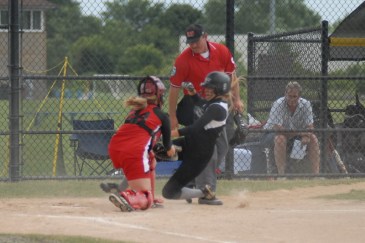
There were some of each, but there were also plenty of balls that got tagged pretty well; all three runs came off of solo home runs.
So in the absence of huge numbers of Ks, it becomes pretty obvious that the other 7 players who are not part of the battery had to step up to keep this a 2-1 game. If you watched the game you certainly saw that.
Which brings me to my point. The game ended 2-1, but the score could have easily been much higher were it not for some spectacular plays on both sides, both in the infield and outfield.
Those defenders made their pitchers look awfully good. And that’s ok, because I really believe the pitcher’s job isn’t to strike everyone out. That’s just fortunate when it happens. Instead, a pitcher’s job is to induce weak contacts that are easy to field.
In other words, the perfect inning isn’t 9 pitches for three Ks. It’s 3 pitches, all easy popups to 1st base so the first baseman can just pick up the ball and step on the bag if she drops it.
So contrast that defensive performance with others I’ve seen or heard about over the years, where the pitcher does her job. But instead of weak grounders or popups resulting in outs, they result in runners on base because of errors or lack of effort on the fielders’ part.
And what happens after a few of those? The coach calls time, heads out to the circle, and replaces the pitcher (who hasn’t made an error yet). It’s clearly not the pitcher’s fault, but I guess it’s easier to replace one pitcher than four defensive players.
So in the stats as well as in live action the pitcher ends up looking bad. Especially if those errors get marked as hits. (Anyone ever seen a box score that showed one error when you know there were at least 6? I sure have, especially in high school games.)
The thing is, having a porous defense doesn’t just have a short-term effect on the team, i.e., losing a game or a tournament. It also has a long-term effect. Because good pitchers don’t want to look bad, or have to work overtime every game to get three outs. So what happens? Good pitchers will leave, and tell other good pitchers why. Then it gets tough to get good pitchers, so the team has to settle for lesser pitchers, who give up more contacts that turn into even more baserunners. Then you’re in the death spiral.
Here’s another way to think of it. What coach would sign up for a tournament where the rules stated certain teams would be given 6 offensive outs per inning while theirs only got 3? You’d have to be crazy to agree to that. But that’s what happens when the team can’t play good defense behind their pitcher. And that makes it tough to win.
So while it’s easy to blame the pitcher, or give too much credit for that matter, the reality is the better your defense is the better your pitching will look. Just ask the world champion Bandits.
The definition of sportsmanship – and class
This isn’t a fastpitch softball story, but it’s still one I found worth sharing because it demonstrates everything great about sports and what they teach you. Full disclosure: I am friends with Abbey D’Agostino’s uncle Tim and Aunt Janet Boivin so the story has a little extra impact for me.
If you haven’t heard, this happened during the women’s 5000 meter race at the Olympics. Everyone was running in a pack when Nikki (no relation to Hillary) Hamblin of New Zealand tripped, and the USA’s Abbey D’Agostino fell over her.
Understand that Abbey has waited a long time for this opportunity. If I recall correctly she just missed the cut for the 2012 Olympics while she was still in college, so making the team and having the opportunity to go for the gold was the fulfillment of a dream.
After falling like that, many runners would have just gotten up and tried to make up the time. That’s what being a competitor is supposedly all about. But Abbey saw that Nikki was hurt, and instead of taking off she stopped to help Nikki up off the ground and start running again.
Then, in an interesting turn, after both ran a few meters Abbey went down again. (Later we would discover she tore her ACL and meniscus when she fell originally. Nikki stopped to help her up, and the two of them proceeded to help each other finish the race. (Shades of Cool Runnings, eh?)
The other thing to understand is they weren’t friends before. They didn’t know each other at all. But they are bound together for life now.
We see a lot of negative things out there in the world. At softball parks we see all kinds of bad behavior from players, coaches, parents and fans. But this story is a reminder, on the biggest stage of all for most sports, of what it’s really all about.
If you’d like to learn more, here’s one of the many stories that have come out of this incident, complete with an interview of both runners.
Hopefully Abbey will be back on the track sooner rather than later and will have another shot at a medal. But if she never runs competitively again, she’s set an amazing standard for all athletes. Watch for the Disney movie in about five years. 🙂
Softball back in for the 2020 Olympics
Just saw the news that softball (and baseball) have officially been voted back in for the 2020 Olympics. Not too surprised given where they will be held.
Japan is as fanatical about fastpitch softball as the U.S. – maybe more. And they have a gold medal to defend, despite the fact that it’s likely most of the players on that last team probably won’t be on the 2020 team.
I know a lot of people are really ecstatic about it. For me, I’m more “meh.”
Don’t get me wrong. I love watching the games on TV, especially the medal games. It’s exciting to see the best players in the world going head-to-head, and even though the Olympic rings have lost some of their luster it’s still a pretty big stage. And for me personally at least there’s now something interesting to watch.
But many of those who are so excited have a belief that having softball in the Olympics will drive participation and give female softball players something to dream about. For whatever it’s worth I disagree.
I don’t think young female softball players, as a whole, care that much about the national team. Just ask any you know who is on the national team right now. You’ll probably get a blank stare. Or ask who was ever on the Olympic team for the U.S. You might get a couple of good guesses, but beyond the high-visibility pitchers most probably won’t know.
When I’m doing lessons I will often ask students if they have heard of this top-level college player or that high-profile pro. Most have not. They just don’t care. They’re more focused on their own performance.
If participation overall is down I don’t think it’s because there was no Olympic team to aspire to. I would say cost is much more of a factor now. It used to be you could join a team and play all summer for around $500. Now it’s more like $1,500 to $2,000 on the low end, and $20,000+ on the high end for a bigtime exposure team that travels around the country.
That puts softball out of the reach of a lot of families, especially in the current economy. They’ll either find a cheaper sport, or they’ll find another activity that doesn’t cost them as much.
As far as the hopes and dreams go, let’s be honest. There are precious few spots on the Olympic roster to being with. You have to be a top-level college player (current or former) to have any hopes of making it (Crystal Bustos excepted).
It may be an incentive for a precious few. And good for them. But for most, reality will likely set in at a young age as they realize they’re not destined to become one of the greatest fastpitch softball players in the U.S.
I’m glad it’s back in, and I’m glad our sport will get more exposure. But is it a game changer? I don’t think so.
The Neverending Softball Story

I was talking with a couple of fastpitch hitting and pitching students this week about their schedules for the next couple of weeks. They were explaining that they probably wouldn’t be coming out for lessons because “we have Nationals next week, then tryouts when we get back.”
That just seems crazy to me. I know it’s the way things are but I can’t help but think they shouldn’t be.
Why couldn’t there be a couple of weeks at least between the end of this season and the beginning of the next? What is so all-fired important about getting started on next season that it has to happen before players have had a chance to clean the dust off their equipment from the last one? Especially since many schools start classes around the middle of August now. Not much of a chance for the family of a softball player to take a week off for a little R&R that doesn’t involve getting to a field at 7:00 am on a Saturday.
Where it really gets crazy is how all the different alphabet soup of organizations have their so-called Nationals. Some are done already. Some are going on right now. Some will happen next week. Programs that went to one of the early ones often have their tryouts going on while some of the players who might like to play for them are away at other Nationals.
I guess it’s all about the race to capture the best players before someone else gets to them. When players go to these early tryouts, there is a lot of pressure (especially on the better players) to make a decision now – sometimes before they leave the first day of tryouts. They’re told if they don’t decide RIGHT NOW there may not be a roster spot available to them later.
Again, that seems crazy when the actual, important season for these teams doesn’t start for another 8-10 months (depending on their age). But of course, if you can secure those players now your team is set, and there’s no risk of some other team, especially a close rival, getting them instead.
The problem is the solution is the same as early recruiting for colleges. Programs would have to bring some sanity to the process by voluntarily holding off on tryouts until at least mid-August, and preferably a little later. But who wants to be the first?
If it’s going to work, it would have to start with the most desirable teams – the ones everyone would love to play for. If they didn’t start until later (secure in the knowledge players would join their teams (even if they had “committed” under pressure elsewhere first) there would be less incentive for the next tier to be early, and perhaps then it would trickle all the way down.
I don’t think the world would come to an end if tryouts didn’t happen until mid- or late August. So what do you say top tier teams? Will you be the first to start bringing a little sanity to the process, and give committed softball families a window to take a non-softball vacation before school starts (assuming they can afford one after all the travel)?
A player gives back to the game
Been meaning to write this post for a little while because I just find this story to be so cool. It’s about a player named Ashley Lambert who clearly appreciates the opportunity she’s been given to play fastpitch softball. 
First a little background. Ashley definitely comes from a softball family. She’s been playing since she was tiny, strongly supported by her parents Drew and Tricia. Dan was her summer coach for all but I think one season (when she played for me), and you can keep up with Ashley’s softball exploits by following Tricia on Facebook. That’s where I learned about this story, in fact.
Ashley is in college now, playing third base and catching for Beloit College in Wisconsin. She’s #15 in this photo. Often college players will stay involved over the summer by helping coach a younger team, or maybe doing some teaching or clinics. But Ashley went a different route – she decided to become an umpire!
How cool is that? Umpiring is a tough job. I did it as a kid, and have done it in a pinch as an adult when there wasn’t anyone more qualified to do it. But being a real umpire is both physically and mentally wearing.
The physical side probably isn’t so bad for Ashley. As a catcher she’s used to wearing all that gear in 90+ degree heat and 90% humidity. Heck, it probably feels like home to her.
But then there’s the other side – putting up with coaches, parents and fans who all think they know better but have no interest in gearing up and getting out there themselves. She’s a sweet girl, but I’m guessing when she has the uniform on she doesn’t take a lot of guff. I’ve heard umpires say if both sides think they’ve favored the other team at the end of the game they know they’ve done a good job.
I think it’s great that Ashley is spending her summer making sure that when younger girls want to play a little softball that the game is played safely and fairly. I’m very impressed and proud to know her. I wish more former players would consider donning the gear while they’re playing or when their careers are done.
As a player, you might get a whole new appreciation and respect for the role umpires play; they really aren’t going out of their way to call you out. My guess is you’d certainly know the rules better because you’d have to.
If you’re done playing it’s a way to stay involved in the game, and as the title of this post says give a little something back to the game that gave you so much.
So kudos to Ashley for skipping the more fun and easy route of coaching and instead filling a very pressing need. You are an inspiration and a credit to your coaches, the game, and most of all your parents!
Interesting opportunity for Jewish softball players
Any athlete who has done it says there’s nothing like the thrill of competing with the name USA on the front of your jersey. For most, however, it will never be more than a dream.
If you’re a fastpitch softball player of Jewish heritage, however, you have an extra  opportunity to make that dream come true. Because Maccabi USA is seeking Jewish female softball players 18 years old and above to try out for the team that will represent America at the 20th World Maccabiah Games, July 4-18, 2017 in Israel.
From the looks of it, the World Maccabiah Games follows a format similar to the Olympics, with teams from around the world competing in a broad spectrum of sports. Your chances of being part of Team USA increase, of course, because the pool of eligible players is narrowed considerably. It looks like one of those “once in a lifetime” opportunities if you’re willing to spend the time to prepare – and willing to spend half of next July in Israel.
Tryouts for the women’s fastpitch team are July 23, 2016 in the metro Chicago area. The flier I saw did not have more specific information, but you can probably get that by contacting Shane Carr, Program Director, at scarr@maccabiusa.com or Jay Gelman, Softball Chair, at jaydg2@gmail.com. You’ll need to bring all the usuals – turf shoes, cleats, bats, position equipment and water.
If you’re interested in applying, you can do so here. Oh, and good luck to you!
It’s not where you start the race…
One of my favorite sayings is “It’s not where you start the race that counts, but where you finish.” I will say it to players who didn’t make a team they wanted, or who start the season riding the bench, or otherwise find themselves in a less than desirable position.
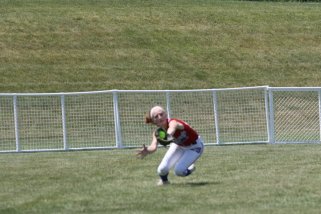
One of my favorite pictures of Erin Yazel. A far cry from the girl who could barely catch a ball hit to her.
Of course, it’s easy to say things like that; platitudes come easily. So I thought I’d share one of my favorite success stories today – one that proves that saying is more than words.
I first met Erin Yazel when she was a first-year 14U player. (I’m old school, so I only recognize even number team levels.) As I understand it, Erin had joined an A-level fastpitch team after coming from rec ball. Not on the basis of her skills as much as the team needed players and Erin tried out.
To put a little more perspective on it, I came to that team as an assistant coach after it was already formed, about midway through the offseason. When you’re working indoors in a small gym it’s tough to get a real read on things.
Once we were outside, however, it became apparent that even though she was an outfielder Erin’s outfield skills were not quite at the level that was expected. That was a potential problem since the team had a few legitimate A-level players and some of their parents were vocal about who could cut it and who couldn’t.
Erin was a hard worker, though, and a good kid, so I went to the head coach and asked her if I could work with Erin separately at practice to help her learn to track fly balls better. The head coach agreed, and off we went. I also suggested to Erin that I could meet her before practice, or stay after, to help her hone her skills some more. She was more than willing since she wanted to be a full-fledged contributor and she, her dad Steve and I spent a lot of time together.
Over the course of that first season she got better and more reliable, although she did end up breaking her nose in a game when she lost track of a fly ball in center. That one was ugly to see and hear, but it didn’t stop her. After a couple of weeks off she was back on the field, more determined than ever.
One of the qualities Erin brought with her was that she was fast – like 2.7 home to first fast. So naturally I suggested she spend the off-season becoming a lefty slapper.
We worked on that the entire winter, along with bunting and swinging away, and by the next spring she was a different player. She took naturally to slapping and soon had earned the leadoff spot in the lineup for our travel team. She also made her JV team as a freshman, and likely would’ve gone straight to varsity if the head coach hadn’t come straight from baseball and didn’t understand the importance of speed and the short game (a deficiency he fixed the following year, by the way).
Erin went on to have a great high school career as well as a travel ball career, and actually came back to me a couple of years later to play on my IOMT Castaways team. I encouraged her to try college softball, and even helped her make a recruiting video, but in the end she decided it wasn’t for her.

Erin’s ISU club team. She is first row, second from the right.
But that doesn’t mean it was the end of her fastpitch career. Instead, she became involved in the Illinois State University club team. If you’re not familiar with the concept, club teams are groups of girls who form their own teams and play against similar teams from other schools. It’s fun and competitive, without the bigtime commitment and time sink of playing at the college varsity level.
This past year was Erin’s second playing for the Redbirds, and it’s clear she’s still loving the game. Her mom Judy sent me her stats.
For the season she had a batting average of .488, with an OBP of .533 and slugging percentage of .537. In 41 at bats she had just 4 strikeouts, and her OPS was a healthy 1.090. You can check out her whole line here.
That’s pretty impressive for a girl who had trouble even getting on the field her first year of travel ball. But it shows what you can do when you have a love for the game, the determination to improve, and the support of great parents. Not to mention self confidence, which Erin always had boatloads of despite some of the outcomes.
So if you’re not quite where you want to be, take a lesson from Erin. Don’t let anyone else define you, and don’t define yourself by where you start. Because that doesn’t matter. The most important consideration is where you finish.
Be the you they already like
This one is for all the fastpitch softball players (and other athletes as well) who are having trouble with being nervous because you’re afraid of failing or letting the team down. In other words, facing a lack of confidence. 
First off, know that everyone goes through this now and then in every walk of life. Even the professionals who are being paid millions of dollars (thousands of dollars in the case of pro softball, but that’s a story for a different day) to play.
The best thing you can do for yourself is to forget about trying to live up to some ideal you think you have to meet and remember that your coach put you on this team for a reason. He or she thought you had something that would help the team win, whether it’s a game, a tournament, a conference championship or some other prize. All you have to be is who the coach already saw and you’ll be fine.
So if you’re a hitter, instead of hesitating until the last possible split second before you get into your swing, start early and slow so you can be aggressive in putting the bat on the ball. She who hesitates tends to hit pop-ups and grounders. But hitters who take their practice swings into the batter’s box and make a plan to hit the ball hard usually do.
If you’re a pitcher who has put the work in, there’s no need to worry about whether you can throw strikes. If you did it in practice you’ll do it in a game. Quit focusing on outcomes and instead just relax and pitch your game. If you’ve been handed the ball the coach clearly thinks you can get the job done. Why would you argue with the coach? 🙂
It’s the same for fielders too. Unless you’re a super great hitter who the coach is trying to hide on defense, you know what to do when the ball comes to you. Just do it. (No, this is not a paid placement.)
Look, everyone makes an error now and then. Everyone has a bad day at the plate, or in the circle, or on the basepaths. That’s what makes the game of softball so hard – and so good when it goes well.
You don’t have to be the next Cat Osterman or Sarah Pauly or Lauren Chamberlain or anyone else. You just have to be you. Just do the things that got you into this position and you’ll have all the success you could ever imagine.
Now go get ’em!






 Life in the Fastpitch Lane