Category Archives: General Thoughts
The Unintended Consequences of Time Limits

Long-time readers (and those who dig in beyond the first post they came to read) know that I am no fan of time limits for fastpitch softball games. Especially some of the ridiculously short time limits that have been imposed over the last few years.
An hour and 15 minutes drop dead? Puh-leeze! One hour? Most games are just getting interesting at that point.
I get why tournaments have gone that route. If we want to be positive, it’s easier to keep things running on-time so teams know when they’re playing and it’s easier to adjust for events such as rain delays or an umpire crew that’s temporarily MIA. It also helps more teams get an opportunity to play in a particular tournament.
If we want to be cynical, it’s greedy tournament directors trying to squeeze as much money as they can out of teams by over-booking the venue.
No matter which side you come down on, however, they have become a fact of life. In any game where there is a decent amount of offense, especially on both side, you’re unlikely to play a 7-inning game.
That phenomenon has created an unintended consequence that could become more troublesome in the future: today’s youth players often seem to lack the mental stamina to play a full 7-inning game.
I don’t think it’s a physical thing. Honestly, physical conditioning is better and more pervasive than ever. Most travel players work hard in practice, practice more often, and do other conditioning exercises (or speed and agility training) outside of formal team practices.
Mentally, however, it seems to be a different story.
First of all, you have the issue of short attention spans. Humans naturally have short attention spans, but some research by Microsoft suggests that our attention spans have decreased considerably since 2000.
But I also believe that players who spend most of their time playing games that are an hour and 15 minutes long or so become conditioned to expect that’s how long a game should be. When placed into a situation where the time limit is longer, or where the game ends when seven innings are completed, they have a difficult time staying in the game mentally once that 1:15 point is reached.
Does it happen all the time, and with every player? Certainly not. When there is something at stake, such as a tournament championship, players can often manage to remain more invested in the game. Especially if it’s a close one.
Even then, however, you’ll often see a drop-off in the quality of play around the fifth inning or so. Suddenly two teams that seemed to be on top of it throughout the contest are suddenly making errors on simple plays, pitchers are having trouble finding the strike zone, and hitters are not managing the quality at-bats they did earlier.
And, since a lot of tournaments will remove the time limit for the finals (and even semi-finals), players’ time limit-conditioned internal clock will tend to take them out of a game before it’s actually over.
Where you’re most likely to see it, however, is in non-tournament play where there is no immediate end goal. Or maybe no end goal at all.
If you’re playing scrimmages or friendlies, it won’t be uncommon to see the level of play drop as the game gets past (or in some cases drags past) the typical time limit your team plays. You begin to wonder at what point the alien ship landed and the pod people took over your team’s bodies.
So what can you do? Being aware of this phenomenon is one thing. Keep an eye on the time, and when you’re getting close to your typical time limit find ways to give your players a mental energy boost:
- If you’re good at pep talks, now might be a good time to give one. Try to re-light the pilot light.
- You can remind your team that you still have 1,2,3 or whatever innings left to go before the game is over. Maybe suggest you focus on winning the next inning if you aren’t doing at already to keep the time horizon short.
- Send the team off for a quick jog up the sidelines to clear their heads.
- Tell them to re-set their mental clocks as if it’s a new game; maybe even do a pre-game cheer at that point if your team normally does one.
- Try to get the lead domino excited about the next few innings so she can get her teammates excited.
We are all products of our conditioning. And right now, many players are being conditioned that fastpitch softball has a time limit, which means they only need to remain mentally focused during that time period.
Don’t let your players fall into that trap. Help them to remain on top of their game no matter how long the game is. It’ll be better for your team’s success. And it will be better for your players when they start (or continue) playing in situations where time limits aren’t a factor.
So what do you think? Is there some validity to these thoughts about time limits, or do your players not have any problems making the adjustment when the game goes longer? Leave your thoughts in the comments below.
You Can’t Hurry Love – Or Softball Skills

Those of you of a certain age (and you know what that age is) probably remember this great song from the ultimate 60s Motown girl group, The Supremes:
If you’re not familiar with the song, be sure to check it out. If you listen closely you’ll hear a lot of the foundational elements that today’s pop music is built on.
But what you’ll also hear is a message that also pertains to fastpitch softball players. Not to mention their coaches and parents.
We live in a world where we want what we want when we want it. We don’t like to wait – we want results NOW!!!! And we’re afraid if we don’t get them NOW!!!! we’re going to miss out on important opportunities.
Now, if you’re 16 years old or above, there is a bit of hurry up involved. If you’re planning to play college softball you don’t have much time to develop the skills required to be invited onto a team. If you’re not planning on playing beyond high school, the end of your career is looming.
The thing is, however, is that softball skills take time to develop. And repetition. Lots and lots of good repetition.
No matter how much you want to be successful, or how much you wish the time element wasn’t true, it is.
Now, a good coach or private instructor can help you shortcut some of that time. Back in the days when The Supremes were cranking out hit song after hit song, most softball skill learning happened through trial and error, and emulation of successful older players.
You looked at what those players were doing and you tried to copy it. Eventually, you figured out what worked best for you and you were ready to rock and roll.
A good coach or instructor will already have a pretty strong idea of what works and what doesn’t, and will be able to look at what you’re doing and help you throw out the stuff that doesn’t work faster.
Still, it’s a process. It may not take as much time as doing it yourself, but it will still take time. Lots and lots of time.
The more you practice with intention and a goal in mind, the more you’ll be able to shave off some of that time. But it will still take time. There is no getting around that.
It takes time to replace old habits with new ones. Here’s a great article that explains why. The short version is that you’re actually making physiological changes under the hood, rewriting what has been hard wired into your brain so you can do things differently/better. Here’s some additional information on it from a past post too.
It would be nice if that weren’t the case – if there was some secret shortcut that would get you to the destination immediately like a transporter on Star Trek. But there isn’t.
In fact, when I start with a new student I will usually place my hand on her head or helmet and tell her if I could just do that, say “Be healed” and instantly turn her into a great player I would.
Of course, I also point out that if I could do that lessons would be $1,000 each and there would be a line down the street a mile long to get some of that, because that’s the dream.
But I can’t. No one can. Each of us learns in our own way, and in our own time.
Put 10 players in front of any coach, have them all receive the same instruction at the same time, and guess what? The results you get will vary.
Some will get it right away, some will get it somewhat, and some may not get it at all and will need it explained differently.
It’s the same for the long-term. Learning anything, especially if you want to do it at a high level, takes time.
It would be nice if coaches could just show a player what to do and she’d be instantly perfect at it, but it doesn’t work that way. And thinking it could is likely to lead to disappointment, which leads to discouragement, which leads to players deciding softball isn’t for them anymore.
Don’t fall into that trap. Instead, follow the Stockdale Paradox. When you’re facing a challenge, like learning a new skill or a new position, know that you will succeed. But don’t put a timeframe or other limitations on it.
Instead, believe in yourself and just keep plugging away at it. Do the right things and you’ll get there. And what a story you’ll have to tell ESPN when they come to interview you.
Fastpitch Skills: Like Riding A Bike

Photo by Lgh_9 on Pexels.com
You would probably be hard-pressed to find anyone who hasn’t heard the expression “It’s like riding a bike – once you learn how you never forget.” This expression is often used to refer to going back to something difficult after years of not doing it, implying that it shouldn’t be difficult to pick up where you left off.
As anyone who has actually ridden a bike after not riding one for 20 years can attest, it’s not quite as simple as it sounds. There is definitely a bit of uncertainty at first, and it’s unlikely you’re going to go flying around like you did as a kid right away.
What people often forget, however, is how difficult learning to ride a bike actually is. Those of us who can ride one take it for granted. But it wasn’t always so simple.
At first, our parents (or some other adult) probably raised the training wheels some so we could get a sense of what it was like without the actual danger of falling off.
Eventually, though, the training wheels came off, and an adult held onto the back of the seat, running along behind us as we got the hang of balancing ourselves while churning our legs to make it go. Most of those adults also probably let go without telling us, despite our admonitions not to, to prove to us that we now had all the skills required to ride successfully. And oh, how we rode!
I bring these sometimes painful yet exhilarating memories up because learning fastpitch softball skills is no different.
At first, players are a bit tentative. Whether they’re pitching, hitting, throwing, fielding, etc. they’re not quite sure how to move and manage all the various pieces, and they do the fastpitch equivalent of falling off a lot.
As they learn, they have to focus on what they’re doing, and most have to think through the various pieces as their brains learn to process the skill. But then at some point it all clicks, and they’re able to do whatever it is they’re trying to do, which enables them to advance as a player.
Just as with riding a bike, it happens at different points for different players. The seemingly lucky ones get it right away. I say “seemingly” because sometimes when things come too easily it can hold players back from developing their skills at a deeper level. Especially when coaches, parents, teammates, etc. are more focused on winning today than helping players become the best they can be. There is value in the struggle.
For most, the skills will come more slowly, with plenty of bumps, bruises and scrapes acting as battle scars as they learn. But eventually they will come.
The goal, of course, is to make fastpitch skills like riding a bike – something players can execute without thinking.
Assuming you can already ride a bike, consider how you do it. The odds are very high that you just hop and do it. Your body knows how to move, how to balance, and what to do when. It feels instinctual, even though it is actually a learned skill.
That’s where you want players to get to on the softball field. They don’t need to “remember” to raise their elbow to shoulder height when throwing. They just do it.
They don’t need to remember to lead the swing with their hips instead of their bats. They just do it. They don’t need to remember to relax their arms and whip through the release zone when they’re pitching. They just do it. It’s like one big Nike ad.
That’s the goal. But it’s important to remember that it takes time. Again, some kids learn to ride their bikes on their own right away, while others can take weeks – especially if they’re afraid of falling off. But they all will learn.
And it takes good repetitions. The more players (and coaches/parents) concentrate on doing it right from the start, i.e., focusing on the process rather than the outcomes, the easier it becomes to do it right under game pressure.
Finally, it takes patience to understand about it taking time and good repetitions. It’s easy to get caught up in wanting everything to be perfect right away, like the players you see on TV.
But I can guarantee you the players you see on TV didn’t look like that when they were younger. In fact, they may have looked more awkward than the player(s) you’re working with right now, as this video of a certain well-known left-handed pitcher shows.
But they persisted and found their “bicycle moment” when it all clicked and they were just able to ride.
You wouldn’t expect any child to simply hop onto a bike and start pedaling away – much less do the complex BMX tricks you see on TV. There’s a progression, and it all starts with those first shaky feet.
It’s the same with fastpitch softball skills. They may need a lot of help at first. But eventually, with persistence, they will find their way, and those skills will be a part of their game forever.
Nothing Grows in the Comfort Zone

Photo by Mina-Marie Michell on Pexels.com
Came across a version of the headline of this post yesterday in another context this week and thought “How appropriate for fastpitch softball!”
Of course, it immediately brought to mind an image of a lush, beautiful landscape with flowers, and trees, and butterflies, and cute little animals romping around freely under a nearly cloudless sky on a warm day with a cool breeze. Surrounded on all sides by a desolate landscape.
We all love our comfort zones. By definition we’re comfortable there. Life is easy, there’s no stress, we can just go along our merry way without a worry in the world.
As nice as that sounds, however, the problem with the comfort zone is it’s locked in time and place. Sure it seems nice, and we believe nothing bad will happen there. But nothing great or new will happen there either.
And that’s the problem. As a player, or as a coach, you’re either moving forward or you’re moving backward. Because it’s not just about you – it’s about you relative to everyone else.
If you stay in your comfort zone while others are struggling to get better, those others will eventually pass you by. Think of a log stuck in a river.
The log stays where it is while the water goes rushing by. It’s not that the log went backward; it’s still exactly where it was. But the water kept moving, and now it’s further downstream than it was.
So it is with your softball skills/knowledge and ability to play/coach. You won’t grow as a player or a coach if you just decide to stay in your comfort zone. You’ll be stuck in time while everyone else moves ahead.
Think of the hitter who dominates when she is younger because she is bigger, or stronger, or better-coordinated than the other girls. She judges her ability based on outcomes, and since her outcomes are better than the others she doesn’t bother to work on getting better. She’s comfortable doing what she’s doing.
In the meantime, other players who may not have been as blessed with natural abilities take lessons, or study what great players do on their own, and start working to make the most of the abilities they have. They learn quality mechanics and how to apply them, and suddenly as the pitching gets better they’re hitting better than the “natural” who stayed in comfort zone.
They grew, and the “natural” didn’t. Suddenly the “natural” doesn’t have as much of an advantage anymore. Eventually the river of players passes her by and she’s left to wonder, “what happened?”
This is also true of coaches. There are so many coaches out there who view the fact they played baseball or softball in high school or college X years ago as giving them all the knowledge they need to coach today’s players.
They stay with what they did (or what they think they did, which isn’t always the same) and what worked for them rather than looking into whether there might be a better way. As a result, they put their players at a disadvantage versus those who are being coached by coaches who are willing to get out of their comfort zones and learn new things.
Great coaches, whether they played at a high level or not, are always looking for every advantage and piece of knowledge they can bring to their players. They’re not afraid to say, “I know I used to teach X, but I’m not teaching that anymore. Let’s do Y, because I believe it’s a better way to go.”
No less than former UCLA head coach and NFCA Hall of Famer Sue Enquist is one of those coaches. I heard a story a few years ago that she was making a presentation at a coach’s clinic about hitting when a member of the audience raised his hand and said that he had one of her hitting instruction videos and what she was saying completely contradicted what she said in the video.
Without blinking an eye she owned it and said, “Well, I know a lot more now than I did then.”
If someone at that level, with all her accomplishments and championships wasn’t afraid to get out of her comfort zone so she could grow, the rest of us shouldn’t be either.
Yes, the living is easy in the comfort zone. But that’s the problem. There’s no growth there – everything just stays as-is.
Steel is forged in fire. Diamonds are created under tremendous pressure.
If you want to grow as a player or coach, make the leap. Get out of your comfort zone and become the player or coach you were meant to be.
How To Build A Reputation As A Warrior
Last weekend once I was done with lessons I went out to watch a tournament where some of my students were playing. It was a gorgeous day for softball and I had plenty of time, so clearly life was good that day!
I arrived in the middle of a game where one of my students, Ally, was pitching, and she did a masterful job. Which, of course, always makes it fun to watch. I also enjoyed watching a couple of other students, Abby and Kylie, during the game as well.
During that game, though, one of the parents mentioned that another student, Maddy, had been pitching in a game earlier and had taken a hard line drive to her right shin. I learned later she’d thrown roughly two or three pitches, got hit, and had to come out of the game it hurt so bad. (Good incentive, by the way, to keep the ball off the middle of the  plate.)
Once that game concluded with a win, the next game started up (after some time to re-set the field). Maddy came out to pitch that game, which I was glad to see. It’s not often I get to see two students pitch the same day.
Maddy struggled a bit in the first inning, and her team struggled to field the onslaught of bunts their opponents unleashed on them early-on. They ended up down 6-0 before they ever got a chance to hit.
After that rough start, however, Maddy took control, didn’t give up any more runs, and ended up with 7 Ks over 5 innings as I recall. Gotta love time limits.
While she was pitching, however, I did mention that she looked a bit uncomfortable physically. Nothing major, but if you were paying attention you could see something was not quite right.
After the game (which her team ended up losing, eliminating them) I stuck around to talk to her a bit afterward. That’s when I saw what she had just accomplish.
The poor girl couldn’t put much weight on her right foot. She was limping pretty badly too. What I saw as “kind of uncomfortable” actually turned out to be pretty painful. I actually asked if she needed me to carry her to the car but she just laughed and said no.
That’s how you get a reputation as a warrior, though. It had to be incredibly painful, especially as the game wore on. She also had to be at least a little worried about having it hit again too. I know I would’ve been.
But she just gritted her teeth, said “The team needs me” and gutted it out.
I’m not big on players playing on injuries where they can make things worse. If you sprain your ankle, or pull a muscle, or get a concussion, or do something else that would make it dangerous to your health to continue, don’t.
Sometimes, though, it’s not dangerous, just painful. If you can “rub some dirt on it” as we used to say and fight your way through it, you clearly have ample helpings of mental toughness. And that’s going to serve you well not just in softball, but throughout your life.
And sometimes, parents can be a little quick to try to keep their daughters from experiencing adversity. Luckily, Maddy’s parents aren’t, and gave her the opportunity to show what she can do.
Congrats, Maddy, on a job well done!
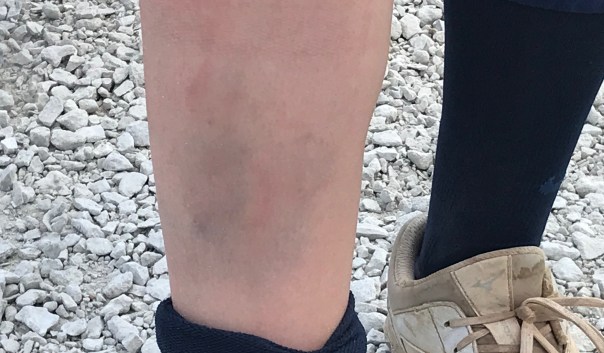
Update: Thought I would share this photo of Maddy’s leg from a week later. It reminds me of a saying I saw on a t-shirt once: scars are tattoos with better stories. Although I  expect this one will heal eventually. Still, you could see the knot through her sock. It should probably come with one of those disclaimers they have before TV shows about not being appropriate for younger or more sensitive viewers!
Seems Like I Never Get to See the Good Stuff

One of my favorite things to do is to go out and catch a game where one (or more) of my students is playing. It can be a bit nerve-wracking at times – especially if a pitching student is facing a hitting student since by default one of them is about to fail – but overall I find it highly valuable.
One of the best parts, of course, is seeing how they perform in context. It’s one thing for hitters to be banging balls all over the batting cage, or pitchers to be racking up the Ks in bullpen sessions. It’s another to see what they do in an actual game situation. It’s like Han Solo says:
About a week ago I had one of those rare opportunities. I didn’t have lessons until later, and high school softball starts pretty early (usually 4:30 during the weekdays) so I ran out to a local school to watch a hitting student named Ella play at least part of a game.
She came to bat twice against what I would characterize as a pretty good pitcher, and she struck out both times. As I watched her struggle I switched from “just here to enjoy a game” mode to “coach/analyst” mode.
I noticed something in her swing. Much as I would have liked to have run down to the dugout and told her about it I would never actually do such a thing. So I did the next best thing. I texted her mom, who was out of town, and asked her to share the information with Ella when the game was over.
Ella’s mom responded that she would, but then I had to leave in the middle of the game to go teach some lessons.
Later I got another text from Ella’s mom. Apparently after I left Ella hit a home run and a double. So she ended up 2-4 that day accumulating 6 total bases. Her mom did say she would pass my message along anyway.
But it figures. I don’t know if this happens to others, but I feel like it always happens to me. I go out to watch a student play and she seems to have a rough time. But I’ll hear before I got there she did awesome, or after I left she got it together and played like a champion.
It wasn’t just Ella either. A couple of days later I watched a 12U pitcher named Sammie for a bit in her first outdoor game of the season. It wasn’t pretty. In the first inning she pitched, which I was there to see, she gave up something like 6 walks, which is uncharacteristic for her and a total surprise after the great off-season she had. She also had 2 Ks, but it wasn’t exactly an offset.
Then I left for lessons, but continued to follow along on GameChanger. Of course, once I was gone she proceeded to strike out the side in the next inning, only giving up one meaningless walk.
It’s enough to make you wonder, “Is it me?” Now, I have heard from parents before that their daughters admit to being nervous when they see me at a game. They want to perform well when I come out to see them, and sometimes it makes them uptight.
Which I find strange since who is going to be a bigger fan and cheerleader for them than me? No reason to be nervous, go have fun. But just in case, I’ve started trying to find places to hide so they don’t know I’m there.
I do know I’m not alone in this. I remember the mom of another hitting student named Emma telling me she never got to see her daughter hit a home run. That was quite an accomplishment because her senior season in high school she hit 15 of them. But when mom was there nothing. She eventually did see one, but it was notable for being the exception.
Now, sometimes I go out to watch a game because I know a student is struggling. I consider that a fact-finding mission so we can get her back on track as quickly as possible, so I don’t even count those games in this post.
The ones I’m talking about is where I see or hear the player is doing well, and I go out with the intention of enjoying the show only to see her under-perform. Luckily no one has flat-out asked me not to come to a game yet, but frankly I sometimes wonder why.
The good news for my students is my lesson schedule (not to mention my wife) keeps me busy so I don’t have a lot of time to get out to games. But if you are one of my students and I do show up, please do me a favor. Relax, have a good time, and just play the way you play when I’m not there. We’ll all be happier for that.
So how about you? Ever have that experience when your student/daughter/whoever plays well EXCEPT when you’re there? Share your stories in the comments below!
Depression A Growing Side Effect of Youth Sports

Photo by Engin Akyurt on Pexels.com
As a youngster and then even later as an adult, sports for me was a way to get my mind off of bigger troubles. No matter what else may have been happening in my life, when I was in the middle of a game the only thing that mattered was the game, which was often a welcome relief.
To me, that’s one of the biggest purposes youth sports should serve – a pleasant diversion from the trials and tribulations of growing up. But for many young people today, especially teens, apparently the opposite is happening. Rather than being lifted up, more young athletes than ever are suffering from depression as a result of their participation in youth sports (including fastpitch softball). Thanks to my friend Tim Boivin for pointing out this article to me, incidentally.
One of the major changes from days past the article points out is how so many high school-age teams are now training like college teams. I certainly know that to be true, because I hear stories all the time along those lines.
I remember a few years ago hearing about a 14U travel team that at tryouts promised “brutal conditioning” for its players. I just shook my head. Truly, do 13 and 14 year olds really need brutal conditioning? And while they may have followed through on that promise, I saw that team play and they weren’t any better than anyone else around the area.
I’ve seen messages on the websites of high school-age travel teams talking about how demanding their coaches are and how they will yell and scream at you if you make a mistake, as if that’s a good thing and something to aspire to. All constant yelling and screaming does is make players tentative and lead to more errors. There’s a huge difference between holding players accountable and making them shrivel up inside until they hate going to practice games.
Now, I know some of the Internet tough guys are going to say kids today are soft. But that’s not true. I see a lot of grit and determination in today’s players, probably moreso than back in the “good old days.”
But the difference is back then most of us weren’t chasing scholarships from the age of 12. Pitchers weren’t expected to have the same level of pinpoint accuracy as the college seniors playing on TV – or professional athletes. Hitters weren’t constantly being harangued about their slash lines and how their last at-bat looked to any potential college scouts in the stands. Fielders weren’t being told their chances at a scholarship were done because they booted a ground ball in the third inning of a showcase.
And most of us weren’t training as if the end goal was to become a Navy SEAL or Army Ranger. We’d show up, warm up, practice, do some running, then get on with our lives.
What ends up happening is that all of the joy gets sucked out of the game. Instead of playing for fun, too many kids end up playing “for their futures.” The valuable lessons of teamwork and overcoming obstacles are replaced with feelings that they will never be enough, or will never do enough to please the coach.
It’s no wonder kids playing youth sports today are more depressed than ever.
The only thing about sports that should make a player sad is that the season is over. What’s important to remember, as I’ve said many times, is that kids are not just short adults. They don’t view the world the same way adults do, and they don’t process information – especially negative input – the same way adults do.
Coaches will do themselves a huge favor by remembering why they started playing sports when they were young, and trying to bring some of that fun and wonder to their teams.
It’s fun learning new things. It’s fun discovering you can do something today you couldn’t do last week (including things that require tough condition). It’s fun working together toward a common goal and being part of something that’s bigger than just you. And when it comes to winning, it’s a lot more fun to be a part of it and a contributor to it than always watching it from the bench.
Softball is a game, and games are supposed to be fun. Keep that approach in mind and maybe we can start to reverse the trend of depression among youth athletes. It has to start somewhere. Let it start with you.
Overhand Throwing May Be the Most Under-Taught Skill in Fastpitch Softball

If there is one universal truth in fastpitch softball it has to be this: basic overhand throwing is the most under-taught part of the game.
It doesn’t matter if you’re watching a local high school or middle school game, a travel ball tournament, or even a college game on TV. You can almost guarantee that many of the throwing motions will be questionable, and some will be downright abysmal.
I see this all the time when I give individual lessons or conduct clinics with a group of players. The mechanics that are used to get a softball from player A to player B – which constitutes a good part of the game when a strikeout doesn’t occur – are often just awful.
So why, exactly, is that? I mean, throwing is certainly a part of every practice. It’s often one of the first things players do at practice or before a game, occurs throughout, and then is often one of the last things that happens at the end.
The only conclusion I can come to is that it’s not being taught. Throwing may be part of warm-ups, but it apparently isn’t a skill anyone thinks about working on. It’s more of a prelude to the “important stuff,” like fielding or hitting or running the bases.
That’s a huge oversight, especially when you consider the often-quoted figure that 80% of all errors are throwing errors. Which means teams could cut out 80% of their errors by learning to throw better.
Where else can you get so much payoff for paying attention to one specific area? Certainly not hitting. It’s highly unlikely you will improve your hitting by 80% no matter how much you practice. Yet teams and individuals will spend hour upon hour working on their hitting mechanics.
Throwing? Nah. Just get loosened up throwing however you feel like it and then we’ll get down to the serious work.
Just imagine, though, if teams would say hey, wait a minute. Let’s take a half hour today and try to learn to throw better. Not only would they be likely to throw harder and improve accuracy; they might also cut down on the arm injuries plaguing so many players these days.
Throwing basics
While there is obviously more to it than I can get into right now, here are a few basics of what you should see players doing when they throw – even (especially) in warm-ups.
- Stand sideways to the target with glove arms in front, hands together in front of you.
- Begin your stride, stepping the front foot so it will land at a 45 degree angle and separate the hands by pulling the elbows apart, with more emphasis in the beginning on the glove-hand elbow. The motion should be like stretching a rubber band.
- As the throwing hand goes back, turn the hand palm-down and start to make a circle. How big of a circle depends on the position and distance you will have to throw. Small circle for catchers and infielders, larger circle for outfielders.
- Land the front foot, which should be about when the glove-side elbow gets as far as it can. Then start pulling the elbow back like you’re trying to elbow someone behind you in the gut. (Be careful not to just swing it around like you’re elbowing someone in the head.)
- As the glove-side elbow begins to pulls back, rotate the hips the hips, which will help pull the shoulders in. You should feel a stretch around the stomach area if the hips are leading the shoulders properly. By now the arm should have completed the circle and be in a position to come forward.
- Continue pulling with the body, bringing the arm forward with the elbow leading, at or slightly above shoulder height.
- Drive through, allow the wrist to snap (don’t “snap” it on purpose, just keep it relaxed and allow it to happen), allow the back leg to drag up naturally, and finish with the throwing-side shoulder facing the target. That shoulder should now be lower than the glove-side shoulder.
There’s a bit more to it than that, but those seven steps should give you a pretty good start. There’s lots of good information out on the Internet that can give you more details too, although it’s important to remember to keep it simple for your players.
Teaching it purposefully
Here comes the tough part. You need to make time to work on these mechanics during practice, and they’re probably going to take a lot more time than you realize. You also need to make sure your players understand how important it is, because in our “instant-everything’ age, with its seven second attention span, it will be easy for players to complain about being bored long before they’re executing anything that looks even close to what I’ve described above. But you have to keep after them.
Once your players have achieved at least a minimal level of confidence, it’s time to bring out the stopwatch. Tell them you want them to throw and catch from 40 feet or 60 feet (depending on their age) with no throw-aways and no drops for one minute. Then start the stopwatch, and call out the elapsed time or the time to go in 15 second increments.
Sounds easy, right? There’s no minimum number of throws and catches required, no time pressure. Just a limit on how long they have to do it.
Allow about a half hour minimum, especially if your team’s mechanics aren’t so hot at first. Just the fact that there is no room for error will create some problems. But any flaws in the throwing motion will be amplified under pressure, and pretty soon even your best players may be throwing balls that hit the dirt or go sailing over their partners’ head.
Calling out the time puts even more pressure on them – again, even though there are no minimums to hit. Knowing that only 15 seconds has gone by gets in their heads. So does knowing there are 30 or 15 seconds left, because they start thinking “don’t make a mistake” instead of focusing on their mechanics.
It can be frustrating. It can be maddening. But it will be worth it when you don’t have to hold your breath every time one of your players winds up to make a quick throw. With good mechanics the ball will go where it’s supposed to. When that happens on a regular basis, you make things easier on the defense, pitcher, and even the offense, and you’ll win a lot more games as a result.
Don’t be one of those coaches who skips over teaching throwing. Put emphasis on it, demand excellence, and it will pay off for you big time.
Product Review: Queen of the Hill Helps Fastpitch Pitchers Improve Leg Drive
Leg drive for fastpitch pitchers often falls into that category of “I know it when I see it.” But explaining how to get it if it doesn’t come naturally to a pitcher is a whole other challenge.
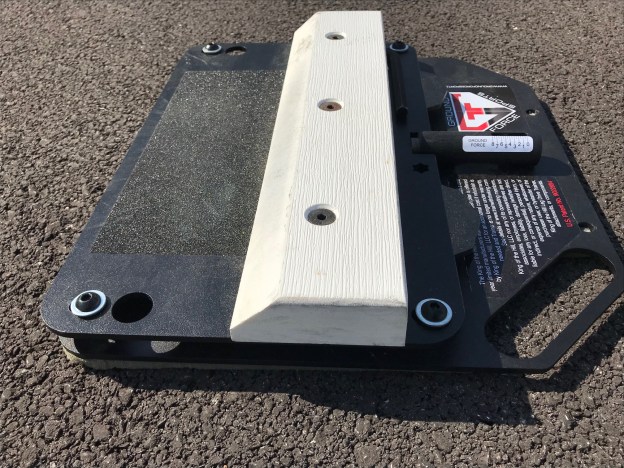
That’s where a new product called the Queen of the Hill (QotH) from Ground Force Sports can be – shall I say it? – a game changer. Instead of explaining to pitchers that they need to push off harder from the pitching rubber, the QotH lets them experience whether they are doing it or not – not just with their sense of feel, but with sound.
The product itself is pretty simple on the surface. It consists of a base plate, plus a spring-loaded top plate that has pitching rubber attached to it. The front of the pitching rubber  has a 45 degree angle to it, which right away encourages pitchers to get into a better drive position before they ever throw a pitch. (Leaving your foot flat on the ground is no way to achieve a powerful leg drive.)
To use it you can lay the QotH on the flat ground, or place it in front of the pitching rubber on an indoor mat or field. Then, using the included Allen wrench that is held on the back of the rubber, you set the tension level on the QotH.
NOTE: The Allen wrench is designed to be held very securely after you insert it into the hole in the back of the rubber. That’s a good thing for transport, so you don’t lose it, but not so good if you’re in the middle of a pitching session and you want to make a quick change of tension. After my first time using it in lessons I discovered the best approach is to stick it in your pocket after the first use, then return it to the holder when you’re completely done with it.
The tension spring has a handy scale from 0 to 8 so you can set the proper level at the  beginning, and then increase the tension to keep it challenging as the pitcher gets better. It only takes a few seconds to increase the tension. If your pitcher gets so powerful that even the highest tension level is too easy, there’s a second heavier-duty spring that you can use to keep it challenging. These guys have thought of everything!
Once the QotH is set up the fun begins. Make sure the pitcher places the sole of her foot against the angled surface on the front of the pitching rubber. She then goes through her normal windup and throws a pitch.
If she uses her legs to explode with a powerful push-off, you’ll hear a “click-click” as the top plate slides back then comes forward again. If she just throws her stride leg forward without getting a good push, you’ll hear nothing.
And that’s the beauty of the QotH. The pitcher doesn’t just feel the movement of the top plate – she can hear whether she was successful.
That audible cue tells her (and everyone else) right away if she got into her legs or not. If not, she knows she needs to work harder, helping her build the good habits that will result in better drive mechanics.
Of course, you also must be sure to set the level properly. Asking a 70-lb. 10 year old to make the QotH click at Level 8 is unrealistic, no matter how hard she tries.
What I have found works is to set the level light in the beginning, in the 2-4 range depending on the age and size of the pitcher, then work your way up from there. The tension should be set so the pitcher can get the “click-click” with strong effort, but not with anything less than that. When she is getting a “click-click” every time, it’s time to increase the tension level. I usually move it up by one number, so say from 5 to 6.
The product itself appears to be very solid and well-built, so it should last a long time. It’s very heavy – I believe it weighs about 25 lbs. – which is good, because that means a strong pitcher won’t be pushing it backward as she drives out. But it can be a shock if someone tries to pick it up without realizing how much effort it takes.
My only quibble with the design is with the carrying handle. The inside part has very square edges that make it a bit painful to carry, especially over a longer distance. I’m sure a little duct tape would take care of it, but it would be nice if those edges were rounded out a bit more.
So far, the reaction from the pitchers I’ve tried it with has been overwhelmingly positive. One of the first, a high school pitcher named Allison, smiled and said “I want one!” after just a few pitches. She could feel the extra launch she was getting right away – almost as if the spring was pushing her out (which it wasn’t).
Other pitching students who have tried it, whether they are 10 or 18, both said they liked it and that they could feel the difference. I also know a couple of dads who have either purchased it or are in the process of considering it.
I haven’t seen any quick speed jumps just yet, but I know others have reported gains of 1 to 3 mph after just a few sessions. I think those gains will come as the pitchers get used to the timing, and get used to getting into their legs more.
So how much does all this wonderfulness cost? It’s not cheap. The Ground Force Sports website has it listed at $329, although if you type in the coupon code Coach James (a friend of mine who is the one who originally told me about it) you can save $25.
But look at it this way. How much do you spend on a bat that may last a season, or two if you’re lucky? The benefits from the QotH will last throughout a pitcher’s career – and may even help prolong that career by helping her continue to play in college.
One last story about it. A couple of weeks ago I brought it to a pitching clinic where I was working with a few 10U pitchers. I used it to help them get the feel of driving instead of stepping.
When I was done, one of the young male instructors from the facility approached me and said he’d been using the baseball version (King of the Hill) with his pitchers and that it had done a lot to reveal to them just how little they were using their legs.
We chatted about it for a few minutes. Then it occurred to me: Using the QotH kind of puts you in an exclusive, “in-the-know” club. So on top of everything else there’s that benefit if you’re interested.
Overall, I’m not much of a gadget guy. I see a lot of stuff out there that just makes me shake my head and ask “why?”
But if you want to help fastpitch softball pitchers learn to use their legs powerfully and efficiently, the Queen of the Hill is definitely worth the investment. Can’t wait ’til that first pitcher needs the other spring!
Eating the Elephant

Photo by Pixabay on Pexels.com
A question I will often pose to my fastpitch softball students is “How do you eat an elephant?” Regardless of age, the first time they hear it they tend to look at me as if I have completely lost my mind.
The correct answer, of course, is “One bite at a time.”* That’s a critical lesson for anyone trying to learn a new skill, or even make improvements to existing skills.
What it means in realistic terms is you don’t have to learn (or master) the skill all in one big gulp. You’re far more likely to have success (and far less likely to give up too soon) if you give yourself permission to learn whatever you’re trying to learn a little bit at a time.
This is particularly true of complex skills such as hitting and pitching that have a lot of moving parts. Trying to learn all the mechanics (or fix all the problems) at once is going to be extremely difficult if not impossible. Our brains simply don’t function that way.
But breaking the skill into smaller components, prioritizing them so you know what to work on first, and then focusing on each of those areas in order will enable you to create a progression where success builds on success.
For example, when I’m working with a new pitching student I like to use a technique called “backward chaining.” That’s a more sophisticated way of saying you start at the end of the skill and work your way backwards, because if you don’t get the end right nothing else you’ve done up until then matters.
So for pitchers we’ll work on starting the ball overhead, palm facing the catcher, bringing the upper arm down until it contacts the ribcage, and pulling the ball through into the release zone so the lower arm whips and the wrist snaps itself. (That’s a simplified version of what goes on and what I look for, but will suffice for now.)
Most young pitchers will tend to want to bring the entire arm through at once, get behind the ball too early, and push it through the release zone. Heck, some have even been taught to turn the ball backwards and push it down the back side of the circle, which is definitely what you don’t want to do.
So it takes a bit for them to learn to relax and let the arm work in two pieces. That’s why we focus on helping them get that feel, because it will serve them well as they get into the full pitch.
But if we tried to do that, plus get a proper launch, plus worry about getting into the right position at each point during the motion, etc. the odds are they wouldn’t learn anything. Especially how to whip the ball through.
The other element that enters this discussion, of course, is the impatience of players themselves. It’s understandable.
They are growing up in a world where they have instant access to everything – information (via smartphones and the Internet), food (microwave and fast food meals), transportation (no need to walk, we’ll drive you!) and so forth. The idea of having to wait for something they want is often foreign to them.
So, they try to eat the elephant like a python – unhinge the jaw and try to swallow it whole.
Again, it doesn’t work that way. As a result, realistic expectations have to be set.
They have to understand that doing this drill or taking a couple of lessons here and there won’t turn them into instant superstars who are mechanically perfect. Progress will come incrementally. Sometimes in increments so small it’s hard to tell it’s being made.
But if they keep working at it, the cumulative effect will take hold and eventually that big ol’ elephant will be gone.
The lesson for coaches (and parents) is don’t try to fix everything at once. It’s been tried. It doesn’t work.
Focus on one thing at a time, adding each new piece to what you’ve already done, and you’ll save a lot of heartache for you and the player.
For players, the lesson is to be patient and, as Bobby Simpson says, get a little better each day. Remember if you want to walk a mile you just need to start putting one foot in front of the other. Eventually you’ll get there.
So grab a fork and dig in! The sooner you get started, the sooner you’ll reach your goals.






