Blog Archives
Buying Tools v Learning to Use Them
Like many guys, at one time in my life I thought woodworking would be a great, fun hobby to learn. Clearly that was before my kids started playing sports.
So I started becoming a regular at Sears, Ace Hardware, Home Depot, Menards, Lowes, and other stores that sold woodworking tools. YouTube wasn’t a thing back then (yes, I am THAT old), so I also bought books and magazines that explained how to do various projects.
Here’s the thing, though. I might skim through the books or an article in a magazine to give me just enough knowledge of which end of the tool to hold, then I’d jump right in and start doing the project.

Needless to say, the projects I did never quite came out the way the ones in the pictures did. I also didn’t progress much beyond simple decorative shelves and things like that – although the ones I did make held up for a long time.
The thing I discovered was that buying new tools was a lot easier, and a lot more fun, than learning how to use them. Buying tools is essentially “retail therapy” for people who aren’t into clothes or shoes. And you always think if you just had this tool, or this router bit, or this fancy electronic level, everything will come out better.
Nope. Because no matter how good the tool or accessory is, it still requires some level of skill to use it.
Fastpitch softball parents and players often suffer from the same affliction. They believe that if they get the latest version of expensive bat they will hit better.
They believe if they purchase this gadget they saw promoted on social media it will automatically cure their poor throwing mechanics. They believe if they purchase this heavily advertised pair of cleats they will automatically run faster and cut sharper.
Again, nope. New softball tools like bats and balls with parachutes attached and arm restricting devices and high-end cleats are certainly fun to buy, and there’s nothing like the anticipation and thrill of seeing that Amazon or FedEx or UPS truck coming down the street to make you want to burst into song.
But they’re just tools. In order to get the benefits of those tools you have to learn how to use them correctly then work with them day after day, week after week, month after month, year after year.
And as we all know, that part isn’t as much fun. There’s a reason it’s called the grind.
Take that bright, shiny $500 bat. If you’re still using a $5 swing, or you’re too timid to even take it off your shoulder, it’s not going to do you much good. It may look pretty but you could be using a $50 bat to the same effect.
You have to get out and practice with it. Not just during practice but even when no one is around. The more you do it the better you’ll get at learning how to use it – just like I discovered with my fancy jigsaw.
Pitching, fielding, throwing, baserunning, it’s all the same. No fancy glove or high tech gadget is going to help you get better no matter how much it costs. You have to learn how to use it, which means getting off your butt (or off your screen) and using it.
If you don’t know how to use it, seek out somebody who does and have them help you. It’s a pretty good way to shortcut the learning process, and often a better way to invest your time and money.
Yup, sure, new tools and toys are a lot of fun to wish for and shop for and buy. But even the best ones can quickly become shelfware if you’re expecting them to do all the work for you.
Get the tools that will help you get the job done, but always remember you have to learn how to use them to reap the full rewards. Otherwise you’re just throwing away money.
Welcome to the 2025-2026 Season – Wait, What?

A couple of weeks ago as I was busy wasting time scrolling through Facebook I came across something that made me think I must have fallen asleep in front of the TV and not woken up for three months. It was an announcement from a couple of teams about “open workouts” (translation: tryouts) for the 205-2026 season.
“Wait, what?” I thought. I mean, the high school season is still in high gear everywhere high school softball is played in the spring, and travel teams are still working their way through their “shake off the rust” tournaments in preparation for the travel season to begin in earnest.
So why in the name of Carol Hutchins are travel teams already looking for players for the next freaking season??? (You know I’m not happy because I used three question marks instead of one.)
This is just insane. Coaches should be focused right now on the players in front of them and helping each and every one of them reach their potential this season, not out looking for new players so they can unceremoniously dump anyone on their roster they don’t think measures up.
But of course, that’s one of the problems in today’s game. There aren’t as many coaches as there used to be, at least by what I would define as a coach.
Instead, they have been replaced by “managers” who, instead of developing the players they have, are always on the lookout to acquire players someone else has taken the time and effort to coach up. Like Pokemon cards, if you collect enough of those already-baked players you can just throw them on the field and watch them bring home the trophies/rings/banners/whatever is being given away to tournament winners these days.

So now it’s a race to see who can get to those high-level players first.
Now, admittedly, that’s nothing new. I remember when teams used to hold tryouts after the current season was over.
There were always a couple of programs that would try to jump the gun, either by playing in sanctions that ended earlier so they technically were into next season or by holding “special tryouts” maybe a week before their season ended. These organizations would pressure the kids who tried out to make a decision right then and there so they could lock up the talent before anyone else had a chance, although if someone better came along the original offer might be rescinded anyway and then those kids would have to scramble to find a new team.
But even those shenanigans occurred right around the end of the season for everyone.
Now they’re looking for next year’s team while this year’s team is just getting going with their season. And people wonder why players don’t seem to be as loyal to their teams or coaches as they used to be.

In my opinion, and the opinion of a lot of coaches I know whom I respect immensely, the focus during this season should be on helping the players you have now get better rather than finding their replacements. That’s the way to build a winning culture and create a positive experience.
Holding public workouts for next year’s team, before you even know what players or positions you may need, is a sure way to create divisiveness and negativity within the current team. It could even drive some of your current “good” players out because they’re not feeling valued or loved by the organization or the coaching staff.
It’s also a bad idea because you never know who is going to step up during this season and surprise you. If you listen to current high-level college players talk about their early days in the sport, you’ll find many of them were not studs right out of the gate.
Many, in fact, sat the bench a lot (although that’s a travesty in and of itself). Some of the best pitchers today were the #4 or #5 pitcher on their travel teams before they grew, or the mechanics from their lessons kicked in, or someone just gave them a chance to pitch some quality innings and it all came together for them.
It just seems wrong to me for teams and organizations to be ignoring who they have in front of them right now in search of some mythical team for the future. At least if they really believe in the stuff on their website that says they’re “in it for the girls.”
There will be plenty of time for tryouts or other events to convince top talent that they would be better served with a new team that’s “more at their level” than the one they’re on now. I wouldn’t even object so much if you did it right before the end of the season, although don’t be surprised if a few of your “lesser” players on the current team decide not to spend the time and money going to whatever nationals you’re heading to if they’re feeling like you’re planning to cut them once the last out is recorded.
But seeking out new players at the beginning of your primary season? That’s just ludicrous.
Run with the players you have now and help them finish the season better than they started. You just might find you don’t need as many new players as you thought.
Keeping the Softball Skill Plates Spinning
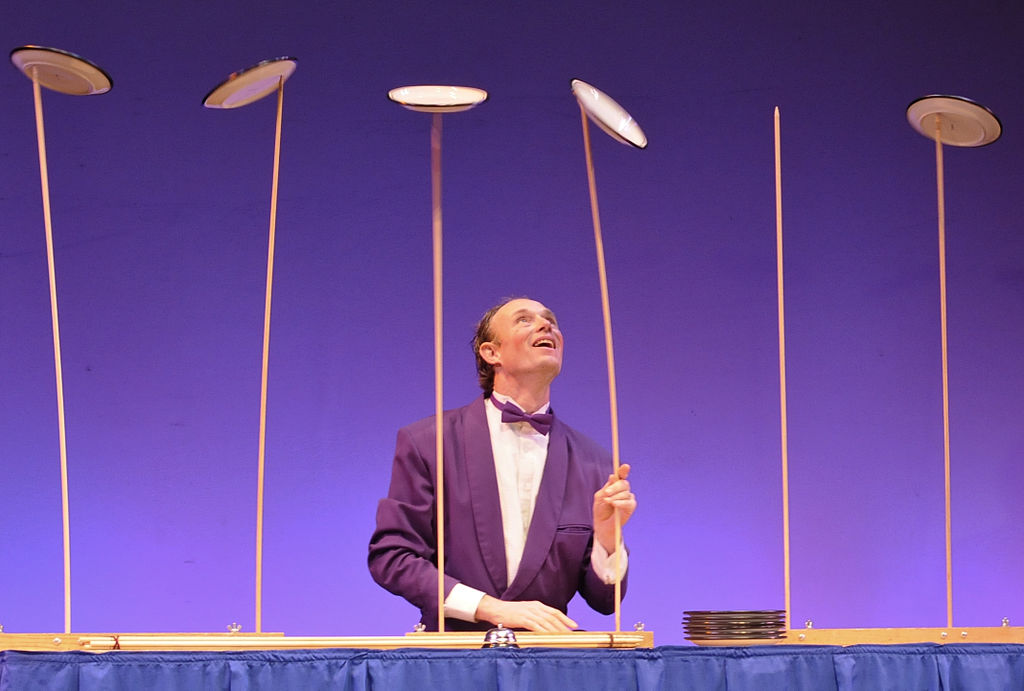
If there is one image that perfectly describes the challenge of keeping fastpitch softball skills (especially pitching and hitting) sharp, it’s the old circus act of the plate spinner. (For those of you who have never seen one in action, here’s a video. Sorry you have to watch an ad first.)
If you don’t feel like watching the video, basically what you had was a set of sticks across a long table. The spinner would get one going on top of a stick, then get another going, and so on until each stick had a plate spinning on top of it.
Of course, the challenge was that while he (it’s almost always a he) was getting the next plate going, the previous ones would be losing momentum. As a result, he constantly had to jump from one plate to another and give them a tweak until he had them all going well at the same time.
Sounds about right, doesn’t it? When you’re working on complex skills such as pitching or hitting, there are a lot of moving parts. Just like there are a lot of moving plates.
While you’re working on one thing, say leg drive for pitchers, another part of the pitch such as the long, loose arm may start “wobbling.” So then you have to take care of that again.
And as you’re doing that, the pitcher starts closing too early or too much, gets off the power line, starts throwing her glove out to the side or develops some other issue.
If you see that happening, the good news is you’re not alone. It’s actually pretty common, and not just among the very youngest players. Even the most accomplished players will start to wobble now and then in one area or another. That’s why college, pro and national teams have hitting, pitching and other specialty area coaches.
So how do you deal with it? Here again you can take a cue from the plate spinner.
When he sees a plate begin to lose momentum he doesn’t try to run over to it before he gets the plate he’s working on spinning properly.
(In fact, I’d bet that seeing plates wobble is good for the act, because it introduces a sense of concern. How interesting would plate spinning be if the plates were never in danger of falling off the stick?)
Coaches and parents should do the same. Work on one thing at a time and get it going well before going back and addressing a previous issue that is cropping up again. If the player is struggling you can let her know what the other issue is to reassure her that all her mechanics aren’t falling apart and that you’ll address the problem later.
Another good idea is to learn your craft so you’re aware of what’s urgent and what can be dealt with later. Again, a plate may be wobbling but it might be capable of going on for a while before it actually becomes an issue. Knowing what to address (and when) is essential for securing long-term success.
Finally, understand that the player is probably going to break a few plates as she learns her mechanics. That’s ok.
Failing in some aspects is part of the learning process. I have no personal experience with plate spinning, but before you pay good money to see someone perform this amazing feat he probably spent a lot of time learning how to get one plate spinning, then two, then three, etc. In the meantime, a lot of dishware was harmed.
Eventually, though, with a lot of effort he was able to put on an entertaining, dramatic show.
Your players will be the same. Pitchers may struggle to throw strikes or hit spots as they work to become the best they can be. Hitters may swing and miss a lot before they start driving the ball.
But if you stay focused on the process rather than the immediate results, the results in time will take care of themselves.
So if you’re facing that situation right now – even if a lot of the plates of wobbling – don’t freak out. It’s a natural part of the learning experience.
If she is motivated, eventually your player will get all the plates spinning fast and tight so she can thrill the crowd. And you can take your bow.
Image courtesy of Henrikbothe [CC BY-SA 4.0 (https://creativecommons.org/licenses/by-sa/4.0)%5D
Fastpitch coaches: when you’re offering instructions, be specific

One of the challenges of coaching fastpitch softball, or any sport for that matter, is offering directions that are meaningful to the player. While there are several elements that go into meaningful directions, I find that being specific is definitely key.
What does that mean, be specific? Here’s an example I heard today. A student told me she was working on fielding ground balls, and one of her coaches told her she had to get lower. That was probably correct – I wasn’t there so I don’t know, but let’s assume it was.
The problem with saying “get lower” is it leaves out an important element: how to get lower. If you’re bending at the waist, does that mean bend more at the waist? No, that would be silly.
The proper direction would be to lower your hips as you go down to the ball. That makes it easier to get to the ball while remaining in an athletic position where you can make the play.
Non-specific instruction reminds me of a joke that was making the rounds a few years ago. A group of people are in a helicopter in Seattle, checking out the sights, when a sudden fog rolls in.Not only are they having trouble seeing but the instruments go all haywire.
Now they’re lost, and need directions to get back to the airport. The pilot decides to hover next to a building where he sees some lights on. He sees there are people inside, so he quickly writes up a sign that says “Where are we?” and holds up it for the people inside to see.
They see the message, and take a minute to write up their own sign. When they hold it up it says, “You are in a helicopter.” The pilot immediately says “Right” and heads straight for the airport. When the helicopter lands, all the passengers are amazed. “How did you know from their sign where we were?” one asks.
“Easy,” said the pilot. “The information they gave us was completely accurate and completely useless. I knew we were by Microsoft.”
That’s the thing about directions. It’s easy to say do this or do that, but is what you’re saying actually helpful? Or is the message simply, “Play better!” – which I actually used once in a post-game speech to break the tension when the team was down.
For the most part, players don’t need you to tell them they’re doing poorly. If they have any experience at all they can tell they’re having problems. What they need is help fixing them. The more you can give them the “how” instead of just the “what,” the faster they’ll likely be able to address the issue and get it corrected.
Telling a hitter she’s pulling her front shoulder out is true, but useless. Telling her how to keep her front shoulder in, by leaving it strong and driving her back side around it, is helpful. (By the way, telling her she’s pulling her head out is neither accurate nor helpful, because it’s not the head that’s getting pulled out, it’s the front shoulder.)
Telling a pitcher she’s throwing high is useless. Even the least experienced pitcher can see that on her own. Telling her to whip through the release and fire the ball at the plate instead of getting the hand ahead of the elbow and pushing it up through release will help her correct it.
If you don’t know the “why” of common issues, find out. There’s plenty of great information out there. Search around on Life in the Fastpitch Lane (this blog) for ideas. Go to the Discuss Fastpitch Forum (if you didn’t come from there already) and poke around for hours. Search on YouTube – although be careful because there’s a lot of bad information out there too. Buy books and videos. Observe what great players do. Ask a more experienced coach. Attend coaching clinics and/or the NFCA Coaches College.
The more you know, the more specific directions you’ll be able to give them. And the better you’ll be able to help your players perform at the level you want them to.
Life in the Fastpitch Lane Makes the List
Had to share this with all of you, because it’s always nice to be included. This blog, Life in the Fastpitch Lane, was recently featured in a blog post from Decker Sports highlighting their picks for the 7 Best Softball Blogs to Follow. Wow, that’s a lot of “blogs” in one paragraph. 
It really does feel good to be selected to the list, especially looking at some of the others that made it. Unlike coaching, where you can see and measure the results with each session, blogging is kind of a solitary activity. You throw things out there you find interesting and/or helpful, and hope it resonates with at least one other person. But unless someone leaves a comment (hint, hint) you just never know for sure.
So it’s great to see the kind words the folks at Decker Sports shared. From the beginning, my goal has been to make Life in the Fastpitch Lane helpful and informative. Despite the fact that I’ve been coaching girls fastpitch softball for more than 20 years now, I still learn new things every day.
I credit not only other coaches in the field but also my students. They’re constantly driving me to come up with new ways to explain something, or to create new drills and ideas to help them learn. One of the biggest challenges is trying to get into the head of each individual to understand why she is (or isn’t) doing what she’s doing, what it feels like or looks like or sounds like to her, so I can teach her in a way that will work for her and more importantly help her achieve success on the field.
That can be challenging enough with an older player. It can be mind-boggling for an old coot like me to try to think like an 8 year old girl. Yet that’s what also keeps it fun and exciting. I hope I never get to the point where everything just works automatically the first time all the time. How boring would that be?
So as I discover new ideas and approaches, I will continue to share those insights with you. If each post helps just one softball player achieve success and feel better about herself, it’s more than worth the time and electrons.
And thank you again to the folks at Decker Sports. Be sure to check out their website for the softballs and training products they offer, and their blog for more training tips.
Return of the Indiana United Fastpitch Elite/Rick Pauly Clinics
Earlier this year I blogged about a fantastic fastpitch pitching event held, of all places, in Southeastern Indiana. Put on by Rick Pauly, hosted by Indiana United Elite Fastpitch and Coach James Clark, and featuring an array of top-level pitching coaches, it was an incredible learning experience for players, parents and coaches alike.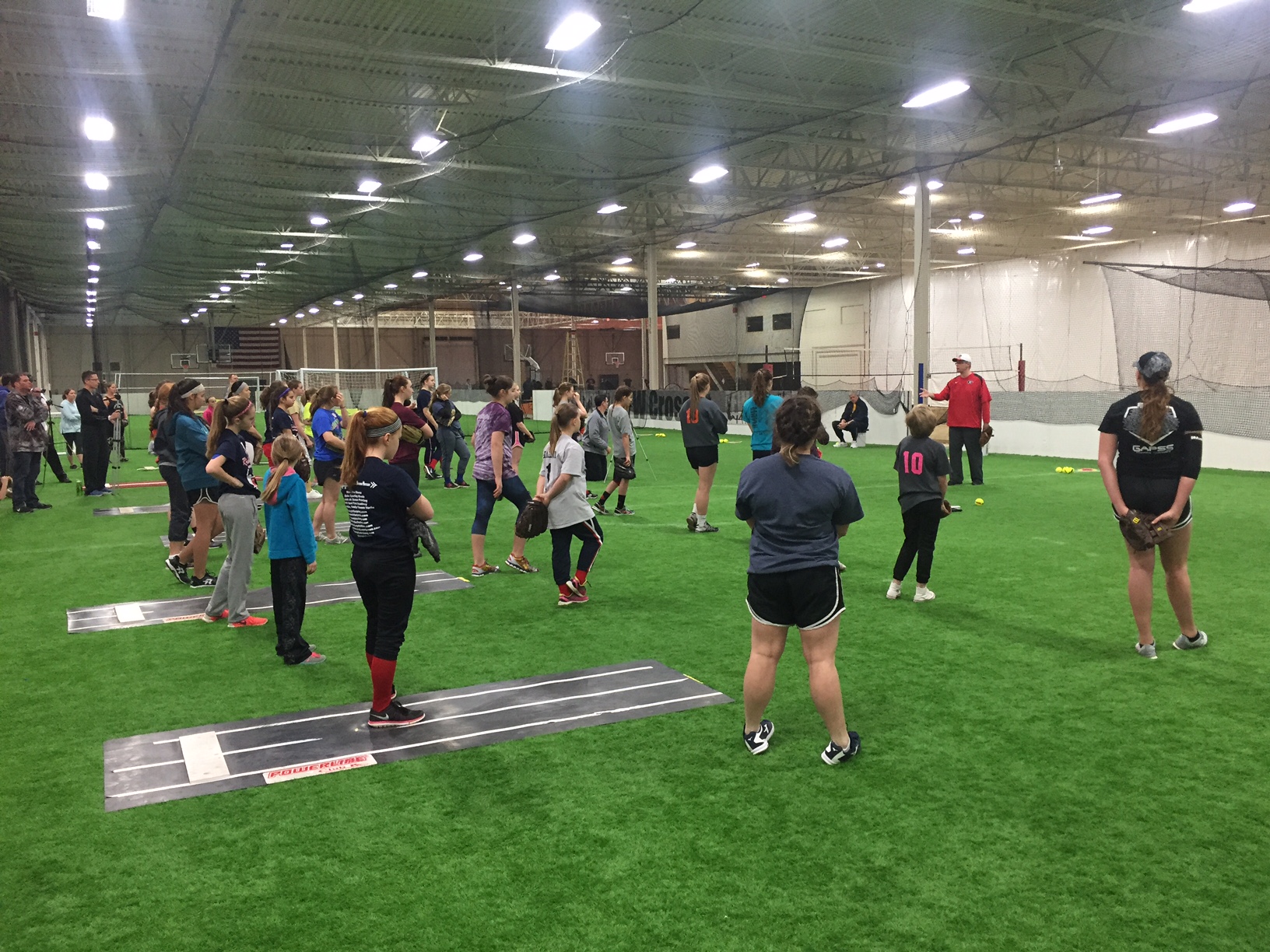
Never one to be content to rest on his laurels, Coach James has outdone himself with the latest iteration. The 2017 clinic, again in Richmond, Indiana, has expanded in its scope to not only offer top-level pitching instruction but also clinics on hitting, catching, the short game/slapping and defense.
This year’s instructor lineup is impressive once again, with college coaches and former college and NPF players offering hands-on instruction. The nice thing about these clinics is they’re not like so many, where they show a big name who is the “face” but then have very little interaction. The faces you see on the flyer will all be actively participating in or leading the instruction.
Throughout the weekend there will be plenty of time for discussions and questions too. One of the highlights for me last time was many of the instructors gathered together in a room tossing around ideas and opinions until the wee hours of the morning – all part of an impromptu session that began with a simple question. Those little side conversations alone are worth the price of admission.
Coach James promises it will be bigger and better than ever, and I believe it! The clinic runs the weekend of January 6,7 and 8, 2017 – timed this time to both make sure it didn’t interfere with high school and college seasons and to give players time to lock down what they learn before tryouts begin for spring high school ball.
Click here to register, and here to schedule the sessions you want and to pay. Most sessions are $70 each and run an hour and 15 minutes. The exceptions are the recruiting discussion that costs $25, and the beginning and advanced pitching sessions with Rick and Sara Pauly which cost $150 and are scheduled for 3 hours, although last year Rick was having such a great time he ran a bit long on both sessions.
Download the flyer for complete information, and then be sure you sign up now. Slots are filling fast. I’m sure you’ll find it’s a great investment in your softball future.
Private softball instructors level the playing field
As someone who has a broad interest in the state of youth sports in general as well as fastpitch softball specifically, I’m always interested to read articles on the topic. There’s no doubt that the U.S. (along with more and more other countries) has become sports-crazy, to the point where it is having a negative effect on young players. 
There is one aspect that always strikes me as missing the mark, however, which is their description of instructors. Maybe it’s because I’m a private softball instructor myself, but I don’t think it’s just me taking it personally.
When they talk about how crazy parents have gotten, sooner or later the articles will refer to how on top of everything else parents “then drag their kids to an instructor to spend even more time on their sport, usually in the hopes of acquiring that D1 scholarship.” Or something to that effect. It’s not an actual quote, just a sort of paraphrase of what I’ve seen.
That may be true in some cases. But for the most part I see the role as being somewhat different.
In the good old days these pundits like to talk about, they say kids just showed up at the field and learned to play there. They didn’t need all these adults around.
Well, the reality is that was wonderful for the kids with great athletic ability. You know the ones I’m talking about – you give them a ball, or a stick or some other piece of athletic equipment and they’ll instinctively know what to do with it. But maybe not so much for the kids for whom it didn’t come naturally, or who hadn’t grown into their bodies yet, or who were a little slower in developing their motor skills.
Basically what happened was they got left behind quickly and never had the opportunities to advance in a sport they may have loved but weren’t particularly good at yet. They got weeded out early.
That’s why I say a good instructor can level the playing field. He or she can take a player who may not be the greatest athlete and teach him or her to be competitive and find success on the field, court, rink or whatever. Success being defined by the player and his or her family.
I’ve worked with a lot of kids who had no ambition of playing in college – not just at the D1 level but at any level. Some just wanted to be successful in high school, or on their travel team, or in their rec league. They wanted to get off the bench and become important to their teams.
Is there something wrong with that? I don’t think so, and if I can help them achieve that goal where they might not have otherwise it’s terrific.
Not everyone was blessed with great DNA or grew up in a family that played sports all the time. A good instructor can help make up for those “disadvantages” and level the playing field, giving them opportunities they may not have had otherwise and helping them to achieve all they can achieve.
Of course, even the best athletes can use a little help along the way to shortcut their learning curve, and they’re fun to work with too. My point is that most of the parents who take their kids somewhere for instruction aren’t the ones you see in TV documentaries and NY Times ads, relentlessly trying to drive their kids to sports success they themselves never achieved. They’re just trying to help their kids feel good about themselves and build some great sports memories.
Like Riding A Bike

People often use the phrase “it’s like riding a bike” To refer to how easy it is to pick up a skill again when you’ve been away from it for a while. When it comes to softball training, however, there’s another use.
Players will often get impatient with themselves when they don’t pick up a skill right away. Pitchers will be wild when trying a new pitch). Hitters will swing and miss while working on improving their swings, or hit a popup or soft dribbler. Catchers will go for a block only to have the ball go between their legs. Lots of different things can happen.
When they do, I will often ask if they can ride a bike. I have yet to run into one who can’t. I’ll ask them if they have to think about how to ride a bike. They always respond no.
Then I ask them if it was always that way. What happened when they first took off the training wheels? Usually mom or dad held onto the seat and ran behind them until they were ready to take a few tentative pedals on their own.
Eventually, though, they figured it out. And once they did, they probably never gave it much thought again.
The same goes for softball skills. At first they can be difficult, and require a lot of thought (as well as a lot of trial and error). The success rate may be fairly low. But the more they do it, and really go after it, the less they will have to think (or worry) about it.
It’s a thought that seems to resonate. They know there were scraped knees and elbows at first on the bike, but today the only remarkable thing would be if they fell off.
When players get frustrated, remind them of their experience riding a bike. It might help them get back on track.
How do you help players learn patience while they’re learning a new skill? Any tips or tricks you’ve found helps them understand?






 Life in the Fastpitch Lane