Category Archives: General Thoughts
You Can Never Break the (Kinetic) Chain
A term that has grown in popularity lately in the fastpitch softball world is the “kinetic chain.” If you’ve seen any of the many “how-to” posts or videos on Facebook groups, Instagram, Tik Tok, or other social media outlets you’ve no doubt come across the term.
You may have even nodded along as the creators talked about the importance of maintaining the kinetic chain even though you weren’t actually sure what it is. If you’re nodding along with this one you’re in luck because we’re going to define it before we get into the meat of today’s topic. You’re welcome.
Basically, the kinetic chain is an instance where the body’s muscles, joints, and nerves all work together as interconnected links to produce a complex movement. Each link works with the others to transfer energy through the body, creating a multiplying effect that improves the result of the final, intended action, such as swinging a bat or throwing a ball.
The key here is that each link in the chain has to work with the others in the context of the overall movement, and it has to do its job at the right time, i.e., in the proper sequence. If any link in the chain acts independently, or at the wrong time, it reduces instead of enhances the overall outcome.

Ok, I know that was a little complex and abstract, but I think it’s important to establish the science first so this isn’t just one of the many millions of random opinions out there masquerading as fact. Now let’s get to the fun stuff – how it applies practically to fastpitch softball.
The kinetic chain and hitting
The basic kinetic chain for quality hitting involves moving the hips first (using the big muscles in the core, the abdominals, etc.), followed by the shoulders, and finishing with the arms to deliver the bat to the ball.
Yet what you see many young and even some older hitters doing is initiating the swing with their arms and then yanking on the bat for all they’re worth to try to hit the ball hard. That works off the tee, and can even work in games at times if the hitter is reasonably strong.
But when you do that, you’re basically putting the cart before the horse. The arms are supplying the bulk (if not all) of the energy that is going into the ball, essentially choking off any energy the big muscles in the legs and torso are trying to produce.
Rather than moving a lot of energy up through the chain, that arms-based swing is limiting how much of that energy can be used – by a lot. It also reduces the body’s ability to adjust to the pitch as it’s coming in because the arms are creating an early path that gathers momentum as the bat moves forward.
It’s like firing an arrow and then trying to aim the bow. It just doesn’t work.

By keeping the kinetic chain intact the hitter has time to see the ball while she’s generating larger energy than she can with her arms alone, gathering information about where the ball is headed, and is then in a better position to direct that energy when the ball gets to her.
The same limiting factor comes into play when hitters spin their back leg in place (the old “squish the bug” cue) rather than engaging the hips. While it may appear to the naked eye that some high-level hitters do that, if you look at high-speed video you’ll see that they actually turn the hips into the ball then fall back into the “turned” position after contact.
Honestly, I’ve been fooled by that before myself, thinking that a hitter didn’t use her hips enough. But a quick video shows she actually did what she was supposed to – it just happened so quickly it was difficult to see in real time.
The kinetic chain in pitching
There are a lot of similarities between hitting and pitching as far as the kinetic chain goes. You are still doing a ground-up movement, with a firing order that moves from the hips to the shoulders to the arms.
The difference here, though, is that you’re focused on one arm, and that arm has two pieces that need to fire in order to maximize the transfer of energy (and thus ball speed). So the full sequence is hips-shoulders-upper arm-forearm.
Notice I didn’t say anything about the wrist. It does contribute to the overall pitch, but not forcefully as some people still believe.
The wrist is more of a “let it happen” than a “make it happen” contributor on most pitches. The exception, in my opinion, is the curve ball, where it does have to do a little bit of work to put the hand under the ball properly to achieve the correct spin.
After that, though, it’s still more of a “let it happen.”
What trips up many pitchers trying to achieve speed is muscling up at the shoulder, or forearm, or trying to do a hard snap upward with the wrist. Those actions may feel powerful, but not only do they not add anything to the energy transfer to the ball, they actually take away from it.
When you muscle up on any of the downstream segments it chokes off at least a part of the flow of energy. Less energy into the ball = reduced speed.
What you want instead is to allow the joints to move freely in a quick acceleration/deceleration sequence that moves the energy from one segment to another until it reaches the ball. Muscling up slows the individual piece that’s being used down, which means it has less energy to pass along to the next one.
This relaxed flow of energy is especially true for what happens with the arm. Once the hips and shoulders have stabilized (stopped turning forward), the upper arm uses the energy from the body to begin accelerating toward release.
This movement will happen much faster if it’s allowed to happen rather than the pitcher trying to force it to happen by consciously muscling the arm downward. Just accept the energy and direct it downward until the upper arm comes into contact with the ribcage.
If that happens, the sudden stop of the upper arm transfers the energy down into the lower arm, causing the forearm to accelerate suddenly until it reaches brush contact/brush trigger – the light contact of the forearm (not the elbow!) against the hip. This action causes the forearm to decelerate suddenly, delivering all that energy that was created throughout every phase of the pitch and transferring it into the ball through the fingers.
Again, any attempt to force these movements by muscling up will have the opposite effect to what is desired – it will break the kinetic chain and reduce the speed.
You see this reduction a lot with pitchers who are trying to force strikes. They slow their arms down to get the ball over the plate and then can’t figure out why they’re not throwing faster.
Then, of course, they try to muscle up the finish and not only are they throwing slower, they’re now less accurate as well. It’s a vicious circle.
By the way, all of these principles apply to overhead throwing as well, although in a slightly different manner. The concept is the same though – if you want to throw hard, you have to let the chain happen instead of trying to force movements.
Better by design
The human body is an entire system designed for one primary purpose: to keep us safe. Each movement has a particular purpose that was developed to work in concert with other movements to create the optimal whole.
So you can see why breaking the kinetic chain by imposing unnatural movements on it isn’t a great idea. Let the body work the way it’s designed to work and you’ll achieve much better results – with less wasted effort to boot!
Losing Doesn’t Build Character – It Reveals It

Today’s post was actually suggested to me by my partner in podcasting Jay Bolden of BeBold Fastpitch. Not sure why he didn’t keep it for himself since he writes some great posts on his own Facebook page, but I will definitely take it. Thanks, buddy!
I think we’d all agree that it’s easy to look like a good coach, and a good person, when your team is winning., because it’s true that winning covers up a lot of other problems. You may be the most clueless coach in the world, but if your team is winning a lot more than it’s losing no one is likely to have any complaints.
That’s understandable. As Nuke LaLoosh says, winning is a lot more fun than losing.

Where you truly see the measure of a coach, however, is when things aren’t going so well. When the team is having a rough season, or maybe just going through a rough patch, how the coach reacts reveals a lot about who he or she really is.
First, let’s talk about how a good coach will or should handle losing, just to do a little level-setting.
No one likes losing. I know I sure don’t, and especially didn’t when I was coaching teams. I was one of those “I hate losing more than I like winning” types.
So with that in mind, you have to look at WHY you’re losing. The first place a good coach will look is in the mirror, asking questions such as:
- Have I been training my team well enough?
- Have I been making good decisions about who is on the field?
- Have I been putting together the most potent batting order, based on facts, not feelings?
- Have my in-game decisions been good ones?
- Are we playing the right level of competition?
- Are our strategies appropriate for the personnel we have?
- Have I built an atmosphere where players are playing with confidence or with fear?
That’s a great starting point. But the truth is you could be doing all the right things and the team is still losing. The softball gods are funny that way, and when you make them angry for some reason you may have to sacrifice a chicken to get back on track.

If you noticed, all of the above had the coach looking inward, at him or herself first, to ensure that the problem isn’t staring him or her in the mirror.
Now let’s talk about what bad coaches do: they blame. They will:
- First and foremost blame their players for not playing well enough or trying hard enough.
- Blame their facilities or their budgets for not giving them enough money to be better.
- Blame the administration for not supporting them.
- Blame the parents (yes, even in college) for expecting too much, or questioning the coach, or I suppose for not having better DNA.
- Blame the umpires for not calling a fair game.
- Blame whoever happens to be out of earshot at the time.
- Blame whoever happens to be in front of him or her.
I’ve heard stories where a coach’s idea of coaching is to essentially yell at her players to “play better.” That’s the sum and total of her advice.
No advice on HOW to play better after a problem, such as stay down on a ground ball, or go for the lead runner first, or you have to look up to see where the ball is before trying for another base, or anything else helpful like that, So it’s no surprise when the same problems keep coming up. Thanks, coach.
We’ve also all seen the coaches who scream at their players, telling them how bad they are after they make a mistake. No attempt to build a positive atmosphere, or encourage them instead of letting them get down on themselves. Just constant berating.

And do things get better? Maybe by luck sometimes. But for the most part, that type of approach is counter-productive for one simple reason: it’s addressing the wrong problem.
Look, no one likes to lose. Some take it harder than others (like me) but no one actually likes it.
So screaming about it or blaming others doesn’t address the core issue. It’s an attempt to cover it up with bluster instead.
So what types of things does losing reveal about a coach’s character? One is their maturity level.
Good coaches will attempt to work the problem and maybe change the atmosphere or the mindset if needed to try to change the outcomes. They will look to support their players, and look for solutions to the problems the team is facing.
Bad coaches will deflect the problems and substitute anger and noise for a thoughtful approach. They don’t know what to do to change things so they throw tantrums in the moment in an attempt, I suppose, to hide their lack of a viable solution.
Losing also reveals their ability to see the larger picture. Good coaches know they will get through the current series of loses, and develop a plan to help expedite that process.
Bad coaches let their emotions take over and focus on the immediate.
Then there’s the worry about what others think of them. Both good and bad coaches will often have that concern. I mean, after all, we all want to be thought of as being good at what we do.
But good coaches understand they have to set those temporary perceptions aside; after all, if all else was the same except for the won-loss record, those people calling for their heads would instead be scheduling a parade.
Good coaches realize they have to separate themselves from the current unfortunate circumstances and think about times when their teams were winning so they can clear their heads and address whatever the causes are. If they truly believe in what they’re doing, and stay true to it, they know the wins will come again.
Bad coaches, on the other hand, will try to cover up their insecurities by directing their anger and blame at others, never stopping to think about the fact that they may need to change what they’re doing or how they’re approaching the team in order to flip the script and back on track. And the more they let those negative thoughts creep in, the worse things are going to get for them.
As we often say, softball is a game filled with failure and adversity. There’s absolutely no reason to think those things will affect you as a coach at some point, or more likely many points, in your coaching career.
How you handle losing when it comes, though, will say a lot about who you are and what you truly believe in. It is entirely a test of character, graded on a pass-fail scale.
Be sure you’re ready to pass that test. Not just for the sake of your players, or your program, but for yourself.
Walk the Path That’s Set Before You

We’ve all been there at some point in our lives (even the youngest among us). We have a plan, a preferred path we’ve chosen to walk, only to find that for some reason that path is not open to us at this particular point.
At that point we have two options: turn around and go home, or walk an alternative path until we can (maybe) get to the one we want to follow. This is true in life in general, and it’s true in fastpitch softball specifically.
Since this isn’t a life coaching blog, we’re going to look at the softball example. You can apply the advice, however, as you choose.
Let’s take the example of a tryout since high school softball is just getting going in much of the U.S. Perhaps the path you’ve chosen (or desire) is to play on the varsity team, or to play a particular “glamour” position such as pitcher or catcher or shortstop.
But when the tryout results came out you were placed on JV instead. Or maybe you’re on varsity but the coach has already told you that the position you love is already taken by someone he/she thinks is better than you.
(Yes it may also be taken by someone who isn’t better than you but that the coach likes more for some reason, but we’ll set that discussion aside for another day.)

Essentially your path forward is blocked for now. You can get angry about it and walk away. Or you can say to yourself “if that path isn’t open what other options do I have?”
Let’s start with making JV instead of varsity. This may be a blessing in disguise.
Sure your ego takes a hit, especially if some of your travel or rec teammates made varsity. But ask yourself if you would rather sit the bench on varsity, maybe getting 10 innings of playing time total for the season, or you would rather be an every day starter on JV?
(Incidentally, Jay Bolden and I discuss this topic in more detail on next week’s From the Coach’s Mouth podcast. Be sure to check it out.)
While there are some things you can learn by watching games and participating in the varsity practices, you need to be playing regularly in games to keep your skills sharp.. You will probably be better off playing than sitting, even if the team you’re playing on isn’t that great.
And being on that team may also give you a better opportunity to develop other skills such as leadership which will serve you well not only in softball but throughout your life. So take the path that’s been set before you and walk the heck out of it; your time will come, and you’ll be even more ready to seize it.
What about the path to your favorite position being closed right now? In that case, I’d say go where the team needs you to be now, prove yourself, and you’ll be that much more ready for when your preferred path opens again.

Here’s an example. I worked with a terrific catcher a few years ago. She helped take her team to second in State among large schools, and was recruited to a strong D2 school to be their catcher.
When she got there, though, a senior transfer had come in and was given that spot without even the chance to compete for it. So what did she do?
She took advantage of whatever other opportunities were made available to her to get on the field.
It started with being the DH. She did well there, so the coach, recognizing this girl’s athletic ability, decided to try her out in left field to see if she could shore up the defense as well as the offense.
My catcher hadn’t played a lot of outfield, but she had played some, and in this situation she played the heck out of it, diving for balls and using her catcher arm to throw out runners at home. She used the opportunity to prove what type of player she was, and once the senior graduated she was back behind the plate where she wanted to be.
You can do the same. Whether your coach puts you in the outfield, or at second base, or at first base, or simply asks you to DH, give it all you have and do your best to learn that position as quickly as you can.
You never know what might come out of it, and if nothing else at least you’re on the field showing what you can do. Because it’s tough to show what you can do from a seat in the dugout.
Life is full of twists and turns, and you’re not always going to like them. They might even seem scary at times.
But rather than fighting them, if you keep putting one foot in front of the other and make the best of the current situation, good things will happen for you.
Path photo by Pixabay on Pexels.com
What It Takes to Really Learn Something (or Unlearn Something)
When I was but a lad heading into high school, my heart’s greatest desire was to learn how to play the guitar. Partially because I loved music, but also because I thought doing so would help me meet girls.
(Don’t judge, Eddie van Halen started on guitar for the same reason, although he did a little better than me on learning it.)

Anyway, for my 14th birthday (just as the summer started) my parents bought me the cheapest piece of junk available that will still work, a $20 Decca guitar from Kmart. But I didn’t care – I had a guitar, along with a little songbook with songs like Born Free and Red River Valley that had the little finger placement charts above every chord.
I pretty much spent the entire summer locked in my room for 4-6 hours a day every day, playing the same old songs over and over until they began to sound like actual songs. In a month I felt comfortable enough to play that guitar in front of my parents and a couple of their friends.
Within a couple of months of starting I bought my first “real” guitar for $100 out of my 8th grade graduation money – a Suzuki 12 string that I still own to this day. It’s not very playable anymore but I still keep it around for sentimental reasons.
I tell you this story to point out a valuable lesson: if you really want to get good at something, you can’t just dabble at it or put in time against a clock. You have to work at it deliberately, with a goal and a sense of purpose.
In other words, you have to know your “why” or you’re just going to spin your wheels.
So if you’re a pitcher who is trying to increase her speed or learn a new pitch, you can’t just go through the motions doing what you always did. You can’t just set a timer and stop when the timer goes off.
You have to dig in there and keep working at it until you make the changes you need to make to reach your goal.
If you’re trying to convert from hello elbow to internal rotation, you can’t just throw pitches from full distance and hope it’s going to happen. You have to get in close, maybe slow yourself down for a bit, and work on things like upper arm compression and especially forearm pronation until you can do them without being aware of them.
It might take a few hours or it might take a month of focused, deliberate practice. But you have to be willing to do whatever it takes to get there.
The same goes for hitters. If you’re dropping your hands as you swing or using your arms instead of your body to initiate the swing you’re not going to change that overnight by wishing for it.
You have to get in there and work at it, and keep working at it until you can execute that part of hitting correctly. No excuses, no compromises; if you want to hit like a champion you have to work like a champion.
There will sometimes be barriers that seem insurmountable, and no doubt you’ll get frustrated. But there is some little thing holding you back and you attack it with ferocity, with a mindset you won’t let it defeat you, sooner or later you will get it and be able to move on to the next piece.

When I first learned how to play an “F” chord it was really difficult. It requires you to use your fingers in ways other chords don’t, especially when you’re a beginner.
But I needed to master that “F” chord cleanly so I could play certain songs, so as physically painful as it was (especially on that cheap little Decca guitar) I kept at it for hours on end until it was just another chord among many in the song.
The same will happen for you if you work at it. The thing you can’t do today will become easy and natural, and that will put you in a better position to achieve your larger goals.
Yes, it takes a lot to make a change, especially if it’s from something you’ve been doing for a long time. Old habits die hard as they say.
But if you approach it with passion and purpose you’ll get there – and you’ll be better-positioned for your next challenge. .
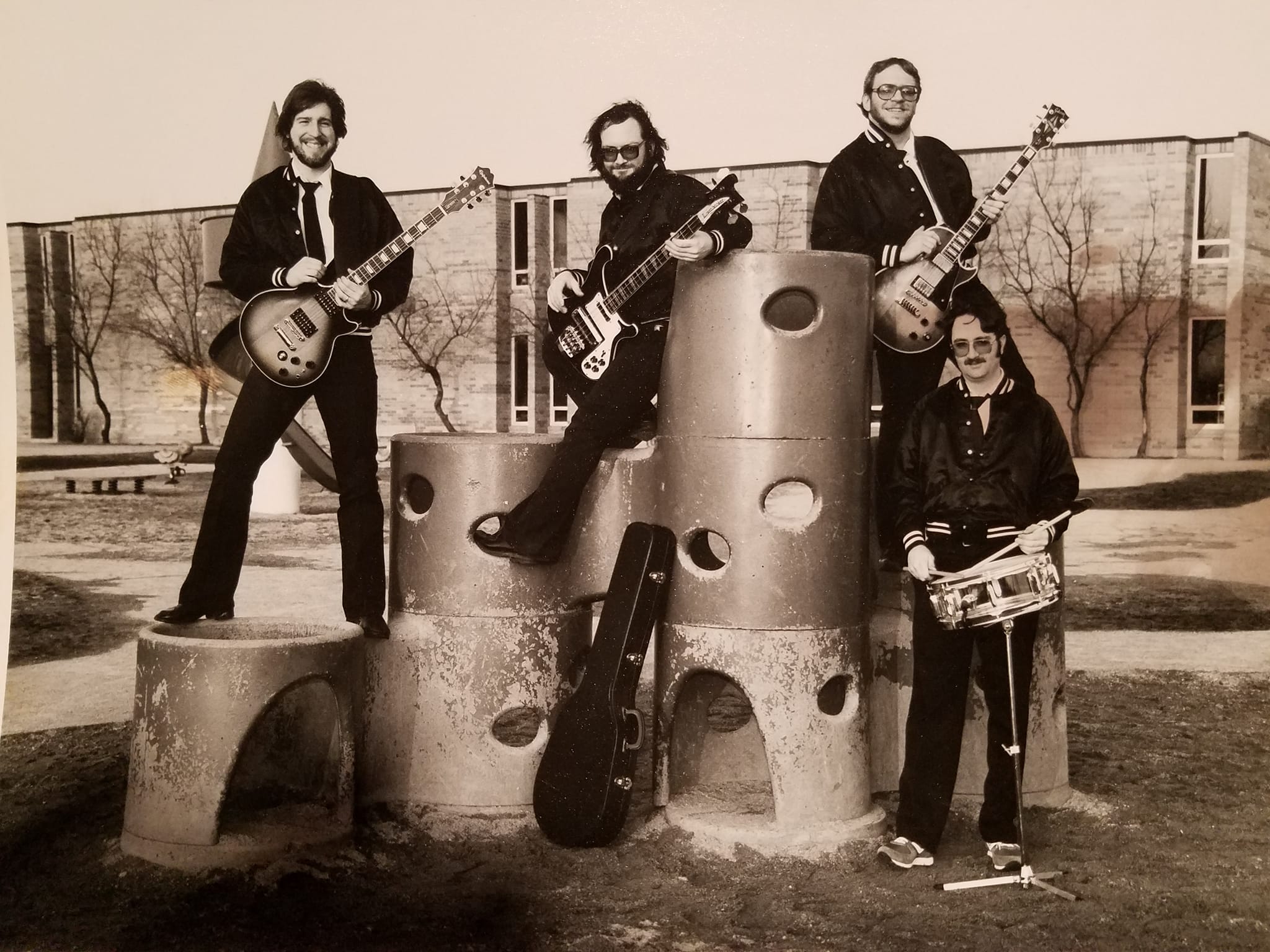
BONUS CHALLENGE: Yes, one of those young fellows up there in the top photo is me. See if you can guess which one and put your choice in the comments below. (HINT: It may not be the one you think.)
The Odds Are Stacked Against You in Fastpitch Hitting
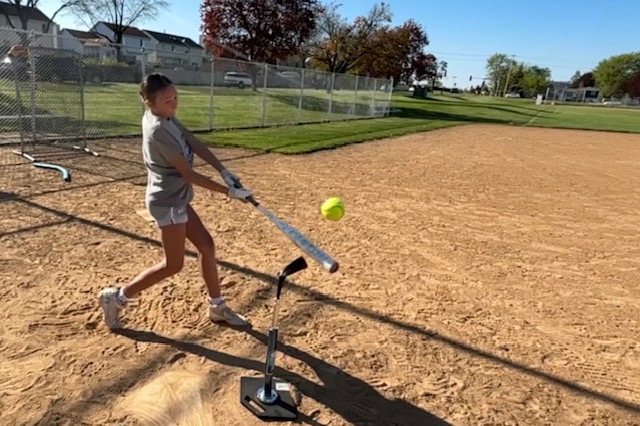
A few days ago I was doing a hitting lesson with one of my students, a young lady named Avery. We got to talking about why the success rate for hitting in fastpitch softball is generally so low.
That’s when she said something profound that her mom Abbey had told her that I hadn’t really thought about in that way: Hitting is 9 on 1.
I think most of us tend to think about the battle between the pitcher and the hitter, i.e., how the pitcher is trying to get the hitter to miss the ball or at least mis-hit if she does make contact so doesn’t go too far. But while the hitter is up at the plate standing alone, the pitcher has one other person in front of her and seven others behind her to help her get the out on that weak hit.
That’s a pretty unfair advantage, don’t you think? Picture a basketball game, or a soccer match, or hockey game, or pretty much any sport where scoring means getting the object at the center of the game into the other team’s goal.
You don’t have to be Mr. Vegas to figure out who is going to win that contest, no matter how skilled the player on the one side is.

Yet when the scoring opportunity comes up for a player in fastpitch softball (or slow pitch, or modified pitch, or baseball, etc.) she’s facing a whole phalanx of opponents whose only goal is to prevent her from achieving her goal. Seems pretty unfair, doesn’t it?
And that’s why the stats of a game, even if kept honestly (versus the person who scores every contact as a hit or anything close as an error, depending on whether his/her team is at bat or in the field), don’t always tell the whole story.
For example, a hitter can slam a screaming line drive directly at the face of the opposing shortstop, who throws her glove up in instinct to protect herself. If said screaming line drive goes into the glove and the shortstop’s palmar grasp reflex (yes that’s a real thing) causes her hand to contract around the ball, the hitter is out.
Never mind that she smoked the pitch that the pitcher mistakenly threw over the heart of the plate. One of the seven fielders happened to be in the way of the ball as it was on its way to being a double and turned that great contact into a drop of a few percentage points in her batting average.
Or what about the well-hit ball to the outfield that goes to the person the other team is trying to hide? She puts her glove up over head to make sure the ball doesn’t hit her, and instead it nestles softly in the web like a bird landing in its nest.

The hitter did nothing wrong, and the fielder, quite frankly, didn’t do anything intentionally right, but the fielder gets high fives while the hitter gets nothing except another ding against her batting average. And those are just the extreme examples.
During the course of the game most times there are seven fielders behind the pitcher, plus the pitcher herself, whose job it is to make sure the hitter doesn’t reach base. And then you have the catcher whose job it is to clean up anything around the plate. That’s a pretty stacked deck.
The only way the hitter can be absolutely assured of not being out after contact is to drive the pitch over the fence. And while the number of hitters doing so has increased dramatically over the last several years, those are still a low percentage of all contacts made.
So the next time you’re wondering why failing 7 out of 10 times at the plate makes someone an all-star, remember that the odds are stacked against the hitter from the beginning. And beating 9 on 1 odds is a pretty good reason to celebrate no matter how it happens.
The Hero’s Journey Always Includes Trials and Tribulations

The so-called hero’s journey is one of the most fundamental tropes in storytelling. In fact, if you line them up in a chart the stories are all pretty similar.
One of the key points, whether you’re talking about Ulysses or Hercules from ancient mythology or more contemporary heroes such as Frodo Baggins, Dorothy Gale (from The Wizard of Oz), Anna and Elsa, or Luke Skywalker, the path the hero must walk is never smooth or easy. It’s filled with trials and tribulations, setbacks and betrayals, dark moments of doubt, and other challenges before the hero ultimately (and often barely) triumphs.
So it’s amazing to me how people think their or their daughter’s softball journey should be filled with nothing but sunshine and unicorns, one success after another without any setbacks or suffering whatsoever. Sorry, it doesn’t work that way.

Even those who turn out to be the highest-level players often tell stories about how they were the fourth or fifth pitcher on their travel team for years, or how they could barely crack the lineup in pool play or their first couple of years of high school ball before they became the player we all came to know. In fact, in real life as in fiction, it’s the trials and tribulations they go through that make them capable of being heroes when the moment arises.
Rather than fearing or avoiding adversity, it’s important to embrace it. It’s a lot easier to weather the next storm (and there’s always a next storm) when you’ve already gotten through the last one.
Besides, if there weren’t challenges and obstacles to overcome that softball journey would be pretty danged boring. There is no triumph with challenge.
In other words, if Frodo could just take a casual stroll into Mordor without all those evil forces pursuing him and putting his life at risk, it wouldn’t be much of a story. It certainly wouldn’t be one that has become beloved and retold many times since it was first released in 1954.

The same with Ulysses and Hercules, which are many centuries older. If they just did what they needed to do without the trials and tribulations no one would be interested in either of them.
It’s the obstacles that make us who we are. For many (me included, by the way), it’s the people who told us we couldn’t do something or weren’t good enough that kept us working harder to prove them wrong.
It’s the times we failed to reach a goal we really wanted that caused us to double down on our efforts and keep working until we got there.
They say that each of us are the heroes of our own stories. Or at least we should be.
If that’s true, remember that your hero’s journey won’t be nearly as interesting or powerful if it’s all sunshine and puppy dogs. While I’m not advising that you seek out problems, I will say they’re going to find you whether you want them or not.
The key is not to be afraid of them or let them take over your life. Even in the biggest slump or lowest points of your life or softball career, remember that you have the ability to overcome whatever difficulties come your way.
Also remember that heroes rarely do it alone. Anna and Elsa had Kristoff and Olaf. Frodo had the Fellowship of the Ring. Dorothy had the Scarecrow, Tin Man, and Cowardly Lion, Luke had Han and Leia, among others.
Let those around you help you through the tough times and keep your spirits up when you feel like giving up. And in the end, remember when you do triumph over all that adversity, the success will be that much sweeter.
Today’s problems will pass. No one can say exactly when, but they will pass.
When they do, you’ll come back stronger than eve, ready to complete your own hero’s journey, whatever that may be. And you’ll have a great story to go with it.
Photo by Alex Kinkate on Pexels.com
The Effect Changing Bodies Can Have on Athletic Performance

No, this isn’t a “Freaky Friday” type of post, although I suppose that type of body changing could be an interesting topic. This is about physical changes with a player’s body.
Back around the fifth grade, most of us learned in health class that as we pass from childhood to adolescence, the hormones in our bodies start to go crazy and major changes begin to manifest themselves. One of the most visible and significant is rapid growth.
A girl who was once a cute little butterball suddenly shoots up 4, 5, 6 inches and becomes a lanky young woman. Another goes from a scrawny flyweight to a muscular middleweight.

Or maybe one day you look and realize the girl who used to have to look up at you now has a significant height advantage over you. (I was going to say looks down on you but, while that is also part of the deal, it’s a separate conversation for another day.)
Sometimes it happens gradually, but more often it seems like it happens overnight. And when those rapid changes do occur, they can have a significant impact on things like balance, proprioception, and coordination – all essential requirements for athletic performance, especially in a precision sport such as fastpitch softball.
Take hitting for example. We all know (or should know, at least) that a big contributor to good hitting is timing. You need to get your foot down on time and your body parts moving in a proper sequence in order to take a round bat to a round ball and hit it square while it’s traveling toward you at a rapid speed and moving (intentionally or unintentionally) in two planes simultaneously.
Sounds complicated doesn’t it? Well, it is.

Now imagine trying to do all that while standing on 4 inch high stilts while having the bat strapped to 3 inch long boards at the end of your wrists. It would be pretty awkward, don’t you think?
Yet that’s what kids who experience rapid growth spurts are going through every time they swing the bat. They used to know where their entire body was in space, including their limbs (which are the most difficult to manage), but surprise! those body parts suddenly aren’t where they used to be anymore.
The result is that hitter has to figure out how to manage this new, sometimes oddly proportioned body in order to achieve the level of performance she was achieving before. And worse yet, those body parts may still be growing, which means she’s trying to adjust to a moving target with runners on base and the game on the line.
And you wonder why she’s struggling some.
The same is true for pitchers and fielders. Things aren’t where they used to be anymore, and until they figure it out performing smoothly and confidently may be off the table for a while.
Another complicating factor is some of this growth may come with what we call “growing pains.” That’s not just a euphemism for the socially awkward teenage years.
It’s a real phenomenon causing physical pain every time they move. One place it shows up a lot is in the legs, or more specifically the knees, with a little gift from nature called Osgood-Schlatter Disease (OSD).
OSD causes pain just below the knee due to an irritation where the tendon from the kneecap attaches to the tibia, one of the bones in the shin. It can cause pain during activities such as running and jumping – or squatting.
Many a young catcher has had to find a new position thanks to a visit from the OSD fairly. And while it will eventually go away as the body settles in to its new configuration, it can take a while. In the meantime many movements that used to be pain-free now come with a cost.
Another thing that can happen during this time of development is what might be characterized as a “thickening” of the body. While your adolescent girl may not gain a great deal more height, especially if she’s not genetically disposed to being tall (thanks mom and dad), her body change from being a little twig to being more, um, stout.
While that will help her in certain ways – thicker muscles will add strength that can make up for a lack of overall size – she’ll still have to learn how to manage that newfound strength so she doesn’t fall into a habit of “muscling up” where she should be remaining loose and flexible. If that thickening happens rapidly it could throw her off considerably until she gets used to her new body.
Then, of course, there’s the elephant in the room for many young women – the development of breasts. That alone can have a serious effect on her movement patterns overall, how her back feels, her posture, her core strength, her flexibility in certain positions and more. And, of course, the larger they are the greater impact they will have on her physically.
All of which explains why your daughter’s or your players’ performance may suddenly go in the toilet for a little while. It’s not that she’s forgotten how to run, or hit, or pitch, or throw overhand, or field a ball.
It’s that what used to work for her body no longer works with the proportions she now has. And until she figures it out her performance may suffer for a little while.
So what can you do as a parent or coach? First of all, understand that his is going on and be a little more forgiving of any performance downgrades.
It’s not that she’s not trying, or is screwing up on purpose. It’s that she honestly doesn’t know how to overcome the situation right now.
Second, you can help her understand what’s happening to her as well. Explain that this is a normal, natural part of growing up, and encourage her to keep working hard. The coordination or balance that has temporarily abandoned her will come back once she gets used to playing as who she is now.
Once you have those parts understood, find devices or exercises or routines that can address the issues she’s having and help her get back on track faster. For example, if she is having trouble with balance get a balance cushion or pad and have her stand on one foot, first with her eyes open and then with her eyes closed, so she can feel her body in space. (The link will take you to a Google search results page.)
Seek out other exercises from professionals as well that can help her. Or you can hire a professional trainer to work with her while she’s having these issues.
If she’s having problems with feeling her body in space, especially her limbs, look into proprioception exercises. A new device from PantherTec called the Kinesthetic Awareness Training (KAT) module can also provide helpful feedback to bring the brain and body back into alignment. (Watch this space for a future product review.)
If she’s complaining about pain, especially in or around her knees, don’t just dismiss it as being soft. Get to your pediatrician have her checked out for OSD or other physical issues. Playing sports can take a toll on the body, and not all problems are the result of a specific injury.
Sometimes it’s cumulative wear and tear, and sometimes it’s something more serious. No matter what, get it checked out and addressed before the body’s instinct to avoid pain starts creating patterns in her movements that are less than ideal.
Finally, don’t assume this is just a preteen/early teen problem. The effects of puberty can last into young adulthood, and many of them can go up and down at different times.
Before you hit the panic button, try to recognize what’s happening physically with your daughter’s or your players’ body and help her address those changes. Because the sooner she is able to deal with how her body feels now, the sooner she’ll get back to performing the way you and she want.
It’s a Short Walk from the Bench to the Stands

Today’s post is primarily aimed at softball players and their parents, although coaches could also learn a thing or two. Especially those who wonder why they keep having trouble filling their rosters.
The basic premise is that whether you’re talking travel ball or even college ball, when you pick a team to play on it’s important to choose one where you might actually play. (High school ball is a separate animal because in most cases where you play is determined by where you live.)
Sounds obvious, doesn’t it? Yet when you look around even casually you’ll see it’s not as obvious as it might seem.

All too often parents will choose teams for their players, or players will make their college decisions, based on the perceived prestige of being there rather than considerations such as “Can I/my daughter actually get on the field?”
Yes, you can enjoy bragging rights for a while. You can get heads to turn when you wear the jersey or other spirit wear and walk into a room of softball people.
But ultimately the shine will wear off (see what I did there?) if you’re not actually on the field playing the game.
Ok, you say, but my goal is to get recruited to a P4 school, and to do that you have to be seen by those coaches. So I need to be on a team that’s playing at (and preferably winning) the tournaments those coaches are watching.
Sure, that’s true. But if you’re not on the field, all the coaches are learning about you is that you’re apparently not good enough to play, particularly when it matters. Do you think that helps or hurts your recruiting chances?
Not playing on Sundays not only means the P4 coaches don’t get a chance to see what you can do. It also means a whole lot of other coaches on other college teams that might have a wonderful opportunity available for you to play and to shine aren’t getting that look either.
No matter what level you’re talking, no college coach wants to take a player sight unseen because their jobs are on the line with every selection they make. They’re not going to make an offer simply because you were on a “name” team, no matter how big the name. If you’re not playing they’re going to figure there must be a reason for it and move on.
At which point you take that short walk from the bench to the next logical step – sitting in the stands while others play the game.
The same is true for playing in college – maybe even moreso. College athletics is about winning, because winning attracts money.

You may dream of playing at the University of Wherever, but if you don’t have a realistic chance of getting on the field, or at least playing an important role, you’re probably not going to be happy with that decision for very long. You need to at least be able to compete for a position.
If you’re simply outclassed by the other players at your position it’s likely your passion for the sport will fade and you’ll be taking that short walk before long.
So what can you do to avoid ending up in the stands before you’re ready for that to happen? There are a couple of things.
To begin with, choose your team wisely and realistically. Take off the rose-colored glasses and do you best to objectively determine whether you can compete for a spot on the field. That includes not only skill level but how set the coach seems to be on his/her lineup. If the same nine are always playing when it counts, regardless of whether they’re performing well or not, you might be better off somewhere else.
If you’re already on a team and you’re not playing, you have two options: get better or get moving.
The first thing you need to do is to look inward and ask if you’re giving everything you have every minute you’re there.
That starts with practice. Are you hustling and working your butt off at practice all the time, or do you take reps off or sleepwalk through certain drills/activities? Are you vocal and enthusiastic, even when you don’t feel like it, or do you it and sulk if you’re not playing regularly?
Coaches notice who wants to be there and who doesn’t, who works hard and who doesn’t. Your effort and enthusiasm are totally within your control, so make sure yours is saying you really want to be there contributing.
You can also keep working to improve your skills. Ask what you need to do to earn more playing time, then work on whatever you’re told until it meets the standard that’s required.
And if you do get that opportunity, be sure you make the most of it to show why you should get more. Otherwise you’re simply reinforcing the coach’s previous decision to keep you on the bench.
The other situation you might face is the realization that for whatever reason this is not the right team for you. At that point, it’s time to start looking at where you might be a better fit.
It could be that your skill level doesn’t match the other players – and never will. It could be that the coach simply doesn’t like you for whatever reason (it happens). It could be any number of things.
If it’s something you can’t change no matter how hard you work, though, there’s no sense staying where you are. Find a place where the team actually needs what you have to offer and then take advantage of that opportunity.
You’ll be happier, and your old team will have the opportunity to replace your roster spot with someone they feel is a better fit for them as well. Everybody wins.
Even great players can find themselves on a team where the path to the stands is shorter than the path to the field. If you’re in that position, don’t sit around waiting for things to get better.
There’s a place in this sport for everyone. Find yours and you’ll be a lot more satisfied with the outcomes.
Bleachers photo by Julion Santos on Pexels.com
Lessons from the Great Wall of China

Pretty much everyone knows or at least has heard about the Great Wall of China. It’s quite the construction feat, running 13,170 miles using materials such as earth, stone, and brick.
While we think of it as one cohesive structure, it’s actually a series of fortifications built by multiple dynasties. While there are no receipts from Lowe’s to tell us exactly how many bricks were used to build it, researchers have estimated it took anywhere from 3.8 to 42 billion bricks/stones to create the incredible wall we marvel at today.
Now think about this: The Great Wall of China wasn’t just plopped in place whole. Each of those 3.8 to 42 billion bricks was laid in place, one at a time, over a period of 2,000 years. All without the help of any modern powered equipment – just hard, backbreaking manual labor from slaves, convicts, soldiers, and random peasants who couldn’t run away fast enough.
And before they could lay the top parts that people walk along and ooh and aah over, they first had to put the ones along the ground in place. And then the layer above that, and the layer above that, and so on.
The same is true for building skills in fastpitch softball (or anything else for that matter, but hey, we’re talkin’ softball here). All too often I see posts on social media from parents or coaches looking to help a player “add 4-5 mph to their pitching speed” or “give a hitter an extra 50 feet of distance on their hits” in the next couple of months.
Sorry folks, it doesn’t work that way, unless their overall mechanics are so bad that any type of guidance will help them overcome some seriously limiting flaws.
The reality is improvement often comes in unnoticeable-to-the-naked-eye increments on a player who is already pretty good. Maybe it’s a slight relaxation of critical muscles that enable a little extra acceleration or a little better positioning of body parts than was achievable before.
Maybe it’s a little extra strength from workouts that doesn’t show up on a force plate or a radar. But it enables a quicker deceleration or a little more efficient transfer of energy from one segment to another or a little faster spin than was happening before that sets a player up for future success.
Stack enough of those little improvements together, one-by-one, and suddenly, before you know it, you have built them into something that will make people say “wow.”

Where it’s different, of course, is that fastpitch softball players can’t bring in a phalanx of slaves, convicts, soldiers, and peasants to do the work for them while they collect all the glory. They have to do the work themselves, repetition after repetition, whether it’s skill work, lifting, speed and agility, or whatever else they need.
The tough part is being patient throughout this process. We all want to see instant results – coaches as much as players and parents.
Again, though, it doesn’t work that way (at least 99.999% of the time). It would be like carrying a bunch of bricks over to where you’re building your wall and trying to stack them all at once.
The result is probably not going to last for nearly 3,000 years and draw visitors from all over the world. In fact, it probably won’t last a day and the only visitor it will draw is the local building inspector telling you to tear it down and try again.
There are no miracle cures or programs that will instantly take a player from zero to hero. What it does take is time and focused work, doing what you’re supposed to do to the best of your abilities each so that over time those individual efforts pay off into a larger, more effective, and more satisfying whole.
So keep stacking those bricks. And be sure to appreciate and celebrate even the smallest victories – even if they’re just a movement feeling better than it did before.
The journey will be worth it when you see the incredible structure you’ve built.
Great wall photo by Ella Wei on Pexels.com
Person First. Student Second. Player Third.
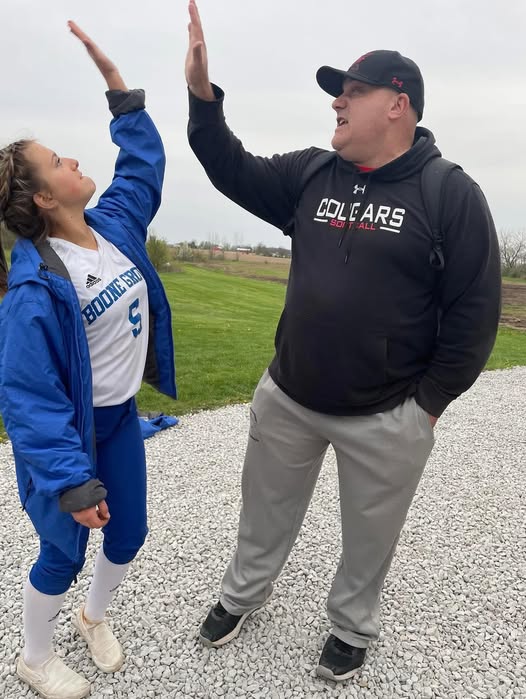
Today’s post was actually written by my partner in podcasting Coach Jay Bolden of Be Bold Fastpitch LLC. As many of you know Jay and i do the From the Coach’s Mouth podcast, where we interview coaches and talk amongst ourselves about all sorts of fastpitch softball and general coaching topics.
You can find it on all your favorite podcast platforms, including Spotify and Apple Podcasts. Ok, commercial over.
A couple of days ago, though, I saw Jay put up a great post on his Be Bold Fastpitch LLC Facebook page, talking about how he approaches working with his students. It was very heartfelt and great advice for all of us to remember so I asked him if I could reprint it here. He, of course, is a great guy so he said yes.
So here’s what he had to say on the topic. He has a lot of great content like this so I highly recommend that if you are on Facebook you give him a follow. And if you’re not, get on Facebook and then follow him. It will be well worth it.

Without further ado, here’s the post:
Let me say this loud and clear…
Person first. Student second. Player third.
Somewhere along the way, youth sports flipped that order — and we’re seeing the damage every single day. Kids tied up in performance anxiety. Kids terrified to make a mistake. Kids who think their value comes from stat sheets, exit velos, strike percentages, and trophy photos.
That’s on us as adults.
If a kid thinks her worth depends on how she plays on Saturday, then we failed long before the first pitch.
Because softball is a chapter in her life — not her entire identity.
Before I care about her curveball, her batting average, or where she hits in the lineup… I care about what kind of person she’s becoming.
Is she kind? Coachable? Honest? Does she show up for others?
That matters more than any tournament ring.
Then comes the student.
Grades, habits, responsibility, learning how to manage real life — those are the things that carry her long after her last at-bat.
Player is last on purpose.
Not because the game doesn’t matter — it does.
But because the game is the platform, not the identity.
We’re not just coaching softball.
We’re developing strong, confident young women who can handle life.
Person first.
Student second.
Player third.
And when we get that right?
The softball takes care of itself.
Train Hard. Play Bold. Chase Greatness.






 Life in the Fastpitch Lane