Category Archives: Fielding
Giving a Little Love to the First Basemen

Have you ever stopped to think about which defensive position in fastpitch softball is the least valued? I think you can make a pretty argument for first base.
I mean, sure, there are plenty of parents who think that playing the outfield (doesn’t matter which specific position) is an insult to their highly talented daughters. Especially in the 10U-14U age groups.
But eventually they come to see that playing the outfield has some pretty unique challenges, as well as that having great outfielders can make or break a team’s success. Game-saving catch or throw, anyone?
There is, however, one position that doesn’t seem to get much love from coaches, parents, or fans in general: first base.
I’ve heard plenty of long-time coaches say that first base is where you put a good hitter who can’t field or throw. Or it’s where you put a left-handed thrower whose parents are complaining about her being in the outfield.
Those who think that way, however, are missing an important point, which is that a great first baseman can make up for some serious deficiencies at other positions.
The most obvious, of course, is when you have a team that struggles to throw the ball accurately. A quality first baseman will snag all those errant throws while still finding a way to either keep her foot on the bag somehow or sweep a quick tag as the runner is approaching first.
I’ve even seen first basemen do the splits trying to pick up a throw going in the dirt. Not consciously, necessarily, but they’re so focused on getting the ball and getting the out they just end up there. It’s quite a sight to see.
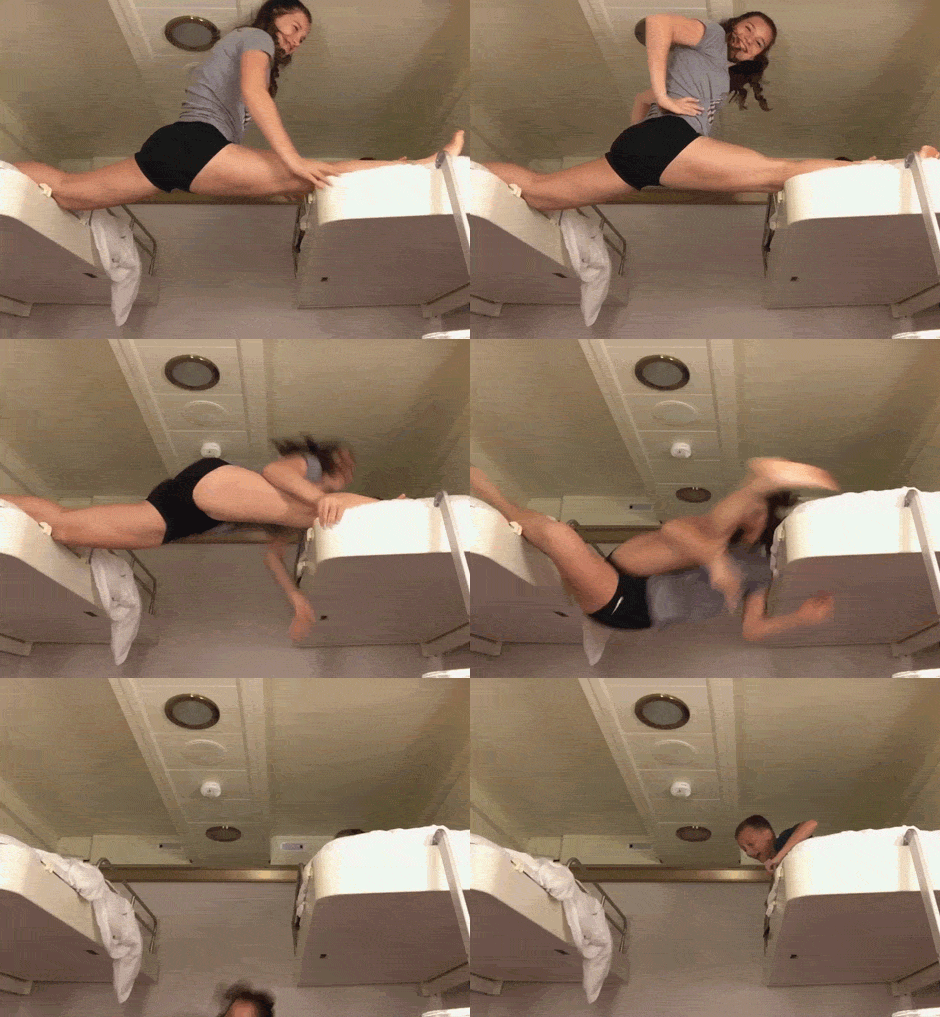
A heads-up first baseman can also save you some runs when another infielder forgets there is a runner on third with less than two outs. A quick snag and throw to home can catch a baserunner who thought she could take advantage of a fielder who either didn’t know or should have known better.
On a dropped third strike first basemen have to know where to position themselves based on where the ball ended up, then have to stand there while that batter/runner charges full steam ahead toward them. That may not seem like too complicated of a play but how many times have you seen it played incorrectly – and had a hitter who struck out reach base instead?
First basemen have to know when to charge a bunt and when to go back to the base. They’re often involved in rundowns between first and second as well as home and third.
They have to know when to go for that ground ball to their right and when to let off of it to cover the base. And they’re often the cut on throws to the outfield, which means they have to understand how to get in position depending on where the ball is hit and then pick out the catcher’s voice from the cacophony of voices on the field, in the dugout, and in the stands telling them what to do.

In other words, it’s more than just standing there playing a simple game of catch on an easy ground ball to short.
Basically, first base is what you might call a “lunch bucket” position because most of the time, if you’re playing it well, no one notices or they take it for granted. Even on some of the crazy stretches or the jump and tags.
But don’t come up with a ball in the dirt and you’re going to hear about how you have to “scoop it.” Come off the bag a little late on a wild throw and you’re going to hear about how you have to come off sooner. Even if the real solution would be a better throw to begin with.
It can be a frustrating for sure. Which is why I thought it might be nice for those first basemen out there to get a little love and recognition for everything they do to basically fix the mistakes everyone else makes.
So here’s to all of you who play first base – a position so under-valued it doesn’t even have a cool nickname. I see you.
Keep doing what you’re doing and saving your teammates’ bacon time after time. You may not get a lot of recognition, but they’ll surely miss you when you’re not out there.
Throw It Like You Know It

So, you’re a fastpitch pitcher and you’ve added a new pitch to your arsenal. You’ve worked weeks, or months, to learn the nuances and perfect it to the point where you throw it pretty reliably in practice.
But then, when you go to trot it out in a game, it turns into a hot mess.
If it’s a drop ball it rolls in like you’re playing bocce ball. Changeups go sailing high and wide, riseballs go over the backstop, and curveballs end up forcing your catcher to lay out after them like a wide receiver catching a pass from the third-string quarterback.
So what happened?
There’s a pretty good chance the problem isn’t from the neck-down; it’s from the neck-up. Because instead of just relaxing and throwing the pitch you practiced, you got nervous that it wasn’t going to work and started tying yourself in knots trying to make sure it did.

How did that work out for you?
That’s why, when you go to introduce a new pitch to your gametime routine, you need to clear your mind of thoughts about it being your first time, you hope it works, it was really bad last time, etc. and just throw it like you know it.
There’s a pretty good chance if you’ve been pitching for a while you don’t think much about throwing your fastball – or whatever your base pitch is. You’ve done it thousands of times by now, and you already know you can do it.
Doesn’t mean it will be perfect every time – no one’s is, not even the high-level pitchers you admire. But you’re not worried because you know if this one doesn’t work quite right the next one will.
Well, it’s the same with a new pitch. Let’s take a changeup.
You told your coach you’ve been working on it and want to throw it this game. You’ve gotten the speed and location to be right in practice but have little to no experience with in games.
When the call comes in, however, your muscles tense, your mouth gets dry, and you start to breathe a little harder and more rapidly.
There’s really no reason for that reaction, however. First of all, hopefully your coach is smart enough to call it in a situation where the outcome doesn’t matter, such as no one on base and you’re ahead in the count 0-2 or 1-2.
At that point, what’s the worst that can happen? You throw a ball and it’s now 1-2 or 2-2. You’ve thrown balls before with the fastball, so why should this particular one be treated any differently?
Oh, but you’re worried you’re going to embarrass yourself by rolling it in or sailing it over your catcher’s head. So what’s the difference here?
The count is still 1-2 or 2-2, just as it would be if you had barely missed the strike zone. No runners advanced, no one walked, a shadow didn’t fall upon the earth, seas didn’t begin to boil, the ground didn’t rupture. no one died. It’s just a ball.

Only now you’ve thrown one in a game, you know a little more what it feels like, and you’ve just taken another step forward in your pitching career. Someday, when throwing a changeup is as natural to you as breathing, you’ll probably laugh about it.
So given all that, why worry about it at all?
The better approach is to pretend like you’ve been throwing this new pitch for years and just chuck it in there – i.e., throw it like you know it. With a more positive approach like that you’re far more likely to have success, and avoid all the negative outcomes you were worried about originally.
By the way, this concept isn’t just for pitchers. Hitters should apply their new hitting mechanics rather than relying on their old ways.
Slappers, particularly converted righties, should go after their slaps as if they’ve been doing it for years. Fielders should try that new sidearm tilted toss as though it’s been part of their routine all along. And so on.
If you take the “throw it like you know it” approach you’ll find you build your confidence quickly and your game will improve exponentially. You’ll also find you’re having a lot more fun in the process.
Efficiency Is the Secret Sauce to Improving Performance
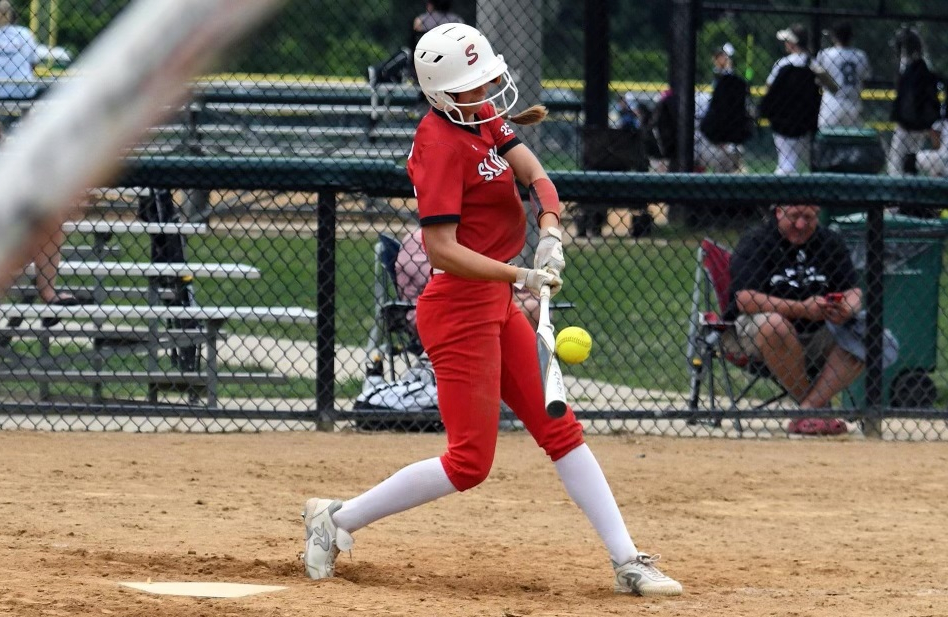
Everyone is always looking for that one magical drill, or technique, or exercise, or something else that will help them improve their level of performance in games.
Building strength is often where players and coaches turn when they don’t know what else to do. And yes, you can definitely drive some level of improvement through strength or speed and agility training. But often the results don’t match the expectations – or at least the hopes.
That’s because there’s another element to the whole process: efficiency, or the ability to improve output without increasing the level of input.
Take a look at these two illustrations. The first one shows a player whose mechanics are inefficient, such as a hitter who only uses her arms or a pitcher who pushes the ball through release with a forced wrist snap.

Let’s say she is working hard but not seeing the results. Increasing her input is only going to raise her performance slightly, because the rather flat relationship between input and output remains the same.
When you have high efficiency, however, as seen in this chart, the difference between input and output is much greater

Both players are putting in the same level of effort. But the second is getting much more out of it. In fact, while the first player’s performance is below the midline of the chart, the second player’s performance is already above it.
Which means if player one wants to reach the same level she is going to have to somehow double her input. Yet if player two only increases her input a little more, her output goes to the top of the chart.
Now, all of the objects and their placement here are arbitrary; they’re not based on a specific set of numbers but rather just an illustration of the principle. But the correlation is real.
It’s essentially a great example of the coaching phrase “Work smarter, not harder.”
When you are inefficient, increasing your effort (strength building, practice time, and so forth) even to a significant level often only results in a small, incremental improvement in overall performance. If you are highly efficient, however, the effect of putting in even a little extra effort is multiplied and you can make significant gains toward your performance goals.
Think of it this way: if you were running a 100 meter dash race with a prize of the latest, greatest smartphone would you rather be on the starting line with everyone else or 10 meters ahead of the pack? I know which one I’d choose.
Being more efficient through mechanics that are proven to be superior gives you that head start on the race to the top. It doesn’t guarantee you’ll stay there – you still have to keep working or the less efficient players could pass you eventually – but having a head start is definitely a significant advantage in anything where there’s competition for success.
That’s why it’s important for players, coaches, and parents to understand what efficient mechanics are for every skill – hitting, pitching, throwing, fielding, base running. There are plenty of great resources out there that can point the way, starting with where you are right now on Life in the Fastpitch Lane.
For pitchers you might want to also check out Rick Pauly’s Pauly Girl Fastpitch website as well as Keeley Byrnes’ Key Fundamentals Softball blog. The Discuss Fastpitch Forum is also a great resource for a wide variety of topics.
Social media sites such as Facebook, Instagram, and YouTube have some great content (along with a lot of not-so-great content so you need to be discerning about who and what you follow).
If you’re not sure if you’re using efficient mechanics right now, a great way to check is to watch high-level college and pro games to see what those players do, and compare it to what you (or your daughter/player) is being taught. If you don’t see the same things, you’re probably not learning efficient mechanics.
All you need is a smartphone and a TV and you can capture your own clips. Throw them in some sort of video analysis software and you are ready to spend hours upon hours going down the rabbit hole. But at least you’ll be informed.
The bottom line is working harder always works better when you work smarter too. Focus on improving your efficiency rather than just your input and you’ll see your output rise dramatically.
Two Hands or One? It Depends

I’m pretty sure every fastpitch softball player ever has been instructed to catch with two hands. This mantra is drilled into them from the first time they put on a glove – and often until the last time.
Yet if you watch high-level players play you will often see players catching with just their glove hand. So which way is correct?
The answer is: it depends.
Sorry to equivocate but there is no “right,” one-size-fits-all answer. Because either way can be right depending on the situation.
Using two hands
When receiving a throw, the two-handed approach is generally preferred if the ball is thrown within the area of the torso. Using two hands helps secure the ball and protects against an error in case it accidentally doesn’t make its way into the pocket of the glove.
Two hands are also generally preferred when a throw must be made immediately following the catch, such as on a potential double play. Catching with two hands means the throwing hand is right there with the glove, enabling a faster transfer than if the throwing hand is somewhere else.
Another time two hands is the way to go is when fielding a ground ball between the feet. Especially if it is bouncing instead of rolling. Using two hands makes it easier to react to the unexpected and still make the play.

In the outfield, players should be using two hands to field a fly ball they are already camped under. I know, I know, lots of MLB players use one hand but keep in mind their gloves are large and the ball is much smaller. Not to mention they are bigger and stronger.
Fastpitch softball outfielders are better served using two hands so they can clamp down on the ball after the catch. Just be sure the throwing hand is to the side rather than helping to close the back of the glove like so many seem to like to do.
Finally, when outfielders are fielding a rolling or bouncing ball with no need to make an immediate play, two hands is the way to go.

Using one hand
It would be safe to assume that any situation that isn’t mentioned above would be better-served by using one hand. And you’d be right. But let’s go through a few anyway.
The first is when the player has to reach for a ball, i.e., ball that falls outside their center mass. Reaching with one hand allows you to reach further than doing it with one hand.
That’s just science. The extra inches gained may make the difference between an out and an error.
This reaching applies not just left, right, and up but also down. For example, an outfielder making a do-or-die play will be better off reaching down with her glove hand only so she can keep moving fast and pick up the ball on the run in order to gain more momentum into the throw. Trying to use two hands will only slow her down.
On ground balls, anything to the right or left will work better with one hand – again because it increases the player’s range. Can’t tell you how many times I’ve seen players try to go laterally with two hands only to see them miss by an inch or two. Maddening!
There are also a couple of positions that are (or at least should be) primarily one-handed. Take first base for example.
While it would be nice if all throws came right to them with time to spare, the reality is that’s rarely the case. First basemen are always stretching in some direction, even if it’s forward.
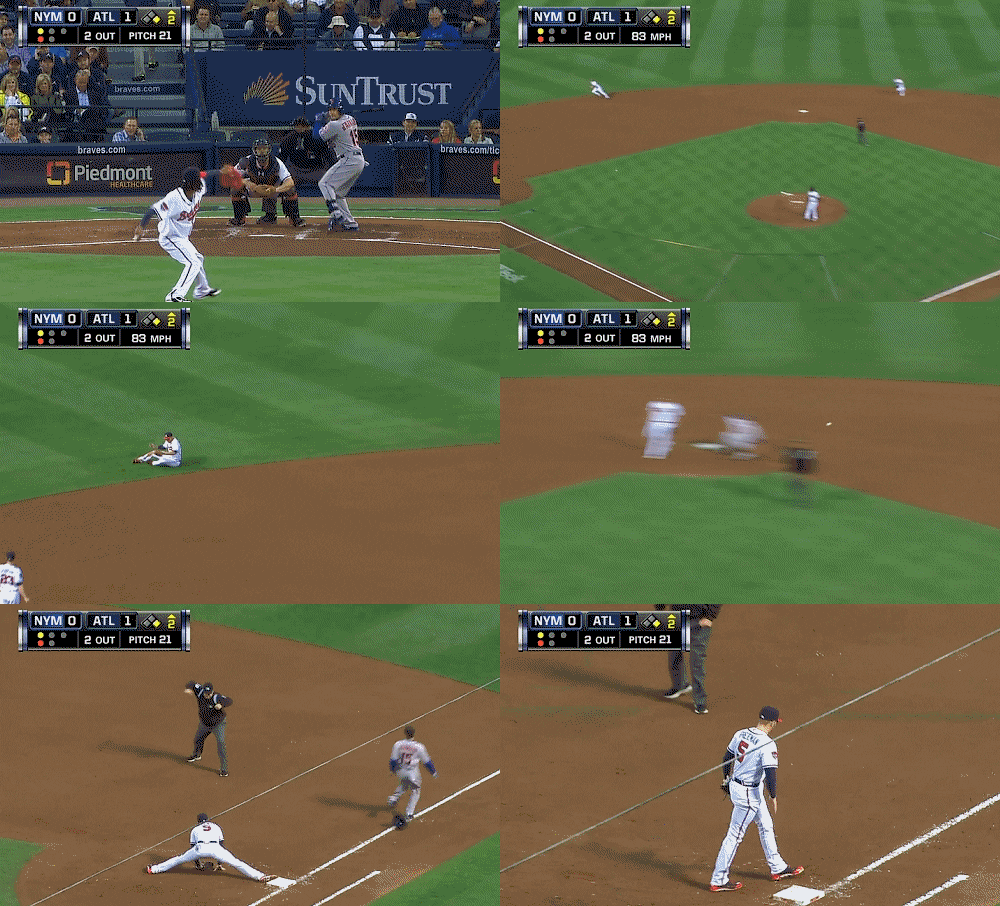
Having a first baseman try to make these catches one-handed is a rookie mistake. Letting them reach with the glove, and throw the other hand back, will help your team secure more outs, especially as the pace of play gets faster. You can read more about that here.
Catcher is another one-handed position, although for different reasons.
Most times catchers are going to try to receive their ball in the center, even if they have to move that center from side-to-side. The issue here is protecting their throwing hand.
Balls deflecting off bats, bouncing off the dirt, or even breaking suddenly all put the throwing hand at first. Sprain a thumb, jam a finger, or even break a bone in the back of the hand and that valuable catcher will be watching from the sidelines for a while.
Learning to receive with one hand while keeping the other protected will help keep that catcher on the field when you need her.
One-handed catching also has the added bonus of reducing the time to transfer the ball from the glove to the throwing hand on a steal.
Catchers who use both hands to catch the ball tend to pause to transfer the ball before pulling it back to throw. By catching with one hand catchers can bring the ball and mitt to the throwing hand, thus making the transfer part of the throw instead of a separate operation.
It’s a difference of hundredths of a second, but those hundredths can make the difference between safe and out. Here’s where you can learn more about one-handed catching.
Bottom line
So you can see there’s no single blanket answer. How many hands to use depends on the position and the situation.
My recommendation is to teach all players to do it both ways when appropriate. And for goodness sake let your catchers and first basemen use one hand even during warmups so they can build that all-important skill.
Learning to Fix One Issue at a Time

Photo by freestocks.org on Pexels.com
One of the best AND worst things to ever happen to fastpitch softball training has to be the ready availability of instructional videos on sources such as YouTube.
It’s one of the best things because it has made a whole world of knowledge available to parents (and coaches) that was never available before. Personally, I think it’s one of the big reasons there is far more parity in the sport than there used to be.
Prior to YouTube, much of the best knowledge was concentrated in Southern California among a small group of coaches. If you were lucky enough to live near one, you received high-level coaching. If you were on the other side of the country, maybe not so much.
But once better information started becoming more available on YouTube (and through the Internet generally), enthusiastic players, parents and coaches were able to learn from the best no matter where they lived. Not saying everyone took advantage of it – there’s still a lot of bad coaching out there – but at least the information became available.
So why do I think it’s also one of the worst things that happened? Because parents and coaches could see how their kids/players looked compared to the examples, and the top-level players, and many became obsessed with trying to get their kids/players to look like the ones they saw on video.
That in and of itself isn’t a bad thing either. But where it became a problem is they wanted to make it happen instantly. So rather than addressing one issue at a time, they started trying to fix everything at once. That is probably the least effective way to learn anything.
What does that mean? Take a pitcher for example. The parent/coach sees the pitcher doesn’t have enough leg drive, so he/she starts working on that. Then he/she notices the arm seems a little stiff. So rather than continuing to focus attention on the leg drive, the pitcher now starts focusing on keeping the arm loose.
Then the parent/coach sees the glove swimming out and… well, you get the idea.
All of those are valid corrections. But it’s difficult, if not impossible to make all of them at once. Or even all in one session.
(DISCLAIMER: I know about this from direct experience because I used to do it too. Probably still do now and then, but I try to catch myself before it gets out of hand.)
A better approach is to set priorities, and then work on those priorities – even if other parts of the skill aren’t up to par. Or even if they are affected by the changes you’re making right now.
The reason is despite all the talk and hype about it, science has shown us that there is no such thing as multitasking. (Sorry all you people who think you’re good at it.)
The human brain can only pay attention to one task at a time. And making corrections to softball mechanics, or anything else for that matter, takes time, no matter how much we wish that wasn’t true.
Enabling players to remain focused on making a single correction, then moving to the next, will produce far better results than trying to fix everything at once.
But what about the discussions on how random practice (doing different things each time) is better than block practice (doing the same thing over and over)? That is true after a certain point, once the player has acquired a certain level of proficiency in the skill. For example, fielding ground balls to the left, right and center, hard and soft without establishing a set pattern will help translate those infield skills to a game better than doing 10 to the left, then 10 to the right, etc.
But that presumes the player already knows how to field ground balls to the left, center and right, hard and soft. If not, the fielder must first acquire that skill, which is best accomplished through repetition and focus.
Giving players who are learning new skills, or replacing old skills with new ones, an opportunity to focus on one specific piece at a time (and without pressure for overall results, such as pitchers throwing strikes or fielders not making any errors) will create a better foundation and ultimately shorten the learning curve. Then, once the player has reached a certain level of at least conscious competence you can start moving into ensuring all the pieces are working the way they should.
Yes, there is a lot of great information out there (and plenty of bad too). And yes, it would be nice if you could just say things once and your kids/players would grasp it all right away. But that’s not how things work.
Avoid the temptation to “correction jump” (the coaching version of task jumping) and you’ll find you produce better long-term results – with far less frustration for you and your kids/players.
To Track the Ball, Think Video Not Photo

While the ready availability of modern technology (think: screens) has given us many marvelous advantages, it has also created some issues. One of the most profound is our increasingly short attention span.
You see it all the time – especially us coaches as we try to explain something important to our players even as we watch their eyes glaze over or pay attention to everything but us after about a minute. (Still, we persist in talking for 10, 15, 20 minutes anyway, especially if we just lost a game.)
That’s bad enough, because of course we’re imparting not just tremendous softball instruction but also life wisdom. 🙂 But where this short attention span can really hurt players is in how they track the ball during the game.
Often it seems like player tend to view the ball (and make decisions) based on a point in time. It’s like their brains take a photograph of where the ball is at a particular moment, then their movements and reactions are based on what they see in that moment.
The problem, of course, is that one point in time doesn’t give us enough information about what will happen going forward. For example, a photo of a player diving for a ball doesn’t necessarily tell us whether she successfully made the catch or not.
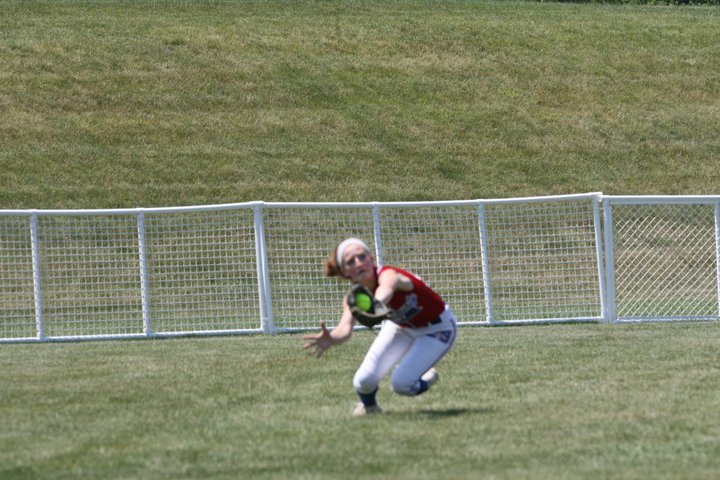
The ball may be in her glove, but will it stay there?
What they need instead is to take more of a video approach, i.e., see the flight of the ball as a series of points moving through space. (For those who don’t know, video is made up of a series of individual photos that play rapidly in succession, creating the illusion of motion. You learned something today.)
This “photographic” approach to seeing where the ball is going hurts several areas. Take catchers, for example.
They see the ball is going down and will need to be blocked. But they don’t wait long enough to see the flight of the ball in space, they just react to wherever it is 10 feet in front of the pitcher.
So they drop to block, only to watch the ball careen past their right shoulders. A little more information and they could’ve centered their bodies on the flight of the ball. Instead, it gets by and a run scores.
Hitters also need that type of spatial information. In fact, they need to track the ball as long as they can to get a feel for whether it will be inside or outside, high or low, and whether it may have some movement to it. All of that information can have a huge impact on when they bring the bat to the ball as well as where they take it to.
If they just take a mental photo they’re unlikely to take the bat to where it needs to go unless they’ve been specifically trained to recognize the ball’s flight earlier. But by tracking the ball through space the way they would watch it come in on video, hitters can make the adjustments they need to achieve greater success.
This principle also applies to fielding ground balls and fly balls. Ground balls can take detours due to field conditions (rock, divots, a lost helmet) and fly balls can go all over the place due to spin and wind. Using a “mental photo” to judge where they’re headed, and then checking out, is a fast track to an error. Seeing the whole travel of the ball, including where it’s going, will be much more effective.
Yes, in our short attention span theater world it gets increasingly difficult for players to learn to focus for more than a few seconds at a time. But if they can learn to watch the video instead of looking at the photo, they’ll be a lot more successful.
A quick rundown on why you should regularly practice rundowns
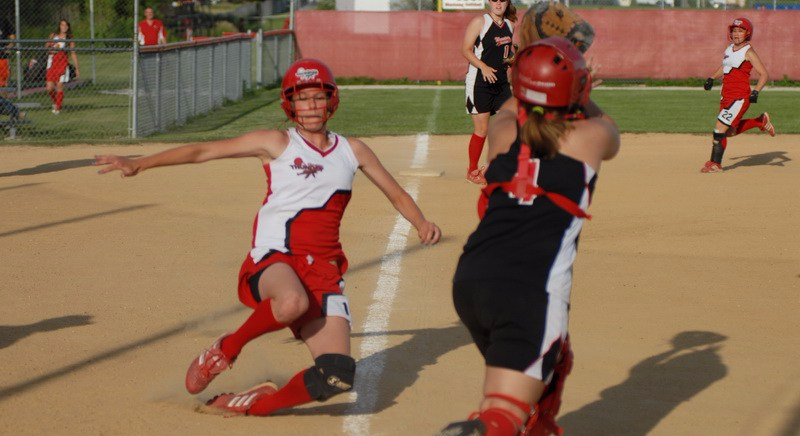
A few years ago, when I was still coaching teams, I heard through the grapevine that one of the parents was griping about how much we practiced rundowns. He was a “baseball guy,” and as such was of the belief that rundowns didn’t happen very often. He couldn’t figure out why we would spend so much time on them.
Forget about the fact that if he’s opened his eyes a little more he would’ve seen that in fastpitch softball, rundowns tend to happen a little more often. It’s a faster game than baseball, with shorter distances between bases (60 feet v 90 feet for those who don’t know) and a smaller field overall.
As a result, baserunning tends to be somewhat more aggressive, and runners (as well as coaches) are more likely to take chances. Especially if they’re not sure they’re going to have many opportunities to score.
But even if that wasn’t the case, there are a lot of other things your team can gain from practicing rundowns other than the specific skill of handling rundowns. Here are a few.
Precision
Rundowns occur over shorter distances overall, and they tend to squeeze in more as they go on. That means there isn’t a lot of room for error. Throwers learn to throw to a specific spot instead of a general direction, and receivers learn to focus intensely – especially when the throw may be coming from an odd angle because the thrower didn’t maintain a good line of sight.
Grace under pressure
This goes along with precision. Things happen quickly in a rundown, and they can go wrong very quickly. If you panic, you’re likely to pull the glove down early and miss a throw, or make a throw you don’t need to make, or hold the ball too long. Rundowns help players learn to handle pressure and stay focused on the task instead of the outcome. By the way, that goes for the person running too. Their job is to stay alive until the defense makes a mistake. Can’t do that if you’re in panic mode.
Communication and teamwork
The ideal rundown has zero throws: the ball gets ahead of the runner, and the fielder chases her down until she makes the tag. But that doesn’t happen too often, so fielders need to be able to communicate effectively to coordinate their efforts. I’m not a believer in the receiver calling “ball” and the thrower holding the ball until they hear that, but if one side isn’t doing their job the other side needs to be able to tell them. Or if the thrower is running with the runner between her and the receiver, blocking the line of site, one of them needs to tell the other to move over so she can see. Or think about a first-and-third situation, with a runner caught between first and second. The team needs to know how to communicate effectively if the runner on third starts heading for home, so the team can break off the rundown on the trail runner and get the lead runner. So much going on!
Conditioning and agility
Yeah, you could have your team line up on the baseline and run a bunch of sprints to build up their speed and recovery time. But why not have them practice rundowns instead? They can get the same level of conditioning – especially if you limit the number of runners who can sub in – and you don’t have to listen to all the complaining. Create a little competition with a prize at the end and they’ll practically kill themselves trying to win. They’ll also learn how to change directions quicker – a valuable skill in several aspects of the game.
It’s fun
When I was a kid, we used to call it “running bases.” Others call it “pickle,” and I’m sure there are other names. But the basic rundown was something we used to do for fun when there weren’t enough kids around or we didn’t have enough time to play a regular game. All you need is a couple of gloves, a ball, something to use for bases, and some space. Instead of treating it like a drill, treat it like a reward – something fun to do at the end of practice.
The beautiful thing is if your team gets really, really good at executing rundowns, they can generate more outs in the field. They’ll look for opportunities, and will be more confident in going after the lead runner in tag situations. On the offensive side, they’ll be more comfortable if they do wind up in one, helping you avoid some outs on the basepaths.
Don’t take rundowns for granted. Make them a regular part of your practice routine and watch the difference they make.
Now it’s your turn. How often do you practice rundowns? How good is your team at executing them? And if you played running bases/pickle as a kid, what did you call it?
What fastpitch softball coaches can learn from HGTV shows

As a fastpitch softball coach , when you’re looking for ways to improve your players, it’s likely you think of DVDs, YouTube videos, books, and sites like the Discuss Fastpitch Forum as your go-to resources. Yet there is another, kind of out-of-the-box option that might help you from a philosophical point of view: HGTV.
No, they haven’t suddenly started running fastpitch softball content there, although that would be nice. But what they do a lot of is shows such as Fixer Upper and Flip or Flop Atlanta that take an older, cramped-looking, out-of-date house and turn it into an amazing showplace home with giant, airy rooms, lots of sunlight and picture-perfect furnishings.
Of course any of you with kids (or who are players who are part of a family) know that about 10 minutes after the cameras leave the new owners are going to crap it up with all kinds of stuff that doesn’t fit the decorating theme laying everywhere. But for those few brief, shining moments it’s practically a palace.
What’s fun about those shows is seeing how they do it. Sometimes the house they finally pick (usually from two or three options) is just old and outdated. It has gold or avocado appliances, yellowing linoleum floors, a bunch of small rooms, a tiny kitchen, etc. Every now and then, though, they get the big challenge – a house where there is actual garbage (or worse) in every room, the siding is missing, the shingles are coming off, the ceiling is falling apart, and there are holes in the walls.
Whatever the current state of the house, that’s what they work with. Just like a fastpitch softball coach getting a player.
The first step, of course, is evaluating what needs to be done to get the house to its ultimate state. Sometimes that just means some tweaks here or there, such as tearing out a wall or two, adding a fresh coat of paint, and updating cabinets and fixtures in the kitchen and bathrooms. Of course, even their “tweaks” cost tens of thousands of dollars.
Other times, however, the only solution is to tear the house down to the studs and foundation, inside and out, and start over.
That’s what fastpitch softball coaches face too. Sometimes a player comes in with a pretty good swing, or decent throwing technique, or a good pitching motion, etc. and just needs a few tweaks to up their game.
Other times, it doesn’t take long to see that a swing looks like an unmade bed (unorganized, no particular sequence or purpose to the movements). Or the throwing technique makes you wonder how they get the ball anywhere at all. Or the pitching motion was learned at the bowling alley.
In cases like that, it’s not time to be shy. You just have to tear it down to the studs and start over.
Of course, just like on HGTV you first have to get buy-in from the owner – in this case from the player. On the house programs, they draw up plans on the computer and show the owners what they plan to do. As a coach you can also use a computer to show examples of high-level players to demonstrate the swing/technique/motion you’re going for.
But you need to go beyond that as well. You need to paint the picture for them in their minds about what their softball life will be like once they make the fix. You also need to explain it’s not something they can master in a week or two.
The HGTV shows are compressed to fit into an hour, but really they’re like a Rocky training montage. A lot of people put in a lot of work to make the changes happen.
In the case of fastpitch softball players, only one person can really put in the work – the player. Can’t subcontract out drills or practice and expect any improvements to be made. Which is another reason the player needs to be on-board.
The climax of the HGTV shows is the Big Reveal – the point where they walk the owners through their new, way better than before home. Many happy tears are shed and high fives exchanged.
The Big Reveal for players is when they finally get back on the field, and suddenly things that were difficult or nerve-wracking become easy and relaxed. Hitters go to the plate with confidence, knowing they can take the pitcher deep. Fielders can make quick, sharp plays and throws because they’re not worried about whether they’ll catch it or where the ball will go. Pitchers can focus on dominating hitters rather than wondering where the ball will go or if it will do what it’s supposed to do.
Take your cue from HGTV. Figure out what your players need to make them showplace-worthy (or showcase-worthy I suppose) and put your plan together from there. If you do have to take one down to the studs, be kind. It will be worth it in the end.
Photo credit: chumlee10 via Foter.com / CC BY-SA
Defense can make a fastpitch pitcher look good – or bad
While it may same rather obvious on the surface, after watching the National Pro Fastpitch (NPF) championship game on TV I thought it might be worthwhile to bring it up again. It, of course, being the effect defense has on making a fastpitch pitcher look good or bad.
(By the way, kudos to my hometown team, the Chicago Bandits, for taking the title for the second year in a row.)
Normally at the NPF level you expect to see a lot of dominant pitching. While the pitching was good in this game, I wouldn’t call it dominant. The definition of dominant being a lot of strikeouts or weak infield hits. 
There were some of each, but there were also plenty of balls that got tagged pretty well; all three runs came off of solo home runs.
So in the absence of huge numbers of Ks, it becomes pretty obvious that the other 7 players who are not part of the battery had to step up to keep this a 2-1 game. If you watched the game you certainly saw that.
Which brings me to my point. The game ended 2-1, but the score could have easily been much higher were it not for some spectacular plays on both sides, both in the infield and outfield.
Those defenders made their pitchers look awfully good. And that’s ok, because I really believe the pitcher’s job isn’t to strike everyone out. That’s just fortunate when it happens. Instead, a pitcher’s job is to induce weak contacts that are easy to field.
In other words, the perfect inning isn’t 9 pitches for three Ks. It’s 3 pitches, all easy popups to 1st base so the first baseman can just pick up the ball and step on the bag if she drops it.
So contrast that defensive performance with others I’ve seen or heard about over the years, where the pitcher does her job. But instead of weak grounders or popups resulting in outs, they result in runners on base because of errors or lack of effort on the fielders’ part.
And what happens after a few of those? The coach calls time, heads out to the circle, and replaces the pitcher (who hasn’t made an error yet). It’s clearly not the pitcher’s fault, but I guess it’s easier to replace one pitcher than four defensive players.
So in the stats as well as in live action the pitcher ends up looking bad. Especially if those errors get marked as hits. (Anyone ever seen a box score that showed one error when you know there were at least 6? I sure have, especially in high school games.)
The thing is, having a porous defense doesn’t just have a short-term effect on the team, i.e., losing a game or a tournament. It also has a long-term effect. Because good pitchers don’t want to look bad, or have to work overtime every game to get three outs. So what happens? Good pitchers will leave, and tell other good pitchers why. Then it gets tough to get good pitchers, so the team has to settle for lesser pitchers, who give up more contacts that turn into even more baserunners. Then you’re in the death spiral.
Here’s another way to think of it. What coach would sign up for a tournament where the rules stated certain teams would be given 6 offensive outs per inning while theirs only got 3? You’d have to be crazy to agree to that. But that’s what happens when the team can’t play good defense behind their pitcher. And that makes it tough to win.
So while it’s easy to blame the pitcher, or give too much credit for that matter, the reality is the better your defense is the better your pitching will look. Just ask the world champion Bandits.
Softball skills are analog, not digital

All of the players, and probably most of the parents by now, are too young to remember when radio dials were analog. Getting your favorite station tuned in was an art. You’d move the dial quickly to get it close, then move it very slowly until it sounded just right. Better radios also had a “fine tuning” knob that let you make smaller adjustments.
Where it really compares to softball is that once you had the station tuned in perfectly, there was no guarantee it would stay tuned in. The analog signal could “drift” a bit, at which point you’d have to re-tune it in. As compared to today’s digital radios where you set the correct numbers and they radio does all the work to lock it in and keep it locked in.
That’s why I say softball skills are analog. It would be nice if they were digital – you tune them in and they stay with you automatically. But the reality is your technique can slip just a bit, especially during the long season when there may not be time to practice and hone things as much as you’d like. You get off a bit, you start to worry and guess at corrections, and before you know it you’re further off than before. Soon it’s nothing but static.
That’s where a little in-season correction can help. Whether you do it yourself or go to see your coach for that particular skill, taking a little time to re-tune the skills can make a huge difference.
The value of using a private coach is he/she can take a look from the outside and compare what you’re doing to what you ought to be doing. It’s a little faster and easier than trying to diagnose it yourself. But the key is that comparison.
If you’re trying to do it on your own, don’t think about what you’re doing. Think about what you should be doing, and try to get back to that. Find the sweet spot on the “dial” and tune your skills to that. Before you know it you’ll be back on track.
Again, it would be nice if softball skills were digital. But they’re not. Everyone needs a little fine tuning now and then. Understand that they’re analog and make adjustments accordingly. You’ll have a much happier season.






 Life in the Fastpitch Lane