Category Archives: College softball
Things To Do While Waiting Out Covid-19

Well, it’s official: the World Health Organization has declared the Covid-19 coronavirus a full-blown pandemic. The cascade effect has been postponement or outright cancellation of college and high school softball seasons, and could have a significant effect on the summer season as well.
(For those reading this post long after March 2020, it should be an interesting time capsule for how things were perceived while we were in the center of it. And much of what I’m going to say here applies to non-pandemic times too.)
At this point it would be easy to say “Aw, the heck with it” (or perhaps something a bit stronger), sit in the house and start power watching Stranger Things or Game of Thrones. Neither of which I have ever seen, by the way.
But you can also look at this extra, unexpected down time as a gift. There is plenty you can do without game or team activities.
And you’ll want to do them, because sooner or later this too shall pass and we will be back out in the sunshine, where we our biggest worry is whether we will knock those base runners in with a hit or get the out to win the game instead of whether we will fall deathly ill and infect a vulnerable family member.
So here are some suggestions on how to turn the currently bad situation to your advantage. Starting with…
Take some time off to heal
These days the softball season (like most other youth sports seasons) seems to run 12 months a year. That leaves little time to let your body rest and recuperate the way it needs to, because it seems like there is always some critically important game or tournament or camp or something coming up.
Well, now there isn’t, and we don’t know when there will be again. So take advantage of it. Take some time off and let your body do its healing thing. If you haven’t had your injury checked out and it’s causing sufficient pain, go visit your doctor. He/she may be thrilled to not have to look at another runny nose or listen to a wheezing cough.

Right now a little ankle pain doesn’t look so bad.
Even if you’re not injured, think about taking a week off just to let your body get some much-needed rest. You’ll be amazed at what it can do for you.
Fix the little issues that make big differences. One thing I’ve always prided myself on is being able to work around injuries to keep players on track. For example, I once gave a few pitching lessons to a girl in an ankle-to-hip hard cast.
Obviously we didn’t work on leg drive. Instead we focused on spins and stability. She sat on a stool and worked on perfecting her change, drop and curve balls.
Once the cast came off, she ended up being ahead of where she had been rather than behind. Shows you the value of narrow concentration.
If you’re a pitcher who has been struggling with whip, this is the perfect time to work on it, because you don’t have to worry about how it will affect you in a game. And if you’re diligent about it, by the time you do have to pitching to hitters again the whip will be second nature.
Or maybe you’re a hitter who tends to dip her back shoulder toward the catcher during her stride, or lets her hands get ahead of her hips. Take the time to fix it now.
Figure out what your biggest single issue is and work on it. If you get it done and the season is still on lockdown, work on another one. Rinse and repeat until it’s time to go play again.
Re-set your mindset
This particularly applies to college players who had already started their seasons. If it wasn’t going the way you’d hoped this temporary shut-down could be the best thing that happened to you (unless you’re a senior, in which case my heart goes out to you).
The first rules of holes is that when you find yourself in one, stop digging. That can be tough to do, however, when you are playing so many games trying to win a conference championship so you can get invited into the post-season tournament.
Now you have the perfect opportunity. First, let go of whatever was bothering you. Leave the past in the past and start looking forward.
Second, and this is most important, use this time to gain some perspective. When you were struggling or even in a slump, it seemed earth-shattering. But it wasn’t. At the end of the day, it was still just softball.
Now you’ve had softball taken away from you as the result of a rapidly-spreading disease that could affect your health (although so far it doesn’t seem likely) or the health of someone you love, like a parent or grandparent. THAT is earth-shattering.
Remember there are worse things than striking out with runners on base, booting an easy ground or fly ball, or giving up a walk-off hit. Like not getting to play at all.
Find the joy again in just being on the field, so when you are you’re able to keep things in perspective – which will likely help you improve your performance.
Learn to think like a coach
Talk to any coach who is a former player and sooner or later you’ll hear him/her say “If only I knew what I know now when I was playing.”
It’s unfortunate, but most of us don’t really put in the effort to really learn our craft until we’re put in a position where we have to teach someone else. It’s then that we decide we’d better know what we’re doing, in which case a whole new world opens up to us.
Why wait until your career is done? Start talking to knowledgeable people, watch video analysis of what top-level players do, check out DVDs from the library (or your coaches) and find whatever other information is available to you.
Sure, some of it is going to be garbage. Maybe a lot of it, especially random clips on YouTube. But if you compare what you’re seeing to what high-level players do you can start gaining a better understanding of what you should be doing so you can apply it to your own game.
Share what you know with younger players
You don’t have to go into full-on coaching or instructing. But if you’re hanging around somewhere and you run across a younger person who wants to learn a skill you know, take some time to share it with them.
Remember, when one coaches two learn.
Clean your stuff
Don’t just wash your uniform. Take the time to really do all you can to get the dirt, blood, grass and other stains out of it. Especially the white stuff. Fels-Naptha Laundry Bar and Stain Remover, which is available at most hardware stores as well as online, is great for that.
Clean the dirt out of your cleats, and wipe down the top parts. Maybe even polish them so they look great. If you have broken shoelaces now is a good time to change them.
Clean your glove with leather soap or saddle soap and put some conditioner in it. (Not oil, because that will make it heavy, but more of a paste-like conditioner.) If necessary, this is a great time to get it re-strung.
Wipe down your bat with soap and water. Remember how proud you were when it was shiny and new? See if you can feel like that again.
Give your batting gloves the sniff test. If you can do it from across the room it’s time to either try soaking them in laundry detergent for a bit or get a new pair.
And for goodness’ sake, clean out your equipment bag! Take everything out of it, including the 300 empty or partially empty water bottles crushed at the bottom of it, dump out the dirt, take a clean cloth and wipe it out, inside and out. Then, when you go to pack it up again, KonMari that sucker and only put things in it that make you happy.

Yes, these bottles.
Stay positive
Things may look bleak right now, but they will get better. Best thing you can do is remain positive, because sooner or later (hopefully sooner) softball games will start to be played again and life will return to its hectic normal.
Sick person photo by Polina Tankilevitch on <a href=”https://www.pexels.com/photo/woman-in-blue-sweater-lying-on-bed-3873179/” rel=”nofollow”>Pexels.com</a>
Be As Water

Photo by Pixabay on Pexels.com
One of the most well-known pieces of advice from the late, great Bruce Lee was a simple three-word statement: be as water. For those interested in more of what he meant, or who are just wondering who the heck Bruce Lee was, here’s a video:
While Lee’s advice was ostensibly meant to encourage martial artists to give up their old, rigid approach to movement in favor of one that was more free-flowing, I find it’s also great advice for fastpitch softball players. Here are a few examples.
Pitchers
When pitchers want to throw harder, they tend to tighten up their muscles and become very stiff. They also do it when they’re trying to guide the ball to a location (even if it’s just the general strike zone). Yet that’s the worst possible thing to do in each situation.
If you’re trying to gain speed, remember tight muscles are slow muscles. You can swing your arm around much faster if you relax and let it go versus trying to force it around.
Being stiff when trying to gain better control also works against you, and actually makes it more difficult. If you are tight and off-line somewhere in your circle, you will stay there and the ball will go somewhere you don’t want it to.
But if you are loose, a gentle nudge is all it takes to get back on-line. Plus, you have momentum working for you, because if you are loose and using good mechanics (i.e., those that follow the natural way the body moves) it’s a lot easier to follow the natural line.
To improve as a pitcher, be as water.
Hitters
The same things about tight versus loose apply to hitters. If you try to muscle up on the ball you’ll lose the whipping action of the bat into the hitting zone, costing you valuable bat speed.
Being tight also makes it difficult to react and adjust to pitch speeds, spins and locations. A rigid swing will tend to continue going wherever it started to go; a relaxed swing allows you to make adjustments without losing bat speed.
Then there’s the mental aspect. If you are uptight generally (aka in your own head) you are going to be worried about far too many outside factors, such as your last at bat or the fight you had with your mother before the game, to bring your swing thought down to “see ball, hit ball.”
There will be no flow to your swing, just a sort of panicked flail as the ball comes in. You may even start seeing things that aren’t there, or lose your perspective on exactly where the strike zone is. Much can happen.
To improve as a hitter, be as water.
Fielders
As a fielder, you want to be able to move smoothly to the ball. You want your throws to be easy and sure.
That’s going to be tough if you are tight and rigid. The word “flow” is frequently used to describe a great fielder. And what water does.
Being rigid or mechanical in your movements is a sure ticket to many more errors than you should be making. And if you are that way because you are AFRAID of making errors and being pulled out of the game, it only gets worse. Forget about all that.
To improve as a fielder, be as water.
Approach to the Game
Perhaps the area Bruce Lee’s advice applied to most is your general approach to the game. In the video, he says that if you pour water into a cup it becomes the cup. If you pour it into a teapot, it becomes the teapot.
Fastpitch softball players need that type of flexibility as well. You may be asked to play a position that isn’t your usual one. You can either resist or go with it.
Yes, playing outfield rather than catcher or shortstop may not be your preference. But if you go with it and prove yourself in the role you were asked to play you are far more likely to get the opportunity to show what you can do in the position you want to play. I’ve seen it happen.
You may not like your coach’s coaching style. Understood – there are some bad coaches out there. But often it’s not a matter of good or bad, it’s just different than you prefer.
Rather than bracing yourself against it like a rock, be as water. Adjust your expectations and get as much as you can out of the experience. Everyone has something to teach – even if it’s just not to be like they are in the future.
You may not be getting the playing time you want or feel you deserve. That may be true. But before you just blame the coach and jump ship, ask yourself if you’re doing all you can do to earn the spot you want.
Are you diving for balls in practice? Are you displaying a positive attitude? Do you go to the weight room, take extra batting practice or bullpen work, ask for one more ground ball if you pooch one in practice, help clean up team equipment at the end of practice or a game, etc.?
Maybe the answer is yes and you’re just not getting a fair shot. It happens. But before you decide that, determine whether you have been trying to shape yourself to the program the way water shapes itself to the cup or wishing the program would shape itself to you.
Final Question
So after all of this, if I were to ask you which is stronger, the rock or the water, what would you answer?
Many would say the rock. Not a bad answer on the surface, because if you place a rock in a stream or river, the water will be forced to go around it.
Over time, however, the water will wear away the rock and any other obstacle in its path until it can once again flow smoothly.
So I ask you again: which is stronger, the rock or the water?
Be as water, my friend.
Congratulations to Allison Musgrove for Signing at Marian University
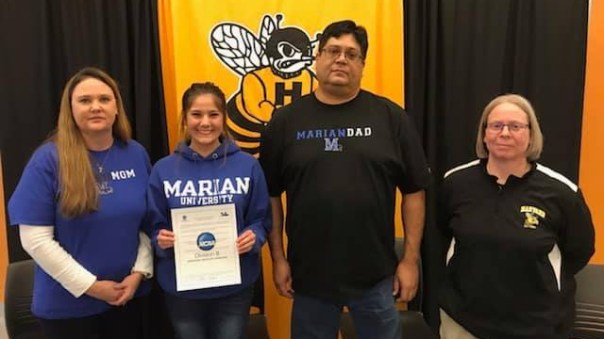
This is the type of post I always love to write because it means someone has fulfilled a goal. So today I want to take the opportunity to congratulate Allison Musgrove, who plays for Harvard High School and the McHenry County Heatwave, for officially signing to play softball next year at Marian University in Fond du Lac, Wisconsin.
Allison is a terrific pitcher and hitter. Although she isn’t very big, her pitches and bat pack a wallop!
Unlike many of my students who start with me young, Allison was already in high school when we started working together. Her former pitching coach (whose daughter I also taught back in the day) had left the area and she and her parents Vern and Crystal were looking for a replacement. Fortunately they were given my name.
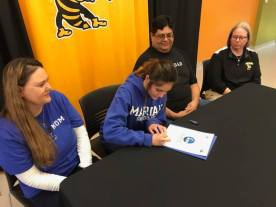
Mom and dad are all smiles.
One of the fun things is Allison and I hit it off instantly. We bonded on our love of Star Wars, comic book characters (she is a huge Marvel fan) and other nerdy pop culture.
I love the fact that when I made one of those references, either to illustrate an instruction point or just in general conversation, she actually got it without explanation. Still need to get her watching the DC TV shows on the CW, but all in good time.
Allison has always had a tremendous work ethic to go with her talent, which makes lessons fun. She pays close attention and works hard at the things I assign her.
She is also a perfectionist, which can work against her at times, leaving her frustrated when something doesn’t come right away. But she pushes through it, largely because she has such a great attitude. Even when she is having a little trouble it doesn’t take much to get her to smile again.
Of course, a lot of that is due to tremendous parenting. Both Crystal and Vern are always there with words of encouragement and support. They raised a polite, respectful, yet fun daughter who can take some ribbing and give it right back.
One of my favorite success stories is about her hitting. Originally I only worked with her on pitching. But one day she asked if we could work on hitting too since she’d been struggling.
We worked on her hitting and it started to come around. First with some hard outs, then singles here and there, and finally consistent hits with extra base hits, including a few home runs.
Allison has come a long way since we first met. Marian University has definitely made a smart decision in signing her.
I wish her luck, and am letting her know publicly that Fond du Lac isn’t that far from home for me. I plan on coming out to see her play in 2021 – but probably not until toward the end of the season when the weather is hopefully a little warmer.
Congratulations, Allison! You earned it!
My Advice to Softball Parents: Lighten Up, Francis

Anyone who has seen the movie “Stripes” knows the reference in the headline. If you’re not familiar with it, it’s a great scene where the new recruits are just getting to know each other, and one of the guys starts a serious rant about what he’ll do to the others if they call him Francis instead of Psycho, or do some other stuff. His drill sergeant, Sgt. Hulka, is not impressed. You can see a condensed version of this very funny scene here:
So why am I bringing up this random movie reference? Because it seems like there are more and more parents these days who could use Sgt. Hulka’s advice.
While it doesn’t always hold true, it does seem like the craziness of parents today is in inverse proportion to the age of the players. In other words, if you really want to see crazy, check out a 10U game.
Not sure why that is. Maybe by the time players get to 18U the parents have figured out that the outcome of a softball game isn’t worth risking a potential heart attack and have mellowed out. Or maybe all the players with crazy parents have been weeded out, or have told their parents, “Hey, I’ll drive myself to the game, why don’t you see if you can find a hobby that makes you less likely to find you sitting in the parking lot dashing off angry emails to whoever will listen?”
Of course, that’s not to say you don’t see that behavior at the older ages. I have been at D1 college games at major schools where parents are yelling things from the stands at the umpires, and the coaches, as though there were still back playing rec ball. But that’s more the exception.
Here’s the thing, though. All that crazy yelling and stomping around and getting into fistfights is really a waste of energy.
I know all this stuff seems critically important at the time. Especially today, when so many parents believe their daughter is D1 athletic scholarship material and don’t want any idiot umpire/coach/league administrator/whoever screwing up her chances.
Really, though, it’s not. I’ve been involved in fastpitch softball for more than 20 years. I had two daughters play at some level from the time they were 10 until they left high school. I’m sure I got worked up pretty well from time to time myself, although I did manage to keep my crazy in check as I recall.
But whether things went well or not during a game, none of it really mattered in the big scheme of things. My daughters played, then they didn’t, then they want on to become fine human beings and productive members of society. Even if some blue was occasionally squeezing the zone on them.
If you really want to see how crazy it is to let the crazy out, try this experiment. At your next tournament, go watch two teams you couldn’t care less about play. Sit or stand somewhere you can hear the parents and watch the same game they’re watching. Then count how many times people get angry about something that just makes you shrug your shoulders.
The reality is, a softball player’s career is short, which means your time to enjoy watching your player(s) as a parent is short. It’s not life-or-death. It’s just a game.
Next time you feel your blood beginning to boil and the urge to express yourself loudly, just remember the immortal wisdom of Sgt. Hulka: Lighten up, Francis.
Kids Are Not Just Short Adults
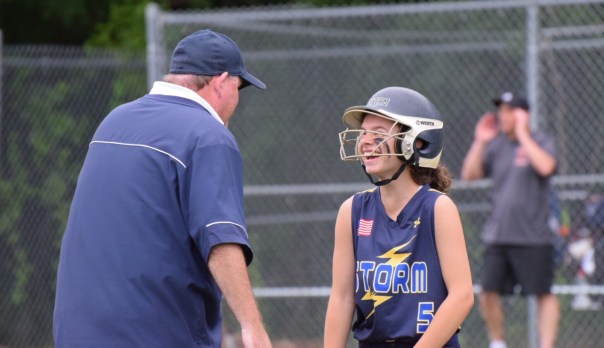
Today’s topic could also fall under the category of “Why your team doesn’t look like the ones you see on TV.” It’s definitely something to keep in mind at any time of the year, but especially as travel ball and rec teams swing into the heart of their seasons.
The idea that kids aren’t just short adults is not original to me. I heard it somewhere a few years ago. But I think it’s a topic that bears repeating often.
One of the toughest challenges coaches face is getting their teams to perform the way they want. There can be all sorts of reasons for it. But in my experience, one of the most important is that coaches often view their players, especially the younger ones, through the wrong lens.
As adults, coaches tend to think like adults. Well, most of them anyway. I’ve certainly seen plenty of tantrums on the field that would make a two-year-old jealous.
Going beyond that, however, what I mean is by the time you qualify as an adult in the eyes of the law you have gained a certain measure of experience and knowledge. You have learned how to control your body. You have learned how to focus when you need to, and when you don’t feel like it, often driven by the need to remain employed.
Kids often have none of that – or at least not enough of it. They don’t have the perspective adults have. They may not know how to sort through overwhelming or conflicting information to determine what is most important. Their bodies are growing and developing, and doing all kinds of crazy things to simultaneously freak them out and embarrass them.
Many haven’t fully developed the fine motor skills that allow them to make subtle adjustments in the way they do things. In our screen-driven age their ability to focus is probably the lowest it’s ever been.
Yet coaches often disregard all of that when they approach their players. They expect to be able to tell them something once, or maybe twice, and then see it executed perfectly on the field. Not gonna happen.
Reality in expectations
To get the most out of your players, it really helps to try to understand where they are in their development, both physically and mentally. Take pitchers, for example.
When you watch on TV, you’ll often hear the announcers talk about pitchers always hitting spots with pinpoint accuracy. First of all, if that was actually true there probably wouldn’t be nearly as many home runs, doubles, or triples as there are today. College pitchers miss their spots all the time. Either that or the coaches calling the games aren’t very good at their jobs. I’m pretty sure I know which one the coaches will tell you is correct.
But even if it were, the minimum age of the pitchers you’re watching is 18, and more likely somewhere in the 20-22 range – especially as we get to the Women’s College World Series. If you’re comparing a college senior to a 12U pitcher, that’s a 9-10 age difference, and probably a 9-10 year experience difference. Imagine how much better you could get at anything with another 9-10 years of experience.
Even a 14U pitcher and a 19 year old college freshman likely have 4-5 year age and experience difference between them. And that’s not even counting the countless hours of practice mandated to that college pitcher, and the high-level conditioning, and everything else that goes into it.
Yes, they may be doing the same things. But your player isn’t just a shorter version of what you see on TV. There are plenty of differences under the hood.
Development v. results
Another difference between adults and kids is their expectations from the experience. Coaches want to win – some more than others. Kids want to experience the game.
Part of that is the old “have fun.” But there are different ways to have fun. In my experience, what they want most is to have the opportunity to play and then to do well when they get it. Basically, like all of us they want to feel good about themselves.
They may not realize how much work it takes to get good. But they’ll never figure it out sitting on the bench game after game. Nor will they feel very good about the game or the team, even if the team is winning all the time. They don’t think that way.
In my opinion, at the younger ages – say, up to 14U – the goal should be player development. That means helping kids learn and putting them in a position to succeed. Not just for one game during pool play, but every game – as long as the player is willing to learn and making the effort to improve.
Yes, that philosophy could cost you playing in the championship game of your local 10U B tournament. It could even mean getting eliminated early on Sunday. But so what?
No one but you, and maybe a few fanatical parents, cares about winning that particular tournament. That doesn’t mean you should go crazy and put a kid who’s never pitched before in the circle in a bracket game. But you can certainly give that kid an opportunity in mid-week friendly if she’s been working at learning to pitch. And put her somewhere else on Sunday for at least part of the time.
I know on TV there are starters and role players. But those college players are there for entirely different reasons. Up to 14U, again in my opinion, your job is to develop players, not necessarily win hardware. Do it well, and you’ll find you win a lot more hardware when it means a whole lot more. As President Lincoln said, “No man is so tall as when he stoops to help a child.” Or woman.
Appreciate them for who they are
We have certain expectations for adults, in the way they interact with us and the way they react to things. Most adults learn to mask their true feelings and thoughts, either as a way of fitting in or avoiding problems.
Many kids haven’t learned that skill yet, at least not fully. I’ve worked with young pitchers who seemingly had a whole circus going on in their heads. It would be easy to get angry or frustrated by it.
Instead, I’m amused. Mostly, anyway. It’s amazing to see someone so unencumbered by what they are “supposed” to do, and just living their lives happily.
That doesn’t mean they didn’t put in the effort – they did. It just didn’t look like the way an adult would do it. As I saw it, my job was to change the way I communicated with them to deliver information in a way they could accept, not the way I wished they would accept it.
And you know what? It did get through, because when they got on the field they were able to perform the skills just fine. Maybe not with the precision of a D1 athlete. But with plenty of skill for their 10U travel team or their rec league.
Instead of trying to get them to see the game through your eyes, try to see it through theirs. It will help you relate to your players better. And honestly, you’ll find you age a whole lot slower than others who insist on adulting all the time.
Oh, and by the way, that’s a lesson a lot of college coaches could learn too. Instead of trying to fit everyone in the same box, let them be who they are, even if it’s quirky. I find people of all ages are far more willing to run through a wall for you if you meet them on their terms rather than trying to force them to be who you want them to be.
What taking personal responsibility looks like
In my last post, I talked about the need for players to take personal responsibility when it comes to playing time. The idea is to control things you can control, like your effort, being on time, always being prepared, keeping a positive attitude (yes attitude is a choice), etc. rather than focusing on factors such as whether the coach likes you, or politics are at play, or things like that.
That’s great in the abstract. You’ll hear that sort of thing all the time. Here’s a great video of UCLA head coach Kelly Inouye-Perez talking about how she observes (and ultimately judges) players.
But how well does it work in real life? Let me share a story with you about a college player who has worked her way into the starting lineup by following these principles, and then taken the maximum advantage of that opportunity.
Her name is Taylor Danielson, and she is a freshman at the University of Indianapolis (UIndy), one of the top D2 softball programs in the country. Longtime readers know I’m a big fan of Taylor’s, and have been for a long time.
Taylor is a catcher, and a terrific one. That’s what she was recruited for at UIndy, and eventually I think she’ll wind up behind the plate.
But to start her freshman season, UIndy already had someone in that position they liked. Rather than complain that life is unfair, or get angry that she wasn’t “being given a fair chance” like many people would, Taylor kept working hard and getting herself ready for whatever opportunities she did get.
It didn’t take long. The coaches liked what she was showing in the batting cage, so they decided to see how the freshman would handle the jump to college pitching. They made her the DP, which meant she hit but didn’t play the field.
After a “close but no cigar” start, Taylor started ripping into the ball, becoming a significant contributor on offense. You can check out her stats here. As of this writing they’re pretty impressive. Or you can just check out this video.
If nothing else, it definitely demonstrates that if you can hit, the coach will find a place for you in the lineup.
Next, the coaching staff decided to see what she could do on the field. She’s done a little catching, but most of her innings have come elsewhere. So far this season she has started in left, right, and at second base. (Again, this is after being recruited as a catcher.)
Basically, rather than worrying about what SHE wanted to do, Taylor took the mindset of “whatever you need, I’m there.” In fact, as she started to gain innings in the outfield she asked the coaches if she could take extra practice time with the outfielders to make sure she was ready.
So, you may wonder how she made such an impression. I recently had the chance to watch her play and can tell you one of the factors.
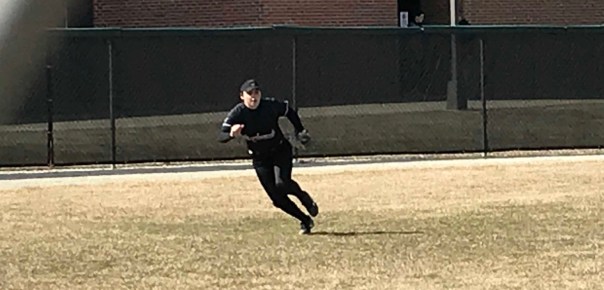
Taylor was in left on a chilly day. There wasn’t a lot of action out her way, but every now and then a hitter would get around on a pitch and pull it foul down the left field line.
Most players probably would have jogged after the ball to retrieve it. No one would blame them either. But not Taylor.
Instead, she sprinted after every one of those obvious foul balls as if the game was on the line. There was just a joy about her, that she had this opportunity to play the sport she loved. Although there is also a school of thought that says it was a convenient way for her to raise her body temperature a bit in the cold and the wind. 🙂
Now, it is possible to put in all that work, hustle, be a good teammate and all that and still not have it work. My next post will talk about a situation where that scenario did occur.
But in the end, you want to know you did everything you could to be successful. If you’re going to fail, fail doing your best.
Taylor took her best shot, and it has paid off bigtime. Perhaps you can generate similar results.
Product Review: Softball Bound app makes the college search easier

Unless you are one of those incredibly talented players who has famous softball coaches going out of their way to plan their weekends around watching your 12U/14U games, you’re probably going to have to devote a considerable amount of time researching potential opportunities and looking up the contact information for the coaches at schools you’re interested in.
Now a new app called Softball Bound, which is available for the iOS and Android platforms, has made that part of the process a whole lot easier. Rather than having to spend hours looking up each school individually, and then clicking through to gather information about it and the softball program, Softball Bound puts all that information right at your fingertips. In fact, according to the counters on its website, it provides info on 996 NCAA and 196 NAIA 4-year institutions.
Finding the right schools
The interface is simplicity itself. The default view takes you to an address book-like listing of colleges, starting with the As of course.
Down the right hand side is the entire alphabet, so you can click on a letter, based on the first letter in its name, and be taken right to all the schools that begin with that letter. So if you want to look up Baylor, you click on B and scroll down. For University of Whoever you click on U, which is probably more intuitive in the long run.
That’s not your only option, however. A little filter icon in the upper right hand corner lets you narrow down your choices by Division (NCAA 1,2, and 3, plus NAIA 1 and 2), Conference, State, or any combination of all three. If you have your heart set on  playing NCAA Division 1 in Tennessee, you can find all the schools that meet those criteria.
If you know exactly the school you want to look up, there’s also a search function. (You can only look up colleges, not coaches or conferences; use the filters for that.) The search function is intuitive, so as you type in your choice it starts showing suggestions.
Core information
Once you’re into a specific school there is a tremendous amount of information. The topic section offers the school’s name, address, and general website. The second section provides the name of the coach (usually the head coach, but sometimes an assistant who is involved in recruiting), along with the coach’s email address and phone number.
These are active links, so clicking on the email address or phone number will start an email or make a call, respectively. You will want to handle that with care. On the other hand, think of how impressed a college coach will be if 10 minutes after a game is over you send a messaging thanking him/her for stopping by to see you.
There is also a link to the softball team’s website so you can easily learn more about the program or do your homework before you contact the coach. Never hurts to start an email or a call by congratulating a coach on a recent win, conference championship, or personal milestone.
Deeper details about the institution
Where Softball Bound really shines, however, is the additional information it gathers. The bottom section offers a wealth of statistics about the school, such as undergrad enrollment, the average yearly cost, graduation rate, and average salary after graduation. It also helps you determine whether you have the academics to qualify by offering the average SAT and ACT scores for students at that institution.
Be aware you have to scroll down to see all of the information. The basic school and coach information stay on the screen permanently, but you can scroll through the bottom section to get the rest.
The only negative I found was that I couldn’t read some of the information on my iPhone. If the line is too long it just disappears. Hopefully the developers will be fixing that, because knowing how much money the average salary after graduation or the freshman return rates could be very valuable in helping you narrow your choices.
Carrying relationships forward
Once you’ve made your selections, you can “favorite” them. They then appear on a short list so you don’t have to go through the entire search process each time. As you refine your list further you can remove schools with a click of button as well.
As you build the relationship with different college coaches you can also ask Softball Bound to add them to your regular contact list so you can call or email the coach without having to go into the app. That’s also a very handy feature.
One of the other advantages of the Softball Bound app is they are constantly updating the contact and other information, which means you don’t have to worry about working from an outdated list.
On the website, they also offer the option of purchasing their list for $250. Not sure why you’d want to do that, especially since college coaches frown greatly upon mass mailings. It’s much easier to just purchase the app for a few dollars – especially because if you buy the list it’s up to you to maintain it. Sounds like a lot of unnecessary work to me.
A wealth of helpful, additional information
Speaking of the Softball Bound website, they have more than just product information there. They also have a list of camps you may want to attend, as well as information about the academic side and how to get ready for college. Plenty of links to info on testing (SAT and ACT), creating a skills video, eligibility and so forth. It’s all freely available to anyone and worth checking out.
If you’re actively pursuing playing fastpitch softball in college, or even thinking you might want to, this app is definitely worth it. Especially at $3.99 in both the Apple App Store and Google Play. It can save you a lot of time and effort, and give you a tremendous advantage in your recruiting efforts.
NFCA to NCAA: Make us stop!

By now you’ve probably heard that at the recent National Fastpitch Coaches Association (NFCA) convention, D1 softball coaches finally stepped up to take a stand against early recruiting.
It wasn’t quite as strong as those coaches saying “For the good of our sport and the prospective student athletes we hereby all agree to VOLUNTARILY stop offering verbal commitments to 7th graders.” But it was a start.
If you don’t feel like following the link, essentially the D1 softball coaches have asked the NCAA to impose a rule that says they can have zero recruiting contact with any player until September 1 of that player’s junior year. That would mean the coaches can’t have any recruiting contact at tournaments, at their own camps, or anywhere else.
If a player calls or email the coach, the first question should be “What grade are you in?” If the answer isn’t “I’m a junior,” the coach should respond that he/she isn’t allowed to talk to that player. A snapshot of the changes can be found here.
In my opinion, this is a tremendous step forward. As I (and many, many others) have stated in the past, asking a 7th or 8th grader to make such a momentous decision as where she will attend college is ridiculous, and a huge disservice to the player.
Your choice of college should be based first on what you plan to do for the rest of your life. Especially since a post-college playing career is generally less lucrative than working the overnight shift at the local mini-mart. A player should be choosing a college with the thought that if she got hurt and could no longer play softball, that would still be the school she wants to attend.
What 7th or 8th grader is prepared to make that decision? Few, if any in my experience. They are going through tremendous changes at that age – physical, mental, social – and most are doing all they can to just manage that.
Freshmen and sophomores are a little more mature, but they too are just really beginning to discover what their likes and aptitudes are – factors that will have a huge effect on their ultimate choice of a career, and thus of a college.
They’re also getting a better idea of their academic acumen, as the change from middle school/junior high school to high school can be huge in terms of academics. By their junior years, they should have a better idea of the type of school that fits their academic capabilities.
I know a lot of people (including myself) who didn’t choose their college until their senior year. It’s a tough decision even at that age, much less a much younger one.
Then there’s the “youth sports” aspect of fastpitch softball. In the last few years, it feels like it’s become less about the “human drama of athletic competition” and more about nailing down the almighty verbal offer. Perhaps a change in the recruiting rules will let the girls enjoy the sport a little longer before they have to start sweating whether Coach So-and-so saw them and liked their performance.
This is definitely a good thing, and heading in the right direction. It’s unfortunate that the coaches, or the institutions, couldn’t just agree to do it themselves. But I suppose all it takes is one to disregard the voluntary rules and the whole structure comes down like a giant game of Jenga.
Making it an edict from the NCAA puts the threat of punishment in place, so maybe it will hold up for a while. At least until certain programs figure out what the loopholes are, because there are always loopholes.
Perhaps it will also put an end to jokes about D1 coaches following tall pregnant women around Walmart, handing out business cards and saying “If you have a girl and she plays softball, especially as a pitcher, call me.”
One thing to keep in mind, of course, is that as I read it a new ruling would only apply to D1 colleges. What about the D2 schools? If they are not included, might they start sweeping in to grab some of those top-tier players whose parents are more concerned with the scholarship than the specific school?
D3 schools aren’t allowed to offer athletic scholarships, of course, but they always seem to find academic money for athletes they like. I wonder how a D1-only ruling would affect them? Probably not an issue right now, but you never know how the law of unintended consequences will affect things.
Still not convinced? Here’s a link to another page on the NFCA website that shows some research on some outcomes that affect early commits, such as coaches leaving or the fact that 60% of players had no idea about what they wanted to major in at the time they committed.
So there you have it. Perhaps some sanity will finally come to recruiting. And perhaps by the time the late bloomers bloom, there will still be a place for them to go play. Most importantly, girls who aren’t even sure which backpack to buy for the new school year won’t be getting pressured to choose what college to attend in a few years.
What do you think? Are you glad early recruiting is potentially ending? Or were you in favor of it? Let’s get a discussion going in the comments below.
4 Things to Include When Reaching Out to College Coaches

Guest post by Lindsay White, Let’sGetSigned.com, Instagram: @LetsGetSigned. For many young softball players, playing in college is the dream. They know they need to contact college coaches to make that dream happen, but beyond that they’re not sure what to say or do. This guest post from Lindsay White, who has been through the journey and now helps others, will provide some more specific guidance on how to achieve greater success in your hunt for a place to play in college.
So you want to play college ball but don’t really know where to start. Or maybe you’ve already started reaching out to some coaches but haven’t heard anything back. Trust me, you’re not alone. (And if you haven’t started reaching out yet, what are you waiting for? Go for it!)
Remember, coaches have busy schedules and aren’t always able to reply to your email at lightning speed. They’re probably sifting through their emails as we speak and will eventually get to yours. Don’t give up just yet.
I don’t know how many times I’ve been at a tournament speaking to girls and their parents and they say… “I just don’t know what to say in my emails,” or… “I wrote an email introducing myself but never heard anything back.” This happens a lot, trust me!
So today I’m going to help you out. I’m going to show you how to stand out in a coach’s in box and ACTUALLY get a reply by following the 4 tips below when reaching out to college coaches.
1. Include the Coach’s Name
This one might seem obvious, but I can’t stress its importance enough (and many times it’s overlooked). Make sure to include the coach’s NAME.
The absolute worst thing you can do is copy and paste the same email over and over again to 100 college coaches. And trust me, they can tell. Addressing them by name at the beginning of your email shows that you wrote this email specifically to them.
I don’t know how many times I’ve worked with a student athlete, taken a look at the emails they’ve been sending and I see this at the top of their email…
“To Whom It May Concern”
or… “Hey Coach”…
or… “Mr. Peterson”
First of all, “To Whom It May Concern” shows that you took absolutely zero time researching who you’re contacting. You might as well tell them you picked their team out of a hat.
Second, “Hey Coach” will have them wondering if you even know their name. Grab their attention by showing them you know EXACTLY who you’re contacting. That you reached out to them specifically because you’re interested in playing for them.
Last, “Mr. Peterson” is just weird; they aren’t your 3rd period history teacher. Have you ever been on the field and yelled to your coach… “hey! Mr. Peterson?” No. This will just catch them off guard and leave them a bit confused.
Make sure to start the email with “Hi Coach XYZ,”…
Do NOT miss this step!
2. Tell Them Specifically Why You Want to Play for Them
Again, coaches can tell when you’ve copied and pasted the same email over and over again. You want to show coaches that you know exactly who they are, know a bit about their program and why you want to play for them specifically.
Do you know how many emails these coaches are getting from girls a week? Do you know how many of them are probably copy and pasting the same email to tons of other coaches?
Most emails sent to college coaches are super generalized. Meaning, any coach could read it and it would apply to them. No, you want the coach to read it and realize that you reached out to them specifically, because you want to play for THEIR school in particular.
Take a look at this general email below:
“Hi there!
My name is Lindsay White and I’d love the opportunity to play for your team. I’m a center fielder and think I’d be great asset to your program. I live in Salt Lake City, Utah and will be graduating in 2019.
I look forward to hearing from you!
-Lindsay”
Now take a look at the email below where I tailor the email to this specific coach:
“Hi Coach Isakson!
First off, I want to say congratulations for winning your regional this year. That’s so exciting! You had such an awesome group of girls.
Anyway, I can’t help but notice that you’ll be losing 2 of your starting outfielders in 2019. I’m sure you’re already looking to fill those spots. It just so happens that I’m a center fielder and will be graduating high school in 2019 and would LOVE the opportunity to play for you and wear the Grizzly uniform
I look forward to hearing from you!
-Lindsay”
In the second email, I not only address the coach by name, I show that I know about his program and how they did this year (that I’ve done my homework), and I even mention their school mascot. This coach clearly knows I sent this email to him and only him.
3. Include A Player Profile
The best thing you can do is to keep your email short, simple and easy to read. Like I said, their inbox is probably overflowing. The last thing they have time for is to open a super long email and take out 10 minutes of their time just to read through it.
Make it so they can skip the boring stuff, and go straight to the good stuff… the stuff they’re actually looking for.
This is where your player profile comes in. What’s a player profile? It’s a simple document, ideally a single page, of all stuff softball. What position you play, when you graduate, any special awards you’ve received, where you’re from, etc.
This becomes their quick reference guide; you’ll want to attach it to your email as a PDF document. Now they can quickly print it off and add it to their stack of prospects, and can come back to it later if needed.
4. Your Game Schedule
Please don’t ever send an email out without including your summer game schedule and/or your high school game schedule. These coaches want to come watch you play (if possible). They can’t do that if you don’t let them know when and where you’ll be playing.
Often times these coaches will already be at your tournaments scouting (if you’re in the same area). But they’ll be SURE to make sure to come find you. You already reached out to them, told them you want to play for them, trust me, they’ll make time to come find YOU.
Sometimes coaches aren’t always able to make it, simply because you live far away or they’re busy. Trust me, they have connections everywhere. Sometimes a coach will send a friend, colleague, or another coach to scout you out.
A game schedule is overlooked way too often. Put it in the very first email you send them. That way, they have all the information all in one place and don’t have to come back to you asking for more info.
Making their job easier is your goal. And trust me, not many other girls are doing most or even any of these 4 things.
Use this post as a guideline when writing your next or even first email to a coach and you’ll be super happy with the results.
Have you already been reaching out to coaches? Leave a comment below and tell me how it’s going.
 Lindsay White played every varsity softball game in high school from freshman to senior year. She then went on to play in the SWAC conference, making All-Region 2 years in a row. She then got signed to Dixie State University where she graduated with a degree in Business. She now works with high school girls to help get them signed to play college softball on scholarship, with amazing success. Many of her girls have gotten signed within just a few months of implementing her strategies.
NOTE: This post was edited to remove an offer for templates that are no longer available.
Lessons Learned from the Women’s College World Series
Well, that was quite a Women’s College World Series (WCWS) wasn’t it? Lots of fastpitch softball drama (the good kind) from the Regional games all the way up to Championship Series.
Show of hands: how many stayed up until the bottom of the 17th on Monday? I know I did, and I paid for it the rest of the week with interrupted sleep patterns.
As I did the lessons the last few weeks I also asked my students if they were watching the games. Some were, some weren’t. That’s too bad for the ones who weren’t because there’s lots to be learned from watching the game played at such a high level.
With that in mind, here are a few of my own observations and takeaways coming out of a very fun series.
Catchers need to block
Not just sometimes but every time. I saw several balls get by catchers in crucial situations because they tried to glove a ball and couldn’t quite do it. When pitches are coming in at 65+ mph and hit shinguards, they tend to bounce far away. And usually in odd directions.
Get that ball centered on your body – judging where it’s going, not where it is – get on your knees and get over the ball.
Good framing helps
There were definitely strikes called that could have gone either way. (And some, of course, that should have gone the other way, but that’s a different topic.) Catchers framing pitches well can sometimes – sometimes – make the difference.
More bullet spin than you’d expect
When the TV would show the slow motion replays of certain pitches, I was surprised to see just how many pitches had bullet spin rather than directional spin. 
(For those who aren’t familiar with the term, bullet spin is when the ball is spinning like a clock face as it’s coming toward you, and you can see the “button” on the front. Bullets spin this way so they don’t move off their direct targets when fired. Good for bullets, bad for pitchers because nothing is easier to hit than a ball that doesn’t change direction.)
I know announcing from the press box is tougher than it looks – I’ve done it – but it was rather funny when a commentator would talk about so-and-so’s tight spin on her rise ball, or how the pitcher just threw a late breaking curve ball, and as he/she is saying it you can clearly see the ball with bullet spin.
Rise balls don’t really rise, but if they were going to they’d have to be spinning backwards. Curve balls would have to have side spin on them. And so forth. A ball with bullet spin isn’t going to break – early, late, or otherwise.
It pays to work on baserunning
I saw some really amazing plays where heads-up baserunning definitely gave the team on offense an advantage.
I saw a runner on first take second on a changeup. I saw runners alerting watching as a throw from the outfield was directed toward a base they weren’t going for, giving them a chance to advance unexpectedly. I saw runners sliding away from possible tags to avoid being out.
Then there was the other stuff. I saw runners going from first to second on a ground ball allow themselves to be tagged so the defense could make a double play. I saw runners over-estimating their speed when they were the only play in town and making an out instead of giving their team a base runner. I saw runners run in front of a fielder going for a ground ball instead of behind and getting called out for interference.
Getting runners on base is really the key to success. The more the merrier. But they don’t really matter until they reach one base: home. The more you can do to get them there, the more runs you’ll score and the more likely you are to win ballgames.
Putting the fast in fastpitch
By the time the Championship Series came around we had the opportunity to see some incredible pitching.
It’s hard to imagine thinking of a pitcher who throws in the mid-’60s as “slower,” but when the others are consistently in the 70s – even up to 75! – that kind of is the case.
What was interesting was that 70 mph pitch speeds didn’t make for 1-0 games. Even the 17 inning barn burner wound up with a double-digit run total. But the ability to throw flat-out harder than everyone else does make a difference, especially in crucial situations where a team really, really needs an out.
I think we saw that even at that level, it’s tough not to be enamored of the pitchers who can flat-out bring it.
It takes a pitching staff
It seems that gone are the days when you could just ride one big arm for the entire tournament. Even if she threw 200 pitches the day before.
Both Oklahoma and Florida got to the big dance using two pitchers, and on Tuesday night Florida pulled in a third and Oklahoma used four!
Has the pitching gotten worse, or the pitchers gotten softer? Not from where I sit. The hitters have simply gotten better. They say hitting is about timing and pitching is about disrupting timing. No better way to disrupt a group of hitters and keep them from getting comfortable in the batter’s box than by showing them different looks, speeds, and styles.
Great defense still makes a difference
Maybe more than ever. There were so many great defensive plays throughout the last few weeks that you could easily make a lengthy highlight reel just on that.
The key for the winners in different games wasn’t the spectacular stuff, though. A lot of it came down to making the plays they were supposed to make. You do that, and the rest is icing on the cake.
Great coaches care about their players
It’s unfortunate that at every level – even D1 college – there are coaches who care more about their records and looking good in front of whoever than they do about their players. Those coaches tend to view their players like the do the field or the equipment – pieces that are there to be used as-needed to fulfill the coach’s goals.
That’s not what you saw with the teams who made it to the final 8. Or especially the Championship Series. From the outside at least, both Patty Gasso and Tim Walton seem to genuinely care about their players, and build relationships with them. Not just the stars but also the role players.
I can’t remember who said it, but there is a quote from a coach who said something to the effect of “We all know the same X’s and O’s. It’s what you do with the players on your team that makes the difference.”
While knowing the game and recruiting great talent areimportant, many teams have smart coaches and great talent. There’s a reason Oklahoma and Florida have dominated the WCWS the last few years.
Umpires are human
Yup, saw some bad pitch calls and blown calls on plays at various bases. But while they may be the topic of conversation, those are the minority. That’s a tough job, and there are bound to be mistakes.
I occasionally make mistakes in my job too. I try not to but it happens. Get over it.
Seeing that umpires may blow a call should be that much more incentive to do more so that a blown call doesn’t cost you the game. In high school and college, games last seven innings. (In travel ball usually fewer due to time limits.) Within the allotted 21 outs there is ample time to hit, field, run bases, etc. in a way that will help your team win. Focus on that.
Look at it this way: if your team is leading 10-1 and an umpire blows a play at the plate, calling an opponent safe instead of out, no one is likely to get too worked up about it. Put yourself in that position and the rest takes care of itself.
Those were some of the things I saw. How about you? What stood out to you? What did you see that you haven’t before, or that made you cringe? Leave your thoughts in the comments below.






 Life in the Fastpitch Lane