Author Archives: Ken Krause
Life in the Fastpitch Lane Makes the List
Had to share this with all of you, because it’s always nice to be included. This blog, Life in the Fastpitch Lane, was recently featured in a blog post from Decker Sports highlighting their picks for the 7 Best Softball Blogs to Follow. Wow, that’s a lot of “blogs” in one paragraph. 
It really does feel good to be selected to the list, especially looking at some of the others that made it. Unlike coaching, where you can see and measure the results with each session, blogging is kind of a solitary activity. You throw things out there you find interesting and/or helpful, and hope it resonates with at least one other person. But unless someone leaves a comment (hint, hint) you just never know for sure.
So it’s great to see the kind words the folks at Decker Sports shared. From the beginning, my goal has been to make Life in the Fastpitch Lane helpful and informative. Despite the fact that I’ve been coaching girls fastpitch softball for more than 20 years now, I still learn new things every day.
I credit not only other coaches in the field but also my students. They’re constantly driving me to come up with new ways to explain something, or to create new drills and ideas to help them learn. One of the biggest challenges is trying to get into the head of each individual to understand why she is (or isn’t) doing what she’s doing, what it feels like or looks like or sounds like to her, so I can teach her in a way that will work for her and more importantly help her achieve success on the field.
That can be challenging enough with an older player. It can be mind-boggling for an old coot like me to try to think like an 8 year old girl. Yet that’s what also keeps it fun and exciting. I hope I never get to the point where everything just works automatically the first time all the time. How boring would that be?
So as I discover new ideas and approaches, I will continue to share those insights with you. If each post helps just one softball player achieve success and feel better about herself, it’s more than worth the time and electrons.
And thank you again to the folks at Decker Sports. Be sure to check out their website for the softballs and training products they offer, and their blog for more training tips.
Helping pitchers understand pulling the ball through release whipping instead of pushing
The other night I was working with a very young pitcher named Kaitlyn on her basic mechanics. She’d been off pitching for a few weeks and was just getting back into it.
As we were working I noticed she was cutting her arm circle off toward the bottom, with the result that she was pushing the ball through release. As you can imagine, the result was the pitches were slower and rather erratic.
I wanted to help her get back on track and get into a position to whip the ball through release as she should. But one of the challenges of working with pitchers who are 8 or 9 years old is figuring out a way to communicate what you want (and why) to them.
As I and others have said before, young children are not just short adults. They think differently and have a different frame of references than adults. So it’s important to come up with ways of explaining things to them that make sense.
In this case, saying “you need to whip the ball through the zone” wouldn’t have meant much. So I thought, “what would help her understand?” That’s when I came up with this idea. 
I knelt down in front of her, held my hand out, and told her to punch my hand. (That’s not me in the photo, obviously. That’s her mom, who is much more photogenic than I am. You’re welcome.) She made a fist and pushed her hand into my hand.
I then told her to pull her hand back again, and this time slap my hand instead of punching it. This time she used a motion that was more like whipping the ball. 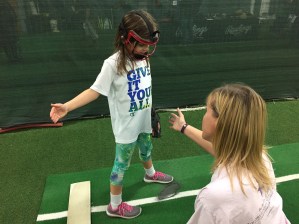
After one more punch and a few more repetitions of slapping, we went back to pitching. Bingo! She started coming through with a whip, and the ball started coming faster and more accurately.
So if you have a pitcher who struggling to feel that acceleration of the lower arm past the upper arm, give this one a try. And if you do, let me know how it works in the comments below.
Evidence of the value of team sports
Those of us involved in team sports such as fastpitch softball like to talk about all the benefits they provide. Most of the time, however, it has been more opinion and belief than anything that could be proved.
The folks at Ohio University have done some research and put together an infographic that shows both the value of participating in team sports (based on survey information) as well as some data on an apparent decline in participation in team sports in high school. The culprits, as you might suspect, include obesity, spending too much time in front of screens (TV, texting, surfing the Internet, etc.) and aggressive coaches who created a poor experience.
The full infographic is below. Definitely worth a look – including the evaluation at the end.

Helping fastpitch catchers learn to throw to bases faster
In fastpitch softball, as in baseball, catchers tend to make their bones in two areas above all else. One is their ability to block pitches in the dirt. The other is their ability to throw out baserunners, either on steals or pickoffs.
Key to the latter is the ability to make a quick throw. While having a strong arm is important, a strong arm can be offset by requiring a slow, deliberate release. And for  catchers whose arms are not the strongest, having a quick release becomes even more critical.
One of the ways you can speed up a catcher’s release is by getting rid of the need to “find” the base first. In other words, when the catcher goes to throw the ball – either on a steal or a pick – she shouldn’t have to look at where the base is and process the information.
Instead, she should just know instinctively where it is. The tenth of a second or two she saves by not having to “find” the base first can make the difference between safe and out.
Even the runner is safe, if it’s just by a hair it will serve as a warning to the other team’s coach not to get too adventurous on the basepaths. After all, coaches generally don’t test the catcher’s arm/release with their slowest runners – they use their fastest. If you can make it a photo finish with the fastest runner, it’s unlikely the coach will be anxious to send the rest.
So how do you get catchers to throw with more instinct? One of my favorite methods is by using a blindfold. Here’s how it works.
First, you must have already trained your catchers on proper technique, including the need for urgency. If you haven’t done that first, stop now and do that, then come back to this idea.
If you have, however, then it’s time to bring out the blindfold. The catcher starts with the ball in her glove and the blindfold in place. Make sure she’s in line with where she would normally set up, then have her get into her runners on base stance. Tell her to visualize where the base you’re throwing to is. I usually like to start with throws to second.
When she’s ready, either blow a whistle or yell “she’s going.” At that point the catcher pops to her feet (or drops to her knees if she can throw that way) and executes the throw as quickly as possible.
If she has a good feel for where the base is without seeing it, and good technique, she should be able to make the throw reasonably close. If she doesn’t, it could go anywhere and you’ll know you have some work to do.
If the throw goes offline, be sure to tell the catcher where it went so she can get a feeling for the difference between where she thinks it is and where it actually is. Also be sure to watch as she makes her throw for mechanical flaws (such as not pointing the front shoulder at the target) that can throw her off.
One way to make it more interesting is to offer a prize. This is particularly effective if you’re working with multiple catchers at once, since once one of them is successful it will spur the others. I’ve used a stick of Chapstick, a pack of gum or a roll of Mentos as prizes. You can select whatever you want.
Having a competition for a prize is a great way to end a training session, by the way. I like using this type because everyone has a shot at it (versus having only one winner) if they execute properly.
To add a degree of difficulty, have the receiver sit on a bucket or a chair. That cuts the adjustability of the receiver, so the throws really have to be spot-on. If you’re working with multiple catchers, you can add in some conditioning by having one be the thrower, one the receiver, and another chasing down errant throws. Give the thrower one shot, then she sprints down to become the receiver, carrying the ball with her. The running not only helps them build their legs but also fatigues them, helping simulate the feeling of having played a couple of games already.
This drill/game can be used for any base. It can be particularly interesting for right-handed catchers to learn to throw to first base on a pickoff attempt since the moves will have to be stealthy and they must rotate beyond the 90 degrees required to throw to second. It can get pretty random, especially outdoors, so your “chaser” will get a good workout in.
Throwing to bases blindfolded can be pretty challenging at first, so keep them encouraged. Let them know there is a degree of difficulty involved, and there’s no shame in not being able to do it at first.
But if they CAN learn to throw to bases instinctively, without seeing, the whole process will become a whole lot easier when they’re not blindfolded.
Don’t be surprised, by the way, if this quickly becomes your catchers’ favorite drill/game. The ones I’ve used it with usually will ask if they can do it, or will select it if given a choice of how to close out practice.
Truth is it’s not only challenging – it’s fun. And a point of pride when they’re able to make the throw.
Tossing out baserunners takes a lot of instinctual play. This is a great way of helping to build those instincts.
Congratulations to Taylor Danielson for signing with UIndy
One of the best parts of my job as a fastpitch softball instructor – actually THE best part – is seeing them succeed. That’s why I was so excited and honored to watch as Taylor Danielson signed her National Letter of Intent to play softball at the University of Indianapolis (UIndy). Go Greyhounds!

Taylor Danielson signs her National Letter of Intent for UIndy as her parents Chris and Tracy watch.
I’ve written about Taylor a couple of times before, most recently just a couple of weeks ago. She is an amazing catcher who can frame and block with the best of them. She’s also very vocal, the types coaches love because she takes command on the field.
She’s a great hitter as well (as the post about the knee injury attests) and when she’s healthy she has 2.8 speed from home to first – a pretty rare skill for a catcher. It’s no wonder the UIndy coaches verballed her more than a year ago and are excited for her to come over.
Taylor is also a high quality human being. For all her talent on the field she is very humble off of it. I’ve never heard her say a mean word about anyone, even people who probably deserved it. She is kind and caring, and always has a smile on her face. She’s also very polite, which seems to be more and more rare in our me-first world. Definitely credit her parents Chris and Tracy for that.
 I actually first met Taylor when she came to catch for a pitching and hitting student of mine named Kate Kiser – before Kate wound up going to volleyball full time. While she was catching I used to give her a tip here or there, which I tend to do with catchers. Something must have clicked, because her dad asked if I would give her full-time catching lessons. We also did hitting together, and Taylor was a sponge with both.
I couldn’t be happier that Taylor has this opportunity. UIndy is a high-quality program, and I’m sure Taylor will help them become even better. So Taylor, congratulations. I know you will continue to be awesome. Looking forward to catching a couple of games in your senior high school season, and at UIndy as well.
Return of the Indiana United Fastpitch Elite/Rick Pauly Clinics
Earlier this year I blogged about a fantastic fastpitch pitching event held, of all places, in Southeastern Indiana. Put on by Rick Pauly, hosted by Indiana United Elite Fastpitch and Coach James Clark, and featuring an array of top-level pitching coaches, it was an incredible learning experience for players, parents and coaches alike.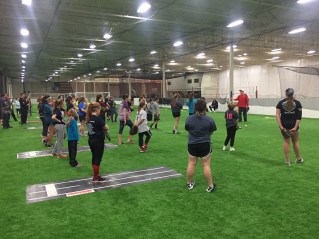
Never one to be content to rest on his laurels, Coach James has outdone himself with the latest iteration. The 2017 clinic, again in Richmond, Indiana, has expanded in its scope to not only offer top-level pitching instruction but also clinics on hitting, catching, the short game/slapping and defense.
This year’s instructor lineup is impressive once again, with college coaches and former college and NPF players offering hands-on instruction. The nice thing about these clinics is they’re not like so many, where they show a big name who is the “face” but then have very little interaction. The faces you see on the flyer will all be actively participating in or leading the instruction.
Throughout the weekend there will be plenty of time for discussions and questions too. One of the highlights for me last time was many of the instructors gathered together in a room tossing around ideas and opinions until the wee hours of the morning – all part of an impromptu session that began with a simple question. Those little side conversations alone are worth the price of admission.
Coach James promises it will be bigger and better than ever, and I believe it! The clinic runs the weekend of January 6,7 and 8, 2017 – timed this time to both make sure it didn’t interfere with high school and college seasons and to give players time to lock down what they learn before tryouts begin for spring high school ball.
Click here to register, and here to schedule the sessions you want and to pay. Most sessions are $70 each and run an hour and 15 minutes. The exceptions are the recruiting discussion that costs $25, and the beginning and advanced pitching sessions with Rick and Sara Pauly which cost $150 and are scheduled for 3 hours, although last year Rick was having such a great time he ran a bit long on both sessions.
Download the flyer for complete information, and then be sure you sign up now. Slots are filling fast. I’m sure you’ll find it’s a great investment in your softball future.
One way to avoid re-injuring a knee
The #KyleSchwarber coming back from a knee injury storyline is getting a lot of coverage right now during the World Series. But I think I have a fastpitch softball story that can top it.
Taylor Danielson, whom I have written about before, hurt her knee playing high school softball back in the spring and wound up missing the whole summer. This would have been more worrisome since this was to be the summer between her junior and senior year, but fortunately she had already verballed to a college. (I won’t say which quite yet due to superstition, but check back in a couple of weeks.)
When the injury occurred she was told she wouldn’t get back on the field until 2017. While that is a good prognosis for an ordinary person, Taylor is hardly an ordinary player. She worked her butt off rehabbing her knee, and was finally cleared for limited action for the end of the fall ball season.
There were some caveats. No catching (she’s an awesome catcher), and while she could hit, she couldn’t run full out. No stretching a single into a double, or going from first to third. She was under strict orders to run base to base and that’s it – a shame since she has 2.8 speed from home to first.
Since she couldn’t run like she wanted, Taylor decided to address it her own way. The video shows how – she hit the ball so far she was able to jog her way around the bases. All of them.
Just goes to show where there’s a will there’s a way. And you can’t keep a great player down.
Why you should never let anyone else set your limitations
If you’ve been a regular Life in the Fastpitch Lane reader, you know I love inspirational stories about real softball players. Not just the ones who make all the headlines, but also those who you may not see on TV but inspire anyway.
(If you’re not a regular reader, be sure to search through some older posts!)
Today is a great example. I first met Kaylee Arendt when she played for me at 14U. She

Hope College’s Kaylee Arendt, with her parents Roger and Deanna, show what can be done when you don’t let others set your limitations.
actually didn’t show very well in her first day of tryouts, probably because she was nervous, but she really wanted to make the team so she came back the next day and made a great showing.
I had the pleasure of coaching her that season, and also working with her in private lessons. I found her to be a coach’s dream – engaged, driven and very coachable.
A couple of years later she started playing high school ball. The varsity coach there (who I am happy to report was finally let go this year) didn’t seem to agree with my assessment. Despite the fact that Kaylee had tremendous power and a great attitude, he flat out told her that she would never play varsity softball. She just wasn’t good enough and never would be, according to him.
That might have devastated a lot of players and cause them to leave the game. Not Kaylee. She did quit playing HS ball, but she continued to play during the summers. Her goal was to play in college.
As you can probably tell by the accompanying photo, that goal was achieved with the support of her parents Roger and Deanna. She played at another school her freshman year, and is now playing first base for Hope College in Holland, Michigan. Go Flying Dutchmen! (Unfortunately the roster hasn’t been updated yet.)
I heard she had a strong fall ball season, and I have no doubt she’ll be tearing it up come spring!
This is an important lesson for any softball player. Softball is a game of adversity and disappointment. Even when you’re doing well you’re often failing more than you succeed, especially at the plate. It takes a special kind of person to play this game at all. But if you believe in yourself, and work hard, you can overcome the obstacles that get in your way. That applies to life in general too, by the way.
Personally, I’m happy to see Kaylee doing so well, and I thank her mom Deanna for allowing me to share her story. If you’re a player who maybe didn’t make the team you wanted, or aren’t getting on the field as much as you would like, or have been told you don’t have what it takes, remember this story.
Don’t be defined by what others think. Just keep working and pursuing your goals. You may just surprise a lot of people, and wind up on the winning side after all.
Sports administration not just a boy’s game anymore
With today being the last day of Women in Sports Week, it seemed like this would be a good way to finish it out – talking about opportunities for women in sports administration. Once the almost exclusive enclave of men, more women are now finding success off the field in sports. – Ken
Guest post by Ohio University’s Athletic Administration Program.
While men outnumber women in sports administration roles, Women’s Sports Week celebrates the females who are quickly moving into higher positions in the industry. With the fact that ESPN now has 48 female anchors, reporters, analysts, and contributors, they’re also paving the way for a new generation of younger women who want to hold professional positions in the industry.
Starting at the college level, intercollegiate athletics programs are experiencing an increased female presence. Of the 969 NCAA D1 head coaches for 2014-15, 40.2% are women with field hockey, lacrosse, equestrian, golf, and fast pitch softball leading the way. Keep in mind, however, that men coach over 43% of women’s teams while women coach only 3% of men’s teams.
One way to help increase female representation in athletic administration and professional roles is to provide these girls with successful role models like Mary Alice Hill, the first female Athletic Director in the country. She also played an instrumental role in obtaining the first NCAA scholarships for female athletes, 75 years after the NCAA was created.
To learn more about the growing female presence in the business sides of the sports industry, check out this visual resource created by Ohio University’s Athletic Administration program.

The growth of women’s sports in America
Guest post by Ohio University’s Athletic Administration Program.
As women’s sports gain more fans it isn’t surprising that just last year the women’s College World Series averaged almost 440,000 more viewers than the men’s College World Series. In celebration of the growing popularity of women’s sports, and Women’s Sports Week, here’s a look at the big impact women are making in athletics.
Girls’ participation in sports has grown an average of 50% a year over the last 5 years. In fact, there were over 364,000 high school girls participating in fast pitch softball during the 2014-2015 school year.
Athletic clothing and shoe companies have taken notice and have geared television campaigns specifically towards women for the first time. With half of shoppers on the NBA online site coming from the female population and sales of $5 billion on Nike’s women’s athletic wear in 2014, this group is clearly becoming powerful.
To learn more about the evolution of women’s sports, check out the visual resource below created by Ohio University’s Athletic Administration Program.






 Life in the Fastpitch Lane