Monthly Archives: August 2026
A 50+ Run Differential Is Not the Brag You Think It Is

Well, here we are, with fall ball tournaments starting up again. Hope y’all enjoyed your two-week break. Now it’s time to get back to business.
And one of the things you can count on with social media posts on Sunday night or Monday morning is the proud parent who can’t wait to tell the world that their daughter’s team went undefeated in their tournament (or round robin) over the weekend, outscoring their opponents by 50, 55, 60, or even more runs.
I get it. They’re happy to feel like they made a great choice during tryout season, and that their daughter is an awesome team with strong players.
But honestly, folks, going 6-0 and putting up a run differential of 50+ isn’t the brag you think it is. Instead, what it means is you probably weren’t in the right tournament.
When was the last time you heard about a team in the Women’s College World Series, or any collegiate tournament for that matter, ripping through the opposition and outscoring them all by that much? Sure, they may have had a double-digit run rule victory on one opponent, but not on everyone they faced.
There’s a reason for that: Because you don’t get better by beating up on weak opponents. You get better by being tested by opponents of equal or better quality. Iron sharpens iron and all of that.

Now, I understand sometimes things happen, especially at the B or C levels. Coaches might be unsure of how good a brand new team will be, so they go into a lower-level tournament to avoid having the type of weekend that leads to a Sunday night filled with parent calls asking questions and offering advice.
But if it turns out your team is actually a lot better than the coaches might have thought, it’s not a time for bragging and boasting. Quietly take the win, then make sure your team will be playing higher-quality opponents next weekend. Even if it means some schedule reshuffling.
Yes, it’s fun to win, but it’s a lot more fun when the opponent is able to challenge you for the win. There’s a much greater sense of satisfaction in it, and again, what you learn on the field by scrapping and clawing your way to victory instead of dominating every game from the outset will serve all the players better down the road should they decide they’d actually like to be (or play on) a more competitive team.
Because let’s face it. I’m pretty sure you could beat a bunch of three year olds in a game of basketball, no matter how bad your skills might be. But would it really be an accomplishment?

So if you find yourself in that situation this fall, take the win with a big heaping helping of salt, and keep the bragging and boasting to a minimum. Then make sure your team is seeking out better competition rather than trophy hunting in the shallow end.
You’ll be a lot more satisfied in the long run.
If You Want Them to Learn, Let Them Struggle
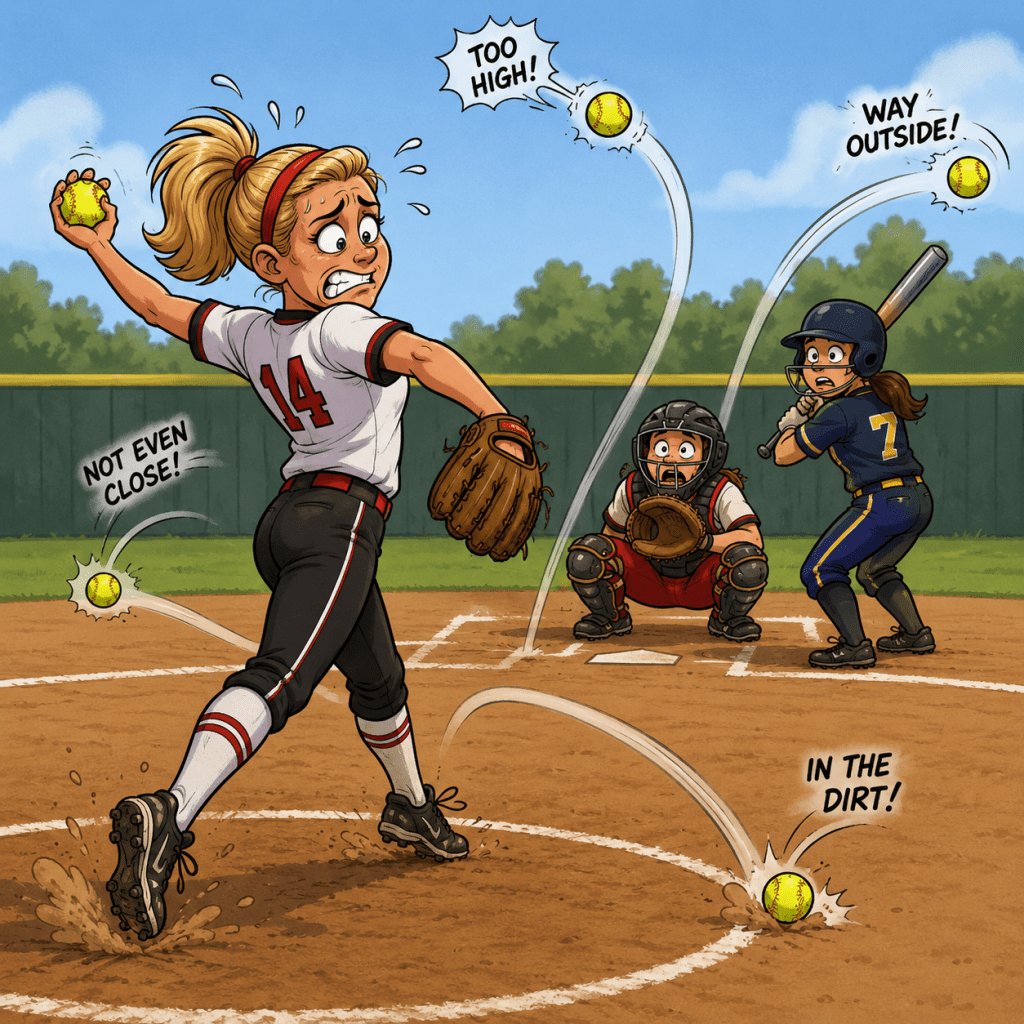
Most people have heard the old saying, “Give a man a fish, feed him for a day; teach a man to fish, feed him for a lifetime.” But what happens when the man is having trouble learning how to fish?
He’s working at it, but not having much success. In the meantime he’s getting hungry.
What do you do? Take over and catch a fish for him so he doesn’t feel hungry anymore? Or let him continue to struggle until he gets the hang of it?
In my opinion, unless the hunger situation is growing dire, you should probably let him continue to figure it out for himself. Nothing like a little hunger pang to push the learning process along.

It’s the same with fastpitch softball skills – without the hunger part of course. It can be difficult to watch a player – especially one who is your child – struggle to learn a new skill.
We all want to see our kids be successful. We don’t want to see them in distress, or feeling confused, and we certainly don’t want to have them feel like they’re falling behind their peers.
So it’s tempting for a parent to jump in the minute their daughter doesn’t seem to be getting some new concept. It’s tempting for a coach to start firing off instructions after every repetition to try to force the learning process to go faster.
Believe me, I’ve done both of them.
But here’s my sincere advice to you: don’t. Instead, push down those protective instincts and let them struggle to learn whatever it is they’re supposed to learn.
Not because it’s acceptable to be mean to them, but because they will learn whatever it is better.
That’s not just me saying it. Learning experts across the spectrum will tell you that the struggle is a part of the process.
When we struggle to learn something, we have to dive deeper into it, giving us a better understanding of what we’re trying to do. Yes, it may take a little longer, but we will internalize it better, getting us to the unconscious competence state that enables the highest level of performance.
Neuroscience research shows that when learners struggle with a concept or a task, it changes the brain. Neural pathways are strengthened and become faster – a pretty important benefit when you consider the speed of our sport and the complex decision trees that have to be run through in most plays.
When players have to struggle through learning a skill they also tend to learn it at a deeper level, making it more repeatable over the long term.

Think about it this way: If you jump in and try to shortcut the learning process by giving players the answer instead of learning to solve the problem on their own, it may solve the short-term issue of them not being able to perform.
But you’re not exactly going to be able to do that for them when the game is on the line. If they haven’t internalized the solution themselves through their own struggles, they’re unlikely to be able to perform under pressure in the heat of the game.
So does that mean no coaching at all? Of course not. That would be a silly conclusion to come to.
It’s more a matter of once someone explains what needs to be done, give the player time to understand how to accomplish the task within her own frame of reference, and on her own timetable.
Let’s say a player is trying to learn how to field ground balls. The team coach explains how to get down to the ground, how to position the glove, whether to stay back or charge in depending on the speed of the ball, when and how to set her feet, etc.
Then a ground ball is hit to her and she completely whiffs the play, not doing anything the coach said. As a parent should you jump in and try to explain it to your daughter because you know her best?
I would say no, at least if the coach seems to know what he/she is doing. All you’re going to do is become a distraction to the learning process.
As I keep pointing out, kids are not just short adults. Just because something was explained to them doesn’t mean they understand everything that was said.
For the very young, keep in mind they’re not that many years away from when their whole process of learning about the world around them involved sticking it in their mouth.
Instead, give them the opportunity to learn through trial and error. They try something, and it either works or it doesn’t.
If it doesn’t, they move on to try something else. And if they don’t try something else on the next round, hopefully the coach will give them another cue, or type of cue, that will help guide them down the path to discovery.
There’s a place for letting them struggle, and there’s a time to step in.
It’s important to keep in mind too that unless you are the player’s coach as well as parent, you have a different relationship with your daughter than the coach does. She will hear things differently from the coach than she will from you.
Basically, when the coach tells her to do something she will hear guidance. When you say the same thing, she will hear criticism and will be more likely to shut down automatically. That’s a different type of struggle for another day.
At the same time, regardless of the actual volume, your daughter will tend to hear your voice over the coach’s voice because her brain has been tuned to hear you whether she wants to or not. That will ultimately get in the way of her developing a strong player-coach relationship and will likely stunt her softball growth even further.
And if you are both parent and coach, take my advice on this one from personal experience: Have another coach give your daughter the corrections. She’ll take them a whole lot better.
Yes, it can be difficult to watch your daughter struggle to acquire a new skill or improve an old one. But don’t take that struggle as a negative sign – or as something you need to fix for her.
It’s simply a part of the process – an important part of the process. By letting her work through it in her own way, and on her own timeline, she will ultimately learn it better, at a deeper level, and be able to draw upon it when she needs it most.
And she’ll get greater satisfaction from it when it finally does come together.
New Season, New Opportunity, New You.

Welp, the 2025-2026 season is completely behind us now. Hopefully you had a little opportunity to take some time off, do some non-softball things, and generally put some space between what was and what is to be.
Now, as the new season gets under way for many (at least at most levels), there is an important question to be answered: who do you play to be as a player? In other words, do you plan to make this season a continuation of the last one, or are you looking for something more?
If you’re happy with the way last season went you may not have a whole lot of incentive to change things up. It was working well, and while you are always looking to get better it’s more on a straight line from where you were.
There’s nothing wrong with that; in fact, it makes a lot of sense. No sense jumping off a winning horse in the middle of a race.
But if you weren’t happy with how last season went, this time of year presents a golden opportunity to make next season a better experience. This is true of players, coaches, parents, and even umpires by the way.
Essentially, you don’t have to settle for who you were last season, particularly if you have joined a new team. Instead, you have the opportunity to be whoever you want to be – as long as you’re willing to put in the work to back it up.
For example, suppose you were a .220 hitter, batting toward the bottom of the lineup if you were in the lineup at all. Once you have established that is where you should be, it becomes difficult to climb out of that hole.

The new season, however, resets the clock, especially if you’re with a new team. They won’t know how you struggled before.
They will see you where you are now, and if where you are now is someone who is hitting .345, the new team is far more likely to find a place for you higher up in the batting order – not just in pool play or throwaway games but the games when everything is on the line.
It’s the same all over the field. Give up too many walks or hits (or both) as a pitcher last season? Here’s your opportunity to show you can get three quick outs.
Make too many errors on the field? Here’s your chance to show that you are now a sure-handed fielder with a strong, reliable arm.
The weight of the past has been lifted from you. It’s like removing all the old plastic bottles and other debris (including those old batting gloves that have been fermenting in sweat) that have been accumulating at the bottom of your bat bag since the first time you used it.
It feels lighter and cleaner, making it easier to cart around while helping you get ready for a fresh start. So how do you replace the old you with, well, You 2.0?
It starts with taking some action. If you just sit around hoping this season will go better than the last one, nothing is going to change, because while your thoughts may reveal what you want, your actions are what determine what you get.
Start by changing your mindset or your attitude. Instead of being mad or sad that you don’t have what other people have, start figuring out what you need to DO to get what they have, then start doing it.
It might be practicing more – or at all. If you’re a fielder who wants to make fewer errors, find someone who will hit or even toss you lots of ground balls, fly balls, whatever you need to work on.
If you can’t find anyone to help, bounce a rubber ball off a concrete wall. Don’t let what you can’t find limit you; instead, be creative in order to get what you want.
If there are skills you need that you can’t acquire on your own, get lessons from a qualified instructor. If you can’t afford a qualified instructor, ask a team coach for extra help.
Working with a team coach will not only help you with those specific skills. It will also help build a relationship between you and the coach that will make them a little more inclined to select you when decision time comes.
If you can’t find a coach, look up videos on YouTube or other sources, and then video yourself performing the skill to see if what you’re doing looks like what you’re supposed to be doing. A word of caution though: there are a lot of bad drills and incorrect techniques being taught online, especially on social media sites such as Tik Tok and Instagram, so be careful whose advice you follow.

Once you’re on the field in a team setting, make sure You 2.0 acts the way you want coaches and fans to perceive you. Act confident, even if you don’t feel confident, and be aggressive rather than tentative, even if you’re unsure of yourself.
People in general respond to confidence, and are much less willing to assume a bad play is how you play normally. And the funny thing is if you fake that confidence in the beginning, you’ll probably gain it as you go along, growing into the player you want to be perceived as being. You’ll have more fun that way too.
The bottom line is you don’t have to be stuck with who you were before. If you’re on a new team you have the opportunity to be whoever you want through your action, your attitudes, and your overall approach.
Even if you’re on the same team, however, a change in performance, a change in approach and a change in attitude will be noticeable. While you will have to overcome some old assumptions about you, there’s no better time to start changing those assumptions than when everything feels fresh and new again, and your team is looking 100% ahead.
Take advantage of the new season to build a new you, or at least You 2.0, and you’ll be much more likely to enjoy the outcome.
The Three Basic Types of Players – Which One Are You?

Today’s post comes from another lesson by Dr. Rob Gilbert, sports psychology professor at Montclair State University in New Jersey. If you’re not already doing it I suggest you call his Success Hotline – (973-743-4690 – where he provides a daily message about how to become a high performer, and listen to his Success Hotline podcast, which is a collection of older messages.
You can also check out this interview that Jay Bolden and I did for the From the Coach’s Mouth podcast a couple of months ago. You’ll thank me if you do it.
In any case, Dr. Gilbert talked about how there are essentially three types of players in the world: those who are Serious/Serious, those who are Serious/Fun, and those who are Fun/Fun. If you’re a player, which type you are can have a huge impact on how successful you are .
Fortunately this isn’t like Motor Preferences, which are baked in at birth; you can change which type you are at any time if you’re willing to do so. Before we look at each type, though, see if you can guess which one has the best chance of being successful.
Got it? Good. Let’s dig in.
Serious/Serious
This type of player is all business all the time. She never smiles, never gets into goofing around with her teammates, never takes a minute in the dugout to just enjoy the moment.
She is there to do a job, and by golly she’s not going to let anything distract her. Honestly, a lot of coaches, especially newly minted ones, fall into this category too.

This type of player is never going to be satisfied or happy with her performance because there’s always something to improve on, always something she could do or could have done better. While that might sound like dedication, it can also lead to frustration and depression because nothing is ever good enough.
She’s also probably going to be a bit lonely in a team setting because nobody will want to be around here. She may excel, but she’ll never enjoy it.
Fun/Fun
We’ve probably all known someone like this. Unlike the Serious/Serious player, this one is a lot of fun to be around because she’s like a walking birthday party (without the cake).
Nothing ever gets her down. If she makes a mistake she legit laughs it off because really, who cares? It’s just a game.
The problem here is much of the time she can’t focus enough to be a strong contributor. There are times when you need to have your head in the game and be distraction-free so you can perform well and the team can continue to win.
But this player is too busy having a good time to notice. Which means you can’t really count on her to perform when you need her most.

Maybe she’ll get lucky and make the play or get the hit anyway. But do you really want to count on luck?
You might think well, at least she’s good to have on the bench to keep the team “up.” This is true up until the point her antics become a distraction. Then it can be a detriment.
Serious/Fun
This player combines the best of the other two without the obvious downsides. She takes her game seriously, and works hard to be the best she can be.
Like the Serious/Serious player she will likely take extra reps when she can, will work on the little nuances that can help her improve her game, and will be able to bring a laser focus when it’s needed.
Yet like the Fun/Fun player she doesn’t take a “life or death” approach. She still knows it’s a game, and while she may take a critical loss hard, she will also be able to let it go after feeling what she needs to feel.
She will also have an appreciation for the fact that she gets to play this beautiful game regardless of the outcome, and that she gets to become friends with people she might never have met or hung out with otherwise.
Essentially, her approach is balanced, and she can move between being serious and fun as appropriate, allowing her to become not just the best player she can be, but the best human being she can be.
The Big Question
So there you have it – the three basic types of players. Now the question is which type are you? And which type do you want to be?
From my (and Dr. Gilbert’s, by the way) point of view, the optimal is Serious/Fun. You want that balance that we talked about so you don’t get too down on yourself when things don’t go your way, and you don’t let distractions keep you from developing yourself into the player you’re meant to be.
If you’re in the Serious/Serious category, try to find someone who is more Serious/Fun and perhaps adopt them as a role model. If you have direct access to them (a teammate, a friend, etc.) ask them how they manage to find the fun even when they’re being serious. Their answer might surprise you.
If not, look for a famous player, maybe even in a different sport, and see what they do to lighten themselves up. If they’re a high-performer you can be sure they’re serious at least some of, if not most, of the time.
Read about them, look for YouTube or podcast interviews, and see what they have to say. I’ll bet you’ll find some who used to be Serious/Serious but learned how to lighten up along the way.
They don’t have to be from your sport, or even sports at all for that matter. They could be actors, or business people, or doctors/nurses, or from any other profession. Every type of job has its challenges; learning how others keep those challenges in perspective just might help you with yours.
If you’re Fun/Fun on the other hand, you have to make sure you’re playing at the right level. Even if you have the physical ability, you’re probably not going to be that happy on a super-serious A level travel team or a Division 1 college team.
So you have a choice: you can either make a decision to take your softball more seriously and put in the work required to improve your focus and mental game, or find a team with like-minded players and coaches. You may not win a lot, but if you’re a true Fun/Fun that probably won’t matter as much. Just getting out and playing will be good enough for you.
This is not a question of right and wrong. It’s more of what’s right and wrong for you.
Figure out which type you are, and whether that’s the type you want to be. If it is, run with it.
But if it’s not, put in the work to become the player you want to be and you’ll be more satisfied with your experience in the end.






