Blog Archives
Compete Against Yourself First

The desire/urge to compete is pretty much baked into our DNA. Where originally it was a survival mechanism – those who were best at finding resources (or taking them from others) were the most likely to live – that drive lives on today in many forms, including the desire/urge to score more runs than an opponent.
It can be good thing, spurring us on to achieve more than we would have otherwise had we not had an example to compete against or a level of performance to aspire to. But it can also turn ugly when it moves from helping us establish goals to judging our self-worth by how we compare to others – either specific individuals or others in general.
The problem with these types of comparisons is they often don’t take into account the fact that the competition is often not occurring on a level playing field.
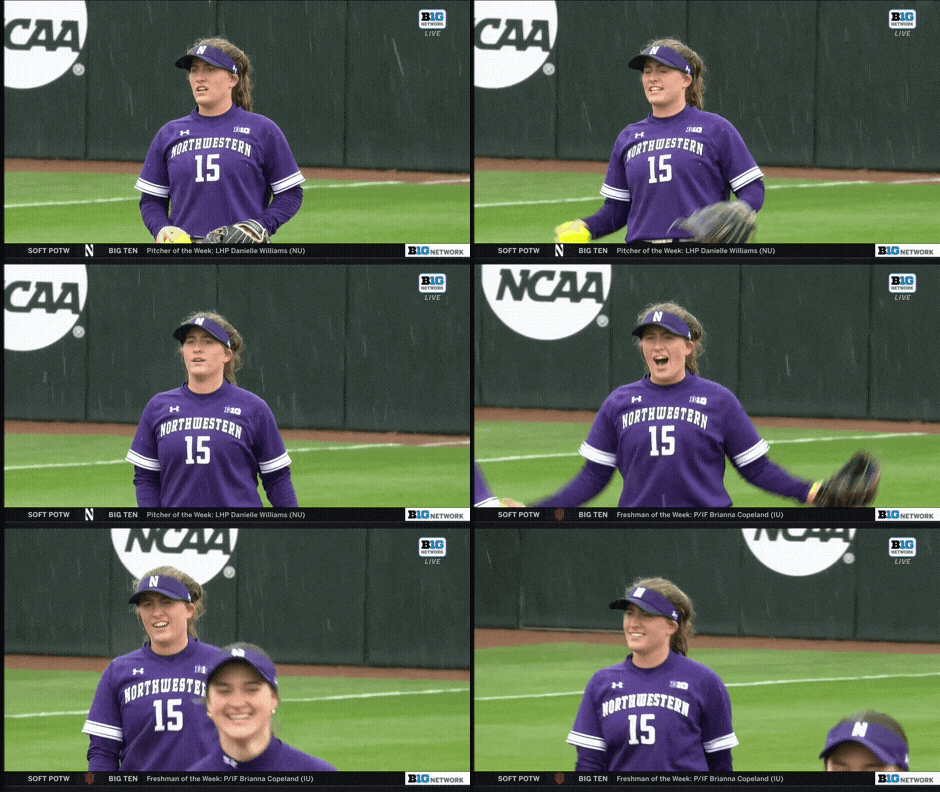
Take a couple of beginning pitchers for example. They both start learning at the same time, so it’s easy to think that they will progress at the same pace.
But maybe one is a little more naturally athletic or simply more coordinated than the other because physically they’re developing at different paces – each at her own pace, incidentally. The more athletic one is likely to jump out to an early lead, throwing harder, throwing more strikes, being ready for a second pitch, etc. before the other.
The one who falls a little behind may look at it and feel bad about herself. She can say, “I work just as hard and practice more, but I am not getting the same results. Therefore I must not be very good.”
That’s the wrong way to look at it, in my opinion. Rather than comparing herself to the other pitcher, the second girl should instead look inward to see if she is better than she was a week ago, a month ago, six months ago, etc. She might like what she sees a whole lot better.

Perhaps when the girl who’s feeling bad started out she was arcing the ball in, or having trouble making it to the plate. For an older girl, maybe she was throwing hard but it was anyone’s guess where it might go.
Now she is getting to the point where you could put her in a game when it matters. She may not be quite as spectacular as the other one (at this moment), but she is leaps and bounds better than she used to be.
And here’s the funny thing. Just because she’s behind right now doesn’t mean she will be forever.
Some kids are just naturally more coordinated than others at younger ages. Some kids have earlier exposure than others to quality coaching, which shortcuts the learning process. Some kids just take a little longer to grow or gain strength than others.
But when player two catches up, look out! She may just end up being the best of the bunch.
I recently heard a story about the legendary pitcher and Olympian Cat Osterman talking to a group of youth players at USA Softball’s High Performance Program (HPP) national player selection event. After watching the quality of the talent that was there, she told them that when she was their age there was no way she would have been invited to such an event, much less have been able to win a spot on the roster.
She didn’t become the Cat Osterman we know until a little later. She was tall and gangly and hadn’t quite figured out how to get those long arms and legs all moving together in a way that would dominate hitters.
Had she primarily been comparing herself to the other pitchers around her she might have become discouraged and given up. And the sport would have missed out on one of its all-time greats.
But instead, she just kept going, focusing on making herself better so she could get more opportunities to pitch. I’m sure at times she looked at who was ahead of her and thought, “If I can get better than her (or them) I’ll be pitching all the time.” She is a competitor, after all.
Yet she apparently never let the fact that she wasn’t as good right now discourage her from trying to become better. She kept plucking away at it, and eventually passed them all – to the point where she was good enough to compete and medal in the Olympics in 2004, 2008, and 2020. A pretty remarkable feat by any standards.
The bottom line is each of us has a path to walk, and we walk it at our own pace. You can’t control how good someone else is at any given point in time, but you can control your own progress toward your goals.
It’s ok to look ahead and say you want to beat this person or that person as a way of measuring progress toward those goals. But in the end remember the main person you’re competing against is yourself.
Keep trying to better yourself, little by little, day by day, step by step, without overly worrying that this person or that person is ahead of you right now. Keep walking the path and one day you’ll look back and be amazed at how far you’ve come.
Turn, Turn, Turn? Not Anymore
It’s a pretty safe bet that “Turn, Turn, Turn” is the best-known songs by the 60s folk-rock band The Byrds. It’s either that or “Mr. Tambourine Man,” but I personally think the former is the better song. After all, tough to beat having your lyrics written by folk legend Pete Seeger by way of The Bible.
Even if you never listen to an oldies station you’ve no doubt heard it. It’s pretty much required in any movie about the 60s, or that references the 60s in some way. But just in case you’ve somehow managed to avoid it all these years, here’s a video. Enjoy!
The key point of the song (and why I bring it up, other than my love of jangly 60s music) is it says there’s a “time for every purpose under heaven.”
While that may be mostly true, in the softball world today it seems like there isn’t time for one thing – stepping back and making major corrections in mechanics without the pressure of an upcoming game.
I know Bill Hillhouse says there’s never a bad time to fix mechanics. But it sure is a lot tougher to make a significant change when there is a tournament coming up in a few days.
Once upon a time, the post-season was a great time to make those fixes. You finish up with Nationals at the beginning of August, then take a couple of months off to rest and recuperate before starting up again.
There might be a game or even a tournament here or there, but nothing like we see today. The way things work right now, players are often trying out for their next team before they’ve finished with the current one. Then it’s straight to practice to get ready for a two-month schedule of tournaments every weekend.
Of course, player performance in those early games sets the tone for how they’ll be perceived, especially if they’re on a new team where they’re not known. So rather than taking a step back to maybe fix things that could be better, players are more likely to continue down the path of what’s worked so far. Even if it’s not optimal.
The problem is certain mechanical fixes are likely to make a player worse before they make her better. Now, for some it doesn’t matter. If your mechanics are bad and you’re not performing, there’s little risk in making changes. Nowhere to go but up and all of that.
For others who have had success already but want to get better, however, it can be a problem. They were comfortable with where they were, and they were doing well, so making changes gets them out of that comfort zone, creating a risk of failure where there used to be success. And failure is an important part of the overall learning curve.
A pitcher maybe slower or less accurate until she resets her timing or gets all the body parts working together properly. A hitter may be tentative rather than aggressive until she’s had a chance to figure everything out. You get the idea.
The long-term benefits are there. It’s just hard to keep that in mind when you’re in the circle, in the batter’s box, on the field, etc. No one wants to look bad, especially in front of a new team (and coach). So they’ll tend to fall back on what they always did rather than forging ahead into new territory.
I don’t blame the players (or their parents). You gotta do what you gotta do. But with our 12-months a year season there’s little time available to fail for a little while to succeed in the future.
There has to be a better way. Somehow or another, there needs to be a season where pitchers can take the time to focus on changes that will help them increase speed without having to keep their change, drop, or other pitches sharp. Or hitters can focus on getting their sequence right instead of worrying about making contact with the ball. You get the drift.
What’s the solution? One idea is to play fewer tournaments, or maybe even fewer games overall in the fall. I know that won’t be a popular idea but it would definitely create some headroom for experimentation.
If you can’t do that, maybe teams can set aside a month or two during the winter months to work on reaching some specific goal or making a major change. Recognize that your player may not look like your player for a little while, but ultimately she will be better.
Maybe you have other ideas. If so, please share them in the comments.
All I know is there really needs to be a time for everything – including getting away from the pressure to perform so players can take the time they need to get better. It may be tough to accept at first. But the results will be worth it.
For A Proper Fastpitch Softball Warmup, Get Dynamic!

Just about everyone knows how important it is to warm up before undertaking any athletic activity, both to prepare for the best performance and to reduce the risk of injury. (I would say “everyone,” but I still hear horror stories of players being thrown into games or or having their pitch/overhand throw speed measured at camps without any warmups at all.)
What apparently isn’t as well-known is that the type of warmup you do can have a significant impact on both performance and injury prevention.
There are basically two types of warm-ups: static and dynamic. Static warmups involve standing still and pulling on muscles. One example is shown in the (staged) photo at the top of this post, where a player lays her arm across her chest, places her wrist just above the elbow of that arm, and either presses on the arm or tries to pull it a bit. (This, by the way, is one of the most useless “stretches” you can do because it really doesn’t stretch anything.)
Other examples include all the players sitting in a circle with their legs stretched out in front of them, attempting to grab their toes while they sit and chit chat about their day, rolling up on your back and trying to touch the ground behind your head with your toes, and the ever-popular point your elbow to the sky and try to pull it past your head with the other hand.
Dynamic warmups involve stretching the muscles by increasing the range of motion as you make different movements. A few examples are butt kicks, cherry pickers, torso rolls, and shoulder circles. You can see a few more examples in this video from Jason Domnanovich, a trainer for the Chicago Bandits (courtesy of the NFCA):
What’s the difference? Probably the most important is that static stretching actually turns off your nervous system, making it more difficult to perform at a high level. In other words, instead of preparing you for competition it hurts your preparation. This process of turning off the connection between the mind and muscles also makes you more prone to injury.
Dynamic warmups do the opposite. They activate the muscles so they’re ready to perform. Muscles that are activated can run faster, throw harder, more laterally more quickly, rotate more powerfully – all the things we want do on a softball field. Warming up dynamically also prepares the muscles for the stresses they will face during a game or practice session, helping reduce the chance of injury.
I know from personal experience the difference dynamic stretches can make. When I was still coaching teams, we moved from static to dynamic stretching before all activities and rarely experienced an injury. Not that we had a lot to begin with, but the number of injuries fell even further. That’s good, because healthy players will contribute a lot more to your success than injured ones.
Does that mean you should never perform static stretches? No, not at all. They’re fine after the game or practice to help the muscles relax after being taxed and prevent them from tightening up as they recover. In fact, it’s recommended. Just don’t do it before the game or practice.
So how do you go about making the transition to dynamic warmups? What exercises/activities should you do?
This video provides an excellent, softball-specific resource. It’s the one I used to learn more about it, and to build a dynamic warmup routine. (No, I have no financial stake in you buying the video, I just know it’s good.)
There are plenty of others as well. Just search on “dynamic stretching softball” and you’ll find a wealth of resources that will help you build a warmup that will actually help your team gain a little extra edge while preventing injuries.
If you (or your team) is still standing motionless, tugging on muscles before the game, stop it! Make the transition to dynamic warmups. You’ll be glad you did.
Oh, and if you have any stories to share about dynamic versus static warmups, be sure to add them in the comments below. While you’re at it, be sure to hit the Like and Share buttons, and take some time to subscribe to Life in the Fastpitch Lane so you never miss a post again.






 Life in the Fastpitch Lane