Category Archives: Pitching
What the WCWS Can Teach Us about the Changeup

Whenever I see one of my students after a tournament weekend, the first question I usually ask them is “How did it go?” Knowing how they performed in game situation is very helpful in determining what we’re going to work on in that lesson.
Hopefully I get more than “good” or “fine” or “terrible” as a response.
The next question I ask pitching students is “What pitches did you throw?” (assuming they have more than just a basic fastball). That’s where it can get a little dicey.
The answer I least like to hear is “Mostly just my fastball,” especially if that pitcher has also developed (or is developing) a decent (or better) changeup. Sorry, I know that was a lot of parentheses in one sentence but hopefully you followed it.
Now, I know that pitchers these days, especially the younger ones, often don’t have a lot of input into the pitch calling process. But I will still ask them why they didn’t throw their changeups more.
The typical answer are:
- The other team couldn’t hit my fastball so my coach didn’t want to give them a slower pitch to hit
- I threw one but it rolled in/went high/went wide so my coach didn’t want to throw it anymore
- I had a little trouble with it during warmups so my coach didn’t want to chance it in the game
- My coach says he/she doesn’t like the changeup or prefers to go with speed
- I threw a few but when one got hit my coach quit calling it
- I dunno
I get the thinking behind most of these reasons (except the last one). Coaches want to win games so will tend to go with what they think will accomplish that goal.
They also tend to be risk-averse, and often view a pitch that looks so different from everything else in the pitcher’s arsenal as too risky to throw, particularly in close games.
I hope those coaches were watching the #2024WCWS (Women’s College World Series). Because it was a veritable clinic on how effective a changeup can be – and how often it can be used.
I’ve commented to a number of people that I think I’ve seen more changeups thrown in one inning by some of these pitchers than I’ve seen in total over the last five years. It was like someone suddenly remembered how great the changeup is and passed a memo along to all the top D1 college teams in the country.
Stanford’s NiJaree Canady, to me, was the poster child for this display of pitching chicanery. Because she wasn’t just throwing a couple per inning.
No, she was often throwing at least a couple per HITTER!

She also did a great job of wiping out excuse #1 above. Canady was consistently throwing all her other pitches at 70 mph+.
I don’t care how good a hitter you are, that’s going to be tough to catch up to, especially if you can locate the ball to match the hitter’s weaknesses. At one point I saw a quote from Monica Abbott saying she thought Canady could be the first female pitcher to throw 80 mph in a game in a couple of years.
Yet Canady and the Stanford staff didn’t go there and try to blow everyone away with speed. They actually used that speed to set up her changeup, which is where she was getting a lot of her strikeouts. If it’s good enough for one of the last teams standing in the WCWS…
Another thing I saw was various pitchers (including Canady) throw some sub-par changeups. They would throw them for close balls in tough counts.
I remember at least one pitcher (I think it was Nicole May in the final game of the championship series, a pretty important time) roll the ball in on a change at least once, maybe twice. Yet the Oklahoma coaches didn’t quit calling it.
I also remember a few along the way going high, going wide, and (gasp!) even getting hit – occasionally for a home run. But those pitchers’ coaches didn’t quit calling it, because they understood that’s going to happen, even to very high-level pitchers, and that the next one in the zone will still be effective.

There were also times when a pitcher might not be throwing her best changeup. But again, on softball’s biggest yearly stage, the coaches understood that changing speeds that way could be effective even if the pitch didn’t go for a called strike.
After all, nobody wants to look bad on national TV swinging through a changeup, so it gets in the hitters’ heads. If a highly accomplished, high-level hitter can feel that way imagine the psychological pressure a changeup can put on a 12U, 14U, or even older hitter.
Probably the only argument against the changeup that the WCWS didn’t answer directly was the coach wants to call the pitches he/she thinks will win the most games. And throwing a changeup on a regular basis doesn’t give us as much assurance of winning this game right now as throwing a speed pitch does.
So here’s my question: where do you think all these high-level pitchers learned to throw their changeups in pressure situations? I can pretty much guarantee that it wasn’t at the WCWS, or even during the college regular season.
Those pitchers most likely had youth coaches who believed in them, and believed in developing them to become the best they could be. I don’t have direct knowledge of the circumstances but I’d bet pretty good money that NiJaree Canady, Kelly Maxwell, Nicole May, Teagan Kavan, and all the other pitchers we watched this past weekend who throw in the high 60s and low 70s didn’t have youth team coaches who told them to just go out and blow the ball by everyone.
My guess is their coaches threw the changeup even when they didn’t need to, because they knew it would help those players (and countless others) become the best they could be. They also knew one single pitch rarely determines a tournament outcome so they could always come back with something else or change strategies if the changeup didn’t work.
All those young women throwing changeups in the WCWS were given ample opportunities to develop that pitch so it would be ready for when it mattered most.
Hopefully today’s youth coaches were paying attention, and saw how effective the changeup can be when it is called early and often, sometimes a couple of times in a row, even against some of the best hitters in the game.
If you have a pitcher who can throw a changeup, even if it isn’t the greatest in the world right now, take advantage of it and use it. If you let her develop it now I guarantee it will help your team win more games in the long run.
And you might just get the pleasure of watching one of your pitchers throw it on TV someday.
Fastpitch Pitching Advice from Taylor Swift

This week’s topic goes hand-in-hand with last week’s blog post about the art of pitch calling. If you haven’t read that one yet I suggest you do; it’s brilliant.
All too often these days it seems like fastpitch pitchers are treated like a vending machine. Someone puts a pitch call in and pitchers are expected to spit it out with zero thought involved.
To me, and I think to most pitching coaches (PCs chime in here in the comments) that is absolutely the wrong approach. Instead, pitchers need to be playing along in their heads, thinking about what that hitter looks like, what’s worked on her in the past (if she’s faced her before), what pitches are working today (and how well), and what she thinks ought to be the next pitch she throws.
Then, if the pitch call lines up with what she’s thinking (more or less), she throws it. If it doesn’t, she takes the advice of the ubiquitous Ms. Swift to:
I know it can be difficult. Sometimes nigh on impossible if the pitcher has a coach who believes in his/her own omniscience when it comes to pitch calling, whether that opinion is justified of not.
But if the opportunity is there the pitcher really ought to be the final deciding factor on which pitch gets thrown next. Just like a pilot is the ultimate decision-maker when the plane is in the air.
After all, it’s the pitcher who is going to have to live with the consequences of her pitch.
Of course, in order to do that effectively someone has to train the pitcher on how to set up a hitter and keep her off balance. In other words, how to make decisions on which pitches work best in which situations.

I like to do this during lessons. Team coaches can do it during bullpens. Here’s how.
Select a type of hitter and a situation. For example, no one on, no one out, left slapper leading off.
Then ask the pitcher which pitch she wants to throw. If she’s not sure where to start, guide her with some parameters such as whether the slapper is experienced or a newly converted righty, whether she runs toward the pitcher or toward first base as she comes out, if she stands tall or squats down, how good the defense is behind her, etc.
You can also give some general hints, such as slapping is about timing and slapper are usually trying to put the ball on the ground between shortstop and third. All of that will factor into which pitch to throw.
The pitcher then makes the call. If it’s a good one, she throws it and the outcome (ball or strike) leads into the next pitch call. If the pitch decision isn’t so good, the coach talks it through with the pitcher a little more to help guide her.
With some regular training the pitcher can become smarter, and thus an active participant in the pitch calling decision rather than just a robot programmed to follow directions.

I understand that it’s difficult for a player to feel confident enough in her own decisions to try to overrule a coach by shaking off a pitch. Doubly if the coach is a parent or teacher or just someone who has a more authoritarian approach to their coaching.
But it’s a skill worth learning. And not just for softball.
There’s a pretty good chance that at some point in her life, that pitcher will face a non-softball decision that involves some risk, or perhaps even a moral dilemma. The easy thing to do will be to just follow along with whatever the person in charge says.
But the easy thing isn’t always the right thing. Gaining experience in being part of the decision process, and standing up for herself when she feels strongly another way, will help her avoid much more serious issues later in life than whether a particular hitter got on base in that at bat.
Again, I know it isn’t easy. But it’s worth learning.
Knowing when to shake off a pitch call, and having the confidence to actually do it, is an important of growing as a player, and growing up.
Don’t just be a pitching vending machine. When pitchers become an active part of the pitch calling decision they’ll find they have more success – and more fun.
Vending machine photo by Jenna Hamra on Pexels.com
The Art of Pitch Calling

Whenever a group of fastpitch softball fanatics gets together to talk about pitching, they (we) often talk about the three S’s – speed, spin, spot. You need a healthy dose of all three to be successful, especially at the higher levels.
Within that, however, there is one significant caveat.
Success with speed and spin is almost entirely pitcher-driven. In other words, when you get into a game the pitcher takes whatever skill she has acquired in these areas and applies it to the best of her ability.
Spot, however, is a little different, because often the pitcher doesn’t really have a choice in which spot she is throwing to. She may want to (or prefer to) throw high and inside in a particular situation, for example, but if whoever is calling the pitches wants it low and out that’s where she’s expected to throw it.

That’s what makes pitching calling such an art. No matter how great the pitcher is at hitting her spots, that alone isn’t enough. The pitch caller also has to be smart enough or experienced enough to call the right pitch in each situation or all that spot-hitting ability is essentially neutralized. Or even detrimental.
So how do you go about calling pitches? That really depends on the level of play and the ability of the pitch caller to determine what will work based on all the available information.
For example, in the P5 conferences, and I’m assuming many other collegiate programs, the team has a wealth of data on each hitter and what her tendencies are. Especially for long-term players. There’s a lot of data science in it.
They know what pitches and locations a hitter strikes out on the most and what she pummels over the fence on a regular basis. They know if she’s susceptible to certain locations based on past performance and they know which pitcher threw that particular pitch.
After all, if a hitter has trouble on the inside against a pitcher who throws 70 mph, it doesn’t mean she’ll always have trouble in that location. The more varying the data is, and the more of it you have, the better chance you have of making a good decision.
That, incidentally, is why some freshmen or newly elevated-to-starter-status players will start out hot and then cool as the season wears on. At first there isn’t much reliable data about them, but eventually it starts to accumulate.
But what if you don’t have the luxury of well-populated spray charts and other data? That’s where it becomes more of an art form.
There are some charts out there (like this one) that offer some guidance based on things you can observe. Most of them are based on common sense, such as if a hitter is crowding the plate try to jam her inside with your fastest pitch.
Again, however, it’s not quite that formulaic. It could be that this particular hitter is crowding the plate because she is awesome at hitting inside pitches and not so good at hitting outside pitches.
You try to smoke her inside and she’s going to turn on the ball and launch a very long, dispiriting home run.
That’s why it’s important to develop a feel for pitch calling rather than simply relying on charts or conventional wisdom or other things from the past. You need to be able to look at a hitter and see what she’s bringing to the plate that day.
Another important skill is learning how to set the hitter up for the outcome you want. For example, if she awkwardly swings at a low outside pitch for strike one, she just showed you she’s probably not comfortable out there.
Try another one a little further off the plate. If that induces strike two, see if you can get her to swing at a curveball off the plate.
If she doesn’t bite, you can try coming inside, then going back outside again if necessary. The idea is to make sure she never gets totally comfortable with what she’s seeing.
Another good strategy is if the hitter fouls a ball straight back on a speed pitch (fastball or drop ball), come back at her with a changeup. If you make her look bad with that she’ll probably figure you’re coming in for the kill with a speed pitch again so maybe throw her another change that falls off as it reaches the plate.
The possibilities are endless. The key is to see where she looks least comfortable and use that information to keep her off-balance and uncertain.
One other key piece of information when you’re calling pitches is to never throw more strikes than you have to. What does that mean?
When you get two strikes on a hitter it’s tempting to try to just put her away right then and there by overpowering her, especially at the younger ages. But unless the other team’s hitters are completely over-matched by your pitcher, that’s a bad idea.
They’ve already had an up-close and personal look at two pitches. If the hitter is any good at all she is starting to figure out your pitcher a little more.
Instead, throw a ball that looks like a strike. It could be a drop or curve or rise that starts in the zone but gets out of it by the time it reaches the plate.
It could be a fastball that’s a ball’s width too high or too wide to be hit effectively. It could be a dying quail of a changeup that starts out thigh-high and then hits the plate or the dirt in front of it.
Just don’t give them anything too good to hit. Work the edges, throw off the hitter’s rhythm, or do something else to make sure she can’t take her best swing at the ball and you’re likely to achieve much better results.
While there is science to pitch calling, at the end of the day it’s still more of an art. And like any art, some people have a knack for it and others don’t.
If you find you’re a don’t-have, find someone else on the team who does have it – an assistant coach, a catcher, even another pitcher – and let them do it. If there are no other options talk to people you know who are good at it to learn their thought processes as to why they call the pitches they do.
That way when you call a spot you’ll not only expect your pitcher to hit it. You’ll be confident it’s a spot worth hitting.

Changeups Work Better When You Call Them

Ask anyone who knows a thing or two about fastpitch softball pitching about the changeup and they’ll tell you it’s one of the greatest weapons a pitcher can have in her arsenal. The ability to take 10-15 mph off the speed of a pitch while making it look like it will be delivered at the pitcher’s top speed works at every level, from rec ball to college to international play.
Here’s the thing, though. Just like a $500 bat works better when you swing it than when you stand there watching pitches go by, the changeup is far more effective when you throw it.
Now, that may seem obvious but from what I hear from frustrated pitchers, parents, and pitching coaches across the country apparently it’s not. For whatever reason, it seems like when many or most coaches are calling games they prefer to try to blow the ball by the hitter with every pitch rather than mixing in changeups and offspeeds.
Even when the pitcher is clearly not capable of blowing the ball by every hitter on the opposing team.
Personally, I don’t get it. One of the fundamental tenets of pitching is that hitting is about timing and pitching is about upsetting timing.
What better way to upset timing than to throw a pitch that looks like it will be fast but actually comes out slow? Not only do you get to make the hitter look silly on that pitch, you’ve now planted the idea that she can’t just sit on the speed and hit it (because she doesn’t want to look silly again), which means you’re now living rent-free in her head.
I think in some cases one reason coaches will shy away from the changeup is they try one and the pitcher either throws it toward the sky or rolls it in. They’ll then make the decision it isn’t working so won’t call it again.
That’s crazy though. Does that mean if a pitcher throws a fastball in the dirt or into the backstop they won’t call the fastball anymore?
Of course not.
So why shy away from a great pitch when the first one doesn’t work? Try a few, and if it’s still not working then table it for that game and come back to it another time.
Now, I will admit that some fortunate coaches may have a pitcher who actually can blow the ball by all the hitters on opposing teams so they may feel that pitcher doesn’t need to throw a changeup in games. After all, she’s already successful without it.
But that’s short-term thinking. Because if the pitcher really is that good, and wants to continue playing at higher levels, she’s going to eventually find that speed alone no longer gets the job done.
And if she finds that out in college (as some do every year) she’s then going to be scrambling to try to learn to throw a pitch that she should have been throwing regularly since she first learned how to spot that fastball. It could make for a very rough season.

A good changeup has the opposite effect of a pitching machine. The reason most hitters find it tough to hit off a machine (at least at first) is that the speed of the arm feeding the ball doesn’t match the speed of the pitch coming out.
In other words, the arm moves slowly to put the ball in the feeder, but then the ball comes out at whatever high speed it’s set at. The visual cue of the arm doesn’t match the speed of the pitch and thus the hitter has trouble figuring out when to swing.
A great changeup gets the same effect in the opposite way. The visual cue of a well-thrown changeup makes it look like it will come at the pitcher’s top speed, but then the ball comes out 10-15 mph slower.
By the time the hitter’s brain has processed what’s happening she has either already swung or was frozen in place by the incongruity of what she saw, and doesn’t recover until after the umpire has called the pitch a strike.
None of that goodness can happen, however, unless someone actually calls for the changeup.
My recommendation on how to use the changeup is the same as the instructions for how to vote in Chicago: early and often.
Show it early so the hitters know it’s a possibility, meaning they shouldn’t get too comfortable. Even if it doesn’t work the first time it may just set the hitter up for the next speed pitch, i.e., it will make the fast pitch look faster.
Use it often to keep the hitters off-balance. Again, even if it’s not actually working the best.
Force the hitters to learn to have to lay off of it and maybe you’ll get a few more called strikes on other pitches as hitters and coaches try to guess when it’s coming. A little confusion at the plate goes a long way.
Finally, use it regularly to help your pitchers learn to throw it more reliably in games. Many coaches and programs talk about “developing players.”
Here’s a chance to put your money where your mouth is, metaphorically speaking. Help your pitchers become more effective in the long term by developing their changeups, even if it costs you a win now and then, and you’ll have fulfilled that part of your mission.
It’s easy to think of the changeup as being a “beginner pitch” because it’s usually the second pitch a pitcher learns. And because movement pitches such as drops, rises, curves, etc. seem more impressive.
But the reality is a pitcher who is changing speeds effectively, and at will, without tipping the pitch, is going to be awfully tough to hit at any level. Start calling the change more often and you just might be pleasantly surprised at the results it delivers for your pitcher – and your team.

Little Things That Make a Big Difference

It seems like softball coaches, players, and especially parents are always in search of the “silver bullet” – that one technique or piece of knowledge or magic adjustment that will take an average (or below-average) player and turn her into a superstar.
That desire is actually what keeps a lot of what I would call charlatans – people who claim to have a “secret sauce” when really what they have is a knack for hyping otherwise very ordinary solutions – in business. It’s also what drives some of the incredibly crazy drills or controversial posts you see on social media.
Well, that and a need to constantly feed things into the social media machine so they can keep getting those clicks.
In my experience there is no single silver bullet or secret sauce drill that can turn an average player into a superstar overnight. There is no “next big thing” either.
But there are a lot of little things that can make a huge difference in your game if you learn to execute them properly. Here’s a little collection of some of them.
Pitching a rise ball
The rise ball is often the toughest pitch to learn. That’s because getting true backspin on a 12 inch softball (versus the typical bullet spin) requires the pitcher to do some things that work against the body’s natural tendencies.
One of the biggest has to do with what the hand and forearm do at release.
The natural movement for the hand and forearm as they pass the back leg is to pronate, i.e., turn inward. If you hold your arm up and let it just drop behind you, you’ll see that inward turn when you get to the bottom of the circle.
Try it for yourself, right now. Go ahead, I’ll wait.
When you’re throwing a rise ball, however, you have to keep the hand and forearm in supination, i.e., pointed outward, as you go into release if you want to be able to cut under the ball and achieve backspin. Otherwise you’re throwing a drop ball.
What often happens, however, is that in trying to keep the forearm and hand pointed out, the pitcher will cup her hand under the ball so the palm is pointed toward the sky or ceiling. That may work to impart backspin when doing drills from a short distance away, but it will also create a “big dot” spin instead of a more efficient and active “small dot” spin when thrown full-out.
So, to throw a true backspin rise the pitcher needs to learn to keep the palm of her hand pointed mostly out to the side, with just a slight cupping of the fingers. In other words, throw with more of a fastball-type orientation (fingers down) going into release, then angle the hand back up slightly so the fingertips are under the ball instead of to the side.
Do that and you have a much better chance of getting 6 to 12 backspin. (For those unfamiliar with that term, think of an analog clock, with the spin direction moving from the bottom at 6:00 to the top at 12:00.)

Another key is to freeze the fingers at release rather than trying to twist the ball out like a doorknob.
Again, twisting or “twizzling” the ball (as Rick Pauly calls it) will work when you’re self-spinning or throwing at a short distance. But once you try to put any energy into the ball, your hand’s natural tendency to pronate or turn in (remember that from a few minutes ago?) will cause you to turn the palm forward and create bullet spin.
Now, if you can throw the ball 70 mph or more, I suppose it doesn’t matter how your rise ball is spinning so you can get away with that. But if you’re not, forget the twizzling and make sure your hand simply cuts under the ball like a 9 iron hitting a golf ball onto the green and you’ll have a lot more success with it.
Bend in slightly to the curve ball
The curve ball tends to have the opposite problem. Here, you want your hand to be palm-up (if you’re throwing a cut-under curve) so the spin axis is on top of the ball.
The problem is many pitchers will tend to extend their spines a little as they go to throw the curve, which will naturally make the hand tend to sag down, turning the palm more out and away rather than up.
To avoid that issue, try bending in slightly over your bellybutton (on the sagittal plan for those who love the technical terms). That slight bowing in makes it easier to maintain a palm-up orientation, placing the spin axis on the top of the ball and creating a better chance for the fast, tight spin that enables a late break.
Get hitting power from your hips, not your arms
Look, I get it. You hold your bat in your hands, which are at the ends of your arms. So logically you would think to hit the ball harder you should use your arms more if you want to swing the bat harder.
And yes, that will work if you’re on a tee, where the ball isn’t moving. But if you’re not 7 years old, it won’t work so well when the ball is moving.

The reason is when you use the arms to create power, you give up control of the bat. You’re just yanking it wildly and hoping something good would happen.
The better approach is to use your hips (and core) to generate energy through body rotation. More energy, in fact, than you can create with your arms.
Then use the arms to easily direct that energy toward the ball. Approaching it this way will give you the adjustability you need to take the bat to where the ball is going instead of where it was when you first started the swing.
Generating power from the hips first also gives you more time to see the ball before you have to commit the bat, further allowing you to fine-tune the path of the bat to where the ball will be when it gets close to the plate.
Remember, the difference between a great contact and a weak one, or no contact for that matter, can be measured in centimeters (fractions of an inch for those who don’t remember the metric system from school). The ability to make fine adjustments during the swing is often the difference between a great hit and a poor one. Or none at all.
Shoulder tilt creates bat angle
While we’re talking hitting, another small adjustment has to do with the angle of the shoulders at contact.
We’ve all heard the instruction to “swing level” at some point or another. Many of you may have even said it, or say it now.
But if by swing level you mean having the bat parallel to the ground you’re just asking for a season filled with pop-ups and ground balls.
If you look at great hitters at the point of contact, you’ll see that 99 times out of 100 they have an angle on the bat that slopes down from the handle to the barrel. If you look a little further, you’ll see that the angle of the bat usually matches the angle of the shoulders.
So…if you want to get a great bat angle to hit rising line drives and other powerful hits, you don’t really need to manipulate the bat. You just need to let the back shoulder tilt downwards toward the ball. This preferably happens about halfway through the turn rather than dropping the shoulder first and then turning.
Think of the back shoulder as an aiming device. Once you see where the ball is headed, take the back shoulder in that direction and swing on a plane that matches the shoulder angle.
Before you can say “Bob’s your uncle” (always wanted to use that one) you’re crushing the ball deep – without having to do any crazy manipulations.
A better way to put on your glove or mitt
Given the power of the Internet to spread information I’m surprised that this little trick isn’t more well-known.
When most people put on a softball glove or mitt, they tend to put it on as they do a regular glove, i.e., one finger in each slot. I mean, it makes sense, right?
But that’s now how the pros do it. The problem with the one finger, one slot approach is that you ring and little fingers are your two weakest fingers. Far weaker than the index and middle fingers.
So when you go to catch the ball, your weakest (little) finger is trying to close at least half, if not more, of the glove by itself while the strongest part of your hand is closing the other half. You don’t have to be an anatomy expert to figure out why that can contribute to a lot more dropped or mis-handled balls.
Here’s a trick that can solve that issue: Take your ring and little finger, hold them together, and then slide them into the loop in the last finger stall. Then move each of the other fingers over one toward that end, leaving the area for the first finger open.
Now your two weakest fingers have combined to create one stronger finger, better balancing the closing power between the thumb and other side of your hand. You middle finger also gives somewhat of an assist to the other two.

And bonus, you no longer have to leave your index finger out of the glove to keep it from hurting when the ball hits the palm of the glove because it’s not in that spot anymore!
It’s going to feel awkward at first, especially because your hand won’t go into the glove quite as deeply. But try it for a month. You’ll never go back to the old way.
Little things mean a lot
None of these little tips are earth-shaking or revolutionary. But each of them can make a significant difference in your performance.
If you’re struggling with any of these issues, give these tips a try. It’s amazing the difference a slight adjustment can make.
Developing Fastpitch Pitchers: The Speed v Accuracy Debate

One of the age-old questions when developing fastpitch pitchers is whether coaches should prioritize speed or accuracy.
Of course the real answer is they should focus on mechanics and everything else comes from that. In other words, focus on the process and the outcomes will take care of themselves.
Still, you do need some way of measuring whether the mechanics you’re working on are helping your pitcher get better or not. The two most common are speed and accuracy.
So we again come to that question: which of those should be the priority? In my opinion, the priority for young pitchers should be speed. Here’s why.
Let’s say you choose to prioritize accuracy. Understandable, especially if you are a team coach.
You want pitchers who can get the ball over the plate and get hitters swinging. After all, you can’t defend a walk and all that, and no one likes a walkfest.

The problem is, if you sacrifice speed for accuracy your pitcher will develop a way of pitching that is totally focused on that outcome. That will get her by up until about the age of 12, especially if you’re not playing high-level ball.
But at some point she will need to gain some speed or she won’t be pitching anymore. While it may have been good enough to “just get the ball over the plate” when she was younger and the opponents didn’t hit very well, those hitters have been developing too.
And they can now crush those slow meatballs all the way toward South America.
So she’s going to have to gain some speed. The problem is, that’s going to throw off her whole way of pitching because she’s going to need to use her body differently than she’s been doing it, which means her accuracy will go down anyway. And now she’s neither fast nor accurate.
Let’s look at it from the other side. If you focus on speed first, your pitcher may have some trouble throwing strikes at first.
Young people don’t always have total command of their bodies, and some have less than others. Which means you could have arms and legs (as well as pitches) going everywhere when they try to use their full energy But…
The more they work at it at full or near-full energy level, the better they’ll be able to feel their body moving in space. Pitches that were way wide, or going to the top of the backstop, or rolling in the dirt, start getting closer to being strikes.
The zone keeps narrowing until finally the pitcher can throw reliably. Only instead of throwing meatballs she’s bringing heat.
And as she gets older, the mechanics she developed to build that speed continue to be refined, giving her better and better control without having to go back to the drawing board and re-learn how to pitch.
In the end, it comes down to what your goals for that pitcher are. If all the team coach cares about is not giving up walks to ensure a better shot at wins in the short term, it might make sense to go for accuracy.
Your pitcher will definitely get more opportunity to pitch right now.
If, however, you’re looking to develop your pitcher in a way that delivers long-term success, put the priority on speed and let accuracy come later. Because by the time a pitcher is 13, she needs a minimum level of speed to even be considered for most teams, much less given the ball when it counts.
You show up to a tryout with speed and no one cares how many batters you walked or hit when you were younger. They may even be willing to take a chance on you if you look a little wild.
But show up throwing in the mid-40s or less and you’re probably not going to be pitching much no matter how accurate you are. Because by that time accuracy will be considered table stakes, not a point of differentiation.
The #1 Measure of the Quality of a Fastpitch Pitcher

Ask a group of fastpitch softball coaches or fanatics what the best way is to measure the quality of a pitcher and you’re going to get a variety of answers. Most of which come down to the three S’s – speed, spin, spot.
The most popular, in most cases, is likely to be speed. There’s no doubt about it that speed is important (it is called FASTpitch, after all). The higher the speed, especially at the younger or less experienced levels, the harder it will be (generally) for hitters to put a bat on the ball.
Speed is also easy to measure. You set up your radar gun, turn it on, and the highest number wins. Often you can also eyeball it, particularly if there is more than a couple of miles per hour difference between pitchers.
Others will tell you that speed is less important than spin. Being able to make the ball break – not just angle or bend toward a specific location but actually change direction as the pitch comes in – can really give hitters fits.

They think the ball will be in one location and orient their swings accordingly only to realize the ball is somewhere else by the time it reaches the bat. That phenomenon can either induce a poor hit or a swing and miss, depending on the pitch and the amount of break it has.
Finally, there will be those who insist that pitchers hitting their spots, i.e., throwing the ball to the location that is called within a couple of inches of that location, is really the be-all and end-all measure of a fastpitch pitcher. These are usually coaches who 1) believe in the infallibility of their pitch calling and/or 2) are looking for a reason not to pitch a particular pitcher who is otherwise doing just fine.
In my opinion, though, none of those three S’s are the most important measure of the quality of a pitcher. So what is?
It’s simple: the ability to get hitters out. Preferably with as few pitches as possible each inning.
Think about it. What does it take for your team to come off defense and get the opportunity to put runs on the board so you can win?
You need to get three outs, hopefully in a row but definitely at some point.
You’re not awarded any outs for your pitcher hitting a particular speed with her pitches, or getting a certain number of revolutions per minute/second on her breaking pitches, or nailing her locations 8 out of 10 times. The only thing you’re given an out for is the hitter either swinging and missing up to three times or hitting the ball in a way that your fielders can get her out.
(I was going to say easily out, but while that is preferred even a difficult out is an out. But it sure is safer when they’re easier.)
To me, a perfect inning for a pitcher is when she induces three shallow pop-ups to the first baseman. Easy to field, and if the first baseman fails to catch the ball in spite of that she can still pick up the ball and step on first rather than having to make a throw.
Not to mention a pitcher who can get hitters out with just a few pitches is going to keep her pitch count low, enabling her to throw more pitches throughout the weekend.
After all, the minimum for striking out the side is nine pitches. If your pitcher can get the side out in seven or eight pitches, that difference is going to add up over time. Particularly because even the best strikeout pitchers rarely require only nine pitches inning after inning.
Outs are the currency of our game. You only get so many – 21 in a non-timed game, maybe 12 or 15 in a typical timed game – so a pitcher who can make them happen efficiently is going to be more valuable at game time than one who merely looks good on paper.
So how does a pitcher become that low-count, efficient pitcher? Really, it’s through a combination of the three S’s.
Sure, she needs some measure of speed with which to challenge hitters. But she doesn’t have to be overpowering.
One of the most effective pitchers I ever coached, a young lady whose pitch counts were typically in the 8 to 12 per inning range, never threw above 54 on my Pocket Radar. But man could she throw to a hitter’s weakness and make the ball move as well as change speeds while making every pitch look like it would be the same.
In other words, she could also spin and spot the ball. All three together were a deadly combination for her, even against quality hitters.
She wasn’t the flashiest pitcher you’ve ever seen, and she probably wouldn’t be the one most coaches would choose first if they were watching several pitchers throw in a line. But when the game or the championship was on the line, she was usually the one her team wanted in the circle.
Because she knew how to get hitters out, plain and simple.
There’s no doubt that overpowering speed is impressive, and it can often make up for deficiencies in other areas. Just ask all those bullet spin “riseball” pitchers.
But if you want to win more games, don’t make speed, or spin, or spot alone your only deciding factor.
Look for the pitcher who knows how to get hitters out, doesn’t matter how. She’ll make you look like a smarter coach.
Why Good Circle Visits Are So Critical to Pitchers’ (and Team) Success

One of the toughest decisions a coach has to make during a game is when to take a pitcher out. That decision is based on a lot of factors.
For example, it’s easier to leave a pitcher in a game to see if she can work her way out of trouble if the game doesn’t mean that much. On the other hand, if you’re in a big tournament, the pitcher is your #1 (and thus perceived to be your best chance at winning) and a loss means elimination, it can be very tempting to stick with her even if you know in your heart of hearts she’s done.
If you do decide the current pitcher needs to be replaced, however, one thing that shouldn’t be a difficult decision is deciding how to take her out. That should be handled by a circle visit, either by the head coach or the team’s designated pitching coach.
(ASIDE: If the pitcher is the head coach’s daughter, the visit should probably be handled by literally anyone else. That’s the voice of experience talking, folks.)

The reason I bring this up is I recently heard a story about a team where, when they want to change pitchers, there is no circle visit. The coach just sends the new pitcher out from the bench to tell the current one it’s time to take a seat.
That’s just wrong for so many reasons, not the least of which is the mental game wellbeing of the pitcher – a factor which will no doubt be of importance down the road. It’s also just rude.
A pitcher would have to be pretty unaware of her surroundings and what’s going on in the game to not realize she is struggling. I mean, if she’s walked the bases loaded in 12 pitches she probably has a pretty good clue that she’s not exactly on top of her game.
A circle visit gives the coach an opportunity to say, “Doesn’t look like today is your day,” or something to that effect.
If the pitcher was doing well up to that point the coach can say words to the effect of, “Looks like you’re having some trouble with the umpire. Let’s give her a different look and see if we can’t get out of this jam.” If she wasn’t, the coach can say something such as, “Rough one today. I think we need to change things up right now, but if you keep working there will be other opportunities.”
I’ve talked to many current and former players, and nearly all agree that girls are far more likely to think the worst of themselves and believe it when someone tells them they’re not very good. Even if they know it’s not true.
A few kind words when making a pitching change can help mitigate some of that thinking and bolster the pitcher’s base confidence level. And as we all know, confidence is a critical element to have when you’re playing the position that is most under the spotlight, and has so much impact on the team’s success.
But circle visits aren’t just for pitching changes. Getting out in front of problems, especially if they’re happening to your #1, can help you avoid having to make that tough decision later.
Sometimes when a pitcher starts to struggle she just needs a little positive reinforcement from the coach. Sometimes she needs the visit just to slow the game down and give her a chance to regain her composure, or her mojo. Sometimes she just needs to get out of her own head for a bit.
One time when one of pitchers was struggling I called time, walked to the circle, and said, “A horse walks into a bar and the bartender says, ‘Hey, why the long face?'” I then turned around and went back to the bench.
She was a bit stunned at first, I think, but then she realized my Dad joke was just a way of telling her A) don’t take all this too seriously, and B) you’re doing fine, just relax. It worked too – she pitched herself out of the inning with no more trouble.

A circle visit isn’t really a time to offer pitching instruction, although I was known to draw a power line or two in the dirt in my coaching days when I thought it would help. It’s a time to help pitchers deal with the mental side, whether it’s calming down so they can continue or softening the blow of taking them out so they know the situation is temporary, not permanent – and that coming out of a game mid-inning doesn’t make them a bad human being or a terrible pitcher. Everyone gets pulled sooner or later.
Now, I know at this point some of you keyboard warriors are thinking this point of view is soft, and that female pitchers need to not be such snowflakes. They need to toughen up Buttercup and just deal with it.
So for those who think this way let me ask you this: when was the last time you saw a Major League Baseball pitcher get taken out of a game without a coach coming out to the mound to do it? You can count those times on the fingers of one ear.
So if an MLB pitcher who is a fully grown adult and is getting paid millions, or tens of millions, of dollars per year to throw a ball needs a coach to come out and tell them personally that they’re done for the day, why shouldn’t a young or adolescent girl who is just playing for the love of the game be offered the same courtesy? Or a college pitcher for that matter.
If you’re a coach who is managing pitchers in-game, be smart about it. Get off your behind and talk with your pitchers when they need it – whether it’s to calm them down or make a change.
They may not like seeing you come out of the dugout but that feeling will be temporary. Because they will appreciate you showing you care about them as a person as well as a pitcher.
Proper Form? The Shadow Knows!

You’ve no doubt heard that different people learn best in different ways. The four basic learning styles are visual (watching the skill performed), audible (listening to instruction about the skill), kinesthetic (learning by doing), and reading/writing (using written words to understand).
Fastpitch softball instruction typically uses audible (coach explains) or visual (coach demonstrates, or at least tries to) learning, then expects that to translate into kinesthetic as the player tries to emulate the instruction. The idea is to get the “feel” of the movements so they can be carried forward later.
While this is important, some players have difficulty moving from visual/audio to kinesthetic learning. They are trying, but they can’t quite get the feel of it and thus go right back to old habits.

A great example is a pitcher trying to learn to keep an elbow bend down the back side of the circle to allow her arm to whip at the end. She may be trying to bend it, but as she goes into the back side her elbow straightens out and the arm becomes stiff, which means no whip.
One solution is to video the player so she can see what she is doing. Sometimes it helps, but often she has trouble translating what she sees into what she does.
A better approach is to use a mirror so she can see what she’s doing AS she tries to feel it. The combination of the two is very powerful, and often helps shortcut the learning curve.

But what if you are outside and don’t have access to a mirror? Not to worry – there is another solution: her shadow!
If you place the pitcher with her back to the sun, her body will cast a shadow. She can then watch that shadow as she moves to see if she is maintaining elbow bend or coming out of it over the top.
This quick, crude video demonstrates how that works:
Note how rather than reaching back with the hand I pulled the upper arm or elbow down, maintaining bend that leads into release. By watching the shadow while moving her arm, your pitcher can begin to feel where her arm needs to be as she practices.
She can continue to observe as she builds up speed, first without a ball and then throwing a ball into a net or screen. Over time she will feel it more and more until she no longer needs the visual cue – at which point you can really turn her loose.
This is just one example of how you can use a player’s shadow to enhance learning. For example, if she tends to drop her hands or flatten out her back too early while hitting, her shadow will show it, enabling her to make that adjustment.
If she is pulling her hand straight back while throwing instead of retracting her elbow with her scap and then letting her hand rotate behind her, that will be easy to spot in a shadow too.
Next time you’re outdoors on a sunny day and a player struggles to get the feel of a skill, give this idea a try. It’s quick, easy, and free – and the shadow always knows!
Pros and Cons of New Pitching Rule on Leaping
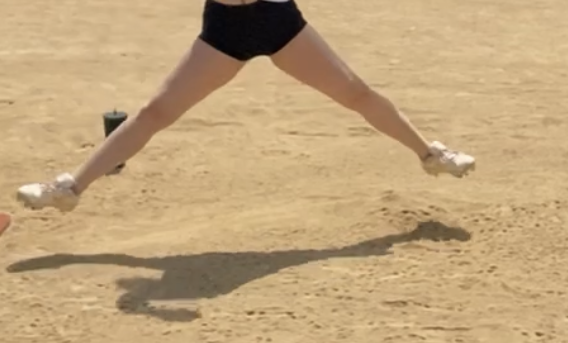
By now you’ve no doubt heard about a very significant change to the fastpitch softball pitching rules in the NCAA, NFHS, and various travel ball level organizations. The rule involves leaping, i.e., having both feet in the air during the stride-out portion of the pitch.
Up until this rule change leaping was illegal, which meant if a pitcher was called for it the batter would automatically be credited with a ball, even if the pitch came in fat and happy down the middle. That collective sigh of relief you heard a few weeks ago came from pitchers, their parents, their grandparents and other relatives, their team coaches, their pitching coaches, and other interested parties when it was announced that leaping will now be allowed.

Of course, no change occurs in the fastpitch softball world without some level of angst being generated, and this rule change is no exception. Some are in favor, some are against, but whatever their point of view most are passionate about whatever they think.
That’s why I thought it might be a good idea to go through the pros and cons of leaping while pitching in a more dispassionate way to help everyone understand this change a little more.
But First – Leaping v Crow Hopping
Before we get into the pros and cons I think it’s important to distinguish between leaping, which is now legal, and crow hopping, which remains illegal, because many use the terms interchangeably. Especially coaches who are complaining about an opposing pitcher.
Leaping is what happens when a pitcher strides off the pitching rubber, her back foot loses connection with the ground, and both feet are in the air at the same time until the front foot lands. Often this is the result of a late push or drive off the pitching rubber by the drive leg.
Most people consider there to be no particular advantage to leaping, and in fact it might actually reduce a pitcher’s speed a little. Leaping is now allowed since the rule change.
Crow hopping starts out the same way as a leap, with both feet off the ground. The difference, though, is that the drive leg lands first AND THEN there is a second push-off. This gives the pitcher an advantage because she is essentially starting her pitch from a much closer distance – generally six to eight feet.
This shorter closing distance gives the batter less time to react, essentially making the pitcher appear to be faster than she actually is. Crow hopping is still not allowed by the rules.
Pros of the Leaping Rule Change
The biggest pro of the change to allow leaping IMHO is it theoretically eliminates opposing coaches trying to get a successful pitcher pulled out of a game, or get into a pitcher’s head to the point where she is no longer effective, by complaining that she is leaping (or crow hopping as most say). Because what can be better than a grown man or woman playing head games with a 12 year old?
Think of all the time and animosity that will be saved by not arguing about whether a pitcher is legal or illegal because her back foot came an inch or two off the ground. In today’s world of timed games that alone will be a plus.
Another pro is it gives pitchers the opportunity to learn their craft without having to worry about whether their back foot is coming off the ground. Pitching is hard enough; removing a meaningless obstacle to learning it enables budding pitchers to focus on the mechanics that will help them develop and grow.
Finally, it saves the umpires (especially the ones working solo) from having to watch for and call pitchers for leaping. With that off their plates they can focus on things that are far more important to the outcome of the game – such as calling balls and strikes or runners leaving early on a steal or a fly ball.
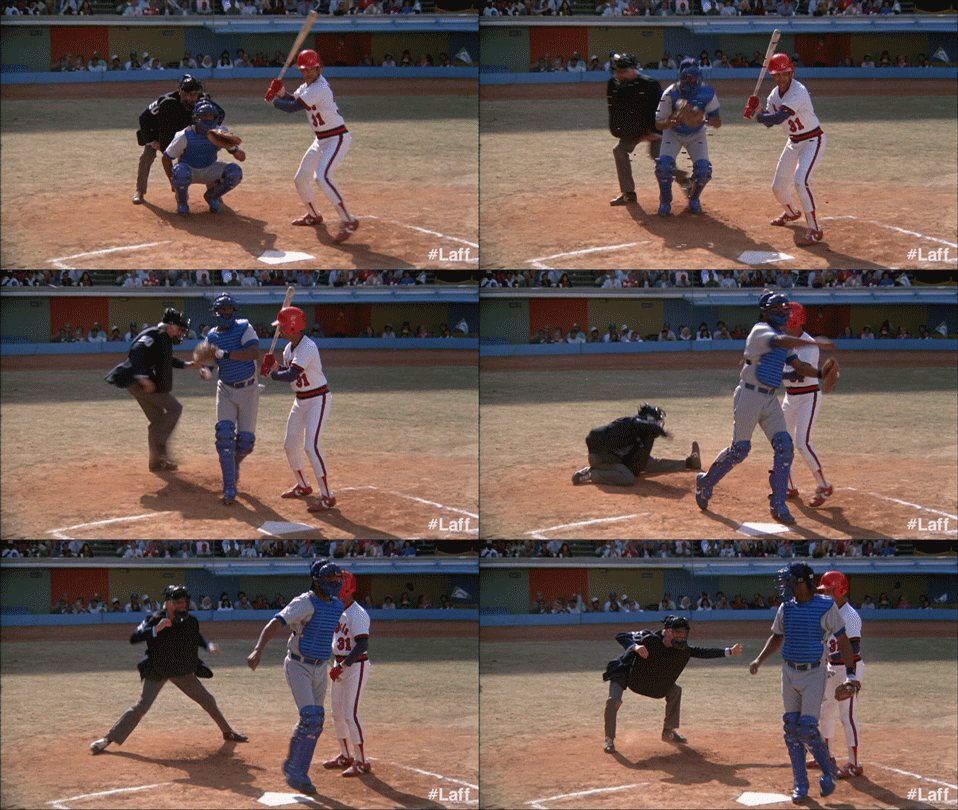
Again, in my opinion and the opinions of many other pitching coaches there is no real advantage gained by a leap, so it’s essentially no harm, no foul.
Cons of the Leaping Rule Change
The biggest con to the rule change is that leaping is kind of a gateway to crow hopping. If you stop calling leaping, umpires may eventually quit calling crow hopping, which will then give pitchers an unfair advantage.
We’ve seen this in the men’s game. Many of the top men’s pitchers crow hop and don’t get called for it because umpires seem to have given up worrying about it.
Will that happen in women’s fastpitch as well? Time will tell.
Another con to leaping is that mechanics are not as efficient, which means pitchers may actually be giving up a little speed, accuracy, or movement. Many will not be able to transfer as much energy into the ball because their posture or timing (or both) is off, and they may not be able to get their arms and/or hands into the optimal position for delivery.
If no one is worried about proper leg drive because pitchers won’t be called for leaping it could lead to pitchers not achieving their full potential. Pitching coaches will quit looking for it and pitchers will never make the effort to correct it.
I fully believe that a pitcher who can keep herself stacked properly over the back side will pitch better than if she strides in a way that pulls her back foot off the ground prematurely. That’s just biomechanics and physics.
Finally, there is the health and safety issue. Pitchers who leap, especially if they go after with with enthusiasm because it’s no longer illegal, will put themselves at greater risk of ankle, knee, hip, and back injuries, particularly in the lower lumbar region.
The weight-forward, body-forward posture most leapers have will cause more strain as they collide with the ground. Over time, those repetitive out-of-balance landings can lead to injuries that could put a pitcher out of action for a month, several months, a year, or even longer.
And then she’ll have to relearn proper technique anyway to avoid future injuries. Why not just start from a safer technique and go from there?
Choose Wisely
The bottom line for me is that the rule change is a good thing from a practical, in-game point of view, but it shouldn’t be considered carte blanche to use poor technique.
I will still strive to teach my students how to drive more efficiently, with their drive foot on the ground. But if they do come up a little, I’m glad to know it’s not going to cost them the game anymore.






 Life in the Fastpitch Lane