Category Archives: Pitching
Product Review: Portolite Signature Spiked Practice Mat
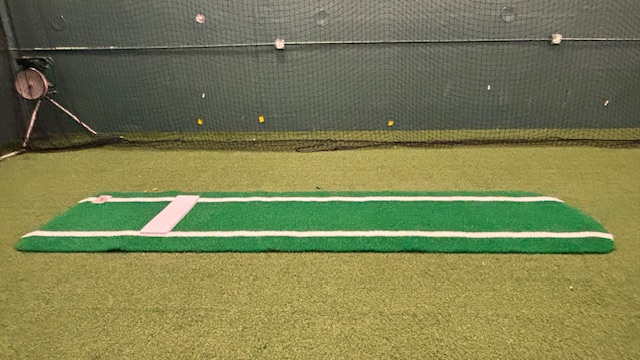
Having a good-quality practice mat for indoor pitching practice is an essential to me. It helps cut down on “gym stepping” (taking a step forward with the pivot foot before launch) and gives some good feedback about the direction the pitcher is going and distance the she is covering in the drive phase of the pitch.
For years I have used a mat designed for use on turf. It was good for two of the facilities I work at, both of which have very low-pile, carpet-like turf. But at the third, which has turf that is a little more grass-like, I found that the mat would slide forward and turn toward the throwing hand-side after two or three pitches for all but the smallest girls. Which meant that I would have to stop the lesson and readjust the mat pretty frequently.
The solution I came up with was to turn the mat backwards so the pitcher could use the pitching rubber to push off of but would then land on the regular turf. It solved the problem of the turning mat, but made it kind of pointless to have an 8 foot long mat since most of the mat would be in the opposite direction to which she was going.
Finally, I decided to do what we all do in these frustrating situations – search the Internet for a solution. I finally found one I thought would work: the Portolite Signature Spiked Practice Mat. I have used and liked Portolite products before, so it definitely caught my interest.
But the cost was a little high, which caused me to hesitate before pulling the trigger (more on that later). Finally, I saw a Black Friday sale and decided to roll the dice.

I’m glad I did, because it is definitely up to the task of staying in place on higher turf, even with the biggest/strongest/heaviest pitchers. No more turning, no more sliding forward, no more resetting the mat every few pitches.
You just lay it down wherever you want it and it stays there for hours or even days without having to touch it. Here’s a little more in-depth look.
(NOTE: There are no promotional considerations for this review. I purchased the mat as a consumer and am not being paid to write this review. Just thought you should know.)
Basic construction
The mat definitely features high-quality construction. The turf side is thick and built to hold up to heavy use, and the back side appears to be made of heavy-duty rubber. The two are attached seamlessly and look like they will hold up for years without splitting apart.
(For contrast, the turf and backing on my Jennie Finch mats began separating at the front edge shortly after I got them, and I occasionally have to glue them back together to reduce the chances of them coming apart completely or having a pitcher trip over them.)
The pitching rubber isn’t just glued to the mat – it is bolted on with four bolt and nut combinations that are incorporated somehow into the rubber then stick out of the bottom.
I don’t think that pitching rubber is going anywhere. This construction also means (according to the manufacturer) that you can replace the pitching rubber at a later date if it gets too worn or damaged.
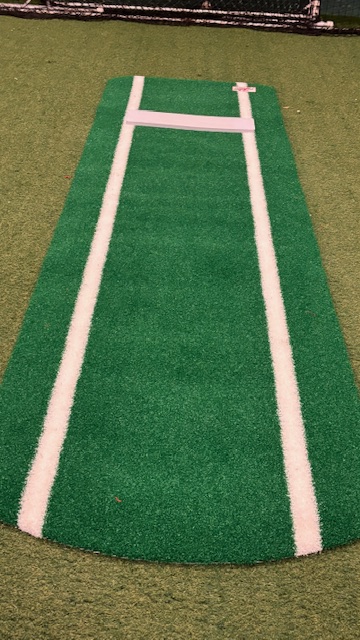
The overall length of the mat is 3 feet wide by 11 feet long, with 8 feet from the rubber to the end of the mat. That should be sufficient for most pitchers, while also leaving a generous 3 feet on the back side so both feet can start on the mat, even with a deep drop back.

The lines appear to be deeply sublimated or otherwise embedded into the turf so I don’t think you I have to worry about them wearing away any time soon. I wish there was a center line instead of (or in addition to) the two lines extending down either side from the pitching rubber, since I think that makes a good reference for pitchers.
But it’s not a deal-breaker, and I suppose I’ll get used to it. You can also order the mat with no lines if you prefer.
The turf comes in three colors – green, red, and clay – so you can choose the one that suits you best. I’ve always had and liked green mats so that’s what I went with. It’s a bright green right now, but we’ll see how it holds up after hundreds of shoes have slid across it.
I can’t speak to the durability yet since I’ve only been using it a few weeks. But it looks like it ought to hold up for years.
One other thing that takes a little getting used to is that it feels a little spongier than the other mats when you walk or land on it. That’s probably good for young backs and knees versus landing on hard concrete with just a thin piece of carpet over it.
The Spiked Side
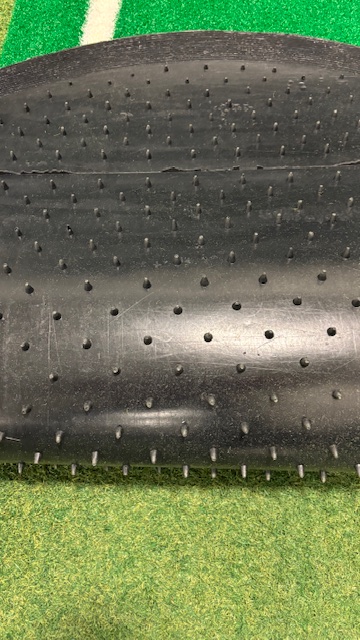
Here’s where the real magic happens, at least for me. As I said, the whole reason I purchased the mat was to try to solve the problem of the mat slipping on the turf. It has definitely done that.
The key is the 1,200 little spikes on the bottom side. They are molded as a part of the heavy-duty rubber backing, creating a plethora of individual grip points.
As pitching people know, the goal is to land into the front foot like an airplane rather than on top of it like a helicopter. That momentum is what can cause the mat to twist or slide forward.
With the Portolite mat, though, all those little spikes distribute the landing load throughout the mat so it stays in place easily. I have yet to have to make any adjustments, other than to change the distance for different age pitchers.
But once it’s down, it’s down until you pick it up and move it. So yes, total success for the goal I had.
And in case you were wondering, while it does leave a pattern of little indentations when you first pull it up to move it or put it away, those indentations go away quickly, leaving the base turf looking like it did before you laid the mat down. That’s important if you’re in a shared space like I am.
Heavy weight
Another reason I think it stays in place so well is that the mat itself is heavy – probably due to the molded rubber backing. It weighs 30 lbs., which is roughly 50% more than my other mats that clock in at 23 lbs.
That’s great for functional use, but it can be a challenge if you have to carry the mat for any distance. I’m a pretty big guy so I can handle it, but it’s definitely something to consider if you are on the smaller side or not particularly strong. It will give you a workout.

I wish it came with a little carrying pouch like other brands do, which I think would make it easier to transport. Then again, because of the construction the Portolite mat doesn’t roll up as tight without great effort so maybe it would be difficult to get one in an appropriate size.
Either way, right now I have to roll it up and grab it by either end to move it around the facility, It’s the one time when I miss the other mat.
The cost
Earlier on I mentioned that it’s not cheap. The current price on the Portolite website (as of January, 2026) is $999 USD.
When I first saw that I decided to roll the dice and see if there might be a Black Friday sale since it was getting close to the holidays. My gamble was rewarded, and I was able to purchase it for $799.. Add in the tax and shipping and it was $935 out the door – still expensive but every little bit helps.
Assuming it lasts for several years (as it appears it will), it’s not so bad. For example, at 5 years of use that $935 works out to $187 per year. Add in the savings on chiropractors for not having to constantly bend over to reset the mat and it’s a pretty good bargain.
More options
Portolite has some other mat options in addition to the one I purchased, including a shorter throw-down mat for $299 and their Pro Spiked Game Mat for $1,899. The short mat would be great, I suppose, if you don’t need the full length for your pitcher to land on (or you don’t want to carry a 40 lb. mat around).
The game mat is similar to the practice mat but I believe the turf is even heavier duty, it includes 1,700 spikes (versus 1,200 for the practice mat), and it weighs 60 lbs. Clearly it is made to hold up to heavy use and abuse, even on outdoor surfaces.
I know of at least one program that is planning to purchase a couple to use on dirt to try to eliminate the dreaded “pitcher’s trough” that happens after multiple games in a day.
The bottom line
When I was first looking at this mat I was concerned because it was a lot of money to pay for something that I wasn’t 100% sure would solve the issue. But I am happy to report that it did solve the sliding/turning problem, and my pitchers like using it.
So if you’re having similar issues, know that you can purchase this pitching mat with confidence. Time will tell how well it holds up (maybe I’ll share a report on that sometime in the future) but I can definitely recommend it as a solution for the immediate need.
Product Review: pitchLogic Softball

For those who have been hiding under a softball-shaped rock over the last few years, data has become an increasingly important part of our sport. Whether it’s statistics about on-base percentages, whiff percentages by pitch location, how much external rotation is being achieved, or other detailed metrics, coaches at all levels are looking to quantify what their athletes are doing to help improve performance.
This obsession also applies to what happens when a pitcher throws a specific type of pitch. Speed is obviously one important metric that has been easily measurable for a number of years, whether it was with a Stalker or Jugs radar gun or more recently with the advent of the PocketRadar.
The other two parameters that are normally listed along with speed are spin and spot, i.e., how the ball is spinning and whether it goes to the location it was supposed to. Spot is fairly easy to determine with your eyes alone; if you know where the ball was supposed to go you should be able to see whether it went there.
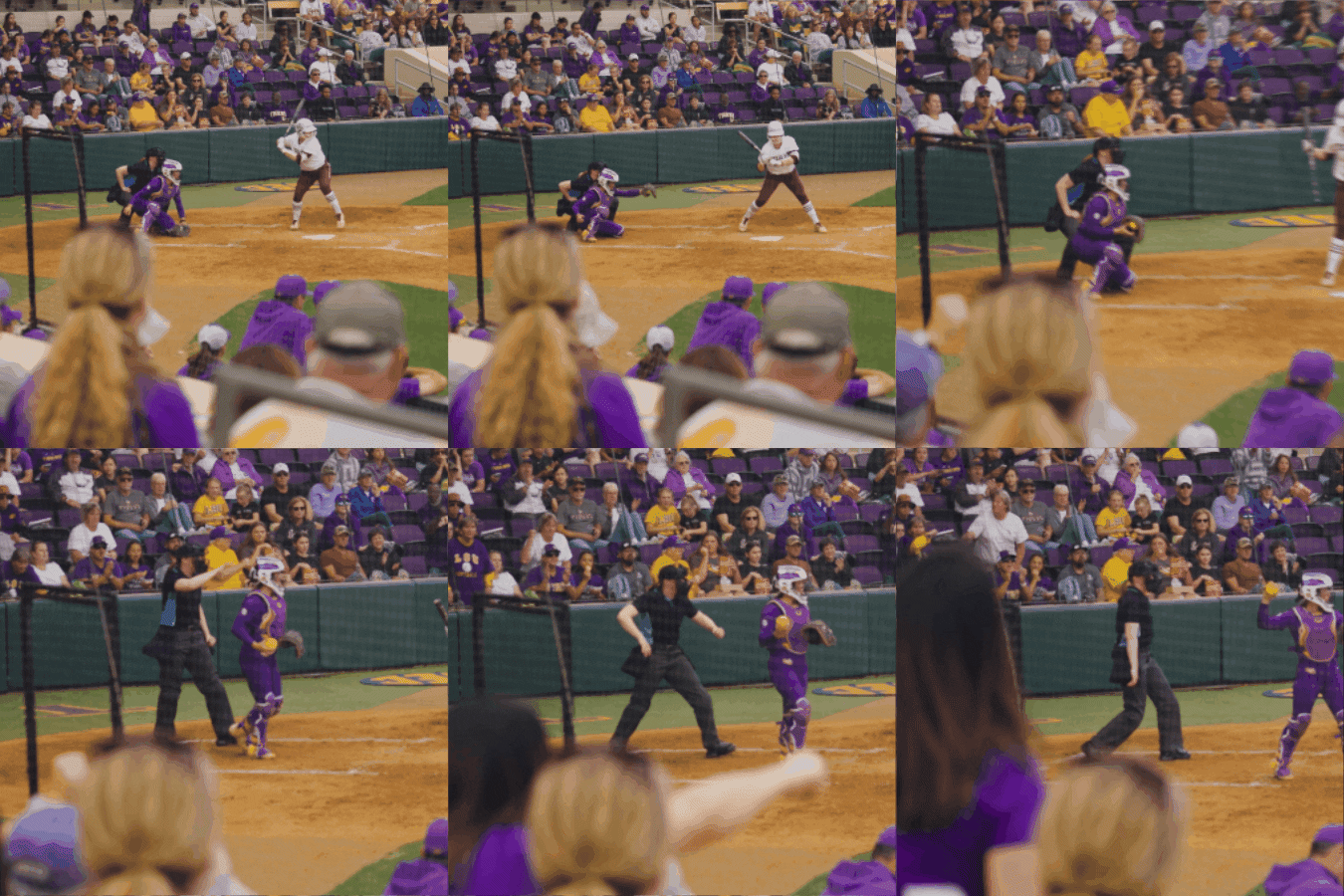
That leaves spin. One simple way to determine whether a ball had the correct spin is to mark a stripe or color the seams to make it easier to see the spin direction, then compare that to what is expected for that pitch.
For example, if you’re throwing a curve ball was the spin direction going around the ball at the “equator” (middle of the ball), going from pole to pole (top to bottom or bottom to top), or some variation in between? You also want to see where the spin axis (the point the ball spins around) was, because an improperly oriented spin axis will generally have a negative effect on the quality of the movement.
You can see all of that with your eyes, but it’s still difficult to quantify. And you totally miss another important factor in ball movement: how fast the ball was spinning. You can see if it’s fast or slow, but not HOW fast or HOW slow, which also affects how sharply the ball will break, thus making it harder to hit.
A Rapodo system will give you those types of answers, but those cost thousands of dollars which puts them out of the reach of most individual coaches and bucket parents. You pretty much have to go to a camp, clinic, or measurement event to capture that data, and even then it’s only a single snapshot in time.
In the past, you had the RevFire ball or the Diamond Kinetics ball, which were far more affordable to the average user. But both of those have been long been relegated to the ash heap of history; you can probably still find one on eBay somewhere but all technology has a “best by” date and both of those are long past it.
Fortunately, a new entry into this category was introduced in 2025: the pitchLogic softball. F5 Sports, the manufacturer of pitchLogic balls, has had a baseball version for several years that has become quite popular.
They have now taken that same technology and applied it to fastpitch softball. But is it worth the investment, i.e., does it do the job? The short answer is yes.
If you’re serious about measuring spin direction, spin rate, spin efficiency, and a whole bunch of other parameters and don’t want to break the bank (or your marriage) to do it, you’re going to want to look into this innovative product. Let’s break it down in more detail.
What’s In the Box
This part is pretty simple. It comes with one pitchLogic softball, a Qi-type platform charger, and a short USB A to USB micro cable to connect the charger to a power source. The charger has a small indent in it to keep the ball in place while charging – no O ring necessary (DK ball users know what I’m talking about).
How It Works: The Basics
The pitchLogic softball system consists of two components: a ball with a microchip or some other technological magic inside of it and a free companion app, which you can download from the Apple App Store or Google Play once the ball arrives. The two are connected via Bluetooth, which means you don’t have to have a WiFi signal available to use it.
There are two versions to the app: a player version and a coach version. If you’re a bucket parent who wants to measure your own daughter’s performance and progress, the player version will do you just fine.
It will capture the data from each throw and store it in the cloud for you so you can review it later or even share it with college (or other) coaches. Since you’re only using it with one pitcher it’s really all you need.
The coach version allows you to create a roster so you can track the performance of multiple players, separating them into individual sessions so you can access them as-needed. You just have to remember to select the correct player before you start the session – nota difficult skill but one I’ve already failed on once.
Setting up a player on a roster is easy to do, too. You click on the roster button at the top of the app, click Manage, then click on the plus sign (+) and fill in the requested data. If you want to remove someone from the roster later you click on the minus (-) sign and they are deleted.
The player management section also gives you the ability to share all the data with the pitcher automatically by inputting her (or her parent’s) email address. They will then receive a link that enables them to check it all out themselves whenever they want.
When I purchased the ball it came with five roster spots. If you’re a team coach that’s probably plenty; if you’re an instructor like me it’s not nearly enough, but fortunately you can purchase additional roster spots for an added cost.
Capturing Pitches
Whichever version you have, once the proper player is selected and the ball has been paired to your device, you click on the start session button and then select which type of pitch the pitcher is throwing so it can be tagged in the records. You don’t have to tag the pitches, but it’s definitely helpful, especially when you go back a few days later to review the data or if you want to send it to someone else. Helps to know what type of pitch was being thrown.
The pitcher then throws the pitch and the data immediately shows up on your device’s screen. I generally just use my iPhone because it’s handy, and the key information is pretty readable even to my old eyes.

Hopefully in the future they will add the ability to zoom in by pinching the screen, which would make it even easier while helping the pitcher focus on the right information.
The only caution is that the pitcher has to keep the ball still before she throws the pitch or the app won’t read it. If you have someone who likes to twizzle the ball or spin it in her glove before she throws she’s going to have to remember not to do that for the duration of the session.
So far, I have found that the pitchLogic softball records most, but not all, of the pitches thrown. I’d say it’s around 95% success. Every now and then it will miss one, but it usually captures the next one.
If you have a few missed pitches in a row, stopping the session and then restarting it usually solves the problem. Worst case you can close the app and restart it to reset everything. So far I have not had it totally shut down.
The Data
Ok, here’s where it gets fun. It starts with the clock face, which appears on the top or top left depending on whether you orient your device in portrait or landscape mode. For simplicity I am going to refer to everything’s position in landscape mode.

The clock face gives you three important pieces of data at a glance: the spin direction in blue (including the orientation of the ball), the arm slot in oranage (where the arm was at release), and the last touch on the bal in a darker orange or rust colorl. If your pitcher is having trouble with her spin orientation, that last touch info can be helpful in diagnosing it.
The blue arrow shows the direction in which the ball was spinning. For example, a “perfect” riseball will point to 12:00, a “perfect” drop ball will point to 6:00, and so on. The blue ring shows the orientation of the ball as it is spinning.
So let’s say a right-hander throws a curveball and the arrow points to 9:00, which is the perfect spin for left-to-right. But instead of the ring part being pretty much flat it is a near-perfect circle. That tells you that even though the spin direction was good, the spin axis is tipped either too far forward (most likely) or backward toward the pitcher (unlikely but you never know).
You now know that even though the spin direction was good, you still need to make adjustments to get better, tighter break on the ball. This relationship is also shown under “spin efficiency” at the bottom.
The closer the arrow and ring are being aligned, the higher the efficiency and again the better the pitch will break. Honestly, even though I’d heard that explanation it took me a little time to truly understand. Good news is once you get it it’s pretty easy to understand from then on.
Other metrics that appear along the bottom include pitch speed, total spin or spin rate in revolutions per minute, vertical movement, horizontal movement, spin efficiency (see above), and spin/velocity ratio. Here’s a quick explanation/evaluation of those metrics:
- Speed – How fast the ball is moving. Most people I know who use the pitchLogic softball tend to disregard this reading as it can vary from what a dedicated radar will read. The explanation I’ve heard is that it measures the speed immediately out of the hand whereas a radar gun takes multiple measurements along the ball’s flight path and averages them. The speed readings are sometimes fun to look at but I wouldn’t personally use those as the official measurement because it’s not repeatable when a radar gun is being used.
- Total spin – Super important reading. The faster the ball is spinning the better the pitch will perform, providing it’s thrown well to begin with. You want to push those spin speeds up high, so definitely want to pay attention here. For those who still think in terms of RevFire’s revolutions per second, you can use a little math to draw up a correlation chart.
- Vertical movement – A prediction of how far up or down the ball will deviate from a straight line out if thrown on a straight line out. Upward movement is shown as a positive number, downward as a negative number. Be aware, though, that it doesn’t record the actual movement, just the expectation. I’ve seen riseballs that went straight down with great spin get shown to have pretty significant upward movement so use with caution.
- Horizontal movement – Same as vertical movement, but left to right, with left movement shown as a negative umber right movement as a positive number.
- Spin efficiency – As noted above, this is how much the spin direction and orientation of the ball align with each other. For a curveball, a 9:00 reading with a flat ring would be 100%. You want to shoot for 90% and above. Realistically, you may be surprised how low the efficiency is in the beginning, even on pitches that appear to move well.
- Spin/velo ratio – I haven’t used this one much. I think you have to establish a baseline of speed with a fastball first. Then you’ll see with this reading how close other pitches are to the fastball’s maximum velocity. If that’s not correct hopefully someone will clarify but at this point that’s my understanding.
Those are the home screen parameters. But as they say on the TV commercials, wait! There’s more!

Tucked behind the home screen tabs are additional tabs. For example, in addition to the clock reading you can also see a scatter chart of all pitches for that session (based on the predictions, not actual performance), video if you shot some video (more on that later), and a 3D representation of actual ball trajectory that you can view from different angles by dragging the picture with your finger.

The section on the right, besides showing the basic input screen, also has tabs that let you review specific sessions for that pitcher, each pitch that was recorded, and a more detailed metrics page that shows more in-depth data than the home screen. In portrait view, the “All Metrics” tab appears next to the focus metrics listed in the bullets above.
Reporting

As cool as the in-app data is, the pitchLogic softball can also generate a web-based report that shows you graphs and scatter charts for the entire session that make it easy to see how well the pitcher performed that day. You can also share this information with the pitcher, her parents, or other coaches by copying and pasting the web link into a standard email, text, or other type of message.
Video capabilities included
Another nice feature is the ability to shoot video of the pitch and have it embedded with the rest of the information. I find this very helpful for when a pitcher is struggling to get the correct spin.
For example, one girl was getting good apparent movement on her curve but the metrics said she had more of a dropball release. After shooting video we saw that her wrist was extended back instead of flexed upward going into release.
That visual helped her correct the issue and improve her metrics almost instantly. Seeing, in this case, was definitely believing.
Durability
We all know a tool like this can take a beating, especially if you use it a lot. So far, mine has held up well despite hitting concrete floors barely covered by turf, catcher’s equipment, metal backstops, and whatever else is around for an errant ball to hit.
A nice additional perk is that the manufacturer offers you the option of replacing the cover of the ball every six months on-demand and at no charge. No need to worry if it gets nicked, or if the cover starts to show wear or get slick. They literally have you covered.
Customer Service
This is another area where the pitchLogic softball manufacturer F5 Sports excels. I bought one of the “first run” balls, which had some issues. When I contacted them the people at F5 immediately acknowledged they were having some issues and said they would replace the ball as soon as they had worked out the kinks.
They were as good as their word. The new ball has sat in the trunk of my car through blistering heat and below-freezing temperatures and continues to work great.
That said, their website could use some improvement. For example, there is no place to purchase extra player accounts on the website – you have to contact them to do it. Being able to place an order like that online, with no human interaction, would be much more efficient.
Cost
By now you’re probably wondering what does all this wonderfulness cost? It’s not cheap, but i’s not crazy either.
An individual one-year membership, which includes the ball, the app, and the re-covering option, costs $300. You can save a little money with the two-year membership, which costs $495. Both options require you to pay the full amount up-front.
The website doesn’t list a price for the Coach option that allows for multiple players (and coaches), but I believe the annual subscription is $500. At least that’s what I recall them saying, although the final price depends on how many roster spots you need to include.
Again, not cheap, but when compared to the other options for capturing this type of information it’s a bargain. Especially when you realize it’s much simpler to operate and not fussy at all about how you set it up.
Recommended
The bottom line is that the pitchLogic softball is a tremendous tool for training pitchers to learn how to spin the ball properly in order to maximize their effectiveness in this important parameter.
Whether you want to help just your own daughters/players or you’re helping multiple students, the pitchLogic softball is a smart, high-value investment. If you have the means, I highly recommend purchasing one sooner rather than later. You’ll be glad you did.
New Speed High Posts Are About More than Just Speed

Anyone who follows Life in the Fastpitch Lane on Facebook (which I highly recommend you do) knows that I do a post on every pitching student who achieves a new personal best. They can be new students, longtime students, students who have impressive achievements, students about whom you might wonder, “Why is he bragging about that?”
Doesn’t matter, if they do it I’m sharing it. I’m proud of every single one of them because of what it means to them.
But of course there’s always someone who likes to rain on the ol’ parade, and this is no different. I recently saw a Facebook post putting down the idea of celebrating speed achievements, arguing that other factors such as spin and spot are more important, and basically saying we shouldn’t celebrate speed so much.
So I thought it might be worthwhile to address why I do these posts, the thinking behind them as well as the practical realities. There are actually a few factors. Let’s start with…
It’s measurable and empirical (mostly)
Measuring speed is relatively easy. You set up a radar, point it toward the pitcher, and have her throw. You then get a number which you can compare to the numbers that came before it.
Thanks to products such as the Pocket Radar it’s also relatively inexpensive. For example, you can pick up a Smart Coach for $399 or a Ball Coach for $299, (even less during Black Friday or another sale) which is a whole lot less costly than a Jugs or a Stalker, and it works just as well.
That means these days just about anyone can acquire a radar and start taking readings. While there are ways to game a radar to get a higher number (such as moving it toward the pitch while it’s in flight), if you just set it up so it’s stationary the numbers you get will be pretty consistent from pitch to pitch.
Until recently, to gather data for spin and spot you would need a $5,000 Rapsodo setup or a Trackman system that costs so much they don’t even list a price on their website. Not exactly in the budget of the average pitcher parent.
The new PitchLogic ball from F5 Sports is showing a lot of promise in this area, making it far more affordable for families to keep on hand and use whenever they want. But right now speed is still the easiest thing to measure.
It shows (and rewards) progress
While there are no doubt people who love the radar numbers for the bragging rights, that’s not how I see them. For me, it’s more about showing progress and rewarding the work it took to get there.
Seeing a photo posted and reading a story about them can give pitchers incentive to keep working hard and striving for more. It can help them feel good about the long, boring grind that’s involved in getting better.

Now, I will admit if they’re not showing progress it can be a little discouraging. But what’s important to remember in those cases is that it’s not linear.
A pitcher can get some gains, but then hit a plateau or even backtrack a little depending on a number of factors, such as a sudden growth spurt, their emotional state, health and nutrition and other factors. They may also have a case where they made certain mechanical improvements but then have to make others before the next personal best can be reached.
Even then, though, having a tangible data point such as a readout on a radar can help them keep working until it all comes together again. And the feedback they’re getting from the radar can be invaluable in telling them whether further adjustments are required.
It’s a controllable
While it’s true that stats such as overall strike percentage, first strike percentage, earned run average, and other pitching stats that appear in GameChanger are good indicators of effectiveness, they are not within the pitcher’s control.
An umpire with a tight strike zone (as so many seem to have these days) may be calling pitches a tracking system would classify strikes as balls. The official team scorer may mark reached on error plays as hits, tanking the pitcher’s ERA.
The ball may have done exactly what it was supposed to do when thrown and the hitter just did a good job of getting her bat on it. Doesn’t mean it was a bad pitch, but it sure looks like one in the box score.
The speed is the speed whether the pitch is hit, missed, or watched, and regardless of what the umpire thinks it is. Throwing hard is something the pitcher can control, so measuring in-game speed in particular will show if she’s giving it her all or pitching scared.
That can be invaluable feedback for future physical and mental training.
It’s easy to understand
Many of the people who read these types of posts aren’t necessarily softball people. They’re family, friends, co-workers, neighbors, and others who like to read success stories about kids.
Posting a story that pitcher A hit 25 revolutions per second or 2500 revolutions per minute on her riseball with 83% efficiency and six inches of vertical movement is probably going to be tough for the non-softball fanatic to understand.
Heck, there are a lot of coaches who don’t actually know how to read those numbers.

But saying pitcher A was throwing 52 mph and is now throwing 53 mph is something pretty much anyone can understand. Friends and family can say wow, great job and be confident that it really was something to celebrate.
That makes everyone feel good. Grandma might even bake some cookies to celebrate.
Final word
The truth is some of the most effective pitchers in terms of getting hitters out quickly weren’t the fastest pitchers in the tournament, but they had great command of their pitches.
At the same time, though, their effectiveness went up as their speed increased. Speed may not be everything, but a lack of speed isn’t anything.
It’s going to get you beat up more times than not, especially as you get older and hitters get better.
So the next time you see a post talking about a new speed high, don’t try to run it down, and don’t feel bad if your pitcher isn’t rising to the same standard yet. Everyone is on their own journey, and everyone has their own ceiling.
Instead, celebrate that a young lady has seen improvement in one aspect of her game, and trust that she’s also working on the rest. Everything else will sort itself out over time.
Help for Pitchers Who Are Banging Their Elbows Into Their Hips

It’s more common than you might think: pitchers, especially those who are trying to keep their pitching arms in close to their bodies (as they should) suddenly start feeling slight to intense pain as they go into release. Once it catches their attention, they realize their elbows are hitting their hips. HARD.
Well-meaning coaches, other pitcher parents, and even some random people will tell them to solve the issue they should clear their hip out of the way or bend out more so their arm totally misses their body as they go into release. While yes, that will solve the immediate issue, it will also create less-than-ideal mechanics that will ultimately limit most pitchers’ ability to compete at a high level.
That’s because compression of the upper arm against the ribcage and light brush contact of the forearm are both essential to stabilizing the shoulder complex to prevent a more serious injury, transfer more energy into the ball to improve speed, and sure consistency of release to improve pitch accuracy/command.
By now you may be asking if that’s the case, why is my pitcher/daughter getting giant bruises on her elbow area and/or hip area while other pitchers are not? The simple answer is because those who are not raising those ugly bruises are making contact differently than those who are.
The bruises are coming from the position the arm and hip are in going into release.
When the bruises are happening, the elbow are is making direct contact with the pelvis (hip bone), crashing into it in a bone-on-bone manner. When they’re not happening, the pitcher is making contact with with the soft tissue (muscle) on the forearm just below the elbow into the muscle (soft tissue) on the side of the hip, interrupting the acceleration of the arm enough to transfer the energy without stopping it completely.
So what causes the elbow to slam into the hip instead of passing by it? I find that typically there are two causes, which can happen either independently or in the worst cases at the same time. Correct those and the problem usually goes away,
Cause #1: Staying Too Open
Every pitcher needs to open her shoulders and hips (externally rotate) to some extent to create an aligned, powerful arm circle. The shoulder in particular is important because when you are facing straight ahead, the arm can only come back so far before it has to deviate off-line.
This deviation stresses the shoulder, leading to injury, and takes the arm out of its ideal movement around the shoulder, affecting both speed and accuracy. Opening the shoulders makes in possible for the arm to move around at incredible speed while using the shoulder the way it’s designed to be used.
The problem occurs when the hips and shoulders don’t come back forward to an area around 35-50 degrees going into delivery. The body then starts blocking the arm, and the pitcher either has to then go around it or slam her elbow into her hip.

Think about where your elbow is when you are just standing normally. It sits squarely on your hips. If it does that while you’re standing still, what makes you think it won’t do that when you’re aggressively trying to throw a pitch.

The cure for this is to move into that 35-50 degree angled range we mentioned earlier. When you are in this position, even standing, your elbow is clear of your hip while allowing your forearm to still make light brush contact with the side of your hip as it passes the hip.
To learn that, have the pitcher do a ton of easy walk-ins, where she starts out facing the plate, then takes an easy step with her throwing-side foot before going into the pitching motion. She should do this slowly, with no leg drive at all, and focus on moving her body open with good external rotation of the shoulders and then back into a roughly 45 degree position.
On the field you can throw a regular ball from a short distance. But at home, have her look into a mirror as she does the movements without a ball, paying attention to how her body is moving and coming back to the finish position.
Ideally, her hips will move a little ahead of her shoulders as she comes down the back side. Once she can do it without a ball, have her throw a rolled up pair of socks or a lightweight foam ball into the mirror, again paying attention to how her body is moving.
You get all the benefits of brush contact while maintaining solid posture (no contorting to move the hips out of the way or throw the shoulders too far off) so the pitcher can pitch pain-free.
Cause #2: Keeping an Arch in Your Back
The second major cause of banging the elbow into the hip in a way that causes injury is having your back arched backwards going into release. This can happen even if you are getting to the 35-50 degree position we talked about above.
At the top of the circle, it is desirable for a pitcher to have her back arched back at least 15 degrees toward first if the pitcher is right-handed or toward third if the pitcher is left-handed. It’s a movement that helps load the muscles in the back so they can help accelerate the arm on the way down. It also helps getting proper external rotation and keeping the arm on-path.
After the peak of the circle, however, the arch should come out and the pitcher should be in some level of flexion by the time she is going into release. In other words, she will be slightly bent toward third if right-handed or toward first if left-handed.
If the arch doesn’t come out, however, it pulls the pitching elbow backwards instead of letting it flow freely through its natural path. When that occurs the pitcher will either bang her elbow into the side or even back of her hip.

She may also try to compensate for this bad position by trying to move her elbow away from that area, causing her to throw low and very inside, which will make pitching even more difficult than it already is.
To solve this issue, the pitcher needs to learn how to come out of the arch as her arm comes down the circle. One way to do that is to have her practice throwing a pair of rolled up socks into a mirror, watching herself to see what position her body is in when overhead and then when releasing the socks.
She should see herself arching at the top then flexing in at the bottom. You can even put a piece of tape on the mirror to help her see it. Have her start slowly, then build her speed until she can execute it without thinking.
Another way to address this issue is a drill I got from Rick Pauly of PaulyGirl Fastpitch called the Bow-Flex-Bow. For this one you will need a piece of Theraband that is at least as long as the pitcher’s arm.
Have her grab both ends of the Theraband and stand at a 45 degree angle, as if getting ready to do a pitching drill. She then takes the Therabad up and into a pitching motion, with both hands moving forward toward the “plate” before starting to separate overhead.
When she is at the top of the circle her back will need to arch to get the Theraband behind her head. As she comes down, make sure she bows back in to come to the finish so instead of arching/flexing back she is now flexing forward.
Baby and Bathwater
No question that banging your elbow into your hip is not only unpleasant but counter-productive for achieving both speed and accuracy. But totally avoiding any contact between the body and the arm isn’t the way to go either.
The issues listed here aren’t the only reason it can happen but they are the two most common. By making the corrections to achieve proper upper arm compression and light brush contact you can stop the pain while improving performance.
Where Have All the Pitchers Gone? 2025 Edition

Two years ago almost to the day I wrote the post below. Sad to say things don’t seem to have gotten any better so I thought it would be worthwhile to re-post it.
I still believe one of the biggest problems is coaches who are so averse to losing that they won’t give their less experienced pitchers the opportunity to develop. Instead, they go with their Aces all the time, even when they don’t need to. For example, in weekday “friendlies” or pool play games, especially when seeding is going to be determined by a blind draw anyway.
Pitchers who don’t get the opportunity to pitch get discouraged and stop doing it. In the meantime, pitchers who are over-pitched develop over-use injuries and then often become unavailable to pitch when they get older.
It all ends up in a perfect storm of not enough pitchers to go around by the time teams get to 15U/16U. Or sometimes even second year 14U.
Teams need pitchers right now like crops need rain. Let’s try to do better at the early ages and give budding pitchers an opportunity to grow.
Because you never know. Today’s gawky, uncoordinated 11 year old may just turn out to be tomorrow’s stud – if she’s given the incentive to stick with it.
Yes, I know, it sounds like a folk song but it’s a legitimate question. Especially now that we are hot and heavy into the softball tryout season.
If you’re following softball-oriented Facebook groups or forums such as Discuss Fastpitch you’re probably seeing this plea a lot, particularly in the older age groups: Impossibly great team looking for one more bracket pitcher to complete our outstanding roster.
With all the 8-10 year olds jumping into the pitching pool you would think there would be a cornucopia of pitching at every level. It’s not unusual to see box scores on GameChanger that show four or five pitchers each getting an inning of work on a regular basis. And it’s been that way for long before GameChanger existed.
So what happened to all those pitchers?

Well, somewhere along the way they stopped pitching. Or maybe even playing the game entirely.
Sure, some probably found that they just didn’t care for the pressure of being in the circle. And some probably found that they didn’t like all the extra work that goes with being a pitcher. All legit, and to each her own.
But I can’t help but think that the rapid shrinking of the pitching pool might in many cases also be driven by team coaches and parents who are more focused on winning 10U or 12U games or trophies than they are on ensuring their players develop properly.
Take the coach who has 5 pitchers on his/her roster but gives 90% of the innings to the #1 pitcher. Yes, it’s nice to win games and tournaments, but if you’re only really giving one pitcher an opportunity to pitch regularly the others won’t develop.
Then they won’t develop, they’ll fall farther behind, get discouraged by their lack of progress as well as their lack of opportunity, and eventually stop pitching. So now four more are out of the pitcher pool for the future.
Oh, and in the meantime the #1 develops an overuse injury and may end up not pitching either.
Then there are the coaches who set impossible standards for their young, developing pitchers. They tell them in order to pitch they need to “hit their spots” 80% of the time.
Not because it’s necessary – really the only “spots” that are important at the 10U level are ball and strike – but because they heard on TV or read an article that said that’s what college pitchers do. Or because they want to use the vague “hit your spots” as an excuse not to pitch a girl who isn’t going to walk in and dominate every game.
So again, she doesn’t get circle time, falls behind, and eventually gives it up because what’s the point of taking lessons and practicing if you never get to pitch, even in “friendlies” or pool play?
Pitching coaches who say they’re teaching 10 or 12 year olds to throw seven pitches aren’t much help either.

Most 10U and 12U pitchers have enough to do mastering a fastball and and a changeup. Having them work on five other pitches – especially with some of the crazy mechanics I’ve seen them try to use – is a recipe for disaster.
Those pitchers never master their fundamentals. So when the hitters get better all those so-called different pitches turn out to be bullet spin fastballs to different locations that are fairly easy to hit. And then they’re out of the pitching pool because they’re getting hammered all the time.
And the list goes on. If we really want to have more pitchers available at 16U and 18U, parents and coaches have to do more to encourage greater success for more pitchers at the younger levels.
Keep them pitching, keep them developing, and give them opportunities to learn their craft – even when they’re bad at it. Then maybe there won’t be so many teams begging for pitchers or fighting over the same ones at the older levels.
My good friend Jay Bolden and I have started a new podcast called “From the Coach’s Mouth” where we interview coaches from all areas and levels of fastpitch softball as well as others who may not be fastpitch people but have lots of interesting ideas to contribute.
You can find it here on Spotify, as well as on Apple Podcasts, Pandora, Stitcher, iHeart Radio, or wherever you get your podcasts. If you’re searching, be sure to put the name in quotes, i.e., “From the Coach’s Mouth” so it goes directly to it.
Give it a listen and let us know what you think. And be sure to hit the Like button and subscribe to Life in the Fastpitch Lane for more content like this.
Lead photo by Pixabay on Pexels.com
Coaches, Stop Putting Pitchers in Games without Warming Them Up

Today’s post was a suggestion from several of my pitching coach colleagues who all shared similar horror stories. As you can probably tell from the title, it comes from their pitching students being put into game situations (usually very difficult ones) without the opportunity for a proper warm-up.
If you’ve been seeing this rest assured you’re not alone. Apparently it’s happening all over the softball world based on the stories I’ve been hearing, and expect to hear in the comments afterward.
Now, let me state up-front that I don’t think too many coaches are doing it intentionally. It’s more a matter of circumstances.
Here’s a typical example. Pitcher A starts the game and is doing fine for three inning. Then, in the fourth, the other team figures her out and starts hitting her, or she starts walking batters like she’s being paid to do it, or a combination of both.
Suddenly the coach realizes he/she needs to bring in a reliever and calls in Pitcher B from first base, or right field, or the bench, or wherever Pitcher B has been spending her time this game. No warning, no warm-ups, just her name called and a frantic gesture to come to the circle.
Of course, Pitcher B isn’t at all ready to come in and pitch effectively, either physically or mentally, so she throws her five allotted warm-up pitches and then proceeds to struggle. In the meantime, the coach gets mad because Pitcher B is not performing up to her usual standards; doubly mad if Pitcher B is normally his/her reliable Ace.
It happens. I’ve seen it happen. I’ve counseled distraught pitchers after it happened, because they feel like they let their teams down, their coaches yelled at them for not pitching their usual games, and in some cases they’ve now lost confidence in their ability to pitch at all.
But the problem isn’t with the pitcher. It’s with the coach who didn’t plan ahead and perhaps doesn’t understand that going in to pitch is a little different than subbing in at second base or shortstop or center field.

There is a reason pitchers typically warm up for anywhere from 10 to 40 minutes or more. Pitching a softball well requires a complex set of movements that are unique to that position and that must be precisely timed.
A little stiffness here, a little imbalance there, and the whole mechanism is off enough to cause pitchers to struggle. It doesn’t take much. It also requires a certain rhythm that must be found before the pitcher is ready to go full-out. And that’s just for a basic fastball.
Each pitch also needs its own warm-up time to help the pitcher home in on the precise mechanics that will make it do what it’s supposed to do, whether it’s to move in a certain direction, give the impression it will come in at a different speed, or do something else that will cause the batter to either swing and miss or hit the ball weakly.
On top of all that, pitchers need that warm-up time to prepare themselves mentally for the battles ahead. They need to find their inner calm or inner fire or whatever it is they use to help them compete, and they need to feel ready to face the trial by fire that is inherent in the position.
None of that will happen if the pitcher is suddenly yanked into the game and given five warm-ups. It also won’t happen if a pitcher is pulled from the game or the bench and told to go warm up quickly and then two minutes later the coach is asking “Are you ready yet?”
Oh, but you say, the pitcher warmed up before the game. I guess that’s better than nothing, but just barely. Keep in mind that that warm-up likely happened more than an hour ago.
In the ensuing time most if not all of the benefits of warming up have been lost. The pitcher’s motion is cold (even if the arm isn’t), her rhythm has been lost, and her mind has been focused elsewhere.
It’s almost the same as saying she warmed up before the game yesterday so should be ready today. In pitching terms, that hour is so long ago it’s as if it never happened.
I understand that there are times when it’s unavoidable. Sometimes the pitcher gets injured, whether it’s taking a line drive off the bat, having a runner slide into her on a play at the plate, getting hit by a wild pitch when she’s batting, or twisting her ankle landing halfway into a hole that resulted from no one dragging or raking the field after the first of the day was thrown.

At that point someone has to take over. In these types of emergency scenarios it’s important for coaches to keep their expectations (and their game plans) realistic.
Keep pitching calling simple (fastballs and changeups most likely) and don’t be surprised or express disappointment or anger if the pitcher isn’t as effective as she usually is. She’s trying, coach.
In any other situation, remember these wise words: Your lack of planning does not constitute my emergency.
Even when things are going well, coaches should have a backup plan in place. Keep a pitcher warmed up and ready to go in at a moment’s notice, just in case whoever is in right now needs to come out. Unless there is a huge disparity, a warmed up #3 will probably do better than a cold #2, or even a cold #1.
Also keep in mind the health and safety factor. A pitcher who has not gone through a proper warm-up is at higher risk of injury, especially in and around joins like the shoulders, elbows, knees, and ankles. Giving your pitchers adequate time to warm up before heading into that stressful, high-impact position will make it far more likely she’s ready to go not just this time but the next time you need her too.
Pitching is hard enough on the body, the mind, the emotions, and the spirit. Don’t make it harder by pulling a pitcher in without a warm-up.
With a little planning and forethought you can keep your pitchers healthier and produce better results for the team.
Parent Catchers: Please Take a Seat

Let’s get this out of the way right away: I’m not trying to tell you not to catch for your daughters. That time behind the plate as your daughter is learning to pitch is some of the best time you’ll ever spend with her.
No, I’m talking about the position you’re in as you take your place behind the plate. This advice is based on a phenomenon I’ve noticed over the years, but particularly recently, and especially with younger pitchers just learning control.
Parents who catch for their daughters are colloquially referred to as “bucket dads” or “bucket moms” because of their habit of sitting on a bucket to catch. The term is sometimes used self effacingly when giving advice (“I’m just a bucket dad but I think…”) or as a derogatory term (“if we could just get all the bucket moms to keep quiet…”).

But it turns out, that position on the bucket might just be the best thing for pitchers who are struggling with throwing high.
Over the winter I had a few parents who decided not to use the bucket. But rather than squatting down behind the plate (which can be a challenge for some), they decided to just bend at the waist.
I began to notice that those pitchers were tending to throw high. So, I started asking the parents to either sit on a bucket or squat and whaddya know? All of a sudden pitches that were going high started coming in hot in the strike zone instead.
It makes sense. When a parent (or any catcher) is standing up, the target or focal point of the pitcher’s eyes tend to stay up with it. The eyes are critical to throwing at a target (especially the dominant eye), so if the eyes are being drawn upward due to the catcher’s posture the pitcher will tend to throw high – even if the glove is hanging down.

By squatting or sitting, the pitcher’s eyes are drawn into the strike zone, making it easier for her to throw strikes.
If you have a pitcher who can’t quite seem to bring the ball down or hit low locations while you’re standing up, grab a bucket and give this trick a try. It just might help her build better habits that translate into better results in a game.
My good friend Jay Bolden and I have started a new podcast called “From the Coach’s Mouth” where we interview coaches from all areas and levels of fastpitch softball as well as others who may not be fastpitch people but have lots of interesting ideas to contribute.
You can find it here on Spotify, as well as on Apple Podcasts, Pandora, Stitcher, iHeart Radio, or wherever you get your podcasts. If you’re searching, be sure to put the name in quotes, i.e., “From the Coach’s Mouth” so it goes directly to it.
Give it a listen and let us know what you think. And be sure to hit the Like button and subscribe to Life in the Fastpitch Lane for more content like this.
Two Quick Tips to Help with Pitching Accuracy

One of the biggest deterrents to developing quality pitchers for the long haul is emphasizing accuracy over good mechanics in the early years. Yes, it’s tough to watch a young pitcher struggle with control, and it’s really tempting to tell her to just do whatever to get the ball over the plate so she isn’t walking everyone.
But that type of thinking places the emphasis on outcomes instead of the process. And as anyone who has ever taught anyone to be good at anything can you, if you keep your focus on the process the outcomes will take care of themselves.
Still, we’re at the time of the year where accuracy does, in fact, matter a lot. So how do you get your young pitchers to improve their strikes to balls ratio while keeping them focused on the process?
Following are a couple of tricks you can try.
Set up a barrier to block the problem area
This is one of my favorite. In fact, I’ve probably written about it before but it bears repeating here.
Let’s say your pitcher is throwing everything into the dirt in the batter’s box on her throwing side, e.g., a right handed pitcher throwing into the right hand batter’s box consistently.
Set up a hitting screen (or a ball bag or any other solid object) about 20 feet in front of her that allows full access to the plate but nothing more. You want it far enough away that if she hits it the ball won’t bounce right back at her, but close enough that any slight deviations from a good pitch will hit the screen or other object.

Then tell her to throw a pitch without hitting the screen without offering any instruction on how to do it.
At first she may plunk it a few times. She will probably get a little frustrated at first.
But in time (most likely sooner rather than later) her body and her brain will make some tiny adjustments on their own that allow her to get the ball over the plate without putting the object, herself, or her catcher in any danger.
After she does that a couple of times I like to say, “So you can throw the ball over the plate, you just weren’t doing it” or something to that effect as a way of helping them to an “Aha!” moment while keeping it light. But you do you.
Once the pitcher can throw consistently without hitting the screen, remove the screen and let her keep going. I would say 9 times out of 10 she will continue to throw successfully because she has made the adjustments required at a subconscious level.
If she hits one of those 1 out of 10 situations, pull the screen back in and have her work through it again.
I find this method works better than offering external cues such as “step more to your left” or “let go a little later” because the pitcher is able to find what works for her on her own, without a lot of conscious thought. These become internal cues that she can carry with her more easily into a game, and seem to have a more long-lasting effect.
Make sure her dominant/targeting eye can see the target
Each of us has one eye that is more dominant than the other. In ancient days its job was to home in on an enemy or a potential source of food to help the individual with survival.
Today the need isn’t quite so urgent for most of us but the biological reality of it still exists. You can use this fact to your advantage with your pitchers.
You want them to be sure that when they are getting ready to throw the pitch that their dominant eye is hyper-focused on the target. It doesn’t necessarily have to stay there throughout the pitch, but at some point when the brain is making its decision of how to throw the ball you want to use the dominant eye to help the brain understand the target is “here.”
So how do you know which eye is the pitcher’s dominant eye? Here’s a simple method I actually learned when my sons were at a sleepaway camp with the Cub Scouts. The instructors at the BB gun range would check for the dominant/targeting eye to know how the boys should set up to shoot.
Have the pitcher place her hands together in front of her with one overlapping the other to form a small opening in the space between the thumb and first finger on both sides. The opening must be small in order for the rest to work.
Once she has it, have her hold her hands in front of her at arm’s length and look at you through the hole. Whichever eye is looking at you is the dominant eye, I guess because when we can only use one eye we instinctively go to the dominant one.

If the eye is on the glove side there’s very little potential for problems. It will stay in front as the pitcher’s body opens so should have a good view of the target throughout the pitch.
If it’s on the throwing hand side, however, the pitcher will have to take a little more care to make sure that eye can see the target when it’s time to throw since it will be on the back side.
Eventually the pitcher won’t have to look at the target throughout the pitch. Many high-level pitchers look at the ground or the sky as they’re throwing because it helps them do what they need to do, although it’s likely they’ve already set the target with their dominant eye before they even start their motions.
For those who need a little more help, though, reminding the pitcher to use her dominant eye to focus on the target can help her brain and body make the movements that will deliver a better, more accurate pitch.
Keep it natural
Whenever a pitcher struggles to hit her target there will be no lack of suggestions from whoever is around on how to get more accurate. They all mean well, but like the folks who yell “Just throw strikes” as if the pitcher was trying to walk everyone, most of that advice is either unhelpful or can actually stunt that girl’s growth as a pitcher.
Using these two tricks while you’re practicing can help set good habits that carry over into games without interrupting the natural flow of the motion. If you have a pitcher who’s struggling with control, give these ideas a try.
And if you have others, please be sure to share them in the comments.
My good friend Jay Bolden and I have started a new podcast called “From the Coach’s Mouth” where we interview coaches from all areas and levels of fastpitch softball as well as others who may not be fastpitch people but have lots of interesting ideas to contribute.
You can find it here on Spotify, as well as on Apple Podcasts, Pandora, Stitcher, iHeart Radio, or wherever you get your podcasts. If you’re searching, be sure to put the name in quotes, i.e., “From the Coach’s Mouth” so it goes directly to it.
Give it a listen and let us know what you think. And be sure to hit the Like button and subscribe to Life in the Fastpitch Lane for more content like this.
A Quick Primer on Fastpitch Pitching Rules

When you go to a game it often seems there are two kinds of people when it comes to the rules of fastpitch softball in general. One group feels like they know absolutely nothing and are often confused about why umpires made the call they made.
The other group is absolutely certain that they know everything there is to know about the rules and that, like the royalty, their word is sacred and indisputable. This post is for both of them.

It was actually spurred by a note from an old coaching friend who told me that after 10 years out of the game he is coming back to coach an 8U team and wanted to be sure he’s up-to-date on the latest pitching rules. Kudos, Ted, on looking before you leap.
We’re not going to get into the entire Rule 6 from the USA Softball rulebook, which covers everything. Instead, we’re going to focus on some of the recent changes as well as misconceptions that even some umpires may have.
Here we go.
Starting position (aka Start Back Rule)
Back in the old days of fastpitch, female pitchers were required to start with both feet in contact with the pitching rubber. That is no longer the case.
Pitchers must start with the foot on the throwing hand side (often referred to as the “pivot foot” or “drive foot”) in contact with the pitching rubber. That doesn’t mean it has to be sitting squarely on it; a heel barely in contact with the rubber is still considered to be in contact both by the rules of softball and the rules of physics.
But the other foot, popularly referred to as the “stride foot,” can be anywhere the pitcher wants as long as it is behind the rubber and within the 24 inch width of the rubber. That said, pitchers need to be careful about how far they set it.
Some will take this ability to the extreme, placing it far back even though it’s not right for them (although that placement can be correct for others). The easy way to figure out a good starting point is to step on the rubber and place your feet like you’re going to steal a base or run a race. Then make any minor adjustments from there.
Step Back Rule
Here’s a quick quiz: once pitchers place their feet and go into their motion are they allowed to take a step further back with the stride foot? The answer is it depends which rules body they are playing under.
A step back IS allowed under National Federation of High School (NFHS), USSSA Softball, Little League, National Softball Association (NSA, but Great Lakes Region only) and often many local rec leagues that are not affiliated with any national organization. If you are playing under a sanctioning body not listed here you may want to check their rulebook to see what is permissible.
A step back IS NOT allowed under USA Softball, PGF, Alliance Fastpitch, and some other organizations (check your local listings). If the pitcher steps back to begin the pitching motion an illegal pitch will be called.
So what does this mean for your pitchers? I teach my students to use a “start back” rather than “step back” technique. “Start back” is legal everywhere, so there are no issues with it.
On the other hand, if your pitcher is used to stepping back and then gets called for it when you play somewhere it’s not allowed, it’s totally going to mess her up for the rest of the game. She will be thinking about not stepping back instead of throwing the pitch, and even if she can block that out it will mess up her rhythm and her timing, resulting in a lot more balls and meatballs than you’re used to seeing.
Have her learn the “start back” and you’ll both be a lot better off.
Leaping (two feet in the air)
This is a fairly recent change. If you’ve been away for a while you remember when fastpitch pitchers were required to drag their pivot away from the rubber; if it came off the ground it was technically an illegal pitch, although this rule violation was rarely called for the most part. At least until you got into an important game and your pitcher was doing it.
This rule was changed a few year ago. Now it’s ok if the pivot leaves the ground and both feet are in the air. I don’t know this for sure but I have little doubt the change was made to eliminate coaches and parents from complaining constantly about an opposing pitcher their players couldn’t hit off of.
It was designed to get rid of all the ticky-tacky chirping when a pitcher’s foot was off the ground by a few inches so the kids can play the game. A good thing by my estimation, as I talked about here.
Of course, you know the story of “give a mouse a cookie.” Rather than simply being grateful that a minor irritation has been removed, some folks have decided to try to take advantage of the new rule by teaching their pitchers to leap like Johnny Lawrence in Cobra Kai.

The problem here is that when you leap that way you’re most likely to land on the foot you pushed from originally, particularly if you plan to maintain front side resistance when you land. If you push again, that’s a crow hop – which is still illegal.
Those who are teaching it claim there is no second push, they’re just landing on it. Either way, now an umpire once again has to watch closely to determine if a rule is being violated – the very thing the original rule was designed to eliminate.
That leaves us with a dilemma. Either the various governing bodies need to crack down on anything they even suspect is a crow hop or they need to eliminate the rule entirely so umpires can focus on the actual game action again. We’ll see what happens going forward.
The hands when taking your position on the rubber
Sometimes in their enthusiasm to throw a pitch young pitchers will develop a habit of stepping on the rubber with their hands together. This is illegal everywhere.
When a pitcher steps on the rubber she needs to have her hands separated. The ball can only be in one hand.
What some umpires don’t seem to understand is that it doesn’t have to be in the throwing hand. It can be in either hand when she steps on the rubber.
Unfortunately if you come across one of those rare folks in blue who don’t know the proper rule there isn’t a whole lot you can do about it. Bringing out the rulebook to prove you’re right is a big no-no.
Basically have your pitcher put the ball in her throwing hand to step on and get through the game. And secretly roll your eyes until next game.
Presenting the ball
I’m not quite sure what “presenting the ball” actually means, but whatever it’s supposed to be let me assure you there is no such rule. Case closed.
Moving the pivot foot prior to the pitch
While some people interpret the rule about keeping the “pivot foot” on the pitching rubber prior to the pitch as meaning it can’t move once it’s in place, that’s not true.
USA Softball rules (which all other rule sets are based on) specifically state the pitcher can slide her foot along the pitching rubber as long as said foot remains in contact with it. That also goes for other little wiggles or motions, including rocking back onto the heel – again, as long as contact is maintained.
What you do have to watch out for is the pitcher lifting her foot off the rubber (even slightly), or stepping forward off it (aka a “gym step”). In the case of the former it’s best to learn not to lift off, but there’s no need to go crazy if it’s coming up a little.
That’s really hard to spot from behind the plate or even from behind first base unless it’s egregious, and even then the umpire has to be inclined to watch for it and call it if he/she sees it. Most of them have more important things to do on the field than watch for that.
Read it, know it, live it
There are plenty of other rules in the rulebook, but these are probably the key ones every coach, parent, and player should know. That said, if you’re a coach playing in leagues or tournaments it behooves you to know ALL the rules, including any specialty rules that are specific to a particular tournament, so you can make sure your pitchers are prepared to succeed.
My good friend Jay Bolden and I have started a new podcast called “From the Coach’s Mouth” where we interview coaches from all areas and levels of fastpitch softball as well as others who may not be fastpitch people but have lots of interesting ideas to contribute.
You can find it here on Spotify, as well as on Apple Podcasts, Pandora, Stitcher, iHeart Radio, or wherever you get your podcasts. If you’re searching, be sure to put the name in quotes, i.e., “From the Coach’s Mouth” so it goes directly to it.
Give it a listen and let us know what you think. And be sure to hit the Like button and subscribe to Life in the Fastpitch Lane for more content like this.

Energy Creation: The Rolling Snowballs Corollary

This seems like an apt analogy since as I write this much of the USA is still dealing with a fair amount of snow, including many places that rarely get any. Welcome to my world, although we actually haven’t gotten much all winter.
Anyway, the other day I was trying to explain the concept of acceleration to a young pitcher. We were talking about the need for her arm to pick up speed down the back side of the circle instead of staying at one speed if she wants to throw harder.
Then an idea hit me, thanks to a childhood misspent watching Saturday morning cartoons.
“Think about a snowball rolling down a hill,” I said. “At first, the snowball is small. But as it rolls down the hill, the snowball starts picking up more snow, getting bigger and bigger. Then, when the snowball reaches the bottom and stops, the snow explodes all over the place!
“That’s what needs to happen with your pitching arm,” I continued. “As you come down the back side you start moving your arm faster, which gathers more energy like the snowball gathers snow, until the ball explodes out of your hand at the end.”

That made perfect sense to her. The more the snowball moves downhill the faster it goes and the more snow (energy) it picks up.
Ergo (love that word, rarely get to use it in a sentence), getting that arm to move faster down the back side of the circle is critical to maximizing speed. Logical, right?
But that doesn’t mean pitchers can always do it. Some will do it naturally. Others will do it once your bring it up. But some have to unlearn old movement patterns and replace them with new ones before they can execute it.
One of the best ways to help them learn that acceleration is by moving the pitcher in close to a net or tarp, having her stand with her feet and body at 45 degrees to the target, and then throwing with a full circle, emphasizing the speed on the back side of the circle. You can also do that with six or eight ounce plyo balls into a wall.
I also prefer they move their feet as they do it since body timing is also crucial to great execution.
The key here is feeling the arm moving as quickly as it can. But there’s another caveat.
To really make this work and get the acceleration, the arm has to be loose and the humerus (upper arm) has to be leading with the forearm trailing behind, i.e., throwing with whip. Moving the whole arm in one piece, as you do when you point the ball toward second base and push it down the circle, will not yield the same level of results. In fact, it could cause injuries.
Once the pitcher can execute this movement from in-close, start moving her further away and trying it again. Take your time with this process, because if you move her back too fast and she perceives the target is too far away she will start muscling it to make sure it gets there rather than letting it move naturally.
At each step, take a video and look to make sure there is at least somewhat of a bend or hook at the elbow instead of a straight arm. If not, move her back up or slow her down temporarily so she can get the proper mechanics.
Then speed it up and try again.
By the way, the energy snowball concept is not just for pitchers. This type of acceleration into release or contact is also critical for overhand throwing and hitting.
Or pretty much any other athletic skill requiring power.
Now, if you’re an adult with lots of real-world experience, all of this may seem obvious to you. You may even be wondering why I’m spending so much time on it.

But a young player, or even a young adult player, may not have the real-world understanding of basic physics or biomechanics to tie acceleration into energy production. For them, it’s helpful to put it in a context that they can easily comprehend based on what they have already seen.
Even if it comes from a Saturday morning cartoon.
If you have a player who’s struggling to understand the concept of acceleration into action, try talking about the rolling snowball. It just might break the ice with them.
My good friend Jay Bolden and I have started a new podcast called “From the Coach’s Mouth” where we interview coaches from all areas and levels of fastpitch softball as well as others who may not be fastpitch people but have lots of interesting ideas to contribute.
You can find it here on Spotify, as well as on Apple Podcasts, Pandora, Stitcher, iHeart Radio, or wherever you get your podcasts. If you’re searching, be sure to put the name in quotes, i.e., “From the Coach’s Mouth” so it goes directly to it.
Give it a listen and let us know what you think. And be sure to hit the Like button and subscribe to Life in the Fastpitch Lane for more content like this. Commercial over.
Snow roller photo by Perduejn, CC BY-SA 4.0 https://creativecommons.org/licenses/by-sa/4.0, via Wikimedia Commons






