Category Archives: Pitching
Thank goodness for Kyle Schwarber

Once again an odd title for a fastpitch softball blog, but bear with me. It’ll make sense.
Adversity is one of those things most fastpitch softball players have to face at one time or another. Our sport is hard, and it’s unforgiving.
Just a few inches either way on a pitch can mean the difference between a backward K and walking in the tying run. It can also mean the difference between a line drive single and a line drive out.
When too many bad things start to happen, it can quickly become overwhelming – especially for young players contending with all those hormones, social pressures, and other things we adults tend to forget about as soon as we can. It can definitely get players feeling bad about themselves, and into a mindset that they are the only ones it’s happening to.
So again, thank goodness for Kyle Schwarber. He was one of the heroes of the Cubs’ World Series win in 2016, coming back from a knee injury to play a key role in several victories. A guy who seemingly had it all knocked.
Well, if you don’t follow the Cubs you may not be aware that for the last couple of weeks he wasn’t with the Chicago National League ballclub . Instead, he was down on their AAA affiliate in Iowa.
The reason? After all his heroics and accolades, he’d lost his swing this year. Just couldn’t quite seem to get into a groove, relax and hit. So the Cubs thought they’d take some pressure off of him, let him go into the minors for a few games to get his swing back away from the glare of the spotlight in Chicago.
It seems to have worked, because he’s back with the Big Club now. (Glad I checked that – gotta love the Internet.) Hopefully he’s exorcised his hitting demons and will start tearing it up again.
The lesson here for young fastpitch softball players is that it can happen to anyone. Schwarber gets paid millions of dollars to play a game that bears a lot of similarities to ours. If he can lose his swing, what makes a fastpitch players whose parents are paying hundreds or thousands of dollars for them to play think it can’t happen to them?
Fastpitch players may not have a lower-level farm team to go to when they are in trouble, but they can certainly follow the same principles:
- R-E-L-A-X (mixing a little football in here, even if it’s from a team I despise) – The world isn’t coming to an end, and peace in our time isn’t riding on your next at bat. You already know you can do well because you’ve done it before. Worrying won’t help. Just get out of your own head for a bit and try to ease the tension.
- Go back to basics – Work on your fundamentals. If you’re having trouble hitting, jump on a tee and take some quality swings. If you’re a pitcher who has lost her control, work your way back from the end of the pitch and see where the problem is occurring.
- Stay positive – It’s easy to fall into the negative thinking trap. But having trouble doesn’t make you a bad player, or a bad person. It just makes you human. Try a little positive self-talk. Think about what it felt like when you were successful. Focus on the good and it will come back a lot faster.
- Know you will come through it – I remember reading about something called the Stockdale Paradox in the book Good to Great. If you want the long version, follow the link (I highly recommend it). Otherwise, here’s the short version. When you’re in a tough situation, you need to do two things. One is know you’ll come through it. The second is don’t put a timeline on when you will come through it, because if you don’t come out of your funk by the next day, or the next tournament, or the next whatever deadline, you’ll get more depressed and make your situation worse.
If a player like Kyle Schwarber can hit a point where he needs to take a step back in Iowa, it can happen to anyone. Just know you’re not alone, and remember that often the only way out is through.
Photo by Minda Haas, @minda33, Instagram minda.haas
Lessons Learned from the Women’s College World Series
Well, that was quite a Women’s College World Series (WCWS) wasn’t it? Lots of fastpitch softball drama (the good kind) from the Regional games all the way up to Championship Series.
Show of hands: how many stayed up until the bottom of the 17th on Monday? I know I did, and I paid for it the rest of the week with interrupted sleep patterns.
As I did the lessons the last few weeks I also asked my students if they were watching the games. Some were, some weren’t. That’s too bad for the ones who weren’t because there’s lots to be learned from watching the game played at such a high level.
With that in mind, here are a few of my own observations and takeaways coming out of a very fun series.
Catchers need to block
Not just sometimes but every time. I saw several balls get by catchers in crucial situations because they tried to glove a ball and couldn’t quite do it. When pitches are coming in at 65+ mph and hit shinguards, they tend to bounce far away. And usually in odd directions.
Get that ball centered on your body – judging where it’s going, not where it is – get on your knees and get over the ball.
Good framing helps
There were definitely strikes called that could have gone either way. (And some, of course, that should have gone the other way, but that’s a different topic.) Catchers framing pitches well can sometimes – sometimes – make the difference.
More bullet spin than you’d expect
When the TV would show the slow motion replays of certain pitches, I was surprised to see just how many pitches had bullet spin rather than directional spin. 
(For those who aren’t familiar with the term, bullet spin is when the ball is spinning like a clock face as it’s coming toward you, and you can see the “button” on the front. Bullets spin this way so they don’t move off their direct targets when fired. Good for bullets, bad for pitchers because nothing is easier to hit than a ball that doesn’t change direction.)
I know announcing from the press box is tougher than it looks – I’ve done it – but it was rather funny when a commentator would talk about so-and-so’s tight spin on her rise ball, or how the pitcher just threw a late breaking curve ball, and as he/she is saying it you can clearly see the ball with bullet spin.
Rise balls don’t really rise, but if they were going to they’d have to be spinning backwards. Curve balls would have to have side spin on them. And so forth. A ball with bullet spin isn’t going to break – early, late, or otherwise.
It pays to work on baserunning
I saw some really amazing plays where heads-up baserunning definitely gave the team on offense an advantage.
I saw a runner on first take second on a changeup. I saw runners alerting watching as a throw from the outfield was directed toward a base they weren’t going for, giving them a chance to advance unexpectedly. I saw runners sliding away from possible tags to avoid being out.
Then there was the other stuff. I saw runners going from first to second on a ground ball allow themselves to be tagged so the defense could make a double play. I saw runners over-estimating their speed when they were the only play in town and making an out instead of giving their team a base runner. I saw runners run in front of a fielder going for a ground ball instead of behind and getting called out for interference.
Getting runners on base is really the key to success. The more the merrier. But they don’t really matter until they reach one base: home. The more you can do to get them there, the more runs you’ll score and the more likely you are to win ballgames.
Putting the fast in fastpitch
By the time the Championship Series came around we had the opportunity to see some incredible pitching.
It’s hard to imagine thinking of a pitcher who throws in the mid-’60s as “slower,” but when the others are consistently in the 70s – even up to 75! – that kind of is the case.
What was interesting was that 70 mph pitch speeds didn’t make for 1-0 games. Even the 17 inning barn burner wound up with a double-digit run total. But the ability to throw flat-out harder than everyone else does make a difference, especially in crucial situations where a team really, really needs an out.
I think we saw that even at that level, it’s tough not to be enamored of the pitchers who can flat-out bring it.
It takes a pitching staff
It seems that gone are the days when you could just ride one big arm for the entire tournament. Even if she threw 200 pitches the day before.
Both Oklahoma and Florida got to the big dance using two pitchers, and on Tuesday night Florida pulled in a third and Oklahoma used four!
Has the pitching gotten worse, or the pitchers gotten softer? Not from where I sit. The hitters have simply gotten better. They say hitting is about timing and pitching is about disrupting timing. No better way to disrupt a group of hitters and keep them from getting comfortable in the batter’s box than by showing them different looks, speeds, and styles.
Great defense still makes a difference
Maybe more than ever. There were so many great defensive plays throughout the last few weeks that you could easily make a lengthy highlight reel just on that.
The key for the winners in different games wasn’t the spectacular stuff, though. A lot of it came down to making the plays they were supposed to make. You do that, and the rest is icing on the cake.
Great coaches care about their players
It’s unfortunate that at every level – even D1 college – there are coaches who care more about their records and looking good in front of whoever than they do about their players. Those coaches tend to view their players like the do the field or the equipment – pieces that are there to be used as-needed to fulfill the coach’s goals.
That’s not what you saw with the teams who made it to the final 8. Or especially the Championship Series. From the outside at least, both Patty Gasso and Tim Walton seem to genuinely care about their players, and build relationships with them. Not just the stars but also the role players.
I can’t remember who said it, but there is a quote from a coach who said something to the effect of “We all know the same X’s and O’s. It’s what you do with the players on your team that makes the difference.”
While knowing the game and recruiting great talent areimportant, many teams have smart coaches and great talent. There’s a reason Oklahoma and Florida have dominated the WCWS the last few years.
Umpires are human
Yup, saw some bad pitch calls and blown calls on plays at various bases. But while they may be the topic of conversation, those are the minority. That’s a tough job, and there are bound to be mistakes.
I occasionally make mistakes in my job too. I try not to but it happens. Get over it.
Seeing that umpires may blow a call should be that much more incentive to do more so that a blown call doesn’t cost you the game. In high school and college, games last seven innings. (In travel ball usually fewer due to time limits.) Within the allotted 21 outs there is ample time to hit, field, run bases, etc. in a way that will help your team win. Focus on that.
Look at it this way: if your team is leading 10-1 and an umpire blows a play at the plate, calling an opponent safe instead of out, no one is likely to get too worked up about it. Put yourself in that position and the rest takes care of itself.
Those were some of the things I saw. How about you? What stood out to you? What did you see that you haven’t before, or that made you cringe? Leave your thoughts in the comments below.
What a way to end your career
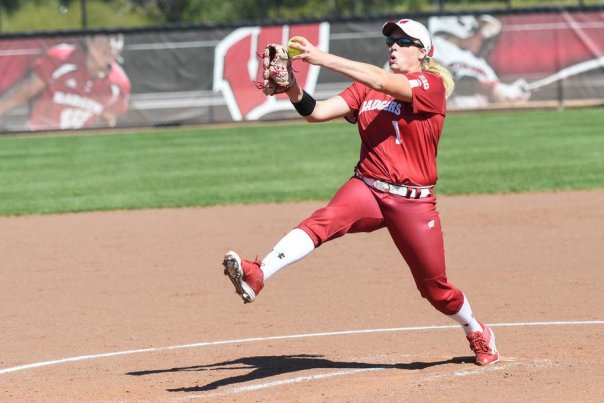
Just had to give one last shout out to Kirsten Stevens at the University of Wisconsin Madison for ending her fastpitch softball career with a bang. Kirsten was named to the Eugene Regional All-Tournament team after a stellar performance last weekend.
Her key accomplishment in the Regional was throwing a 2-0, five-hit shutout against the UIC Flames in a must-win game. It’s my understanding that this was the farthest UW Madison has gone in the NCAA Division 1 tournament in its history, and she got to be a contributor to the team getting there. 
In that game, Kirsten secure 8 strikeouts, including one to end the nail-biter of a 7th inning when UIC threatened to tie the game by opening the inning with two hits to put runners on first and second with no outs. But Kirsten bore down, getting the next hitter to pop up a bunt attempt on a lovely riseball to relieve some pressure, then inducing another out before finishing out the game with the final K to send UW Madison to the finals against Oregon.
It was quite the storybook finish for her. Or so it appeared.
The next day, Kirsten was brought in to throw one more time after UW Madison fell behind the Ducks. After settling in she was able to secure three outs, including once again finishing out the inning with a K, bringing her tournament total to 9, which was second only to Oregon star Maggie Balint. Her tournament ERA was 0.88, which was also good for second-best, this time behind Oregon’s Miranda Elish, who blanked the Badgers in the final. To add to the accomplishments, Kirsten gave up no walks in 8 innings pitched, making her #1 in K/BB ratio. Needless to say, she was on fire.
It was quite a way for the senior to finish a great career filled with many accolades. Congrats to Kirsten on a job, and a pitching career, well done.
Related content:
Helping young fastpitch pitchers learn to focus

One of the fun but challenging aspects of working with very young fastpitch softball players (under about 10 years old) is getting them to focus for any length of time. There are usually lots of things going on in their heads at any given time, and the slightest activity anywhere else can distract them in a major way.
That can be a problem at any position. But it gets even more noticeable with pitchers. As a fastpitch pitcher you have to be able to dial in to the strike zone. Visualizing the pitch location before you throw it is helpful for improving accuracy. That’s tough to do, however, when the three ring circus is playing in your head.
This is where playing to the player’s competitive nature can be a real asset. Giving her something specific to do, with a prize attached, can help drive that focus level right up.
I actually stole this idea from Cindy Bristow at Softball Excellence. It came in one of her newsletters, which are a great source for drills and games.
Set up a tee on the plate, and place a ball on top of it. Then challenge the pitcher to knock the ball off the tee with a pitch. You’ll be amazed at how quickly she gets dialed in.
That’s what we did here with Kaitlyn, the girl in the accompanying video. She was having a bit of trouble focusing on this day, so I set up the tee and put a 14 inch ball on top of it. It probably would’ve been more fair to use a basketball or soccer ball, but I decided to challenge her.
In the beginning, I offered her a sucker if she knocked it off. Her mom immediately upped the ante and offered her a milkshake on the way home if she succeeded. We then spent the last 10 minutes of that lesson with her pitching balls at the tee. The rule was she had to hit it directly – no fair bouncing the ball into the tee so it falls off. Also she had to use good mechanics, not just aim the ball at the target any old way.
That first night she came close a bunch of times but didn’t quite get it. The following week her mom told me Kaitlyn was in a foul mood on the way home. She really wanted that milkshake.
The video is from that next lesson. We gave her 15 minutes this time. Kaitlyn ratcheted up the focus, and was right around it for much of that time. Thinking she needed a little extra help to succeed, I had her little sister stand directly behind the tee on the other side of the net. A few more throws and Bingo! Success!
Of course as Han Solo says, good against a remote is one thing. Good against the living is something else.
Today I heard Kaitlyn earned a game ball for her pitching. Two scoreless innings with a couple of strikeouts.
I wouldn’t say it was all in the drill. She put in a lot of hard work throughout the off-season. But I will say it helped.
If you have a pitcher who could use a little help zoning in during practice give this drill a try.
Tips for winning the cat-and-mouse game between pitchers and hitters

One of the most fundamental elements of a fastpitch softball game, especially at the higher levels, is the cat-and-mouse game between pitchers and hitters. Once you get past pitchers just hoping to throw more strikes than balls, and hitters just hoping to make some sort of contact and get on base, the “game within the game” within the first 35-43 feet of the field is quite something to behold.
I work with both pitchers and hitters, so in writing this post I’m kind of like the arms dealer selling to both sides. But it also gives me a pretty interesting perspective because I have a pretty good idea of what each side is being told.
One of the keys to winning that cat-and-mouse game, however, is a willingness to adjust your strategy as the game goes on. Those who go in with a plan and stick to it, no matter what’s actually happening during the game, aren’t going to be as successful as those recognize a new opportunity has come up or what they’re doing, no matter how well-researched it was, just isn’t working.
Here are a few examples of what pitchers (and their catchers, can’t forget them) and hitters can do to adjust to what’s happening in a game. While this list is by no means all-inclusive, or even universally agreed-to, hopefully it can at least create a starting point for better in-game thinking on both sides.
Aggressive hitters
If there’s one universal taught to every pitcher, it’s the concept of getting ahead of the hitter in the count. Almost all the time that means throw the first pitch for a strike, usually with heat behind it.
When a pitcher is facing an aggressive team, or even a single aggressive hitter, who like to swing at the first pitch, that can get dangerous. You’re throwing a strike to hitters who are looking to pound one.
So the counter to that is to start hitters with a changeup or offspeed pitch. Get them to swing and miss, foul off that first pitch, or even mis-hit it into the field for an out. You might even want to follow that up with another one. After all, who expects two changeups in a row? It’s called fastpitch, right?
By throwing a first-pitch change (or first two pitches offspeed) you will often get the results above, AND upset the hitter’s timing for the rest of the at-bat since your change will make your heat seem even faster. Plus, it’s really tough to hit out of an 0-2 hole.
If you’re a hitter, the counter-move to that is to pay attention and figure out the pattern. In other words, if the three batters in front of you got a first-pitch change, there’s a pretty good chance you’ll get one two. Sit on that pitch and drive it. Then don’t forget to tell your friends.
Drop balls
The first thing hitters need to do when facing a drop ball pitcher is to figure out where the ball is dropping. Once they know that they have a couple of options.
If the ball is dropping pretty much on the plate, or at the back of it, one thing they can do is move forward in the box to catch the ball before it drops. The other option is to move to the back of the box so the ball is pretty much landing even with their front foot.
In doing so you’re pushing the umpire further back, and making it tougher to call the pitch for a strike. Although technically a strike is the height of the ball over the plate, that gets tougher to judge when the hitter is further back. If you’re successful with this strategy you can start taking those drops for balls, and maybe even take that pitch out of the pitcher’s arsenal that day.
For pitchers, the counter to that move is to have the ability to adjust where the ball breaks based on where the hitter is standing. That’s easier said than done.
Most times when pitchers practice drop balls they only practice them to one location. Smart pitchers, however, will practice moving the break forward and backward by having the catcher move up and back and changing their release point slightly to accommodate the different distances. When a pitcher can do that, her drop becomes a more formidable weapon.
The hitter’s counter? Get better at hitting drop balls.
Pervasive changeups
Ever seen a pitcher (or a coach calling signals) who is in love with her changeup? She throws a great one, so every hitter gets one or two each at bat.
If you as a hitter are having trouble with her speed or movement, here’s an idea: you know the change will come. Just wait for it and hit that. I’ve seen that strategy executed very successfully. Not only do you get the hits; you take the change off the table for a while.
I’ve also seen that ignored – even in the Women’s College World Series. I remember Arizona’s Taryne Mowatt win a national championship by feeding Tennessee’s hitters a steady diet of changeups. I also remember thinking “Why isn’t Tennessee sitting on that change?” – a thought even the announcers echoed an inning or two later. Make the pitcher pay and she will stop it.
The counter for pitchers is not to abandon it entirely. Just lay off it while it seems like the hitters are waiting for it. Once they start getting more aggressive at the plate, bring it back.
Working inside/outside
Pitchers who are consistently pounding the inside or outside corner should be fairly easy to deal with after a couple of innings. Hitters simply need to move into the plate when pitchers are living on the outside corner, thus turning an outside pitch into a middle pitch, or back off a bit if the pitcher is living on the inside corner to turn that inside pitch into a middle pitch. By the way, in my world right handed hitters should always start in on the plate against left handed pitchers until they see the pitcher will throw them inside.
The counter for pitchers, of course, is to take advantage of what the hitters are leaving on the table. In other words, if they’re backing off the plate due to inside pitches, then start throwing the outside corner. Conversely if they’re crowding to get the outside pitch, throw them inside.
That said, pitchers also need to be careful about getting baited to throw a pitch the hitter really likes. I’ve had any number of hitting students who were able to turn well on an inside pitch but struggled a little to let the ball get deep enough on an outside pitch. I will also tell them to crowd the plate. If you throw them inside that ball is likely to go a long way. The last thing the cat wants to do is get caught in the mousetrap.
Zoning in
If hitters don’t want to adjust where they stand at the plate, another strategy they can use is to identify where the pitcher is throwing the ball the most and cut the strike zone in half – or even into one quarter.
For example, one former high school coach I know of was very risk-averse, so he only liked to throw on the low outside corner. If you know that, you can narrow your strike zone to that one zone, look for a ball there, and take it downtown.
Most of the time, though, you’ll probably wind up cutting it in half. If the pitcher can’t throw a strike from the waist up, then just put the blinders on (or maybe pull your helmet visor down a little lower) and only swing at pitches below the waist.
The same for pitchers who throw almost all outside or inside. Where you make contact with the ball changes on inside versus outside, so if you know which half of the plate the ball is likely to be on you can adjust accordingly.
The counter for pitchers (at least where you have control over pitch locations) is to start breaking the pattern to keep the hitters honest, especially when you’re ahead in the count and can afford to miss the strike zone. You might even want to do it now and then even if you don’t have control of pitch calling because, hey, everyone misses a location now and then. Just be prepared to take the heat in the dugout afterwards – even if you’re successful in getting the hitter out.
Slappers
The conventional wisdom on slappers is to pitch them low and outside. But since a slapper wants to hit the ball on the ground in the 5-6 hole, throwing low and out may be the biggest gift you can give them. That’s usually where I start the tee when I begin teaching slappers because it’s the easiest way to get the proper results.
I always tell pitchers there are two types of slappers: those who run straight at the pitcher, and those who try to run to first base as they slap. The strategies are different for each of them.
For slappers who try to run to first base first, the low and out strategy will often work. For well-trained slappers, however, not so much.
In that case, you want to throw them up and in or low and in. Get them to pop up, or hit a weak ground ball to the right side of the infield where the throw is shorter.
For those who are anxious and starting a bit early, you can also throw them a change. Maybe they’ll run through the box, make contact outside of it, and get called out. Or maybe they’ll have to hold up to avoid running out, taking away some of the advantage of the running start.
For slappers, the first counter is to run straight at the pitcher every time. If you see the ball coming at you, then peel off a bit. You can also start a little later than normal to let the ball get deeper on you, or even a bit behind before you make contact (assuming the pitcher is throwing you inside consistently). Unlike hitting away, the closer the ball is to you the deeper you want to let it get so you can get it to the left side.
The other key counter for slappers is not to be one-dimensional. Be able to hit, straight bunt, drag bunt up the first baseline, soft slap, or hit up and over depending on how you’re being pitched and where the defense is playing you. The more you can do, the less the pitcher can rely on any one strategy.
Pay attention
The one common thread you may have noticed in all of those cat-and-mouse games is the need to be aware of what’s going on and pick up on any patterns or tendencies the other side has. The more you do that, the more likely you are to win the battle.
Now it’s your turn. What did I miss? What can hitters or pitchers take advantage of, and what is the counter to that move? Leave your thoughts in the comments below.
Also, one quick plug. If you haven’t already done it, you can subscribe to receive notifications every time there’s a new post on Life in the Fastpitch Lane. Fill in your email in the box on the upper left side and never miss a post again!
Fastpitch pitchers: getting the feel of the whip
One of the things that keeps being a fastpitch softball instructor fun and interesting is that there is always some new puzzle to solve. That was certainly the case with a girl named Kate and her pitching.
I started working with Kate on her pitching late in the summer last year. Once the weather turned cold I didn’t see her for a while – schedules just didn’t match up – but she continued to work on her own.
When we did get together earlier in the year her speed just wasn’t quite where it should have been. She was working hard, and putting in plenty of effort, but when the ball came out it sort of floated toward the plate. It was almost as if every pitch was a changeup.
That just didn’t sit well with me, of course. Kate is a terrific girl, always smiling and very polite. If I say “good job” she invariably says “thank you.” I’ve actually told her she doesn’t have to thank me every time I say something nice, but it’s tough to overcome good upbringing.
Anyway, I knew here was more speed in Kate, but we were having trouble finding it. It just didn’t seem like she was driving her arm/hand through release.
I tried a couple of different drills, and even gave her a Jugs Lite Flite ball to practice with, thinking the lighter weight might help her feel acceleration into release a little better. The light ball helped a little, but there was still something not working in her delivery.
The other night she came in for a lesson, and I could see during warmups she still wasn’t getting the ball out properly. So I decided to try the towel drill. This is a drill where the player holds a towel, goes into a K position, then whips the towel through. If you do it right you’ll it snap forward somewhat.
Well, that wasn’t working either. After a couple of attempts I wasn’t seeing what I wanted. Then I had an inspiration. I told Kate rather than holding onto the towel she should bring it down and throw it to her dad, Mark, who was about 10 feet in front of her.
The first time she tried it the towel didn’t go anywhere. The second time it went straight to the top of the cage we were working in. But then she started to get it, and the towel went forward. A few more reps and she was easily throwing it quickly to her dad.
So I backed her up and put a ball in her hand. Sure enough, there was a visible speed jump from before. She did it again and had the same result. We finished normal warm-ups and went into full pitches and whaddya know? Suddenly the ball was hitting the catcher’s glove with a nice “thwack!”
She was a bit wild, but I told her don’t worry about that right now. Let’s just focus on your newfound speed. She was able to maintain it throughout the lesson and we were all happy about the breakthrough.
Still, you never know. Sometimes these gains are only temporary. That’s why I was so delighted to receive this text from Mark a couple of days later:
“(W)e can hardly contain our excitement!!!! We just finished our team practice and Kate absolutely rocked it. IT being the pitching part. Her speed is nearly matching the other girl. Perhaps just a few mph difference, and that’s negligible in pitching speak.
On the way home Kate said the sweetest thing to a dad’s ear. ‘I’m so happy.’ I asked her ‘about what, Kate?’ ‘That you found our coach, Ken.'”
I believe what was happening with Kate was that she was twisting her wrist as she released – probably the result of all those wrist flips she used to do before starting with me. Once I had her throw the towel she couldn’t do that anymore if she wanted it to go anywhere, and that gave her the feeling of how to get the ball through the release zone properly.
So if you have a pitcher who is struggling with speed – especially if it looks like she’s in permanent changeup mode relative to her effort level – give this drill a try. Maybe you’ll get a nice text too!
Getting the feel of the push off in fastpitch pitching

Getting a strong push-off is essential to maximizing speed for fastpitch pitchers. You need to develop a lot of forward momentum so that when your front foot comes down the stop is very sudden, which helps accelerate or sling the lower arm through the release zone.
Unfortunately, young pitchers often have trouble getting the timing down to create an early push. Instead, they will kick the stride leg forward while just sitting on the drive leg, and then try to push at the end, which is too late.
I’ve had pitchers skip before, because that mimics the sequence, i.e., push off first then reach with the leg. It works for some but not others. So if you or someone you know is still having trouble getting the feel, here’s something to try.


Place an obstacle out in front of her, very low to the ground like the swim noodle Alyssa’s father Tony is holding here. Then have the pitcher jump over it, using a normal forward jumping motion rather than thinking about pitching.
When she does it, ask her what she feels. If she isn’t sure, have her do it again. What she should feel is the drive leg pushing first, then the stride leg reaching out. If she does it correctly you’ll see it, as shown in the photos here.
Yes, this motion would be illegal for a pitch – big time illegal – but that’s not what you’re going for right now. Because if she could get the push legally you wouldn’t be doing this drill.
You just want her to feel the push first. After she does it a few times, have her go back and now try to copy that feeling with an actual pitching motion. If she’s gained the feel, and is driving her body forward first, the back foot should pretty much take care of itself.
So far, every pitcher I’ve tried this with has made an immediate improvement in her drive mechanics. I’m not quite ready to pronounce it foolproof yet, but it’s looking good.
If you’re facing this issue give it a try, and let me know in the comments how it works out. And if you’ve done this before, share your experience and whether it worked for you too.
Congratulations to Wisconsin pitcher Kirsten Stevens
Huge congratulations are in order for University of Wisconsin – Madison pitcher Kirsten Stevens on being named the Big Ten Pitcher of the Week. Can’t say it comes as a surprise, though, after the weekend she had.
Kirsten toss not one but two shutouts in earning her third and fourth wins on the season. And this after being sidelined for most of the off-season with a broken foot.
When the accident first occurred it looked like the Badger might miss the first part of the season. But with a strong work ethic and help from the Wisconsin coaching staff and trainers, she beat the prognostications and is back on the field.
And what a pre-season it’s been. Kirsten is currently sporting a miniscule ERA of 0.28, which is what happens when you’ve only allowed one run for the season so far. Over the weekend she also had a personal best 11 strikeouts against Hofstra, continuing the blistering pace for Ks she set as a goal before the year.
And the best part? Kirsten is one of the nicest human beings you’ll ever meet. Always with a smile on her face, always remembering to have fun, and always making time to speak with and encourage the young players who look up to her (literally as well as figuratively) when she meets them.
All we can say here is keep up the good work! And again, congratulations to both you and the team who helped you achieve a well-earned honor.
Keeping fastpitch pitchers on the straight and narrow
One of the keys to maximizing both speed and control for fastpitch pitchers is driving straight down the powerline (more or less). That is the direct line that starts at the middle of the pitcher’s rubber and continues straight until it intersects the center of home plate.
Wander too far off the line and your power will be spread across too wide an area to be effective. Think about a laser versus a flashlight. Both send light out from the source. One (the flashlight) spreads its energy across a wide area; the other (the laser, obviously) focuses all its energy in one direction, and on a very small area. Which is powerful enough to cut through metal?
Still, it’s one thing to tell a pitcher to go straight down the powerline, even when there is one drawn right in front of them. It’s another to get them to do it, especially when they’re working hard to maximize their leg drive.
If you’re indoors and using a pitching mat, here’s a way to help pitchers learn to take a more direct route. Either move the mat or the pitcher so she is standing with her throwing-side foot next to the mat as Jenna is here. Then have her execute the pitch.
She will receive instant feedback as to whether she stayed straight, and the long line of the pitching mat will serve as a visual guide as to where her foot should go.It seems to be more effective than the simple drawn line, because there is dimension to it. And it’s safer than using a larger obstacle such as a bat bag – just in case the pitcher makes a mistake.
As a bonus, the long line of the mat will also give her a guide for her throwing-side foot, helping pitchers who tend to let that foot swing too much out behind their glove-side foot. If your goal is for the throwing-side foot to drive straight down the line, she can just trace the side of the mat with that foot to get the feel.
For those who are outside, a narrow roll of foam from the hardware store will serve a similar purpose. Just be sure to anchor it down so it doesn’t blow away.
If you have a pitcher who’s having trouble staying on the straight and narrow, give this a try. And as always, let me know how it works for you.
How many pitches should a fastpitch pitcher have?
I know the title sounds like a tongue twister (how much wood can a woodchuck chuck), but the question of how many pitches a fastpitch pitcher should have is an important one. Mostly because it determines how pitchers will be spending their valuable practice time.
The “old school” approach is that a pitcher only needs three pitches – drop, changeup and riseball. And that approach has served many pitchers well for a lot of years.
That may be outdated thinking, however. Over the weekend I again was one of the supporting instructors at the Indiana United Fastpitch Elite clinic, which was led by Rick and Sarah Pauly. On Friday night, Rick presented a PowerPoint talking about the overall mechanics of pitching, and then took questions both during and after the presentation.
One of the questions, from my friend Mike Borelli, was how many pitches should a pitcher have. Rick turned to Sarah, the winningest pitcher in National Pro Fastpitch history, and asked her how many she had.
Her reply wasn’t three. It was seven. As I recall she named drop, change, rise, two curves, backdoor curve and a screwball.
Rick and Sarah then went on to talk about how with today’s hitters you need to have more weapons.
Think about why that is. In the old days in women’s fastpitch, the ball was white, with white seams, and pitchers even at the international level stood 40 feet away. Pitchers put in way more time learning their craft in the off-season than hitters did. That might have been a good thing because what most people were teaching about hitting was pretty bad. Hitters are smarter, too, spending more time studying pitchers and looking for patterns. Also, there is no doubt today’s bats are much hotter than those back in the day.
You put all that together and having more than three ways to attack a hitter starts to make sense. (FULL DISCLOSURE: I have quite a bit of confirmation bias in this way of thinking because I’ve been saying it for years.)
If all you have is three pitches, even if they’re great ones, you become more predictable. And predictability is deadly. Just ask any pitcher who has a coach who likes to favor certain pitches. It’s a lot easier to dig in and hit if you know what’s coming.
Now, no doubt some of your pitches will be better than others. No doubt you will throw them more than others. But if that’s all you throw, it’s easier to prepare to hit against you. Throwing in something a little different, even now and then, keeps hitters off balance and uncomfortable, which is the key to great pitching.
It was great to hear this philosophy confirmed by someone who has been around the women’s game, and played the men’s game, for a long time. If you’ve been restricting yourself/your daughter/your students to three pitches, you might want to give this a little thought. Perhaps it’s time to add a new pitch.






 Life in the Fastpitch Lane