Category Archives: Hitting
Return of the Indiana United Fastpitch Elite/Rick Pauly Clinics
Earlier this year I blogged about a fantastic fastpitch pitching event held, of all places, in Southeastern Indiana. Put on by Rick Pauly, hosted by Indiana United Elite Fastpitch and Coach James Clark, and featuring an array of top-level pitching coaches, it was an incredible learning experience for players, parents and coaches alike.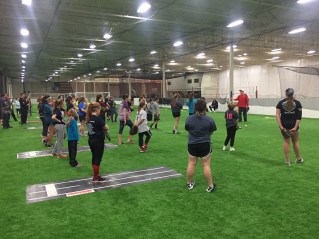
Never one to be content to rest on his laurels, Coach James has outdone himself with the latest iteration. The 2017 clinic, again in Richmond, Indiana, has expanded in its scope to not only offer top-level pitching instruction but also clinics on hitting, catching, the short game/slapping and defense.
This year’s instructor lineup is impressive once again, with college coaches and former college and NPF players offering hands-on instruction. The nice thing about these clinics is they’re not like so many, where they show a big name who is the “face” but then have very little interaction. The faces you see on the flyer will all be actively participating in or leading the instruction.
Throughout the weekend there will be plenty of time for discussions and questions too. One of the highlights for me last time was many of the instructors gathered together in a room tossing around ideas and opinions until the wee hours of the morning – all part of an impromptu session that began with a simple question. Those little side conversations alone are worth the price of admission.
Coach James promises it will be bigger and better than ever, and I believe it! The clinic runs the weekend of January 6,7 and 8, 2017 – timed this time to both make sure it didn’t interfere with high school and college seasons and to give players time to lock down what they learn before tryouts begin for spring high school ball.
Click here to register, and here to schedule the sessions you want and to pay. Most sessions are $70 each and run an hour and 15 minutes. The exceptions are the recruiting discussion that costs $25, and the beginning and advanced pitching sessions with Rick and Sara Pauly which cost $150 and are scheduled for 3 hours, although last year Rick was having such a great time he ran a bit long on both sessions.
Download the flyer for complete information, and then be sure you sign up now. Slots are filling fast. I’m sure you’ll find it’s a great investment in your softball future.
One way to avoid re-injuring a knee
The #KyleSchwarber coming back from a knee injury storyline is getting a lot of coverage right now during the World Series. But I think I have a fastpitch softball story that can top it.
Taylor Danielson, whom I have written about before, hurt her knee playing high school softball back in the spring and wound up missing the whole summer. This would have been more worrisome since this was to be the summer between her junior and senior year, but fortunately she had already verballed to a college. (I won’t say which quite yet due to superstition, but check back in a couple of weeks.)
When the injury occurred she was told she wouldn’t get back on the field until 2017. While that is a good prognosis for an ordinary person, Taylor is hardly an ordinary player. She worked her butt off rehabbing her knee, and was finally cleared for limited action for the end of the fall ball season.
There were some caveats. No catching (she’s an awesome catcher), and while she could hit, she couldn’t run full out. No stretching a single into a double, or going from first to third. She was under strict orders to run base to base and that’s it – a shame since she has 2.8 speed from home to first.
Since she couldn’t run like she wanted, Taylor decided to address it her own way. The video shows how – she hit the ball so far she was able to jog her way around the bases. All of them.
Just goes to show where there’s a will there’s a way. And you can’t keep a great player down.
Getting hitters started on time
Getting hitters started on time is often a challenge. You work, and work, and work on developing proper hitting mechanics. You hit off the tee, soft toss, front toss and everything else you can think of. 
Then the next game comes along and it seems like it all falls apart. That hitter that was bombing balls in practice stands there frozen at the plate until the ball is on top of her, then quickly executes what I can only call a “panic swing” – one that says “Oh crap, I better swing.”
There can be reasons for it, although most tend to lead back to fear of making a mistake. So the hitter waits and waits and waits, then realizes she ought to be swinging. At which point it’s too late to hit the ball well.
One long-standing way of attempting to overcome this was of thinking is to say you should be thinking “Yes, yes yes” and then either yes or no. In other words plan on swinging until you see otherwise.
Another common way of expressing it is the pitch is a strike until you see otherwise. In other words, plan on it being good, and then hold up if it’s not.
Here’s a little different way of approaching it. When the hitter is taking too long to decide, she is essentially trying to determine if she should start her swing. Of course, by the time she starts it she is already too late. So tell her she shouldn’t be thinking about whether to start the swing. She should start it every time, and then while she is in her swing decide whether to continue or stop.
If the hitter is using good mechanics, i.e., starting the swing with her hips, followed by her shoulders and then her bat, she’ll have plenty of time to hold up before committing the bat to the swing. In the meantime, she has her body in motion, developing power and preparing to apply it to the ball. Her eyes are also gathering information about the speed, location and spin of the ball, helping her to decide whether to take the swing.
So if she’s started her swing, the only thought should be whether to stop if the pitch is a bad one.
Give it a try, and let me know if it works for your hitters.
Sometimes you just gotta go with what you’ve got
As both a fastpitch softball instructor and general fanatic for the sport, I have to admit I spend an inordinate amount of my waking hours looking at information and analyzing techniques to try to become as educated as I possibly can. Hi, I’m Ken, and I’m a softball technique-aholic
It’s well-intentioned to be sure. I firmly believe, based on roughly 20 years in the sport that the better-trained a player is, the higher the chance she has for success. And the less raw athletic ability she has, the more specific training she requires.
But I also believe (again based on experience) that there is a Law of Diminishing Returns when it comes to trying to perfect technique. While it’s true that optimal technique should yield the best results, that’s also only true if it’s implemented with optimal effort or enthusiasm.
This is where a lot of players seem to get hung up. Especially the most dedicated. They are focused so much on trying to achieve the optimal mechanics that they get in their own way.
Hitters become tentative trying to achieve the best bat path and as a result slow their swings down. Or they focus so much on one part of the swing that they let the rest fall apart.
Pitchers work so hard on getting just the right launch technique, or keeping the arm circle exactly where it should be, that they get all tight and don’t let their bodies work for them. Catchers worry so much about how they’re making the transfer on a steal that they become over-conscious and thus too slow.
Every part of the game can be affected, regardless of position, or whether you’re on offense or defense.
So here’s my advice: as they say in auto racing world, sometimes you gotta run with the one that brung you. Or in the case, go with what you’ve got.
If you’re a hitter still reworking her swing, do the best you can to use what you’re learning. But don’t focus on doing it perfectly. Do it the best you can while still coming at it with full energy.
After all, the ball doesn’t care how you hit it. A strong contact with an ugly-as-sin swing will beat a soft contact with a perfect swing every time. A strong swing with much-improved mechanics will generally yield better results than a tentative swing that looks good only on slow-motion video.
The same goes for the rest of the game. You may not have perfected that backhand or rake technique on ground balls, but if you go after them like you mean it you may just surprise yourself. Pitchers who continue to try to throw hard will be much more effective than those who again look like they’re trying to make the perfect video instead of getting hitters out.
Believe me, I’m all for perfect mechanics. But they should never be a conscious effort, at least in a game situation. When you’re in the game, go with what you’ve got. You can always work on perfecting it at the next practice.
Way cool: Slugger lets you customize your bat
Back when the Louisville Slugger Catalyst fastpitch bats first came out and were the hot bats, my daughter Kim had a chance to get one for free, courtesy of my friends at Softball Magazine. But she decided to pass because they were yellow and she just didn’t like the way they looked. I know, right?
While it shouldn’t make a difference – the only measure of a bat should be how well you can hit with it – it actually does seem to matter. Kim’s not the only one to object to a piece of equipment because of its appearance.

Not your mother’s Slugger – you can customize your LXT HYPER fastpitch bat to suit your preferences. and tastes
For those with daughters/players who are fashion-forward, however, there is good news. On June 1 Louisville Slugger announced not only the release of the new LXT HYPER fastpitch bat line, but an amazing feature – you can customize it to suit your tastes by going here.
I tried it out earlier in the week and it’s way cool. Often times when companies say you can customize a product they mean you can change a couple of colors, or a graphic here or there. With the LXT HYPER you essentially start out with a colorless bat, then specify the color of every component, from the knob to the end cap.
(WARNING: If you are graphically challenged you may want to have one of your more artistic friends check your work before you submit, as you can really make it crazy. Unless that’s what you’re going for.)
I tried the site out earlier in the week and it was pretty easy to use. It walks you through the choices, and as you make each one that choice gets added to “your” bat. They have lots of color options, including some fades in certain areas, enabling you to go from subtle and reserved to Fantasia. You’ll be amazed at how many choices you’ll have to make.
Once you get the colors selected, you can also further customize your bat by having your name or nickname imprinted on it. You only get 9 characters, however. Not bad if your name is Sue Rolls but you’ll have some decisions to make if it’s Hyacynth Mickelweed. There are three font selections, from a script type of writing to a blockier style. But no matter what you put, at least there won’t be any more arguments with teammates should you happen to select all the same colors for your bat.
Now, it might be tempting for the whole team to get the same color combination, or you may want to select colors based on your current team. But these things tend to be moving targets. If you change teams, or your school team has a vastly different color scheme than your travel team, it might not work out so well. Just something to keep in mind.
Of course, good looks alone are no reason to select a bat. Ultimately it has to perform. Slugger’s press release says:
“Available in -11, -10, -9 and -8 weight drops, the LXT HYPER’s 100 percent composite design now features the all-new PBF Barrel Technology that doubles the sweet spot for unmatched power. Louisville Slugger has also improved the LXT HYPER’s patented TRU3 Dynamic Socket Connection, allowing for necessary movement between the barrel and handle. This maximizes barrel trampoline effect, while also eliminating negative vibration. The result is the absolute best possible feel when you bring the bat through the zone.”
Understand that all this wonderfulness doesn’t come cheap. The retail price is $479. But if you’re looking for a high-performance bat that lets you express your personality on the way to the plate as well as at it, and you can afford it, the LXT HYPER is definitely worth a look.
About that “hardly ever strikes out”
Last weekend I was watching a college fastpitch softball game on TV (surprise surprise) when one of the announcers started talking about how the current hitter rarely strikes out. This is one of those statements I’ve heard a number of times through the years, and while it seems to impress a lot of people I have to admit I’m not one of them. 
Don’t get me wrong. I’m not a fan of or in favor of striking out. But then, I’m not in favor of any type of out, and that’s what a strikeout is – an out.
You can make an argument that it’s better to put the ball in play because something still might happen. You can advance a baserunner, or maybe even get lucky with an error. And all that is true.
But if those things aren’t happening during your at bat then it really doesn’t matter whether the out is a strikeout, a popup, a ground ball or something else.
Here’s how I look at it. If you have a high batting average or OPS and low strikeouts, that’s impressive. But if you have a low batting average or OPS with low strikeouts, it’s not such a big deal. You may not be swinging and missing, but you’re not exactly crushing the ball either.
Not striking out can be accomplished simply by being very conservative with your swings. A slow, careful swing aimed at “just making contact” will help you avoid striking out. But it’s not exactly going to drive the ball into the outfield either.
Sure, you’ll manage a few flairs, a duck snort or two, maybe even a ground ball through a pulled-in infield. But you’re going to make it too easy for your opponents to get you out.
I’d rather see a hitter be aggressive, with an intention of hitting the ball hard, than laying back just trying not to strike out. Sure, you’ll miss a few. But the odds are a lot of good things will happen along the way. Better things, in fact.
In most games you only get a few swings at most. Be sure you’re taking advantage of every one of them. That way, if you’re ever on TV, the announcers will have more to say about the things you do than the things you don’t do.
Product Review: Jugs Tee – It’s All About That Base
Batting tees are one of the most important tools a hitter can own. They’re great for working on swing mechanics, pitch locations and other techniques. They’re also great for getting in a few warm-up swings before the game.
There are all types of tees out there – all rubber, all plastic, a combination of the two. Lately, though, the most popular design has been a metal pipe-style with an inverted rubber cone on the top. You’ll typically find them in facilities with batting cages.
They’re not much to look at, and they often have a weight ring at the bottom of them to keep them from getting knocked over, but they get the job done.
The venerable Jugs Sports company is out to change all of that with their new professional style Jugs T. Retailing for $74.95, it improves on previous designs from other manufacturers in several ways, making it a great choice for facilities, coaches and individual hitters.
The first thing you’ll notice is how beautiful it looks. First-generation tee designs looked like they were built with steam fitting pipes and plywood from the local hardware store. The Jugs T appears to be made from highly polished aluminum with a solid metal base (more on the base in a minute). The bottom section is a deep, shiny blue, while the extension section is natural silver in color. You feel good just taking it out of the package.
It assembles in about 30 seconds – just screw the extension section into the base and you’re good to go. The rubber cone also feels thicker and more rigid than earlier tee models.
That comes in handy if you live up north like I do and leave the tee in the car during cold weather. With other tee designs if the cone is bent while it’s sitting in the trunk it takes a while before it holds a ball reliably.
Not the Jugs T. The thicker material bounces right back and is ready to go. I know – I tried it.
All of that is nice. But the real differentiator, in my opinion, is the base. It’s a solid metal plate instead of wood, and it is heavy – 10 lbs. according to the Jugs website. No need to put a 10 lb. barbell weight on this tee. In fact, the first couple of days I had it I kept handing it to people and telling them to feel the heft. It also has a pentagonal design that keeps it from going over the side if someone swings too low, and the entire base is coated in rubber so it won’t scuff gym floors.
Don’t worry about carting it around, however. The base also has a cutout that forms a convenient carrying handle. It’s easy to transport from cage to cage, or from the dugout to a practice area.
Another issue tees can sometimes develop is the inability to keep the ball at the desired height. You set the ball on it and the shaft starts to sink. So far that doesn’t seem like it will be a problem with this tee. It feels very solid when you raise and lower it, a good sign that it will continue to hold its ground even after repeated use. The adjustment range is a standard 23 inches to 46 inches – comparable to other tees I’ve used – making it ideal for your smallest players as well as your tallest ones.
Overall, like everything Jugs produces it’s a high-quality piece of equipment. If you’re looking for a professional style hitting tee that will stand up to tough use year after year, the Jugs T is a great choice.
Another way to measure bat speed
Developing good bat speed is important to hitting. Because of its significance there are all kinds of ways of measuring it. 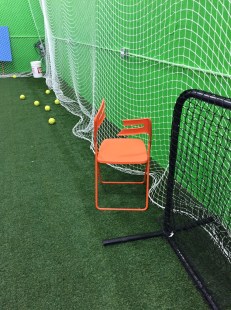
You can use a radar gun. You can use an electronic swing analyzer. There are probably a couple of others that involve advanced technology.
And then there’s what’s depicted here. At the start of this session, this was a fully intact plastic chair. The way it looks now is the result of a line drive off the bat of Emma Bartz.
The chair was about 30 feet away. One second it was fine, the next split second it looked like this.
She hit it so hard that the chair didn’t even move. The ball just went straight on through.
Oh, and by the way, this was off a tee. I can only imagine what would’ve happened if you added the pitch velocity to it.
It was pretty cool to see. On the other hand, I also made sure to tell her the time-honored phrase: No chip-ins.
Like Riding A Bike

People often use the phrase “it’s like riding a bike” To refer to how easy it is to pick up a skill again when you’ve been away from it for a while. When it comes to softball training, however, there’s another use.
Players will often get impatient with themselves when they don’t pick up a skill right away. Pitchers will be wild when trying a new pitch). Hitters will swing and miss while working on improving their swings, or hit a popup or soft dribbler. Catchers will go for a block only to have the ball go between their legs. Lots of different things can happen.
When they do, I will often ask if they can ride a bike. I have yet to run into one who can’t. I’ll ask them if they have to think about how to ride a bike. They always respond no.
Then I ask them if it was always that way. What happened when they first took off the training wheels? Usually mom or dad held onto the seat and ran behind them until they were ready to take a few tentative pedals on their own.
Eventually, though, they figured it out. And once they did, they probably never gave it much thought again.
The same goes for softball skills. At first they can be difficult, and require a lot of thought (as well as a lot of trial and error). The success rate may be fairly low. But the more they do it, and really go after it, the less they will have to think (or worry) about it.
It’s a thought that seems to resonate. They know there were scraped knees and elbows at first on the bike, but today the only remarkable thing would be if they fell off.
When players get frustrated, remind them of their experience riding a bike. It might help them get back on track.
How do you help players learn patience while they’re learning a new skill? Any tips or tricks you’ve found helps them understand?
ASA finally eliminates the helmet chin strap
In case you haven’t already heard, the Amateur Softball Association has finally eliminated the rule requiring fastpitch softball players to use a chin strap on their helmets at all levels of Junior Olympic play. If you’re not up on their lingo that basically means everything from 18U on down. The new rule takes effect January 1, 2016.
All I can say is it’s about time. Someone from ASA must have finally gone out to a game or two and seen how silly the rule was. While there probably were a few, I can’t recall ever seeing any player in the last few years who had the chin strap snugged up on her chin in a manner that would keep her helmet on.
Most times, they were sagging well below the chin line, like a bunting on the Fourth of July. If the helmet came off, the player was probably in more danger of being choked by the chin strap than being hit in the head with an errant throw.
Probably wouldn’t hurt to keep the chin strap in your bag just in case you run into a tournament or organization that still requires them. But it’s good that this rule, at least, has finally caught up to reality.
By the way, ASA is also now allowing hitters to use on-deck hitters to use either on-deck circle. That’s great, because it’s always been a safety issue.
Maybe not in Oklahoma City or other areas where big tournaments are held. They have plenty of distance between the on-deck hitter and the plate.
But in community ballparks all across the US, and I’m sure other countries as well, often times the next hitter up is about 10-15 feet away from getting slammed with a foul ball.
Many tournaments already allowed it anyway as a local rule. But now it’s official – on-deck hitters can warm up behind the current batter, no matter which bench their team is occupying.
Glad to see both of these rules enacted, even if it should’ve happened a long time ago. Better late than never.






 Life in the Fastpitch Lane