Category Archives: General Thoughts
Changing Bodies: a Big X Factor to Performance

I have written many times about how as much as we would like it to be, performance improvement does not always follow the neat, linear “hockey stick” pattern. In fact, it is often messy, filled with gains and losses, ups and downs, little wins and little defeats.
Or as Dire Straits so wisely put it, sometimes you’re the windshield, sometimes you’re the bug.
There can be a lot of reasons for this phenomenon. A player may be physically tired from a lack of sleep or a poor diet, may have a nagging injury you don’t know about, may be under mental stress that isn’t being shared, may feel overwhelmed by the moment, may be trying too hard to compete and tying herself up in knots, may feel un- or under-appreciated, may just be having an overall bad day, etc.
One I think a lot of people fail to take into account, however, is something that youth athletes and even young adults into their early 20s all are facing: their bodies are changing. Sometimes in obvious ways, sometimes subtly.

And every time their bodies change in some way they have to re-learn how to move them in a way that is conducive to good performance.
Think about the last time you were surprised when you saw that a young person who had been a cute little butterball a couple of months ago has suddenly sprouted up to become lanky and lean. Or how the scrawny little kid you remember has filled out and now looks like she could kick your butt in a wrestling match.

The passage of time, even as little as a month, allows you to see these differences because you remember who they were and now see who they are. You are far less likely to notice these same types of changes in someone you see every day because your frame of reference for the differences is hours instead of weeks or months. But they’re still there.
When those types of major body changes occur, they can throw off the entire the movement mechanism. Especially if the entire body hasn’t grown at the same rate.
Picture a young lady whose arms and legs have grown at a faster rate than her torso. Eventually her torso will catch up, but right now there’s an imbalance she isn’t used to.
Her body is still trying to move relative to her old proportions but that method doesn’t work anymore. Longer levers they’re not used to may make it more difficult to throw or pitch a ball or swing a bat because the way they used to feel those movements is not the way they feel it NOW.
We’ve all heard the expression “growing pains.” For those who experience a rapid, sudden growth spurt, those pains are very real.
Osgood-Schlatter disease is a great example. Rapid growth of the bones, muscles, tendons, and ligaments around the knee can create tremendous stress, causing anywhere from some to extensive knee pain, especially during athletic movements. It is difficult for young athletes to deal with it, and the old adage of “Rub a little dirt on it” doesn’t help much when your body is in revolt.
Changing bodies can also affect athletes’ balance and coordination. Their center of gravity can change, or the way they perceive their bodies in space can change, affecting athletic performance until they internalize those changes.
And this doesn’t happen just once. It can happen over and over until they make it out of that phase of their lives.
That means there will be a lot of ups and downs in performance and progress until they reach the point of who they’re meant to be.
So when you’re wondering why your favorite player is putting in the work and paying attention to the details but not seeing the results she desires, keep the X factor of body changes in mind. It might help you weather the ups and downs more easily.
Main photo by Willians_photography on Pexels.com
Beware the Slow, Hidden Erosion of Skills

Most people in the fastpitch softball world are believers that practicing is essential to building, maintaining, and improving skills. Whether you’re a pitcher, catcher, fielder, or hitter, it’s important to get those practice reps in.
What they don’t often realize, however, is how even with the best dedication to practice there is another factor that can erode those skills – a lack of gametime experience.
Let’s take pitchers for example. You can get individual instruction, do bullpens two, three, four times per week, and even do the lonely practices on your own. But if you’re not getting in-game opportunities, your ability to hit speed, spin, and spot is going to deteriorate.
It doesn’t happen quickly, as it would if you’re not practicing at all. But the fewer innings you get in the circle, the less likely you are to perform well when you do get an opportunity.
Instead of earning 7-10 Ks, throwing 1-2 Ws, and giving up a couple of hits, suddenly you’re only striking out 4, walking 4, and letting up 4 hits. As a result, teams are scoring more runs against you (earned or unearned).
At that point you coach begins to lose a little confidence in you and gives even fewer innings, maybe waiting for “safe” situations (translation: being well in front or well behind). Your skills deteriorate a little more, and the downward spiral continues.

Yet that reduction in quality probably has less to do with physical skills than it does with mental factors.
If you’re getting a decent number of innings, you’re far more likely to feel confident in what you’re doing, which means you’ll be more aggressive and more mentally positive in your approach. You’ll perform better, and look like a good choice when it’s time to make playing time decisions
If your innings are being reduced, however, you’ll probably feel more pressure to perform. You’ll become more conscious of what you’re doing, and will focus more on outcomes than on the process.
That misplaced focus will make you tighter and will likely cause you to try to force the outcomes (for example, trying to force strikes instead of letting them happen). The net result is you won’t perform as well, leading your coach to feel like using you is taking too much of a risk, which means your innings will be reduced, which means you’ll feel even more pressure to produce and probably do even worse.
It’s a vicious cycle.
The same is true for anything on the field. Hitters who are confident are far more likely to make good contact than hitters who are worried that if they don’t get a hit on the next at-bat they will be benched.
Fielders who are worried about making a throwing error are likely to tighten up their throw, ruining their mechanics and throwing the ball away anyway. Baserunners who are unsure of whether to take the extra base may stop rather than take a chance, or hesitate and then get thrown out because they made their decision too late.
So what can you do about all this? It depends on the situation.
You can start by controlling the controllables. Do as much physical and mental preparation as you can, and then make sure when you get an opportunity you keep your emotions and mental approach in check.
Confidence is king, so pump up yours any way you can before you take the field and then keep those little demons of self-doubt off your shoulder. Believe in yourself and you’re likely to relieve a lot of the internal pressure.

From there you have to evaluate your situation. If your coach is supportive of you and encouraging you even when you’re not at your best, and continues to give you opportunities even when your current performance level may not always recommend it, count yourself fortunate and give it your all.
If you feel like you’ve lost your coach and that your opportunities are continuing to shrink even when your performance is improving, it might be time to look for another situation where you can start fresh. Professional athletes do that all the time across all sports.
How many times has a bust on one team gone on to become a star (or at least a solid contributor) on another? More than you can count for sure.
It’s fairly easy to do in travel ball (in most areas anyway), and now college athletics has made it easier as well. In high school it’s tougher – you may have to move or attend a school that will be more of a financial burden – so salvaging the current situation is probably the better choice. But if it’s not salvageable, there are options as difficult or as unpleasant as they might be.
The reality is, to achieve their potential players need in-game playing time. Otherwise, their skills will erode the way the water erodes the rock until there is very little left.
If you’re in that situation, be sure you’re honest with yourself and then choose wisely. It will save you a lot of heartache in the long term.
Lead photo by Nadtochiy Photography on Pexels.com
Before You Go Ballistic Over Errors or Other Mistakes…

When I sat down to start this week’s blog post I found myself staring at a blank screen, wondering what I should write about. Then serendipity struck in the form of my good friend Tim Boivin.
Tim just happened to send me a link to this Facebook post from United Baseball Parents of America showing Phillies teammates consoling Orion Kerkering after his misplay of a comebacker in the 11th inning put the final nail in the Phillies’ exit from Major League Baseball’s postseason. You can read more about that play here.
First of all, as I’ve said many times, one bad play or one bad call is never THE reason for a loss. If the Phillies had scored a few more runs earlier in the game, or prevented the Dodgers from scoring its only other run, that 11th inning misplay never would have happened and the Phillies would have one.
That point aside, though, making an error that ends a game can be devastating for any ballplayer in any game, but even moreso when it’s not just game-ending but season-ending. If you see any of the post-game photos or interviews the heartbreak is obvious.
Not to mention all the fan chatter that’s no doubt going to haunt him for a while – all the keyboard warriors and barstool experts who never made it past 12U rec ball who are going to talk about how “bad” he is and how he should be drawn and quartered for costing “them” the series. But at least he has the consolation of an MLB paycheck, which will help him get through it pretty handily.

Now think about that in terms of your youth, high school, or even college player. If one of the most talented athletes in the world – and if you’re playing MLB you are no matter where you fall on that scale – can have a momentary glitch in a big game, why would you think your young player would be immune from it?
And think about the fact that there was a lot more at stake for the Phillies coaches and other players than there is in your typical weekend tournament. Yet the coaches didn’t scream at Kerkering and the other players came over to console him when he was down.
That’s an object lesson we should all keep in mind. No one sets out to misplay a ground or fly ball, or give up a fat pitch down the middle, or strike out, or throw to the wrong base. That stuff just happens – unfortunately it’s part of the game.
We do have a choice, however, on how we react to it. Any player with any sense of game awareness realizes when she (or he) has made a critical, game-changing mistake and most likely feels bad about it.
Rather than going ballistic, the better reaction is help that player understand that this momentary lapse will not define him/her for life. Despite what it may feel like right now, it’s just one more bump on a road that will be filled with them.

Emotional scars can run deep, and the body keeps the score for a lot longer than most of us realize. By helping players keep these glitches in perspective you can save them a lot of heartache now and in the future – and reduce the chances of a repeat performance should those players find themselves in another high-pressure situation again.
Also remember that at the end of the day it’s just a game. No one was seriously damaged when Kerkering muffed the play, and no one will be seriously hurt when a 12 year old softball player makes a mistake either.
Keep it in perspective and the fastpitch softball experience will be a lot better for everyone.
Why It’s Important to Celebrate Progress, Not Just Achievement

Everyone loves to celebrate the big achievements in softball – winning a tournament or conference championship, tossing a no-hitter, hitting the game-winning home run, and so on. Those are definitely highlight in a player’s career and should be lauded whenever they occur.
Yet celebrations of a player’s performance don’t always have to wait for some major achievement. In fact in my experience it’s often more important to celebrate progress, even if it’s on a small scale, because those little wins now are usually what lead to those big wins down the road.
Here’s a good example. Let’s say you have a hitter who, as they say in Bull Durham, couldn’t hit water if she fell out of a boat. She’s all arms with no control over the bat, and she seems to defy the law of averages by not even making random contact through sheer luck.

Realizing it’s a problem she starts to take hitting lessons, and within a couple of lessons she hits a weak ground ball to second and pops out to first in the same game. Nothing to write home about in the big scheme of things – it’s still a couple of outs – but she at least put the bat on the ball.
That’s something to celebrate because it represents progress. Now, perhaps inspired, she keeps working at it and next game hits a hard line drive to shortstop or flies out with a direct hit to the left fielder.
Again, she is showing progress. Because you are celebrating and encouraging her she continues to work, and suddenly those hard-hit balls start finding some gaps between fielders.
It’s been little steps along the way, but they have been important steps. And maybe before you know it she’ll come to bat with the game on the line and produce one of those highlight reel moments that would have been unthinkable not too long ago.
I’ve seen it happen. If you have, tell your story down in the comments.
Or what about the pitcher who can’t seem to find the plate with both hands and a flashlight due to poor mechanics? She can force the ball over enough to keep giving her opportunities, but her walks are still out-pacing her strikeouts and soft contacts and you’re starting to reconsider your position with the playoffs coming.
She realizes it too and starts taking the need to work on her mechanics more seriously. She puts in the work and you can see her start looking more like a pitcher should look, even if the outcomes, while better, still aren’t where the team needs her to be.
The same goes for pitchers and speed. It takes some longer to figure things out than others, or for their bodies to even have the physical capacity to deliver an appropriate level of speed for her age.
But if she keeps working on the mechanics and on learning to feel what her body is doing at different points in the pitching motion, the improvement will come.
Again, by celebrating the progress you can send a message that what she’s doing is working and she should keep on doing it. That little bit of encouragement may be just what she needs to fulfill her potential and become a reliable member of your pitching rotation.
These are just two examples of what is often called the “grind.” While it would be wonderful if you could just make a tweak here or there and see it pay off instantly, that’s not how it usually works.
Progress doesn’t come in leaps and bounds for most; it’s normally a lot more incremental. But if you wait to recognize only the big achievements they may never happen because the player gets discouraged before she reaches that point.
A better approach is to look for the good, even when it’s small, and call it out to keep players going when the going gets tough.

Now, all of that assumes these players are working on making the changes that are needed in order for progress to occur. Empty praise doesn’t help; they have to be making the effort to fix whatever is preventing them from getting better or they’re just going to fall further behind.
But if they are, take the time to recognize the progress even if the big achievement doesn’t come right away. Because it will in time.
Buying Tools v Learning to Use Them
Like many guys, at one time in my life I thought woodworking would be a great, fun hobby to learn. Clearly that was before my kids started playing sports.
So I started becoming a regular at Sears, Ace Hardware, Home Depot, Menards, Lowes, and other stores that sold woodworking tools. YouTube wasn’t a thing back then (yes, I am THAT old), so I also bought books and magazines that explained how to do various projects.
Here’s the thing, though. I might skim through the books or an article in a magazine to give me just enough knowledge of which end of the tool to hold, then I’d jump right in and start doing the project.

Needless to say, the projects I did never quite came out the way the ones in the pictures did. I also didn’t progress much beyond simple decorative shelves and things like that – although the ones I did make held up for a long time.
The thing I discovered was that buying new tools was a lot easier, and a lot more fun, than learning how to use them. Buying tools is essentially “retail therapy” for people who aren’t into clothes or shoes. And you always think if you just had this tool, or this router bit, or this fancy electronic level, everything will come out better.
Nope. Because no matter how good the tool or accessory is, it still requires some level of skill to use it.
Fastpitch softball parents and players often suffer from the same affliction. They believe that if they get the latest version of expensive bat they will hit better.
They believe if they purchase this gadget they saw promoted on social media it will automatically cure their poor throwing mechanics. They believe if they purchase this heavily advertised pair of cleats they will automatically run faster and cut sharper.
Again, nope. New softball tools like bats and balls with parachutes attached and arm restricting devices and high-end cleats are certainly fun to buy, and there’s nothing like the anticipation and thrill of seeing that Amazon or FedEx or UPS truck coming down the street to make you want to burst into song.
But they’re just tools. In order to get the benefits of those tools you have to learn how to use them correctly then work with them day after day, week after week, month after month, year after year.
And as we all know, that part isn’t as much fun. There’s a reason it’s called the grind.
Take that bright, shiny $500 bat. If you’re still using a $5 swing, or you’re too timid to even take it off your shoulder, it’s not going to do you much good. It may look pretty but you could be using a $50 bat to the same effect.
You have to get out and practice with it. Not just during practice but even when no one is around. The more you do it the better you’ll get at learning how to use it – just like I discovered with my fancy jigsaw.
Pitching, fielding, throwing, baserunning, it’s all the same. No fancy glove or high tech gadget is going to help you get better no matter how much it costs. You have to learn how to use it, which means getting off your butt (or off your screen) and using it.
If you don’t know how to use it, seek out somebody who does and have them help you. It’s a pretty good way to shortcut the learning process, and often a better way to invest your time and money.
Yup, sure, new tools and toys are a lot of fun to wish for and shop for and buy. But even the best ones can quickly become shelfware if you’re expecting them to do all the work for you.
Get the tools that will help you get the job done, but always remember you have to learn how to use them to reap the full rewards. Otherwise you’re just throwing away money.
Fall Ball Is a Great Time to See What You Have

It seems like only yesterday that the summer travel ball season was getting started – and teams were already promoting open workouts and private tryouts for the next season.
Well, next season is now officially upon us, and with that comes fall ball games. Back when I was coaching teams, fall ball usually meant one practice a week, a couple of double headers (if you could find another team that wanted to play), and maybe a tournament or two if you could scrape up enough players who weren’t committed to fall sports at their schools.
Nowadays for most teams, though, practices are multiple times per week (3-4 for some teams!), there’s a tournament practically every weekend through Halloween, and maybe even a few more “friendlies” sprinkled in here and there. That’s progress I guess.
If you are following this type of heavy schedule I do have a suggestion for you: don’t just treat it like summer ball 2.0. Instead, use at least some of this time to figure out what you have in the way of players. I mean, hopefully you chose well in the tryout process, but you never really know until you see them in action.
To do that effectively you have to be willing to do something that many coaches these days seem reluctant to do: potentially lose some games you might have otherwise won.

For example, instead of pitching your Ace for one out of two games of pool play and as many bracket games as she can go without her arm falling off like you usually do, try using your #2, #3, or even #4 more. Your #1 will probably appreciate the additional rest and recovery time, and you’ll have more opportunity to see what the other pitchers (especially the new ones) can do in a game situation.
There is also an added bonus to this strategy: If your #1 is a strikeout pitcher and the others are more “pitch to contact,” your fielders will get more work and you’ll gain a better understanding of exactly what you need to work on – whether it’s skills, knowing what to do with the ball, communicating effectively or some other aspect. Better to find out now than next summer when it’s probably too late to do anything about it.
One other thing you can do with pitchers is maybe leave them in the circle a little longer than you usually might to see if they can work their way out of a jam or regain their control if they start to lose it a little. Sometimes all a pitcher needs to get out of funk is to get more innings; this is the perfect time to make that happen.
You can also use the fall to shake up your batting order a bit and give hitters who normally are at the bottom a chance to get a few more at-bats. Maybe you don’t move the whole bottom up to the top at once – no sense in going crazy with it – but moving one or two up strategically might help them find their rhythm better and might give you some extra quality bats throughout the lineup for when you need them most.
Going back to fielders, the fall gives you a good chance to see what your backups at a particular position can do. Instead of using, say, the same shortstop or the same catcher, or the same something else in every game, put those backups into a starting role and see how they handle it; they might just surprise you.
The fall is also a good time to try out different strategies to A) see how your team handles them and B) short up any areas of deficiency you discover.

For example, I know the short game isn’t as important in fastpitch softball as it used to be. Everyone digs the long ball these days, but there are still times when the ability to perform a suicide squeeze or lay down some other type of bunt can make the difference between winning and losing a big game.
If you try it in the fall and it works, you’ll have more confidence trying it next spring. And if it doesn’t, well, that practice plan kind of writes itself.
The same goes for unusual defensive sets. If you’re facing a speedy slapper maybe you want to try pulling your second baseman or shortstop in closer, like up next to the circle, to see if you can take away her speed.
Or if you’re facing a situation where you’re pretty sure the offense is going to try a bunt, bring your first and third basemen in about 15 feet away from home to give them a better shot at making the play. You can even try having them shift into that from a more traditional set once the pitcher is ready to throw the pitch so you don’t give it away.
You can also use the fall to try some trick plays, like those first and third plays you keep practicing but never call, or faking a throw to first on a ground ball to see if you can sucker the lead runner into a rundown. The possibilities are endless.
Sure, there are times when you’re going to have to go with what you know. If you’re trying to win an early bid to Nationals next year to get that out of the way you’re probably going to want to play to win. But if it’s a meaningless tournament, or a showcase where you’re just going to play X number of games and then go home, why not use it to find out what you don’t know?
Yes, it can be difficult to lose a game you might’ve won, and nobody likes losing. But taking that small risk now can pay big rewards down the road.
Don’t just take it from me, though. On our From the Coach’s Mouth podcast Jay Bolden and I have spoken to several college coaches who have followed this fall ball strategy to help them get ready for the spring. If it’s good enough for them…
Leaves photo by Pixabay on Pexels.com
A Softball Lesson from General George S. Patton

When I was still working in the business world, I used to have this quote from WWII General George S. Patton hanging in every cubicle and office I worked in:
“A good plan, violently executed today, is better than a perfect plan executed next week.”
I would also copy the paper I had it on and give it to new co-workers when they joined the company, especially the younger people who might be intimidated coming into their first big jobs.
I found them to be great words to live by for a variety of settings. And they definitely work for fastpitch softball.
Think about hitters. We’ve all seen hitters who let good pitches go by waiting to see the perfect pitch.
They wind up in an 0-2 hole, where their odds of seeing a perfect pitch go down substantially, and as a result their chances of getting a good hit drop significantly as well.
Or take pitchers who are working on a new pitch. They feel like they’re doing pretty well with it, but they (or their coaches) are reluctant to use it in a game because they don’t have full (perfect) control over it yet.
The result is they never gain game experience with it because none of us is ever going to be perfect. Instead of waiting for absolute reliability, I say pick a safe situation (nobody on, nobody out, 0-1 count for example) and give it a try.
Worst case the count goes to 1-1, but it could have done that anyway with a “safer pitch” that the pitcher doesn’t throw well or that the umpire misses. Throw that new pitch so you start getting used to it in game situations so you have it for later – not to mention maybe it works the way it should now even if it’s by luck and you start building confidence.
The words of General Patton don’t just apply to players either. Coaches, how many times do you work on a defensive play for when there are runners on first and third, or a special offensive play such as a suicide squeeze, only to be too afraid to try it in an actual game?
Your team’s ability to win an important game might just come down to its ability to execute one of these high-risk plays. But if you’re too worried it’s not ready when you’re playing a friendly or a non-conference game, you’ll never know if it’s ready when it counts.
I say give it a try now, when a screw-up doesn’t mean as much, and see what happens. Maybe you learn your team is close to executing it but needs a little more work; maybe you learn there’s no point in wasting valuable practice time because your team is never going to be ready to pull it off with any degree of certainty.
But at least you’ll know.

Remember that in softball, as in most things in life, the situation is changing constantly. Waiting until you have the “perfect” conditions or opportunity means you could be passing up a whole lot of other ones that, while they carry a little more risk, also carry a lot of potential rewards.
With fall ball coming up, this is the perfect time to trot out some of those special plays, or new pitches, or more aggressive approaches at the plate, or new fielding techniques, whatever else has been gathering dust in your back pocket.
Prepare as best you can in the time you have, then give it a try. You may just surprise yourself.
When Old Ways Become My Way or the Highway

I recently received a rather exasperating note from the mother of one of my catching students. She told me her daughter’s team coach is now insisting that their catchers rip off their hockey-style masks when going after foul balls and making other types of plays.
Neither her daughter or the other catcher is happy about it. They’ve both been taught (one by me, one by someone else) to leave the mask on.
But they are both concerned that if they don’t follow what the coach says they won’t get playing time. In my mind if they both band together and refuse what’s the coach going to do – pull in an outfielder to catch? But let’s table that discussion for now.
The coach’s admonition was, “You play for me and not your catching coaches,” thereby asserting the right of kings in making decisions regardless of the facts or the best information available. In other words, it’s the old coaching philosophy of “my way or the highway.”
From what I am told, this entire controversy cropped up when the other catcher missed a pop-up. The coach drew the conclusion the miss was caused by a lack of visibility within the mask without any real evidence to support it.
The reality is of the many things that could have caused the catcher to miss that pop-up, a lack of visibility caused by the mask is one of the least likely. That’s because the hockey-style masks are designed specifically to provide full visibility throughout the catcher’s field of vision.
Back when I was a catcher, in the days when dinosaurs roamed the earth, we used flat masks that were held in place by elastic straps on the back of your head. They provided good visibility straight ahead, i.e., in the direction the pitch would come from, but restricted your peripheral vision, making it difficult to locate pop-ups or see a ball coming in from the side on a tag play at the plate.
Additionally, those masks were easy to pull off and toss out of the way, so it made sense to remove them for anything that wasn’t a pitched ball coming from straight in front of you.
Today’s masks are large hunks of plastic designed to protect the catcher’s entire head. They are form-fitting and difficult to remove quickly. In fact, trying to remove the mask when doing something like chasing after a foul ball can become a huge and painful distraction if it gets caught on your nose or ears or forehead.
Ripping the mask off can also cause problems if you’re wearing sunglasses or even worse prescription glasses in order to see. The glasses get pulled off and now you’re far worse off than you would have been had the helmet remained in place.
Then there’s the problem of getting rid of it. The old flat masks were lightweight and easy to toss; a full-on hockey-style mask is much bulkier, making it harder to toss and creating more of a tripping risk because of its size. Tough to catch a pop-up when you’re lying flat on your belly, no matter how well you can see it.
Finally, we come to what happens on a play at the plate. When a runner is sliding into home (or worse, crashing into the catcher as she goes to apply the tag even though the runner is supposed to avoid contact) the catcher will be much better protected with the helmet on than the helmet off.
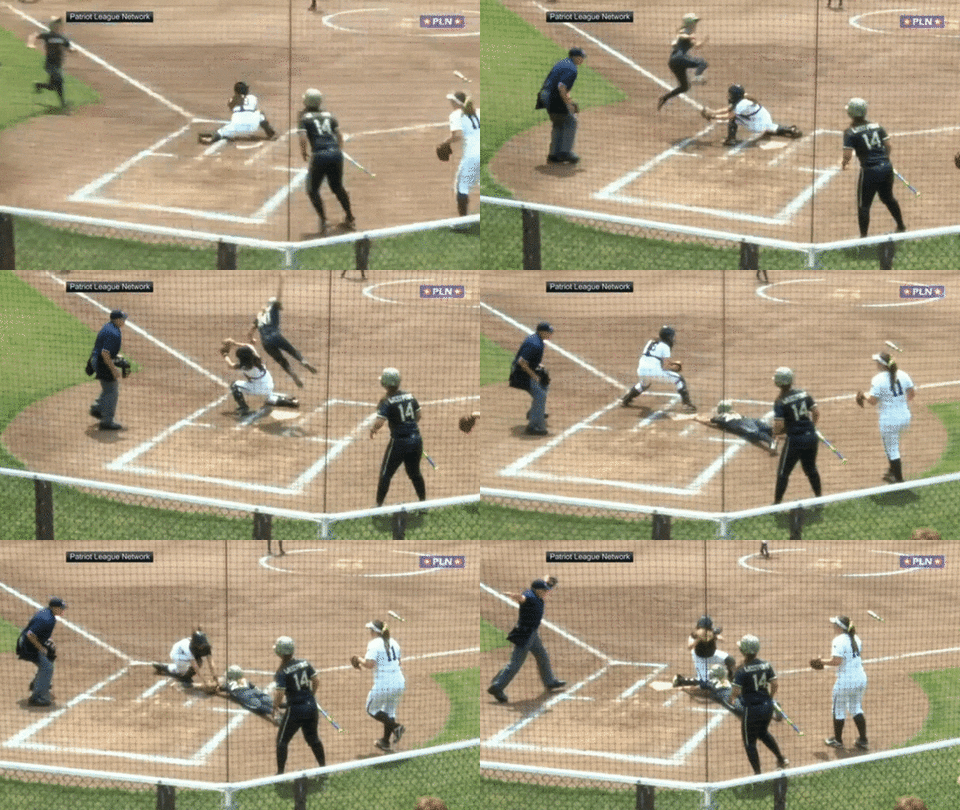
No cleats to the face, no banging your unprotected head on the ground if you’re knocked backwards.
By the way, this isn’t just me saying all this, although it is what I tell catchers. A quick Google or AI search will find pretty much all top-line catching instructors saying the same thing. Removing the catcher’s mask is both unnecessary and less safe.
So the only reason left to insist your catchers rip off their masks when making a play is because YOU ARE OPERATING OFF OF OLD AND OBSOLETE INFORMATION (saying it loud for the folks in the back), and you are letting your ego get in the way of doing what’s best for your players.
This is why it is so important for coaches to continue to seek out new information and learn. Not just about catcher’s masks but all aspects of the game.
The old ways may have worked, but there are a whole lot of smart people out there who have the time, tools, talent, and budget to research every aspect of the game more thoroughly. If new discoveries or information come along that can help your players do better why wouldn’t you want to take advantage of it?

I know some people hate to admit that they may have been wrong in what they were teaching, but they need to get over it. They need to understand it isn’t that they were wrong – it’s that they were using the best information they had at the time, and now they have new and better information.
As my buddy and podcast partner Jay Bolden says, as coaches we expect our players to be learning and improving all the time. Why shouldn’t we demand the same of ourselves?
The fact is we should be eager to learn more, because the smarter and more informed we are, the better chance we have of developing better players who will help us win more games. Sticking with something because that’s the way you’ve always done it is a very poor way to coach, and one that could hurt a player’s development – or even end up with her injured.
The catcher’s mask discussion is just a symptom of a larger issue. Before you insist on players doing something in cases where they’ve been taught something else, take the time to do a little research and see WHY it’s being taught differently.
You might just learn something that will help you not just now but in the future as well.
My good friend Jay Bolden and I have started a new podcast called “From the Coach’s Mouth” where we interview coaches from all areas and levels of fastpitch softball as well as others who may not be fastpitch people but have lots of interesting ideas to contribute.
You can find it here on Spotify, as well as on Apple Podcasts, Pandora, Stitcher, iHeart Radio, or wherever you get your podcasts. If you’re searching, be sure to put the name in quotes, i.e., “From the Coach’s Mouth” so it goes directly to it.
Give it a listen and let us know what you think. And be sure to hit the Like button and subscribe to Life in the Fastpitch Lane for more content like this.
7 Lessons from the 2025 WCWS

Like many coaches I’m sure, over the last couple of weeks I’ve been telling my students that they should watch the Women’s College World Series games. See what they do and how they do it, because in most cases
it’s a master class in how to play the game.
Students aren’t the only ones who can learn from it, however. There were a lot of lessons in there for coaches at all levels as well.
In some cases it was the strategies those coaches followed, whether it was using the element of surprise (such as a flat-out steal of home) or how they used their lineups. In others it was how they dealt with their players through all the ups and downs of a high-stakes series, or even their body language (or practiced lack of it) when things went wrong.
So with the WCWS now concluded and a champion crowned, I thought it would be a good opportunity to recap and share some of those lessons (in no particular order). Feel free to add any you think I may have missed in the comments.
WARNING: There be spoilers here. If you have games stacked up to watch and are trying to avoid learning the outcomes of those games stop reading now, go fire up your DVR, then come back afterwards.
Individual Greatness Doesn’t Guarantee Success
Ok, quick, think about who were the biggest names going into this year’s WCWS. Odds are most of you thought of three pitchers in particular: Jordy Bahl, Karlyn Pickens, and NiJaree Canady.
They have been the big stories all season, and for good reason. All are spectacular players who make a huge difference for their teams.
Yet only one of those names – NiJaree Canady – was in the final series, and her team did not win the big prize. This is not a knock any of these women, because they are all outstanding.
It is merely an observation that for all their greatness, it wasn’t enough in this particular series. To me, the lesson here is not to get intimidated by facing a superstar and fall into the trap of thinking your team simply can’t match up.
Teagan Kavan, the Ace for Texas had almost double the ERA and WHIP versus NiJaree Canady, almost double the ERA of Karlyn Pickens (although their WHIPs were close), and a somewhat higher ERA and WHIP than Jordy Bahl. Yet in the end Kavan was the one holding the champion’s trophy.
Get out there and play your game as a team and you can overcome multiple hurdles as well.
Riding One Pitcher Doesn’t Work As Well As It Used To
Back in the days of Jennie Finch, Cat Osterman, Monica Abbott, Lisa Fernandez, etc., teams used to be able to ride the arm of one pitcher all the way to the championship. That is no longer the case.
One reason for that is the change in format, especially for the championship. It used to be you only had to win one final head-to-head matchup to take home the prize. Now, it’s best two out of three, which extends how much a pitcher in particular has to work, especially if you’re the team coming back through the loser’s bracket.
It’s not that today’s athletes are any less than those of the past either. I’d argue they’re probably better trained and better conditioned that even 10 years ago.
But the caliber of play has continued to increase, and every one of the players is now better trained and better conditioned than they used to be, with science and data leading the way. That elevation in performance makes it that much tougher to play at an athlete’s highest level throughout the long, grueling road to the final matchup.
The stress and fatigue of playing on the edge takes it toll, especially on the pitchers who are throwing 100+ pitches per game. And while the effort of pitching in fastpitch softball may not create the same stresses on the body as overhand pitching, repetitive, violent movements executed over and over in a compressed time period are going to take their toll.
Smart teams will be sure to develop a pitching staff and use that staff strategically to preserve their stars for as long as they can. Yes, when you get to the end you’re going to tend to lean on your Ace more.
But the more you can save her for when you need her at the end, the better off you will be.
(NOTE: This is not a critique of either coach in the championship series. This is more advice for youth and high school coaches who over-use their Aces to build their won-loss record instead of thinking ahead to what they will need for the end of the season.)
In a 3-Game Series, Winning Game 1 Is Critical
Winning that first game gives you some luxuries that can help you take the final game.
When you win game one, you have the ability to start someone other than your Ace because worst-case if you lose you still have one more game to try to win it all. You can bring your Ace back fresher, and you won’t have given opposing hitters as many looks at your Ace as they would have had otherwise.
If you lose game one, it’s do-or-die. You need to do what you need to do to keep the series going so you will pretty much be forced to use your Ace. She gets more tired, and opposing hitters get more looks at her in a short period of timing, helping them time her up or learn to see her pitches better.
That makes it rougher to win game three for sure.
Even the Best Players Make Errors Under Pressure
So there’s Texas, sitting on a 10-run lead in the top of the 5th inning with three outs, then two outs, then one out, then one strike to go. One more out and the run rule takes effect, making them the 2025 WCWS champions. I’m sure their pitcher, Teagan Kavan, was looking forward to it all being done since she’d throw her fair share of pitches in the WCWS too.
But then disaster struck. Texas Tech put the ball in play and a throwing error by Texas put what should have been the third out on base. Another throwing error and a couple of hits later the score is now 10-3 and Texas Tech feels revived.

I’m sure the original error was a play they’ve practiced a million times. But in that situation the throw pulled the first baseman off the bag and kept Texas Tech in the ballgame.
That’s something to remember with your own teams. Even the best players make mistakes and/or succumb to pressure. The key is to not hit the panic button (or the scream at players button) and instead keep your cool so the players calm down and get back to business.
Also notice Texas coach Mike White didn’t pull his shortstop in the middle of the inning because she made an error. Instead, he put his faith in her and she made plays later that preserved the win.
It Ain’t Over ‘Til It’s Over
Same situation but from the Texas Tech side. It would have been easy for them to say 10-0 was an insurmountable lead and begin to let up a little.
Instead, they battled to the final out, and played like they always believed they could still win it. While it would have been tough, if a few more things went their way who knows?
Every player on that side did their jobs to the best of their ability, always believing they could still take the lead. And for a while there it looked like they might.
Now, one thing they had was the luxury of time. With no time limits and no run limits, they had the potential to score enough runs to get back in the game.
It didn’t happen, but it could have. As long as you’re not restricted by time there’s always that chance you can come back. Keep doing your best and you never know what might happen.
Pay Attention to the Little Opportunities
You have to admit the steal of home by Texas Tech was both fun and a gutsy call. I don’t have any inside information on it, but I’m guessing Coach Gerry Glasco knew it was an opportunity long before he called for it. He just had to wait for the right situation.
In watching the replays, it looked to me like the catcher wasn’t paying attention when she threw the ball back, because who would be crazy enough to try to steal home like that? The Texas Tech runner, though, was on a flat-out sprint from the moment the pitch was released and she ended up scoring pretty much unchallenged.
The lesson her isn’t just to keep awareness of what’s happening when you’re on defense, although that’s important. It’s also to think ahead and see what’s happening on the field when you’re up to bat, to see if there are opportunities to advance baserunners or score without putting the ball in play.
It was a gutsy call for sure. But I doubt it was done without a lot of forethought.
Practice the Little Things Too
On the other side of the coin was the hit off the intentional walk in the first game of the championship series. After throwing the first three balls, NiJaree Canady apparently lost a bit of control on the last pitch and Texas took advantage of it, swinging on a pitch that was too close to the plate while the defense was relaxed knowing it was an intentional walk.
Again, I don’t have any inside information but I’ll bet Texas Tech didn’t spend much time practicing intentional walks. Why would they when they had the two-time NFCA Pitcher of the Year throwing for them? Why would she need to walk anyone intentionally?
So when the situation came up, perhaps she wasn’t quite as ready as she should have been. I know you may be thinking “how hard is it to throw a pitch to a spot off the plate for someone who has pinpoint control everywhere else?”
It’s actually harder than you think, and a skill that has to be practiced like any other. Your pitchers are used to throwing strikes. Throwing a ball on purpose may seem as foreign to them as throwing with the opposite hand.
If you think you might throw an intentional walk, or do anything else out of the ordinary for that matter, be sure you practice it first. The less you leave to chance the better chance you have of it working.
Murphy’s Law In Action
Cindy Bristow once told a clinic full of coaches “My girls make the same mistakes your girls do. They just make them faster.” Over the years I have found that to be true.
If things can go wrong they will go wrong. Nothing you can do will change that.
But you can be as prepared as possible, and remember that no one ever sets out to perform poorly. Those things just happen.
Even the best players and coaches make mistakes or have good intentions blow up in their faces. Hopefully we can all learn from them and use that knowledge to help us get better for the next time.
Welcome to the 2025-2026 Season – Wait, What?

A couple of weeks ago as I was busy wasting time scrolling through Facebook I came across something that made me think I must have fallen asleep in front of the TV and not woken up for three months. It was an announcement from a couple of teams about “open workouts” (translation: tryouts) for the 205-2026 season.
“Wait, what?” I thought. I mean, the high school season is still in high gear everywhere high school softball is played in the spring, and travel teams are still working their way through their “shake off the rust” tournaments in preparation for the travel season to begin in earnest.
So why in the name of Carol Hutchins are travel teams already looking for players for the next freaking season??? (You know I’m not happy because I used three question marks instead of one.)
This is just insane. Coaches should be focused right now on the players in front of them and helping each and every one of them reach their potential this season, not out looking for new players so they can unceremoniously dump anyone on their roster they don’t think measures up.
But of course, that’s one of the problems in today’s game. There aren’t as many coaches as there used to be, at least by what I would define as a coach.
Instead, they have been replaced by “managers” who, instead of developing the players they have, are always on the lookout to acquire players someone else has taken the time and effort to coach up. Like Pokemon cards, if you collect enough of those already-baked players you can just throw them on the field and watch them bring home the trophies/rings/banners/whatever is being given away to tournament winners these days.

So now it’s a race to see who can get to those high-level players first.
Now, admittedly, that’s nothing new. I remember when teams used to hold tryouts after the current season was over.
There were always a couple of programs that would try to jump the gun, either by playing in sanctions that ended earlier so they technically were into next season or by holding “special tryouts” maybe a week before their season ended. These organizations would pressure the kids who tried out to make a decision right then and there so they could lock up the talent before anyone else had a chance, although if someone better came along the original offer might be rescinded anyway and then those kids would have to scramble to find a new team.
But even those shenanigans occurred right around the end of the season for everyone.
Now they’re looking for next year’s team while this year’s team is just getting going with their season. And people wonder why players don’t seem to be as loyal to their teams or coaches as they used to be.

In my opinion, and the opinion of a lot of coaches I know whom I respect immensely, the focus during this season should be on helping the players you have now get better rather than finding their replacements. That’s the way to build a winning culture and create a positive experience.
Holding public workouts for next year’s team, before you even know what players or positions you may need, is a sure way to create divisiveness and negativity within the current team. It could even drive some of your current “good” players out because they’re not feeling valued or loved by the organization or the coaching staff.
It’s also a bad idea because you never know who is going to step up during this season and surprise you. If you listen to current high-level college players talk about their early days in the sport, you’ll find many of them were not studs right out of the gate.
Many, in fact, sat the bench a lot (although that’s a travesty in and of itself). Some of the best pitchers today were the #4 or #5 pitcher on their travel teams before they grew, or the mechanics from their lessons kicked in, or someone just gave them a chance to pitch some quality innings and it all came together for them.
It just seems wrong to me for teams and organizations to be ignoring who they have in front of them right now in search of some mythical team for the future. At least if they really believe in the stuff on their website that says they’re “in it for the girls.”
There will be plenty of time for tryouts or other events to convince top talent that they would be better served with a new team that’s “more at their level” than the one they’re on now. I wouldn’t even object so much if you did it right before the end of the season, although don’t be surprised if a few of your “lesser” players on the current team decide not to spend the time and money going to whatever nationals you’re heading to if they’re feeling like you’re planning to cut them once the last out is recorded.
But seeking out new players at the beginning of your primary season? That’s just ludicrous.
Run with the players you have now and help them finish the season better than they started. You just might find you don’t need as many new players as you thought.






 Life in the Fastpitch Lane