Category Archives: College softball
Fastpitch catchers: On your feet or on your knees
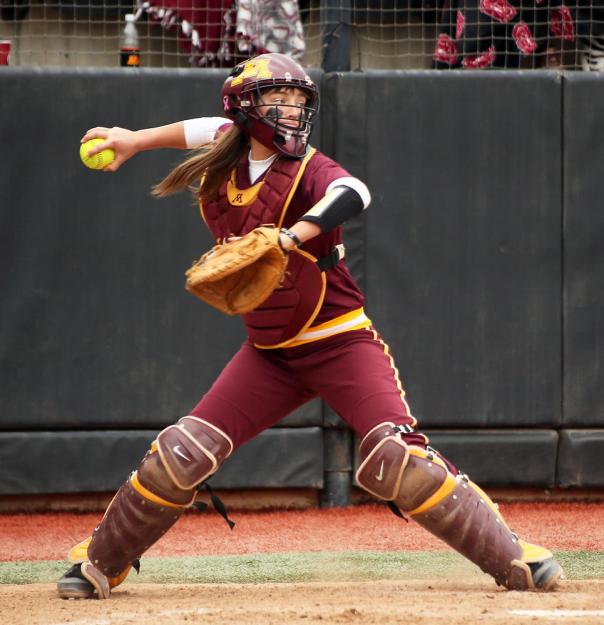
University of Minnesota vs. Oklahoma State University Women’s softball.
Ok, I’ll admit it. The headline was my opportunity to offer a tribute to one of my favorite Blue Oyster Cult albums. But it does have relevance for fastpitch catchers as well as coaches when it comes to making throws to various bases.
There is certainly a perception in some circles that to be a high-level catcher you have to be able to throw from your knees. Of course, like many of these so-called “absolutes” that is simply not true.
Throwing out runners on a steal is basically a math problem. Since it’s summer let’s make the math easy to start.
Let’s say the runner can go from first to second in 3.0 seconds and the pitcher is throwing 60 mph, which means it takes 0.4 seconds from the time leaves her hand until it reaches the plate. Simple subtraction says 3.0 – 0.4 = 2.6.
That’s the amount of time the catcher has from the moment the ball hits her glove to the moment it must be at second base to catch that runner: 2.6 seconds, aka her “pop” time. Notice that nowhere in that simple mathematical formula does it say anything about how the ball is thrown, because it doesn’t matter. It just has to get there on time.
So if the catcher can throw hard enough to get the ball to the base in 1.5 seconds, that means she has 1.1 second to receive the ball, get into position, transfer the ball to her throwing hand and get it on her way.
If it takes less time to throw the ball, she has more time for the other stuff. If it takes her more time to throw, the transfer and positioning time goes down.
Of course, when you’re talking about high-level catching, such as at the D1 college level, 2.6 seconds is a terrible pop time. You won’t be catching if that’s what it takes. They’re looking for sub-2.0 times, the faster the better.
So using our simple math again, if the runner has 2.6 speed and the pitch is still taking 0.4 seconds to reach the plate, the pop time is 2.2 seconds. Allow for a little variance and you’re looking at, say, 1.8 seconds.
Now the throw must get there much faster, but it still doesn’t matter how it gets there as long as it gets there on time. There are no style points in softball. It either works or it doesn’t.
As I’ve been watching the D1 Regionals and Super Regionals I’ve seen both. Some catchers have thrown from their knees, while others popped up. Why the difference?
Sometimes it’s dictated by where the pitch comes in. A high pitch, whether it’s intentional with a rise ball or some other pitch that got away from the pitcher will lead to a throw from your feet. It would be silly to throw from your knees in that situation.
On low pitches it’s a little different. For some catchers, going to their knees feels right. For others, especially those who lack speed or mobility, it may be too difficult to get to their feet in time to make the throw. They simply don’t have the agility so they must go to their knees. Those who are quicker and more agile, on the other hand, can get up, get into position, and make the throw with time to spare.
Ultimately it comes down to 1) what it takes to get the job done and 2) personal preference. As long as the ball beats the runner to the bag in time to make the tag and get the out, how it got there doesn’t matter. Not even a little bit.
I’ll take a catcher who throws from her feet and gets people out over one who throws from knees and doesn’t, or gets very few, any day of the week, and for a double header on Sunday. I’m sure any college coach would agree, because only a fool would think otherwise.
What a way to end your career
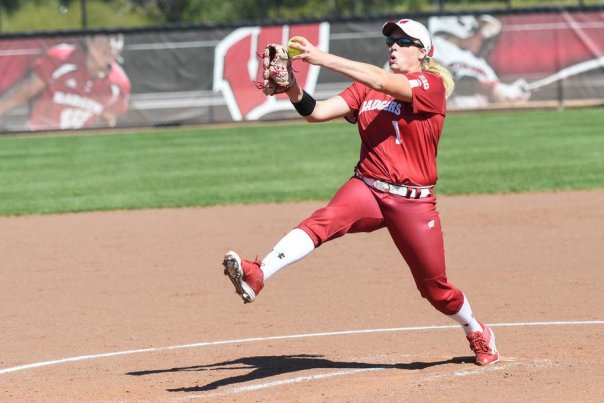
Just had to give one last shout out to Kirsten Stevens at the University of Wisconsin Madison for ending her fastpitch softball career with a bang. Kirsten was named to the Eugene Regional All-Tournament team after a stellar performance last weekend.
Her key accomplishment in the Regional was throwing a 2-0, five-hit shutout against the UIC Flames in a must-win game. It’s my understanding that this was the farthest UW Madison has gone in the NCAA Division 1 tournament in its history, and she got to be a contributor to the team getting there. 
In that game, Kirsten secure 8 strikeouts, including one to end the nail-biter of a 7th inning when UIC threatened to tie the game by opening the inning with two hits to put runners on first and second with no outs. But Kirsten bore down, getting the next hitter to pop up a bunt attempt on a lovely riseball to relieve some pressure, then inducing another out before finishing out the game with the final K to send UW Madison to the finals against Oregon.
It was quite the storybook finish for her. Or so it appeared.
The next day, Kirsten was brought in to throw one more time after UW Madison fell behind the Ducks. After settling in she was able to secure three outs, including once again finishing out the inning with a K, bringing her tournament total to 9, which was second only to Oregon star Maggie Balint. Her tournament ERA was 0.88, which was also good for second-best, this time behind Oregon’s Miranda Elish, who blanked the Badgers in the final. To add to the accomplishments, Kirsten gave up no walks in 8 innings pitched, making her #1 in K/BB ratio. Needless to say, she was on fire.
It was quite a way for the senior to finish a great career filled with many accolades. Congrats to Kirsten on a job, and a pitching career, well done.
Related content:
College softball not always the Valhalla you imagine

There is a belief by many in the fastpitch softball world that making it to play in college gives you entry into a virtual Valhalla where the coaching is top-notch, the players are dedicated to and fully supportive of one another, and all the problems of school or travel ball disintegrate into the rarefied air of collegiate competition.
I’m here to tell you that’s not actually the case. At least not everywhere all the time. I was reminded of that yesterday while watching a collegiate game.
It was a well-played contest between two very competitive teams, each battling to the last out for the win. The weather conditions were hardly ideal, which made the competitive spirit of the players stand out that much more.
Yet sitting in the stands, I once again noticed how it isn’t all that much different from 10U travel ball. I’ve seen games at all levels, and talked to players and coaches as well. Here are a few of my observations on the similarities from yesterday and the past that will hopefully bring a measure of reality to your hoped-for college experience.
Parents still live and die with their daughters’ performances.
I’m sure this never goes away. But you can generally tell whose daughter is at the plate by the way the parents react. When it’s someone else’s kid, they’re relaxed and enjoying the game. When their kid comes to bat, they suddenly tense up.
Many bring out the smartphone to video the at-bat, probably to go over it later in great detail. I’ve heard tales about this or that dad who is pretty brutal on his daughter’s performance. (Moms not so much, although I’m sure it happens.)
Pitchers’ parents have it worse. They have to sit on the seat cushion of nails for the entire half inning. If their daughter struggles, they either tense up visibly or deflate like a balloon. Not all of them – many actually just sit and watch the game, supporting their daughters with the sheer force of their will as best they can – but there are those who definitely go too far with it.
Yelling at the umpires
Another surprising thing. Although it happens at pro games too so I guess I shouldn’t be too surprised.
But still, do parents really think they’re helping their cause by riding the home plate umpire? In the best care scenario, the plate ump will be a professional and ignore the peanut gallery. That’s usually what happens.
Below the best case, he/she might start giving a little more leeway to the opposing team just to prove a point. Umpires are human beings too (despite what some of you think) and subject to the same human reactions as the rest of us.
There is probably less yelling at and complaining about umpires overall than at a 10U game. But by the time the parents who do it have players of college age, they’ve had a lot of practice at it.
Complaining about the coaches
Pretty much the same thing as with umpires, only different topics. It’s all the usual complaints – playing time, coaching strategy, lineups (why would they put so-and-so in the 5 spot? She hasn’t had a hit since the Democrats controlled Congress!).
They’ll also critique every decision on the field, especially if it goes south. Stealing bases is a great idea until a runner gets thrown out. Then it’s “What were they thinking?” Why are we bunting, or why are we not bunting, is another popular question.
Even the pitch calling gets questioned on a case-by-case basis. Particularly if it results in a home run. Hey, it’s possible the right pitch was called but not thrown. Or the right pitch was called and thrown, but the hitter just did a heckuva job hitting it. That happens too.
Honestly, the parents or fans who do this are in the minority. Versus 10U ball where everyone is an expert and the score doesn’t matter. But it does go on. Why do you think coaches pretty much tell parents at the beginning of the season please come out and support us, but we don’t want to hear from you ever?
Players sniping at one another
I am pretty sure there are some college coaches who are good at keeping a lid on this sort of thing. But softball players are human, and not all humans are good at handling personal responsibility. So when something goes bad on the field, their instinct is to blame others instead of owning their own mistakes.
For example, a player who makes a bad throw might blame the receiver for not moving fast enough to catch it. Or a player who lets a spinner drop in front of her might blame another player for causing confusion by going after the ball – even though every team drills who has priority over who into their players’ heads from day one.
On offense, players might blame one another for lack of production at the plate in a give situation. Especially if the player who struck out with runners in scoring position isn’t a star.
These are the kinds of things losing teams do, even when they’re winning. It happens at 10U, 12U, 14U, etc. And it can happen in college.
Coaches having favorites – and non-favorites
It’s a pretty safe bet that all college coaches have favorites – the kids they count on more than others. The better ones at least make an effort to hide it. But many others make it pretty obvious.
One of the easiest ways to tell is by how long a leash each player has. For example, if player A makes an error, she gets yanked out of the game right away, benched so she can think about her egregious transgression and her sabotaging of the coach’s goal of joining the 500 wins club. If player B makes the same error, however, nothing. “Shake it off,” she’s told. Pretty easy to see who is the favorite.
The problem with this thinking, of course, is that should Player A get back on the field, she will be that much more uptight and cautious. She will be playing not to make an error instead of to make a play. That usually becomes a self-fulfilling prophecy.
Still, not every coach gets that. And the more they play favorites, the more they create the sorts of divisions in their teams that will prevent them from losing.
Focusing on one play as the reason for a loss
Yes, this still goes on in college too, unfortunately. I’ve written in the past about how it’s never just one thing that causes a loss. But not everyone understands that, even in college. Where they should.
That play at the plate where the runner was called safe when she was clearly out. That bad pitch that ended up in the outfield bleachers. That mishandled ground ball that let the winning run on base. And so forth.
All of these are but single incidents over the entire course of the game. In college there are no time limits, so the minimum length is 6.5 innings. That means the visitors have 21 outs to work with. The home team has either 18 or 21 depending on whether they are winning or losing after 6.5.
So yes, that play at home was costly. But how much would you care if your team had scored 6 more runs? A little argument, then you’d be laughing about it. Same for that error, or that meatball served up like you went to Olive Garden. They’re all meaningless if the team scores more runs, or plays better defense overall.
No game turns on just one play. There are ample opportunities to win throughout. But that instinct to make it all about one event can be strong. Even at the college level.
It’s still fastpitch softball
Just as the game itself doesn’t really change from 10U to college, the things around it don’t change much either. If you don’t believe me, try hanging out at a college game – the closer to home plate the better.
Then just listen to and watch what’s happening around you. Playing in college is still a worthwhile goal. Just be realistic about your expectations once you (or your daughter) get there.
It’s fun – but it’s not Valhalla.
Congratulations to Wisconsin pitcher Kirsten Stevens
Huge congratulations are in order for University of Wisconsin – Madison pitcher Kirsten Stevens on being named the Big Ten Pitcher of the Week. Can’t say it comes as a surprise, though, after the weekend she had.
Kirsten toss not one but two shutouts in earning her third and fourth wins on the season. And this after being sidelined for most of the off-season with a broken foot.
When the accident first occurred it looked like the Badger might miss the first part of the season. But with a strong work ethic and help from the Wisconsin coaching staff and trainers, she beat the prognostications and is back on the field.
And what a pre-season it’s been. Kirsten is currently sporting a miniscule ERA of 0.28, which is what happens when you’ve only allowed one run for the season so far. Over the weekend she also had a personal best 11 strikeouts against Hofstra, continuing the blistering pace for Ks she set as a goal before the year.
And the best part? Kirsten is one of the nicest human beings you’ll ever meet. Always with a smile on her face, always remembering to have fun, and always making time to speak with and encourage the young players who look up to her (literally as well as figuratively) when she meets them.
All we can say here is keep up the good work! And again, congratulations to both you and the team who helped you achieve a well-earned honor.
Congratulations to Taylor Danielson for signing with UIndy
One of the best parts of my job as a fastpitch softball instructor – actually THE best part – is seeing them succeed. That’s why I was so excited and honored to watch as Taylor Danielson signed her National Letter of Intent to play softball at the University of Indianapolis (UIndy). Go Greyhounds!

Taylor Danielson signs her National Letter of Intent for UIndy as her parents Chris and Tracy watch.
I’ve written about Taylor a couple of times before, most recently just a couple of weeks ago. She is an amazing catcher who can frame and block with the best of them. She’s also very vocal, the types coaches love because she takes command on the field.
She’s a great hitter as well (as the post about the knee injury attests) and when she’s healthy she has 2.8 speed from home to first – a pretty rare skill for a catcher. It’s no wonder the UIndy coaches verballed her more than a year ago and are excited for her to come over.
Taylor is also a high quality human being. For all her talent on the field she is very humble off of it. I’ve never heard her say a mean word about anyone, even people who probably deserved it. She is kind and caring, and always has a smile on her face. She’s also very polite, which seems to be more and more rare in our me-first world. Definitely credit her parents Chris and Tracy for that.
 I actually first met Taylor when she came to catch for a pitching and hitting student of mine named Kate Kiser – before Kate wound up going to volleyball full time. While she was catching I used to give her a tip here or there, which I tend to do with catchers. Something must have clicked, because her dad asked if I would give her full-time catching lessons. We also did hitting together, and Taylor was a sponge with both.
I couldn’t be happier that Taylor has this opportunity. UIndy is a high-quality program, and I’m sure Taylor will help them become even better. So Taylor, congratulations. I know you will continue to be awesome. Looking forward to catching a couple of games in your senior high school season, and at UIndy as well.
Return of the Indiana United Fastpitch Elite/Rick Pauly Clinics
Earlier this year I blogged about a fantastic fastpitch pitching event held, of all places, in Southeastern Indiana. Put on by Rick Pauly, hosted by Indiana United Elite Fastpitch and Coach James Clark, and featuring an array of top-level pitching coaches, it was an incredible learning experience for players, parents and coaches alike.
Never one to be content to rest on his laurels, Coach James has outdone himself with the latest iteration. The 2017 clinic, again in Richmond, Indiana, has expanded in its scope to not only offer top-level pitching instruction but also clinics on hitting, catching, the short game/slapping and defense.
This year’s instructor lineup is impressive once again, with college coaches and former college and NPF players offering hands-on instruction. The nice thing about these clinics is they’re not like so many, where they show a big name who is the “face” but then have very little interaction. The faces you see on the flyer will all be actively participating in or leading the instruction.
Throughout the weekend there will be plenty of time for discussions and questions too. One of the highlights for me last time was many of the instructors gathered together in a room tossing around ideas and opinions until the wee hours of the morning – all part of an impromptu session that began with a simple question. Those little side conversations alone are worth the price of admission.
Coach James promises it will be bigger and better than ever, and I believe it! The clinic runs the weekend of January 6,7 and 8, 2017 – timed this time to both make sure it didn’t interfere with high school and college seasons and to give players time to lock down what they learn before tryouts begin for spring high school ball.
Click here to register, and here to schedule the sessions you want and to pay. Most sessions are $70 each and run an hour and 15 minutes. The exceptions are the recruiting discussion that costs $25, and the beginning and advanced pitching sessions with Rick and Sara Pauly which cost $150 and are scheduled for 3 hours, although last year Rick was having such a great time he ran a bit long on both sessions.
Download the flyer for complete information, and then be sure you sign up now. Slots are filling fast. I’m sure you’ll find it’s a great investment in your softball future.
The most wonderful time of the year
You can almost hear the music, can’t you? But I’m not talking about Christmas. I’m talking about the Women’s College World Series (WCWS)!
It’s amazing how far this tournament has come in the last few years. It used to be you were lucky if you could find the championship game on TV. Now pretty much the entire tournament is being broadcast across several networks, including ESPN (every flavor except The Ocho), The Big Ten, PAC 12 and SEC. There may be a couple of others but those are the ones I know – and have watched so far.
What a great opportunity for younger players to immerse themselves in high-level softball too. From a single vantage point on the couch (or on the floor) they have a chance to see dozens of teams from across the country – to see the speed the play at and the energy they bring.
In my mind it’s also a great opportunity to see the mistakes they make, from getting double off a base on a line drive to running into a tag to misjudging a fly ball to throwing too high or too low and so on. Pitchers can see college pitchers whose educations are being fully (or at least partially paid for) leave a ball fat on the plate and then watching helplessly as it leaves the park. There is some comfort in knowing that even the best players aren’t always perfect.
I know for many players in the 10U -13U ranks that the travel and rec ball seasons have started, and you may have games over the next three weekends. But if you can, set your DVRs or grab a few moments between games and check out the WCWS. I think you’ll like what you see – and you’ll help boost the ratings so all those networks will keep showing all those games.
Fastpitch Face Masks Revisited
Interesting how times and opinions change. Last week while searching for something else I came across this old blog post. It dates back to May of 2008, and in it while I don’t outright oppose face masks I don’t exactly come across as supporting them either.
I have definitely changed my tune on that score, especially when it comes to pitchers and corner infielders (third and first base). Guess I’ve seen enough hard shots and needless injuries to now believe wearing a face mask should be the standard in fastpitch softball now rather than an oddity.
To me, the risks of damage to the face are simply too high to ignore. All it takes is one hard shot off a juiced-up bat to forever change a softball player’s life.
Not just in how they play the game either. I mean actual life. No matter how much we wish it wasn’t so, how someone looks has an effect on how we react to them and often even whether they get a particular job or not. To put it bluntly, studies have shown that attractive people are more successful. A blow to the face from a softball could end up hurting one’s career chances.
This, of course, is on top of the immediate trauma and time lost in softball and other activities while injured.
The good news is, much of the stigma formerly attached to using a mask has gone away. Up until recently, high school-age players were told that wearing a face mask would be perceived as a sign of weakness by college coaches, severely reducing their chances of being recruited.
Apparently even that stigma is going away, as evidenced by the fact that Kelly Barnhill, a freshman pitcher with two-time WCWS champions Florida, wears a mask when she pitches. And she is just one of a growing number of college pitchers who are wearing masks not simply because of injury but as a permanent choice.
If a masked pitcher is acceptable to the 2X champions, it should be considered acceptable at all levels of play now. At the Rick Pauly Elite Pitching Clinic in Indiana, no less than former Georgia pitching coach Rick Pauly himself flat-out said pitchers should wear masks as well. If he’s saying it, players should be listening.
The only thing left, I suppose, is to make face masks mandatory. I know there are those out there who oppose it, just as people opposed face cages for hitters when they were introduced. No doubt some opposed catcher’s gear back in the day too. But as the risks and liability costs continue to rise, it probably won’t be long before the only pitchers not wearing masks will be those grandfathered in under the old rules.
Does every player need one? I still don’t think so. For me the dividing line is how much damage a ball to the face will do. A hard ground ball that takes a bad hop on a shortstop will be painful and leave a mark, but it’s unlikely to crush an orbital bone. A hard shot back to a pitcher or corner, however, could do serious, permanent damage.
But here’s the bottom line. It doesn’t matter what I think. If you’re a player, it’s your face. If you’re a parent, it’s your daughter’s face. Get the facts, make the best decision and don’t let what anyone else says be the determining factor. Better to have the protection and never need it than to need the protection and not have it.
Congratulations to Emma Bartz for signing with Northwestern
I am very pleased and excited to congratulate Emma Bartz on signing her National Letter of Intent today to play softball at Northwestern University next year. (I never like to post these things until they’re official and the ink is dry.)

Emma Bartz signs her NLI to play softball at Northwestern
Emma is not only an outstanding softball player but an outstanding human being, as evidence in this blog post from about a year ago. She is very kind and polite, and always has a smile on her face. It’s always nice when good things happen to good people.
We started working together almost by accident. She was going to start hitting lessons with someone else, but it just so happened a student of mine at the time, Amy Abel, was at her house and recommended she come and see me instead. How lucky for me!
The great thing about Emma is she gives 100% on every rep, as seen here recently. In fact, that’s been one of the challenges, learning a little plate discipline because she really likes to get after the pitches. While she is not very tall she is quite strong – no doubt in part due to her legacy as a cheerleader.

Closest I could come to Northwestern purple.
She’s also fast. Like lightning fast. Normally I would suggest a kid with her speed turn around and slap. But when I saw the power she had from the right side I thought that would be her best bet, and it turned out to be right.
Congratulations to Emma, and her parents Jean and Keith who raised an incredible daughter. I’m looking forward to watching Emma during her senior season in high school, and then at NU.
Lesson learned from the WCWS
So another WCWS is behind us. Have to admit there was some terrific play and some incredible games to watch. Auburn came darned close to completing their Cinderella run, and all the teams competed well – even those that went out in two straight.
There were some bad plays as well – simple errors such as a ball going through a shortstop’s legs, misjudged fly balls, poor baserunning – all the things we yell at our 12U and 14U players for. Even the big girls get it wrong sometimes.
But the thing that struck me most were the smiles on the players’ faces – even when something went wrong. It’s not that they were taking the game lightly. But they had an appreciation for where they were and what they were doing.
Here they were, on one of the biggest stages in the country, playing on TV before millions of viewers. Despite the fact they made an error or hit a batter with a pitch, or popped up in a crucial situation, those players kept on smiling.
That’s some pretty amazing coaching, to create an atmosphere like that where they could not only play for the love of the game but show that love outright. To me that was the biggest lesson we all can learn.
While it may seem like life or death in the heat of the moment, it’s really not. Teams with players who can smile through adversity and move on to make the next play will always do well. Those who dwell on their mistakes instead of enjoying the moment are likely to implode.
Be the team that smiles.






 Life in the Fastpitch Lane