Category Archives: Coaching
When Designing Your Scheme, Be Sure It Fits Your Players

Today’s topic may seem completely self-evident to some of you – to the point where you say “Duh!”
Yet I can’t tell you how many times I’ve watched a game (in person on TV) or spoken with players and/or parents and realized what should be a cardinal rule of softball has been violated yet again.
This rule is particularly important in middle school or high school ball, where coaches don’t get to choose their teams from a vast pool of players but instead must make the best out of whoever goes to that school. Sometimes those coaches win the lottery, and other times they end up with a donkey.

But even if you do have a wider range, ultimately you have to look at the skillsets and physical attributes of your players and make decisions accordingly. Here’s an example.
For a long time, slapping and the short game was the key to winning, especially in college. As a coach you may love to create chaos on the basepaths and force the other team into making mistakes. But if you look at your team in the huddle and what you see more closely resembles a nest of baby turtles, you’re going to have to find another way to score runs.

The reverse is also true on offense. If you roughly weigh more yourself than all your players put together, you’re probably not going to be going deep with any regularity. So while you may love the way college teams like Oklahoma and Arizona State launch bombs on a regular basis, you’re probably going to need your players to master techniques such as bunting, slug bunting, and the ol’ hit-and-run. At least if you want to win ballgames.
The same is true of your pitching staff. If you have one or more dominant pitchers who can rack up 10, 12, 14 strikeouts a game, with the mental toughness to get critical strikeouts when needed, you can probably give up a few more defensive errors, or put a weak glove in the lineup if it means one more strong bat. If, however, your pitchers are more along the lines of letting hitters get weak hits and counting on your defense to get the outs, you’d better have strong gloves out on the field.
You can always use the big hitter/weak glove as a DH or pinch hitter. With the added benefit in the latter case of having that big bat available on demand rather than having to hope you get to her.
Speaking of defense, the type of players you have will (or at least should) affect the types of defense you play as well. Let’s take the outfield for example.
If you have speedy outfielders who are good at going back on fly balls, you can afford to play them in a little closer to the infield to try to cut off the Texas Leaguers and duck snorts that seem to plague your team and no one else’s. That is, unless your pitcher is prone to give out moon shots the way Olive Garden gives out breadsticks.

Your players’ capabilities will (or should) also affect scheme decisions such as bunt coverages. In fastpitch softball it’s standard to have the first and third basemen crash the plate on bunts.
But if your first baseman isn’t particularly good (or even adequate) at fielding balls on the ground, or making a quick throw from a bent over position, or is the biggest turtle in the conference or the complex, having her try to field a bunt up the first base line may be your ticket to an early ulcer.
You may want to consider having your pitcher field anything up the line. Unless, of course, she is a hot mess fielding as well, in which case you can either try pulling your second baseman up next to the pitcher in obvious bunt situations or have a track coach work with your third baseman so she can try to cover everything up-close.
The bottom line is you may have done X, Y, or Z when you played, or seen a particular approach on TV, or attended a coaches clinic where a Power 5 coach with a multi-million dollar budget that includes a huge scholarship pool said “This is what we do.” Or gotten your butt beaten by a vastly superior team whose success you’d very much like to copy.
But before you pull the trigger on introducing your new scheme, ask yourself honestly if you have the players who can pull it off.
If so, great. Have at it.
But if not, it’s better to take a look at what you DO have and build your schemes accordingly. You’ll ultimately produce WAY better results.
Homework v Herework

You have probably heard the statement that it takes 10,000 hours to master a particular skill. While there is definitely some dispute about this statement, especially since one size never fits all, the more critical point is that for 99.999% of the population it takes a lot of repetition to truly get good at something.
What most don’t realize, however, is that in most endeavors there are two types of work.
One can be classified as traditional “homework,” i.e., you learn the basics at practice or lessons and then you continue to work on them at home. The other is what I call “herework,” or the work you do during those practices or lessons.
The challenge for many players is they (and often their parents) think they can accomplish everything they need during the herework and don’t feel the need to do the homework. Here’s why that’s a critical mistake.
Let’s say you’re a pitcher who has been taught to turn the ball back toward second, lock your arm, and push the ball down the back side of the circle. You’ve come to realize that’s not what elite pitchers do, so you go to an instructor who can teach you how to keep a bend in the elbow and the ball oriented to generate whip.
The coach can show you how to do it, and walk you throw various drills that will encourage the change in behavior. That’s good herework and very valuable to the learning process.
But if you leave the practice and don’t work on those same drills while you’re on your own (homework), you’re probably not going to be able to replace your old habits with new ones. So you will continue to perform the movements the way you’ve always done them because that’s what is ingrained into you.
The problem with that is the next time you go to practice or a lesson, you’re right back to square one. Which means instead of building on what you’ve learned already you have to go back and try to learn it again. That’s not much fun (or very efficient) for either you or the coach.

What it comes down to is herework is about making changes, or learning how to make changes. Homework is about locking those changes in so you can continue to move forward.
The same is true with hitters dropping their hands. You know it’s a bad thing, and you can learn what to do instead of dropping your hands to swing the bat in practice. But if you don’t work on that new approach at home, it’s pretty unlikely you will quit dropping them any time soon.
Now, I don’t want to imply that this is a one-week process. How long it takes depends on how long you’ve been doing what you’re doing and how badly you want to change it.
After all, many players want the reward of improvement but are reluctant to put in the hard work to achieve it. I think many also hope their coach will wave a magic wand and make them instantly better.

But it doesn’t work that way. While it may not take 10,000 hours, it does take some investment of time, on your own, to replace old habits with new and see the types of improvements you want to make.
Understanding the difference between herework and homework will help you get there much faster.
Is Better Technique Worth the Effort?

We’ve all seen it at one time or another.
A player comes in with lots of raw ability. She can throw harder, hit farther, pitch faster, etc. that the typical player her age. Yet she looks like an unmade bed when she executes those skills.
Ah, we think, if only she had better technique. Then imagine what she could do.
So, we begin working with her to clean up her mechanics and what happens? Her measurables drop.
The speed reading on overhand throws or pitches isn’t quite as high as it was when she walked in, and maybe she’s having more trouble hitting the target than she used to. Instead of hitting bombs she’s hitting pop-ups or ground balls – or even missing the ball completely.
At that point you begin to ask yourself whether all that time spent working on improving her did her any favors.
In the short term, the obvious answer would seem to be no. As ugly as her technique was it was working for her, while what she’s doing now doesn’t seem to be.
But those early impressions can be deceptive. And in the long term, especially as the level of competition increases, the work she’s putting in now is almost guaranteed to pay off well later.
How do we know? There are a few factors.
Physics and biomechanics
The laws of physics are immutable. Unless you’re this guy.

Which means if what you’re doing takes better advantage of the laws of physics, all else being equal the outcome will be better.
The same goes for biomechanics. If you use your body in a way more in line with how it’s designed to be used, again all else being equal, you will achieve better results.
The key is all else is rarely equal. Our bodies are marvelous things, capable of doing all sorts of things.
But they also prefer to be comfortable when doing them. So if you’re comfortable with bad technique you will tend to do it with more enthusiasm/energy than you will something new.
That additional energy is often more than enough to compensate for any lack of solid application of physics or biomechanics, especially in younger players. As a result, the measurables created with weaker technique will often outshine those of the new, better technique.
The trick here is to get comfortable enough with the new mechanics so you can execute them with the same energy and enthusiasm as the old ones. That takes time – time which impatient players, coaches, and parents are often unwilling invest.
They’re looking for the “get rich quick” scheme, and when one doesn’t pay off immediately they’re on to the next. But any smart investor knows your best path to getting rich is to make targeted investments now and let time take care of the rest.

Removing randomness
Another factor that plays into it is our memories tend to be selective. Sure, that player may hit a bomb with poor technique. But we tend to forget about all the popups and easy ground balls that come between those bombs.

One of the goals of better technique, however, is to remove the randomness from the performance. Players with poor technique are often all over the place with what they do. If you compare video from one swing or one pitch to the next you may see vastly different approaches.
The goal of improving technique is to lock the player into a single set of mechanics that are easily repeatable. Once she has mastered those mechanics it’s simply a matter of learning how to apply them in various situations.
That repeatable approach enables the player to adjust more easily to whatever happens because she’s always starting from the same baseline. This consistency in approach leads to consistency in outcomes.
Greater flexibility
We also tend to filter out other factors, such as the player with poor technique hits bombs against weaker pitchers but struggles against better ones – especially if the rest of the team does too. We often see only what we want to see.

Essentially, the player’s technique works up to a certain point, then fails her miserably (most of the time anyway).
With a more organized, disciplined approach, however, she will have the flexibility to apply the technique she has as the situation requires. She’ll be able to catch up to fast pitching, and wait on slow pitching, because she understands how to adjust her technique to each situation – as opposed to yanking the bat as hard as she can in the general direction of the ball and hoping for the best.

The more the player understands how to adjust her technique to each situation, the better chance she will have for success. A disciplined, informed approach will almost always yield better results in the long term.
You get out what you put in
With all of that said, it isn’t enough to have someone show you how to do something. No matter how famous they may be or how many social media followers they have.
The player has to put in the time to learn and internalize the new technique. Otherwise it’s not going to make her better, and may even make her worse since she’s now trying to walk in two worlds at the same time.
So is better technique worth the effort? In my opinion, yes – as long as you’re willing to change what you’re doing an embrace what you’re being taught.
It can offer a huge advantage to everyone from beginners to seasoned veterans. You just have to have the patience to work through the challenges, and maybe even accept lesser performance, until you reach the pot of gold at the end of the better technique rainbow.

The Challenge of Making Changes

“If you always do what you’ve always done, you’ll always get what you’ve always gotten.” This quote, generally attributed to car magnate Henry Ford, explains in a nutshell why fastpitch players, parents and coaches should constantly be seeking new information and new techniques. After all, who doesn’t want to get better?
What’s hidden underneath the surface, however, is a fairly large obstacle: change is (or at least can be) difficult. Which means even if you’re making the right changes for the right reasons it doesn’t always work right away.
How many times have you watched a pitcher attempt to improve her mechanics and seen her speed go down a little instead of up? How many times have you watched a hitter take her swing from looking like an unmade bed to a well-organized attack and yet she suddenly struggles to hit the ball as hard as she did?
At that point its tempting to wonder if you’re actually helping her, or if she is helping herself. Why is she losing ground instead of gaining it?
To answer that question I have a little challenge for you. If you are over the age of 5 I presume you know how to use a fork and a spoon competently enough to feed yourself without making a mess. You can probably do so fairly quickly, without thinking about it.

Now try switching hands and doing the same. In other words, if you normally eat with your right hand, try eating with your left. (For extra challenge, try it with chopsticks, especially if you are not native to them.)
Suddenly, something you do every day without even thinking about it becomes more awkward and difficult. You have to think about how to scoop/stab the food to keep it on the spoon/fork/chopsticks, the angle of the utensil as it approaches your mouth, keeping the utensil steady as you get close to your mouth and a few other things you probably haven’t considered since you were a toddler.
And if you go long enough, or try to go too fast, you will probably find some of that food dribbling down your chin or dropping into your lap. You will probably also take longer than if you had used your usual hand.

It’s not that you don’t know how to eat. It’s that you’re doing it in a way that is unfamiliar.
That is the same experience athletes typically have when they are trying to make changes or learn something new. The technique they were using previously may not have been ideal, but they were comfortable with it and could execute it quickly and without thinking.
Now, as they try something unfamiliar, those same movements feel awkward and uncomfortable. They actually have to think about what they’re doing, and that slows the entire process.
So rather than quick, energy-driven, ballistic body movements they’re making movements that are labored – slowed by the conscious thought of trying to do what they’re now supposed to do.
So what’s the solution? Time. You know, that thing that all of us try to rush through to get to the great results.
Essentially what has to happen is the new movements have to be able to be performed with the same comfort level as the old ones to see the gains. That doesn’t usually happen right away, even with elite athletes.
Instead, it takes conscious work and effort to learn the new movements properly and build the confidence required to execute them with 100% energy.
The best way to do that is start slowly and work from short distances, preferably into a net, wall or other large surface. Get the feel of the new movements, then gradually increase the speed.
The coach or athlete should use video to check her movements and be sure she is not falling back into old habits as speed increases. If she is falling into old habits, slow it back down, get it right, then try increasing the speed again.
Once she is comfortable at a good speed, start moving toward a more game-like experience. For pitchers (and overhand throwing), that’s increasing the distance to see if the quick movements can be maintained.
For hitters, it’s moving off the tee into front toss – easy at first, then gradually increasing the speed. If you have access to a pitching machine and can feed it competently, you can use that as another step before having the hitter face a live pitcher.
This gradual, stepped progression will give the athlete an opportunity to replace old habits with new in a way that allows her to focus on the process, not the outcomes. By the time outcomes come into play she should be able to execute the skill with full energy and attack – at which point you will see the gains you’re looking for.

It’s not easy to do this. Most athletes just want to do the full skill rather than step through progressions, at least a first. But it’s worth it in the long run.
If you have an athlete who is working to make changes but not seeing the benefits yet, be patient and trust the process. If she’s working on the right changes, and working diligently, it will happen.
In the meantime, grab that carton of chow mein and try eating it with the opposite hand. It will give you a greater appreciation of just how difficult it can be to do something old in a new way.
Photo by RODNAE Productions on Pexels.com
Product Review: OnForm Video Analysis and Messaging Software

One of the most important tools a coach or instructor can have in their toolbox (and on their phone) is a video analysis app.
The ability to provide instant, visual feedback, including the ability to mark it up like John Madden diagramming a football play, is invaluable in helping players develop. As is the ability to review it later and offer more in-depth analysis.
I started many years ago with the mobile version of RightViewPro, then moved to Coaches Eye, which I’ve probably used for 10 years or more. It could be clunky at times, especially because if you wanted to be able to search for a particular player’s video later you had to manually tag each one after you shot it, but it got the job done.
Then in September I received an email from TechSmith, the creators of Coaches Eye, that they had decided to discontinue the product and would no longer be supporting it. They generously gave a one-year sunset period, but it meant I had to find a new app to use for my students.
I had played around with Hudl Technique before, but when I checked them out I discovered that product was also going away because it was being replaced by an app called OnForm, which is available on the Apple and Android platforms. I decided to check it out, and let me tell you I am very glad I did.
(At this point I think it’s important to point out that I purchased OnForm with my own money, and I am not being compensated in any way for this review nor do I get anything if you click a link or download the product. I have no affiliation with them whatsoever. I am strictly sharing my experience with the product to help you if you’re looking for a video analysis app for your own use.)
Core Usability
OnForm takes what most of us liked about Coaches Eye and similar apps and kicks it up a notch. For example, you can specify higher capture rates (up to 1080p) and shutter speeds to minimize blurring when you capture a video. Very handy, especially in the lower light conditions you typically find indoors.
Rather than storing all your videos on your device forever, OnForm lets you choose how long after you shoot them you want to keep them. After that they are stored in the cloud, where you can access them on-demand.
One of the best overall features, especially if you are a coach or instructor, is how the videos are organized. You create a folder for each player on the main page by clicking on the + button in the upper right hand corner and following the directions. You can choose whether you want to add a person for one-to-one coaching, add a team, or connect with another user who has sent you an invite code.

Once you’ve set up your first player, all the rest follow the same template for sport and role, so all you have to do is fill in the name. It just takes seconds to set someone up, but from then on you can open their folder and all the videos you shoot automatically are saved to that folder.
As someone who shoots a lot of video, sometimes in a single night, that is a huge time-saver. The videos within each folder are saved by date, and you can choose whether to share them with the player/parent automatically or just keep them to yourself. You can even import outside videos in other apps on your device, although only on a one-off basis unless you are importing them from Hudl Technique.
Live Analysis
Now let’s talk about usability. When you open the video you have a pretty standard toolset where you can mark straight lines and arrows, freehand lines and arrows, circles, squares/rectangles and even a single line that shows the degree of tilt or angle.

Additionally, there is an angle tool that not only lets you measure various angles initially but also enables you to change the angle if you did it wrong by clicking on it. Former Coaches Eye users will really appreciate that. Actually, you can do that with any of your markings but it’s particularly useful on the angle measurement tool.
You also have some interesting tools such as a stopwatch so you can measure how long it takes to execute a skill and a measurement tool that lets you mark distance. For the latter, think of measuring a hitter’s or a pitcher’s stride, or how far a bunt traveled, etc. As long as you know one reliable dimension you can mark that and OnForm will make the rest of the calculations for you.
Perhaps the coolest tool, and one they just added a couple of days ago (late November 2021 for those reading this later) is the skeleton tracking tool.
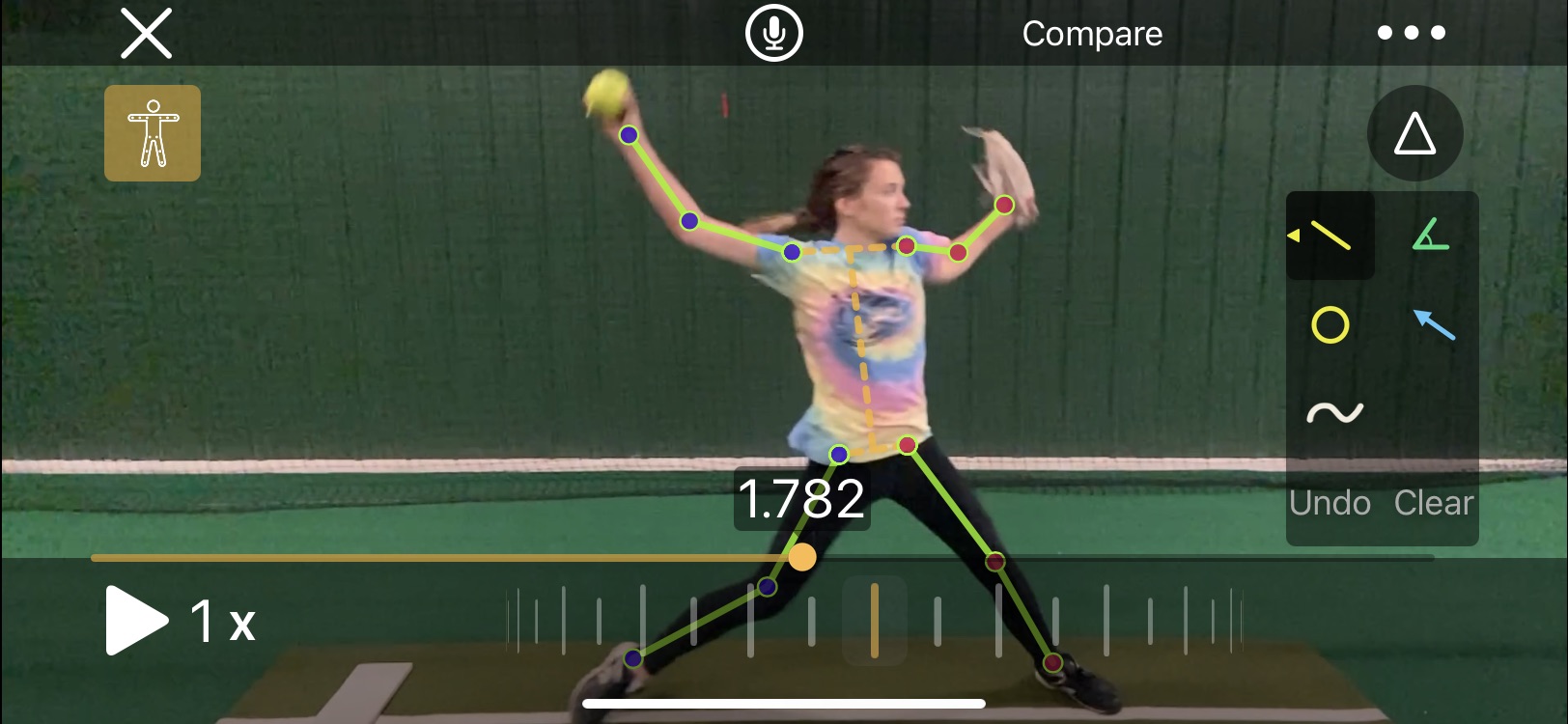
With the click of an icon OnForm will automatically mark every joint in the body and draw lines between them. Then, as you play or scrub the video, the skeleton lines will move with the player providing an unprecedented look at how how/she is moving through space. If the sequence of movements is important to you, you’re going to love this tool’s ability to display it.
Incidentally, the skeleton tracking overlay isn’t just for new videos. You can apply it to any video you’ve shot.
The toolset is rounded out by several additional capabilities, including:
- The ability to play videos through at full, 1/2, and 1/4 speed off a dropdown menu
- Two scrubbing tools – one which moves quickly through the movement, letting you go back and forth, plus a wheel that makes much finer movements so you can show subtle details
- An undo button to remove one line, circle, etc. at a time as well as a clear button to remove all markings
- A compare button that allows you to bring in a second video, whether it’s a previous video from that player or a pro example you’ve stored in a Reference Content folder, to provide a side-by-side comparison
- The ability to flip the video, which is handy if you want to, say, compare Cat Osterman or Monica Abbott to your right-handed pitcher
- Ability to trim the video to get rid of time between activities or other excess footage
- Editable titles and tags so you can mark exactly what was happening (such as which pitch a pitcher was throwing)
- Ability to edit the name, I suppose in case you got it wrong or the name changes
- Ability to save certain videos as favorites so you can find them more easily later
That’s a lot of capabilities, right? But we’re not done yet!
Recorded Analysis/Online Lessons
If you want to wait until later to analyze the video and then share the file with the player or parent, you can also do that. The Record feature gives you the option of recording the screen and live sound or just the screen.
You can pause the video in the middle or record straight through. Once it’s recorded it automatically plays a preview so you can check your work.
From there you can save the video as-is, trim the front or back, or discard it. If you’re happy with it you can share it directly through OnForm (if you’ve invited the player to join) or through email, messaging or some other app.
Pricing
Ok, now it’s time to get to the nitty-gritty. OnForm offers four different packages depending on your needs. Each comes with a one-week free trial so you can see whether it’s what you want. Be sure to double-checking pricing here since it may have changed since this blog post was written.
The first is a Free package that limits you to 10 videos in your account. If you don’t think you’ll be using it much, but want the option to shoot the occasional video, this one should work for you.
Next up is the Personal package, If you’re working with your own kids only (as opposed to coaching a team or being an instructor) this one should work for you. For $5/month or $49/year you can capture, store and analyze up to 500 videos as well as create up to 5 analysis videos in a 30-day period.
The Coach package (which is the one I have in case you’re interested) provides unlimited videos and analyses/voice over lessons for one coach, as well as allowing any invited athletes to upload unlimited videos to you for free. It also gives you the ability to create notes to go with each video and broadcast lists to reach multiple players at once. This package isn’t cheap, at $29/month or $299/year, but if you plan to use it a lot I think you’ll find it’s worth it.
Finally, OnForm offers the Team/Academy package, which includes everything in the Coach package along with the ability to create three (3) coach accounts rather than one so multiple coaches can access and use the same videos. That one is $69/month or $699/year. It’s probably best-suited to collegiate teams, large travel programs or facilities that offer teams.
My Take
So how is it in practice (no pun intended)? I think it’s tremendous, and a significant upgrade over the products I’ve used in the past.
Creating the videos and marking them up is fast, easy and reliable. They are really helpful with illustrating what is happening and what needs to be done. For pitchers I love being able to draw a single line and show the forward/backward tilt of their bodies.
As previously mentioned I love the way the videos are organized. Rather than having to come home and tag each video, they’re already in the right folders and available. I’ve even moved some videos into one of the Reference Content folders so I can easily call them up to show what famous fastpitch players do.
The analysis tools are easy to use as well, and I definitely love being able to easily discard a video and start over rather than having to wait for it to render (as I did in Coaches Eye) before I could delete one I knew went bad.
Do I wish it was cheaper? Of course, who wouldn’t? But the value is there, and OnForm is continuing to develop the product and add new features so as long as the value is there I think it’s worth paying the price.
Finally, there is their support. When I contacted them to ask why the skeleton tracking feature wasn’t showing up in my iPad they got back to me within 12 hours to explain you need an A12 chip or higher for that feature to be available.
Bummer, but at least they got back to me quickly which is great. They also have a way for users to request new features (I’m going to ask for a clock face drawing tool), and a blog to keep you up-to-date when something new is introduced.
I wholeheartedly recommend OnForm as a training tool for fastpitch softball players. As a bonus, you can use it for many other sports and activities as well, so if you have, say, a softball player and a golfer, one instance will work for both.
Check out the free one-week trial. I think you’re going to let what you find.
Coaches: Harsh Conditions Do Not a Great Garden Make

One of the things that never ceases to amaze me is the way too many fastpitch softball coaches choose to treat their players. Whether I am walking by a field when a team is practicing or just talking to some of my students, the “tough guy” (or “tough gal”) stereotype seems to be alive and well.
Now understand, I am all for discipline and accountability. There is nothing wrong with demanding the very best from your players on a daily basis.
But that doesn’t mean you have to berate and belittle them on a constant basis. It’s like the only tool in some coaches’ toolbox is a hammer – a big one – and they feel they have to use it all the time in order to draw the best performance out of their players.
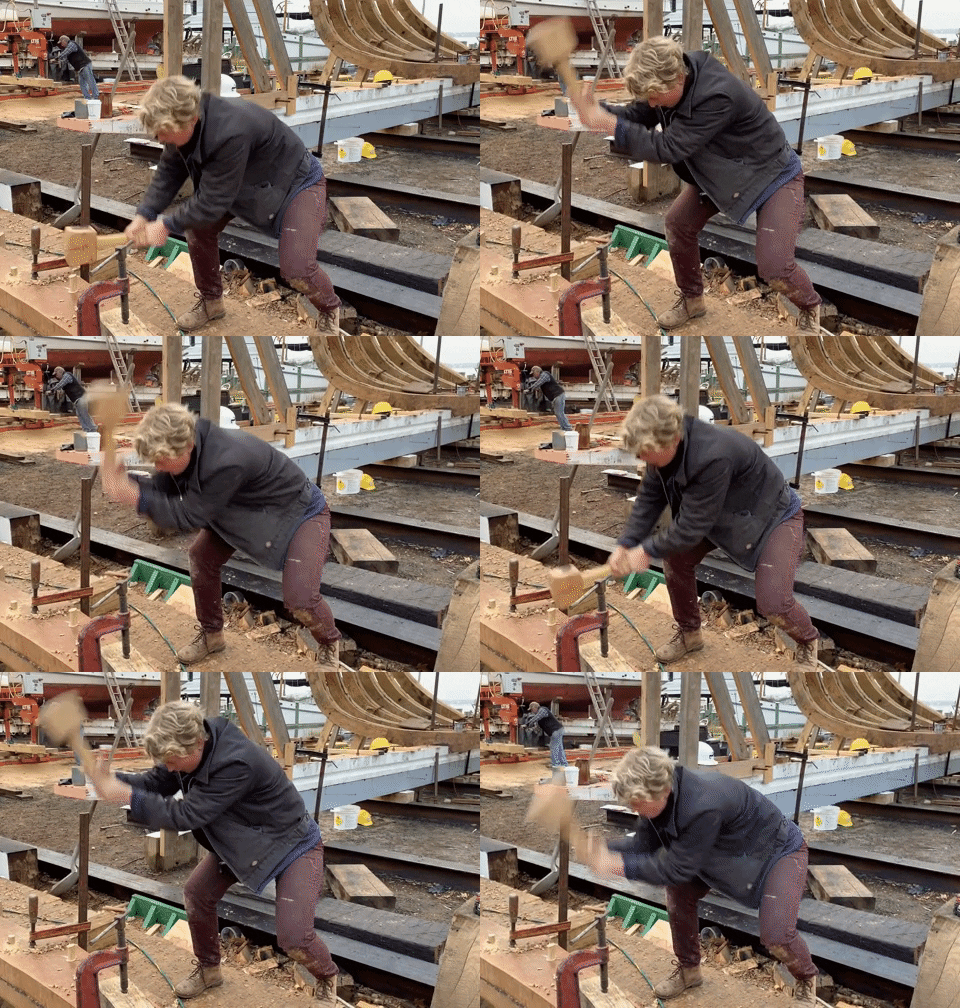
I don’t get where they think that will work. If an adult had a job where they were receiving nothing but negative feedback or outright abuse, you can bet they’d be posting a negative review on Glassdoor at the very least and looking for a new job as soon as they could.
It’s like the old saying – people don’t leave jobs, they leave managers. Yet coaches are still surprised when their players don’t return the next year.
It might help to think of your players as seeds that need to be nurtured. Yes, some plants can grow in the concrete under harsh conditions, getting trampled all the time.
But they rarely turn into beautiful gardens. Instead, they look small and sad – not the types of plants anyone is going to stop and admire.
The same is true of fastpitch softball players. Especially the younger ones – those under the age of 14 who tend to take everything adults say at face value.
If all they ever hear is how bad they are, or how stupid they are for missing a play or making an error, they will tend to believe it.
Sure, an occasional player might break through that difficult environment and survive, but most will not. They will find another outlet that helps them feel better about themselves.
Which means if the goal is to grow the game, taking an approach that drives them out makes little sense.
Coaches who want to be tough also have to remember that what they view as “normal” may not seem so normal to their players. As I have said many times, kids are not short adults. They often lack the experience and background to put certain things in perspective.
Harsh criticism doesn’t just roll off their backs. They aren’t yet able to “take it with a grain of salt.”
Kids in many cases are very literal. And females in general are more prone to believing whatever negative things are said about them.
So what winds up happening is that performance under these conditions goes down instead of up, which leads to even more berating and abuse, which hurts performance even more, and the results take a familiar path.

Taking this type of approach may make you feel good as a coach, or like you’re doing your job. But it’s really lazy coaching.
Rather than yelling at or otherwise berating your players for poor performance, why not help them get better? Teach them the game, and understand everyone learns in different ways and at different paces.
Hold them accountable when needed, but understand the difference between a lack of ability (at this time) and a lack of effort. Only the latter should bring out your ire. The former should drive you to find new and better ways to help your players learn and improve.
Provide a little sunshine, a little water, and a good overall environment and your players will grow faster and much healthier in the game.
Coaching, Bearded Dragons and Relationship Building

It was yet another oppressively hot, very humid day here in the Midwest – the type we used to associate with Mississippi but now is happening here on a regular basis.
My first lesson of the afternoon, a young 10U pitcher we’ll call Hermione (for reasons that will become obvious shortly), had the look of someone who wanted to be anywhere but a pitching lesson.
“Jump some rope to warm up,” I told her, and she slowly shuffled over to the fence where the rope was hanging before giving it a half-hearted effort. Then she went out to throw with her mom, and could barely get the ball there despite the fact they weren’t more than 15 feet apart.
This was the second time in a row she had come out that way. “Maybe she just doesn’t want to pitch,” I said to her mom. That’s ok, I said, but then no sense torturing her with a lesson.
Mom left it up to Hermione and she said she wanted to do it so we continued – after I talked to her for a few minutes.
“I know it’s hot,” I told her, “but there’s nothing we can do about that. But attitude is a choice. You can choose to put the effort in or not – it’s totally in your control.”
That worked about as well as you’d expect it to work on a 10U player, but we continued anyway.
“She may be tired,” her mom offered. “We went to the zoo yesterday.”
“Really?” I replied, thinking we might have a different way to approach things. “What zoo?” I asked Hermione.
“Mmph,” she said.
“Milwaukee,” her mom added.
“I love the Milwaukee Zoo,” I said to Hermione. “What are your favorite exhibits?”
“Mmph,” she replied again.
Then mom stepped in again. “We went to the small mammals, (something else I don’t remember), and reptiles.”
“Reptiles?” I said. That’s an unusual choice if you’re only seeing three.
“I like reptiles.” Hermione offered.

Aha! An actual response. I dug into it a little more, and then came the turning point. Her mom said the reptile house didn’t have any bearded dragons.
“Oh, you like those?” I asked.
“Yes,” she said with some enthusiasm. “I have a bearded dragon in my room.”
From then on it was like someone flipped a switch. Instead of looking like someone in a hostage video she became quite animated as we talked about beardies in general (that’s what the “in the know” people call them) and hers in particular.
Over the course of the lesson I learned her beardy’s name as Phoenix Firebolt (for Dumbledore’s pet and Harry Potter’s broomstick), which of course meant I also learned she liked Harry Potter. I learned that beardies eat grain and bugs, and that bugs are a lot more expensive than grain.
I learned she liked to dress Phoenix up in costumes, and that Phoenix wasn’t exactly a fan.
“I just have a couple,” she told me. “A lot of people do it all the time.
I also learned she liked to take Phoenix for walks, and that if she took the leash off outside without an adult present Phoenix would try to escape. A lesson discovered the hard way.
Throughout all of this conversation Hermione continued to pitch. Her throws got harder and more accurate.
I would make corrections here or there, but quickly follow that up with a beardy question. The lesson flew by, with Hermione making tremendous progress.
It was a good reminder for me. There is a saying that players don’t care how much you know until they know how much you care.
In other words, your ability as a coach to build a relationship with a player on her terms is critical to your success.
Whether it carries over automatically to next week remains to be seen. But hopefully, at least with this one player, I have a key to unlock her resistance or reluctance and help her enjoy her pitching lessons instead of just enduring them.
That’s the challenge for all coaches. Get to know your players, especially at the younger ages. Find out what floats their boats.
Because if you can establish some common ground there, they just might let you in a little faster to help them become the players they’re meant to be.
Bearded dragon photo by Saketh Upadhya on Pexels.com
Loyalty Is a Two-Way Street

This is the time of year when the rubber starts to hit the road in travel ball. All the promises of tryouts, all the good intentions, and all the talk of “we’re in it for the girls” starts getting tested as games get real and the outcome of the season is at stake.
The result is that some players/families begin to get disenchanted with their positions on the team and start thinking they might be better-served somewhere else.
They may or may not be correct. If you’re a player or parent who thinks playing time should be handed out like Halloween candy, regardless of effort or output, you’re probably not going to be any happier on the next team than you are on this one.
Your lack of skills and knowledge will be a detriment to whatever team you’re on, and coaches will recognize that pretty quickly. Your lack of effort to improve will also be noticed, making it easier for you to be left watching the game from the dugout.
But there is another class of player who may also be facing this decision. She has been working hard, showing improvement, earning her right to be on the field. But for whatever reason, the coaches have made their decision not to play her and that’s the end of that.
No matter what that player does or shows she can do, her fate on this team is sealed. Those are the ones who may find it necessary to seek a team.
Yes, I’ve seen all the bloviating on Facebook and other sources about how you just have to stick it out, and how horrible it is that players switch teams so quickly these days – whether that’s at the youth or college level.
I’m all for having to work your way up, and quite frankly think you should never join a team where you will clearly be the best player, either overall or at your position. The competition will make you better.
But all of those memes and rants presume you are working with a level playing field. Unfortunately, there are a lot of ways the field can be made permanently unlevel.
One common example is a player might play the same position as the coach’s daughter, or the coach’s daughter’s best friend. For a certain type of coach, that means his/her daughter or her friend will always play every inning at that position – no matter how many errors she makes or how many times she strikes out with runners in scoring position.
At that point, you either resign yourself to playing another position or playing your position with another team. If there isn’t an opportunity to ever show what you can do, the only option left is the status quo. Or as my friend Ray Minchew puts it, “It’s tough to build a track record when you never get on the track.”
What that often means is that you fall into the category of “spare parts.” A team needs a minimum of nine players to field a full team, but it’s likely that all nine won’t be able to be at every game. So it also needs people to fill in.
That’s where you come in. If one of the starters can’t make it, and the coach can’t find a guest player to fill that spot, you get on the field. Just know that once the starter comes back you will be back to the bench, no matter how well you did when you had that opportunity.
One of the things the “just tough it out” proponents will tend to bring up at this point is loyalty. They will moan how players are selfish and no one shows loyalty to the team anymore.
In my opinion, however, loyalty is a two-way street. If a coach isn’t loyal enough to his/her players to give them opportunities to demonstrate their abilities and legitimately compete for a spot, why should any of the players be loyal to the coach or team?
The reality is they probably won’t be. If all decisions are transactional, i.e., either the coach wants to win and doesn’t care if players are happy or the coach is more interested in keeping certain players happy or making them the “stars.” there is little reason to stick around if you’re not part of the “in-crowd.” Your situation isn’t going to change.
All anyone should be able to expect is a fair shot at playing. They then have to show what they can do.
But if they do, they should be rewarded appropriately. Otherwise, what is the incentive for working hard or for sticking it out?
If you’re a coach who wants loyalty from your team, start by showing loyalty to your players. ALL your players, not just your favorites or the ones who share a last name with you.
No one signs up for a team for the opportunity to ride the bench all season with no hope of parole. They want to play. Every. Single. One. Of. Them.
Give them that opportunity and they will be yours for life. But if you don’t do it, don’t be surprised when your “spare parts” decide they’d rather seek their fortunes elsewhere.
College Playoffs and WCWS Create Unique Learning Opportunity

The next few weeks promise to be a softball fanatic’s dream.
First you have all the major D1 college conference championships that will be televised on the various flavors of ESPN. Plus all the others that are available through various streaming services, including D2 and D3.
Then there are the regionals, super regionals and Women’s College World Series games that will take us through early June. Here’s an overview of what that schedule will look like.
While I’m sure it will be enjoyable to watch, there’s more to it than just entertainment. All this great softball on TV provides an invaluable learning opportunity for young teams – and one which most of today’s players don’t seem to take much advantage of.
When I start with a new student, I will often ask her if she can name any famous players at whatever skill we’ll be working on. For example, if it’s a new pitching student I’ll ask who she admires as a pitcher or what famous names she knows.
More often than not I get a blank stare. If I name a few for them, such as Cat Osterman, Amanda Scarborough, Monica Abbott, or Sarah Pauly, most of the time they may have heard of the name but have never seen them pitch.
As a result, most of the time they have no idea what a high-level pitcher looks like in action. The same is true for hitters and fielders.
That’s why the next few weeks present such a tremendous opportunity. Some of the best players in the world will be showcased doing what they do best. These are young women who do what you would like your players to do.
So why not take advantage of that and replace a normal practice with a watch party? You can find out when a local or semi-local team is playing and watch that game.
Or see if there is a player from your area on one of the teams and have your team watch her specifically. Show them that these aren’t just figures on TV but real players who once stood where your players do now.
Make a party of it. Supply some snacks, order some pizza, maybe even organize a sleepover if that’s appropriate. Then at game time, actually watch what happens and discuss the action on the field.
You might even pause the game and run back a good play to show the effort that went into it, or re-watch a bad play to talk about what should have happened instead. You can also talk about the strategy of why a team or player did what they did (good or bad) to help raise your team’s collective softball IQ.
It has been estimated that the majority of people in the world (65%) are visual learners. Showing your players both good and bad examples in real time helps them understand more thoroughly the techniques and strategies you’re trying to teach them.
As you watch the game, perhaps the coaches and players can make a list of things they want to work on at the next practice. Maybe it’s diving to catch a ball. Maybe it’s a type of slide they saw, or a spectacular over-the-shoulder catch. Maybe it’s a suicide squeeze.
Whatever it is, seeing it performed and then trying it themselves may be just the spark they need to inspire them to play at a higher level than they are now.
Watching a game on TV also gives your players a chance to gain some perspective about their own performance. They may see a pitcher give up a critical home run, then come back to strike out the next hitter.
They may see a player make an error to give up the go-ahead run, then come through later in the game with a key hit. Ultimately, especially in an elimination game, they will see the “thrill of victory and the agony of defeat” played out in real time.
The other nice thing about watching the games on TV (versus going in person, which is also a great experience) is that it doesn’t cost much. A little food and drink, the price of the cable or streaming channel (if it isn’t free) and the time to clean up afterwards is about all you need.
But you can create a learning and bonding experience that will benefit your players for a long time to come.
Sure, we all like to grind away on the field. But if all your players ever see is each other, and players on other teams of comparable ability, they may never realize there is a much larger world out there.
Show them some of the best in the world playing the game at a high level and you just might inspire a level of play and enthusiasm in them that they wouldn’t have achieved before.
Better Idea on Advertising for a Player

One the (many) things that make me shake my head in confusion is to see the way teams advertise for players. Whether it’s on a discussion board such as Discuss Fastpitch, in one of the many softball-related Facebook groups, or somewhere else, it’s always the same:
“‘Team Awesome’ is looking for two or three players to fill out its roster for the upcoming season. We need an ‘A’ level #1 starter; must throw 65+ with great control and command of all movement pitches. Also looking for a catcher with pop times of 1.7 seconds who can hit bombs and a shortstop with great lateral movement and an overhand throw of 60+.”
Aren’t we all?
I mean, look at those descriptions. Great teams start with being strong up the middle. If you can acquire a true Ace pitcher, a stud catcher, and a D1 prospect shortstop you’d be pretty well set up to win a lot of ballgames, even if the rest of your team was mediocre at best.
But that’s the thing. Those types of players don’t grow on trees. They’re highly desired by everyone, which means by the time Team Awesome’s ad runs those players have already been snapped up.
It’s also a pretty good bet that the name-brand top-level teams don’t have to advertise or post to find those players. Those players come to them because of their reputation and ability to get them seen by college coaches.
So it’s a pretty good bet Team Awesome is not going to find that caliber of player sitting around after tryout season is done.
That doesn’t mean Team Awesome can’t find great players – players who can help them elevate the state of their game. What they should be doing, in my opinion, is taking a tack more like this:
“Team Awesome has a couple of open opportunities for players ready to make a bigger impact and see the field more often. If you’re a great #2 pitcher stuck behind an incredible #1, come give us a look. If you’re a catcher who has been working her butt off to become a starter but can’t even get a look, we’ll look at you. If you think you have what it takes to play the field against high-level competition but just get overlooked on your current team, we could use another good (position) – especially if you can hit. Being on a trophy-winning team is nice, but being the reason your team earns a trophy is even better.”
Those are the players who are likely to be available. Or who are at least considering seeking their fortunes elsewhere.
Most kids sign up because they want to play ball, not sit on the bench while others play ball. And while there is tremendous satisfaction in working your way up and earning your spot on your current team, that’s not always in the cards for everyone.
Some players are victims of “Daddyball” or “Mommyball,” where the team is built for and around the daughter(s) of the coach(es). No matter how hard you work you’re never going to overcome that mindset, so a change of scenery will create new opportunities.
On the other hand, sometimes, no matter how hard a player works, there are others in their position who also work just as hard – and were blessed with more athletic ability/talent/whatever you want to call it. If a player is stuck behind that person – and rightfully so because she’s better – she can either accept limited playing time or find another situation where she can contribute more.
Those are the players you should be trying to find – the hidden gems looking for a place to shine. They can make just as much of a difference to your team as the studs you think you want but without some of the risk.
Because those stud players you’re advertising for can go anywhere. But the kids who are given opportunities to stand out will likely be at least a little more loyal to the team that gave them that opportunity. Which means you’re less likely to have to run the same ad next year. They’re also likely to be a little more forgiving if your team isn’t quite as awesome as you told them it was during the recruiting process because at least they’re getting the innings they were looking for.
Next time you’re looking for a couple more players, instead of advertising for known studs try encouraging those looking for an opportunity to prove they can be the studs to give your team a try. You never know who you might find that will make your team look better – and you like a recruiting genius.






 Life in the Fastpitch Lane