Author Archives: Ken Krause
Product Review: Cimmaron Safety Net and Frame Makes BP Safer
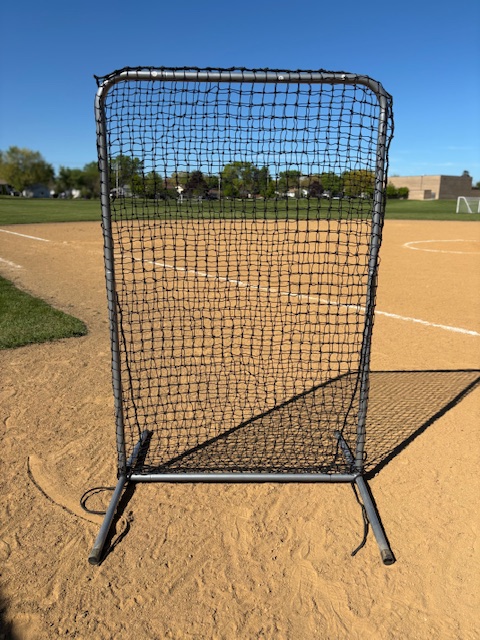
Whenever I see a coach doing front toss at practice from 15 feet away without a net to hide behind, my first thought is always “That coach must not have much faith in him/herself as a hitting coach.”
But the reality is (most of the time anyway) that they would use a screen if they had access to one. Sure, you could try using a Bownet or similar product but the blowback on a hard-hit ball directly into the net would probably negate any value in setting it up.
Effective protection, even from some 10 year olds, requires a much sturdier protective screen – the type you see at high schools, colleges, batting cages, and professional stadiums. The trouble there is your typical youth coach, or even a high school coach who has to practice at an off-campus field, can’t exactly cart around a heavy-duty screen with a heavy-duty net, nor do they have the time to assemble and disassemble it with all the nuts and bolts that are required.
For years I had that problem solved with the old Jugs Snap-Together Screen. It was the perfect solution – a heavy-duty net that slipped over a heavy-duty frame that was easy to put up and take down. The push–in snapping mechanism meant you could slide the pieces together, then have the snaps hold them in place. Then, when it was time to leave the field, I could quickly pull it all apart and put it back in the carrying bag, ready to transport anywhere I needed it.
All good things must come to an end, however, and last fall that screen gave up the ghost. Some of the snaps didn’t work anymore, and the net was beginning to fray, which increased the risk of a hard-hit ball breaking through.
Since Jugs doesn’t offer that product anymore I searched and searched for something similar to replace it, That’s when I came across the Cimmaron 6×4 #42 Safety Net and Screen at Epic Sports.
It’s a little smaller than the Jugs screen was, but it was still big enough to hide behind after throwing a pitch. (One time when it pays to be a little under 6 feet tall.)
The description mentioned a snapping mechanism but there weren’t any closeup photos to show if what they meant and what I thought of were the same. But with no other viable alternatives I figured I’d give it a try and made the purchase.
I’m happy to report it’s everything I hoped it would be.

The 1-1/2 inch steel tubular frame is lightweight yet very strong and confidence-inspiring. The net, made from #42 nylon, has held up well after take some direct hits; I have full confidence in it.
It’s also a little easier to assemble than my old protective screen was, probably because it’s a little smaller than the old one so there are fewer pieces to assemble. There are three pieces that comprise the bottom, two along the sides, and three that form the top and the upper part of the sides.
All parts have a number sticker on them that correspond to the supplied diagram that shows you how to put it together. The first time I did it I had a little trouble figuring out what went where but that was due to operator error.
I didn’t bring the diagram with me to the field, and I then assumed the two pieces that form the top corners worked the same way as the Jugs screen, i.e., the long part goes across the top and the short part goes down to join the side. When that didn’t work it was easy enough to figure out how to put it together properly and it’s been a breeze ever since.

The net is also easy to put on. It has a pillowcase-type of structure – the top and sides are closed while the bottom is open, so you can quickly slip it on and off the assembled frame. There is also a nylon rope at the bottom that allows you to secure the bottom of the net so you don’t catch a hard ground ball to the feet.
Unlike the Jugs net, there is no hole in center to pitch through. That’s ok, though, because I am used to turning L-screens with the tall side to the right and pitching around it, so it’s essentially the same.
It’s even a plus in some ways because a ball with a little tail to it won’t come across the frame, unlike the hole-type where I got clipped a few times with a line drive even though I swear I wasn’t standing in the hole.

The only downside I see to this product is that it doesn’t come with a carrying back. That seems like an oversight given that the quick up-and-down construction makes me think it was designed for portability.
Fortunately I still had the Jugs screen carrying bag so I’m using that. I also tried a speaker stand carrying bag from Sweetwater, which worked ok too. Neither one is quite deep enough to fully close because of the design of the two base pieces, but they are both wide enough and will both work as long as you’re careful getting it in and out of the vehicle.
I’m guessing the manufacturer opted not to offer a bag to keep the price down, but it sure would be nice for one to be offered even if it’s a separately purchased accessory for those of us who need to cart it in and out on a regular basis.
Speaking of price, the Cimmaron protective screen is relative bargain in my opinion. It’s just $179 for the frame and net. When compared to the cost (and time) of a visit to the emergency department or immediate care facility after taking a line drive to the head it’s definitely worth it.
And if you want to add padding around the frame it costs a little more but if your goal is to put it up and take it down the same day it feels to me like you’re better off without the padding.
So if you’re a coach who is pitching front toss with real balls to your team and want to feel a little safer while doing it, check out the Cimmaron 6×4 #42 Safety Net and Frame. In my opinion it’s worth every penny. And yes, I paid for my own.
My good friend Jay Bolden and I have started a new podcast called “From the Coach’s Mouth” where we interview coaches from all areas and levels of fastpitch softball as well as others who may not be fastpitch people but have lots of interesting ideas to contribute.
You can find it here on Spotify, as well as on Apple Podcasts, Pandora, Stitcher, iHeart Radio, or wherever you get your podcasts. If you’re searching, be sure to put the name in quotes, i.e., “From the Coach’s Mouth” so it goes directly to it.
Give it a listen and let us know what you think. And be sure to hit the Like button and subscribe to Life in the Fastpitch Lane for more content like this.
Two Quick Tips to Help with Pitching Accuracy

One of the biggest deterrents to developing quality pitchers for the long haul is emphasizing accuracy over good mechanics in the early years. Yes, it’s tough to watch a young pitcher struggle with control, and it’s really tempting to tell her to just do whatever to get the ball over the plate so she isn’t walking everyone.
But that type of thinking places the emphasis on outcomes instead of the process. And as anyone who has ever taught anyone to be good at anything can you, if you keep your focus on the process the outcomes will take care of themselves.
Still, we’re at the time of the year where accuracy does, in fact, matter a lot. So how do you get your young pitchers to improve their strikes to balls ratio while keeping them focused on the process?
Following are a couple of tricks you can try.
Set up a barrier to block the problem area
This is one of my favorite. In fact, I’ve probably written about it before but it bears repeating here.
Let’s say your pitcher is throwing everything into the dirt in the batter’s box on her throwing side, e.g., a right handed pitcher throwing into the right hand batter’s box consistently.
Set up a hitting screen (or a ball bag or any other solid object) about 20 feet in front of her that allows full access to the plate but nothing more. You want it far enough away that if she hits it the ball won’t bounce right back at her, but close enough that any slight deviations from a good pitch will hit the screen or other object.

Then tell her to throw a pitch without hitting the screen without offering any instruction on how to do it.
At first she may plunk it a few times. She will probably get a little frustrated at first.
But in time (most likely sooner rather than later) her body and her brain will make some tiny adjustments on their own that allow her to get the ball over the plate without putting the object, herself, or her catcher in any danger.
After she does that a couple of times I like to say, “So you can throw the ball over the plate, you just weren’t doing it” or something to that effect as a way of helping them to an “Aha!” moment while keeping it light. But you do you.
Once the pitcher can throw consistently without hitting the screen, remove the screen and let her keep going. I would say 9 times out of 10 she will continue to throw successfully because she has made the adjustments required at a subconscious level.
If she hits one of those 1 out of 10 situations, pull the screen back in and have her work through it again.
I find this method works better than offering external cues such as “step more to your left” or “let go a little later” because the pitcher is able to find what works for her on her own, without a lot of conscious thought. These become internal cues that she can carry with her more easily into a game, and seem to have a more long-lasting effect.
Make sure her dominant/targeting eye can see the target
Each of us has one eye that is more dominant than the other. In ancient days its job was to home in on an enemy or a potential source of food to help the individual with survival.
Today the need isn’t quite so urgent for most of us but the biological reality of it still exists. You can use this fact to your advantage with your pitchers.
You want them to be sure that when they are getting ready to throw the pitch that their dominant eye is hyper-focused on the target. It doesn’t necessarily have to stay there throughout the pitch, but at some point when the brain is making its decision of how to throw the ball you want to use the dominant eye to help the brain understand the target is “here.”
So how do you know which eye is the pitcher’s dominant eye? Here’s a simple method I actually learned when my sons were at a sleepaway camp with the Cub Scouts. The instructors at the BB gun range would check for the dominant/targeting eye to know how the boys should set up to shoot.
Have the pitcher place her hands together in front of her with one overlapping the other to form a small opening in the space between the thumb and first finger on both sides. The opening must be small in order for the rest to work.
Once she has it, have her hold her hands in front of her at arm’s length and look at you through the hole. Whichever eye is looking at you is the dominant eye, I guess because when we can only use one eye we instinctively go to the dominant one.

If the eye is on the glove side there’s very little potential for problems. It will stay in front as the pitcher’s body opens so should have a good view of the target throughout the pitch.
If it’s on the throwing hand side, however, the pitcher will have to take a little more care to make sure that eye can see the target when it’s time to throw since it will be on the back side.
Eventually the pitcher won’t have to look at the target throughout the pitch. Many high-level pitchers look at the ground or the sky as they’re throwing because it helps them do what they need to do, although it’s likely they’ve already set the target with their dominant eye before they even start their motions.
For those who need a little more help, though, reminding the pitcher to use her dominant eye to focus on the target can help her brain and body make the movements that will deliver a better, more accurate pitch.
Keep it natural
Whenever a pitcher struggles to hit her target there will be no lack of suggestions from whoever is around on how to get more accurate. They all mean well, but like the folks who yell “Just throw strikes” as if the pitcher was trying to walk everyone, most of that advice is either unhelpful or can actually stunt that girl’s growth as a pitcher.
Using these two tricks while you’re practicing can help set good habits that carry over into games without interrupting the natural flow of the motion. If you have a pitcher who’s struggling with control, give these ideas a try.
And if you have others, please be sure to share them in the comments.
My good friend Jay Bolden and I have started a new podcast called “From the Coach’s Mouth” where we interview coaches from all areas and levels of fastpitch softball as well as others who may not be fastpitch people but have lots of interesting ideas to contribute.
You can find it here on Spotify, as well as on Apple Podcasts, Pandora, Stitcher, iHeart Radio, or wherever you get your podcasts. If you’re searching, be sure to put the name in quotes, i.e., “From the Coach’s Mouth” so it goes directly to it.
Give it a listen and let us know what you think. And be sure to hit the Like button and subscribe to Life in the Fastpitch Lane for more content like this.
Welcome to the 2025-2026 Season – Wait, What?

A couple of weeks ago as I was busy wasting time scrolling through Facebook I came across something that made me think I must have fallen asleep in front of the TV and not woken up for three months. It was an announcement from a couple of teams about “open workouts” (translation: tryouts) for the 205-2026 season.
“Wait, what?” I thought. I mean, the high school season is still in high gear everywhere high school softball is played in the spring, and travel teams are still working their way through their “shake off the rust” tournaments in preparation for the travel season to begin in earnest.
So why in the name of Carol Hutchins are travel teams already looking for players for the next freaking season??? (You know I’m not happy because I used three question marks instead of one.)
This is just insane. Coaches should be focused right now on the players in front of them and helping each and every one of them reach their potential this season, not out looking for new players so they can unceremoniously dump anyone on their roster they don’t think measures up.
But of course, that’s one of the problems in today’s game. There aren’t as many coaches as there used to be, at least by what I would define as a coach.
Instead, they have been replaced by “managers” who, instead of developing the players they have, are always on the lookout to acquire players someone else has taken the time and effort to coach up. Like Pokemon cards, if you collect enough of those already-baked players you can just throw them on the field and watch them bring home the trophies/rings/banners/whatever is being given away to tournament winners these days.

So now it’s a race to see who can get to those high-level players first.
Now, admittedly, that’s nothing new. I remember when teams used to hold tryouts after the current season was over.
There were always a couple of programs that would try to jump the gun, either by playing in sanctions that ended earlier so they technically were into next season or by holding “special tryouts” maybe a week before their season ended. These organizations would pressure the kids who tried out to make a decision right then and there so they could lock up the talent before anyone else had a chance, although if someone better came along the original offer might be rescinded anyway and then those kids would have to scramble to find a new team.
But even those shenanigans occurred right around the end of the season for everyone.
Now they’re looking for next year’s team while this year’s team is just getting going with their season. And people wonder why players don’t seem to be as loyal to their teams or coaches as they used to be.

In my opinion, and the opinion of a lot of coaches I know whom I respect immensely, the focus during this season should be on helping the players you have now get better rather than finding their replacements. That’s the way to build a winning culture and create a positive experience.
Holding public workouts for next year’s team, before you even know what players or positions you may need, is a sure way to create divisiveness and negativity within the current team. It could even drive some of your current “good” players out because they’re not feeling valued or loved by the organization or the coaching staff.
It’s also a bad idea because you never know who is going to step up during this season and surprise you. If you listen to current high-level college players talk about their early days in the sport, you’ll find many of them were not studs right out of the gate.
Many, in fact, sat the bench a lot (although that’s a travesty in and of itself). Some of the best pitchers today were the #4 or #5 pitcher on their travel teams before they grew, or the mechanics from their lessons kicked in, or someone just gave them a chance to pitch some quality innings and it all came together for them.
It just seems wrong to me for teams and organizations to be ignoring who they have in front of them right now in search of some mythical team for the future. At least if they really believe in the stuff on their website that says they’re “in it for the girls.”
There will be plenty of time for tryouts or other events to convince top talent that they would be better served with a new team that’s “more at their level” than the one they’re on now. I wouldn’t even object so much if you did it right before the end of the season, although don’t be surprised if a few of your “lesser” players on the current team decide not to spend the time and money going to whatever nationals you’re heading to if they’re feeling like you’re planning to cut them once the last out is recorded.
But seeking out new players at the beginning of your primary season? That’s just ludicrous.
Run with the players you have now and help them finish the season better than they started. You just might find you don’t need as many new players as you thought.
Take One More Look Around the Dugout
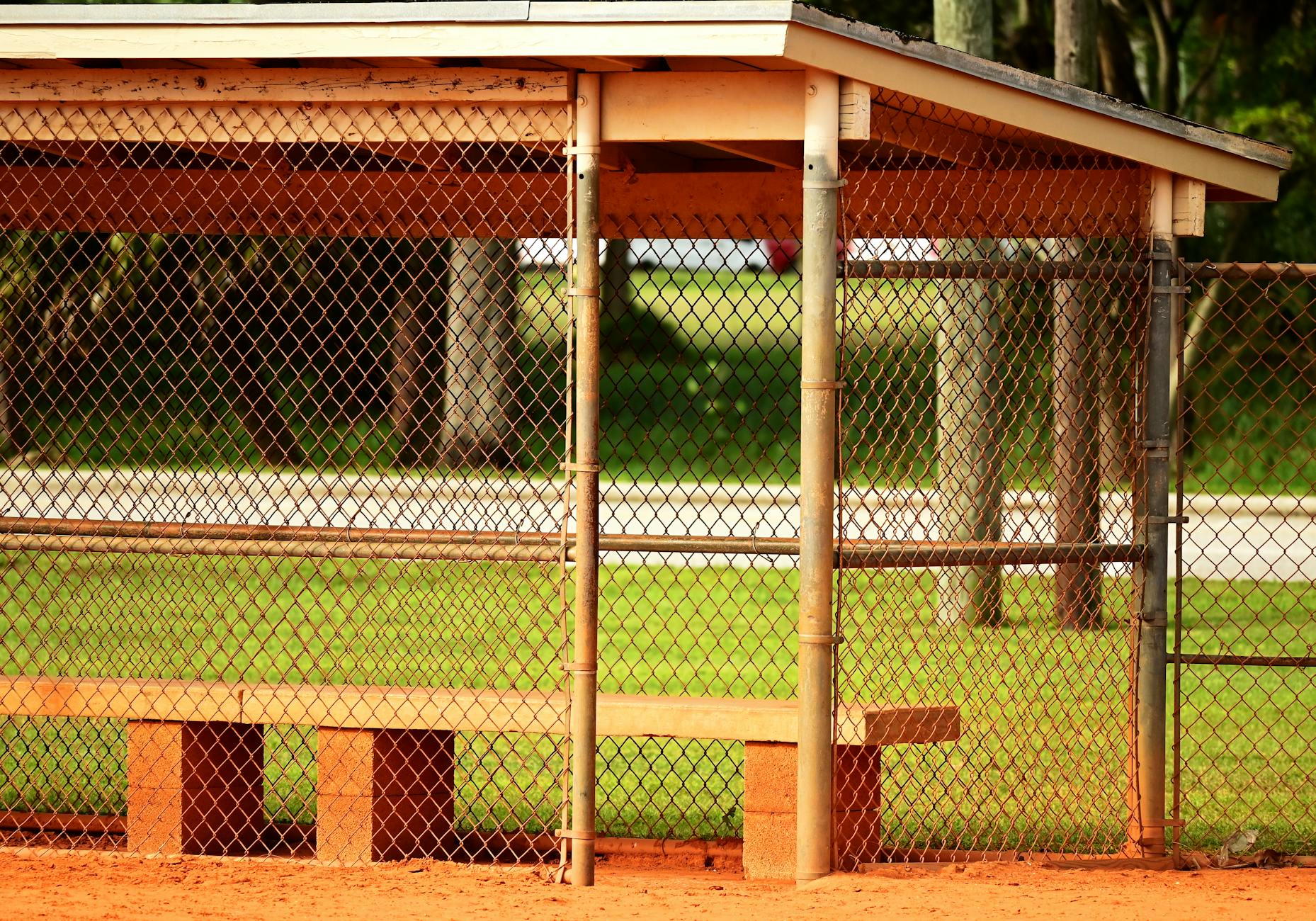
I’m not sure if it’s just human nature or perhaps a cultural thing, but it certainly seems like it’s common for most people to be always looking ahead to the future.
As graduation approaches, high school seniors look forward to starting a new era of freedom in college or their careers; college seniors look forward to starting their first jobs; older adults look forward to their next jobs or even retirement.
Yet at this time of the year, it’s important for players, parents, and coaches who are leaving the sport of fastpitch softball to take one more look around the present to appreciate all the good things that have been a part of the experience for the last several (or many years).
Players and parents can think about the first time those players grabbed a glove or bat, put on a uniform with their team’s name on it, and stood in the dirt.

They probably had no idea about the journey on which they were about to embark; they just knew they were excited to feel the sun on their faces and the breeze in their hair as they stood there waiting for someone to teach them where to go and what to do.
Along the way they made friends and established rivalries – some of them friendly, some of them not so much. At times those friendships and rivalries shifted as they joined different teams or went to different schools.
But always, always, there was the thrill of competition and the quest to get a little bit better so they could feel the thrill of external praise or the inner satisfaction of a job well done.
From those first days where they could barely lift the ball or the bat or take it in the right direction to the days when others marveled at their skill, they kept at it, game after game, week after week, year after year. Sometimes that meant waking up at zero dark thirty in a strange hotel room to get to a distant field, spending 12, 14, 16 hours at the ballpark through chilly, damp, foggy mornings followed by blistering heat followed by cool, damp night air, all in search of a championship trophy, ring, bat, or other memento.
Then, when it was done, making that long car ride home.

Or it meant enduring an uncomfortable, noisy ride in a bus that smelled like sweat socks, stale snacks, and the occasional vomit to play in freezing cold temperatures on rain-soaked or snow-soaked fields for the opportunity to represent their school and perhaps earn a conference title or perhaps a state tournament berth.
On the coaching side there was all the preparation and planning and looking for new drills or new ideas or new techniques that could give your team an edge. There were the unseen hours taking care of a field, planning lineups, reviewing stats, pricing and purchasing equipment, taking part in live or online coaching clinics, all to have every move you made on the field questioned by everyone who hadn’t done any of that.
For the parents it was all the hours spent sitting on a bucket or hitting ground/fly balls or pitching batting practice or chasing after balls that had been hit or driving one child to practice or lessons while trying to manage everything for your other children. Then feeling your breath catch and your blood pressure soar every time your favorite player toed the rubber or had a ball hit to her or stepped up to the plate.
Sometimes it seemed like it would never end. Yet now it has, or is about to.
The last out comes to us all. Some experience it sooner, some experience it later, but we all experience it.
When that final out comes to you, my advice is not to just rush off like it’s another game in a long line of games, because it’s not. It’s the end of a part of your life that was probably pretty important.
Before you pack up, take a little time to look around the dugout and the sidelines and experience as many of the sensations as you can one more time.
The refreshing touch of a cool breeze on a hot, hot late spring or summer day.
The sound of cleats clattering on concrete and scrunching in the dirt as the team goes to take the field. The music of balls popping sharply into gloves or cracking off a bat. Someone yelling “heads up” as you frantically try to avoid being plunked by an errant foul ball from another field. Or the low din of dozens of camp chairs and pop-up tents all being folded up at once.
The smell of hot dogs and hamburgers grilling in the distance, that whiff of a quick afternoon rain shower making its way toward you, or that unmistakable aroma of a new glove or fresh ball. Not to mention the fragrance of freshly mowed grass intertwined with the morning or evening dew, lying like a comfy blanket over the entire area.
Mostly, though, take a moment to remember all the souls that touched yours, and that you in turn touched, along the way.
Some may have been along for the whole journey. Others may have been there for a fleeting moment.
In reality, though, most were only there in your life because you shared a common interest in fastpitch softball. How lucky you were to have spent time with each and every one of them – even the ones you didn’t particularly care for.
Because they all had an impact, large or small, on shaping you into the person you are today.
You will move on to other challenges and adventures happy times and sad times, triumphs and failures. You may even go on to play other sports. I hear pickleball is popular now.
But there will never be anything like the thrill of competing (or watching your child/team compete) for all the marbles on a fastpitch softball team.
Hope you enjoyed it while it was happening. And if you’re not quite to that point, you can also take heed to appreciate it now, in the midst of all the craziness, because one day you’ll miss it all.
To all of those who have played, watched, or coached their final out, or are about to, I salute you. Thanks for your contributions to this great sport, and good luck to you whatever the future brings!
Just remember to take that last look around before you leave. You’ll be glad you savored the moment.
My good friend Jay Bolden and I have started a new podcast called “From the Coach’s Mouth” where we interview coaches from all areas and levels of fastpitch softball as well as others who may not be fastpitch people but have lots of interesting ideas to contribute.
You can find it here on Spotify, as well as on Apple Podcasts, Pandora, Stitcher, iHeart Radio, or wherever you get your podcasts. If you’re searching, be sure to put the name in quotes, i.e., “From the Coach’s Mouth” so it goes directly to it.
Give it a listen and let us know what you think. And be sure to hit the Like button and subscribe to Life in the Fastpitch Lane for more content like this.
Dugout photo by Nelson Axigoth on Pexels.com
The Power of a Kind Word (or Two)

A couple of nights ago one of my hitting students, we’ll call her Persephone (for no reason other than it amuses me), came in for her first lesson in a few weeks. She is playing high school ball right now and has been tearing it up for the most part, but Persephone has had a little less success lately and decided it was time for a tune-up.
Her dad walked in before her and gave me a heads-up that Persephone had had a rough game that night, going 0-3, and was also having a little family-based teen angst on top of it. Always nice to have some warning in those cases.
When Persephone came in (wish I’d picked a name that is easier to type) I could see her mental state was no minor issue. She was an emotional pot ready to boil over.
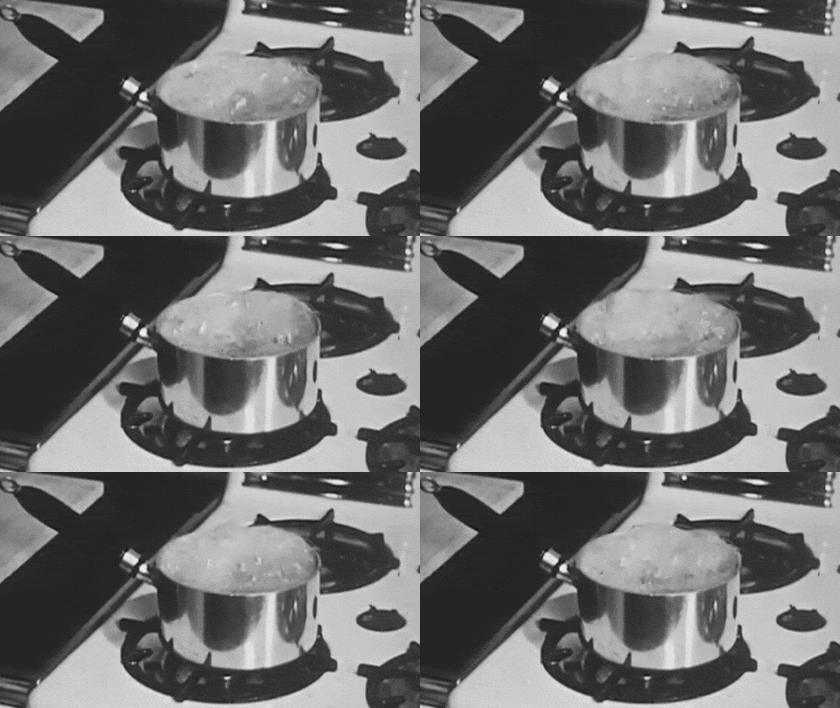
She was trying to keep the lid on it, but it was rattling pretty hard. Most of the time she is a pretty even-keel, laid back young woman but even the toughest among us can get overwhelmed at times, and that’s what was happening here.
We started into the lesson and I asked her about the game. She told me she just couldn’t hit the pitcher, and in particular was unable to touch her curveball. Persephone told me she was swinging and missing it by quite a bit.
Her dad had told me in the beginning that it wasn’t just Persephone who had that trouble that night; the opposing pitcher was one walk shy of a perfect game. But Persephone is a team leader who sets high standards for her performance, so it didn’t matter to her that everyone else struggled; she felt she could have and should have hit that girl anyway.
I talked to her some about the mental game, staying focused on the process instead of outcomes, keeping it simple, how to relieve stress at the plate, all of that. It helped somewhat.
When I went to front toss I identified a mechanical flaw too – she was pulling her front side out instead of hitting around it, so it’s no wonder she couldn’t touch those outside curveballs. She made the correction and started hitting a little better, but I could see she was still in her own head too much.
Then the miracle happened.
There was another hitting instructor doing a lesson in the cage next to us. His name is Dave Doerhoefer, and we have known each other for more years than either of us probably cares to admit.
Dave is a friend as well as a great coach, and we often have chats about the current state of the sport, especially when it comes to teams playing too many games and not practicing and teaching enough.
He was working with his student on firming up her front side as she went into rotation instead of letting it collapse but she was having trouble grasping the concept. His line of sight took him directly toward our cage and he saw how hard Persephone was swinging the bat and how sweet her technique was, so he asked Persephone if his student could watch her a few times because she has such a nice swing.
It was literally like the clouds had parted and the sun was doing a happy dance in her heart.

Dave’s question totally pulled Persephone out of her self-inflicted funk and her face just lit up. Then she started lighting up my front toss pitches too – including the outside ones.
That one simple question, which was also in effect a great, unsolicited compliment from someone that had no stake in the process but just liked what she was doing, turned Persephone’s entire approach around.
Later I thanked Dave for his kind words and told him what it had meant to Persephone. He shrugged and thanked me for telling him that, but admitted he had no motivation in it other than wanting his student to see another hitter doing what he wanted her to do in real time.
Now, I will say Dave may come to regret his kindness because in addition to being a hitting instructor he is also a varsity softball coach at Vernon Hills High School, and his team may play Persephone’s somewhere along the way – perhaps the State playoffs. But I’m sure he’s ok with it because Dave’s #1 focus is on helping fastpitch softball players get better, no matter if they are his or his opponents’.
The point here is it didn’t take much to make Persephone’s day and help her go from feeling bad about herself when she came in to walking on air with a big smile on her face when she left. You have the power to do the same.
When you’re at the field and you see someone do something great, whether it’s a driving big hit or making a diving catch or throwing a knee-buckling changeup or making a heads-up slide, don’t just admire it to yourself. Find that girl after the game and tell her – even if she’s on the opposing team. That goes for parents as well as coaches.
You never know what someone else has been going through, and those few kind words may be just the inspiration they need to keep fighting and overcome their struggles. It only takes a few seconds, but the ripple effect from that encounter might just alter the trajectory of a life in a positive way, even if just by a few degrees.
And the best part? Offering up a sincere compliment now and then doesn’t cost you anything but a little thought and time.
I know some of the happiest stories my students tell me are when an opposing coach or parents tells them they did a great job. So this weekend, get out there and if you see something good say something good about it.
You never know who needs to hear it.
My good friend Jay Bolden and I have started a new podcast called “From the Coach’s Mouth” where we interview coaches from all areas and levels of fastpitch softball as well as others who may not be fastpitch people but have lots of interesting ideas to contribute.
You can find it here on Spotify, as well as on Apple Podcasts, Pandora, Stitcher, iHeart Radio, or wherever you get your podcasts. If you’re searching, be sure to put the name in quotes, i.e., “From the Coach’s Mouth” so it goes directly to it.
Give it a listen and let us know what you think. And be sure to hit the Like button and subscribe to Life in the Fastpitch Lane for more content like this.
Lead photo by Pixabay on Pexels.com
6 Benefits of Playing Under Sandlot Rules

Let me start by acknowledging that today’s ballplayers are far more technically skilled and athletically knowledgeable than they were when I was young lad, and even when I started coaching more than 25 years ago. If you go out to a ballpark this weekend, even to a local B-level or C-level 10U tournament, you’re likely to see a higher level of overall performance than you would have even 10 years ago.
Don’t even get me started on how crazy good high school and college softball players are today.
We can attribute a lot of that growth, in my opinion, to the tremendous amount of information that is available to coaches today as well as the tremendous amount of time teams and individuals invest in structured, organized training sessions and practices. With competition levels already high and improving each year, you’re either getting better or getting left behind.
Yet for all their technical prowess, I think today’s players may be missing out on a few things that are equally important to their level of play – and probably more important to their development as human beings: the benefits of playing under what’s called “sandlot rules,” i.e., unstructured playtime.
Following are some of the benefits that could be gained by downsizing the organized team activities (OTAs) and giving players more time to play under “sandlot rules.” And not just softball but whatever games those players want to play at the time.
1. Acquiring decision-making capabilities
In OTAs, coaches or other adults decide what players are going to do pretty much every minute of every practice or game. They determine who’s going to play where, what order they will bat in, what strategies they’re going to follow, even what uniforms to wear, right down to the color of socks.
Under sandlot rules all of those decisions have to be made by the players themselves. They pick the teams (if teams are needed), agree on the rules, determine what equipment is needed, set the boundaries for play, etc.
Whatever needs to happen to get game or activity going, players get to decide on them. If they can’t decide, that leads to the benefit of…
2. Learning conflict resolution
Let’s say the players want to play a game of softball, but there are no lines on the field. A batter hits a ball down the line and the defense says it’s foul while the offense maintains it was a fair ball.
With no umpire to look to, the players on both sides will have to come to a conclusion. If neither side can convince the other of its position, the likely outcome is the ol’ do-over.
No matter what they determine, however, they will have worked the problem and decided on an outcome. Or they won’t agree on one, in which case the game is probably over and no one gets to play anymore.
Either way, they will have learned a valuable lesson about the value of cooperation and compromise to achieve a higher goal (in this case continuing to play).
3. Developing problem-solving skills
Certainly the situation in point #2 also involves an element of problem-solving too, but I’m thinking of more general problems for this benefit.
For example, let’s say there are enough players to have 7 on each side. But a full team requires 9 on each.

When I was a kid and that was the case, we would close an outfield section (usually right field except for me, who hits left-handed) and have the team on offense supply a catcher. It was understood that the supplied catcher was obligated to perform as if he was a member of the defensive team and do all he could to get the out if there was a play at home, or backup any plays out on the field.
If you only had 4 or 5 kids available to play, you’d switch to a different game such as 500, which incidentally is where most of us learned to fungo, helping build hand/eye coordination and bat control. Whatever the issue is, under sandlot rules there are no adults to solve the problem even make suggestions so it forces the players to work together to overcome any obstacles themselves.
What a concept.
4. Improving athleticism
There is a lot of talk these days about the benefits of playing multiple sports instead of specializing early, especially in terms of cross-training muscle groups. Heck, I’ve written about it myself.
But you don’t need OTAs to get that benefit. It’s all available on the sandlot, or at least your local park.
Want to improve speed, quickness, and agility? Playing tag is a great way to do it, especially if you have two people serving in the “it” role. Nothing brings out competitiveness and causes people of all ages to run fast, cut hard, and move their bodies in impossible ways like trying to avoid being tagged. Remember, though, to let them set the rules.

Want to build some upper body strength? Go find some monkey bars or something else to climb and let them go wild.
They’ll do it with an enthusiasm you don’t usually see during formal pull-up sessions. Add a competitive element of some sort and they’ll drive themselves to exhaustion.
Just be sure to avoid the temptation to tell them what to do. Simply put them in the situation, or better yet encourage them to do it in their free time, and you’ll all reap the rewards on and off the field.
5. Elevating their mental health
Mental health among young people has reached a crisis level, and the decline of independent activity is often cited as one of the leading causes. According to data from the Centers for Disease Control and Prevention (CDC), 4 in 10 high school students (40%) said they had a persistent feeling of sadness or hopelessness, and 2 in 10 (20%) said they seriously contemplated suicide while 1 in 10 (10%) actually attempted it.
This was a significant increase over the same questions asked just 10-15 years prior. And even more younger students are exhibiting these tendencies at the same time school days and years are getting longer, homework is increasing, and recess time is being cut to just 29.6 minutes a day on average – if they get recess at all.
Giving players of all ages more unstructured free time to “just go and play” may help turn this trend around, resulting in happier, healthier, more well-adjusted, and more productive young people – and adults.
6. Letting them have fun
Always remember that fastpitch softball is a game, and games are meant to be fun. Nobody signs up thinking “boy, I hope we do a lot of work today.”
In pretty much every survey of young athletes you’ll find, the #1 reason they quit sports (often around the age of 13 or 14) is that they’re not fun anymore. Inject more fun in their lives and we can keep more of our players playing longer.
Back to the sandlot
The game of fastpitch softball requires a lot of learning, both on the mental and physical sides, so it’s easy for coaches and parents to not want to “waste time on nonsense.” But that nonsense may be exactly what your players need to perform their best.
Give them the opportunity to get back to the sandlot now and then and you’ll help enhance their overall experience with sports – and help them become the adults they’re meant to be one day.
A Quick Primer on Fastpitch Pitching Rules
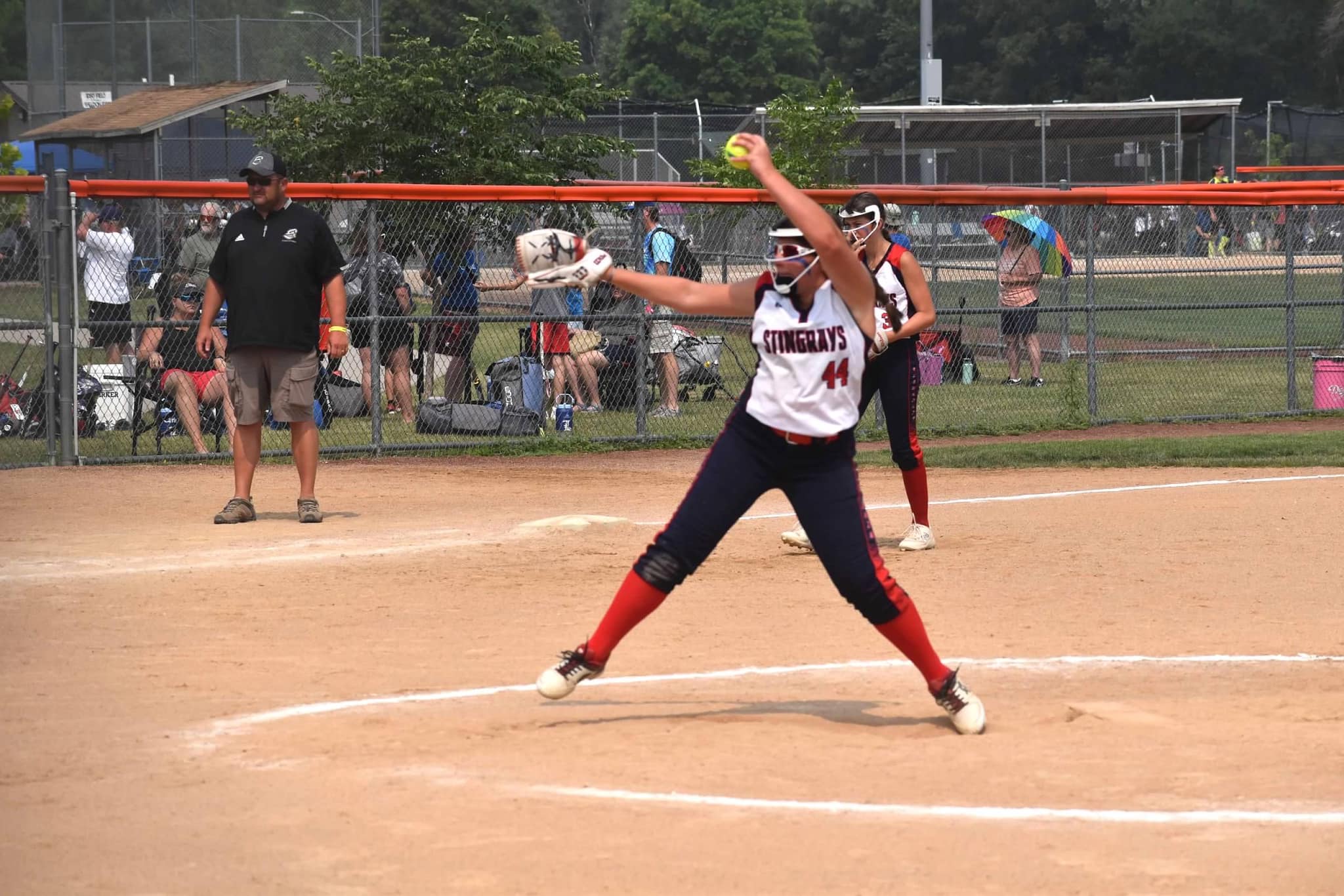
When you go to a game it often seems there are two kinds of people when it comes to the rules of fastpitch softball in general. One group feels like they know absolutely nothing and are often confused about why umpires made the call they made.
The other group is absolutely certain that they know everything there is to know about the rules and that, like the royalty, their word is sacred and indisputable. This post is for both of them.

It was actually spurred by a note from an old coaching friend who told me that after 10 years out of the game he is coming back to coach an 8U team and wanted to be sure he’s up-to-date on the latest pitching rules. Kudos, Ted, on looking before you leap.
We’re not going to get into the entire Rule 6 from the USA Softball rulebook, which covers everything. Instead, we’re going to focus on some of the recent changes as well as misconceptions that even some umpires may have.
Here we go.
Starting position (aka Start Back Rule)
Back in the old days of fastpitch, female pitchers were required to start with both feet in contact with the pitching rubber. That is no longer the case.
Pitchers must start with the foot on the throwing hand side (often referred to as the “pivot foot” or “drive foot”) in contact with the pitching rubber. That doesn’t mean it has to be sitting squarely on it; a heel barely in contact with the rubber is still considered to be in contact both by the rules of softball and the rules of physics.
But the other foot, popularly referred to as the “stride foot,” can be anywhere the pitcher wants as long as it is behind the rubber and within the 24 inch width of the rubber. That said, pitchers need to be careful about how far they set it.
Some will take this ability to the extreme, placing it far back even though it’s not right for them (although that placement can be correct for others). The easy way to figure out a good starting point is to step on the rubber and place your feet like you’re going to steal a base or run a race. Then make any minor adjustments from there.
Step Back Rule
Here’s a quick quiz: once pitchers place their feet and go into their motion are they allowed to take a step further back with the stride foot? The answer is it depends which rules body they are playing under.
A step back IS allowed under National Federation of High School (NFHS), USSSA Softball, Little League, National Softball Association (NSA, but Great Lakes Region only) and often many local rec leagues that are not affiliated with any national organization. If you are playing under a sanctioning body not listed here you may want to check their rulebook to see what is permissible.
A step back IS NOT allowed under USA Softball, PGF, Alliance Fastpitch, and some other organizations (check your local listings). If the pitcher steps back to begin the pitching motion an illegal pitch will be called.
So what does this mean for your pitchers? I teach my students to use a “start back” rather than “step back” technique. “Start back” is legal everywhere, so there are no issues with it.
On the other hand, if your pitcher is used to stepping back and then gets called for it when you play somewhere it’s not allowed, it’s totally going to mess her up for the rest of the game. She will be thinking about not stepping back instead of throwing the pitch, and even if she can block that out it will mess up her rhythm and her timing, resulting in a lot more balls and meatballs than you’re used to seeing.
Have her learn the “start back” and you’ll both be a lot better off.
Leaping (two feet in the air)
This is a fairly recent change. If you’ve been away for a while you remember when fastpitch pitchers were required to drag their pivot away from the rubber; if it came off the ground it was technically an illegal pitch, although this rule violation was rarely called for the most part. At least until you got into an important game and your pitcher was doing it.
This rule was changed a few year ago. Now it’s ok if the pivot leaves the ground and both feet are in the air. I don’t know this for sure but I have little doubt the change was made to eliminate coaches and parents from complaining constantly about an opposing pitcher their players couldn’t hit off of.
It was designed to get rid of all the ticky-tacky chirping when a pitcher’s foot was off the ground by a few inches so the kids can play the game. A good thing by my estimation, as I talked about here.
Of course, you know the story of “give a mouse a cookie.” Rather than simply being grateful that a minor irritation has been removed, some folks have decided to try to take advantage of the new rule by teaching their pitchers to leap like Johnny Lawrence in Cobra Kai.

The problem here is that when you leap that way you’re most likely to land on the foot you pushed from originally, particularly if you plan to maintain front side resistance when you land. If you push again, that’s a crow hop – which is still illegal.
Those who are teaching it claim there is no second push, they’re just landing on it. Either way, now an umpire once again has to watch closely to determine if a rule is being violated – the very thing the original rule was designed to eliminate.
That leaves us with a dilemma. Either the various governing bodies need to crack down on anything they even suspect is a crow hop or they need to eliminate the rule entirely so umpires can focus on the actual game action again. We’ll see what happens going forward.
The hands when taking your position on the rubber
Sometimes in their enthusiasm to throw a pitch young pitchers will develop a habit of stepping on the rubber with their hands together. This is illegal everywhere.
When a pitcher steps on the rubber she needs to have her hands separated. The ball can only be in one hand.
What some umpires don’t seem to understand is that it doesn’t have to be in the throwing hand. It can be in either hand when she steps on the rubber.
Unfortunately if you come across one of those rare folks in blue who don’t know the proper rule there isn’t a whole lot you can do about it. Bringing out the rulebook to prove you’re right is a big no-no.
Basically have your pitcher put the ball in her throwing hand to step on and get through the game. And secretly roll your eyes until next game.
Presenting the ball
I’m not quite sure what “presenting the ball” actually means, but whatever it’s supposed to be let me assure you there is no such rule. Case closed.
Moving the pivot foot prior to the pitch
While some people interpret the rule about keeping the “pivot foot” on the pitching rubber prior to the pitch as meaning it can’t move once it’s in place, that’s not true.
USA Softball rules (which all other rule sets are based on) specifically state the pitcher can slide her foot along the pitching rubber as long as said foot remains in contact with it. That also goes for other little wiggles or motions, including rocking back onto the heel – again, as long as contact is maintained.
What you do have to watch out for is the pitcher lifting her foot off the rubber (even slightly), or stepping forward off it (aka a “gym step”). In the case of the former it’s best to learn not to lift off, but there’s no need to go crazy if it’s coming up a little.
That’s really hard to spot from behind the plate or even from behind first base unless it’s egregious, and even then the umpire has to be inclined to watch for it and call it if he/she sees it. Most of them have more important things to do on the field than watch for that.
Read it, know it, live it
There are plenty of other rules in the rulebook, but these are probably the key ones every coach, parent, and player should know. That said, if you’re a coach playing in leagues or tournaments it behooves you to know ALL the rules, including any specialty rules that are specific to a particular tournament, so you can make sure your pitchers are prepared to succeed.
My good friend Jay Bolden and I have started a new podcast called “From the Coach’s Mouth” where we interview coaches from all areas and levels of fastpitch softball as well as others who may not be fastpitch people but have lots of interesting ideas to contribute.
You can find it here on Spotify, as well as on Apple Podcasts, Pandora, Stitcher, iHeart Radio, or wherever you get your podcasts. If you’re searching, be sure to put the name in quotes, i.e., “From the Coach’s Mouth” so it goes directly to it.
Give it a listen and let us know what you think. And be sure to hit the Like button and subscribe to Life in the Fastpitch Lane for more content like this.
Checkmate! Why Fastpitch Hitting Is Like a Chess Match

Ok, before we begin I am going to flat-out admit I am not much of a chess player. I never liked it as a kid – too slow and boring for me – and can’t remember the last time I played a full game.
Probably when I was in high school, which was a very looooooong time ago.
But I do know enough about it to understand how it’s played from a macro level. Especially after watching The Queen’s Gambit series.
At its core, chess is a game of strategy and anticipation. You don’t go for the kill right away.
You make certain moves in a particular order to put yourself in a position to strike when the chances of success are highest. And you anticipate what your opponent is going to try to do to disrupt that strategy.
In that way it’s a lot like hitting.
The instinct of many young hitters (and more than a few older ones if we’re being honest) is to attack the ball with their bat as soon as it’s pitched. In other words, they initiate the swing with their hands and let the body follow that lead.
That can work sometimes. After all, a broken clock is right twice a day (unless it’s digital, in which case it probably doesn’t work at all) and a blind monkey can find a banana now and then.

It is not, however, an approach that is going to yield regular success, especially in higher levels of play.
Just like in chess, the first move shouldn’t be the main attack. It should be to get the pieces in place so when you do attack the ball you stand a better chance of hitting it.
That’s why a sequence of hips-shoulders-bat after the front foot lands is so important.
The hips have two jobs. The first is to generate power.
The largest and strongest muscles in the body are located in the lumbar-pelvic-hip complex (LPHC). The rotational movement of the hips and core muscles get the body moving in a manner that accelerates as it goes, creating power that can then be transferred up the chain when those same muscles suddenly decelerate the hips.
By delaying the shoulders momentarily, instead of allowing them to ride along with the hips, you create a stretch from the front hip to the back shoulder that acts as a rubber band, helping accelerate the shoulders and ultimately the bat forward rather than using the arms to do it. This frees the arms and hands to focus on directing the bat to the ball rather than yanking it wildly to try to increase the energy.
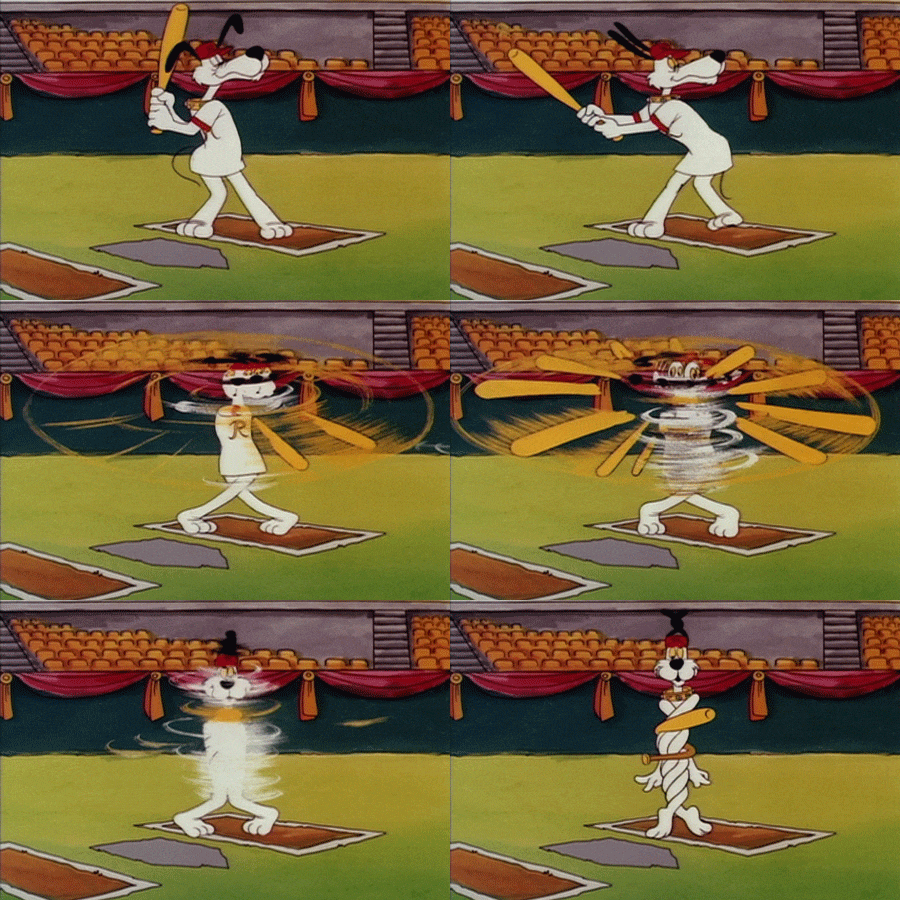
But it’s not just about power. That same movement also helps position the upper body, bringing it to the launch position without having to commit the arms and bat to the ball.
This delay give the hitter more time to see the ball and brings the bat closer to it so the actual launch of the bat occurs over a shorter distance, increasing the chances of making good, hard contact. After all, it’s easier to hit a target from close-in than far away, particularly if it’s not exactly coming in on a straight line.
And that’s where the chess analogy comes in. Rather than rushing the swing, an effective, quality hitter will first get all the pieces in place, then unleash the swing with a controlled explosion when the time is right.
Whereas a weaker hitter will place all her focus on simply getting the bat to the ball from the beginning of the swing.
The other part is the strategic element, the cat-and-mouse game between the hitter and the pitcher. A good pitcher will either be trying to pitch to her strength or the hitter’s perceived or known weaknesses so the hitter must understand what those are and adjust accordingly.
For example, if the pitcher is heavily dependent on her riseball to get hitters out, the hitter must have a strategy to deal with it. That can be to try to stand a little taller and stay on top of it, or look down and lay off those riseballs entirely while hoping the umpire doesn’t have a high strike zone.
The hitter can also look for patterns in the pitch caller’s pitch sequences. For example, if the pitcher is throwing changeups consistently in 0-2 counts, the hitter should be looking for a changeup if she goes 0-2.
In fact, against a tough pitcher she may concede the first two strikes to get to that easier to hit changeup. I’ve seen that work.
Hitters need to be aware of their own weaknesses as well. If a hitter has trouble with outside pitches, and is playing against an opponent who knows that, she should expect a steady diet of outside pitches until she proves she can hit them.
In that case, the strategy might be to crowd the plate and turn the outside pitch into more of a middle pitch – particularly if the hitter is strong on inside pitches. Doing that might even bait the other team into throwing inside to try to handcuff her – at which point she can turn on a pitch she likes and send it off like a rocket.

This is what makes fastpitch softball hitting so interesting and challenging. While it definitely requires a high element of physicality, there are also strategic elements built in that will affect and are affected by the physical components.
No wonder hitting has been called the most difficult feat in all of sports.
So keep that in mind when you’re working with hitters of all ages, levels, and abilities. Have a strategy for how you’re approaching each pitch, and a plan for how you’ll move the pieces in place to execute that strategy, and you’ll greatly increase your hitters’ chances of success.
Checkmate!
My good friend Jay Bolden and I have started a new podcast called “From the Coach’s Mouth” where we interview coaches from all areas and levels of fastpitch softball as well as others who may not be fastpitch people but have lots of interesting ideas to contribute.
You can find it here on Spotify, as well as on Apple Podcasts, Pandora, Stitcher, iHeart Radio, or wherever you get your podcasts. If you’re searching, be sure to put the name in quotes, i.e., “From the Coach’s Mouth” so it goes directly to it.
Give it a listen and let us know what you think. And be sure to hit the Like button and subscribe to Life in the Fastpitch Lane for more content like this.
Chess photo by Gladson Xavier on Pexels.com
The Path to Improvement Is Rarely Linear

So you decided to start taking your daughter to private lessons, or to buy an online package, or do a bunch of research and teach her yourself. That’s terrific – way to step up and help your daughter get better at the sport she loves.
Now it’s time to set some realistic expectations. In my experience, when people think of improvement in sports through lessons, more practice time, etc. they tend to expect it will look like this:

When the reality is it’s far more likely to look like this:


So why can’t it be more linear in the classic “hockey stick” style, especially if you’re putting in the work? Why does it seem like it always has be be two steps forward and one step back?
A lot of it comes down to two things: human nature, and how the human body (and the brain that controls it) works.
Humans are amazingly adaptable to their environments. We can learn how to accomplish incredible things based on what our goals are.
Once we’ve learned how to do those things, however, we tend to internalize the movements that got us there. Which means we stick with them even if the goals have changed.
Let’s take a young pitcher, for example. All her coach really wants from his/her young pitchers is for them to get the ball over the plate, i.e., throw strikes.
“We can’t defend a walk,” the coach keeps calling out, so the pitcher starts using her body in a way that allows her to accomplish the #1 goal – throwing strikes. Doesn’t matter if the movement to do so is efficient, or yields a pitch velocity that makes everyone say “Wow!” or even results in many strikeouts or weak hits.
As long as there are no walks the coach is happy, and the pitcher is a star who gets the bulk of the innings.
Sooner rather than later, however, that strategy is no longer good enough. The pitcher is getting pounded by hitters who can blast a meatball coming over the heart of the plate, so she needs to learn to throw harder, hit spots, and eventually spin the ball too if she wants to continue getting innings.
Unfortunately, the movement patterns that made her so effective at age 9 or 10 are not very conducive to throwing hard or hitting spots or spinning the ball. So she now has to learn new movement patterns.
Only she’s kind of locked into the old ones, and since her body and brain remember that those patterns were great at accomplishing the goals associated with the pitching motion at that time they’re having a hard time giving them up. We are a product of our habits, after all.
As a result, the pitcher’s performance could drop down for a while as she attempts to replace old movement patterns with new ones. Sure, the new patterns will yield more success in the long term by making her movements more efficient and effective, which will make it easier to perform at a higher level.
But it could be discouraging as she sees that temporary performance dip while her body re-learns how to move to accomplish something that used to seem easy and familiar.

The same is true with every aspect of fastpitch softball – hitting, overhand throwing, fielding, even running and sliding. Because before you can achieve any type of improvement you first have to change what you’re already doing, no matter how successful it has been in the past, and change is hard.
At this point you may be wondering if there is a statute of limitations on the backward steps. After all, once you get to a certain level of competence, or even excellence, shouldn’t it be easier to just keep going up without hitting a plateau or (gasp!) seeing performance go down?
No, for the same reasons it’s a problem in the beginning stages. In order to drive improvement, even for those at the highest levels, you have to change something you’re doing, because as the adage says, if you do what you always did you get what you always got.
In fact, it may be tougher at the higher levels because there is more to lose. A player has to decide if the potential improvement to be gained is worth the risk of a temporary loss of performance – especially if that performance has been serving the player well.
Doing something different in a high-pressure situation is likely to result in at least a slight loss in confidence due to its unfamiliarity, which leads to not putting in the same level of effort as the player would with the more comfortable movements. She may also lose some energy temporarily because she now has to think about what she’s doing rather than simply executing the movements at 100% effort with no thought involved.
That’s why high-level players usually make these changes in the offseason.
A high-level player won’t take on that risk, though, without a clear view of the rewards on the other side. She will also have been through the process before too, so should understand the ups and downs of continuous performance improvement.
Sure, it would be great if making changes automatically resulted in an immediate improvement in performance. While that can happen sometimes, more often than not it takes some time (and some missteps) before the benefits of all that work show up on the radar or in the box score.
But just like a butterfly emerging from a cocoon, if you put in the work on the right things, and remain patient, the reward will be there on the other side.
My good friend Jay Bolden and I have started a new podcast called “From the Coach’s Mouth” where we interview coaches from all areas and levels of fastpitch softball as well as others who may not be fastpitch people but have lots of interesting ideas to contribute.
You can find it here on Spotify, as well as on Apple Podcasts, Pandora, Stitcher, iHeart Radio, or wherever you get your podcasts. If you’re searching, be sure to put the name in quotes, i.e., “From the Coach’s Mouth” so it goes directly to it.
Give it a listen and let us know what you think. And be sure to hit the Like button and subscribe to Life in the Fastpitch Lane for more content like this.
Butterfly Photo by Pixabay on Pexels.com
A Tribute to the Parents Who Show Up Just in Case their Daughter Plays

You see them at every high school (and sometimes college) ballfield. In cold weather climes they are bundled up in parkas, blankets, quilts, wool hats, mittens, and whatever else they can find to keep them warm, sitting in their camp chairs either alone or maybe in pairs, steeling themselves against March and early April winds that cut through all their layers like a knife.

In warmer climes they might have rain ponchos or even makeshift shelters to protect them against the showers that can crop up out of nowhere and drench them in a matter of minutes if they’re not prepared.
They do all of this without the assurance of a reward for their efforts. Because these aren’t the parents of the starters or regular players.
No, they’re the parents who show up game after game, putting up with the elements and the difficult conditions, hoping against hope they will get a chance to see their daughters get into the game for an inning or two.
I remember watching them when my daughters were playing high school softball. When I was at a game, no matter how cold or wet it was, I knew I would get the opportunity to see my daughters play the game they loved.
I could count on seeing them pitch, hit, play the field in just about every inning.
But then I would look at these parents and admire their fortitude. They had no such assurances their daughters would get into the game.
They could go days or weeks at a time and never see their daughters so much as pinch run. Their only real hope of seeing their daughters on the field was for their to be a blowout, i.e., their daughter’s team getting either so far ahead or so far behind that the coach would take the starters out and give an inning or two to the bench players.
But you know what? They showed up anyway, game after game, braving the cold, the wind, the occasional rain or even sleet, cheering for the team and just being there supporting their own daughters.
That, my friends, is love.
While honestly I was glad I wasn’t one of them, and even felt a little bad for them in a way, I also couldn’t help but be impressed by their dedication and their quality of character. It would have been easy for them to figure there’s not much point in going, especially when the team was playing against a close conference rival where one run might be the difference between winning and losing.
They could have easily thought, “She’s never going to get in so I might as well use the time more productively.” But they didn’t.
Instead, they showed up before the game started and hung around until the end, supporting their daughters in their sport of choice.
So here’s to all of you who make that choice and sit through all the weather and other challenges just on the off-chance your daughter gets an opportunity to play, even if just for an inning. You are good people, and your dedication hasn’t gone unnoticed.

Dress warm (if needed), keep dry, and I hope your patience is rewarded sooner rather than later.
My good friend Jay Bolden and I have started a new podcast called “From the Coach’s Mouth” where we interview coaches from all areas and levels of fastpitch softball as well as others who may not be fastpitch people but have lots of interesting ideas to contribute.
You can find it here on Spotify, as well as on Apple Podcasts, Pandora, Stitcher, iHeart Radio, or wherever you get your podcasts. If you’re searching, be sure to put the name in quotes, i.e., “From the Coach’s Mouth” so it goes directly to it.
Give it a listen and let us know what you think. And be sure to hit the Like button and subscribe to Life in the Fastpitch Lane for more content like this.
Top photo by Yakup Polat on Pexels.com






 Life in the Fastpitch Lane