Author Archives: Ken Krause
Coaches: Stop Throwing Pitchers Into Games Cold

This is another one of those posts that you would think should generate a collective “duh” from the fastpitch softball world, but based on what I keep hearing it’s not quite as obvious as it would seem. So let me say this loudly for the people in the back:
Coaches, you need to stop putting pitchers into games without adequate time to warm up before they take the circle.
That’s true even of pitchers who warmed up before the game started. If you’re now in the second, third, fourth, or later innings, those pitchers still need some time before they go in to get themselves ready.
And the longer it’s been since they initially warmed up, the more important it is to give them time to go through the process again. Because it takes a certain amount of preparation to get ready physically and mentally, to get the feel of various pitches, the complex timing required, and to switch their heads from field player (or sitting on the bench) to being game-ready.
Look, I know sometimes your pitchers make it look easy when they step into the circle at the beginning of the game. They’re bringing good velo, they have command of their pitches, they’re ripping through batting orders like tissue paper.

As a result, you may think that it’s a switch they can throw and instantly turn into SuperStud. Trust me, it’s not.
It takes time to get ready. And there’s a “use it or lose it” factor built into it.
A pitcher who warms up before the game starts to cool with each passing minute if she’s not pitching in the game. To all of a sudden pull her in from left field or first base or wherever she’s playing currently and expect her to perform at her peak is not only unrealistic. It’s self-sabotaging.
Think about the situation. You wouldn’t be suddenly pulling her in from another position (or the bench) if things were going well for the team.
You’re pulling her in because they’re not, and you’re hoping she can put out the fire. Only she’s really not ready to perform at her peak, so there’s a pretty good chance that instead of making things better she’ll either keep them the same or make them worse.
Sure, you might get lucky and get the out you need to end the inning. But that’s probably going to be the exception.
The more likely scenario is you’ll get a walk, or a hit by pitch, or she’ll give up a meatball that goes sailing to or over the fence as she’s trying to find her groove.

The consequences of that decision may not just affect that game either. You may shake that pitcher’s confidence, especially if you get angry that she didn’t save you from your own bad decision, causing her to be overly cautious the next time out so as not to let you and the team down again.
More importantly, putting a pitcher into a game without adequate warm-up and then expecting her to perform at her highest level is a recipe for an injury – possibly one that is season-ending. No one wants that.
You would never see a Major League Baseball manager or a P4 head softball coach put a pitcher into a game without warming him/her up thoroughly first. Why would you think a younger or even high school-aged player could do it?
Ok, now that we’ve established that concept, the natural follow-up question is “how much time does that additional warm-up require?” After, all, the pitcher did spend some time before the game getting ready, so it shouldn’t be too much, right? Right?
The reality is it depends entirely on the pitcher. Some can warm up quickly, and maybe just need a little tune up before going into the game. They can probably get by with 10 minutes or less.
Others have a lengthy process they must follow in order to feel ready. It could take them 20 minutes or more to go through all their pitches to make sure they’re working properly.
As the person making the decision of when to put them in, you need to be aware of what each pitcher requires and then try to plan ahead so they’re ready to go when you need them. Just don’t wait until you’re already in trouble before you get them up and throwing.
If you think there’s any chance you’ll need a pitcher out of the bullpen/off the bench, get them warming up after 2-3 innings, just to be safe. If you’ll need to pull in a pitcher who’s already playing in the field, send in a sub, even if it’s mid-inning.
Better to have her ready and not need her than need her and not have her ready.
Coming in to pitch mid-game is often tougher on pitchers than starting one. Especially if the wheels are already coming off the wagon.
Giving your relievers enough time to warm up according to their individual needs will save you all a lot of heartaches, as well as give you a better chance of winning more games. It will also help prevent the type of injuries that can ruin a season.
Some Players Make You Look Like a Better Coach; Others Make You Become One

Anyone who has coached for any period of time knows there are basically two types of players.
The first type makes you look like a better coach. You know the type.
You can pretty much tell them anything – even if it’s the stupidest possible thing you could say – and they will be successful. They have the raw athleticism to find the right way to do things because their bodies just intrinsically understand how to move.
You can put them into a position they’ve never played before and they will look like they’ve been doing it all their lives. In fact, people on the sidelines will probably wonder why you HAVEN’T had her there the whole time.
Then there are those who make you become a good coach.
They have not been blessed with tremendous natural athleticism. While some are reasonably competent on their own, many have no real idea how to move their bodies in anything even resembling an athletic way.
You how them how to swing a bat and then they stand flat-footed and pull the bat around as if it’s a sledgehammer. You try to show them how to catch a ball and it looks like they’re afraid it’s going to bite them.
You try to show them how to throw the ball back and it looks like someone trying to unfold a one-person tent (or put away one of the old Jugs pop-up nets).

And pitching? Fuhgeddaboudit. If there’s a way to do it right, she will immediately find its polar opposite.
The ones who make you look like a good coach are really fun to work with, no doubt about it. And they’re good for the ego too.
A lot of coaches love to point to their very best players and show them off as though it was their great teaching that made them the way they are. Surely the coach helped them with that process.
But as I always say, if it was the coach who made them so good then all of that coach’s players would be equally as good. They’re not.
Often, though, it’s the ones who make you a good coach who have the most impact on your life. First of all, you can’t just tell them any old thing and have it work.
You have to figure out how to explain things to them, or demonstrate things to them, in a way they can understand and then execute. Often that means being creative in your approach and coming up with ways of teaching you would have never done otherwise.

The good news is each of those is unique, which allows you to build your coaching toolbox and expand your coaching reference library tremendously. All of which helps you build your own confidence as well.
There is also a lot of satisfaction in teaching a player to do something she just wasn’t capable of doing before. Seeing her get her first hit in a game, or pitch her first strikeout, or make a great catch, or make a perfect throw across the infield to get the out for the first time, gives you a feeling of pride that simply can’t be matched.
There’s no doubt that the players who make you look good will help you win a lot of games. Appreciate them when they come along, but be sure to keep your contributions to their success in perspective.
While they can be more challenging, especially in the beginning, the players who make you a good coach will likely hold a special place in your heart because you’ll know you gave them an opportunity they would not have had otherwise. It’s still up to them to put in the work, but when they do it’s magic.
Why Coaching Different Levels Is Like Teaching in School

The other week I was waiting for my first lesson to come in when my friend and fellow coach Dave Doerhoffer sat down next to me sighing and shaking his head. Dave is an assistant coach at Vernon Hills High School (as well as a private hitting instructor).
As part of that role Dave, along with head coach Jan Pauly, helps oversee instruction for the Stingers travel teams that feed VHHS. On that day his head shaking had to do with the complicated instruction one of the coaches for a 10U team was giving to his players.
I won’t go into details to spare anyone embarrassment, but the gist of it was that while what was being instructed was technically correct for an older player, it was too much for a younger player who just needs the basics to absorb.
This is something that’s probably more common than most coaches and parents realize. Coaches go to a coaching clinic featuring D1 college coaches explaining how they teach this technical aspect (such as footwork at first base) or handle that situation (such as runners on first and third).
Then the travel coaches, all fired up as they ought to be, come back and try to apply those principles to their younglings. Usually with disastrous results. Players get confused, or don’t yet have the skills or experience to apply what’s being taught, and what should be good outcomes become bad ones instead.
Here’s where coaches can learn something from the way school subjects are taught. In language arts, math, science, etc., the early grades start with the very basics, allow their students to learn those, then build on that knowledge when they are ready and able to take the next step.
Take math, for example, Teaches don’t try to teach differential calculus or advanced algebra in first grade. (Thank goodness because I would have never made it out of first grade.)

They start with simple addition and subtraction, then move to multiplication and division. They continue to build on those skills little by little through multiple grades until they can handle more complex and more abstract mathematical principles.
It’s a slow build over time, not just jumping right to the difficult stuff because it’s cool or will make the teacher look good.
The same goes for vocabulary. Young students start with simple words they use and hear every day (except for those words), then learn more complex ones as their basic understanding grows.
Otherwise all that will happen is the teachers will obfuscate the intention in a torrent of enigmatic gibberish until any learning is diffused and the results are ineffectual. So there.
Coaches first need to put themselves into the shoes of their players, evaluate what those players know (if anything) about fastpitch softball, and work from there. Teaching them how to execute a trick play for first and third when those players can barely throw and catch just doesn’t seem like a good use of time or resources.

By the way, this doesn’t just apply to the very young, i.e., 8U, 10U, or 12U players. Ask some college coaches and they will probably tell you stories about good players who lacked basic knowledge on some aspects of the game, such as how to tag up on a fly ball and when you can run. (It’s when the ball is first touched, not when it’s caught.)
When I was coaching teams I learned the hard way not to assume your players know ANYTHING you THINK they ought to know. If you take the stance that if you didn’t teach it directly to them they don’t know it, no matter what they age, you will avoid some ugly surprises just when you need those least.
The bottom line is as a coach you need to look at what your players know and can do, then introduce new concepts that fit within those capabilities. Your players will learn the game better, in a more logical fashion, and you’ll avoid the preventable mistakes that keep us all up at night.
School photo by Ksenia Chernaya on Pexels.com
What It Takes to Really Learn Something (or Unlearn Something)

When I was but a lad heading into high school, my heart’s greatest desire was to learn how to play the guitar. Partially because I loved music, but also because I thought doing so would help me meet girls.
(Don’t judge, Eddie van Halen started on guitar for the same reason, although he did a little better than me on learning it.)

Anyway, for my 14th birthday (just as the summer started) my parents bought me the cheapest piece of junk available that will still work, a $20 Decca guitar from Kmart. But I didn’t care – I had a guitar, along with a little songbook with songs like Born Free and Red River Valley that had the little finger placement charts above every chord.
I pretty much spent the entire summer locked in my room for 4-6 hours a day every day, playing the same old songs over and over until they began to sound like actual songs. In a month I felt comfortable enough to play that guitar in front of my parents and a couple of their friends.
Within a couple of months of starting I bought my first “real” guitar for $100 out of my 8th grade graduation money – a Suzuki 12 string that I still own to this day. It’s not very playable anymore but I still keep it around for sentimental reasons.
I tell you this story to point out a valuable lesson: if you really want to get good at something, you can’t just dabble at it or put in time against a clock. You have to work at it deliberately, with a goal and a sense of purpose.
In other words, you have to know your “why” or you’re just going to spin your wheels.
So if you’re a pitcher who is trying to increase her speed or learn a new pitch, you can’t just go through the motions doing what you always did. You can’t just set a timer and stop when the timer goes off.
You have to dig in there and keep working at it until you make the changes you need to make to reach your goal.
If you’re trying to convert from hello elbow to internal rotation, you can’t just throw pitches from full distance and hope it’s going to happen. You have to get in close, maybe slow yourself down for a bit, and work on things like upper arm compression and especially forearm pronation until you can do them without being aware of them.
It might take a few hours or it might take a month of focused, deliberate practice. But you have to be willing to do whatever it takes to get there.
The same goes for hitters. If you’re dropping your hands as you swing or using your arms instead of your body to initiate the swing you’re not going to change that overnight by wishing for it.
You have to get in there and work at it, and keep working at it until you can execute that part of hitting correctly. No excuses, no compromises; if you want to hit like a champion you have to work like a champion.
There will sometimes be barriers that seem insurmountable, and no doubt you’ll get frustrated. But there is some little thing holding you back and you attack it with ferocity, with a mindset you won’t let it defeat you, sooner or later you will get it and be able to move on to the next piece.

When I first learned how to play an “F” chord it was really difficult. It requires you to use your fingers in ways other chords don’t, especially when you’re a beginner.
But I needed to master that “F” chord cleanly so I could play certain songs, so as physically painful as it was (especially on that cheap little Decca guitar) I kept at it for hours on end until it was just another chord among many in the song.
The same will happen for you if you work at it. The thing you can’t do today will become easy and natural, and that will put you in a better position to achieve your larger goals.
Yes, it takes a lot to make a change, especially if it’s from something you’ve been doing for a long time. Old habits die hard as they say.
But if you approach it with passion and purpose you’ll get there – and you’ll be better-positioned for your next challenge. .
BONUS CHALLENGE: Yes, one of those young fellows up there in the top photo is me. See if you can guess which one and put your choice in the comments below. (HINT: It may not be the one you think.)
The Odds Are Stacked Against You in Fastpitch Hitting
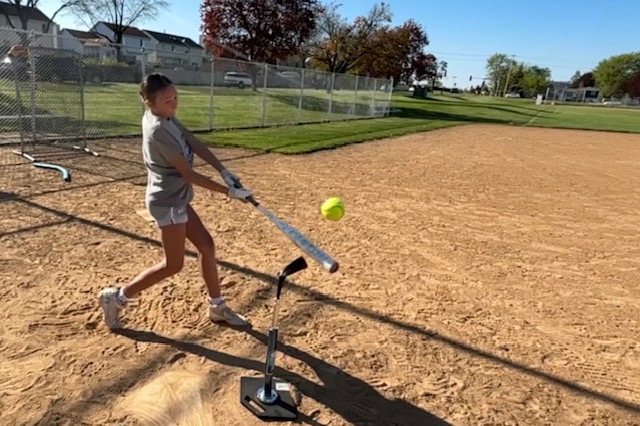
A few days ago I was doing a hitting lesson with one of my students, a young lady named Avery. We got to talking about why the success rate for hitting in fastpitch softball is generally so low.
That’s when she said something profound that her mom Abbey had told her that I hadn’t really thought about in that way: Hitting is 9 on 1.
I think most of us tend to think about the battle between the pitcher and the hitter, i.e., how the pitcher is trying to get the hitter to miss the ball or at least mis-hit if she does make contact so doesn’t go too far. But while the hitter is up at the plate standing alone, the pitcher has one other person in front of her and seven others behind her to help her get the out on that weak hit.
That’s a pretty unfair advantage, don’t you think? Picture a basketball game, or a soccer match, or hockey game, or pretty much any sport where scoring means getting the object at the center of the game into the other team’s goal.
You don’t have to be Mr. Vegas to figure out who is going to win that contest, no matter how skilled the player on the one side is.

Yet when the scoring opportunity comes up for a player in fastpitch softball (or slow pitch, or modified pitch, or baseball, etc.) she’s facing a whole phalanx of opponents whose only goal is to prevent her from achieving her goal. Seems pretty unfair, doesn’t it?
And that’s why the stats of a game, even if kept honestly (versus the person who scores every contact as a hit or anything close as an error, depending on whether his/her team is at bat or in the field), don’t always tell the whole story.
For example, a hitter can slam a screaming line drive directly at the face of the opposing shortstop, who throws her glove up in instinct to protect herself. If said screaming line drive goes into the glove and the shortstop’s palmar grasp reflex (yes that’s a real thing) causes her hand to contract around the ball, the hitter is out.
Never mind that she smoked the pitch that the pitcher mistakenly threw over the heart of the plate. One of the seven fielders happened to be in the way of the ball as it was on its way to being a double and turned that great contact into a drop of a few percentage points in her batting average.
Or what about the well-hit ball to the outfield that goes to the person the other team is trying to hide? She puts her glove up over head to make sure the ball doesn’t hit her, and instead it nestles softly in the web like a bird landing in its nest.

The hitter did nothing wrong, and the fielder, quite frankly, didn’t do anything intentionally right, but the fielder gets high fives while the hitter gets nothing except another ding against her batting average. And those are just the extreme examples.
During the course of the game most times there are seven fielders behind the pitcher, plus the pitcher herself, whose job it is to make sure the hitter doesn’t reach base. And then you have the catcher whose job it is to clean up anything around the plate. That’s a pretty stacked deck.
The only way the hitter can be absolutely assured of not being out after contact is to drive the pitch over the fence. And while the number of hitters doing so has increased dramatically over the last several years, those are still a low percentage of all contacts made.
So the next time you’re wondering why failing 7 out of 10 times at the plate makes someone an all-star, remember that the odds are stacked against the hitter from the beginning. And beating 9 on 1 odds is a pretty good reason to celebrate no matter how it happens.
Why Fastpitch Softball Pitching Is So Danged Difficult

You hear it all the time from coaches, parents, and others sitting safely on the sidelines at fastpitch softball games: Just throw strikes! As if that idea hadn’t occurred to the poor pitcher while she’s sweating out a delightful inning of walks and hit by pitches.
Ah, if only it were that easy. I mean, it doesn’t look that difficult from the outside.
You step or jump or ninja leap your way forward, swing your arm over your head, bring it down, and let go of the ball. What could be more basic than that?
Plenty, to be honest. Because pitching in fastpitch is like a fine Swiss watch.
On the surface, you see the hands going around a disk. But underneath, there’s a complex set of gears creating individual movements that all have to be perfectly in synch to keep the correct time.
Let one little piece of a gear wear down, or get knocked askew, or take on a spec of dirt that slows it down by a microsecond, and suddenly the whole operation is no longer functioning properly.

Think I’m exaggerating? Take a good look at any video or sensor-based analysis of the pitching motion.
You have to be concerned about how the legs work in relation to the arms at launch. You have to look at where the body goes when it drives out – is it relatively straight or going off line?
When the arms go back on a backswing or forward on the first phase of the pitch are they working together and moving toward the plate in an efficient manner or are the wandering all over the place, creating timing and balance issues?
What’s happening with the muscles underneath? Are they loose and flexible the way they need to be in order to move quickly, or are they stiff and locked out?
What’s happening in the shoulder as the arm goes over the top? How is the upper arm positioned relative to the shoulder and the lower arm?
Where is the upper arm positioned when the front foot lands? What is the hand doing at this point?
As the pitcher goes into delivery are her shoulders stable and locked into position or are they swinging around like one of those carnival rides? Does she have good, upright posture, or is she collapsing like a cheap folding chair?

There’s more to consider but you get the idea. Lots of moving parts that all have to work properly, and in synch, in order to “just throw strikes.”
Now add in the idea that this sport is called FASTpitch. So it’s not enough to get the movements correct.
You have to do it while putting every ounce of energy you have into every pitch. All in the space of a couple of seconds start to finish, with a lot of the critical movements occurring in a matter of milliseconds before the pitcher has to move on to the next one.
Anything in that process gets slightly off and suddenly the ball is heading into the dirt, or into the backstop, or into the side of the hitter. And when that happens, the pitcher has to know how to make a micro-adjustment here or there to get everything back on track in an effort to make sure it doesn’t happen again on the next pitch.
What usually happens, especially with younger or beginning pitchers, is that they over-correct instead of understanding they should just relax, trust their training, and allow the gears to get back in line. That’s why one pitch goes into the dirt and the next one hits the field number sign at the top of the backstop.
When you see that issue occurring, the worst thing you can yell is “just throw strikes.” That’s what she’s trying to do.
But a gear has slipped and she’s probably not sure which one or how to fix it. Telling her to “just throw strikes” will only encourage her to try to force the ball over the plate, abandoning all mechanics.
That would be like trying to fix your watch by hitting it with a hammer. You might get lucky, and get it running again, but the odds are you’re just going to ruin the watch.
A better approach is to call time if you can and go out and talk to her. Remind her to trust the work she’s put in and let her body do what it does best, focusing on the process instead of the outcome.
In other words, let her get all her gears back in order. And if that still doesn’t work, tell her it’s just not her day and you’re going to give someone else a try now, and you’ll come back to her another game.
If you’re a non-coaching parent and can’t go out for that circle visit, just be encouraging and supportive. I know it’s difficult to watch your daughter struggle – I’ve been there – but she’ll be able to handle the adversity a lot better if she knows you’ve got her back instead of thinking you are judging or criticizing her in the moment.
If she’s not able to correct things on her own, the time for those corrections is in her next practice session, not under pressure in the middle of a game. Trying to do it in-game will likely only make it worse.
Yes, pitchers like Tegan Kavan, Nijaree Canady, Sam Landry, Emma Lemley, and so many others you see on TV or at live games often make fastpitch pitching look easy.. But it’s anything but – even for them.
Understanding just how complex the individual movements are, and how intricate the timing of each movement is in relationship to all the others, should help you cut your pitcher(s) a little slack when things aren’t going quite the way you or she wants. It ain’t easy.
But like that fine Swiss watch, it’s a thing of beauty when you get it all working the way it should.
Pitching Coach Bill Hillhouse Extraordinaire Could Use Your Help

Yesterday Jay Bolden and I had the privilege of talking with pitching coach Bill Hillhouse for an upcoming From the Coach’s Mouth podcast. If you’re not familiar with him, Bill was the youngest pitcher ever to play for the Team USA Men’s National Team when he joined it in 1993, and was an outstanding player who competed all over the world, winning wherever he went.
(If you’re interested in learning more about his softball resume, I’ve included more facts below.)
Bill then started giving lessons, mostly to female players, as his playing career was winding down. He saw the terrible hello elbow mechanics that were being taught widely at the time and became a very vocal advocate for learning to pitch the way the body moves naturally and the way all the top-level pitchers actually threw – what we today call internal rotation, although he’s not a fan of that description either for various reasons.
He named his business the House of Pitching, and he put out a series of DVDs to help spread his teachings more broadly than he could one-on-one. My guess is thousands of pitchers benefitted from the work he did in explaining everything from basic to advanced pitching mechanics in his lessons, clinics, and DVDs.
It was a business that again took him all over the world and afforded him a comfortable although not lavish living. He was also a columnist for Softball Magazine at the same time I was, which is where we met and became friends.

Then in July of 2025 Bill got the news no one wants to hear: he was diagnosed with stage 4 pancreatic cancer. In typical Bill fashion he didn’t make a big deal about it, not wanting to burden others with his issues, but as we all know getting sick here in the good ol’ USA isn’t cheap.
Suddenly, not only did he have all these medicals bills but he was also cut off from his only source of income – giving lessons.
Which brings me to the point of today’s post. After all the years of helping others (including many who were indirectly assisted by his influence on other pitching coaches like me), Bill could use a little help himself.
His girlfriend set up a GoFundMe page to help him with his expenses while he does his best to battle this disease. He knows it’s not a winnable fight – there is no “cure” for pancreatic cancer – but as a competitor he’s not just sitting around waiting for the inevitable.

In fact, he told us he’s been giving lessons again on a limited basis, and while it’s bringing in some revenue it’s less than he needs to live a normal life. So here’s my ask today.
I know times are tough right now, but if you can please go to https://www.gofundme.com/f/help-bill-hillhouse-through-his-cancer-battle and leave a donation. Even $5 or $10 will help, especially if a lot of people choose to do it.
So maybe instead of your morning Starbuck’s or those McDonald’s Diet Cokes you enjoy, take one day and dedicate that money to Bill. The big corporations won’t miss it, but it will sure make a difference to a guy who has made a difference to so many of us in the fastpitch softball world – including many who don’t even know it.
Thanks for considering it. And keep an eye out for our conversation with Bill coming up in a couple of weeks over at the From the Coach’s Mouth podcast. It was a lot of fun and I’m sure you will enjoy it.
Bill Hillhouse Mini-Bio
Bill Hillhouse was a star pitcher in international men’s softball, playing all over the world including eight seasons competing in New Zealand. He was not only a two-time member of the USA Men’s National Team but was the youngest pitcher ever to play for that team when he joined it in 1993. Among his accomplishments are being named the Pan American Games M-V-P, winning the Men’s Major National Championship three times, earning a gold medal at the U-S Olympic Festival, and being inducted into the USA Softball of Pennsylvania Hall of Fame in 2022.
Bill’s coaching career is equally stellar. After stints as a pitching coach consultant for division 1 Drexel University and the University of Georgia, in 2018 he joined the staff at Providence College in Rhode Island. A strong advocate of men’s fastpitch, he also served the sport as a commissioner for the International Softball Congress from 1997 to 2013.
He is probably best known, however, as a private coach. Operating under the House of Pitching moniker, Bill gave individual lessons and conducted group clinics all over the US and the world. While he coached many high-level softball pitchers to successful college careers, including 2025 WCWS winner Tegan Kavan, he never really publicized his association with any of them. As he told Jay and me, “Their accomplishments were theirs, not mine, the result of a lot of hard work and dedication. I teach everyone the same things but get varying results, so the difference is really in them.”
The Hero’s Journey Always Includes Trials and Tribulations

The so-called hero’s journey is one of the most fundamental tropes in storytelling. In fact, if you line them up in a chart the stories are all pretty similar.
One of the key points, whether you’re talking about Ulysses or Hercules from ancient mythology or more contemporary heroes such as Frodo Baggins, Dorothy Gale (from The Wizard of Oz), Anna and Elsa, or Luke Skywalker, the path the hero must walk is never smooth or easy. It’s filled with trials and tribulations, setbacks and betrayals, dark moments of doubt, and other challenges before the hero ultimately (and often barely) triumphs.
So it’s amazing to me how people think their or their daughter’s softball journey should be filled with nothing but sunshine and unicorns, one success after another without any setbacks or suffering whatsoever. Sorry, it doesn’t work that way.

Even those who turn out to be the highest-level players often tell stories about how they were the fourth or fifth pitcher on their travel team for years, or how they could barely crack the lineup in pool play or their first couple of years of high school ball before they became the player we all came to know. In fact, in real life as in fiction, it’s the trials and tribulations they go through that make them capable of being heroes when the moment arises.
Rather than fearing or avoiding adversity, it’s important to embrace it. It’s a lot easier to weather the next storm (and there’s always a next storm) when you’ve already gotten through the last one.
Besides, if there weren’t challenges and obstacles to overcome that softball journey would be pretty danged boring. There is no triumph with challenge.
In other words, if Frodo could just take a casual stroll into Mordor without all those evil forces pursuing him and putting his life at risk, it wouldn’t be much of a story. It certainly wouldn’t be one that has become beloved and retold many times since it was first released in 1954.

The same with Ulysses and Hercules, which are many centuries older. If they just did what they needed to do without the trials and tribulations no one would be interested in either of them.
It’s the obstacles that make us who we are. For many (me included, by the way), it’s the people who told us we couldn’t do something or weren’t good enough that kept us working harder to prove them wrong.
It’s the times we failed to reach a goal we really wanted that caused us to double down on our efforts and keep working until we got there.
They say that each of us are the heroes of our own stories. Or at least we should be.
If that’s true, remember that your hero’s journey won’t be nearly as interesting or powerful if it’s all sunshine and puppy dogs. While I’m not advising that you seek out problems, I will say they’re going to find you whether you want them or not.
The key is not to be afraid of them or let them take over your life. Even in the biggest slump or lowest points of your life or softball career, remember that you have the ability to overcome whatever difficulties come your way.
Also remember that heroes rarely do it alone. Anna and Elsa had Kristoff and Olaf. Frodo had the Fellowship of the Ring. Dorothy had the Scarecrow, Tin Man, and Cowardly Lion, Luke had Han and Leia, among others.
Let those around you help you through the tough times and keep your spirits up when you feel like giving up. And in the end, remember when you do triumph over all that adversity, the success will be that much sweeter.
Today’s problems will pass. No one can say exactly when, but they will pass.
When they do, you’ll come back stronger than eve, ready to complete your own hero’s journey, whatever that may be. And you’ll have a great story to go with it.
Photo by Alex Kinkate on Pexels.com
Product Review: Portolite Signature Spiked Practice Mat
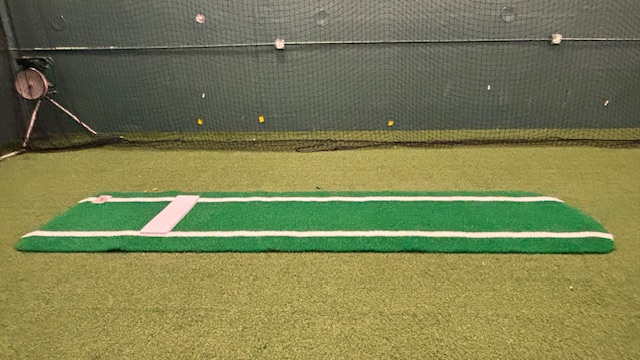
Having a good-quality practice mat for indoor pitching practice is an essential to me. It helps cut down on “gym stepping” (taking a step forward with the pivot foot before launch) and gives some good feedback about the direction the pitcher is going and distance the she is covering in the drive phase of the pitch.
For years I have used a mat designed for use on turf. It was good for two of the facilities I work at, both of which have very low-pile, carpet-like turf. But at the third, which has turf that is a little more grass-like, I found that the mat would slide forward and turn toward the throwing hand-side after two or three pitches for all but the smallest girls. Which meant that I would have to stop the lesson and readjust the mat pretty frequently.
The solution I came up with was to turn the mat backwards so the pitcher could use the pitching rubber to push off of but would then land on the regular turf. It solved the problem of the turning mat, but made it kind of pointless to have an 8 foot long mat since most of the mat would be in the opposite direction to which she was going.
Finally, I decided to do what we all do in these frustrating situations – search the Internet for a solution. I finally found one I thought would work: the Portolite Signature Spiked Practice Mat. I have used and liked Portolite products before, so it definitely caught my interest.
But the cost was a little high, which caused me to hesitate before pulling the trigger (more on that later). Finally, I saw a Black Friday sale and decided to roll the dice.

I’m glad I did, because it is definitely up to the task of staying in place on higher turf, even with the biggest/strongest/heaviest pitchers. No more turning, no more sliding forward, no more resetting the mat every few pitches.
You just lay it down wherever you want it and it stays there for hours or even days without having to touch it. Here’s a little more in-depth look.
(NOTE: There are no promotional considerations for this review. I purchased the mat as a consumer and am not being paid to write this review. Just thought you should know.)
Basic construction
The mat definitely features high-quality construction. The turf side is thick and built to hold up to heavy use, and the back side appears to be made of heavy-duty rubber. The two are attached seamlessly and look like they will hold up for years without splitting apart.
(For contrast, the turf and backing on my Jennie Finch mats began separating at the front edge shortly after I got them, and I occasionally have to glue them back together to reduce the chances of them coming apart completely or having a pitcher trip over them.)
The pitching rubber isn’t just glued to the mat – it is bolted on with four bolt and nut combinations that are incorporated somehow into the rubber then stick out of the bottom.
I don’t think that pitching rubber is going anywhere. This construction also means (according to the manufacturer) that you can replace the pitching rubber at a later date if it gets too worn or damaged.
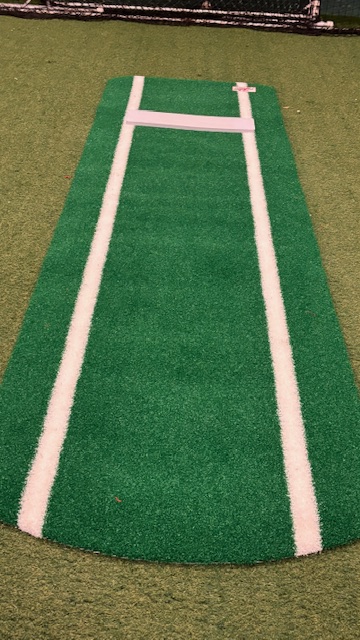
The overall length of the mat is 3 feet wide by 11 feet long, with 8 feet from the rubber to the end of the mat. That should be sufficient for most pitchers, while also leaving a generous 3 feet on the back side so both feet can start on the mat, even with a deep drop back.

The lines appear to be deeply sublimated or otherwise embedded into the turf so I don’t think you I have to worry about them wearing away any time soon. I wish there was a center line instead of (or in addition to) the two lines extending down either side from the pitching rubber, since I think that makes a good reference for pitchers.
But it’s not a deal-breaker, and I suppose I’ll get used to it. You can also order the mat with no lines if you prefer.
The turf comes in three colors – green, red, and clay – so you can choose the one that suits you best. I’ve always had and liked green mats so that’s what I went with. It’s a bright green right now, but we’ll see how it holds up after hundreds of shoes have slid across it.
I can’t speak to the durability yet since I’ve only been using it a few weeks. But it looks like it ought to hold up for years.
One other thing that takes a little getting used to is that it feels a little spongier than the other mats when you walk or land on it. That’s probably good for young backs and knees versus landing on hard concrete with just a thin piece of carpet over it.
The Spiked Side
Here’s where the real magic happens, at least for me. As I said, the whole reason I purchased the mat was to try to solve the problem of the mat slipping on the turf. It has definitely done that.
The key is the 1,200 little spikes on the bottom side. They are molded as a part of the heavy-duty rubber backing, creating a plethora of individual grip points.
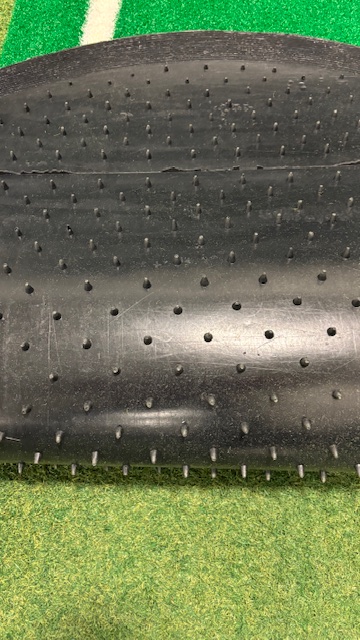
As pitching people know, the goal is to land into the front foot like an airplane rather than on top of it like a helicopter. That momentum is what can cause the mat to twist or slide forward.
With the Portolite mat, though, all those little spikes distribute the landing load throughout the mat so it stays in place easily. I have yet to have to make any adjustments, other than to change the distance for different age pitchers.
But once it’s down, it’s down until you pick it up and move it. So yes, total success for the goal I had.
And in case you were wondering, while it does leave a pattern of little indentations when you first pull it up to move it or put it away, those indentations go away quickly, leaving the base turf looking like it did before you laid the mat down. That’s important if you’re in a shared space like I am.
Heavy weight
Another reason I think it stays in place so well is that the mat itself is heavy – probably due to the molded rubber backing. It weighs 30 lbs., which is roughly 50% more than my other mats that clock in at 23 lbs.
That’s great for functional use, but it can be a challenge if you have to carry the mat for any distance. I’m a pretty big guy so I can handle it, but it’s definitely something to consider if you are on the smaller side or not particularly strong. It will give you a workout.

I wish it came with a little carrying pouch like other brands do, which I think would make it easier to transport. Then again, because of the construction the Portolite mat doesn’t roll up as tight without great effort so maybe it would be difficult to get one in an appropriate size.
Either way, right now I have to roll it up and grab it by either end to move it around the facility, It’s the one time when I miss the other mat.
The cost
Earlier on I mentioned that it’s not cheap. The current price on the Portolite website (as of January, 2026) is $999 USD.
When I first saw that I decided to roll the dice and see if there might be a Black Friday sale since it was getting close to the holidays. My gamble was rewarded, and I was able to purchase it for $799.. Add in the tax and shipping and it was $935 out the door – still expensive but every little bit helps.
Assuming it lasts for several years (as it appears it will), it’s not so bad. For example, at 5 years of use that $935 works out to $187 per year. Add in the savings on chiropractors for not having to constantly bend over to reset the mat and it’s a pretty good bargain.
More options
Portolite has some other mat options in addition to the one I purchased, including a shorter throw-down mat for $299 and their Pro Spiked Game Mat for $1,899. The short mat would be great, I suppose, if you don’t need the full length for your pitcher to land on (or you don’t want to carry a 40 lb. mat around).
The game mat is similar to the practice mat but I believe the turf is even heavier duty, it includes 1,700 spikes (versus 1,200 for the practice mat), and it weighs 60 lbs. Clearly it is made to hold up to heavy use and abuse, even on outdoor surfaces.
I know of at least one program that is planning to purchase a couple to use on dirt to try to eliminate the dreaded “pitcher’s trough” that happens after multiple games in a day.
The bottom line
When I was first looking at this mat I was concerned because it was a lot of money to pay for something that I wasn’t 100% sure would solve the issue. But I am happy to report that it did solve the sliding/turning problem, and my pitchers like using it.
So if you’re having similar issues, know that you can purchase this pitching mat with confidence. Time will tell how well it holds up (maybe I’ll share a report on that sometime in the future) but I can definitely recommend it as a solution for the immediate need.
The Effect Changing Bodies Can Have on Athletic Performance

No, this isn’t a “Freaky Friday” type of post, although I suppose that type of body changing could be an interesting topic. This is about physical changes with a player’s body.
Back around the fifth grade, most of us learned in health class that as we pass from childhood to adolescence, the hormones in our bodies start to go crazy and major changes begin to manifest themselves. One of the most visible and significant is rapid growth.
A girl who was once a cute little butterball suddenly shoots up 4, 5, 6 inches and becomes a lanky young woman. Another goes from a scrawny flyweight to a muscular middleweight.

Or maybe one day you look and realize the girl who used to have to look up at you now has a significant height advantage over you. (I was going to say looks down on you but, while that is also part of the deal, it’s a separate conversation for another day.)
Sometimes it happens gradually, but more often it seems like it happens overnight. And when those rapid changes do occur, they can have a significant impact on things like balance, proprioception, and coordination – all essential requirements for athletic performance, especially in a precision sport such as fastpitch softball.
Take hitting for example. We all know (or should know, at least) that a big contributor to good hitting is timing. You need to get your foot down on time and your body parts moving in a proper sequence in order to take a round bat to a round ball and hit it square while it’s traveling toward you at a rapid speed and moving (intentionally or unintentionally) in two planes simultaneously.
Sounds complicated doesn’t it? Well, it is.

Now imagine trying to do all that while standing on 4 inch high stilts while having the bat strapped to 3 inch long boards at the end of your wrists. It would be pretty awkward, don’t you think?
Yet that’s what kids who experience rapid growth spurts are going through every time they swing the bat. They used to know where their entire body was in space, including their limbs (which are the most difficult to manage), but surprise! those body parts suddenly aren’t where they used to be anymore.
The result is that hitter has to figure out how to manage this new, sometimes oddly proportioned body in order to achieve the level of performance she was achieving before. And worse yet, those body parts may still be growing, which means she’s trying to adjust to a moving target with runners on base and the game on the line.
And you wonder why she’s struggling some.
The same is true for pitchers and fielders. Things aren’t where they used to be anymore, and until they figure it out performing smoothly and confidently may be off the table for a while.
Another complicating factor is some of this growth may come with what we call “growing pains.” That’s not just a euphemism for the socially awkward teenage years.
It’s a real phenomenon causing physical pain every time they move. One place it shows up a lot is in the legs, or more specifically the knees, with a little gift from nature called Osgood-Schlatter Disease (OSD).
OSD causes pain just below the knee due to an irritation where the tendon from the kneecap attaches to the tibia, one of the bones in the shin. It can cause pain during activities such as running and jumping – or squatting.
Many a young catcher has had to find a new position thanks to a visit from the OSD fairly. And while it will eventually go away as the body settles in to its new configuration, it can take a while. In the meantime many movements that used to be pain-free now come with a cost.
Another thing that can happen during this time of development is what might be characterized as a “thickening” of the body. While your adolescent girl may not gain a great deal more height, especially if she’s not genetically disposed to being tall (thanks mom and dad), her body change from being a little twig to being more, um, stout.
While that will help her in certain ways – thicker muscles will add strength that can make up for a lack of overall size – she’ll still have to learn how to manage that newfound strength so she doesn’t fall into a habit of “muscling up” where she should be remaining loose and flexible. If that thickening happens rapidly it could throw her off considerably until she gets used to her new body.
Then, of course, there’s the elephant in the room for many young women – the development of breasts. That alone can have a serious effect on her movement patterns overall, how her back feels, her posture, her core strength, her flexibility in certain positions and more. And, of course, the larger they are the greater impact they will have on her physically.
All of which explains why your daughter’s or your players’ performance may suddenly go in the toilet for a little while. It’s not that she’s forgotten how to run, or hit, or pitch, or throw overhand, or field a ball.
It’s that what used to work for her body no longer works with the proportions she now has. And until she figures it out her performance may suffer for a little while.
So what can you do as a parent or coach? First of all, understand that his is going on and be a little more forgiving of any performance downgrades.
It’s not that she’s not trying, or is screwing up on purpose. It’s that she honestly doesn’t know how to overcome the situation right now.
Second, you can help her understand what’s happening to her as well. Explain that this is a normal, natural part of growing up, and encourage her to keep working hard. The coordination or balance that has temporarily abandoned her will come back once she gets used to playing as who she is now.
Once you have those parts understood, find devices or exercises or routines that can address the issues she’s having and help her get back on track faster. For example, if she is having trouble with balance get a balance cushion or pad and have her stand on one foot, first with her eyes open and then with her eyes closed, so she can feel her body in space. (The link will take you to a Google search results page.)
Seek out other exercises from professionals as well that can help her. Or you can hire a professional trainer to work with her while she’s having these issues.
If she’s having problems with feeling her body in space, especially her limbs, look into proprioception exercises. A new device from PantherTec called the Kinesthetic Awareness Training (KAT) module can also provide helpful feedback to bring the brain and body back into alignment. (Watch this space for a future product review.)
If she’s complaining about pain, especially in or around her knees, don’t just dismiss it as being soft. Get to your pediatrician have her checked out for OSD or other physical issues. Playing sports can take a toll on the body, and not all problems are the result of a specific injury.
Sometimes it’s cumulative wear and tear, and sometimes it’s something more serious. No matter what, get it checked out and addressed before the body’s instinct to avoid pain starts creating patterns in her movements that are less than ideal.
Finally, don’t assume this is just a preteen/early teen problem. The effects of puberty can last into young adulthood, and many of them can go up and down at different times.
Before you hit the panic button, try to recognize what’s happening physically with your daughter’s or your players’ body and help her address those changes. Because the sooner she is able to deal with how her body feels now, the sooner she’ll get back to performing the way you and she want.