Blog Archives
The Risks and Rewards of Playing on the Edge

We all love watching those SportsCenter highlights where outfielders dive for balls in front of them or go flying over the fence to rob a hitter of a home run. Or the ones where a pitcher strikes out a hitter with the bases loaded, a hitter comes through with a clutch hit on a pitch that should be out of her reach, an infielder tosses the ball straight from her glove to get a baserunner out by inches, and so on.
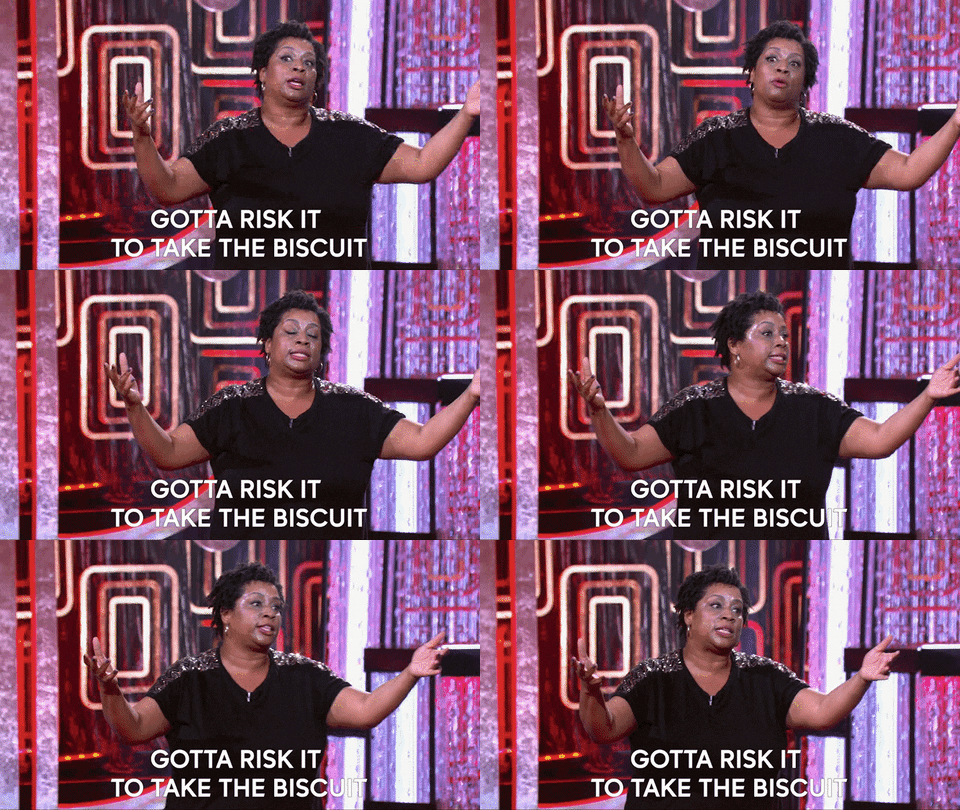
The reason they’re so exciting is that they are unusual because every one of those players is playing to the edge of their abilities. They’re leaving nothing on the field, as the old cliche goes, risking it all to get the biscuit, holding nothing back.
While it’s fun to see when it works, there is also a dark underbelly to these spectacular plays. Take the outfielder who dives head first for a sinking line drive.
If she gets it, great! She’s on SportsCenter. If she misses, however, the ball could squirt behind her and go all the way to the fence, scoring a run or three in the process.
That’s why so many youth and even college players are reluctant to get out there and play to the edge of their abilities. They simply don’t want to deal with the aftermath if something goes wrong – basically getting yelled at by a coach or parent for making a mistake that cost a game.
As they adopt that mentality, they start to play it more and more safe. They’ll pull up on that sinking line drive and let it drop in for a hit that could have been an out.
They will let a close strike go by rather than taking a chance on swinging at a “bad pitch.” They won’t throw a changeup when the situation demands it because they’re afraid it won’t work and they’ll look bad.
As a result, teams lose opportunities to win close games because their players have become conditioned to play it safe.
It’s understandable. No one likes to look bad if they mess up.

But if that’s how they’re thinking, how are they ever going to find out how good they can become?
If coaches really want to see their players develop to their full potential it’s important to create an environment where players feel comfortable and support taking chances that place them at the edge of their abilities.
Maybe it’s a catcher trying a quick pickoff on a runner on third. If she makes a good throw it’s an out that takes a potential scoring chance off the board, and maybe gets the team out of an inning. But if she misses, that run scores, and maybe another if there was a fast runner on second.
Create an atmosphere where that throw is never allowed because of the risk and you could stunt the development of a potentially great catcher. Give the catcher some leeway and you could end up with a stud behind the plate. Even if that particular play doesn’t work.
Just be sure your catcher also understands there’s a time to try it and a time not to. Risk and reward.
Or perhaps you have a pitcher who is working on a new pitch. She can practice it all she wants, but sooner or later she has to throw it in a game for it to have any value.
At first, you’ll throw it in a safe situation, such as a 1-1 count with no one out. That way if she sails it to the backstop it’s not big deal.
Eventually, though, you may need her to throw it even if you’re not sure it will end up somewhere the catcher can reach it. Showing the confidence in her now could pay off today, or it could pay off down the road as she gets more comfortable throwing that pitch in tight situations. Risk and reward.
These opportunities crop up all over the field in all aspects of the game. If you never let your players face the risks of a mistake they will never develop the aggressiveness to take the kind of chances that lead to big rewards.
Yes, it can be tough to see an individual game lost because someone took a risk. But if that loss helps you develop a player who can consistently play to the edge of her abilities without fear, you’ll most likely find that the rewards greatly outnumber the risks.
One last thought in this area. You also have to make sure that when players are given this leeway they are able to understand when the risks outweigh the rewards. Taking chances just for the sake of taking chances or looking cool or building your own personal stats isn’t good either.
Arm them with that ability to make decisions quickly, however, and you’ll have the best of both worlds.
Playing it safe is one way to go. But if you truly believe your mission is to develop your players (versus that just being a statement that looks good on a recruiting post) give your players the permission and support to play at the edge of their abilities.
And maybe one day you’ll see one of them on SportsCenter.
Advice From the Batman: Play to Win

Last weekend my two sons Adam and Eric came over to the house for a big event: to watch “Zach Snyder’s Justice League.”
First off let me say that while the movie is more than four hours long it was time well-spent. Not only because I got to spend that kind of time with two of my favorite people in the world but also because the movie is everything the fans who pushed for it to be released hoped it would be.
If you like epic comic book movies where the characters have real motivations, and lots of action, and you have access to HBO Max (or know someone who does) be sure to check it out. You won’t be disappointed. Here’s a little taste:
Ok, on to softball.
After battling the villain Steppenwolf (and losing), the heroes (sans Superman) are all in the Batcave talking about what their next move is. One of them (can’t remember who, did I say it was a four hour long movie?) makes a suggestion for a strategy. Then the Batman says something profound – something to the effect of:
“That’s just playing not to lose. All that does is delay how long it takes you to lose. We need to play to win.”
What a great concept. Playing not to lose just delays how long it takes you to lose.
Think about that in a softball context, especially now that nearly every travel softball game has a time limit. How many times have you seen coaches call time out for an unnecessary mound conference, or had their hitters go to the plate and slowly tie their shoes, or do some other stall tactic to try to get the “drop dead” alert to go off before they have to do anything?
Plenty, I’m sure.
They may think they’re playing to win, but really they’re playing not to lose. The message they’re sending to their team is either “I don’t think we can beat this team straight up but we’re ahead right now so let’s take it” or “I’m afraid you guys will do something to screw up this victory so I’m not going to give you the chance.”
And yes, the result might be that they win that game. But all it really did was delay how long it will take them to get knocked out.
Winners play to win.
Let’s look at another situation – the coach who doesn’t want her team taking any chances. Don’t throw down to first to try to pick off the runner because you might throw the ball into right field. Don’t try to hit the ball hard with two strikes, just make contact. Don’t throw a drop ball with two strikes because the catcher might miss it.
Those are all things great players do. But this coach isn’t looking for great. She’s looking to not lose because of a mistake.
Now, there are definitely times to be conservative in your approach. But not all the time. That’s playing not to lose instead of playing to win.
The problem with playing not to lose is you put your fate into someone else’s hands. Yes, you’ve minimized your mistakes, but you’ve also minimized your ability to rise above your current level of play to become something greater.
And if every player on the team is afraid to make a mistake, maybe because the coach will scream at her or yank her out of the game in the middle of an inning, the team will never come close to fulfilling its potential. Instead, it will just be trying to hold on for as long as it can until a team that wants it more comes and takes it away from them.
It’s like they say in the grossly underrated comedy “Fired Up!” – you’ve gotta risk it to get the biscuit.
Sure, it’s riskier to play to win than to play not to lose. But what’s the point of playing if you’re not playing to win?
Coaches, teach your players to be confident in their abilities even when it might be easier to just lay back and tie their shoes for five minutes. It’s better for them, and in the long run it will be better for you as well.
Photo by Picography on Pexels.com
My Favorite Time of the Year

We are now in the process of entering my favorite time of the year. Not because the leaves are turning, pumpkin spice-everything is available and hoodies and sweaters can once again hide the fact that I didn’t achieve any of my summer weight loss goals.
Instead it’s because this is the time of year when fastpitch softball players are free to focus on making the major structural changes that will set them up for future success.
During most of the year, at least with the current obsession with playing more games more of the time, you have to be careful about making fundamental changes – at least with players who are already experiencing success. If you try to change the way a pitcher pitches, or a hitter hits, or a fielder throws, etc. there is always the risk that you might make the player worse before you make her better.
That is true even if the change is for the player’s long-term good. Let’s take a pitcher, for example.
She is doing well, racking up a K an inning and doing a good job of getting hitters out. She doesn’t give up many runs or walks, and overall is considered successful.
At the same time, however, you notice that her drive mechanics are weak. If she had a better push-off she’d be more stable when she lands, with better posture, giving her better control while enabling her to throw harder. All good things.
But you also realize that if you spend your time working on drive mechanics, two things will happen. First is she will probably lose a little speed and accuracy because now she has to think about pitching rather than just doing it, and there’s a good chance it will throw off the timing of the rest of her pitch because she’s not used to it. In other words, you will likely make her worse before you make her better.
Second is while you’re working on drive mechanics you’re not looking at the pitches (change-up, drop, rise, etc.) that enable her to mix things up and keep hitters off-balance. If anything is a little off on those pitches you won’t have the opportunity to tweak them and get them back on track – which means she could have some unusual trouble on game day.
That’s why I love this time of the year. With no pressure to perform tomorrow, or this weekend, you have the opportunity to flip the risk/reward ratio.
In-season, with a player who is already performing well, the risk of taking her off-track is significant while the reward is off in the distance since the types of changes I am talking about don’t happen overnight for the most part.
At this time of the year, however, the risk is pretty much non-existent while the potential for a long-term reward is huge.
Of course, the exception to all of the above is the player who is not performing too well to begin with. If you have a hitter who is leading the team in striking out, and whose “best” contacts don’t get out of the infield, there is really no risk in making big changes.
She really can’t get any worse. But if you can turn that around and help her start making more consistent, hard contact and getting on base, the reward is huge – and often paid in smiles and confidence that will serve her well in the future.
For everyone else, however, making changes in-season (and make no mistake, fall ball is now considered by most as a legitimate season instead of an add-on to the summer) must be done thoughtfully. In our instant gratification world, taking a player who is performing well and degrading that performance temporarily, even if it’s for her long-term good, will be a tough sell for everyone.
Which brings us back to now. The next few weeks are an opportune time to get started on the types of major changes that will pay off HUGE next spring.
So grab a pumpkin spice latte, take a few pictures of the fall colors, and get to work. Your future self will be happy you put in the effort now.
Fall leaves Photo by Pixabay on Pexels.com






 Life in the Fastpitch Lane