Blog Archives
It’s a Short Walk from the Bench to the Stands

Today’s post is primarily aimed at softball players and their parents, although coaches could also learn a thing or two. Especially those who wonder why they keep having trouble filling their rosters.
The basic premise is that whether you’re talking travel ball or even college ball, when you pick a team to play on it’s important to choose one where you might actually play. (High school ball is a separate animal because in most cases where you play is determined by where you live.)
Sounds obvious, doesn’t it? Yet when you look around even casually you’ll see it’s not as obvious as it might seem.

All too often parents will choose teams for their players, or players will make their college decisions, based on the perceived prestige of being there rather than considerations such as “Can I/my daughter actually get on the field?”
Yes, you can enjoy bragging rights for a while. You can get heads to turn when you wear the jersey or other spirit wear and walk into a room of softball people.
But ultimately the shine will wear off (see what I did there?) if you’re not actually on the field playing the game.
Ok, you say, but my goal is to get recruited to a P4 school, and to do that you have to be seen by those coaches. So I need to be on a team that’s playing at (and preferably winning) the tournaments those coaches are watching.
Sure, that’s true. But if you’re not on the field, all the coaches are learning about you is that you’re apparently not good enough to play, particularly when it matters. Do you think that helps or hurts your recruiting chances?
Not playing on Sundays not only means the P4 coaches don’t get a chance to see what you can do. It also means a whole lot of other coaches on other college teams that might have a wonderful opportunity available for you to play and to shine aren’t getting that look either.
No matter what level you’re talking, no college coach wants to take a player sight unseen because their jobs are on the line with every selection they make. They’re not going to make an offer simply because you were on a “name” team, no matter how big the name. If you’re not playing they’re going to figure there must be a reason for it and move on.
At which point you take that short walk from the bench to the next logical step – sitting in the stands while others play the game.
The same is true for playing in college – maybe even moreso. College athletics is about winning, because winning attracts money.

You may dream of playing at the University of Wherever, but if you don’t have a realistic chance of getting on the field, or at least playing an important role, you’re probably not going to be happy with that decision for very long. You need to at least be able to compete for a position.
If you’re simply outclassed by the other players at your position it’s likely your passion for the sport will fade and you’ll be taking that short walk before long.
So what can you do to avoid ending up in the stands before you’re ready for that to happen? There are a couple of things.
To begin with, choose your team wisely and realistically. Take off the rose-colored glasses and do you best to objectively determine whether you can compete for a spot on the field. That includes not only skill level but how set the coach seems to be on his/her lineup. If the same nine are always playing when it counts, regardless of whether they’re performing well or not, you might be better off somewhere else.
If you’re already on a team and you’re not playing, you have two options: get better or get moving.
The first thing you need to do is to look inward and ask if you’re giving everything you have every minute you’re there.
That starts with practice. Are you hustling and working your butt off at practice all the time, or do you take reps off or sleepwalk through certain drills/activities? Are you vocal and enthusiastic, even when you don’t feel like it, or do you it and sulk if you’re not playing regularly?
Coaches notice who wants to be there and who doesn’t, who works hard and who doesn’t. Your effort and enthusiasm are totally within your control, so make sure yours is saying you really want to be there contributing.
You can also keep working to improve your skills. Ask what you need to do to earn more playing time, then work on whatever you’re told until it meets the standard that’s required.
And if you do get that opportunity, be sure you make the most of it to show why you should get more. Otherwise you’re simply reinforcing the coach’s previous decision to keep you on the bench.
The other situation you might face is the realization that for whatever reason this is not the right team for you. At that point, it’s time to start looking at where you might be a better fit.
It could be that your skill level doesn’t match the other players – and never will. It could be that the coach simply doesn’t like you for whatever reason (it happens). It could be any number of things.
If it’s something you can’t change no matter how hard you work, though, there’s no sense staying where you are. Find a place where the team actually needs what you have to offer and then take advantage of that opportunity.
You’ll be happier, and your old team will have the opportunity to replace your roster spot with someone they feel is a better fit for them as well. Everybody wins.
Even great players can find themselves on a team where the path to the stands is shorter than the path to the field. If you’re in that position, don’t sit around waiting for things to get better.
There’s a place in this sport for everyone. Find yours and you’ll be a lot more satisfied with the outcomes.
Bleachers photo by Julion Santos on Pexels.com
A Couple of Common Recruiting Myths Busted

As I write this we are heading into one of the most important periods for softball players looking to get recruited to play in college – especially at a Power 4 or other Division i school. Because we are right in front of the major tournaments in Colorado, as well as a few other events across the U.S.
Players (and their parents) at various age levels are eagerly anticipating their opportunities to get on one of the big stages, show what they can, and hopefully get discovered by one of the myriad of college coaches who are scouting at these tournaments. It’s the softball equivalent of the story about actress Lana Turner getting discovered at the Top Hat Cafe soda fountain and going on to a fame and fortune as a leading lady in numerous Hollywood movies.

I hate to be the one to burst anyone’s bubble, but the odds of being “discovered” at a tournament, even a big one, are about the same as the odds of being discovered sitting in a restaurant in Hollywood – basically one in a million. I’m not saying it can’t happen (more on that in a bit), but it’s extremely unlikely to happen. Here’s why.
First, all of these major tournament have multiple sites, and which site you play on plays a large part in determining which college coaches (if any) will be at your site. You may be at the Biggest, Baddest tournament in Colorado, for example, but the field you’re on could be 20 or 30 miles away from the epicenter of the tournament.
As a result, you’re not going to see Patty Gasso, or Mike White, or Gerry Glasco, or Karen Weekly, or others of their stature. Or their assistants.
There may be a handful of coaches at your site, but they’re more likely to be from smaller schools. This, incidentally, is the reason so many local teams are abandoning their local organizations and becoming franchisees of bigger-name programs.
They’re hoping that more well-known name will get them on the better fields at the bigger tournaments. Although you do have to wonder if we’ve already reached the saturation point on that play, particularly with organizations that aren’t too choosey about who they award a franchise to.
The more important reason the idea of being “discovered” is pretty much a pipe dream, though, has to do with the way college coaches recruit. They don’t go to tournaments to see who’s playing and try to find kids they don’t know about.
Ask any college coach and they will tell you they are going to those tournaments to look at specific players in whom they’re already interested. They have had contact with them before, maybe seen some videos of them, or seen them play at another tournament, or know them from their camps.
They have a list of who is playing where and when, and they have mapped out in advance where they plan to be each day (and probably each hour of each day) of the tournament.

There are a couple of reasons for this. One is the rules around recruitment.
College coaches are allotted X number of days they can spend on recruiting activities, and that X is a small number. For example, in the summer recruiting for Division 1 is only allowed between June 1 and July 31. (Other divisions and organizations have their own rules.)
As a result D I coaches can’t waste time wandering from field to field, or complex to complex, hoping against hope they can find some undiscovered talent. They need to check out the players they’re already interested in to see not just how they play but learn about how they handle adversity, what type of teammate they are, how they respond to their coaches and parents, and other “character” information.
Now, if you happen to be playing on the same field as one of those players they’re looking at and you happen to have the opportunity to do something spectacular (such as hit two home runs or pitch a no-hitter) you might earn a look from one of those coaches, or at least get on his/her radar. But again, that’s leaving a lot to chance.
The other reason is those coaches are just not very likely to take a chance on a complete unknown even if you DID look great in the one game where they saw you. They’re likely to figure if they haven’t heard of you until now there’s a reason for it.
There are way fewer slots, especially at the big schools, than there are people who want to fill them. If you haven’t been tagging those coaches on X, texting them, emailing them, calling them, attending their camps, and doing whatever else you can to let them know you’re interested they’re probably going to think you’re not very serious about going there.
Getting recruited is a numbers game and a persistence game. You have to be in it for the long haul and doing all you can to stand out from the crowd. Starting that effort your freshman year is not too early.
Sure, some of the showcases and ranking organizations can help you gain some attention, particularly if you are toward the top of your class. But you still have to be making that individual effort on a regular basis if you want them to know who you are well enough for them to say “Yes, I will make an effort to check you out at the such-and-such tournament.”
So here is what I can tell you: If you haven’t been in touch with any college coaches as outlined above, if no one has said “Send me your schedule” or if you haven’t sent your schedule anyway, there’s no real reason for you to get too uptight about the upcoming tournaments. The coaches you want to impress probably won’t even be looking at you, so enjoy the trip and the opportunity to compete against high-level competition.
Then, when you get home, start your campaign right away so when you find yourself in Colorado or another, similar location next year you can maybe get some of those coaches to spend a few of their valuable minutes watching you. And don’t forget to start upping your skills (including your interpersonal skills and mental game) so they like what they see if/when they do come out to see you.
Again, I’m sure there’s a player every now and then who legitimately gets “discovered” at one of these big tournaments, but that’s not the way to bet. Understanding how recruiting works in the real world, and then following those steps, will do far more to help you achieve your dream.
My good friend Jay Bolden and I have started a new podcast called “From the Coach’s Mouth” where we interview coaches from all areas and levels of fastpitch softball as well as others who may not be fastpitch people but have lots of interesting ideas to contribute.
You can find it here on Spotify, as well as on Apple Podcasts, Pandora, Stitcher, iHeart Radio, or wherever you get your podcasts. If you’re searching, be sure to put the name in quotes, i.e., “From the Coach’s Mouth” so it goes directly to it.
Give it a listen and let us know what you think. And be sure to hit the Like button and subscribe to Life in the Fastpitch Lane for more content like this.
Webinar: What to Do When a College Coach Calls

A few years ago, the college recruiting rules changed to restrict NCAA Division 1 coaches from speaking to potential student athletes until September 1 of their junior year. That was a huge improvement over the Wild, Wild West of recruiting that had seen verbal offers going to eighth grade (or even younger) players on a widespread basis.
Well, September 1 is rapidly approaching, which means there are a whole lot of rising juniors sitting on pins and needles waiting to see if they’re going to get a call or email from the coaches of their first-choice schools. If you are one of those, how prepared are you to take that call or respond to that email? After all, what happens next could determine whether that offer finally comes.
If you’d like to make sure you have your bases covered, Rick Pauly of PaulyGirl Fastpitch has put together a tremendous webinar that explains the process and talks about what you should say as well as how you should say it should you get the opportunity.
It’s about a half hour long, chock full of information that will help prospective student athletes and their parents prepare to make the most of any opportunities that come their way. It’s definitely worth taking a half hour out of your day to see what Rick, a former college coach himself and someone who has helped many players through the process, has to say.
Give it a listen sooner rather than later, and practice the recommendations he makes – just like you would any other skill. Good luck, and hopefully you’ll receive the call of your dreams come September 1.
5 Reasons Lefties Should Be Trying to Hit to Right

The other day I was working with a left-handed hitter and noticed two things.
The first was that her sister, who went out to shag balls after her own lesson, set herself up in left field. The second was that the sister was correct – everything was going out that way.
I told the girl who was hitting that she was late, needed to get her front foot down earlier to be on time, especially on inside pitches, and all the usual advice for someone who is behind the ball. But then it occurred to me – she might have been going that way on purpose.
So I did the most sensible thing I could – I asked her about it. “Did someone tell you to hit to left all the time?” I asked.
“Yes,” she replied. “My old team coach.”
This is the second time I’ve heard that from a lefty. The first actually got that advice from a supposed hitting coach.
Forcing lefties to try to hit to left on every pitch makes no sense to me. Sure, if the pitch is outside you should go with it. That’s hitting 101.
But on a middle-in pitch? No way! Here are five reasons why that’s just plain old bad advice.
Giving Up Power
This is the most obvious reason. The power alley for any hitter is to their pull side.
You get the most body and bat velocity on an inside pitch when you pull it. Laying back on an inside pitch to try to hit it to left is taking the bat out of the hitter’s hands, which you don’t want to do – especially in today’s power-driven game.

Encouraging the hitter to barrel up on the ball and hit to her pull side will result in bigger, better, more productive contacts. And a much higher slugging (SLG) and on base plus slugging (OPS) percentage, leading to more runs scored and opportunities taken advantage of.
Creating a Longer Throw from the Corner
If a left-handed hitter pulls the ball deep down the first base line and has any speed at all there’s a pretty good chance she will end up with a triple. It’s a long throw from that corner to third base, and will likely actually involve two long throws – one from the corner to the second base relay, and another from the relay to third.
A hit to the left field corner, however, will more likely result in a double. It’s a much shorter throw and one that doesn’t (or at least shouldn’t except for the younger levels) involve a relay. One less throw means one less chance for something to go wrong for the defense.
I don’t know about you, but I’d much rather have my runner on third than on second. As this chart from 6-4-3 Charts shows, your odds of scoring go up considerably regardless of the number of outs when your baserunner is on third:

You probably didn’t need a chart to show you that – it’s pretty easy to figure out on your own – but it always helps to have evidence.
Hitting Behind the Runner
Coaches spend a lot of time talking screaming at their right-handed hitters about the need to learn how to hit behind the runner at first. Then why shouldn’t lefties be encouraged to do it as well?
It ought to come natural to a lefty. Now, part of the reason for hitting behind the runner is to take advantage of a second baseman covering second on a steal, which is less common in softball and probably doesn’t happen with a lefty at the plate.
But what about advancing a speedy runner from first to third? Again, longer throw from right.
A well-hit ball to right, even one that doesn’t find a gap, gives that speedy runner a chance to get from first to third with one hit. A well-hit ball to left that doesn’t find a gap will probably still require the runner to hold up at second because the ball is in front of her.
So if you’re teaching your lefties to go to left all the time you’re leaving more potential scoring opportunities on the table. In a tight game, the ability to go to right instead of left could mean the difference between a W and an L.
Taking Advantage of a (Potentially) Weaker Fielder
This isn’t always the case. There are plenty of great right fielders, especially on higher-level teams.
But for many teams, right field is where they try to hide the player who may have a great bat but a so-so ability to track a fly ball or field a ground ball cleanly.

Why hit to the defense’s strength when you can hit to its weakness instead? At worst, if right field is a great fielder you’re probably at a break-even point.
If she’s not, however, you can take advantage of the softball maxim that the ball will always find the fielder a team is trying to hide.
Reducing Their Chances of Being Recruited
Most of today’s college coaches want/expect their hitters to be able to hit for power. Not just in the traditional cleanup or 3-4-5 spots but all the way through the lineup.
A lefty who only hits to left looks like a weak hitter. (And is, in fact, a weak hitter.)
Unless that lefty is also a can’t-miss shortstop, college coaches are going to tend to pass on position players who don’t look like they can get around on a pitch. That’s just reality.
Teach your lefties to pull the ball when it’s appropriate and they stand a much better chance of grabbing a college coach’s attention. And keeping it until signing day.
Don’t. Just Don’t
Teaching lefties to hit to left as their default is bad for them and bad for the team. It also doesn’t make much logical sense.
Encourage them to pull the ball to right when it’s pitched middle-in and you -and they – will have much greater success.
7 Tips to Make 2022 Your Best (Softball) Year Ever

First of all, let me tell you I had quite a debate with myself on whether to write a New Year’s post or just go with a more general topic. But when the stars align – as in the last day of 2021 is also the day I usually put up a new post – it’s a good idea to just go with it.
So here we are. Hopefully 2021 was a great year for you.
We actually had somewhat normal high school, college, and youth softball seasons, although COVID-19 protocols often impacted the spectator part of spectators sports. At least the fans who got in didn’t have to wear a mask on 90-degree days.
Also in 2021, fastpitch softball temporarily returned to the Olympics, albeit in eerily quiet and empty stadiums and played on baseball diamonds. It was sort of like watching a dome game with a field set up for football. The fact that the oddly formatted mini-tournament was finished before the opening ceremonies took place tells you all you need to know about what the International Olympic Committee (IOC) really thinks about our sport.
The Women’s College World Series (WCWS) on the other hand was a TV rating juggernaut, averaging more than 1.2 million viewers per game. That’s 10% more than the 2019 WCWS.
The three-game championship series between Oklahoma and Florida State fared even better, drawing an average of nearly 2 million viewers per game. In the process, we got to see a lot of great softball.
Speaking of great softball, Athletes Unlimited entertained a lot of fastpitch softball fanatics with its playground-brand of choosing up teams and having no coaches on the sidelines. Maybe they’re on to something.
And hopefully you personally had a successful 2021 as well.
Of course, as the disclaimer on every “get-rich-quick” scheme quickly says, past performance does not guarantee future gains. So following are a few tips to help you make 2022 an even better year.
Tip #1: Practice with a purpose
Yes, I know many of you have t-shirts with that very saying on them. But how often do you actually take that approach?
It’s easy to get into the rut of “putting in time.” i.e., going off somewhere and going through the motions of a skill for a half hour or an hour or whatever, or coaches having players performing activities for two, or three, or four hours. None of which will actually help you get better, and could make you worse if the practice is sloppy enough.
If you’re going to practice, then have a goal and go after it wholeheartedly. For example, if you’re a pitcher working on leg drive, then work on getting yourself out faster each time rather than mindlessly doing the leg drive drill you were assigned.
Master the skill, not the drill, and you’ll be a lot better off.
Tip #2: Grow your knowledge
In today’s Internet-accessible world there’s no reason to do things a certain way because that’s how you’ve always done them. There is an incredible amount of research being done in our sport and an incredible wealth of knowledge being shared – if you will open your mind to it.
The National Fastpitch Coaches Association (NFCA) is one of the best. Right now they are in the midst of hosting a series of live coaches clinics around the country that enable top-level coaches to share their expertise with the rest of us.
If you want to go more in-depth on a topic, the NFCA also has its Master Coach program, which offers a combination of live and online courses. I took their very first online Coaches College course earlier in 2021 and it was well worth the time and money. Give it a shot.
There are plenty of private resources as well. PaulyGirl Fastpitch has its High Performance Pitching courses at the beginner, intermediate, elite, and pro levels.
You can learn all about great throwing mechanics from the High Level Throwing program. There’s a cornucopia of hitting courses out there as well.
Then there are resources such as the Discuss Fastpitch board and the Fastpitch Zone and The Bullpen Facebook groups that connect coaches from around the world with one another to share their knowledge and experience. And that’s the just the start.
If you want more knowledge it’s out there. Just be sure to come in with an open mind because some of what you hear may go against everything you’ve ever believed. And that can be a good thing.
Tip #3: Use video
This one doesn’t require a lot of explanation. There’s what we think we see or feel, and there’s what’s actually happening. They’re not always the same.
Virtually every mobile phone includes a high-definition, high-speed camera for free that would be the envy of coaches and players from just 10 years ago. Take advantage of it.
Video yourself or your players often, and see if what you think you’re doing is what you are in fact doing. Compare what you see to the best players in the world.
While you don’t have to match exactly, you should match in principle. If you’re not doing what you think you’re doing, adjust accordingly.
Tip #4: Work on your mental game
Ask any group of coaches or players “who thinks the mental game is a critical contributor to success?” and you’ll probably see every or nearly every one of them raise their hands. Then ask how many take the time during practice or during their free time to work on it and you’ll likely see few (if any) hands.
It’s sort of like Mark Twain’s famous admonition about the weather: everyone talks about it but no one does anything about it.
That is a mistake in my opinion. There are (again) plenty of books and other resources that focus on this aspect of sports. Here’s a list of a few:
- Head’s Up Baseball
- Mind Gym
- The Champion’s Mind
- Championship Team Building
- The Mindful Athlete
- Winning State
- Mental Conditioning for Softball
- The Energy Bus
Invest some real time in developing the mental game – especially the part about overcoming adversity – and you’ll be amazed at what you can do.
Tip #5: Make some time for recruiting activities
This is for those players who want to (or think they want to) play softball in college. If that’s not you, go ahead and skip to Tip #6.
For those still reading, playing softball in college at any level is an accomplishment – and ultra-competitive these days. You’re unlikely to be randomly discovered playing during a local tournament.
If you want to play in college, you need to make an effort to build a relationship with coaches at different schools, and at different levels.
One obvious way is to attend skills camps at schools where you might like to play. While some are just money grabs that have minimal involvement from the college coach, most are both an opportunity for coaches to give back to the game while checking out potential future talent. What better way is there to get them interested in you than to demonstrate your skills in their “house?”
Social media in general, and Twitter in particular, is another great way to establish and maintain contact with coaches. Follow coaches at schools you’re interested in and hopefully they will follow you back.
Share their Tweets with your followers. Send Tweets of your own about your/your team’s latest accomplishments and activities and tag the coach or the program. Be active and be visible.
Just one word of caution about social media: keep it positive at all times. The Internet is written in ink, and more than a few players have eliminated themselves from consideration by their dream schools because of things they’ve posted. That includes photos and negative comments about their parents or current coach.
Present yourself as if the coaches you want to play for are watching every post. Because they are.
Email is still a valid way to contact coaches too. Just keep it brief – they’re busy people and many get hundreds of emails a day. If you want to share a video, be sure the coach can see what you want him/her to see in ONE click. Any more than that and they’ll pass.
This isn’t just for high school players either. While the D1 rules changed and they can no longer contact players before September 1 of their junior years, it doesn’t mean they’re not paying attention to who can play and who is interested in their schools. And there are no such restrictions for D2, D3, and NAIA, although they tend to recruit later anyway.
Recruiting is a marathon, not a sprint, so get out there early and often if you think playing in college might be for you.
Tip #6: Make time for rest and recovery
When you’re dedicated to something it’s easy to overdo it. Don’t let that happen.
Rest and recovery is just as important to high performance as training. Your body needs time to build itself back up after intense activity. So does your mind.
It’s ok to take a day or two off each week during the season as well as during the offseason. Your body and your brain will tell you how much you need for peak performance. You should also plan on taking at least a couple of weeks off at some time during the year for deeper recovery.
Oh, and this applies to coaches too. You’ll find coaching is a lot more enjoyable if you let your batteries recharge now and then.
Tip #7: Resolve to have fun
This is probably the aspect that has been most lost over the course of the last 10-20 years. Yes, we have more technology that can tell us more things, and more practice facilities that enable us to keep working even when the weather is at its nastiest, and more opportunities than ever to take our game to a higher level.
But the tradeoff has been more pressure and more stress to the point where playing (and coaching for that matter) feels like a job. And not a particularly pleasant one.
It’s important to remember that softball is a game, and games are supposed to be fun.
That doesn’t mean it should be like a birthday party without the cake. But it shouldn’t be like studying for finals while waiting to see the dentist either.
Fun in most cases is what you make it. Some people enjoy really digging into things and pushing themselves to their limits. That’s right for them.
But it’s not right for everyone. Others will find their fun in getting a little better each day without killing themselves, competing (in a friendly way) with their teammates, or in being part of a team.
Understand what’s fun for you and then find/create a team with others who share your definition and goals. Like using the wrong pair of cleats, being on a team that isn’t a good fit can be painful.
Good luck to everyone, and I hope you make 2022 your best year ever!
Photo by Damir Mijailovic on Pexels.com
Honesty Is Still the Best Policy When Talking to Players

There is a joke I heard a long time ago that pretty much sums up the softball player recruitment and retention process. It goes like this:
This guy dies and meets St. Peter at the Pearly Gates. He’s excited about making it to Heaven, but St. Peter informs him that he is required to give the guy a choice about where he wants to spend eternity – Heaven or Hell. The guy is surprised, but figures rules are rules and goes along with it. St. Peter tells him he will get to check out each, then must make his decision.
He starts with a tour of Heaven. It’s everything he’d heard – angels sitting on clouds playing harps, everything white, everything calm and peaceful. It all seems pleasant enough and the guy is pretty sure what his decision will be.
Then he’s sent to Hell for a tour there. The Devil meets him at the Gate and welcomes him in warmly. As they walk inside the guy sees a huge party going on with plenty of alcohol, loud music and beautiful people dancing, singing and having the time of their lives.
“I’m shocked,” the guy says. “This isn’t what I pictured at all. I was expecting fire, brimstone and torture.”
“Fake news,” the Devil responds. “That’s just Heaven’s propaganda to try to keep humans from having a good time while they’re on Earth. It’s like this all the time.”
The guy joins in the party while he’s there, but pretty soon his time is up and he must go back to Heaven and give St. Peter his decision. “What do you think?” St. Peter asks him.
“Well, no one is more surprised than me but I am going to choose Hell,” the man says.
“Really?” St. Peter asks incredulously. “You realize this is for all eternity and there’s no going back?”
“Yes,” the man replies. “I appreciate all you’ve done but I’ve made my decision and that’s where I want to go.”
“Ok,” St. Peter tells him. “It’s your decision.” So St. Peter proceeds to do all the paperwork and send the guy off to his final destination. Once he walks inside, however, the man is shocked. All he can see in every direction is his worst nightmares – fire, brimstone, people being whipped and tortured in all sorts of horrible and creative ways.
“What is this?!” the guy screams. “Yesterday it was all parties and good times, and now it’s just horror after horror.”
At which point the Devil eyes him slyly and says, “Well, yesterday you were a prospect.”
The reason I recounted that joke is more and more I am hearing stories about players being promised the world by coaches during the tryout and/or recruiting process. But once they get there it’s a completely different stories.
Players are told they will pitch, but they never get time in the circle because they “don’t measure up” to the pitchers who were already there. They’re promised they will get plenty of time at an infield position, or catcher, or wherever but when game time comes – not just bracket play but even pool play or round robin friendlies – that playing time in that position never materializes. They’re told they don’t measure up to the girls in those positions (often coach’s kids, no surprise there) even though those girls are booting balls like they think they’re playing soccer, not fastpitch softball.
Hitters with high batting averages and OPS are being pushed down the lineup or sat on the bench entirely because they “aren’t used to seeing the level of competition” – even though they’ve already proven they can handle that level.
What becomes clear is that some coaches, hopefully a very small minority, are telling players and their families anything they want to hear in the courtship phase so they can round out their teams. They have no actual intention of providing those players with the opportunities they seek. They just want them there in case they need body to fill in should one of the “starters” get sick or go down with an injury.
Of course, they don’t want a weak link, so they want to get the best backups they can find. But they’re talking to those backups like they have a legitimate chance of taking over a starting position when that is never, ever going to happen – either because the coach doesn’t think the new player is as good as the current ones, or he/she is looking at his/her own kids through rose-colored parent glasses, or wants to be “loyal” to the current players, or has some other agenda.
It’s ok to view some players as starters and others as backups. It happens all the time at all levels. All I’m saying is then be honest with the player and her parents about the role she will play on the team.
Don’t tell her she will get pitching time when you have no intention of putting her in the circle. And don’t use one bad outing the first time out as an excuse to never pitch her again. She was probably nervous, having joined a new team and all and wanting badly to prove herself. That goes double if the team is a step or two up from her last team.
Instead, give her a few opportunities and then make your judgment. Anyone who works with analytics will tell you that you need a sufficient amount of data to spot a trend. One game, or a couple of innings, isn’t a sufficient amount of data.
The same goes with positions on the field. Don’t tell a player she will get an opportunity in the infield if you feel your infield is set and you don’t want to change it. Let her know where her opportunities are so she can make an informed decision about whether this is the team for her.
The same goes for getting on the field at all. If you see her as a backup or role player, be up-front about it. For example, if you want a speedy player to primarily be a courtesy or pinch runner, tell her that rather than saying she’ll get an opportunity at second base when you know that’s not true.
If you are honest about a player’s opportunities or role, the player and her parents will have no real cause to complain when what you said she would do is what she ends up doing. It’s only when coaches say anything so they can fill up their rosters that the trouble begins.
And it will begin. Because what you’ll likely find is that players who are promised a world of opportunities but instead get nothing of the kind will leave as soon as they figured out they’ve been had.
That, of course, is also the difference between the joke above and the reality of softball. In the joke, the decision of where to go was forever. In our sport, if your coach doesn’t want to play someone there’s always someone else who could use her particular set of skills.
So tough as it can be, coaches, be honest. In the long run it’s better for everyone. Including your own team. Because as big as the sport may seem, fastpitch softball is also a small, tight-knit community, especially at the local level, and people talk.
You build a reputation as someone who makes promises with no intention of delivering on them and it won’t be long before people are avoiding your team/program like the plague.
Yes, it can be tough to have those conversations, and there is a risk of pushing players away you might like to have. But it will save you a whole lot of drama and upheaval. And that alone may be worth it.
Product Review: Softball Bound app makes the college search easier

Unless you are one of those incredibly talented players who has famous softball coaches going out of their way to plan their weekends around watching your 12U/14U games, you’re probably going to have to devote a considerable amount of time researching potential opportunities and looking up the contact information for the coaches at schools you’re interested in.
Now a new app called Softball Bound, which is available for the iOS and Android platforms, has made that part of the process a whole lot easier. Rather than having to spend hours looking up each school individually, and then clicking through to gather information about it and the softball program, Softball Bound puts all that information right at your fingertips. In fact, according to the counters on its website, it provides info on 996 NCAA and 196 NAIA 4-year institutions.
Finding the right schools
The interface is simplicity itself. The default view takes you to an address book-like listing of colleges, starting with the As of course.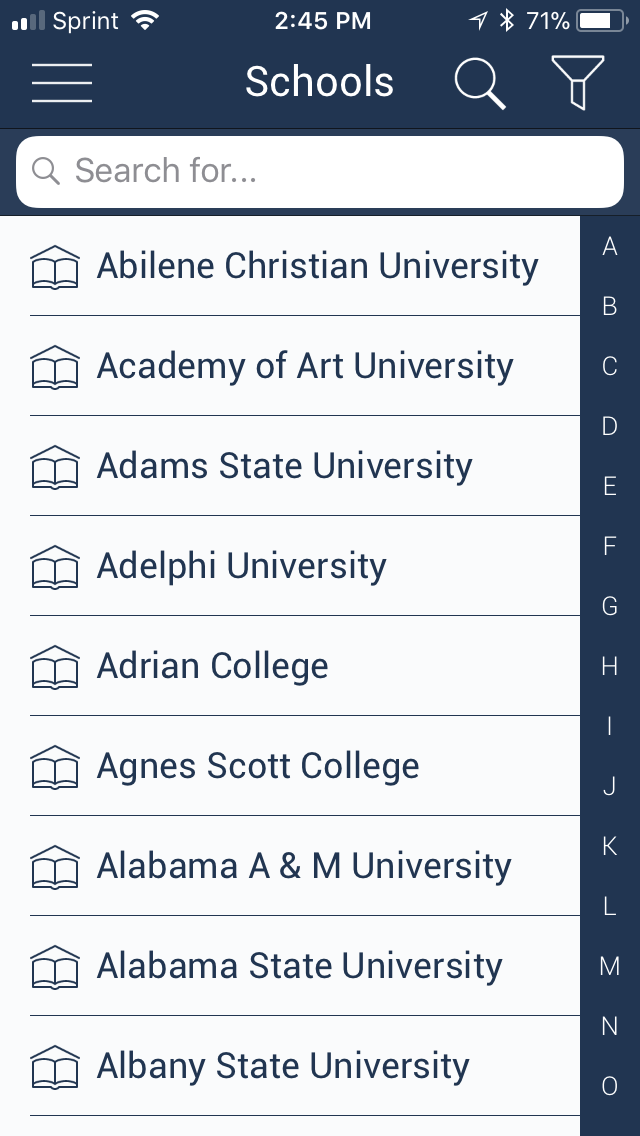
Down the right hand side is the entire alphabet, so you can click on a letter, based on the first letter in its name, and be taken right to all the schools that begin with that letter. So if you want to look up Baylor, you click on B and scroll down. For University of Whoever you click on U, which is probably more intuitive in the long run.
That’s not your only option, however. A little filter icon in the upper right hand corner lets you narrow down your choices by Division (NCAA 1,2, and 3, plus NAIA 1 and 2), Conference, State, or any combination of all three. If you have your heart set on  playing NCAA Division 1 in Tennessee, you can find all the schools that meet those criteria.
If you know exactly the school you want to look up, there’s also a search function. (You can only look up colleges, not coaches or conferences; use the filters for that.) The search function is intuitive, so as you type in your choice it starts showing suggestions.
Core information
Once you’re into a specific school there is a tremendous amount of information. The topic section offers the school’s name, address, and general website. The second section provides the name of the coach (usually the head coach, but sometimes an assistant who is involved in recruiting), along with the coach’s email address and phone number.
These are active links, so clicking on the email address or phone number will start an email or make a call, respectively. You will want to handle that with care. On the other hand, think of how impressed a college coach will be if 10 minutes after a game is over you send a messaging thanking him/her for stopping by to see you.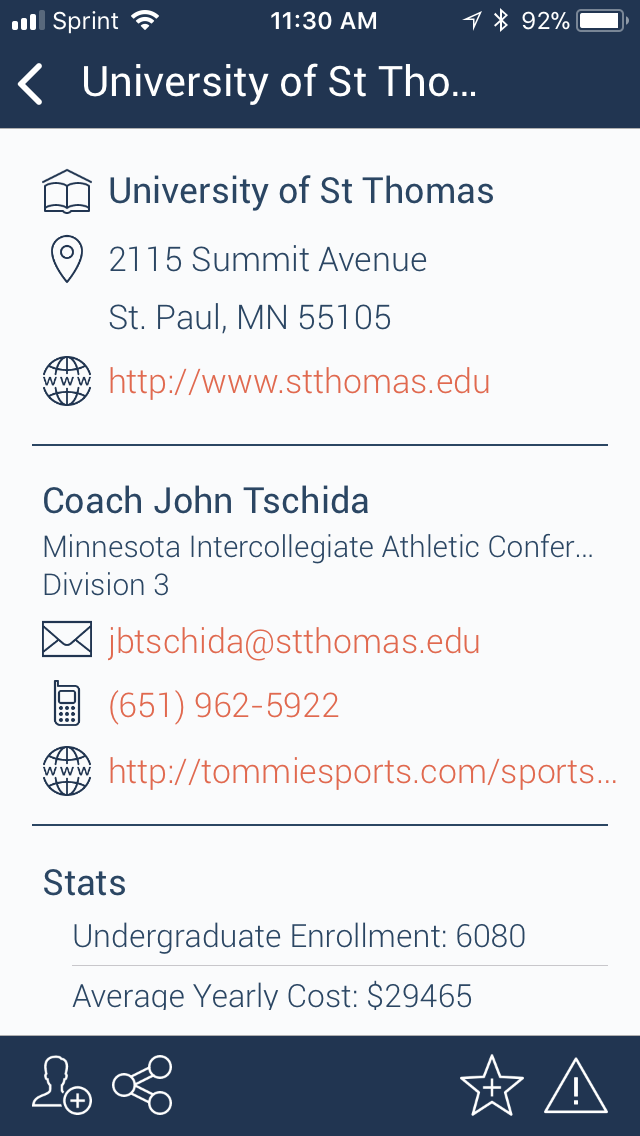
There is also a link to the softball team’s website so you can easily learn more about the program or do your homework before you contact the coach. Never hurts to start an email or a call by congratulating a coach on a recent win, conference championship, or personal milestone.
Deeper details about the institution
Where Softball Bound really shines, however, is the additional information it gathers. The bottom section offers a wealth of statistics about the school, such as undergrad enrollment, the average yearly cost, graduation rate, and average salary after graduation. It also helps you determine whether you have the academics to qualify by offering the average SAT and ACT scores for students at that institution.
Be aware you have to scroll down to see all of the information. The basic school and coach information stay on the screen permanently, but you can scroll through the bottom section to get the rest.
The only negative I found was that I couldn’t read some of the information on my iPhone. If the line is too long it just disappears. Hopefully the developers will be fixing that, because knowing how much money the average salary after graduation or the freshman return rates could be very valuable in helping you narrow your choices.
Carrying relationships forward
Once you’ve made your selections, you can “favorite” them. They then appear on a short list so you don’t have to go through the entire search process each time. As you refine your list further you can remove schools with a click of button as well.
As you build the relationship with different college coaches you can also ask Softball Bound to add them to your regular contact list so you can call or email the coach without having to go into the app. That’s also a very handy feature.
One of the other advantages of the Softball Bound app is they are constantly updating the contact and other information, which means you don’t have to worry about working from an outdated list.
On the website, they also offer the option of purchasing their list for $250. Not sure why you’d want to do that, especially since college coaches frown greatly upon mass mailings. It’s much easier to just purchase the app for a few dollars – especially because if you buy the list it’s up to you to maintain it. Sounds like a lot of unnecessary work to me.
A wealth of helpful, additional information
Speaking of the Softball Bound website, they have more than just product information there. They also have a list of camps you may want to attend, as well as information about the academic side and how to get ready for college. Plenty of links to info on testing (SAT and ACT), creating a skills video, eligibility and so forth. It’s all freely available to anyone and worth checking out.
If you’re actively pursuing playing fastpitch softball in college, or even thinking you might want to, this app is definitely worth it. Especially at $3.99 in both the Apple App Store and Google Play. It can save you a lot of time and effort, and give you a tremendous advantage in your recruiting efforts.
NFCA to NCAA: Make us stop!

By now you’ve probably heard that at the recent National Fastpitch Coaches Association (NFCA) convention, D1 softball coaches finally stepped up to take a stand against early recruiting.
It wasn’t quite as strong as those coaches saying “For the good of our sport and the prospective student athletes we hereby all agree to VOLUNTARILY stop offering verbal commitments to 7th graders.” But it was a start.
If you don’t feel like following the link, essentially the D1 softball coaches have asked the NCAA to impose a rule that says they can have zero recruiting contact with any player until September 1 of that player’s junior year. That would mean the coaches can’t have any recruiting contact at tournaments, at their own camps, or anywhere else.
If a player calls or email the coach, the first question should be “What grade are you in?” If the answer isn’t “I’m a junior,” the coach should respond that he/she isn’t allowed to talk to that player. A snapshot of the changes can be found here.
In my opinion, this is a tremendous step forward. As I (and many, many others) have stated in the past, asking a 7th or 8th grader to make such a momentous decision as where she will attend college is ridiculous, and a huge disservice to the player.
Your choice of college should be based first on what you plan to do for the rest of your life. Especially since a post-college playing career is generally less lucrative than working the overnight shift at the local mini-mart. A player should be choosing a college with the thought that if she got hurt and could no longer play softball, that would still be the school she wants to attend.
What 7th or 8th grader is prepared to make that decision? Few, if any in my experience. They are going through tremendous changes at that age – physical, mental, social – and most are doing all they can to just manage that.
Freshmen and sophomores are a little more mature, but they too are just really beginning to discover what their likes and aptitudes are – factors that will have a huge effect on their ultimate choice of a career, and thus of a college.
They’re also getting a better idea of their academic acumen, as the change from middle school/junior high school to high school can be huge in terms of academics. By their junior years, they should have a better idea of the type of school that fits their academic capabilities.
I know a lot of people (including myself) who didn’t choose their college until their senior year. It’s a tough decision even at that age, much less a much younger one.
Then there’s the “youth sports” aspect of fastpitch softball. In the last few years, it feels like it’s become less about the “human drama of athletic competition” and more about nailing down the almighty verbal offer. Perhaps a change in the recruiting rules will let the girls enjoy the sport a little longer before they have to start sweating whether Coach So-and-so saw them and liked their performance.
This is definitely a good thing, and heading in the right direction. It’s unfortunate that the coaches, or the institutions, couldn’t just agree to do it themselves. But I suppose all it takes is one to disregard the voluntary rules and the whole structure comes down like a giant game of Jenga.
Making it an edict from the NCAA puts the threat of punishment in place, so maybe it will hold up for a while. At least until certain programs figure out what the loopholes are, because there are always loopholes.
Perhaps it will also put an end to jokes about D1 coaches following tall pregnant women around Walmart, handing out business cards and saying “If you have a girl and she plays softball, especially as a pitcher, call me.”
One thing to keep in mind, of course, is that as I read it a new ruling would only apply to D1 colleges. What about the D2 schools? If they are not included, might they start sweeping in to grab some of those top-tier players whose parents are more concerned with the scholarship than the specific school?
D3 schools aren’t allowed to offer athletic scholarships, of course, but they always seem to find academic money for athletes they like. I wonder how a D1-only ruling would affect them? Probably not an issue right now, but you never know how the law of unintended consequences will affect things.
Still not convinced? Here’s a link to another page on the NFCA website that shows some research on some outcomes that affect early commits, such as coaches leaving or the fact that 60% of players had no idea about what they wanted to major in at the time they committed.
So there you have it. Perhaps some sanity will finally come to recruiting. And perhaps by the time the late bloomers bloom, there will still be a place for them to go play. Most importantly, girls who aren’t even sure which backpack to buy for the new school year won’t be getting pressured to choose what college to attend in a few years.
What do you think? Are you glad early recruiting is potentially ending? Or were you in favor of it? Let’s get a discussion going in the comments below.
4 Things to Include When Reaching Out to College Coaches

Guest post by Lindsay White, Let’sGetSigned.com, Instagram: @LetsGetSigned. For many young softball players, playing in college is the dream. They know they need to contact college coaches to make that dream happen, but beyond that they’re not sure what to say or do. This guest post from Lindsay White, who has been through the journey and now helps others, will provide some more specific guidance on how to achieve greater success in your hunt for a place to play in college.
So you want to play college ball but don’t really know where to start. Or maybe you’ve already started reaching out to some coaches but haven’t heard anything back. Trust me, you’re not alone. (And if you haven’t started reaching out yet, what are you waiting for? Go for it!)
Remember, coaches have busy schedules and aren’t always able to reply to your email at lightning speed. They’re probably sifting through their emails as we speak and will eventually get to yours. Don’t give up just yet.
I don’t know how many times I’ve been at a tournament speaking to girls and their parents and they say… “I just don’t know what to say in my emails,” or… “I wrote an email introducing myself but never heard anything back.” This happens a lot, trust me!
So today I’m going to help you out. I’m going to show you how to stand out in a coach’s in box and ACTUALLY get a reply by following the 4 tips below when reaching out to college coaches.
1. Include the Coach’s Name
This one might seem obvious, but I can’t stress its importance enough (and many times it’s overlooked). Make sure to include the coach’s NAME.
The absolute worst thing you can do is copy and paste the same email over and over again to 100 college coaches. And trust me, they can tell. Addressing them by name at the beginning of your email shows that you wrote this email specifically to them.
I don’t know how many times I’ve worked with a student athlete, taken a look at the emails they’ve been sending and I see this at the top of their email…
“To Whom It May Concern”
or… “Hey Coach”…
or… “Mr. Peterson”
First of all, “To Whom It May Concern” shows that you took absolutely zero time researching who you’re contacting. You might as well tell them you picked their team out of a hat.
Second, “Hey Coach” will have them wondering if you even know their name. Grab their attention by showing them you know EXACTLY who you’re contacting. That you reached out to them specifically because you’re interested in playing for them.
Last, “Mr. Peterson” is just weird; they aren’t your 3rd period history teacher. Have you ever been on the field and yelled to your coach… “hey! Mr. Peterson?” No. This will just catch them off guard and leave them a bit confused.
Make sure to start the email with “Hi Coach XYZ,”…
Do NOT miss this step!
2. Tell Them Specifically Why You Want to Play for Them
Again, coaches can tell when you’ve copied and pasted the same email over and over again. You want to show coaches that you know exactly who they are, know a bit about their program and why you want to play for them specifically.
Do you know how many emails these coaches are getting from girls a week? Do you know how many of them are probably copy and pasting the same email to tons of other coaches?
Most emails sent to college coaches are super generalized. Meaning, any coach could read it and it would apply to them. No, you want the coach to read it and realize that you reached out to them specifically, because you want to play for THEIR school in particular.
Take a look at this general email below:
“Hi there!
My name is Lindsay White and I’d love the opportunity to play for your team. I’m a center fielder and think I’d be great asset to your program. I live in Salt Lake City, Utah and will be graduating in 2019.
I look forward to hearing from you!
-Lindsay”
Now take a look at the email below where I tailor the email to this specific coach:
“Hi Coach Isakson!
First off, I want to say congratulations for winning your regional this year. That’s so exciting! You had such an awesome group of girls.
Anyway, I can’t help but notice that you’ll be losing 2 of your starting outfielders in 2019. I’m sure you’re already looking to fill those spots. It just so happens that I’m a center fielder and will be graduating high school in 2019 and would LOVE the opportunity to play for you and wear the Grizzly uniform
I look forward to hearing from you!
-Lindsay”
In the second email, I not only address the coach by name, I show that I know about his program and how they did this year (that I’ve done my homework), and I even mention their school mascot. This coach clearly knows I sent this email to him and only him.
3. Include A Player Profile
The best thing you can do is to keep your email short, simple and easy to read. Like I said, their inbox is probably overflowing. The last thing they have time for is to open a super long email and take out 10 minutes of their time just to read through it.
Make it so they can skip the boring stuff, and go straight to the good stuff… the stuff they’re actually looking for.
This is where your player profile comes in. What’s a player profile? It’s a simple document, ideally a single page, of all stuff softball. What position you play, when you graduate, any special awards you’ve received, where you’re from, etc.
This becomes their quick reference guide; you’ll want to attach it to your email as a PDF document. Now they can quickly print it off and add it to their stack of prospects, and can come back to it later if needed.
4. Your Game Schedule
Please don’t ever send an email out without including your summer game schedule and/or your high school game schedule. These coaches want to come watch you play (if possible). They can’t do that if you don’t let them know when and where you’ll be playing.
Often times these coaches will already be at your tournaments scouting (if you’re in the same area). But they’ll be SURE to make sure to come find you. You already reached out to them, told them you want to play for them, trust me, they’ll make time to come find YOU.
Sometimes coaches aren’t always able to make it, simply because you live far away or they’re busy. Trust me, they have connections everywhere. Sometimes a coach will send a friend, colleague, or another coach to scout you out.
A game schedule is overlooked way too often. Put it in the very first email you send them. That way, they have all the information all in one place and don’t have to come back to you asking for more info.
Making their job easier is your goal. And trust me, not many other girls are doing most or even any of these 4 things.
Use this post as a guideline when writing your next or even first email to a coach and you’ll be super happy with the results.
Have you already been reaching out to coaches? Leave a comment below and tell me how it’s going.
 Lindsay White played every varsity softball game in high school from freshman to senior year. She then went on to play in the SWAC conference, making All-Region 2 years in a row. She then got signed to Dixie State University where she graduated with a degree in Business. She now works with high school girls to help get them signed to play college softball on scholarship, with amazing success. Many of her girls have gotten signed within just a few months of implementing her strategies.
NOTE: This post was edited to remove an offer for templates that are no longer available.






 Life in the Fastpitch Lane