Blog Archives
Softball catchers need to chatter
Last Sunday I was doing another in a series of catching clinics for players ages 10-14. We had some pitchers come in so they could practice the skills they’d been working on all winter – receiving, framing, blocking, throwing down to second – while gaining experience on learning to recognize when to do which. 
As it was going along, though, I noticed something – an unbelievable amount of silence. I called one group of catchers together and asked them “What’s the difference between softball and church?” The girls all stared blankly at me until finally the light bulb came on for one of them and she meekly said, “You’re supposed to be quiet in church?”
Exactly. While many positions on the field can get by with the silent treatment, catcher is not one of them. Catchers need to constantly be chattering for a variety of reasons.
One of the biggest is to make sure their pitchers stay confident. Pitching is a tough position mentally. Everything that happens on the field starts with a pitch. That puts a lot of pressure on pitchers to get it right.
As I often say, the circle looks bright and shiny from the outside but it can be a dark and lonely place on the inside.
Support from the catcher can make it far less lonely. If the pitcher throws a strike, the catcher can tell her “good pitch” or “that’s my girl” or “you’re the one.” Any sort of positive reinforcement. If the pitcher misses, she can say “you’ve got this” or “c’mon just you and me” or something of the sort. Anything to help the pitcher stay up and focused.
It’s not just pitchers who can get help from catchers, though. High-enthusiasm, chattering catchers (Taylor Danielson, I’m thinking of you) can energize the entire team. The obvious responsibility is to make sure everyone knows how many outs there are and what the next play is.
But catchers can also provide encouragement to teams, help panicking teammates regain control and pick up a teammate who made an error. On the other side, they can also call out a player who is slacking or doesn’t have her head in the game.
One of my first catchers had those qualities. Her name was Katie Swanson, and she was definitely vocal. She could be positive, for sure, but she definitely didn’t hesitate to kick butt when necessary. No team was ever going to be low energy when she was behind the plate, and it was a definitely a difference-maker for our team.
For players like Katie, chattering comes naturally. For those who aren’t gifted with that ability it can be developed.
You may feel silly at first, but next time you’re at practice, or working with a pitcher, just start talking. Develop your own patter, things you like to say that come naturally out of your personality.
If you’re funny, use it. If you’re serious, use it. But like any other skill, you have to practice it. The more you do it, the better you’ll get at it and the more naturally it will come. Before you know it you’ll have command of the field – and you’ll capture the attention not just of your teammates and coaches, but perhaps a college coach or two as well.
Now it’s your turn. If you’re a catcher, have you learned to be vocal on the field? If you’re a catcher’s parent or coach, how have you helped your catcher learn to speak up? Or have you?
Too positive can be (almost) as bad as too negative
Before I get into the main topic for today, let me start by confirming that I am a huge believer in positive coaching. I believe the authoritarian yelling and screaming style of coaching is outdated and counter-productive. It may produce some short-term benefits, but in the long term it does more harm than good.
That said, when it comes to fastpitch softball (as well as other activities) there is also danger in going too far the other way.
How could that be? If negative is bad, isn’t the opposite of negative positive – and therefore good? Not exactly.
The danger in going unrealistically positive is it often tends to kill the incentive to improve. If players are constantly being told how wonderful they’re doing, even when their skills leave a lot to be desired, they may not feel the urgency to step it up to the next level.
There are all kinds of examples. A hitter who is crushing the ball against weak pitching despite weak mechanics won’t develop the mechanics she needs to hit higher-level pitching. That’s fine if she never wants to move up in class, but if she does she will find it difficult. Then she’ll be left wondering what happened.
Another example is the pitcher who relies only on her fastball, or the catcher who never learns to block a ball in the dirt. Skills that help better-than-average athletes succeed early generally do not hold up as they get older or face better competition.
What players really need from coaches (and parents) is honest feedback. Praise them for their good work now, but also inform them that they can do better, and become better.
Build that work ethic and sense of striving to improve constantly and you will do more for their self-esteem, and their long-term success, than simply telling them how great they are all the time. It’s how the truly great become great.
Why it’s easier to destroy softball skills than build them
Sooner or later in your fastpitch softball coaching career you’re likely to run into this phenomenon: You spend months working with a player, helping her build her skills little by little, working through the kinks until it seems like the skills are locked in come easily to the player.
Then you hand her off to some other coach and in no time she’s struggling. All that hard work seemingly undone in just a few sessions. You wonder how could that possibly happen?
Actually, it’s easy to understand if you take it out of the coaching context and think about building something (a chair, a shed, a house, some crazy contraption to carry all the team equipment at tournaments) in the physical world.
Let’s take a chair. Not one of those slap-it-together Ikea chairs but one you build from raw wood. You carefully cut and/or carve the wood. You sand it, stain it, polish it. You put it together piece by piece, taking care that all the legs are level and every joint fits together tightly. It takes weeks, or even months, to get it all just so.
Then some knucklehead comes along, picks it up and smashes it against the wall because his favorite pro sports team choked in a big game and got eliminated from the playoffs. All that hard work destroyed in seconds.
The same thing happens to players. Complex skills such as pitching and hitting have a lot of moving parts, and they all need to work together in the proper sequence. Throw off just one part of – say insisting a hitter swing down on the ball and then standing there in an intimidating way until she does it – and the whole skill unravels. The player gets confused, loses confidence, and then she doesn’t perform at nearly the level she’s capable of.
Of course, once she’s not performing she gets benched so everyone loses. Especially the team that could’ve used the skills she walked in the door with.
This is something to keep in mind before messing with a player. Someone who has worked hard to get where she is right now is probably best off being left alone, especially if she is performing when it counts. It takes a long time to build those skills. But it just takes a few misguided ideas and a short amount of time to destroy them.
Product Review: Jugs Tee – It’s All About That Base
Batting tees are one of the most important tools a hitter can own. They’re great for working on swing mechanics, pitch locations and other techniques. They’re also great for getting in a few warm-up swings before the game.
There are all types of tees out there – all rubber, all plastic, a combination of the two. Lately, though, the most popular design has been a metal pipe-style with an inverted rubber cone on the top. You’ll typically find them in facilities with batting cages.
They’re not much to look at, and they often have a weight ring at the bottom of them to keep them from getting knocked over, but they get the job done.
The venerable Jugs Sports company is out to change all of that with their new professional style Jugs T. Retailing for $74.95, it improves on previous designs from other manufacturers in several ways, making it a great choice for facilities, coaches and individual hitters.
The first thing you’ll notice is how beautiful it looks. First-generation tee designs looked like they were built with steam fitting pipes and plywood from the local hardware store. The Jugs T appears to be made from highly polished aluminum with a solid metal base (more on the base in a minute). The bottom section is a deep, shiny blue, while the extension section is natural silver in color. You feel good just taking it out of the package.
It assembles in about 30 seconds – just screw the extension section into the base and you’re good to go. The rubber cone also feels thicker and more rigid than earlier tee models.
That comes in handy if you live up north like I do and leave the tee in the car during cold weather. With other tee designs if the cone is bent while it’s sitting in the trunk it takes a while before it holds a ball reliably.
Not the Jugs T. The thicker material bounces right back and is ready to go. I know – I tried it.
All of that is nice. But the real differentiator, in my opinion, is the base. It’s a solid metal plate instead of wood, and it is heavy – 10 lbs. according to the Jugs website. No need to put a 10 lb. barbell weight on this tee. In fact, the first couple of days I had it I kept handing it to people and telling them to feel the heft. It also has a pentagonal design that keeps it from going over the side if someone swings too low, and the entire base is coated in rubber so it won’t scuff gym floors.
Don’t worry about carting it around, however. The base also has a cutout that forms a convenient carrying handle. It’s easy to transport from cage to cage, or from the dugout to a practice area.
Another issue tees can sometimes develop is the inability to keep the ball at the desired height. You set the ball on it and the shaft starts to sink. So far that doesn’t seem like it will be a problem with this tee. It feels very solid when you raise and lower it, a good sign that it will continue to hold its ground even after repeated use. The adjustment range is a standard 23 inches to 46 inches – comparable to other tees I’ve used – making it ideal for your smallest players as well as your tallest ones.
Overall, like everything Jugs produces it’s a high-quality piece of equipment. If you’re looking for a professional style hitting tee that will stand up to tough use year after year, the Jugs T is a great choice.
Private softball instructors level the playing field
As someone who has a broad interest in the state of youth sports in general as well as fastpitch softball specifically, I’m always interested to read articles on the topic. There’s no doubt that the U.S. (along with more and more other countries) has become sports-crazy, to the point where it is having a negative effect on young players. 
There is one aspect that always strikes me as missing the mark, however, which is their description of instructors. Maybe it’s because I’m a private softball instructor myself, but I don’t think it’s just me taking it personally.
When they talk about how crazy parents have gotten, sooner or later the articles will refer to how on top of everything else parents “then drag their kids to an instructor to spend even more time on their sport, usually in the hopes of acquiring that D1 scholarship.” Or something to that effect. It’s not an actual quote, just a sort of paraphrase of what I’ve seen.
That may be true in some cases. But for the most part I see the role as being somewhat different.
In the good old days these pundits like to talk about, they say kids just showed up at the field and learned to play there. They didn’t need all these adults around.
Well, the reality is that was wonderful for the kids with great athletic ability. You know the ones I’m talking about – you give them a ball, or a stick or some other piece of athletic equipment and they’ll instinctively know what to do with it. But maybe not so much for the kids for whom it didn’t come naturally, or who hadn’t grown into their bodies yet, or who were a little slower in developing their motor skills.
Basically what happened was they got left behind quickly and never had the opportunities to advance in a sport they may have loved but weren’t particularly good at yet. They got weeded out early.
That’s why I say a good instructor can level the playing field. He or she can take a player who may not be the greatest athlete and teach him or her to be competitive and find success on the field, court, rink or whatever. Success being defined by the player and his or her family.
I’ve worked with a lot of kids who had no ambition of playing in college – not just at the D1 level but at any level. Some just wanted to be successful in high school, or on their travel team, or in their rec league. They wanted to get off the bench and become important to their teams.
Is there something wrong with that? I don’t think so, and if I can help them achieve that goal where they might not have otherwise it’s terrific.
Not everyone was blessed with great DNA or grew up in a family that played sports all the time. A good instructor can help make up for those “disadvantages” and level the playing field, giving them opportunities they may not have had otherwise and helping them to achieve all they can achieve.
Of course, even the best athletes can use a little help along the way to shortcut their learning curve, and they’re fun to work with too. My point is that most of the parents who take their kids somewhere for instruction aren’t the ones you see in TV documentaries and NY Times ads, relentlessly trying to drive their kids to sports success they themselves never achieved. They’re just trying to help their kids feel good about themselves and build some great sports memories.
St. Bonaventure softball player donates bone marrow
This seems to be a week for feelgood stories about fastpitch softball players. Here’s another, passed along to me by my friend (and former player) Hillary Klutts.
Katie Sinclair has been a three-year starter for St. Bonaventure University in New York. She was looking forward to her senior season but then fate intervened. 
As a community service project her entire team received a cheek swab and had the results entered into a national database for bone marrow donors. Darned if she didn’t match up with someone badly in need of a donation.
Bone marrow donations are used for patients battling blood cancers. It’s an arduous process with a long recovery time, so she had to make a decision. She could either donate now, help someone she’s never met out, and potentially have a less-than-stellar senior season. Or she could wait until after the season to ensure she was at full strength for the season, but at the same time deny someone who needs it the life-saving bone marrow.
Well, as you might expect by the fact there’s an article about it, Katie went for the donation. Pretty cool when you think about it.
We talk a lot about sports teaching life lessons, such as putting others before yourself. Clearly, Katie Sinclair is a great example of that mindset. While I’m sure there are some out there who can’t believe she’d do that to her team it’s a class act and shows she has her priorities straight. Hopefully the whole St. Bonaventure community is proud of her. Certainly the softball community should be.
Sometimes injuries create opportunities
Over the past couple of days I’ve been emailing back and forth with my friend Stan Goplen, who has been working with his granddaughter JJ to get her ready to make a statement pitching for her high school team this spring. Stan told me that JJ hurt her finger playing volleyball and may not be able to throw for a little. 
Some people would see that as a problem. But I often find that injuries create opportunities. How?
No matter how good it might be for them, sometimes it is tough to get kids to spend the amount of time required to work on one part of the pitching, hitting, throwing or other motion/skill. They get bored easily (especially these days) and want to move on to the complete skill.
An injury takes care of that issue. For example, a pitcher with a hand issue can either sit out, or can work exclusively on her leg drive (which is what Stan planned to do with JJ).
Conversely, a pitcher with a leg issue can work on her arm circle, spins, whip and so forth. I had that happen earlier this year with a 10U pitcher named Jenna. She’d hurt her ankle, so while it was recovering we worked from the waist up, which helped her immensely. By the time she could use her legs fully again she was much better prepared to take advantage of them.
The most extreme case I had was a few years ago when a pitcher named Devin was in a cast from her ankle to her hip. We found a high stool and she sat on that as she worked on her spins and arm path for her curve and drop balls. By the time she was healthy both pitches were considerably better than they had been – because we were able to lock in the arm mechanics she required.
The same concept can be applied to other aspects. Hitters with injured legs can get into a turned position and work on taking the barrel of the bat to the ball (instead of dropping the hands and sweeping the bat through the zone). Fielders with a broken wrist can work on lowering their hips to a ground ball (without catching, of course) or learning to track fly balls over their heads. All it takes is a little creativity and imagination.
So the next time you see a player with an injury, don’t think “oh darn.” See it as an opportunity. You’ll be amazed what you can accomplish.
So how about you? What have you done to take advantage of player injuries? How did it work out for you ?
Congratulations to Emma Bartz for signing with Northwestern
I am very pleased and excited to congratulate Emma Bartz on signing her National Letter of Intent today to play softball at Northwestern University next year. (I never like to post these things until they’re official and the ink is dry.)

Emma Bartz signs her NLI to play softball at Northwestern
Emma is not only an outstanding softball player but an outstanding human being, as evidence in this blog post from about a year ago. She is very kind and polite, and always has a smile on her face. It’s always nice when good things happen to good people.
We started working together almost by accident. She was going to start hitting lessons with someone else, but it just so happened a student of mine at the time, Amy Abel, was at her house and recommended she come and see me instead. How lucky for me!
The great thing about Emma is she gives 100% on every rep, as seen here recently. In fact, that’s been one of the challenges, learning a little plate discipline because she really likes to get after the pitches. While she is not very tall she is quite strong – no doubt in part due to her legacy as a cheerleader.

Closest I could come to Northwestern purple.
She’s also fast. Like lightning fast. Normally I would suggest a kid with her speed turn around and slap. But when I saw the power she had from the right side I thought that would be her best bet, and it turned out to be right.
Congratulations to Emma, and her parents Jean and Keith who raised an incredible daughter. I’m looking forward to watching Emma during her senior season in high school, and then at NU.
Tip to help with throwing the outside pitch
A couple of weeks ago I was working with a new student named Jasmine. She is a high school pitcher who had received some good training previously, but still needs some refinement in a few areas. 
One thing we were working on was throwing to locations – inside and outside. She was doing fine with inside – I find most pitchers have a side that comes easily and a side they struggle with, and for most the easy side is inside – but having trouble with the outside pitch.
Each time she tried the ball either went down the middle or off to the right. She just couldn’t quite seem to hone in on the mechanics to go left.
The cage we were working in had a protective screen for pitchers (or coaches) to duck behind when throwing batting practice. And that’s when the idea hit me. I dragged the screen about 15-20 feet in front of her and basically cut off everything from the center to the right.
Jasmine gave me a nervous smile at first but gamely decided to give it a try. With the right half cut off she was able to focus on the left and get the feel of throwing properly outside. After a few successful pitches with the screen in place we removed the visual aid. Lo and behold, she started popping the glove right on the spot.
If you have a pitcher who is struggling with hitting a spot, give this a try. Just be sure to set the screen up far enough away that if the pitcher does hit it the ball doesn’t bounce back into her. (Don’t be fooled by the photo – objects in picture are farther away than they appear.)
Another way to measure bat speed
Developing good bat speed is important to hitting. Because of its significance there are all kinds of ways of measuring it. 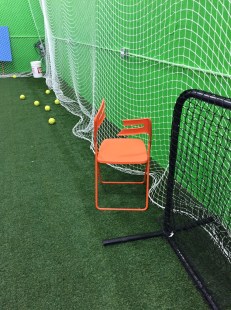
You can use a radar gun. You can use an electronic swing analyzer. There are probably a couple of others that involve advanced technology.
And then there’s what’s depicted here. At the start of this session, this was a fully intact plastic chair. The way it looks now is the result of a line drive off the bat of Emma Bartz.
The chair was about 30 feet away. One second it was fine, the next split second it looked like this.
She hit it so hard that the chair didn’t even move. The ball just went straight on through.
Oh, and by the way, this was off a tee. I can only imagine what would’ve happened if you added the pitch velocity to it.
It was pretty cool to see. On the other hand, I also made sure to tell her the time-honored phrase: No chip-ins.






 Life in the Fastpitch Lane