St. Bonaventure softball player donates bone marrow
This seems to be a week for feelgood stories about fastpitch softball players. Here’s another, passed along to me by my friend (and former player) Hillary Klutts.
Katie Sinclair has been a three-year starter for St. Bonaventure University in New York. She was looking forward to her senior season but then fate intervened. 
As a community service project her entire team received a cheek swab and had the results entered into a national database for bone marrow donors. Darned if she didn’t match up with someone badly in need of a donation.
Bone marrow donations are used for patients battling blood cancers. It’s an arduous process with a long recovery time, so she had to make a decision. She could either donate now, help someone she’s never met out, and potentially have a less-than-stellar senior season. Or she could wait until after the season to ensure she was at full strength for the season, but at the same time deny someone who needs it the life-saving bone marrow.
Well, as you might expect by the fact there’s an article about it, Katie went for the donation. Pretty cool when you think about it.
We talk a lot about sports teaching life lessons, such as putting others before yourself. Clearly, Katie Sinclair is a great example of that mindset. While I’m sure there are some out there who can’t believe she’d do that to her team it’s a class act and shows she has her priorities straight. Hopefully the whole St. Bonaventure community is proud of her. Certainly the softball community should be.
Heartwarming story about Missouri player
Saw this story in an NFCA mailer today and I just had to share it. It’s about Missouri’s Raime Cohen, a pinch runner on the softball team and her journey to get there.
The quick version is she was living in an orphanage in Bulgaria when her American parents adopted her. She had a dream of playing college softball, and after heading to Mizzou took a chance by contacting the coach to ask for a tryout.
What I really like about the story, though, is the perspective she brings. Raime is clearly grateful for all the opportunities in her life, and her good fortune in being adopted by the Cohens. She realizes how different her life would have been without that event, and keeps that in mind every day.
Growing up here in America we sometimes forget how much privilege and how many opportunities we have. Athletes may complain about having to go to practice, or going to a tournament instead of going to a party their friends are throwing. Raime’s story is a great reminder of just how good we all have it.
Sometimes injuries create opportunities
Over the past couple of days I’ve been emailing back and forth with my friend Stan Goplen, who has been working with his granddaughter JJ to get her ready to make a statement pitching for her high school team this spring. Stan told me that JJ hurt her finger playing volleyball and may not be able to throw for a little. 
Some people would see that as a problem. But I often find that injuries create opportunities. How?
No matter how good it might be for them, sometimes it is tough to get kids to spend the amount of time required to work on one part of the pitching, hitting, throwing or other motion/skill. They get bored easily (especially these days) and want to move on to the complete skill.
An injury takes care of that issue. For example, a pitcher with a hand issue can either sit out, or can work exclusively on her leg drive (which is what Stan planned to do with JJ).
Conversely, a pitcher with a leg issue can work on her arm circle, spins, whip and so forth. I had that happen earlier this year with a 10U pitcher named Jenna. She’d hurt her ankle, so while it was recovering we worked from the waist up, which helped her immensely. By the time she could use her legs fully again she was much better prepared to take advantage of them.
The most extreme case I had was a few years ago when a pitcher named Devin was in a cast from her ankle to her hip. We found a high stool and she sat on that as she worked on her spins and arm path for her curve and drop balls. By the time she was healthy both pitches were considerably better than they had been – because we were able to lock in the arm mechanics she required.
The same concept can be applied to other aspects. Hitters with injured legs can get into a turned position and work on taking the barrel of the bat to the ball (instead of dropping the hands and sweeping the bat through the zone). Fielders with a broken wrist can work on lowering their hips to a ground ball (without catching, of course) or learning to track fly balls over their heads. All it takes is a little creativity and imagination.
So the next time you see a player with an injury, don’t think “oh darn.” See it as an opportunity. You’ll be amazed what you can accomplish.
So how about you? What have you done to take advantage of player injuries? How did it work out for you ?
Congratulations to Emma Bartz for signing with Northwestern
I am very pleased and excited to congratulate Emma Bartz on signing her National Letter of Intent today to play softball at Northwestern University next year. (I never like to post these things until they’re official and the ink is dry.)

Emma Bartz signs her NLI to play softball at Northwestern
Emma is not only an outstanding softball player but an outstanding human being, as evidence in this blog post from about a year ago. She is very kind and polite, and always has a smile on her face. It’s always nice when good things happen to good people.
We started working together almost by accident. She was going to start hitting lessons with someone else, but it just so happened a student of mine at the time, Amy Abel, was at her house and recommended she come and see me instead. How lucky for me!
The great thing about Emma is she gives 100% on every rep, as seen here recently. In fact, that’s been one of the challenges, learning a little plate discipline because she really likes to get after the pitches. While she is not very tall she is quite strong – no doubt in part due to her legacy as a cheerleader.

Closest I could come to Northwestern purple.
She’s also fast. Like lightning fast. Normally I would suggest a kid with her speed turn around and slap. But when I saw the power she had from the right side I thought that would be her best bet, and it turned out to be right.
Congratulations to Emma, and her parents Jean and Keith who raised an incredible daughter. I’m looking forward to watching Emma during her senior season in high school, and then at NU.
Incredible pitching clinic happening March 18-19
What are you doing Friday, March 18 and Saturday, March 19, 2016? Whatever it is, if you’re a pitcher, parent of a pitcher or a pitching coach you’re going to want to change your plans and head to Richmond, Indiana. 
The reason? You’ll have the rare opportunity to learn from one of the best instructors in the game – Rick Pauly of Pauly Girl Fastpitch. He is also a former men’s fastpitch pitcher, former pitching coach at the University of Georgia and of course is the father of Sarah Pauly, a standout college pitcher as well as being the career wins leader in the National Professional Fastpitch league.
Friday night is a PowerPoint presentation on the basics of pitching for parents and coaches. Then Saturday there are two sessions – a fundamentals of pitching in the morning and an advanced clinic on movement pitches in the afternoon. (Each session is separate.)
Bill Hillhouse of House of Pitching will be there as well, along with several other great coaches as seen in the flyer image. Sounds like it will be the fastpitch pitching equivalent of The Summit!
Slots are limited, so you’ll want to act now if you want to take advantage of this rare opportunity to learn from some of the best. For more information, download the flyer below.
Edited to add image, updates.
Tip to help with throwing the outside pitch
A couple of weeks ago I was working with a new student named Jasmine. She is a high school pitcher who had received some good training previously, but still needs some refinement in a few areas. 
One thing we were working on was throwing to locations – inside and outside. She was doing fine with inside – I find most pitchers have a side that comes easily and a side they struggle with, and for most the easy side is inside – but having trouble with the outside pitch.
Each time she tried the ball either went down the middle or off to the right. She just couldn’t quite seem to hone in on the mechanics to go left.
The cage we were working in had a protective screen for pitchers (or coaches) to duck behind when throwing batting practice. And that’s when the idea hit me. I dragged the screen about 15-20 feet in front of her and basically cut off everything from the center to the right.
Jasmine gave me a nervous smile at first but gamely decided to give it a try. With the right half cut off she was able to focus on the left and get the feel of throwing properly outside. After a few successful pitches with the screen in place we removed the visual aid. Lo and behold, she started popping the glove right on the spot.
If you have a pitcher who is struggling with hitting a spot, give this a try. Just be sure to set the screen up far enough away that if the pitcher does hit it the ball doesn’t bounce back into her. (Don’t be fooled by the photo – objects in picture are farther away than they appear.)
Another way to measure bat speed
Developing good bat speed is important to hitting. Because of its significance there are all kinds of ways of measuring it. 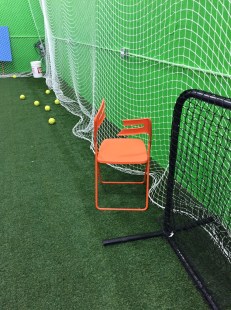
You can use a radar gun. You can use an electronic swing analyzer. There are probably a couple of others that involve advanced technology.
And then there’s what’s depicted here. At the start of this session, this was a fully intact plastic chair. The way it looks now is the result of a line drive off the bat of Emma Bartz.
The chair was about 30 feet away. One second it was fine, the next split second it looked like this.
She hit it so hard that the chair didn’t even move. The ball just went straight on through.
Oh, and by the way, this was off a tee. I can only imagine what would’ve happened if you added the pitch velocity to it.
It was pretty cool to see. On the other hand, I also made sure to tell her the time-honored phrase: No chip-ins.
The long reach of coaching influence
When you’re coaching it’s easy to get caught up in the day-to-day aspects of it. After all, if you’re a team coach there are practices to plan, tournaments to schedule, equipment to order, insurance to purchase, lineups to make out, etc.

Kate Kiser pitching back in 2011. Those were the days!
If you’re a private coach there is (hopefully) a procession of players, each with different needs that must be considered and planned for, scheduling to do, fields or facilities to work with, promotional materials to get out and so on.
So in all of that it’s easy to lose sight of the longer-term impact you might have. That’s why I wanted to share this article today. It’s about a top-level high school volleyball player named Kate Kiser and how she got to be that way, but bear with me. It’s also a softball story.
In the article, the reporter asks Kate which coaches had the biggest impact on her athletic career, and Kate very kindly named me. What makes it interesting is that this is a volleyball article and I coached her in softball pitching and hitting. Kate stopped playing fastpitch softball a couple of years ago to focus on volleyball, and clearly it’s paid off for her. Not just in local accolades but also in the colleges that are recruiting her.
While I didn’t teach her how to set, or serve, or dig or do the other stuff volleyball players from what she says I did have an impact that wasn’t sport-specific. What better reward could there be for a coach than knowing you’ve had a lasting effect on a player?
What makes this success story of Kate’s more remarkable is that she wasn’t always a superstar. I first met Kate when she was 9 (I confirmed that with her mom Kim, a great lady if there ever was one).
Kate had an interest in softball and wanted to pitch. She and her mom came in to the facility I worked in at the time to give it a try. I was pretty booked up, so they had to start lessons at 10:00, which is pretty late for a 9 year old, but they were there every week. After some early progress we started doing hitting as well.
Yet when she went to her first travel softball team it was a rough ride. The coach had his favorites, and Kate didn’t see the field much. In fact, I remember hearing about at least one out-of-town tournament where she didn’t play an inning all weekend. It was rough, but she never gave up.
Fast forward a few years and by 14U she was usually the talk of the tournaments she played in. She was a dominating pitcher and a powerful hitter. Some great travel coaches gave her the opportunity to demonstrate her skills and she blossomed as a softball player. It didn’t just come out of natural ability, though. She worked hard to get there.
Around 12U, I think, she started getting involved in volleyball as well. She quickly worked her way up the club ranks and started attracting attention. By the time she got to high school she had to make a decision on which sport to play. She went with volleyball (obviously), although I can’t help but think her heart is still on the diamond since she mentions it first when listing sports.
Still, while I hated to see her give up softball it’s hard to argue with the results. In addition to All Area and All Conference honors, she’s also been named to the All State team. As I mentioned, a lot of top schools are looking at her to play there too.
On top of all this, she’s a great student, with a shot at valedictorian. She wants to become a doctor, and I have no doubt she will not only do it but become a great one. She may just be the one who cures cancer. I wouldn’t put it past her.
So coaches, there’s something to keep in mind. While you’re teaching the game of softball you may be conveying other more important things to your players as well. You never know where it might lead.
Taking out the “jump up” when blocking
Last Sunday I had the pleasure, nay, the privilege of working with one of my catching students – a girl named Taylor Danielson. Before I get into the specifics let me just say Taylor is a coach’s dream.
Not only is she incredibly athletic and talented, but she’s also one of the most coachable players you’d ever want to meet. You give her a good piece of advice that will help her and she’s all over it.
Taylor is also very self-aware of what she’s doing at all times. She may not always know the fix, but she definitely knows when something just ain’t right.
That was the case on Sunday. After addressing an issue she felt she was having with proper transfer of the ball on throws I asked her if she wanted to go over anything else. “Blocking.” she said. “I always want to work on blocking.”
Understand that blocking is already one of her strengths. You watch her do it and it’s pretty much textbook. She doesn’t try to catch the ball like most catchers. She makes sure she gets in the path of the ball and keeps it from getting behind her. Just one of the many reasons she’s already verballed to the University of Indianapolis.
I tossed a couple of balls at her and noticed something right away. When she went to block, especially side to side, she made a slight movement up before going down. That can be dangerous, especially with a pitcher throwing some heat. I mentioned it and she said she felt it too.
So I asked her to get ready again, and that’s when I spotted the problem. She had gotten into a habit of being more vertical than is desirable in her runners on base stance. Ideally, with runners on base your back is parallel to the ground and your butt and hips are up, close to even with your thighs. That way you don’t have to lift your center of gravity up to move.
But because she was sitting more upright she was having to lift her butt (and her body) before going down.
That was an easy fix. Once back into a proper stance she was once again pouncing on balls directly and quickly, like a cat on a catnip toy.
So if you have a catcher going up before going down give that a look. One simple change can make a world of difference.
Drills for the sake of drills
Check out any fastpitch softball flyer or website offering instructional materials and you will find tons of books and DVDs focused on drills, drills, DRILLS! It almost seems like an arms race sometimes to see who knows the most drills.
Don’t get me wrong – drills can be very helpful. But like anything else they need to be used strategically.
Drills are only valuable when they answer an actual need (other than keeping some players occupied while you work with others). Here’s what I mean.
Take a hitting drill that focuses on extension after contact. Seems like a worthwhile way to spend your time. But if the player already has good extension after contact, it can actually be wasting time that would be better spent on another aspect that isn’t as strong.
The same goes for pitching drills focused on the arm circle. While it can always be a little better, players only have so much time to practice. That circle drill might have already hit the point of diminishing returns, where time spent increases sharply while actual gains don’t rise much at all.
The other issue with doing drills for the sake of drills is that softball skills typically require multiple combinations of movements, whereas drills are designed to isolate movements. As such, drills are great for working on isolated issues.
Sooner or later, however, those individual pieces need to be rolled back into the full skill. Spend too much time on the drills and you won’t have enough time to develop the actual skill that’s required. Sort of like spending the bulk of your time cleaning your boat instead of taking it out on the water.
Once the player has learned the basics, my recommendation is to spend as much time as possible practicing the full skill, end-to-end, and then use drills to address problems you’ve identified within them. As opposed to just running through a set of drills because you saw them on the DVD.
It will be a much more efficient use of time, and will help you turn out more game-ready players.






 Life in the Fastpitch Lane