Developing Fastpitch Pitchers: The Speed v Accuracy Debate

One of the age-old questions when developing fastpitch pitchers is whether coaches should prioritize speed or accuracy.
Of course the real answer is they should focus on mechanics and everything else comes from that. In other words, focus on the process and the outcomes will take care of themselves.
Still, you do need some way of measuring whether the mechanics you’re working on are helping your pitcher get better or not. The two most common are speed and accuracy.
So we again come to that question: which of those should be the priority? In my opinion, the priority for young pitchers should be speed. Here’s why.
Let’s say you choose to prioritize accuracy. Understandable, especially if you are a team coach.
You want pitchers who can get the ball over the plate and get hitters swinging. After all, you can’t defend a walk and all that, and no one likes a walkfest.

The problem is, if you sacrifice speed for accuracy your pitcher will develop a way of pitching that is totally focused on that outcome. That will get her by up until about the age of 12, especially if you’re not playing high-level ball.
But at some point she will need to gain some speed or she won’t be pitching anymore. While it may have been good enough to “just get the ball over the plate” when she was younger and the opponents didn’t hit very well, those hitters have been developing too.
And they can now crush those slow meatballs all the way toward South America.
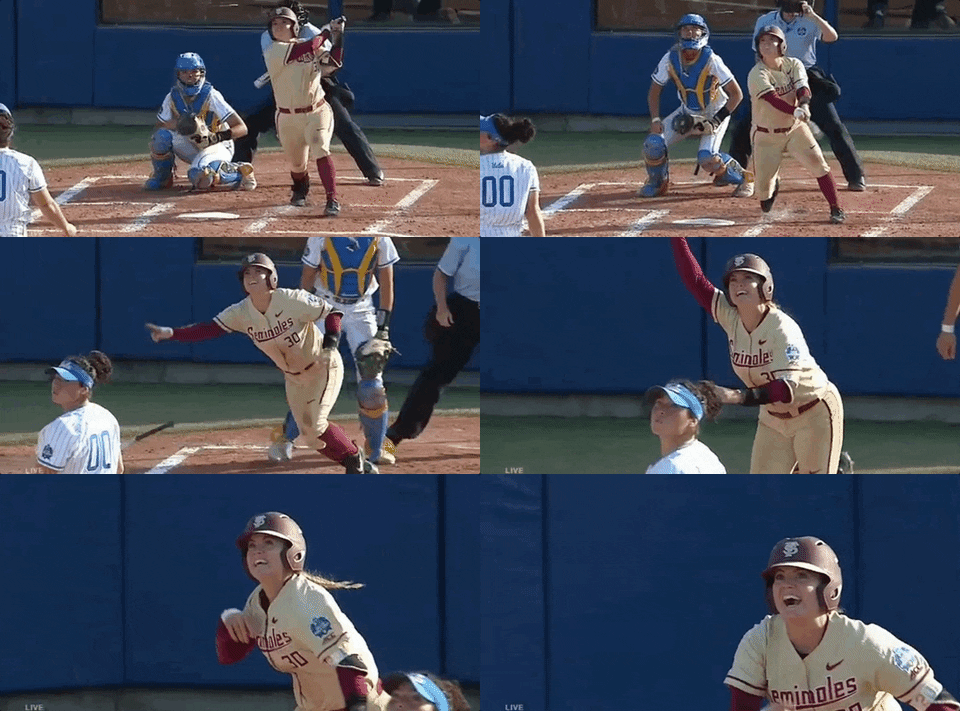
So she’s going to have to gain some speed. The problem is, that’s going to throw off her whole way of pitching because she’s going to need to use her body differently than she’s been doing it, which means her accuracy will go down anyway. And now she’s neither fast nor accurate.
Let’s look at it from the other side. If you focus on speed first, your pitcher may have some trouble throwing strikes at first.
Young people don’t always have total command of their bodies, and some have less than others. Which means you could have arms and legs (as well as pitches) going everywhere when they try to use their full energy But…
The more they work at it at full or near-full energy level, the better they’ll be able to feel their body moving in space. Pitches that were way wide, or going to the top of the backstop, or rolling in the dirt, start getting closer to being strikes.
The zone keeps narrowing until finally the pitcher can throw reliably. Only instead of throwing meatballs she’s bringing heat.
And as she gets older, the mechanics she developed to build that speed continue to be refined, giving her better and better control without having to go back to the drawing board and re-learn how to pitch.
In the end, it comes down to what your goals for that pitcher are. If all the team coach cares about is not giving up walks to ensure a better shot at wins in the short term, it might make sense to go for accuracy.
Your pitcher will definitely get more opportunity to pitch right now.
If, however, you’re looking to develop your pitcher in a way that delivers long-term success, put the priority on speed and let accuracy come later. Because by the time a pitcher is 13, she needs a minimum level of speed to even be considered for most teams, much less given the ball when it counts.
You show up to a tryout with speed and no one cares how many batters you walked or hit when you were younger. They may even be willing to take a chance on you if you look a little wild.
But show up throwing in the mid-40s or less and you’re probably not going to be pitching much no matter how accurate you are. Because by that time accuracy will be considered table stakes, not a point of differentiation.
7 Fastpitch Softball Rules Myths BUSTED!

A few weeks ago one of my students and her dad came to me with a question about the pitching rules. She had been called for an illegal pitch because she stepped on the pitching rubber with her hands together.
I confirmed that that was a rule and we worked on making sure she broke that habit (she never really did it during lessons). But then they also said their team coach told them something else that, as Tom Cruise says in A Few Good Men, just ain’t true. Even though a lot of people seem to think it is
That got me to thinking about some of the other fastpitch softball “rules” myths people seem to believe and spout off about at every opportunity. And since rules posts are pretty popular here on Life in the Fastpitch Lane I thought it was time to address some of those myths. So…

Myth #1: You Have to Present the Ball
This was the question that sparked this post. My pitcher was told you have to show the ball to the hitter before bringing your hands together. In other words, hold it in your pitching hand when you step on the pitcher’s plate (rubber in common terms).
That is completely false. The rules state that you must have the hands separated when you step on the pitcher’s plate. But they also state the ball can be in EITHER hand.
Which means it can be in your glove when you step on, and you can then reach your pitching hand into the glove to grab the ball.
(I would quote the rule with the number but I don’t happen to have a current USA Softball rulebook. If any of you have it feel free to add it in the comments.)
It isn’t just coaches and parents who don’t understand or know this rule, by the way. I have witnessed and heard about umpires not understanding it either, and insisting the pitcher has to “present the ball.”
If you find yourself in that situation, you can decide whether it’s worth arguing. But it’s good to know the truth nonetheless.

Myth #2: The Hands Are Part of the Bat
This one comes up in a hit by pitch (HBP) situation when the ball comes inside and hits the batter’s hand while she is holding the bat.
The umpire will award the batter first base, and immediately the opposing coach will come out of the dugout claiming or screaming she shouldn’t get a base because the hands are considered part of the bat.
There is an easy test for this one. Have the batter hold the bat straight out in front of her with her hands, and then let go. If the hands hit the ground with the bat, they are part of the bat.
Otherwise they are not, and batter gets the base.
Myth #3: The Tie Goes to the Runner
This one is a baserunning situation related to a force out, although some try to apply it to tag plays too.
Basically, the ball and runner arrive at the base at what appears to be the same time (although rarely is that true). If the umpire calls the runner out, the offensive coach will claim she should be safe because the tie goes to the runner.
While that is a very common belief, again there is no such rule. It is entirely up to the umpire’s judgment as to whether the ball beat the runner to the base or runner beat the ball to the fielder’s glove.
In the rare case where both arrive at exactly the same time, which would be a statistical anomaly of the highest order, it is still up to the umpire’s judgment as to whether the runner is safe or out.
You can yell and scream all you want about it but the rules won’t help you out. The umpire’s call is the final word.
Myth #4: If a Fielder in Fair Territory Touches a Ball in Foul Territory It’s a Fair Ball
I actually heard this one being argued by a parent at a high school game about a line drive hit down the third base line.
The ball was over foul territory when it was touched, but the fielder was in fair territory. He was trying to argue that the ball should be fair.
The reality, however, is that fair or foul has nothing to do with the fielder’s position. It’s where the ball is when it hits the ground or is touched by a player. So even if the ball is deflected back into fair territory it is considered a foul ball because of where it was when it was deflected.
Myth #5: A Runner Tagging Up Can’t Leave the Base Until the Ball Is Caught
This is another one that is often misunderstood by the folks along the sidelines, and sometimes in the dugouts too.
A typical situation will have a runner on third with fewer than two outs. A fly ball is hit to the outfield and the runner on third will tag up, i.e., come back to the base and stand with her foot on it.
When the outfielder catches the ball cleanly the runner on third will take off for home. All good so far.
But what if the outfielder bobbles the ball instead of catching it cleanly? Some will argue that the runner can’t leave the base until the ball is secured. But they would be wrong.
The runner is free to leave the base as soon as the outfielder TOUCHES it. This rule is in place to prevent a skilled outfielder from juggling the ball all the way back to the infield before catching to hold the runner at third.

It makes sense when you think about it that way. So coaches, teach your outfielders to catch the ball cleanly if you want a shot at the runner on third.
Myth #6: No Hit By Pitch If the Ball Bounces First
This one may actually be true in some rec leagues, but overall it doesn’t matter if the ball hits the ground before it hits the batter. If a pitched ball hits the batter she is awarded first base.
Myth #7: A Pitcher Can Only Hit X Batters Before She Has to Come Out
Again, this may be true in some rec or other local leagues. But for high school, college, and travel ball the pitcher can hit as many batters as her coach will allow her to.
This one should be self-regulating. Every HBP is another baserunner who has a chance to score.
Hit four in an inning and that’s a free run for the opposition. And if you hit four, who’s to say you won’t hit six, or eight? That’s a lot of free runs to give up.
The smart move if a pitcher is having that much control trouble is to get her out of there and try someone else. But there’s nothing in the rules that requires it.
That’s a Wrap
So there you have it – seven fastpitch softball myths that some/many (depending on the myth) think are true but really aren’t.
So what did I miss? Are there others you’ve seen or heard that drive you nuts? Leave your thoughts like therapy in the comments.
Stonehenge photo by John Nail on Pexels.com
Surviving “One More” Syndrome

Friends, today we are gathered to address one of the most dreaded issues in all of fastpitch softball practice. Of course, I am talking about “One More” Syndrome.
It’s an issue that affects nearly every player at all levels at one time or another. You may not know it by name, but you know its effect.
There you are, working on hitting, pitching, fielding, or some other skill. You’ve had a very successful session when the coach (or a parent) announces “one more,” as in one more pitch to a hitter, one more ground ball to a fielder, one more rep of a particular pitch.
Suddenly it is as if you’ve never seen a softball before in your life, much less have hit, caught, or thrown one. Whatever skill you were executing with tremendous ability has completely abandoned you, leaving you flapping around the field like a drunken penguin.

This is a topic that came up during a lesson last night with a pitcher named Brooklyn. She was cruising along pretty well working on her changeup when I said, “Ok let’s throw one more” – at which point she totally tanked the pitch.
Brooklyn looked at me, smiled, shrugged, and asked, “What is it about saying one more that makes things go bad?” I had to admit I didn’t know, but it does seem to happen a lot. That’s when we came up with the idea of One More Syndrome.
So what can you do about it? One thing is not to put too much worry into it.
For whatever reason, this seems to be a very common affliction. If it was odd that would be one thing. But it pretty much happens to everyone sooner or later.

If you really want to put a stop to it, though, your best bet is probably just not to think about the fact that it’s the last whatever. Just treat it like one more rep and you’ll most likely be fine.
Worst case, just ask the coach or parent not to announce it’s the last one – at least all the time. That way you can work up to the mental toughness not to be affected so you can keep things moving along quickly.
“One More” syndrome is real. But it doesn’t have to be a terrible issue.
Just laugh about it and get on with your practice. Eventually you’ll get to the point where hearing “let’s do one more” will be just another ordinary phrase.

It Pays to Know the Rules

When I was coaching teams, one of my yearly rituals was to read the ASA (now USA Softball) rulebook from beginning to end before the season started. Including the applications scenarios in the back.
I would also scan the rules for other sanctions my team was playing in just to make sure I knew about any variations so I didn’t embarrass myself or my team on the field.
Why would I do that? It wasn’t for fun, I can assure you. The rulebook is pretty dry.

No, I read it to make sure I was ready for those little odd things that can happen that, if you don’t know what you’re doing, could cost you a game. Or even a championship.
With the college softball season getting under way, the high school season about to start in many parts of the U.S., and travel and rec ball not far off, it seems like reading the rulebook and understanding it thoroughly would be a good use of coaches’ time.
What made me think of this is what happened in Super Bowl LVIII (58 for those of you who don’t read Roman numerals).
ICYMI, the game was tied at the end of the fourth quarter so it went into overtime. Which means the Chiefs and 49ers had to do a new coin toss, with the winner deciding whether to take the ball first or let the other team have it.
The 49ers won the coin toss and elected to receive the ball. Under ordinary circumstances that might seem like a good decision because usually overtime is “sudden victory,” the politically correct term for what we used to call “sudden death.” In other words, first team that scores wins.
But what the 49ers allegedly didn’t realize is that the overtime rules changed this year, which meant both teams would get a guaranteed possession, i.e., a chance to score. That rule change gives the advantage to the second team to get the ball because by then they will know what they have to do when it’s their turn.
So after the 49ers notched a field goal (worth 3 points for those who don’t follow football), the Chiefs knew they could tie the game with a field goal if they had to or go for the win with a touchdown, which is ultimately what they did. They succeeded, which meant a lot of third world children are looking forward to receiving free San Francisco 49ers Super Bowl LVIII Champions t-shirts.

After the game, it was brought up that where the 49ers weren’t aware of the new rules, the Chiefs had been going over them twice a week or something like that since the preseason. While it might have seemed boring at the time, it paid off.
There are always new additions (and subtractions) to the rulebook, so taking the time to understand them is critical if you want to serve your team best. Of course, one of the biggest examples here in 2024 is the change to the pitching rules which now allows leaping – although not crow hopping supposedly.
We’ll see about that, but that’s a topic for another post.
It would be pretty embarrassing for a coach to complain that a pitcher’s foot is coming off the ground on her drive forward when that’s now allowed. It would also be pretty risky for a coach to allow or encourage a pitcher to crow hop (replant the drive foot before the stride foot lands) thinking that that is the same as leaping, only to have it get called correctly in a critical game.
Knowing the rules can also help you prevent an umpire who doesn’t know the rules from costing you a game. I can speak to that from personal experience.
A team I was coaching was on defense in a “national” tournament. The other team had runners on second and third with one out so we elected to intentionally walk the current hitter to create a force at home.
My catcher moved behind the left hand batter’s box to receive the ball as I had taught her, and our pitcher threw a pitch. The umpire immediately called an illegal pitch saying the catcher was out of the catcher’s box, which meant the runner on third would score and the runner on second would advance to third. Not exactly the outcome we were looking for.
I went out to argue the call. I explained that unlike baseball, where the catcher’s box is narrow, in fastpitch softball it extends from the far edge of one batter’s box to the far edge of the other.
The umpire disagreed so I asked him to ask his partner. His partner also disagreed so I asked them to get the umpire in chief, which to their credit they did.
After about 10 minutes of consultation between them (and a rule book), they conceded the point, sent the runners back to their original bases and wiped the run off the board.
I’d love to say we got the out at home and went on to win the game. That would be a nice topper, wouldn’t it?
Unfortunately, the next hitter got a ground ball through the pulled-in infield and we went on to lose. But hey, at least it wasn’t because of a rule problem.
The fastpitch softball rulebook is filled with plenty of rules, some common, some obscure, but all worth knowing. Because you never know when a situation will come up where knowing the rules can change the situation immensely.
I know it’s boring, coaches, but do yourselves a favor. Either read the rulebook cover-to-cover yourself or assign someone on your staff to do it.
You never know when a season might turn on it.

Trust the Process and the Outcome Takes Care of Itself

Every now and then when I’m working with a pitching student I will have one who is having trouble hitting some of her spots on command. For example, she will tell me that she can hit inside ok but can’t throw outside.
I will talk to her about how to do it. I used to talk about making adjustments such as striding an inch or two toward where you want to throw, or turning your hand a certain way, etc.
But now I simply tell her to look at where you want to throw and then throw it there. Your body will find a way.
That works much of the time, but not always. In those cases where it doesn’t, I will drag a protective screen about halfway between the pitcher and catcher and say “Try it now.” That trick usually works within a couple of pitches.
“Why do you think you can magically hit that spot all of a sudden?” I will ask (triumphantly, I might add).

“Because the screen is there and I can’t throw it the other way,” they’ll reply in some form or another.
That’s true, but there’s a deeper explanation: by blocking off half the plate, her body was forced to make adjustments to not clang into the screen. We fixed the process, and the outcome was what we wanted.
That’s an important lesson for every fastpitch player to learn. All too often players get so caught up in trying to achieve the outcome they lose the thing that will most help them achieve it.
Pitchers will get so caught up in going for speed they’ll over-throw and try to muscle the ball, slowing it down. Or they’ll get so obsessed with hitting a spot or getting a spin that they’ll contort themselves in all sorts of crazy ways to make it happen.
Hitters will be so hellbent on getting a hit that they’ll just flail the bat at the ball instead of taking an approach that lets them see the ball longer and coordinate all their body parts to deliver the bat more efficiently. Fielders will be so focused on throwing hard to set a speed record that they’ll set aside good mechanics to just chuck the ball any old way, taking the throw off-line and getting a worse score than before.

You get the picture. These players become so intent on whatever outcome they’re trying to achieve that they don’t pay attention to how they’re trying to achieve it. That’s just wrong.
The reality is the process is greater than the outcome just like the graphic at the top of this post shows. (I stole that from a t-shirt I saw on the TV show Seal Team, to give credit where it’s due. Then I had my wife make me one with her Cricut so I can wear it to lessons.)
In other words, if you place your focus on the end you can control and work forward, you’re far more likely to achieve the outcomes you desire than if you try to work back from the outcome.
Yes, the outcomes are important. I’m certainly the first to celebrate a student hitting a home run, or achieving a new speed record, or succeeding in some other way.
But placing all your emphasis on them is not the way to achieve them.
Instead, focus on what you’re doing and what you’re feeling. Listen to your body and check on whether it’s doing what it’s supposed to do.
If you keep your focus there, I can guarantee the outcome will take care of itself. Because you can influence the process while you’re doing it.
But once you’ve done it, you can no longer influence the outcome. It’s simply the result of what you did.
The Downside of Being Coachable

One of the highest compliments a coach, journalist, parent, or other observer can pay to a player is to say he or she is “coachable.” I’ve said it myself many times, both about individuals and as a general character trait, and I still believe in the concept.
When you say an athlete is coachable, what you’re really saying is that he or she isn’t stuck in his or her ways, or doesn’t tune out coaches when they offer instruction, but instead embraces the opportunity to learn and grow their skills. Seems like a pretty important attribute in my book.
As with anything, however, there is also a downside to being coachable. One that doesn’t often get talked about, which is why I’m bringing it up today.
Basically, the downside is this: What if what the athlete is being told just isn’t good advice? Or worse, what if the coaching will actually make the player worse in the short- and long-term?
Lord knows there is plenty of bad coaching out there. Some of it comes from well-meaning volunteers who don’t have much experience so they rely on what they remember from their own youth playing days or something they may have heard at a coaching clinic they once attended.
The problem is they may not remember the information correctly, or completely, or they may remember it correctly but the fastpitch softball world moved on from those teachings years ago. Squish the bug, anybody?
Then there is the contribution of the Internet to spreading bad information. At least back in the day a poorly informed coach was only affecting his/her team, or program at worst.
Now with the ready availability of Facebook groups, Instagram posts, YouTube videos, etc., that bad information is being amplified and shared around the world. Some of it by famous names who really ought to know better but apparently don’t.
So what ends up happening is that the coachable athlete, especially at the beginner level, gets shown poor or sub-optimal techniques that quickly become ingrained habits.
They are able to get by with those techniques for a while if their natural athletic ability is superior to their peers who require more training. But eventually that natural advantage levels off and those peers start catching up to them.

At that point, the coachable athletes may find they have hit a plateau or are even falling behind their peers who, while not as athletic, have received better training. But since they may have two, three, six, or more years doing things the way they’ve done them, the techniques are so ingrained they may struggle to learn new, better mechanics or approaches.
It won’t be for lack of trying – they’re still the same coachable athletes they always were. But they’ve been down the rabbit hole for so long that finding their way out can be a long, painful journey.
How can you avoid this issue with your coachable athlete? The #1 way is to ensure you have good information about what is considered high-level in pitching, hitting, throwing, fielding, conditioning, agility training, strength training, and other pertinent aspects of the game.
It’s going to take some time to research, to be sure. The key is not to believe something just because a famous coach or athlete says it.
Seek out a variety of perspectives from a variety of sources, and see what makes sense. Give preference to those who explain the “why” behind what they’re saying, and see if that makes sense as well.
After all, if an explanation doesn’t seem to make sense from a biomechanical or physics standpoint, it’s probably just so much word salad.
Take the old “swing down on the ball to get backspin” belief in hitting. Its proponents will tell you that doing so will help the ball carry farther in the air.
But when you really think about it, any ball you hit on the bottom half will have backspin, regardless of whether you swung down or up. And any ball you hit on the top half will tend to spin downward.
Then realize that if you swing from the bottom-up you’re more likely to hit the lower half of the ball, while swinging from the top-down is more likely to give you contact on the top half of the ball. Also keep in mind that a popup has plenty of backspin, but it tends not to go very far.
And how much backspin is needed to actually overcome gravity to get more carry on a softball weighing 6.5 oz.? Probably more than you can apply with a bat no matter which way it swings.

Once you believe you have a pretty good idea of what makes sense, compare it to what high-level, highly accomplished softball players do. Notice I didn’t say compare it to what they say, because there are plenty of examples of high-level players (including former Olympians) who don’t teach the same mechanics they used themselves.
Use those high-speed video examples to see what most of them have in common. (Don’t use one player because there are always exceptions.)
Look across a variety of players once you know what you think you’re looking for. Then, when you’re pretty sure you know works best, look for programs, team coaches, and private instructors who will teach those techniques to your coachable athletes.
That way, when they’re a few years into their careers, they won’t find themselves having to break deeply ingrained habits that are no longer working for them.
Being coachable is a tremendous asset for athletes. But always keep in mind the old computer saying: garbage in, garbage out.
Be sure what your coachable athlete is learning is correct from the beginning and it will save him or her a whole lot of heartache and frustration later.
The #1 Measure of the Quality of a Fastpitch Pitcher

Ask a group of fastpitch softball coaches or fanatics what the best way is to measure the quality of a pitcher and you’re going to get a variety of answers. Most of which come down to the three S’s – speed, spin, spot.
The most popular, in most cases, is likely to be speed. There’s no doubt about it that speed is important (it is called FASTpitch, after all). The higher the speed, especially at the younger or less experienced levels, the harder it will be (generally) for hitters to put a bat on the ball.
Speed is also easy to measure. You set up your radar gun, turn it on, and the highest number wins. Often you can also eyeball it, particularly if there is more than a couple of miles per hour difference between pitchers.
Others will tell you that speed is less important than spin. Being able to make the ball break – not just angle or bend toward a specific location but actually change direction as the pitch comes in – can really give hitters fits.

They think the ball will be in one location and orient their swings accordingly only to realize the ball is somewhere else by the time it reaches the bat. That phenomenon can either induce a poor hit or a swing and miss, depending on the pitch and the amount of break it has.
Finally, there will be those who insist that pitchers hitting their spots, i.e., throwing the ball to the location that is called within a couple of inches of that location, is really the be-all and end-all measure of a fastpitch pitcher. These are usually coaches who 1) believe in the infallibility of their pitch calling and/or 2) are looking for a reason not to pitch a particular pitcher who is otherwise doing just fine.
In my opinion, though, none of those three S’s are the most important measure of the quality of a pitcher. So what is?
It’s simple: the ability to get hitters out. Preferably with as few pitches as possible each inning.
Think about it. What does it take for your team to come off defense and get the opportunity to put runs on the board so you can win?
You need to get three outs, hopefully in a row but definitely at some point.
You’re not awarded any outs for your pitcher hitting a particular speed with her pitches, or getting a certain number of revolutions per minute/second on her breaking pitches, or nailing her locations 8 out of 10 times. The only thing you’re given an out for is the hitter either swinging and missing up to three times or hitting the ball in a way that your fielders can get her out.
(I was going to say easily out, but while that is preferred even a difficult out is an out. But it sure is safer when they’re easier.)
To me, a perfect inning for a pitcher is when she induces three shallow pop-ups to the first baseman. Easy to field, and if the first baseman fails to catch the ball in spite of that she can still pick up the ball and step on first rather than having to make a throw.
Not to mention a pitcher who can get hitters out with just a few pitches is going to keep her pitch count low, enabling her to throw more pitches throughout the weekend.
After all, the minimum for striking out the side is nine pitches. If your pitcher can get the side out in seven or eight pitches, that difference is going to add up over time. Particularly because even the best strikeout pitchers rarely require only nine pitches inning after inning.
Outs are the currency of our game. You only get so many – 21 in a non-timed game, maybe 12 or 15 in a typical timed game – so a pitcher who can make them happen efficiently is going to be more valuable at game time than one who merely looks good on paper.
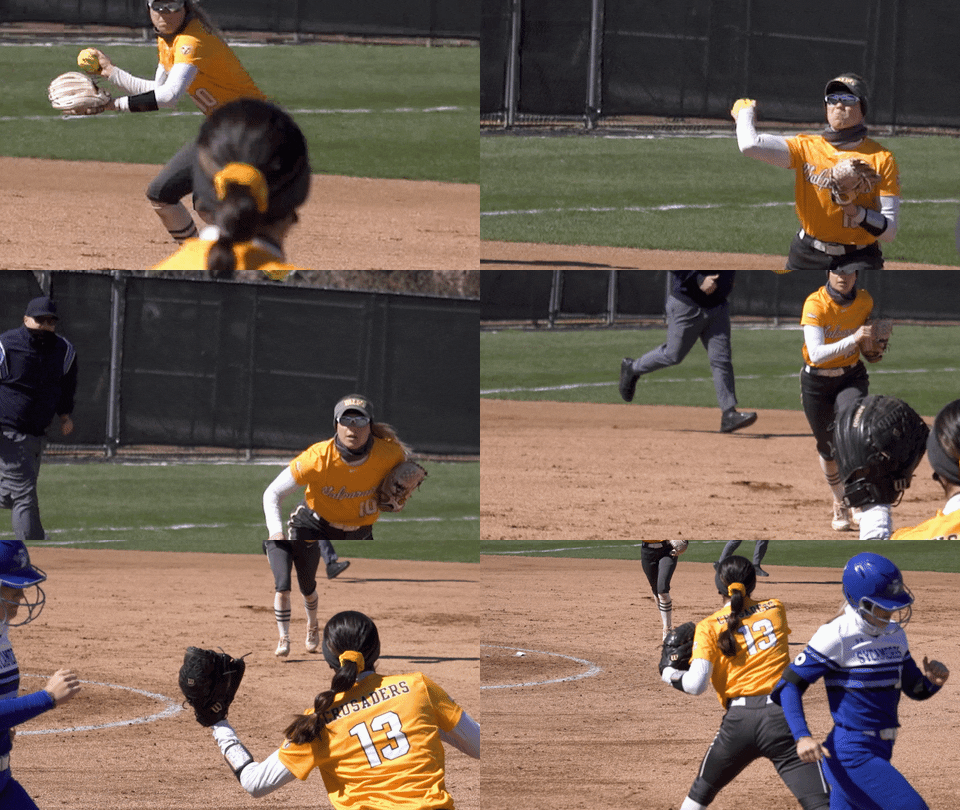
So how does a pitcher become that low-count, efficient pitcher? Really, it’s through a combination of the three S’s.
Sure, she needs some measure of speed with which to challenge hitters. But she doesn’t have to be overpowering.
One of the most effective pitchers I ever coached, a young lady whose pitch counts were typically in the 8 to 12 per inning range, never threw above 54 on my Pocket Radar. But man could she throw to a hitter’s weakness and make the ball move as well as change speeds while making every pitch look like it would be the same.
In other words, she could also spin and spot the ball. All three together were a deadly combination for her, even against quality hitters.
She wasn’t the flashiest pitcher you’ve ever seen, and she probably wouldn’t be the one most coaches would choose first if they were watching several pitchers throw in a line. But when the game or the championship was on the line, she was usually the one her team wanted in the circle.
Because she knew how to get hitters out, plain and simple.
There’s no doubt that overpowering speed is impressive, and it can often make up for deficiencies in other areas. Just ask all those bullet spin “riseball” pitchers.
But if you want to win more games, don’t make speed, or spin, or spot alone your only deciding factor.
Look for the pitcher who knows how to get hitters out, doesn’t matter how. She’ll make you look like a smarter coach.
Why Good Circle Visits Are So Critical to Pitchers’ (and Team) Success

One of the toughest decisions a coach has to make during a game is when to take a pitcher out. That decision is based on a lot of factors.
For example, it’s easier to leave a pitcher in a game to see if she can work her way out of trouble if the game doesn’t mean that much. On the other hand, if you’re in a big tournament, the pitcher is your #1 (and thus perceived to be your best chance at winning) and a loss means elimination, it can be very tempting to stick with her even if you know in your heart of hearts she’s done.
If you do decide the current pitcher needs to be replaced, however, one thing that shouldn’t be a difficult decision is deciding how to take her out. That should be handled by a circle visit, either by the head coach or the team’s designated pitching coach.
(ASIDE: If the pitcher is the head coach’s daughter, the visit should probably be handled by literally anyone else. That’s the voice of experience talking, folks.)

The reason I bring this up is I recently heard a story about a team where, when they want to change pitchers, there is no circle visit. The coach just sends the new pitcher out from the bench to tell the current one it’s time to take a seat.
That’s just wrong for so many reasons, not the least of which is the mental game wellbeing of the pitcher – a factor which will no doubt be of importance down the road. It’s also just rude.
A pitcher would have to be pretty unaware of her surroundings and what’s going on in the game to not realize she is struggling. I mean, if she’s walked the bases loaded in 12 pitches she probably has a pretty good clue that she’s not exactly on top of her game.
A circle visit gives the coach an opportunity to say, “Doesn’t look like today is your day,” or something to that effect.
If the pitcher was doing well up to that point the coach can say words to the effect of, “Looks like you’re having some trouble with the umpire. Let’s give her a different look and see if we can’t get out of this jam.” If she wasn’t, the coach can say something such as, “Rough one today. I think we need to change things up right now, but if you keep working there will be other opportunities.”
I’ve talked to many current and former players, and nearly all agree that girls are far more likely to think the worst of themselves and believe it when someone tells them they’re not very good. Even if they know it’s not true.
A few kind words when making a pitching change can help mitigate some of that thinking and bolster the pitcher’s base confidence level. And as we all know, confidence is a critical element to have when you’re playing the position that is most under the spotlight, and has so much impact on the team’s success.
But circle visits aren’t just for pitching changes. Getting out in front of problems, especially if they’re happening to your #1, can help you avoid having to make that tough decision later.
Sometimes when a pitcher starts to struggle she just needs a little positive reinforcement from the coach. Sometimes she needs the visit just to slow the game down and give her a chance to regain her composure, or her mojo. Sometimes she just needs to get out of her own head for a bit.
One time when one of pitchers was struggling I called time, walked to the circle, and said, “A horse walks into a bar and the bartender says, ‘Hey, why the long face?'” I then turned around and went back to the bench.
She was a bit stunned at first, I think, but then she realized my Dad joke was just a way of telling her A) don’t take all this too seriously, and B) you’re doing fine, just relax. It worked too – she pitched herself out of the inning with no more trouble.

A circle visit isn’t really a time to offer pitching instruction, although I was known to draw a power line or two in the dirt in my coaching days when I thought it would help. It’s a time to help pitchers deal with the mental side, whether it’s calming down so they can continue or softening the blow of taking them out so they know the situation is temporary, not permanent – and that coming out of a game mid-inning doesn’t make them a bad human being or a terrible pitcher. Everyone gets pulled sooner or later.
Now, I know at this point some of you keyboard warriors are thinking this point of view is soft, and that female pitchers need to not be such snowflakes. They need to toughen up Buttercup and just deal with it.
So for those who think this way let me ask you this: when was the last time you saw a Major League Baseball pitcher get taken out of a game without a coach coming out to the mound to do it? You can count those times on the fingers of one ear.
So if an MLB pitcher who is a fully grown adult and is getting paid millions, or tens of millions, of dollars per year to throw a ball needs a coach to come out and tell them personally that they’re done for the day, why shouldn’t a young or adolescent girl who is just playing for the love of the game be offered the same courtesy? Or a college pitcher for that matter.
If you’re a coach who is managing pitchers in-game, be smart about it. Get off your behind and talk with your pitchers when they need it – whether it’s to calm them down or make a change.
They may not like seeing you come out of the dugout but that feeling will be temporary. Because they will appreciate you showing you care about them as a person as well as a pitcher.
Champions Take Their Warm-ups Seriously

You see it before a game or practice everywhere there’s a ballfield.
Teams positioned in two opposing lines, randomly throwing balls in the general direction of the other line. And then chasing said balls behind them.
Hitters casually knocking balls off tees into the bottom of nets – or over the top. Pitchers sleepwalking through a reps of a K drill or slowly strolling through a walk-through instead of going full speed.
Not just youngling rec teams either. The same behavior can be seen with high school teams, travel ball teams, even college teams.
It’s players sleepwalking through warmups as if they are something to be (barely) tolerated before the “real thing” begins.
That’s unfortunate on many levels, but mostly for what it says about those players’ dedication and desire to play like champions.
You see, champions realize that we are a product of our habits. They also realize the importance of paying attention to details.
Warm-up drills should be about more than just getting your body moving and your muscles loose. They should also be preparing you to play or practice at your highest level.
So if you’re just going through the motions, waiting for practice or the game to start, you’re missing a real opportunity to get better.
Take that hitter who is basically just knocking balls off the tee before a game. Hopefully she knows what she needs to do to hit to her full potential, and what she needs to work on to get there.
So if she’s just taking any old swing to satisfy the requirement of working at that station she could actually be making herself worse instead of better because she’s building habits (such as arm swinging, dropping her hands, or pulling her front side out) that may let her get the ball off the tee but won’t translate into powerful hits in the game.
Or take the pitcher who is sleepwalking through her K drills instead of using that time to focus on whether her arm slot is correct, she is leading her elbow through the back half of the circle, and she is allowing her forearm to whip and pronate into release. She shouldn’t be surprised if her speed is down, her accuracy is off, and her movement pitches aren’t behaving as they should when she goes into a full pitch.
Even the throwing drills that often come right after stretching require more than a half-hearted effort. Consider this: as we have discussed before, 80% of all errors are throwing errors.
Which means if your team can throw better, you can eliminate the source of 8 out of 10 errors. Cutting your errors down from 10 to 2 ought to help you win a few more ballgames, wouldn’t you think? That’s just math.

Yet how many times have you seen initial throwing warmups look more like two firing squads with the worst aim ever lined up opposite of each other?
That would be a great time to be working on throwing mechanics instead of just sharing gossip. Not that there’s anything wrong with talking while you throw. But you have to be able to keep yourself focused on your movements while you chat.
Even stretching needs to be taken seriously if it’s going to help players get ready to play and avoid injury. How many times have you seen players who are supposed to be stretching their hamstrings by kicking their legs straight out and up as high as they can go take three or four steps, raise their legs about hip-high, take another three or four steps, then do the same with the other leg.
Every step should result in a leg raise, not every fourth step. And if young softball players can’t raise their feet any higher than their hips they have some major work to do on their overall conditioning.
Because that’s just pathetic. Maybe less screen time and more time spent moving their bodies would give them more flexibility than a typical 50 year old.

The bottom line is many players seem to think warm-ups are something you do BEFORE you practice or play. But that’s wrong.
Warm-ups are actually a very important part of preparing players to play at the highest level and should be treated as such. If you don’t believe it, just watch any champion warm up.
6 Ways to Take Advantage of the New Year

The holidays are over and the calendar has flipped back to January. I would say people are stressing over writing the wrong dates on their checks but who writes checks anymore?
Except the little old lady in front of you in line at the grocery store when you just want to buy a loaf of bread or a half gallon of milk and get on your way?
While in reality New Year’s Day is just an arbitrary date (as evidenced by the many different calendars, each with their own first day of the year), the idea of a new year does provide an extra incentive to think about doing things a little differently going forward.
So with that in mind, here are a few ideas of how you can shake things up a bit and make this your best softball year ever.
1. Get New Batting Gloves
I actually see this one a lot. Hitters go to put on their batting gloves and half their fingers are sticking out, or the palm looks like a surface map of the moon. Or the stench is so bad it hits from 15 feet away.

Batting gloves aren’t that expensive, at least relative to most equipment in fastpitch softball, yet they can save you from a lot of blisters and other issues during long practice sessions. Sure, your daughter should have asked for them for the holidays but she didn’t, because the only time anyone thinks about batting gloves is when they go to put them on.
Don’t be cheap. Pony up a few bucks and replace them. If your daughter is superstitious, tell her she can keep the old gloves in her bag, or her back pocket. Preferably in a sealable plastic bag.
2. Clean Out Bat and “Go” Bags
Over the course of a season, bat bags quickly become a dumping ground for old water and sports drink bottles, half-eaten fruit rollups, used bandages, team handouts, the occasional extra shirt or shorts, miscellaneous plastic wrappers and other detritus of the sport. Not to mention field dirt and those little rubber pieces from turf fields.
With games at a minimum right now, this is a good time to completely empty out the ol’ bat bag, throw or put away everything that doesn’t need to or shouldn’t be in there, and give the inside of the bag a thorough scrubbing to boot. Maybe at a car wash.
The same goes for parents’ gameday “go” bags and coolers. There’s a pretty good chance you have a few science experiments running in there at the moment.
Clean them out before the season starts to crank back up in earnest. Not only will it be healthier (and smell better). It might even make everything a whole lot lighter.
3. Do Some Research about Doing Research
There is a metric crap ton of information about how to pitch, hit, throw, run the bases, warm up, and perform a variety of other fastpitch softball-related skills on the Internet and in social media. Some of it is great, but quite frankly a lot of it is useless at best and garbage at worst.
How do you tell the difference?
Well, rather than just jumping on to the first thing you come across in a search (or while scrolling), do some research about who is putting out the information, such as:
- What is their background?
- How long have they been teaching?
- Do they seem open to new information or are they stuck in their ways?
- How do their students do overall? Not just their one or two best students but across the spectrum?
- Does what you’re reading/watching make sense to you? (You’d be surprised how many videos, especially on apps such as Instagram, actually seem counter-productive when you think about them, even if you don’t have any expertise.)
- Does what the source is espousing match up to what you see the best players in the world doing?
Taking the time to check the source and evaluate what he/she is saying can save you from taking a long, frustrating trip down the road to nowhere.
4. Challenge Your Current Beliefs
It’s very easy to fall into a rut, or assume that you already know everything (or at least enough) about a topic. Taking that attitude can prevent you from discovering a whole other world of knowledge that can make you even better.
Every now and then it’s important to look at information that challenges what you already believe. Especially when it comes to mechanics and general approaches to the game.
You may end up right back where you started, Which is ok – it’s confirmation you’re already on the right track.
But you may also discover techniques or approaches you’ve taken for granted, or that you learned when you were a player, are not quite as beneficial as you thought they were. You can then decide whether to continue blindly following what you’ve always done or make a change that will help you going forward.
Either way, you’ll have made an informed choice.
5. If You’re Taking Lessons, Attend a Non-Affiliated Clinic or Camp
Taking private lessons is a wonderful thing. Obviously I highly recommend them as the best way to make progress toward improvement.
But after a while even the best-designed lessons can get a little dull. They also usually have a limited perspective, even if you’re in a group lesson with 2-4 other players.
Going to a clinic or camp with a different instructor(s) can help in a few ways. Not the least of which is a different instructor may see something your current instructor doesn’t because of familiarity. After a while, we all tend to see what we’re used to seeing.
It also gives you a chance to see how you compare to others. That’s especially important for those who are really driven to be the best.
Sometimes in the drive to get to the next achievement we forget how far we’ve already come. A large group setting can show that while you’re still working on things, you’re actually ahead of the curve overall.

It can also show if you’re behind the curve, which may be an inspiration to those who maybe have trouble getting themselves up for practice sessions. Nothing like seeing where others are to get a player to say “I’d better get after this.”
Many of these clinics and camps are just one day, so it’s not a huge time commitment. But they can be enlightening.
Just be sure to do your research again before just signing up for any old camp or clinic. Make sure the instructors are going to be teaching solid mechanics and approaches or you could end up going backward instead of forward.
6. Do Some Non-Softball Stuff
These days all competitive sports seem to take up a LOT of your time. While you no doubt love it, and wouldn’t trade it for anything in the world, there IS more to life than softball.
This is the time of year to find out what the rest of life is all about. Read a book. Go to a museum or a concert or a dance performance. Watch a completely different sporting event, either live or on TV. Go bowling or ice skating or to a trampoline park (just be careful not to get hurt).
Doing something just for the fun of it will clear your head, reset your spirit, and help you get ready for the long grind ahead.
Make It a Good Year
None of what’s listed here is likely to cost you very much. But the return on investment will be huge.
There’s a reason the windshield is much larger than the rear view mirror. This time of year provides a great opportunity to leave the past behind, symbolically as well as literally, and focus on the road ahead.
Doing these little things will help you do just that.
New Year’s photo by Karolina Grabowska on Pexels.com






 Life in the Fastpitch Lane