Category Archives: Mental game
The Best Tryout Advice You’ll Ever Receive

Tryouts are beginning soon for high school fastpitch softball in many parts of the U.S., and with them comes all the anticipation, hopes, dreams, and yes, anxiety typically associated with trying to earn a spot on a team.
Plenty has been written about things you can do to improve your chances of making the team you want, such as hustling, going out of your way to talk to the coaches, taking chances by doing things like diving for balls and so on. Heck, I’ve written a few of them myself.
Today, though, I want to tell you about a secret most players don’t know that can help free them to show the coaches (or evaluators at an open selection event) what they can really do. If you’re a parent, guardian, or friend of a player, please be sure to pass this tip along to them.
Okay, are you ready? Here it is:
The coaches doing the evaluations want you to do well. In fact, they’re really hoping you do.
That’s right. They’re not standing there waiting for you to mess up or looking for things they can criticize to make you feel bad. Instead, they want you to look good.

How can that be, you ask? Why would they care one way or the other?
It’s simple: they have a need to fill or a problem to solve, and if you come out looking great they can fill the need or solve the problem without having to worry about it anymore. In other words it’s in their best interest for you to be awesome.
I actually had this epiphany while listening to the SmartLess podcast with Jason Bateman, Sean Hayes, and Will Arnett. It’s very entertaining as the three of them interview other celebrities and interesting people; it’s perfect for those long car rides to far-flung games and I highly recommend it.
They were talking about how nervous they would get as young actors auditioning for roles in movies or on TV shows. Then they started directing and producing, putting them on the other side of the audition table, and they realized their main thought there was “I hope this guy/gal is what we need for this role so I can move on to other things.”
It’s the same in fastpitch softball tryouts or evaluation events. The folks with the clipboards have X number of slots to fill.
They want to fill them with quality players as quickly as they can – players about whom everyone will say, “I see why they were selected.” So when you step onto the rubber or into the cage or on the field, they want you to be good.
They need you to be good. They are basically rooting for you to be good.
While I don’t coach teams anymore I can personally confirm from past experience that this approach is true. I never thought about it that way but yes, I hoped every girl I looked at would be awesome because it would make my job easier, especially when it came time to take the field in a game.
Now, I will say in many high school situations the term “tryouts” can be a misnomer. Often most of the team is already selected before the first day.
Still, there is usually a need somewhere, an open slot that needs to be filled for the team to be complete. The coach isn’t trying to eliminate those who can’t fill the spot; he or she is looking for the one person who can.

So when you step into the spotlight, don’t think or worry about the outcome. Focus on the process, which is going out there and showing the coach why you are the solution he/she is hoping to find today.
If you perceive the coach or evaluators as rooting FOR you instead of AGAINST you, you’ll stand a much better chance of setting any nervousness aside and performing to the best of your abilities. With the result of greatly increasing your chances of being selected.
Now go out there and show them what you can do! Good luck to all.
My good friend Jay Bolden and I have started a new podcast called “From the Coach’s Mouth” where we interview coaches from all areas and levels of fastpitch softball as well as others who may not be fastpitch people but have lots of interesting ideas to contribute.
You can find it here on Spotify, as well as on Apple Podcasts, Pandora, Stitcher, iHeart Radio, or wherever you get your podcasts. If you’re searching, be sure to put the name in quotes, i.e., “From the Coach’s Mouth” so it goes directly to it.
Give it a listen and let us know what you think. And be sure to hit the Like button and subscribe to Life in the Fastpitch Lane for more content like this.
Lead photo by Liza Summer on Pexels.com
Preparing for the Inevitble Storms

On this week’s episode of the From the Coach’s Mouth podcast, Jay Bolden and I spoke with Shawnee Harle, 2X Olympian with the Canadian Basketball National Team and now a Mental Toughness Coach with her own business called Winning Matters. While Shawnee had a lot of great insights into the mental game, there was one concept in particular that has been on my mind today: preparing for the storm.
Shawnee said that what most athletes and coaches miss is that there is always a storm coming – kind of like Florida during hurricane season. It’s not a question of if, but rather than of when.
Through experience, most people in Florida have learned that when a hurricane is on its way it’s best to put up the plywood over the windows, lock down anything that can be easily lifted (such as patio furniture), and lay in supplies such as food, water, toilet paper, and bandages so they’re ready for when the storm hits.

If it’s not that bad that’s ok – all they lost was a little time and a little storage space for supplies they didn’t need after all (but can use later). If it is bad, however, they have what they need to get through it until the storm passes and things get back to normal.
Unfortunately, many coaches and athletes like to pretend that the storm isn’t going to hit them. “I’ve put in the work,” they say, or “the negatives won’t hit me if I just stay positive.” But that’s a fool’s position.
According to Shawnee, the storm hits everyone sooner or later. Pitchers have a rough outing or two, or suddenly lose their best pitch for no apparent reason. Hitters go into slumps out of nowhere.
Catchers suddenly can’t throw baserunners out or start having pitches they’d normally catch glance off their gloves. Fielders start making fielding errors or sailing balls high instead of throwing to the base.
No one knows why the softball gods suddenly become angry and throw their wrath at a particular player. They just do, and it happens to everyone.
So knowing that, the question is what are you doing to prepare yourself (or your players)? Have you thought about how you’re going to deal with it and get back on track or are you going to allow yourself to get caught by surprise and then try to ride it out?
Now, some coaches will take the “Suck it up buttercup” approach. They see a problem and think if they tell players to “toughen up” or to “get your head in the game” they will solve the problem.

In reality, they will most likely make it worse.
The better approach is to heed the old saying “In times of peace, prepare for war” and start getting your mental game toolkit together before you need it. Just like smart Floridians gather up their supplies ahead of the hurricane rather than during the middle of it.
There are plenty of resources out there that can help you learn how to prepare for the coming storm. A mental toughness coach such as Shawnee is certainly a good one, especially if you’re playing on a bigger stage where the pressure is extreme.
But there are plenty of self-help options out there. The book Heads-Up Baseball: Playing the Game One Pitch at a Time is a great starting point in my opinion. It’s easy to follow, with great exercises that help you learn to control yourself and understand what else you can or cannot control.
There are many other books, videos, and training tools as well, all designed to address the storms that are inevitable in sports as well as in life.
The key, though, is not to wait until you’re facing the storm but to get out ahead of it. You wouldn’t suddenly try to learn how to hit or pitch or perform any other skill in the middle of a season.
You shouldn’t wait until you’re in the middle of a crisis to try to develop the skills you need to get out of one either.
If you polled 1,000 coaches and athletes and asked them how important the mental game is to success, I’d bet the overwhelming majority, like 90%+, would say “very important.” Ask that same 1,000 how much time they spend on it, though, and you’d probably get an answer of 5% of their time or less.
Face the facts: the storm is coming. It might not be today, or even tomorrow, but sooner or later it will hit. Start preparing for it now and you’ll find you’ll get through it faster and stronger.
The Importance of Intention in Achieving Fastpitch Success

As a private instructor, one of the questions I often get from parents of new students is, “How much should my daughter practice?” While well-intended (see what I did there?) the question is usually a tipoff that said new student generally doesn’t practice very much and the parent is looking for someone who isn’t them to make their daughter practice more.
My answer typically is, “As much as it takes.” I say that because practicing is not a time-based phenomenon. It’s goal-based.
Yes, it would be nice if you could quantify practice into increments of time, such as practice three times per week for a half hour and you will be great.
The reality, however, is it doesn’t quite work that way. Because basing practice on the amount of time ignores an essential ingredient to success in fastpitch softball, or any other endeavor for that matter: intention.
When you perform whatever skill it is you’re working on in practice or a game, you have to have an intention to do it at the highest, most focused, most energetic level you’re capable of on that particular day. The measurable outcomes will vary from day to day depending on factors such as whether you’re tired, hungry, stressed, injured, happy, inspired, “in the zone,” etc.
But the intention to do your best with whatever you have that day should always stay the same. Anything less and you’re basically cheating yourself.
Think of it this way: your ability to execute in a game is greatly affected by how you execute when you’re working on those skills.
If you base your practice on time alone it’s easy to walk through the motions without putting any major effort in. Ask any kid who was forced to take piano lessons from 150 year old nun who seemed to go out of her way to find the most uninteresting music every written for her students to play. Sorry, just had a traumatic flashback.

Back to our topic, let’s take a pitcher who is supposedly trying to increase her speed. Sure, she’s going to a pitching lane three days a week with her mom or dad and throwing for an hour.
But how is she throwing? Is she just throwing pitches from full distance in a way that is easy for her? Or does she have the intention of throwing harder and thus is doing things that might be less fun and less comfortable for her, such as working on her arm whip from a close distance into a net or trying to improve her leg drive by exploding out as quickly as she can without the ball?
Is a hitter just swinging the bat and knocking 100 balls off the tee because she heard somewhere that to improve you should take 100 swings a day? Or is she focused on trying to get her sequence correct and feeling the energy flow up through her body and out her bat with the intention of seeing the ball fly off and hearing a resounding crack?
One might drive minor improvement through sheer volume. The other will take an average or even good hitter and help her become a great hitter in a shorter amount of time.
That’s what having intention is all about. It’s not just about putting in time to check the box.
It’s about putting in real work to ensure that when the game is on the line you’re prepared to perform at the highest level of which you’re capable.
That doesn’t mean everyone has to practice like a maniac. If you’re playing softball for fun in your local rec league and not really too concerned about how you perform overall you don’t need to bring a whole lot of intensity to your practice routines.
As long as you’re doing something a couple of times a week you’ll probably improve enough by osmosis or sheer repetition to perform at an adequate level.

But if you’re a youth player and your goal is to play in college, or win a high school state championship, or dominate in travel ball (even if you don’t plan to play in college), or win one of the big tournaments, you need practice with intention.
If you’re already a college player and your goal is to get off the bench, or win a conference championship, or play in the Women’s College World Series, you’d better be bringing a whole boatload of intention not just to every practice but to every rep you take during that practice. Because if you don’t, someone else will, and they’ll be getting all the glory while you’re stuck watching from the sidelines.
The good news is intention is something you have complete control over. All you have to do is decide you want something bad enough and then put in the effort to get there. It doesn’t cost a cent and it’s readily available whenever you want it.
If you really, truly want to get better and become whatever qualifies in your mind as a top player, don’t just go through the motions and put in the “required” time. Starting cranking up your intention to perform at the highest level you can manage every single day and you’ll find improvement comes faster and more easily.
Book Recommendation: “Crunch Time”

We’ve all seen it or experienced it: the player or coach who is great in practice (aka a cage warrior) and seems like he/she should be a star, only to struggle when they get into a game. It’s frustrating to watch, especially because the breakdowns often seem to happen at the worst possible time, yet helping them break free of that mindset can be extremely challenging.
Fortunately I recently read a book that addresses this very issue. It’s called, “Crunch Time – How to Be Your Best When It Matters Most” by Rick Peterson and Judd Hoekstra.
If you’re not familiar with them, Rick Peterson is currently Developer of Pitching Development for the Baltimore Orioles, was the pitching coach for the Oakland A’s during the “Moneyball” era, and is considered one of the top pitching coaches in all of Major League Baseball.
Hoekstra is a bestselling author of books on leadership as well as a vice president at The Ken Blanchard Companies, a consulting firm that specializes in training business leaders at organizations of all sizes. Pretty good pedigrees for both authors.
While the book’s lessons apply to a general audience rather than specifically to baseball or softball, it definitely speaks to the challenges players and coaches face when challenged to perform under extreme pressure. The nice thing is it’s a pretty quick read too; I finished it cover-to-cover while on a 4.5 hour flight coming home from vacation.

The central theme of the book is that when you are facing a difficult situation you need to reframe it in order to manage the stress and allow yourself to perform the way you know you can. In other words, instead of seeing that difficult situation (such as an at bat where the game is on the line) as a threat, view it as an opportunity.
So in that example, the immediate threat is losing the game if the player doesn’t perform well, i.e., get a hit. But the underlying threats are that coaches and teammates will be mad at the player, the player might get benched, teammates won’t want to associate with the player, one or more parents might be angry with the player, the player will be embarrassed, etc.
The result is the player gets so caught up in potential consequences (especially if he/she has faced this situation before and failed) that he/she freezes up and it becomes a self-fulfilling prophecy. It’s difficult to perform at a high level when you’re paralyzed with fear.
After explaining the need for reframing the authors then get into several techniques to accomplish this task in subsequent chapters, including:
- Reframing from trying harder to trying easier
- Reframing from tension to laughter
- Reframing from anxiety to taking control
- Reframing from doubt to confidence
- Reframing from failure to learning moment
- Reframing from prepared to overprepared
Each chapter not only talks about the techniques but offers anecdotes from the authors’ experience of how they were applied. For example, Peterson talks about making mound visits during MLB games where he used humor to help a pitcher put what was happening into perspective, allowing him to get past an initial walk and single in order to strike out the heart of the opposing lineup and get out of the inning.
One of the nice things is that unlike many “mental game” books, applying the lessons in “Crunch Time” doesn’t require going through a plethora of exercises in order to master the techniques. It’s more of a philosophical approach presented in a simple form that makes it easy to grasp the lessons so you can begin applying them right away.
While I’ve been talking about how coaches can use the lessons in “Crunch Time” to help players, they can also use it to help themselves become better coaches at critical points of the game.
In that way it reminds me of a story legendary football coach Bill Walsh told in his book “The Score Takes Care of Itself.” Walsh was one of the first if not the first to develop the laminated play calling sheets all football coaches now have with them throughout the game, and was lauded as an innovator for doing it.
Yet in his telling, the reason he did it wasn’t because of some stroke of genius. It was the result of him having trouble making quick decisions under pressure. By creating the play calling sheets when he was calm and reasoned, i.e., before the game, he could just look at what he figured out already and just follow it, relieving the pressure of those in-game, critical decisions.
The lessons of “Crunch Time” can help in the same way. Take the international tie breaker, probably one of the most high-pressure situations in softball coaching because often any minor miscue or poor decision can lead to the loss of the game and possible elimination from a tournament or conference championship.
Rather than viewing a loss as a threat, by reframing it as an opportunity (we’ve prepared well for this situation so we have an advantage over our opponents who are clearly nervous about it) coaches can make strategic decisions with confidence, knowing their teams will execute, and can convey that sense of confidence to the team to keep them from being rattled and making those types of mistakes.
As I said earlier it’s a pretty quick read but there’s a lot of great thinking contained within the content. If you’re looking for techniques to help your players perform better, and/or ways to help grow your own coaching abilities, I recommend you pick up or download “Crunch Time.”
Remember to Celebrate Progress and Successes

The other day I went to visit a healthcare professional (HP). Nothing serious, just basically checking a box for the insurance company.
Anyway, we were talking about some lifestyle changes I’ve made to try to stay healthier longer. Yet it seemed like every time I told the HP about some improvement I’d made she countered with I should be doing this or that too.
It was kind of frustrating, because rather than feeling encouraged to continue doing better I was made to feel like no matter what I did it would never be good enough. The focus would always be on what more I could do or should be doing.

That experience got me to thinking about how we coach our fastpitch softball players. (Take that Google algorithms.)
Often times we coaches are so focused on trying to get our players ready for “the next level” (whatever that is) or trying to make them look just like the players we see on TV that we fail to acknowledge all the great work they’ve done to get themselves to this point. And that can be just as discouraging as my experience with the HP.
That’s why it’s important every now and then along the journey to stop and take a look backward even as you’re trying to look ahead to the next goal. Showing a player how far she has come can give her a real boost to continue putting in the work to keep moving forward.
Let’s take a hitter who has been working on her swing. Honestly, I get a fair amount of students whose only goal (or their parents’ only goal for them) is to not strike out every time they come to bat.
Mom and/or Dad aren’t looking for little Amelia to hit home runs or have the highest batting average on the team. They’re simply hoping she doesn’t get totally discouraged from playing because she wouldn’t hit water if she fell out of a boat.
They don’t want to have to cringe every time she comes to the plate, but that’s another story.
So Amelia gets help from a coach or instructor, fixes whatever was causing her to just randomly swing the bat and hope she hit something, and now she’s making contact with greater regularity and getting on base now and then. At which point the goal becomes to start hitting the ball to or over the fence.
That’s great that everyone wants Amelia to keep growing and improving. But maybe in the midst of all that take a step back to appreciate the fact that the original goal has been met and let Amelia feel good about what she has accomplished so far – at least for a few minutes.
Video is great for that, by the way. Even if Amelia isn’t quite getting on base often enough, showing her a video of how she used to swing the bat versus how she is swinging it now will probably help her build confidence and continue to focus on the process instead of the outcomes.
Then let the law of averages take care of the rest.
It’s the same for pitching. Maybe you have a goal of having a pitcher throw faster, or throw more strikes. Or both.
Regardless of the goal, the path to achieving it starts with improving her mechanics.
So perhaps when she started out she looked less like she was trying to pitch and more like she was trying to fold a fitted sheet.

Showing her a video of how she used to look versus how she looks now might give her some encouragement that she’s on the right track, even if the radar isn’t reflecting it or she’s still throwing a few too many in the dirt. That doesn’t mean you still don’t want to hold her to a higher standard.
But you can acknowledge the fact that she is improving so she has something to feel good about while she works toward the bigger payoff.
All of this doesn’t mean you should provide false praise just to spare the player’s feelings. If she’s not putting in the work and showing improvement that needs to be called out. Otherwise, what’s the point?
Often, however, we are in such a hurry to get to the ultimate goal (being names an MVP, making a particular team, winning a scholarship, etc.) that we don’t take the time to appreciate the progress that’s already been made.
So think about that today. If you’re a coach, what can you do to recognize how much better your players are today than they were a month ago, or three months ago, or a year ago, etc.?
If you’re a parent, what can you point to that lets your daughter know you are proud of how far she has come so far? Even if she still has a ways to go.
That little bit of encouragement may be just the thing your player needs to keep grinding – and build a level of confidence that will carry through not just her softball career but her whole life.
5 Positives to Not Being Invited Back

Right now the tryout season for next year is winding down in many part of the country – and beyond. That’s hard for an “old school” coach like me to conceive since I know of many teams that are still playing in various “National” tournaments with this year’s players,
But such is the reality of today’s fastpitch softball world.
For many next year will look pretty much like this year, i.e., same players (more or less) and same coaches. But for some, this is a time of heartache and tears because they’ve been informed that, despite having a tournament or two left to play right now, they are not being invited back to the team next year.
It’s difficult in any situation in life to hear you’re not wanted anymore by the people you’ve given your heart and soul to. If you’re a young, competitive athlete it can be particularly difficult.
So for those in that situation right now let me share a little secret: this may not be as bad of a thing as it seems right now.
Yes, it hurts not to be wanted. But this involuntary change of scenery might actually offer you one huge advantage – a clean slate with which to start over with no history or expectations.
Allow me to share a few of the positives this opportunity presents.
Positive #1: You’re not stuck in someone’s impression of you
It’s an unfortunate fact of life that once a coach decides who you are and what you can do that view never changes. Never mind that you worked hard over the offseason to improve your skills or increase your speed or build your strength.
For too many, the impression they got when you first joined the team is the impression you’re stuck with going forward.
On a new team you get a do-over. Even if that coach has the exact same issue – his/her first impression is the one you’re stuck with – you have that rare opportunity in life to create an all-new first impression.
In other words, wherever you are now is how that coach will see you rather than where you were a year ago. If you really put in the work you may find you’re rewarded better on the new team than you would have been on the old one.
Positive #2: Extra motivation
There is something to be said for revenge or an “I’ll show you” attitude to keep a player motivated on improvement throughout the long, boring offseason. There’s a pretty good chance you’re going to see your old team on the field, this time as an opponent.
What better way to get the better of the situation than to perform well, contribute to your new team’s victory, and show the old coaching staff what they missed in letting you go?

Now, I’m not saying you need to be mean or nasty about it. You don’t want to go into negative territory.
But there’s a pretty good chance that more has been accomplished in all fields in life by people who were once told they weren’t good enough to stay where they were than those who were safe and comfortable. If you’re a competitor at all, not being asked back should be all the fuel you need to kick your dedication and training level up or a notch or two.
And even if you never get a chance for that revenge game, the improvements you make in preparing for it will carry over to every other game in which you compete. Which is pretty cool by itself.
Positive #3: New opportunities
Sometimes moving to a new team can create opportunities you might never have gotten with the old team.
Perhaps the coach of the old team has a batting order he/she likes and never changes. Moving to a new team and proving yourself could give you the opportunity to hit higher in the lineup and get more at-bats. Especially if the coach bases his/her decisions on the stats instead of gut feel.
Or maybe you’ve always fancied yourself a shortstop but that position was already taken by one of the best to ever play the game. You’re not going to displace her no matter how good you are or how hard you work, whereas a new team will welcome your skill level at that position.
Having opportunities is particularly important for pitchers. So if you weren’t pitching much on the old team because you didn’t hit your spots or couldn’t match the others for speed, a new team with greater need at that position just might give you the opportunity you need to develop under game conditions – simply because they don’t have much choice.
All you can ask for is the opportunity to do whatever it is you want to do. The rest is up to you. But at least with the new team there could be more of a chance of getting that opportunity.
Positive #4: An overall better fit
Maybe you joined your old team because they had a great reputation for being the best in the area. But then you found out one of the reasons they’re the best is they are better at convincing already-developed players at coming to them than they are at developing players themselves.
Or maybe you enjoy being a multi-sport athlete while the rest of the team (and the coaches) are more about all softball all the time. As a result, you missed some games for your other sport(s) which caused you to have to sit the bench as punishment for choosing that sport over softball, even if the other sport was in-season and softball was not.

Or maybe the culture of the team was win at all costs, even if it means cheating or hurting your opponents on purpose while you’re more oriented toward playing a clean game.
Whatever the issue might be, you know in your heart of hearts that the old team wasn’t a good fit for you as a person, even if it was a good fit as an athlete. In that case, they probably did you a favor.
You can now find a team whose culture and attitude is a better fit for who you are and who you want to be. With a little distance you may even find that they did you a huge favor by not asking you back; sometimes it’s tough to see the negative behaviors when you’re in the middle of them.
Positive #5: Meeting new people and making new connections
It’s easy to get caught in a sort of closed-loop system, especially in today’s fastpitch softball world where you play so many games and have so many practices that your experience of the world outside your current team is limited.
By moving to a new team you may discover things or people you never knew existed. For example, you may find a skills coach (pitching coach, hitting coach, etc.) or a trainer who can elevate your game tremendously because one or more of your teammates goes to him/her.
You would have never known about that person had you stayed where you were. But this type of serendipity could end up leading you to skills and abilities you never knew existed within yourself.
The same goes for the other players. You may discover a friend for life you would have never known about had you stayed where you were.
Or you may find the way the players on this team approach the game is more in keeping with how you think of it, leading you to have a better overall experience. With a net result that you keep playing long after the attitudes on the old team would have driven you out.
Darkest before the dawn
Not being asked back to the team who already knows you can be tough on the ego and the psyche. It can make you feel like something is wrong with you, or cause you to think that you are somehow “less than” those who were asked back.
Don’t let that kind of thinking creep into your head. Just accept that there are many paths forward, and that what seems like a trauma right now could end up being the best thing that ever happened to you.
Keep a positive attitude, find that new team, and remind yourself that a year from now whatever sadness or hurt you’re feeling today will be little more than a bump in a much longer, better road for you as a player.
Now get out there and kick butt!
Heading photo by Karolina Kaboompics on Pexels.com
Surviving “One More” Syndrome

Friends, today we are gathered to address one of the most dreaded issues in all of fastpitch softball practice. Of course, I am talking about “One More” Syndrome.
It’s an issue that affects nearly every player at all levels at one time or another. You may not know it by name, but you know its effect.
There you are, working on hitting, pitching, fielding, or some other skill. You’ve had a very successful session when the coach (or a parent) announces “one more,” as in one more pitch to a hitter, one more ground ball to a fielder, one more rep of a particular pitch.
Suddenly it is as if you’ve never seen a softball before in your life, much less have hit, caught, or thrown one. Whatever skill you were executing with tremendous ability has completely abandoned you, leaving you flapping around the field like a drunken penguin.

This is a topic that came up during a lesson last night with a pitcher named Brooklyn. She was cruising along pretty well working on her changeup when I said, “Ok let’s throw one more” – at which point she totally tanked the pitch.
Brooklyn looked at me, smiled, shrugged, and asked, “What is it about saying one more that makes things go bad?” I had to admit I didn’t know, but it does seem to happen a lot. That’s when we came up with the idea of One More Syndrome.
So what can you do about it? One thing is not to put too much worry into it.
For whatever reason, this seems to be a very common affliction. If it was odd that would be one thing. But it pretty much happens to everyone sooner or later.

If you really want to put a stop to it, though, your best bet is probably just not to think about the fact that it’s the last whatever. Just treat it like one more rep and you’ll most likely be fine.
Worst case, just ask the coach or parent not to announce it’s the last one – at least all the time. That way you can work up to the mental toughness not to be affected so you can keep things moving along quickly.
“One More” syndrome is real. But it doesn’t have to be a terrible issue.
Just laugh about it and get on with your practice. Eventually you’ll get to the point where hearing “let’s do one more” will be just another ordinary phrase.
Coaches: Remember What You Do Makes A Difference
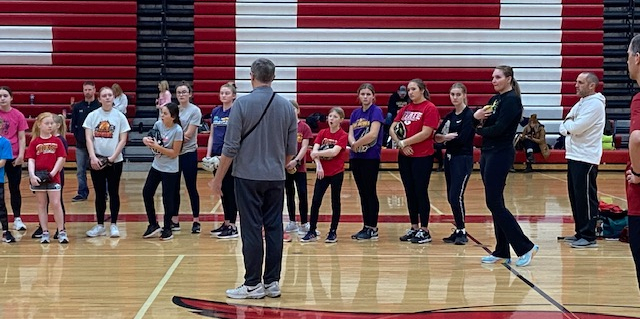
Coaching fastpitch softball can be a grueling grind. The seemingly never ending games, practices, organizational meetings, fundraising concerns, educational seminars, late night calls from concerned parents. etc. can all take their toll after awhile.
That’s why coaching burnout is such an issue and threat to everyone who is crazy enough to grab a clipboard (or tablet) and step onto a fastpitch softball diamond.
It’s easy to become overwhelmed by the sheer volume of work, not to mention the intensity of trying to help 12-15 players become the best versions of themselves as athletes and human beings. That’s a huge responsibility.
But underlying all of that is something else – something embodied in a great scene in the movie Star Trek Generations. (If you’re not familiar with it, this was the movie that handed off the film series from Star Trek the Original Series [TOS to you Trekkers out there] to Star Trek: The Next Generation [TNG]. I so rarely get to use the [square brackets] so what a treat for me.)

This scene takes place shortly after TNG’s Captain Picard runs into TOS’ Captain Kirk in a place called The Nexus, which is sort of a Field of Dreams for sci fi. In it, Captain Picard has been trying to convince Captain Kirk to come back to our reality and help him stop the bad guy who is killing billions of people in his attempt to get back into The Nexus.
At first Captain Kirk turns him down because he is perfectly content in The Nexus. No surprise there because it’s where your life can be whatever you want it to be.
But then Captain Kirk has a realization. (It takes a minute to get to the payoff in this clip but it’s worth it, trust me.)
If you didn’t bother to watch the clip, or weren’t able to, Captain Kirk’s realization is that while he was in Star Fleet he could make a difference in the world. Since he left, though, nothing he does really matters that much.
That’s what coaching enables you to do – make a difference in the lives of your players. And by extension their families.
None of us knows what goes on behind the scenes in the lives of others. So it’s easy to assume that everything is all hunky-dory with them, and that the face you see is indicative of what’s happening “under the hood.”
That may not be the case, however. I can’ remember who originally said it, but I once saw a statement that admonished coaches to remember that their practice might be the best part of their players’ day.
Maybe the player is struggling in school, or had a fight with her parents. Maybe she’s being bullied, or has had a close friend abandon her.
Maybe there is some food or housing insecurity in her family, or a favorite pet is on the brink of crossing the rainbow bridge. (Don’t click the link if you are in public and susceptible to emotional demonstrations.)

There could be hundreds of different things happening in your players’ lives. But when they get to your practice or game they have opportunity to set all of that aside and do something that makes them feel good about themselves and their lives, providing you’re doing it correctly.
The guidance you provide in helping your players overcome various softball hurdles is very likely to carry forward into the rest of their lives.
As a result, you can help a shy kid learn to make friends. You can help a kid who is always down on herself or feeling she isn’t good enough develop self-confidence.
You can help a kid who always follows the crowd (for better or worse) step up and learn to become a leader instead. Or at least learn to make better decisions rather than succumbing to peer pressure.
You can help a kid who has always been coddled and over-protected by her parents learn to manage adversity. You can help a kid with behavioral issues learn to work in a team setting.
You can help a naturally lazy kid develop a work ethic. You can help a kid who over-thinks everything learn to let go of her conscious thoughts (and fears) and trust her gut.
You can help a kid who feels like a failure learn what it’s like (and what it takes) to succeed. You can help a kid who feels unloved and unwanted at home to feel like she’s part of a family of sorts.
You might even prevent a kid from doing harm to herself or others. All while you are helping those kids learn to catch, throw, pitch, and/or hit a softball.
In other words, you can make a difference.
And you never know the ripple effect of making that difference either. Perhaps that kid you helped in some way goes on to cure cancer, or improve the environment, or become an elected official who enacts policies that make everyone’s life better.
Or even becomes a coach herself someday and pays what you did for her forward. Or maybe just grows into a great human being who has a family and/or contributes to society in some small but meaningful way.
All because you were there as her softball coach, making a bigger difference than you could have possibly realized.
Yes, coaching fastpitch softball, like any sport, can be a grind after a while. You definitely need to pay attention to your physical and emotional wellbeing if you’re going to help others. Just like how on a jet they tell you to put on your oxygen mask before you try to help others.
But when things get tough, keep in mind how empty your life would be if you weren’t coaching. Because as Captain Kirk says, while you’re in that chair you can still make a difference.
Make that difference for someone today.
Fear of the Ball? They’re Not Wrong!

Every coach knows that being afraid of the ball, whether said ball is being hit, pitched, or thrown at a player, is one of the greatest performance-killers. It’s kind of like Maslow’s Hierarchy of Needs: players need to feel safe before they put all their energy into whatever activity it is they’re trying to do.
Those who have coached the littles know exactly what I’m talking about. You can see it when they step sideways to catch a thrown or fly ball, or automatically back out of the batter’s box when they’re hitting, or do the “matador” as they try to field a ground ball.

This isn’t just a problem with the littles, however. Many older players also harbor some level of fear of the ball; they’re just better at hiding it.
The typical coach reaction when these things happen is to yell at the player to “stay in there” or “stay in front of it.” But given a choice between being yelled at and actually feeling physical pain, it’s pretty obvious what their subconscious is going to opt for.
I think the thing coaches with players who are afraid of the ball have to acknowledge is that in many or even most cases those kids aren’t wrong. If the ball hits them instead of their bat or glove, it’s going to hurt. That’s just science.
So if you want to get your daughter or your players past moving away from the ball preemptively it’s going to take more than telling them “don’t do that.” Here are some tidbits that may help you with that task.
The Fear Is Often Worse Than the Reality
A lot of the kids who are afraid of the ball haven’t necessarily experienced the pain before. Their brains are simply making assumptions based on other past experiences.
Take a hitter who backs out of the box when the ball is pitched. She’s never been hit by a pitch before. But…
She has been hit by other flying objects before. Maybe a sibling threw a toy at her with sufficient force that it caused bruising or bleeding.

She also knows from picking it up that the ball is hard. So even though she has never actually been hit with a ball while hitting she is afraid of similar pain.
Once she has been hit by the ball, however, she’ll then have a frame of reference for it and it won’t seem so bad after that.
Does that mean you should throw balls with the intention of hitting your players? Of course not. But you can toss them lightly into their arms to help them start overcoming their fear.
You can also give them some incentives. When I pitch to girls who like to automatically step back I tell them if they do it again I will start throwing behind them, and may even toss one back there (lightly) to give them more reason to stay in.
If you’re going to do that, however, be careful. I have hit one or two unintentionally because I didn’t get it far enough behind them. It worked to solve the problem, but it’s not exactly the way to build the player-coach relationship.
Take the Reason for Fear Out
Most of the time a fear of the ball is driven by a lack of confidence that the player can avoid being hit. She feels like she doesn’t have the skills to catch the ball, for example, so she sidesteps to avoid any mishaps that may result from that lack of skill.
The solution here is to give them something less threatening to work with. For example, have players who are afraid play catch with foam balls like a Jugs Lite Flite ball.
The light weight and softer texture will make the entire process less threatening to them. And unless they’re hit right on the nose by a hard-thrown ball at close distance – something you should control in practice – being hit by the ball won’t produce any pain.
When they realize that they will be less inclined to bail out right away, enabling them to build proper skills so they are more confident when a real ball is introduced again.
SIDE BENEFIT: The lighter weight will also encourage them to adopt better throwing mechanics because you don’t need as much strength to throw them.
Be Smart With Practice Reps
One of the temptations coaches have when hitting ground balls is to hit them as hard as they can so the girls “are ready” for hard-hit balls in games.
The problem is, an adult coach (male or female) can hit a ground ball a lot harder than a 99% of 10 year olds will at that age. So rather than teaching their players to get in front of the ball and move into it, they’re teaching their players to sit back and try to avoid getting nailed with the ball.
This approach not only instills fear, it also teaches them to wait on the ball rather than charging it if it’s not hit hard. I don’t know how it is where you live, but the majority of ground balls in a 10U game in my area require being charged.
A better approach in my opinion is to start easy and let them build the confidence in their glove skills – especially if you’re playing on a dirt field that hasn’t been laser-leveled and groomed. Then gradually build the speed until it’s realistic for what they’re going to face.
You might even want to start by rolling balls to them rather than hitting them so they can put their entire focus on learning how to field and make the throw properly. THEN get into hitting them.
This isn’t just for the littles by the way. College and even national team-level teams do this all the time to refine their skills.
Obviously they’re not dealing with fear of the ball at that level (at least hopefully not). But this approach works for both.
Acknowledge the Fear
As an adult it’s really easy to think players should just ignore their fear of the ball. You have 2X, 3X, maybe even 4X as much experience dealing with the issue.
But try to think of it from your players’ experience. As mentioned above, maybe they’re never been hit and so have built the outcome up in their minds more than the reality will be.
Maybe they have been hit and it’s the worst pain they’ve experienced so far in their young lives. You know may know that getting by the ball is nothing compared to a kidney stone or an automobile accident injury, but they don’t. It’s all a matter of scale.
Whatever the reason, it’s not a monster under the bed you can tell them to ignore. It’s very real.
Be understanding and help them work through it little by little. If they feel safe with you they’ll overcome the fear quickly – and could turn out to be your best players in the long run.
Throw It Like You Know It

So, you’re a fastpitch pitcher and you’ve added a new pitch to your arsenal. You’ve worked weeks, or months, to learn the nuances and perfect it to the point where you throw it pretty reliably in practice.
But then, when you go to trot it out in a game, it turns into a hot mess.
If it’s a drop ball it rolls in like you’re playing bocce ball. Changeups go sailing high and wide, riseballs go over the backstop, and curveballs end up forcing your catcher to lay out after them like a wide receiver catching a pass from the third-string quarterback.
So what happened?
There’s a pretty good chance the problem isn’t from the neck-down; it’s from the neck-up. Because instead of just relaxing and throwing the pitch you practiced, you got nervous that it wasn’t going to work and started tying yourself in knots trying to make sure it did.

How did that work out for you?
That’s why, when you go to introduce a new pitch to your gametime routine, you need to clear your mind of thoughts about it being your first time, you hope it works, it was really bad last time, etc. and just throw it like you know it.
There’s a pretty good chance if you’ve been pitching for a while you don’t think much about throwing your fastball – or whatever your base pitch is. You’ve done it thousands of times by now, and you already know you can do it.
Doesn’t mean it will be perfect every time – no one’s is, not even the high-level pitchers you admire. But you’re not worried because you know if this one doesn’t work quite right the next one will.
Well, it’s the same with a new pitch. Let’s take a changeup.
You told your coach you’ve been working on it and want to throw it this game. You’ve gotten the speed and location to be right in practice but have little to no experience with in games.
When the call comes in, however, your muscles tense, your mouth gets dry, and you start to breathe a little harder and more rapidly.
There’s really no reason for that reaction, however. First of all, hopefully your coach is smart enough to call it in a situation where the outcome doesn’t matter, such as no one on base and you’re ahead in the count 0-2 or 1-2.
At that point, what’s the worst that can happen? You throw a ball and it’s now 1-2 or 2-2. You’ve thrown balls before with the fastball, so why should this particular one be treated any differently?
Oh, but you’re worried you’re going to embarrass yourself by rolling it in or sailing it over your catcher’s head. So what’s the difference here?
The count is still 1-2 or 2-2, just as it would be if you had barely missed the strike zone. No runners advanced, no one walked, a shadow didn’t fall upon the earth, seas didn’t begin to boil, the ground didn’t rupture. no one died. It’s just a ball.

Only now you’ve thrown one in a game, you know a little more what it feels like, and you’ve just taken another step forward in your pitching career. Someday, when throwing a changeup is as natural to you as breathing, you’ll probably laugh about it.
So given all that, why worry about it at all?
The better approach is to pretend like you’ve been throwing this new pitch for years and just chuck it in there – i.e., throw it like you know it. With a more positive approach like that you’re far more likely to have success, and avoid all the negative outcomes you were worried about originally.
By the way, this concept isn’t just for pitchers. Hitters should apply their new hitting mechanics rather than relying on their old ways.
Slappers, particularly converted righties, should go after their slaps as if they’ve been doing it for years. Fielders should try that new sidearm tilted toss as though it’s been part of their routine all along. And so on.
If you take the “throw it like you know it” approach you’ll find you build your confidence quickly and your game will improve exponentially. You’ll also find you’re having a lot more fun in the process.






