Monthly Archives: August 2025
Fall Ball Is a Great Time to See What You Have

It seems like only yesterday that the summer travel ball season was getting started – and teams were already promoting open workouts and private tryouts for the next season.
Well, next season is now officially upon us, and with that comes fall ball games. Back when I was coaching teams, fall ball usually meant one practice a week, a couple of double headers (if you could find another team that wanted to play), and maybe a tournament or two if you could scrape up enough players who weren’t committed to fall sports at their schools.
Nowadays for most teams, though, practices are multiple times per week (3-4 for some teams!), there’s a tournament practically every weekend through Halloween, and maybe even a few more “friendlies” sprinkled in here and there. That’s progress I guess.
If you are following this type of heavy schedule I do have a suggestion for you: don’t just treat it like summer ball 2.0. Instead, use at least some of this time to figure out what you have in the way of players. I mean, hopefully you chose well in the tryout process, but you never really know until you see them in action.
To do that effectively you have to be willing to do something that many coaches these days seem reluctant to do: potentially lose some games you might have otherwise won.

For example, instead of pitching your Ace for one out of two games of pool play and as many bracket games as she can go without her arm falling off like you usually do, try using your #2, #3, or even #4 more. Your #1 will probably appreciate the additional rest and recovery time, and you’ll have more opportunity to see what the other pitchers (especially the new ones) can do in a game situation.
There is also an added bonus to this strategy: If your #1 is a strikeout pitcher and the others are more “pitch to contact,” your fielders will get more work and you’ll gain a better understanding of exactly what you need to work on – whether it’s skills, knowing what to do with the ball, communicating effectively or some other aspect. Better to find out now than next summer when it’s probably too late to do anything about it.
One other thing you can do with pitchers is maybe leave them in the circle a little longer than you usually might to see if they can work their way out of a jam or regain their control if they start to lose it a little. Sometimes all a pitcher needs to get out of funk is to get more innings; this is the perfect time to make that happen.
You can also use the fall to shake up your batting order a bit and give hitters who normally are at the bottom a chance to get a few more at-bats. Maybe you don’t move the whole bottom up to the top at once – no sense in going crazy with it – but moving one or two up strategically might help them find their rhythm better and might give you some extra quality bats throughout the lineup for when you need them most.
Going back to fielders, the fall gives you a good chance to see what your backups at a particular position can do. Instead of using, say, the same shortstop or the same catcher, or the same something else in every game, put those backups into a starting role and see how they handle it; they might just surprise you.
The fall is also a good time to try out different strategies to A) see how your team handles them and B) short up any areas of deficiency you discover.

For example, I know the short game isn’t as important in fastpitch softball as it used to be. Everyone digs the long ball these days, but there are still times when the ability to perform a suicide squeeze or lay down some other type of bunt can make the difference between winning and losing a big game.
If you try it in the fall and it works, you’ll have more confidence trying it next spring. And if it doesn’t, well, that practice plan kind of writes itself.
The same goes for unusual defensive sets. If you’re facing a speedy slapper maybe you want to try pulling your second baseman or shortstop in closer, like up next to the circle, to see if you can take away her speed.
Or if you’re facing a situation where you’re pretty sure the offense is going to try a bunt, bring your first and third basemen in about 15 feet away from home to give them a better shot at making the play. You can even try having them shift into that from a more traditional set once the pitcher is ready to throw the pitch so you don’t give it away.
You can also use the fall to try some trick plays, like those first and third plays you keep practicing but never call, or faking a throw to first on a ground ball to see if you can sucker the lead runner into a rundown. The possibilities are endless.
Sure, there are times when you’re going to have to go with what you know. If you’re trying to win an early bid to Nationals next year to get that out of the way you’re probably going to want to play to win. But if it’s a meaningless tournament, or a showcase where you’re just going to play X number of games and then go home, why not use it to find out what you don’t know?
Yes, it can be difficult to lose a game you might’ve won, and nobody likes losing. But taking that small risk now can pay big rewards down the road.
Don’t just take it from me, though. On our From the Coach’s Mouth podcast Jay Bolden and I have spoken to several college coaches who have followed this fall ball strategy to help them get ready for the spring. If it’s good enough for them…
Leaves photo by Pixabay on Pexels.com
A Softball Lesson from General George S. Patton

When I was still working in the business world, I used to have this quote from WWII General George S. Patton hanging in every cubicle and office I worked in:
“A good plan, violently executed today, is better than a perfect plan executed next week.”
I would also copy the paper I had it on and give it to new co-workers when they joined the company, especially the younger people who might be intimidated coming into their first big jobs.
I found them to be great words to live by for a variety of settings. And they definitely work for fastpitch softball.
Think about hitters. We’ve all seen hitters who let good pitches go by waiting to see the perfect pitch.
They wind up in an 0-2 hole, where their odds of seeing a perfect pitch go down substantially, and as a result their chances of getting a good hit drop significantly as well.
Or take pitchers who are working on a new pitch. They feel like they’re doing pretty well with it, but they (or their coaches) are reluctant to use it in a game because they don’t have full (perfect) control over it yet.
The result is they never gain game experience with it because none of us is ever going to be perfect. Instead of waiting for absolute reliability, I say pick a safe situation (nobody on, nobody out, 0-1 count for example) and give it a try.
Worst case the count goes to 1-1, but it could have done that anyway with a “safer pitch” that the pitcher doesn’t throw well or that the umpire misses. Throw that new pitch so you start getting used to it in game situations so you have it for later – not to mention maybe it works the way it should now even if it’s by luck and you start building confidence.
The words of General Patton don’t just apply to players either. Coaches, how many times do you work on a defensive play for when there are runners on first and third, or a special offensive play such as a suicide squeeze, only to be too afraid to try it in an actual game?
Your team’s ability to win an important game might just come down to its ability to execute one of these high-risk plays. But if you’re too worried it’s not ready when you’re playing a friendly or a non-conference game, you’ll never know if it’s ready when it counts.
I say give it a try now, when a screw-up doesn’t mean as much, and see what happens. Maybe you learn your team is close to executing it but needs a little more work; maybe you learn there’s no point in wasting valuable practice time because your team is never going to be ready to pull it off with any degree of certainty.
But at least you’ll know.

Remember that in softball, as in most things in life, the situation is changing constantly. Waiting until you have the “perfect” conditions or opportunity means you could be passing up a whole lot of other ones that, while they carry a little more risk, also carry a lot of potential rewards.
With fall ball coming up, this is the perfect time to trot out some of those special plays, or new pitches, or more aggressive approaches at the plate, or new fielding techniques, whatever else has been gathering dust in your back pocket.
Prepare as best you can in the time you have, then give it a try. You may just surprise yourself.
Hitters, Math, and Being Prepared

Since a lot of the U.S. has either gone back to school or is about to, I thought it would be a good time to talk about math. Specifically, the math of hitting in a game and why letting a good pitch go by early may not be such a good idea.
At its most basic, hitters are given a maximum of 5 pitches that count in each at bat. (Yes, you can get more if you’re fouling off pitches, but for the most part the goal is to hit the ball fair rather than foul it off so let’s stick with that.)
If you just stand there and get to a 3-2 count, that means 3 of the pitches were judged not good pitches to hit by the umpire and 2 were determined to be good. Again, you can debate umpire strike zones all day but for this argument we’ll assume the blue has a good zone.
So that means you had 2 out of 5 opportunities to get a good hit by swinging at a good pitch. Put another way, less than half the pitches were good ones.
Now let’s bring in those foul balls. Maybe they were good pitches you missed, or maybe they actually weren’t good pitches but they were close enough that you (rightfully) felt compelled to swig.
If you had 5 foul balls and 3 of them were borderline. you now had a total of 10 pitches, of which 4 were good and 6 were not. You’re still at the same 40% mark as before.
On the other hand, if one more of those pitches was borderline, you now had 3 good and 7 not-so-good pitches and your percentage of good pitches to hit dropped from 40% to 30%.
Ah, but we’re not done yet.
It’s pretty rare for hitters to hit pitches in all zones equally well. Most have zones where they hit better – say up and in and up and out – and zones where they don’t hit the ball well at all, even though they are legitimate strikes.
So now, of those 3 or 4 good pitches we outlined earlier, maybe only one was in a zone you liked. Which means out of the 10 pitches in that at bat, you only got 1 truly good pitch to hit.
No wonder hitting is so difficult.
Now stretch that across an entire game. If you get 3 at bats, you may only have gotten 3-6 pitches out of 30 that were where you can be confident you could hit the ball hard somewhere.
Pretty low odds, wouldn’t you say? Add in that a hard-hit ball could still be fielded for an out by a fielder and it is amazing anyone has a decent batting average.
The point of all of this is, as a hitter, there is a pretty good chance you’re only going to see 1 truly good pitch per at bat, so you’d better be ready when it comes.

Keep in mind the pitcher’s goal is to not throw you ANY good pitches to hit. At the college level and even high school or higher travel ball levels the opposing team may have a book on your that shows where you like the ball and where you don’t. Guess where they’re going to try to throw it?
At the younger levels, many of the pitchers don’t have full command of their pitches yet so their locations may be a little to a lot erratic. The forgiving term for that is “effectively wild,” i.e., they can’t hit a location reliably, but even if they’re off they’re close enough to the strike zone that it works for them anyway.
We’ve all known pitches like that.
Whatever the case with the pitcher, again, when she does throw a pitch you can hit well you have to be ready to hit it. For me, that means you have to assume EVERY pitch is going to be that pitch, load up and start your swing as if that’s true, and then hold up if you see it’s not.
After all, you don’t want to waste the very few really good pitches you’re going to see by realizing too late that you should be swinging. If you’re only going to see 2 or 3 hittable pitches in a game, you need to make the most of them when they come.
That includes the first pitch you see, by the way. I know some hitters don’t like swinging at the first pitch, and some coaches preach letting the first pitch go by so you can get a look at how the pitcher is throwing. I’m not a fan of either approach.
Keep in mind pitchers are coached to get ahead in the count. Many teams place a lot of emphasis on first pitch strikes and track that stat religiously.
It would be a shame to let the best pitch you’re going to see in that at bat go by automatically just because, don’t you think? At the very least, on that first pitch you should be looking for a particular pitch and your best location to hit, and if you see it go ahead and swing with enthusiasm.
It will take a lot of pressure off of you and keep you from having to go into survival mode later in that at bat. If your coach insists on no swinging at the first pitch you have to abide by that, of course, but hopefully he/she can be convinced to at least green light a pitch that’s in your happy place.
The math is the math. Hitters usually don’t get a lot of opportunities to hit good pitches, so you need to be ready when they do come along.
Take advantage of good pitches when they come and you can make the math work for you.
Teacher photo by Andrea Piacquadio on Pexels.com
It’s OK To Go After the Lead Runner. At Least Sometimes.
With my heavy lesson schedule I don’t often get a chance to go out and watch actual youth softball games. But over the last couple of weeks – thanks to the miracle of modern streaming technology – I’ve been able to watch several games online.
While I was mostly watching some of my students as a fan, the coach in me couldn’t help but notice something rather, well, odd. Let’s set up the situation then we’ll get to what was strange to me.
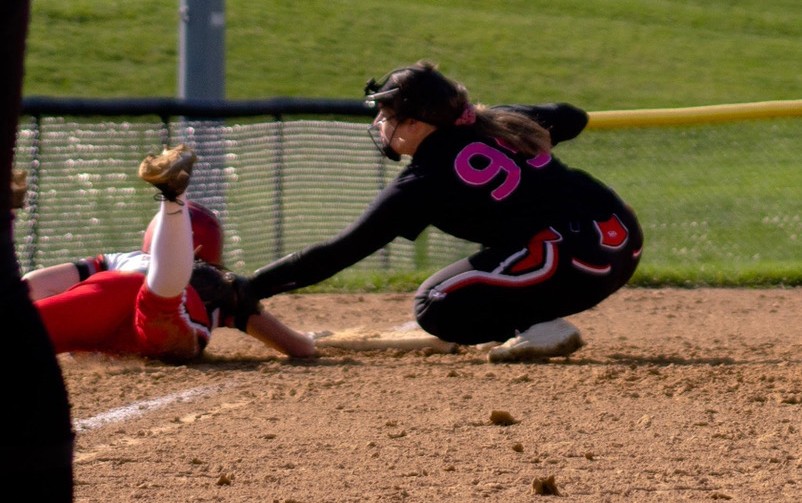
In the plays I’m talking about there were runners on second and/or third base with less than two outs, and only a run or two separating the team on defense (which was behind) from the team on offense. A ground ball was hit right to an infielder or the pitcher and – and the fielder immediately picked up the ball and threw it to first base.
No checking to see what the lead runner was doing – which in most cases was taking off immediately. No awareness that I could see that there even WERE runners on base.

Just automatically making the play at first, which resulted either in a runner scoring, putting the team on defense even further behind, or a runner advancing to third, increasing the offense’s chances of scoring again, especially if the out at first was the first of the inning.
I don’t get that at all. Why wouldn’t coaches be teaching their players to at least take a look at that lead runner, and if there is a play there go for that instead of throwing to first?
To be honest, in the plays I saw the lead runner should have been caught dead to rights. There was plenty of time to make a play if the fielder had been trained to think, “I should see what that lead runner is doing and throw her out if I can.”
In one example, the lead runner on second ran right past the shortstop. Had the shortstop noticed her, she could have made a quick pivot to throwing side and either gotten the runner immediately on a tag play or else created a rundown situation.
But instead, the shortstop showed no awareness at all of the runner who had just passed right in front of her and instead opted to make the long throw across the diamond. Yes, she got the out, but the lead runner eventually went on to core.
Had the shortstop made the throw to third instead that runner would have likely been erased. And since the chances of scoring from third with two outs are more than double than the chances of scoring from first with two outs (.321 v .144) according to 643 Charts, the defensive team wouldn’t have had as a big a hole to climb out of when it was their turn to hit.
Another situation was a combacker to the pitcher with a runner on third. Rather than checking the runner to see if she was going (she was), the pitcher automatically threw the ball to first, allowing an easy score.
Had she looked at the runner she would have seen that a simple toss home would have resulted in either an easy tag play or at least a rundown that, if it was properly executed but didn’t get an out, would prevent a run from scoring.
So does that mean you should always go after the lead runner? Of course not.
There are a number of situations where the out at first is your best option – not the least of which is when your team is having trouble getting outs at all. In that case get an out somewhere and get out of the inning!

Another obvious situation is a ground ball to the second baseman, especially if she is playing somewhat deep. She probably doesn’t have the arm to make a throw home and get the runner so going to first is the smarter move.
Even if she does have the arm, though, if it’s going to be a close play at home but an easy play to first, take the out. There’s probably little likelihood of getting the out at third either so take the out at first.
Bunts in general tend to be another exception. If the catcher fields the bunt she might have a chance of making the play at second because she’s used to making that throw and she’s moving in the right direction to do it.
For everyone else, unless there’s an extremely slow runner on first, take the out with the hitter.
There are some other factors as well, such as whether your team is good at putting up runs. If you’re struggling on offense already, either overall or in that game, you might want to do everything you can to keep the game close, including not giving up runs when you don’t have to. On the other hand, if you’re confident you can trade a run for an out because you’ll make it up in your next at bat, take the out at first.
Another factor is where you are in the game. The fewer outs you have left on offense, the more important those runs given up on defense become.
Even if your philosophy is “take the easy out,” you may need to adjust if you’re coming down to the last inning or two. Yes, there is a risk of making the situation worse if your team can’t execute the throw and tag, but hey, that’s what practice is for.
On the other hand, if your team is up by six runs late in the game, trade that run for the easiest out. You have runs to spare, while the offensive can’t spare any outs.
Early in the game, keep in mind that a well-executed play on a lead runner may cause the other team’s coach to become more cautious on the basepaths. No one wants to get a runner thrown out at home so if you can show you’re able to do it you might just keep the pressure off your defense for the rest of the game.
Speaking of which, the other big factor is your team’s ability to judge whether they can make the throw in time and your confidence that they can execute the play overall. There’s a big difference between trying it with a college or 16-18U travel team versus a 10U travel team versus a rec league team.
Clearly, there is no “one-size-fits-all” solution here. But going for the lead runner is at least worth considering.
Teach your players HOW to do it, then teach them when. You never know when that one out your saved can mean the difference between winning and losing.
Where Have All the Pitchers Gone? 2025 Edition

Two years ago almost to the day I wrote the post below. Sad to say things don’t seem to have gotten any better so I thought it would be worthwhile to re-post it.
I still believe one of the biggest problems is coaches who are so averse to losing that they won’t give their less experienced pitchers the opportunity to develop. Instead, they go with their Aces all the time, even when they don’t need to. For example, in weekday “friendlies” or pool play games, especially when seeding is going to be determined by a blind draw anyway.
Pitchers who don’t get the opportunity to pitch get discouraged and stop doing it. In the meantime, pitchers who are over-pitched develop over-use injuries and then often become unavailable to pitch when they get older.
It all ends up in a perfect storm of not enough pitchers to go around by the time teams get to 15U/16U. Or sometimes even second year 14U.
Teams need pitchers right now like crops need rain. Let’s try to do better at the early ages and give budding pitchers an opportunity to grow.
Because you never know. Today’s gawky, uncoordinated 11 year old may just turn out to be tomorrow’s stud – if she’s given the incentive to stick with it.
Yes, I know, it sounds like a folk song but it’s a legitimate question. Especially now that we are hot and heavy into the softball tryout season.
If you’re following softball-oriented Facebook groups or forums such as Discuss Fastpitch you’re probably seeing this plea a lot, particularly in the older age groups: Impossibly great team looking for one more bracket pitcher to complete our outstanding roster.
With all the 8-10 year olds jumping into the pitching pool you would think there would be a cornucopia of pitching at every level. It’s not unusual to see box scores on GameChanger that show four or five pitchers each getting an inning of work on a regular basis. And it’s been that way for long before GameChanger existed.
So what happened to all those pitchers?

Well, somewhere along the way they stopped pitching. Or maybe even playing the game entirely.
Sure, some probably found that they just didn’t care for the pressure of being in the circle. And some probably found that they didn’t like all the extra work that goes with being a pitcher. All legit, and to each her own.
But I can’t help but think that the rapid shrinking of the pitching pool might in many cases also be driven by team coaches and parents who are more focused on winning 10U or 12U games or trophies than they are on ensuring their players develop properly.
Take the coach who has 5 pitchers on his/her roster but gives 90% of the innings to the #1 pitcher. Yes, it’s nice to win games and tournaments, but if you’re only really giving one pitcher an opportunity to pitch regularly the others won’t develop.
Then they won’t develop, they’ll fall farther behind, get discouraged by their lack of progress as well as their lack of opportunity, and eventually stop pitching. So now four more are out of the pitcher pool for the future.
Oh, and in the meantime the #1 develops an overuse injury and may end up not pitching either.
Then there are the coaches who set impossible standards for their young, developing pitchers. They tell them in order to pitch they need to “hit their spots” 80% of the time.
Not because it’s necessary – really the only “spots” that are important at the 10U level are ball and strike – but because they heard on TV or read an article that said that’s what college pitchers do. Or because they want to use the vague “hit your spots” as an excuse not to pitch a girl who isn’t going to walk in and dominate every game.
So again, she doesn’t get circle time, falls behind, and eventually gives it up because what’s the point of taking lessons and practicing if you never get to pitch, even in “friendlies” or pool play?
Pitching coaches who say they’re teaching 10 or 12 year olds to throw seven pitches aren’t much help either.

Most 10U and 12U pitchers have enough to do mastering a fastball and and a changeup. Having them work on five other pitches – especially with some of the crazy mechanics I’ve seen them try to use – is a recipe for disaster.
Those pitchers never master their fundamentals. So when the hitters get better all those so-called different pitches turn out to be bullet spin fastballs to different locations that are fairly easy to hit. And then they’re out of the pitching pool because they’re getting hammered all the time.
And the list goes on. If we really want to have more pitchers available at 16U and 18U, parents and coaches have to do more to encourage greater success for more pitchers at the younger levels.
Keep them pitching, keep them developing, and give them opportunities to learn their craft – even when they’re bad at it. Then maybe there won’t be so many teams begging for pitchers or fighting over the same ones at the older levels.
My good friend Jay Bolden and I have started a new podcast called “From the Coach’s Mouth” where we interview coaches from all areas and levels of fastpitch softball as well as others who may not be fastpitch people but have lots of interesting ideas to contribute.
You can find it here on Spotify, as well as on Apple Podcasts, Pandora, Stitcher, iHeart Radio, or wherever you get your podcasts. If you’re searching, be sure to put the name in quotes, i.e., “From the Coach’s Mouth” so it goes directly to it.
Give it a listen and let us know what you think. And be sure to hit the Like button and subscribe to Life in the Fastpitch Lane for more content like this.
Lead photo by Pixabay on Pexels.com






 Life in the Fastpitch Lane