Blog Archives
Be Sure to Align Your Expectations with Your Work Ethic

Fall is often the time of year when players get a new start. Maybe they joined a new team that plays at a higher level and has a great track record of success.
Maybe they finally started getting private instruction, or made a decision to try a new instructor who has a strong reputation for turning out champions.
Maybe they hired a trainer to help them get bigger, stronger, faster, and/or more agile than they’ve ever been. Maybe it’s some combination of those things, or even something else we haven’t already named.
Whatever it might be, the fact that they took an action to make a change might just be a sign of better days ahead.
Or it may not be. Because there is one other factor that has to be taken into consideration before any of those other changes take effect: whether your personal work ethic is in line with what you’re hoping to get out of those other changes.
Here’s why that’s so critical.
Let’s say we’re talking about changing teams, whether you joined a new travel team or went through the portal and are now with a new college team. On your previous team you were clearly one of the best players.
Part of the reason for that, though, was that your old team didn’t practice that much, and your teammates didn’t practice on their own. You were more athletic than your teammates – and maybe bigger and stronger – so you just naturally were better.

On this team, though, everyone is at your level athletically (or better), and both they and the team practice more. Suddenly this great team you joined because you wanted to play at a higher level is going to require a lot more work.
If you’re not willing to give up that much of your free time, or you want to still do a whole lot of other things (play other sports, be in a theater group, pursue time-intensive hobbies, etc.), you may have to lower your expectations for what your role will be on this team.
Then there’s getting in with that instructor who you’ve heard so many great things about. You walk in with a lot of anticipation, hoping to catch a little of that magic they seem to be dispensing to others.
After the first couple of lessons, however, you start to wonder when the magic part will come out. Because while your expectations for going to this coach were that you would become a superstar by association, the reality is the actual magic happens in-between the lessons when you work on your own.
And if you’re still more dabbling at it than dedicating yourself to making the changes that coach is asking you to make, you’re not going to see much difference. You will not only need to put in the time, but you’re probably going to have to do things differently than you’re used to doing them – no matter how much you liked doing them your way.
Basically, you’re going to have to get comfortable with being uncomfortable for a little while, even if the short-term results aren’t as good as they were before. If you’ve made a good decision about your coach, the results will come in time.
The thing people often don’t tell you is that highest performers in any field are dedicated to doing more. Not just in terms of volume, although that is often a factor. But in terms of precision.
They are constantly looking for ideas and adjustments that can help them get better. Even if it’s just 5% better.
And they don’t just try it once and, if it doesn’t help, go back to what they were doing before. They give it an honest chance, through multiple repetitions, constantly looking for feedback to make sure they’re doing what they’re supposed to be doing.
If it doesn’t, they don’t get disappointed. They simply look at it as learning one more way not to do whatever they’re trying to do so they can stay focused on what does work.

We’ve all heard the saying, “Winners train. Losers complain.” It is so true.
Winners don’t go out expecting to win because they are so great. They expect to win because they know they have put in the effort that will lead them to those wins.
It’s easy to daydream of greatness. We all love to do it.
But if you have ambitions of seeing those daydreams turn into reality, be sure your work ethic is aligned with your expectations. Otherwise, you’re just chasing rainbows.
Persistence Pays Off as Jenna Kosnoff Signs Her NLI
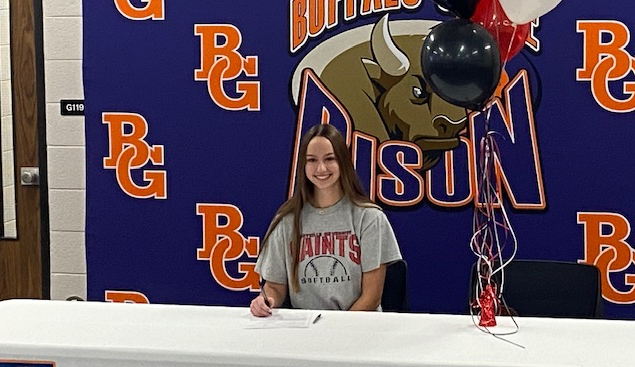
Today’s story is for every fastpitch softball player who may be a little undersized (for now), or perhaps struggles a bit to get all the body parts moving properly, or somehow doesn’t quite measure up to her teammates at the moment. It shows what you can do if you want it bad enough.
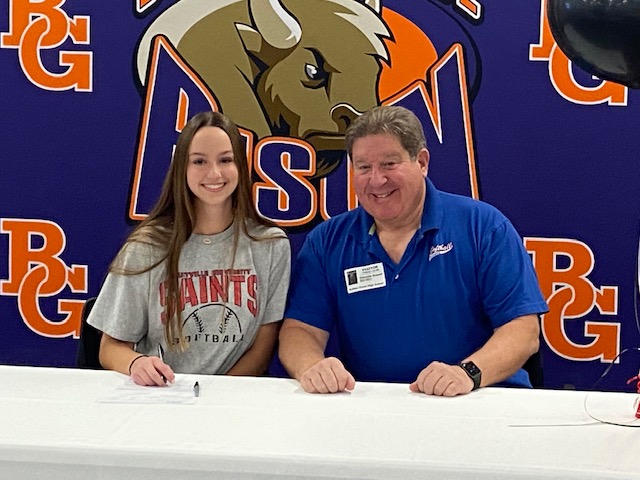
First though, I don’t want to bury the lede: earlier this week Jenna Kosnoff signed her national letter of intent to play for Maryville University in St. Louis. She will be pitching for them, yes, but when she’s not pitching she will likely play the field because she has a great glove and a powerful bat.

I’ve worked with Jenna since she was 10 years old. We started out with pitching, then added hitting later at her request.
Over the last few years she has racked up a lot of wins and a lot of strikeouts as a pitcher, and consistently delivered an amazingly high batting average, on base percentage, and on base plus slugging (OPS) in PGF tournaments. If you were to watch her play today it would be easy to say that she is clearly hugely talented so it’s no wonder she’s doing all that.
But the reality is it wasn’t that long ago that she was struggling great. When I first started working with her Jenna was a scrawny little thing with sticks for arms and legs. You would wonder if she would blow away if a stiff breeze came up.
Jenna never let her size define her, however. She was always determined to be a top player – to the point her dad Gary would tell me when they got home from a lesson she would often go down to their basement or in the garage to continue working on whatever we’d just gone over.

One of the things Jenna struggled with was turning the ball back toward second base and pushing it down the back side of the circle. For those who don’t know that is a weak position for the arm, and one that totally eliminates any chance of getting acceleration and whip into release.
I was convinced that if she could get that corrected she’d start throwing a lot harder, so I finally recommended we shut her down completely from pitching (in the middle of the season) so she could focus on that movement. At that time Jenna was the #4 pitcher on a team where at least two of the others are also going to play college ball so it wasn’t much of a loss for the team. Her coach may have even been relieved because he was nice enough to give her innings even when she was under-performing.
It took about four months as I recall to make the fix. A lot of our lessons at that time never got past the K position. But Jenna never gave up or complained. She just worked it and worked it until we could see she was getting great arm bend and lag.
And just as I had said at the beginning of the process, her speed started going up. Her movement pitches also started working better, and she climbed the ladder to become a #1 pitcher who now throws in the low 60s.
To be honest, it wasn’t just the mechanics change. Jenna grew quite a bit too and worked out like a fiend to develop muscle.
She’s still on the slim side but her arms and legs no longer look like sticks. Still, without the mechanics change, and her determination to make it, I don’t think she’d be where she is today.
The other thing she did was learn to put everything she has into every pitch and every swing. When I went out to watch her play in one of her early games I saw her pitching with an arc – something she didn’t do in lessons.
She had to overcome the mentality of being careful to “just throw strikes.” Now, though, she’s the poster child for giving it all you’ve got every time.
So congratulations to Jenna on this tremendous accomplishment. She has definitely earned it.
And for all of you out there right now who may be being told you’re not enough, keep working. Good things will happen.