Blog Archives
The Power of Using Video When You Practice

One of the tools I use the most when I give lessons is my iPhone. If I see a player making some sort of awkward or inefficient movement, out comes the ol’ phone and I immediately shoot a video I can show that player (and often her parent, guardian, team coach, etc.).
Now, I can stand there and tell the player what she’s doing without using video, but often it seems like they either think I’m exaggerating the movement they’re making or I am making it up entirely. I said that because it has little impact on what they’re doing, and they frequently will go right back to doing it.
But when they see the video, they suddenly know I was not exaggerating for comic effect but if anything was dialed back a bit on it. Seeing is believing, and believing enables them to start making the correction. Things usually get better from there.
That’s great during lessons. But what about the other 90% of the time, when the player is practicing on her own or with a teammate, parent, guardian, team coach, etc.?
There is a solution that will help shortcut the time-to-improvement. It involves a little practice secret that I’m now going to share with you.
The Revelation
These days pretty much everyone’s personal phone has the ability to shoot video. And those video capabilities can be used for more than a Snapchat or a Tik Tok dance video.
Why not set up the phone to the video setting, hit the “Record” button, then take a video of whatever skill she is trying to master? Then she can play it back, watch herself, and see if she is leading with her hips (if she is a hitter), getting some elbow bend over the back side of the circle (if she is a pitcher), or making whatever movement she is supposed to be making at whatever point she’s working on.
I know, genius, right?
Sure, when I shoot video I use the OnForm app so I can easily slow it down, scrub it back and forth, draw on it, measure angles, or do whatever else I need to do. It’s really cool to be able to do that, as I describe here.
But you don’t absolutely need all of that, especially if your coach has told what to look for/work on specifically. The basic video any smart device shoots is enough to give you eyes to see what’s happening and whether the movements that player is making are the movements that player SHOULD be making.
I know on an iPhone you can even scrub it back and forth by tapping on the video and then using one finger to move the little frames at the bottom back and forth. I imagine Android and other operating systems offer the same capabilities.
Different Learning Styles
So what makes video so valuable?
Science has documented that different people learn in different ways. Some of us learn better from reading directions. (Most of those people tend not to be male, as most males tend to jump in first and then only read directions when they get in trouble – usually halfway through the project.)

Some learn better from hearing things explained, the way it would typically happen in a lesson or team practice. “Suzy, you have to get your butt down on the ball.”
Some learn best by actually performing the skill we are attempting to perform. Although in my experience a lot of young players actually have trouble feeling whether they are doing something correctly while they are in the middle of it.
But the vast majority of us (65%) are visual learners. If we see it, we can understand what we’re supposed to do, or what we’re not doing now, better.
Yet when it comes to actual practice sessions, players and coaches rely almost entirely on the two weakest preferences for learning – auditory/listening to instructions (30%) or kinesthetic/doing it and feeling it (5%). Doesn’t make much sense, does it?
By incorporating video into the learning process players can learn faster by using the method most prefer. And even if they are in the other 35%, augmenting auditory and/or kinesthetic instruction with video is neutral at worst and a plus beyond that.
Video Power in Your Pocket
The beauty of all this is that it doesn’t require a lot of work. Today’s teen or preteen carries more video power in her pocket or purse than was available when Debbie Doom (yes, that was her real name, and what a great name it was) was dominating hitters, Lisa Fernandez and Sheila Cornell-Douty were winning gold medals in the Olympics, and Linda Lensch was becoming a USA Softball Hall of Famer.
All you have to do is take that device out of wherever it is, prop it against a nearby bench, bat bag, or rock, and hit “record!” Then you have instant feedback on where you are and whether what you’re practicing is making the player better – or worse.
She can even do it by herself. And if the coach says it’s ok, she can even send it to the coach’s phone or other device to receive additional feedback to make sure she stays on track.
That’s sure a lot faster and easier than the early 2000s, when I started coaching. Back then it was a production.
I had to bring a laptop and separate video camera, set up the camera on a tripod, connect the video feed to the laptop and then whatever video tool I was using, and then manipulate it all to run it back. I had to plan it all ahead too, and hope an errant throw didn’t knock out the camera or laptop.
Now it’s just pull out the phone, open the app, shoot, and review.
Opportunity Knocks
The opportunity here is tremendous, and the cost is nil if you already have a phone or tablet. So why wouldn’t you take advantage of it?
By incorporating video into their practice sessions players can learn more effectively – and reach their goals faster.
Seems like a no-brainer to me.
Phone photo by Wendy Wei on Pexels.com
Proper Form? The Shadow Knows!

You’ve no doubt heard that different people learn best in different ways. The four basic learning styles are visual (watching the skill performed), audible (listening to instruction about the skill), kinesthetic (learning by doing), and reading/writing (using written words to understand).
Fastpitch softball instruction typically uses audible (coach explains) or visual (coach demonstrates, or at least tries to) learning, then expects that to translate into kinesthetic as the player tries to emulate the instruction. The idea is to get the “feel” of the movements so they can be carried forward later.
While this is important, some players have difficulty moving from visual/audio to kinesthetic learning. They are trying, but they can’t quite get the feel of it and thus go right back to old habits.

A great example is a pitcher trying to learn to keep an elbow bend down the back side of the circle to allow her arm to whip at the end. She may be trying to bend it, but as she goes into the back side her elbow straightens out and the arm becomes stiff, which means no whip.
One solution is to video the player so she can see what she is doing. Sometimes it helps, but often she has trouble translating what she sees into what she does.
A better approach is to use a mirror so she can see what she’s doing AS she tries to feel it. The combination of the two is very powerful, and often helps shortcut the learning curve.

But what if you are outside and don’t have access to a mirror? Not to worry – there is another solution: her shadow!
If you place the pitcher with her back to the sun, her body will cast a shadow. She can then watch that shadow as she moves to see if she is maintaining elbow bend or coming out of it over the top.
This quick, crude video demonstrates how that works:
Note how rather than reaching back with the hand I pulled the upper arm or elbow down, maintaining bend that leads into release. By watching the shadow while moving her arm, your pitcher can begin to feel where her arm needs to be as she practices.
She can continue to observe as she builds up speed, first without a ball and then throwing a ball into a net or screen. Over time she will feel it more and more until she no longer needs the visual cue – at which point you can really turn her loose.
This is just one example of how you can use a player’s shadow to enhance learning. For example, if she tends to drop her hands or flatten out her back too early while hitting, her shadow will show it, enabling her to make that adjustment.
If she is pulling her hand straight back while throwing instead of retracting her elbow with her scap and then letting her hand rotate behind her, that will be easy to spot in a shadow too.
Next time you’re outdoors on a sunny day and a player struggles to get the feel of a skill, give this idea a try. It’s quick, easy, and free – and the shadow always knows!
College Playoffs and WCWS Create Unique Learning Opportunity

The next few weeks promise to be a softball fanatic’s dream.
First you have all the major D1 college conference championships that will be televised on the various flavors of ESPN. Plus all the others that are available through various streaming services, including D2 and D3.
Then there are the regionals, super regionals and Women’s College World Series games that will take us through early June. Here’s an overview of what that schedule will look like.
While I’m sure it will be enjoyable to watch, there’s more to it than just entertainment. All this great softball on TV provides an invaluable learning opportunity for young teams – and one which most of today’s players don’t seem to take much advantage of.
When I start with a new student, I will often ask her if she can name any famous players at whatever skill we’ll be working on. For example, if it’s a new pitching student I’ll ask who she admires as a pitcher or what famous names she knows.
More often than not I get a blank stare. If I name a few for them, such as Cat Osterman, Amanda Scarborough, Monica Abbott, or Sarah Pauly, most of the time they may have heard of the name but have never seen them pitch.
As a result, most of the time they have no idea what a high-level pitcher looks like in action. The same is true for hitters and fielders.
That’s why the next few weeks present such a tremendous opportunity. Some of the best players in the world will be showcased doing what they do best. These are young women who do what you would like your players to do.
So why not take advantage of that and replace a normal practice with a watch party? You can find out when a local or semi-local team is playing and watch that game.
Or see if there is a player from your area on one of the teams and have your team watch her specifically. Show them that these aren’t just figures on TV but real players who once stood where your players do now.
Make a party of it. Supply some snacks, order some pizza, maybe even organize a sleepover if that’s appropriate. Then at game time, actually watch what happens and discuss the action on the field.
You might even pause the game and run back a good play to show the effort that went into it, or re-watch a bad play to talk about what should have happened instead. You can also talk about the strategy of why a team or player did what they did (good or bad) to help raise your team’s collective softball IQ.
It has been estimated that the majority of people in the world (65%) are visual learners. Showing your players both good and bad examples in real time helps them understand more thoroughly the techniques and strategies you’re trying to teach them.
As you watch the game, perhaps the coaches and players can make a list of things they want to work on at the next practice. Maybe it’s diving to catch a ball. Maybe it’s a type of slide they saw, or a spectacular over-the-shoulder catch. Maybe it’s a suicide squeeze.
Whatever it is, seeing it performed and then trying it themselves may be just the spark they need to inspire them to play at a higher level than they are now.
Watching a game on TV also gives your players a chance to gain some perspective about their own performance. They may see a pitcher give up a critical home run, then come back to strike out the next hitter.
They may see a player make an error to give up the go-ahead run, then come through later in the game with a key hit. Ultimately, especially in an elimination game, they will see the “thrill of victory and the agony of defeat” played out in real time.
The other nice thing about watching the games on TV (versus going in person, which is also a great experience) is that it doesn’t cost much. A little food and drink, the price of the cable or streaming channel (if it isn’t free) and the time to clean up afterwards is about all you need.
But you can create a learning and bonding experience that will benefit your players for a long time to come.
Sure, we all like to grind away on the field. But if all your players ever see is each other, and players on other teams of comparable ability, they may never realize there is a much larger world out there.
Show them some of the best in the world playing the game at a high level and you just might inspire a level of play and enthusiasm in them that they wouldn’t have achieved before.
See Your Way Clear to Better Pitching Mechanics

Photo by Dhyamis Kleber on Pexels.com
When I have a young student who is having difficulty making the transition from close-up drills to full-distance (or nearly full distance) pitching, I will often tell her to close her eyes and picture that she is still throwing into the screen, net, tarp, backstop or whatever else we were just using. By taking the distraction of how far away the plate is she is then able to focus on the only end she can control – the end she is on.
It is amazing how often that works. Which is why, by the way, I am always amused at coaches who yell at catchers to “give her a bigger target” when the pitcher is having control trouble. I want to yell back “the catcher isn’t the problem; right now your pitcher couldn’t hit an archery target.”
But there is another side to this story. A pitcher’s eyes can be an important contributor to improving her mechanics if she learns how to use them correctly. That doesn’t mean staring down the target with a laser-like focus, however.
To the contrary, it often means doing the opposite, i.e., looking away from where she’s throwing to help her see what she can’t feel right now. Many of us our visual learners, and being able to see what we’re trying to do can help us get there faster and more effectively.
Here’s a good example. Many pitchers are taught that they should turn the ball toward second base at the top of the circle and have the hand on top of the ball as they come down the back side of the circle. That’s just flat-out wrong as you will see if you watch videos of what elite-level pitchers do.
But after months or years of drilling from the “T” position (both arms outstretched completely from the shoulders) with their hands facing down it can be a tough habit to break. They may be trying to keep the hand under the ball at 3:00 and pull it down into release, but they are unaware that they are first turning it over to start the motion.
Here’s where the eyes come in. From the “W” position (arms again outstretched, but this time with the hands shoulder-high and the elbows bent below to form a sort of W) have her turn her head back and watch her hand as she begins the throw. That way she can see immediately whether her hand turns over so she can learn to stop doing it.
Placing the focus of her vision on her hand also places the focus of her mind on staying palm-up, which helps shorten that learning curve. Once she starts down that way she is likely to stay that way into release, or at least close to it. If necessary she can always watch her hand all the way down.
If you do it from a short distance into a net or fence (instead of throwing to a catcher) you take out any concerns about accuracy which again lets her concentrate on the movement. Of course, if she gets the movement right her accuracy will improve anyway so it’s a win-win.
Another way to use the eyes in a creative way is with pitchers who are having trouble going straight down the power line. They launch out and end up either way to the right or way to the left, neither of which is conducive to great pitching.
If you’re using a pitching mat that already has a line in it, or you’ve drawn a power line in the dirt outdoors, have your pitcher look at the line instead of at the catcher.
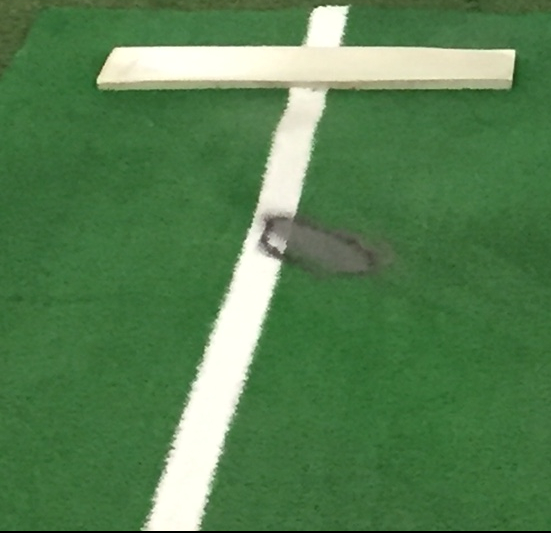
Like this one, only without the worn-out spot.
Remember that one of the big reasons for going down the power line is so the pitcher can throw the ball where she is supposed to instead of going all over the place. By using her eyes to go down the line you just might find that her accuracy improves even though she’s not looking at the target at all.
This is much the same principle you’re supposed to use in bowling, incidentally. Great bowlers don’t look at the pins. They look at those little arrows on the lanes and try to throw the ball there. (I can hear some of you already saying “Oh, THAT’S what those arrows are for.”)
They know if they get the ball in just the right place on the arrows, the far end (where the pins are) will take care of itself. So it is with pitchers and the power line.
Mirrors (or any reflective surface such as a window) can also be very helpful in correcting pitching issues. Do you have a pitcher who struggles to maintain good left-right posture at release (i.e., she leans out to her throwing-hand side)?
Put a vertical line on a mirror with masking or painter’s tape, have the pitcher line her center up with it, and then have her throw a rolled up pair of socks or a Nerf ball into the mirror. As she gets to release, she should see whether she is vertical or leaning out to the side. A few dozen repetitions should have her feeling when she has good posture and when she is leaning.
The mirror is also a great way to see if her hips are remaining stacked up under her shoulders or if she is clearing space to the side or making a “monkey butt” move. If the hips aren’t stacked up under the shoulders and turned in 45 degrees or so to the plate it’s difficult if not impossible to get a brush trigger.
By checking her hip position in the mirror, the pitcher can make sure she has the optimal posture to deliver the ball with the greatest velocity and accuracy.
These are just a few examples. The key takeaway is that the pitcher’s eyes don’t have to be locked on to the catcher’s glove or some other target to be effective.
If she is having trouble learning a move, apply visual learning principles and have her use her eyes to see what she needs to do and whether she’s actually doing it. It can make all the difference in the world.
And if you’ve had a pitcher use her eyes to watch a part of the pitch to make a correction please be sure to share what you did in the comments below so the rest of us can learn.






 Life in the Fastpitch Lane