Blog Archives
New Speed High Posts Are About More than Just Speed

Anyone who follows Life in the Fastpitch Lane on Facebook (which I highly recommend you do) knows that I do a post on every pitching student who achieves a new personal best. They can be new students, longtime students, students who have impressive achievements, students about whom you might wonder, “Why is he bragging about that?”
Doesn’t matter, if they do it I’m sharing it. I’m proud of every single one of them because of what it means to them.
But of course there’s always someone who likes to rain on the ol’ parade, and this is no different. I recently saw a Facebook post putting down the idea of celebrating speed achievements, arguing that other factors such as spin and spot are more important, and basically saying we shouldn’t celebrate speed so much.
So I thought it might be worthwhile to address why I do these posts, the thinking behind them as well as the practical realities. There are actually a few factors. Let’s start with…
It’s measurable and empirical (mostly)
Measuring speed is relatively easy. You set up a radar, point it toward the pitcher, and have her throw. You then get a number which you can compare to the numbers that came before it.
Thanks to products such as the Pocket Radar it’s also relatively inexpensive. For example, you can pick up a Smart Coach for $399 or a Ball Coach for $299, (even less during Black Friday or another sale) which is a whole lot less costly than a Jugs or a Stalker, and it works just as well.
That means these days just about anyone can acquire a radar and start taking readings. While there are ways to game a radar to get a higher number (such as moving it toward the pitch while it’s in flight), if you just set it up so it’s stationary the numbers you get will be pretty consistent from pitch to pitch.
Until recently, to gather data for spin and spot you would need a $5,000 Rapsodo setup or a Trackman system that costs so much they don’t even list a price on their website. Not exactly in the budget of the average pitcher parent.
The new PitchLogic ball from F5 Sports is showing a lot of promise in this area, making it far more affordable for families to keep on hand and use whenever they want. But right now speed is still the easiest thing to measure.
It shows (and rewards) progress
While there are no doubt people who love the radar numbers for the bragging rights, that’s not how I see them. For me, it’s more about showing progress and rewarding the work it took to get there.
Seeing a photo posted and reading a story about them can give pitchers incentive to keep working hard and striving for more. It can help them feel good about the long, boring grind that’s involved in getting better.
Now, I will admit if they’re not showing progress it can be a little discouraging. But what’s important to remember in those cases is that it’s not linear.
A pitcher can get some gains, but then hit a plateau or even backtrack a little depending on a number of factors, such as a sudden growth spurt, their emotional state, health and nutrition and other factors. They may also have a case where they made certain mechanical improvements but then have to make others before the next personal best can be reached.
Even then, though, having a tangible data point such as a readout on a radar can help them keep working until it all comes together again. And the feedback they’re getting from the radar can be invaluable in telling them whether further adjustments are required.
It’s a controllable
While it’s true that stats such as overall strike percentage, first strike percentage, earned run average, and other pitching stats that appear in GameChanger are good indicators of effectiveness, they are not within the pitcher’s control.
An umpire with a tight strike zone (as so many seem to have these days) may be calling pitches a tracking system would classify strikes as balls. The official team scorer may mark reached on error plays as hits, tanking the pitcher’s ERA.
The ball may have done exactly what it was supposed to do when thrown and the hitter just did a good job of getting her bat on it. Doesn’t mean it was a bad pitch, but it sure looks like one in the box score.
The speed is the speed whether the pitch is hit, missed, or watched, and regardless of what the umpire thinks it is. Throwing hard is something the pitcher can control, so measuring in-game speed in particular will show if she’s giving it her all or pitching scared.
That can be invaluable feedback for future physical and mental training.
It’s easy to understand
Many of the people who read these types of posts aren’t necessarily softball people. They’re family, friends, co-workers, neighbors, and others who like to read success stories about kids.
Posting a story that pitcher A hit 25 revolutions per second or 2500 revolutions per minute on her riseball with 83% efficiency and six inches of vertical movement is probably going to be tough for the non-softball fanatic to understand.
Heck, there are a lot of coaches who don’t actually know how to read those numbers.

But saying pitcher A was throwing 52 mph and is now throwing 53 mph is something pretty much anyone can understand. Friends and family can say wow, great job and be confident that it really was something to celebrate.
That makes everyone feel good. Grandma might even bake some cookies to celebrate.
Final word
The truth is some of the most effective pitchers in terms of getting hitters out quickly weren’t the fastest pitchers in the tournament, but they had great command of their pitches.
At the same time, though, their effectiveness went up as their speed increased. Speed may not be everything, but a lack of speed isn’t anything.
It’s going to get you beat up more times than not, especially as you get older and hitters get better.
So the next time you see a post talking about a new speed high, don’t try to run it down, and don’t feel bad if your pitcher isn’t rising to the same standard yet. Everyone is on their own journey, and everyone has their own ceiling.
Instead, celebrate that a young lady has seen improvement in one aspect of her game, and trust that she’s also working on the rest. Everything else will sort itself out over time.

Trust the Process and the Outcome Takes Care of Itself

Every now and then when I’m working with a pitching student I will have one who is having trouble hitting some of her spots on command. For example, she will tell me that she can hit inside ok but can’t throw outside.
I will talk to her about how to do it. I used to talk about making adjustments such as striding an inch or two toward where you want to throw, or turning your hand a certain way, etc.
But now I simply tell her to look at where you want to throw and then throw it there. Your body will find a way.
That works much of the time, but not always. In those cases where it doesn’t, I will drag a protective screen about halfway between the pitcher and catcher and say “Try it now.” That trick usually works within a couple of pitches.
“Why do you think you can magically hit that spot all of a sudden?” I will ask (triumphantly, I might add).

“Because the screen is there and I can’t throw it the other way,” they’ll reply in some form or another.
That’s true, but there’s a deeper explanation: by blocking off half the plate, her body was forced to make adjustments to not clang into the screen. We fixed the process, and the outcome was what we wanted.
That’s an important lesson for every fastpitch player to learn. All too often players get so caught up in trying to achieve the outcome they lose the thing that will most help them achieve it.
Pitchers will get so caught up in going for speed they’ll over-throw and try to muscle the ball, slowing it down. Or they’ll get so obsessed with hitting a spot or getting a spin that they’ll contort themselves in all sorts of crazy ways to make it happen.
Hitters will be so hellbent on getting a hit that they’ll just flail the bat at the ball instead of taking an approach that lets them see the ball longer and coordinate all their body parts to deliver the bat more efficiently. Fielders will be so focused on throwing hard to set a speed record that they’ll set aside good mechanics to just chuck the ball any old way, taking the throw off-line and getting a worse score than before.

You get the picture. These players become so intent on whatever outcome they’re trying to achieve that they don’t pay attention to how they’re trying to achieve it. That’s just wrong.
The reality is the process is greater than the outcome just like the graphic at the top of this post shows. (I stole that from a t-shirt I saw on the TV show Seal Team, to give credit where it’s due. Then I had my wife make me one with her Cricut so I can wear it to lessons.)
In other words, if you place your focus on the end you can control and work forward, you’re far more likely to achieve the outcomes you desire than if you try to work back from the outcome.
Yes, the outcomes are important. I’m certainly the first to celebrate a student hitting a home run, or achieving a new speed record, or succeeding in some other way.
But placing all your emphasis on them is not the way to achieve them.
Instead, focus on what you’re doing and what you’re feeling. Listen to your body and check on whether it’s doing what it’s supposed to do.
If you keep your focus there, I can guarantee the outcome will take care of itself. Because you can influence the process while you’re doing it.
But once you’ve done it, you can no longer influence the outcome. It’s simply the result of what you did.
Happy New Year! Time to Set New Goals

As John Lennon once sang, another year over, a new one just begun. (Or about to in any case.)
For most of us, the turning of a new year is filled with hope and anticipation. It also marks a great time to at least think about making changes.
We make all the usual resolutions – lose weight, get more exercise/join a gym (not always the same thing) quit smoking, quit or cut back on drinking, learn a language, etc. There’s just something about the finality of one year ending and a new one starting that makes it seem like a great time to do a little personal upgrading.
Of course, as U2 sang, “Nothing changes on New Year’s Day.”
Yet if those changes are going to happen they’re not going to happen magically. You have to make them happen. A big part of this for fastpitch softball players, coaches, and parents revolves around your goals.
Hopefully you’ve written those goals down and posted them where you can see them. Nothing like a visual reminder of where you want to go.
But even if you haven’t you probably know in your heart what they are.
So here’s my question for you: When was the last time you really thought about those goals? And more importantly, do they still apply?
Maybe it’s been a few months, or a year, or more, since you set your original goals. But you’re a different person now than you were then, with additional experiences and knowledge under your belt.
Is what you wanted six months or a year ago the same things you want now? If so, can you add some specificity to them?
For coaches
For example, if you’re a coach perhaps you had a goal of increasing your knowledge about the sport. You took some online classes and attended a couple of coaches clinics, and are now a better coach than you were.
So you’ve achieved that general goal. But are there areas where you could still do better? Perhaps it’s time to change your goals to address those areas.
In my personal experience I always felt like I was good at teaching the technical aspects of the game, along with the rules and what to do in specific situations. But I also felt like I wasn’t as good at the strategic aspects as I should be.
So my goal became to learn more about different strategies and how to apply them and when to apply them. It became a difference-maker for me.
Coaches, make an honest evaluation of your strengths and weaknesses. Where do you tend to lose games or players? How would you attack your team if you were an opposing coach?
Then seek out courses, or a mentor, or some other means that can help you shore up that area.
For players
If you’re a player, think about the major aspects of the game: offense and defense. Then think about the sub-groups.
For offense, you’re basically looking at hitting (including the short game) and baserunning. For defense, it’s fielding and throwing – overhand and underhand for pitchers.
Then break it down further into what you do well and what you don’t. In some cases also take into consideration what you can’t really change and how you can work around it.
Baserunning is a great example. If you’re fast you have a natural advantage. But are you smart?
If you can recognize opportunities sooner, and understand when it’s time to take chances and when it’s time to lay up even if you *think* you can make it, you’ll be a lot more successful. I’ll take average speed with intelligence over blazing speed without a clue pretty much every time.
What if you’re not fast? In fact, what if you’re a complete turtle? There are still things you can do.
Seek out a running coach who specializes in sprinters. He/she may not be able to make you fast, but he/she can probably make you faster than you are now by teaching you how to run better technically and how to condition yourself to run better. Every tenth of a second you can shave off your time going from one base to the next will help.
Then make sure you learn everything there is to know so you’re the smartest baserunner on your team. That’s especially important when you’re the trail runner.
I remember a situation where my team had runners on second and third. Kaity, the runner on second, was one of the slowest on a team that wasn’t too fast to begin with.
A ground ball was hit into the infield and I was entirely focused on getting the runner on third home. I watched the play from the third base coach’s box like a spectator.
Fortunately, Kaity was smart. She didn’t wait for any instructions from me, so when I looked back toward her (finally) she was already standing on third.
I said, “At least one of us was paying attention.” She replied, “Don’t worry Coach, I’ve got your back.”
Over the last six months or a year you’ve probably made many improvements to your game. Think about where you may fall short, or what you’d like to do better, and set that as your new goal.
For parents
Here we’re assuming non-coaching parents. Probably one of the biggest goals you can set for yourself is learning when to keep your mouth shut. Which is probably most of the time.
Just kidding, although in some cases it probably applies. But there are things you can do based on your player’s goals.
For example, if your daughter wants to play in college, and seems like she’s serious about it rather than thinking wishfully about it, start educating yourself about the whole recruiting process. It can be beastly, so the sooner you learn about it the better off you’ll be (and the less likely you are to make a critical mistake).
Step one is to talk to the parents of older players who have already been recruited. Find out what they did, what helped them the most, and what mistakes they made. Softball parents who have been through it can be an invaluable and impartial resource to guide you through it.
There are also tons of resources online. Some are better than others, and some are really just blatant commercials to buy their services.
That’s why you probably want to talk with other parents or coaches who have gone through the process first to give you some background. But those outside resources can help you make better decisions, especially if your player isn’t a can’t-miss P5 prospect.
Outside of that, learning more about the game and pieces of it related to what your player does can help you make better decisions when it comes to selecting teams and private coaches if you so choose. These days softball is a big investment so you want to be sure your money is being spent wisely.
As with players and coaches, think about what’s most important for you to improve on this year and set it as a goal. It’ll improve not only your experience but your player’s as well.
Keep moving forward
Always remember that goals should be concrete and realistic. Not necessarily easily achievable, but achievable.
Once you’ve set those goals, take the time (like now) to periodically evaluate them to determine if you’ve achieved them or even if you want to achieve them. Then adjust your goals accordingly.
The more you keep your smaller goals focused on achieving the bigger ones, the better chance you’ll have of ending up where you want to end up.
Happy New Year to all, and let’s make it a good one!
Photo by cottonbro studio on Pexels.com
How A Can of Marking Paint Can Help Hitters Hit Better

There is no shortage of companies out there that manufacture a variety of devices to help hitters hit better. Some are worth the money, others may be well-meaning but detrimental, and still others may be just another ploy to separate you from your money.
One thing I have found to be both helpful and affordable, however, is a $5-$7 can of plain old white marking paint. (You may even be able to find it for less.)
Here’s how I came about this amazing discovery.
I was working with a couple of college players last summer on a large field with no fences. They were hitting bombs off front toss, but both felt like they were just popping it up because their hits weren’t getting all that far from the infield. Or at least that’s what they thought.
The problem was it as a HUGE open field with a lot of grass in the outfield. Enough to put a full-size soccer field behind it.
So when they hit the ball, it was a lot closer to them than it was to the other side of the field. Hence their thought that it didn’t go far.
It was at that point I decide to go to the local hardware store and pick up a can of line marking paint. With the can in hand, I paced off 200 feet from home plate and marked a line. I chose 200 feet because that is the typical fence distance in high schools and colleges, so a fly ball past the line would be a home run just about everywhere.

I did this once to left, once to center, and once to right. I then marked lines in-between just to make them easier to spot depending on where you stood.
(I followed this up by measuring with a 100 foot measuring tape. Proud to say I was within one foot of the tape measure thanks to skills I learned in marching band.)
The next time we did a hitting session I was able to show those hitters that those little can-of-corn fly balls they thought they were hitting were actually traveling 210, 230, sometimes 270 feet. That certainly helped them gain a whole different feeling about what they were doing!
I now try to mark those lines on any field I use. Even if a hitter doesn’t hit anything “over,” just getting close can be quite the confidence-booster. Line drives that fall short but roll past are now seen as getting to the fence, which is a whole different feeling as well.
The only downside, of course, is when whoever owns the field cuts the grass. You then have to re-mark the lines or you will lose them. Worst case you simply have to measure again. (PRO Trick: Try to find landmarks out to the sides, like a shed or a permanent sign, to help you find your markers when they fade.)
I have done this with multiple girls and it has produced tremendous results for me. Knowing the lines are out there gives them a goal, keeping them accountable and encouraging them to give their all on every repetition – kind of like using a radar gun on a pitcher.
As great as it is physically, however, I think the best effect is psychological. When a girl sees she is CAPABLE of hitting the ball to or over a fence it changes her entire approach at the plate.
Rather than just hoping to make weak contact she will then intentionally start trying to hit the ball hard. When that happens, the results tend to improve.
If you have a hitter who needs a little perspective like this, try stopping by your local hardware store or home center and picking up a can of line marking paint. It could pay huge dividends for you.
Today’s Goals Are Tomorrow’s Disappointments
Setting goals is an important part of any sort of development, athletic or otherwise. Without them, it’s easy to meander your way through life. As the Cheshire Cat told Alice during her adventures in Wonderland, “If you don’t know where you’re going, any road will take you there.”
One phenomenon that isn’t often spoken of, however, is what happens to us mentally after a goal has been met. It’s amazing how it can turn around.
I’ve seen this particularly after I started setting up a Pocket Radar Smart Coach for virtually every pitching lesson. Each pitch thrown is captured, and the result is displayed on a Smart Display unit in bright, red numbers.
I call it my “accountability meter” because it shows immediately if a pitcher is giving anything less than her best effort. A sudden dropoff of 6 mph is a very obvious indication that a pitcher was slacking off on that particular pitch.
Here’s the scenario I’m addressing. Let’s say a young pitcher is working hard trying to move from throwing 46 mph to 50 mph. She’s been practicing hard, working on whatever was assigned to her, and slowly her speed starts creeping up.
She gets up as high as 49 once, but then falls back a bit again. She knows she can do it.
Then the stars align and voila! The display reads 50. Then it does it again. And again.
There are big smiles and a whoop or two of triumph! Goal met! Pictures are taken and high fives (real or virtual) are exchanged.
A few weeks later, the pitcher continues her speed climb and achieves 52. Once again, celebrations all around and she starts looking toward 60 mph.
The next lesson she throws a bunch of 50s, but can’t quite seem to get over that mark. What happens now?
Is there still the elation she had just a few weeks before? Nope. Now it’s nothing but sadness.
That 50 mph speed that once seemed like a noble, worthy goal is now nothing but a frustrating disappointment.
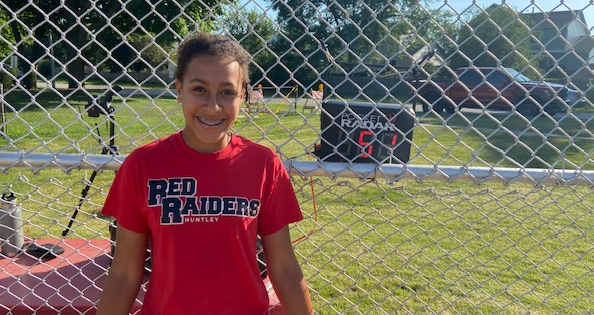
That would be the case for Ajai in the photo at the top. She was all smiles when we took this picture a couple of months ago. But if that was her top speed today she would be anything but happy.
But that’s ok, because it’s all part of the journey. We always want to be building our skills; goals are the blocks we use to do it.
But once they have been met, they are really of no more use to us. Instead, they need to be replaced with bigger, better goals. That’s what drives any competitor to achieve more.
So yes, today’s goals will quickly become tomorrow’s disappointments. But that’s okay.
Remember how far you’ve come, but always keep in mind there is more to go. Stay hungry for new achievements and you just might amaze yourself.
Winning isn’t always the goal
Ask any fastpitch player, coach or parent what the team’s goal is and the easy answer will be “to win.” But when you look at things a bit deeper winning may not always be the primary goal.
Take a 10U or 12U team making the jump from rec ball to travel ball. It can be quite an eye-opener for the girls and the parents. The rules change, the game gets faster, the teams get more aggressive, and the overall caliber of play is generally higher than they’re used to seeing.
In that first year wins may be tough to come by. But that’s ok. The real priority should be getting the players acclimated to the level of competition and helping them understand what it’s going to take to perform their best long-term. That may mean sacrificing a few opportunities to win in favor of player development.
That could mean letting a hitter who isn’t producing bat, even though a better hitter is available. It may mean suffering through more walks to give a pitcher with good long-term potential the opportunity to get reps in facing batters. It might mean putting a fielder into a position she hasn’t quite learned yet in order to give her the experience to play it later.
Winning is nice, no question about it. Me personally, I subscribe to the statement from Moneyball that I hate losing more than I like winning. But if your goal is to develop a team, and its individual players, to be the best they can be, you need to have a plan and stick to it – even if it means you lose more games than you would have otherwise today.
It’s all about your goals, which is why it’s important to set them before the season, when you can be unemotional about it, rather than during the season when you may be willing to do anything required just to get the W.
Know where you’re headed long-term and you’ll be in great shape. And when those wins do start coming, they will be all the sweeter.






 Life in the Fastpitch Lane