Blog Archives
Things Pitchers Can’t Help

Let’s start today’s post with this simple fact: pitching is hard. In fact, it’s not just hard, it’s incredibly hard.
And I’m not talking about the physical toll only, either, that results from having to bring great energy to every single play of every game they’re pitching. There’s also the mental toll of what happens when things don’t go right, as often happens – even at the highest levels of the game as we’re seeing on TV as they say.
All of that is compounded by the type of personality that says yes, give me the ball, give me the responsibility for initiating every play, and have every single person on the field, in the dugout, in the stands, and in the bad parent section of the outfield watch me intensely every time I step onto the pitcher’s plate o throw a pitch. What kind of normal human being volunteers for that type of pressure?
So with all that said, it’s no surprise that pitchers often accept not only their rightful share of the blame when things go wrong; they often take on all of it, whether that’s warranted or not. And most of the time it’s not.
So for all you pitchers, coaches, and pitcher parents who are living and dying on every pitch and every play, I’ve put together this little guide for which responsibilities actually lie with the pitcher and which do not. If you have a pitcher who is suffering through a crisis of confidence because she isn’t perfect all the time, show this list to her and let her know hey – it’s not all on you.
#1 – The Plague of Dropped Third Strikes (D3Ks)
We see this one a lot. The pitcher is pitching effectively, getting hitters to swing and miss on borderline strikes or even balls that look like strikes, but then – the catcher drops the pitch or even misses it completely. Once or twice in a game you can understand that – things happen, even to good catchers.
But when it becomes a pattern, like, say, happening two or three times in an inning, that becomes a problem. If the affected hitters reach base you not only lose an out you should have had; you have a potential run on base that should never have had the chance to score.
When pitchers – especially younger ones – see this, their tendency is to think they have to do something to fix it and cut down on the D3Ks. The usual solution is to try to throw pitches that are easier for the catcher to catch.

The problem with that is those pitches are also easier to hit. Unless hitters are swinging at pitches way over their heads, or way off the plate to the point the catcher can’t reach them without ordinary or even good effort, those D3Ks are not the pitcher’s problem to solve.
She’s doing her job. The problem needs to be solved by the catcher, her coaches (train her up, even if you have to stay after practice to do it), her parents (work with her on non-practice/game days and/or get her catching lessons), or even the catcher herself asking her teammates or friends to give her extra practice.
If I’m advising the pitcher, I’m telling her to keep doing what she’s doing, and maybe even try to get the pitch out a little more so she’s developing herself to compete against better hitters. Maybe if enough runners reach base someone will take one of the actions above and try to fix it – at which point everyone (including the catcher herself) benefits.
#2 – Errors in the Field
Contrary to popular opinion, it’s not the pitcher’s job to strike out every hitter. Sure, strike outs are nice, and they’re definitely helpful because they take some variables out of the play. They also show well for bragging rights.
But they are not a pitcher’s main job. Instead, the pitcher’s main job is to get outs any way she can. If that means inducing hitters to continually hit weak ground balls and easy pop-ups instead of striking them out, so be it.
I’ve known and coached a lot of successful pitchers who didn’t rack up a huge number of Ks, yet somehow they won a lot of ballgames because they made it easy for the 7 fielders behind them to do their jobs. There’s nothing like a 5-pitching inning on a hot and humid day to keep your team fresh and ready to keep playing. (I’m looking at you, Katie Wirtz.)
But for that strategy to be successful, the fielders do have to do their jobs – catch the ball, throw the ball, get the easy out.
If they’re not doing that pitchers can be tempted to try to take on too much and force strikeouts. That’s usually when they start over-throwing the ball instead of pitching with solid mechanics, causing them to get wild and start tossing the ball all over the place.
Errors in the field aren’t the pitcher’s responsibility unless she’s making them herself. Instead it’s again up to the field players, their parents, and the coaches to help them get better so they cut down on the errors to give their team a better chance of winning.
#3 – A High ERA
Ok, this one is conditional, as I will get to in a minute. But these days stats are pretty easy to obtain thanks to apps such as GameChanger, so it’s tempting for a pitcher to go in, look at her stats, and compare herself to other pitchers on the team, or on other teams. Not to mention for other pitchers to repeat what they heard their parents say about them.
Yet the viability of most stats is directly dependent on the quality of the person scoring the game. God bless anyone willing to keep the book, but there’s a huge difference between someone who knows the ins and outs (no pun intended) of scoring a game and someone who is just doing their best to mark something down out of the goodness of their hearts.
ERA is a stat that is dependent on whether a runner reached base as the result of a clean hit or an error. A scorekeeper who marks every ball that’s put in play as a hit, even if there was an obvious error, is going to cause ERAs to go sky high.
Now, I will say a lot of scorekeepers will mark the most obvious errors, such as Little Suzy (poor Suzy, always getting picked on) dropping a pop-up that’s hit right to her or fumbling a weak ground ball or fielding it cleanly and then throwing it into the parking lot. But there are a lot more possibilities for errors.

The definition of an error is basically the failure to successfully get the out on a play that required ordinary effort. So if an outfielder runs up to a fly ball, stops, and lets the ball hit the ground, that’s an error even though she didn’t touch it. If a shortstop stands like a statue as a medium ground ball goes by her two feet to her left, that’s an error.
Then there are the cases where scorekeepers cook the books a little. They mark an error a hit in one case and not in another not because they don’t know better but because they’re actively trying to help one pitcher look better than another.
I don’t think that happens often, but it definitely does happen.
No matter the reason, if a pitcher has a high ERA because she’s throwing meatballs all day to hitters that’s on her. If it’s because errors are being marked as hits for whatever reason, it’s not.
#4 – A Low Strike/High Walk Percentage
Again, this one is conditional. If a pitcher is throwing the ball into the dirt, wide of the batter’s box, over the backstop, etc., that’s on her and she needs to own it.
But there are other cases where that’s not true. An umpire with an inconsistent strike zone can make it difficult for a pitcher to know where to throw the ball to get a strike.
Same with an umpire with an inappropriately small strike zone for the age group. As we mentioned earlier, pitching is already difficult enough without making the strike zone the size of a shoebox.
Now, that said, if that’s the case the pitcher does have a responsibility to adjust to wherever the umpire is calling strikes. But that can be difficult for pitchers with only a year or two’s worth of experience.
And if they are successful in finding that zone, don’t be surprised if they start getting pummeled. Hitters aren’t stupid, and their job gets a whole lot easier if they only really have to worry about swinging at one location – even if it’s their weakest location.
#5 – Being Overmatched
This can happen too, especially at the younger ages.
Sometimes the coach figures the best chance of winning is to put his/her Ace up against a really strong team, only to realize about 10 minutes in that the Ace isn’t up to the task yet. Sometimes the coach chooses to enter a tournament based on dates and location rather than level of competition and ends up learning the hard way that a little more research can sometimes save a lot of heartache.
Sometimes the coach sees improvement in his/her team and consciously decides to test them against a higher level of competition, only to discover they’re not ready yet. And sometimes the coach takes the old axiom about iron forging iron a little too seriously and I guess figures a weekend of good old fashioned buttkicking is just what the team needs to get better.
Whatever the reason, when a pitcher finds herself in that situation all she can do is do the best she can, learn what she can from it, and keep working with a goal of making a better showing the next time she sees a team or group of teams like that.
The Realities
There are times when pitchers need to step up and take responsibility for their shortcomings in a game. They have to control their controllables and do everything they can to get themselves ready each and every time they step into the circle.
But there are also a whole lot of other factors they can’t control, and if they try to take responsibility for those too they’re going to end up hating the position – and we don’t want to see that.
Helping your favorite pitcher(s) understand the differences between the two is a great way to help avoid unwarranted unhappiness and keep them on a path of learning, and growth. Hopefully this little guide will help.
Lead photo by Pixabay on Pexels.com
Social Distancing Adds New Complications to Fastpitch Pitching
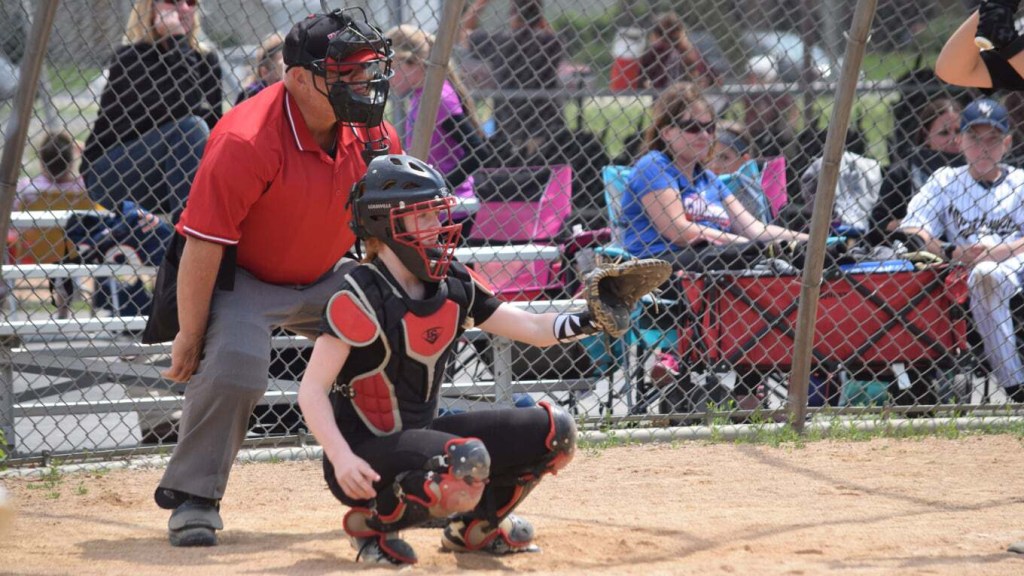
One of the keys to success in pitching in fastpitch softball or baseball is figuring out the umpire’s strike zone. While the rulebook offers certain parameters that should be universal (armpits to top of the knees, any part of the ball crosses any part of the plate, etc.) we all know even under the best of conditions it doesn’t always work out that way.
One of the keys to success in pitching in fastpitch softball or baseball is figuring out the umpire’s strike zone. While the rulebook offers certain parameters that should be universal (armpits to top of the knees, any part of the ball crosses any part of the plate, etc.) we all know even under the best of conditions it doesn’t always work out that way.
Many a pitcher (and a pitcher’s parent) has complained about umpires having a strike zone the size of a shoebox. And that shoebox is rarely in an area that contributes to pitchers keeping their ERAs low.

Instead, it’s far more likely to have the zero point on its X and Y axes about belt high, in the center of the plate. You know, that area that pitchers are taught they should see a red circle with a line through it.

Of course, these are anything but ordinary times. Here in the fall of 2020, in the midst of the worst pandemic in 100 years and with no relief in sight, teams, tournament directors and sanctioning bodies have had to take extraordinary steps to get games in. One of those is to place umpires behind the pitcher instead of behind the catcher in order to maintain social distancing.
It sounds good in theory, I’m sure. Many rec leagues using volunteer parents for umpires have had said Blues stand behind the pitcher. Sure beats spending money on gear.
But while it does allow games to be played, the practical realities have created a whole new issue when it comes to balls and strikes.
When the umpire is behind the plate, he/she is very close to that plate and thus has a pretty good view of where the ball crosses it. Not saying they always get it right, but they’re at least in a position to do so.
When they are behind the pitcher it’s an entirely different view. Especially in the older divisions where the pitchers throw harder and their balls presumably move more.
For one thing, the ball is moving away from the umpire instead of toward him/her. That alone offers a very different perception.
But the real key is that by the time the ball gets to the plate, exactly where it crosses on the plate and the hitter is much more difficult to determine. I don’t know this for a fact, but I’m sure the effects of parallax on vision has something to do with the perception.
Because it is more difficult to distinguish precisely, what many umpires end up doing is relying more on where the ball finishes in the catcher’s glove than where it actually crosses the plate. Not that they do it on purpose, but from that distance, at that speed, there just isn’t a whole lot of other frames of reference.
If an umpire isn’t sure, he/she will make a decision based on the most obvious facts at hand. And the most obvious is where the glove ends up.
This can be frustrating for pitchers – especially those who rely more on movement than raw power to get outs. They’re probably going to see their strikeouts go down and their ERAs go up as they are forced to ensure more of the ball crosses the plate so the catcher’s glove is close to the strike zone.
There’s not a whole lot we can do about it right now. As umpires gain more experience from that view I’m sure the best of them will make some adjustments and call more pitches that end up off the plate in the catcher’s glove. Most will likely open their strike zones a bit, especially if they realize what they’re seeing from in front of the plate isn’t the same thing they’d see from behind it.
Until that time, however, pitchers, coaches and parents will need to dial down their expectations in these situations. It’s simply a fact of life that hopefully will go away sooner rather than later.
In the meantime, my top suggestion is for coaches to work with their catchers to ensure their framing, especially side-to-side, is top-notch. Catching the outside of the ball and turning it in with a wrist turn instead of an arm pull may help bring a bit more balance to the balls-and-strikes count.
Pitchers will have to work on the placement of their pitches as well, at least as they start. This is a good time to work on tunneling – the technique where all pitches start out on the same path (like they’re going through a tunnel) and then break in different directions.
The closer the tunnel can start to the middle while leaving the pitches effective, the more likely they are to be called strikes if the hitter doesn’t swing.
On the other side of things, it’s more important than ever for hitters to learn where the umpire’s strike zone is and how he/she is calling certain pitches. If it’s based on where the catcher’s glove ends up, stand at the back of the box, which makes pitches that may have missed by a little at the plate seem like they missed by much more when they’re caught by the catcher.
If the umpire isn’t calling the edges, you may want to take a few more pitches than you would ordinarily. Just be prepared to swing if a fat one comes rushing in. On the other hand, if the umpire has widened up the zone, you’d best be prepared to swing at pitches you might ordinarily let go.
Things aren’t exactly ideal right now, but at least you’re playing ball. At least in most parts of the country.
Softball has always been a game that will break your heart. This is just one more hammer in the toolbox.
Accept it for what it is and develop a strategy to deal with it – at least until the Blues are able to get back to their natural habitat. You’ll find the game is a lot more enjoyable that way.
Shoes photo by Karolina Grabowska on Pexels.com






