Blog Archives
Why It’s Important to Celebrate Progress, Not Just Achievement

Everyone loves to celebrate the big achievements in softball – winning a tournament or conference championship, tossing a no-hitter, hitting the game-winning home run, and so on. Those are definitely highlight in a player’s career and should be lauded whenever they occur.
Yet celebrations of a player’s performance don’t always have to wait for some major achievement. In fact in my experience it’s often more important to celebrate progress, even if it’s on a small scale, because those little wins now are usually what lead to those big wins down the road.
Here’s a good example. Let’s say you have a hitter who, as they say in Bull Durham, couldn’t hit water if she fell out of a boat. She’s all arms with no control over the bat, and she seems to defy the law of averages by not even making random contact through sheer luck.

Realizing it’s a problem she starts to take hitting lessons, and within a couple of lessons she hits a weak ground ball to second and pops out to first in the same game. Nothing to write home about in the big scheme of things – it’s still a couple of outs – but she at least put the bat on the ball.
That’s something to celebrate because it represents progress. Now, perhaps inspired, she keeps working at it and next game hits a hard line drive to shortstop or flies out with a direct hit to the left fielder.
Again, she is showing progress. Because you are celebrating and encouraging her she continues to work, and suddenly those hard-hit balls start finding some gaps between fielders.
It’s been little steps along the way, but they have been important steps. And maybe before you know it she’ll come to bat with the game on the line and produce one of those highlight reel moments that would have been unthinkable not too long ago.
I’ve seen it happen. If you have, tell your story down in the comments.
Or what about the pitcher who can’t seem to find the plate with both hands and a flashlight due to poor mechanics? She can force the ball over enough to keep giving her opportunities, but her walks are still out-pacing her strikeouts and soft contacts and you’re starting to reconsider your position with the playoffs coming.
She realizes it too and starts taking the need to work on her mechanics more seriously. She puts in the work and you can see her start looking more like a pitcher should look, even if the outcomes, while better, still aren’t where the team needs her to be.
The same goes for pitchers and speed. It takes some longer to figure things out than others, or for their bodies to even have the physical capacity to deliver an appropriate level of speed for her age.
But if she keeps working on the mechanics and on learning to feel what her body is doing at different points in the pitching motion, the improvement will come.
Again, by celebrating the progress you can send a message that what she’s doing is working and she should keep on doing it. That little bit of encouragement may be just what she needs to fulfill her potential and become a reliable member of your pitching rotation.
These are just two examples of what is often called the “grind.” While it would be wonderful if you could just make a tweak here or there and see it pay off instantly, that’s not how it usually works.
Progress doesn’t come in leaps and bounds for most; it’s normally a lot more incremental. But if you wait to recognize only the big achievements they may never happen because the player gets discouraged before she reaches that point.
A better approach is to look for the good, even when it’s small, and call it out to keep players going when the going gets tough.

Now, all of that assumes these players are working on making the changes that are needed in order for progress to occur. Empty praise doesn’t help; they have to be making the effort to fix whatever is preventing them from getting better or they’re just going to fall further behind.
But if they are, take the time to recognize the progress even if the big achievement doesn’t come right away. Because it will in time.
Remember to Celebrate Progress and Successes

The other day I went to visit a healthcare professional (HP). Nothing serious, just basically checking a box for the insurance company.
Anyway, we were talking about some lifestyle changes I’ve made to try to stay healthier longer. Yet it seemed like every time I told the HP about some improvement I’d made she countered with I should be doing this or that too.
It was kind of frustrating, because rather than feeling encouraged to continue doing better I was made to feel like no matter what I did it would never be good enough. The focus would always be on what more I could do or should be doing.

That experience got me to thinking about how we coach our fastpitch softball players. (Take that Google algorithms.)
Often times we coaches are so focused on trying to get our players ready for “the next level” (whatever that is) or trying to make them look just like the players we see on TV that we fail to acknowledge all the great work they’ve done to get themselves to this point. And that can be just as discouraging as my experience with the HP.
That’s why it’s important every now and then along the journey to stop and take a look backward even as you’re trying to look ahead to the next goal. Showing a player how far she has come can give her a real boost to continue putting in the work to keep moving forward.
Let’s take a hitter who has been working on her swing. Honestly, I get a fair amount of students whose only goal (or their parents’ only goal for them) is to not strike out every time they come to bat.
Mom and/or Dad aren’t looking for little Amelia to hit home runs or have the highest batting average on the team. They’re simply hoping she doesn’t get totally discouraged from playing because she wouldn’t hit water if she fell out of a boat.
They don’t want to have to cringe every time she comes to the plate, but that’s another story.
So Amelia gets help from a coach or instructor, fixes whatever was causing her to just randomly swing the bat and hope she hit something, and now she’s making contact with greater regularity and getting on base now and then. At which point the goal becomes to start hitting the ball to or over the fence.
That’s great that everyone wants Amelia to keep growing and improving. But maybe in the midst of all that take a step back to appreciate the fact that the original goal has been met and let Amelia feel good about what she has accomplished so far – at least for a few minutes.
Video is great for that, by the way. Even if Amelia isn’t quite getting on base often enough, showing her a video of how she used to swing the bat versus how she is swinging it now will probably help her build confidence and continue to focus on the process instead of the outcomes.
Then let the law of averages take care of the rest.
It’s the same for pitching. Maybe you have a goal of having a pitcher throw faster, or throw more strikes. Or both.
Regardless of the goal, the path to achieving it starts with improving her mechanics.
So perhaps when she started out she looked less like she was trying to pitch and more like she was trying to fold a fitted sheet.

Showing her a video of how she used to look versus how she looks now might give her some encouragement that she’s on the right track, even if the radar isn’t reflecting it or she’s still throwing a few too many in the dirt. That doesn’t mean you still don’t want to hold her to a higher standard.
But you can acknowledge the fact that she is improving so she has something to feel good about while she works toward the bigger payoff.
All of this doesn’t mean you should provide false praise just to spare the player’s feelings. If she’s not putting in the work and showing improvement that needs to be called out. Otherwise, what’s the point?
Often, however, we are in such a hurry to get to the ultimate goal (being names an MVP, making a particular team, winning a scholarship, etc.) that we don’t take the time to appreciate the progress that’s already been made.
So think about that today. If you’re a coach, what can you do to recognize how much better your players are today than they were a month ago, or three months ago, or a year ago, etc.?
If you’re a parent, what can you point to that lets your daughter know you are proud of how far she has come so far? Even if she still has a ways to go.
That little bit of encouragement may be just the thing your player needs to keep grinding – and build a level of confidence that will carry through not just her softball career but her whole life.
Why Good Circle Visits Are So Critical to Pitchers’ (and Team) Success

One of the toughest decisions a coach has to make during a game is when to take a pitcher out. That decision is based on a lot of factors.
For example, it’s easier to leave a pitcher in a game to see if she can work her way out of trouble if the game doesn’t mean that much. On the other hand, if you’re in a big tournament, the pitcher is your #1 (and thus perceived to be your best chance at winning) and a loss means elimination, it can be very tempting to stick with her even if you know in your heart of hearts she’s done.
If you do decide the current pitcher needs to be replaced, however, one thing that shouldn’t be a difficult decision is deciding how to take her out. That should be handled by a circle visit, either by the head coach or the team’s designated pitching coach.
(ASIDE: If the pitcher is the head coach’s daughter, the visit should probably be handled by literally anyone else. That’s the voice of experience talking, folks.)

The reason I bring this up is I recently heard a story about a team where, when they want to change pitchers, there is no circle visit. The coach just sends the new pitcher out from the bench to tell the current one it’s time to take a seat.
That’s just wrong for so many reasons, not the least of which is the mental game wellbeing of the pitcher – a factor which will no doubt be of importance down the road. It’s also just rude.
A pitcher would have to be pretty unaware of her surroundings and what’s going on in the game to not realize she is struggling. I mean, if she’s walked the bases loaded in 12 pitches she probably has a pretty good clue that she’s not exactly on top of her game.
A circle visit gives the coach an opportunity to say, “Doesn’t look like today is your day,” or something to that effect.
If the pitcher was doing well up to that point the coach can say words to the effect of, “Looks like you’re having some trouble with the umpire. Let’s give her a different look and see if we can’t get out of this jam.” If she wasn’t, the coach can say something such as, “Rough one today. I think we need to change things up right now, but if you keep working there will be other opportunities.”
I’ve talked to many current and former players, and nearly all agree that girls are far more likely to think the worst of themselves and believe it when someone tells them they’re not very good. Even if they know it’s not true.
A few kind words when making a pitching change can help mitigate some of that thinking and bolster the pitcher’s base confidence level. And as we all know, confidence is a critical element to have when you’re playing the position that is most under the spotlight, and has so much impact on the team’s success.
But circle visits aren’t just for pitching changes. Getting out in front of problems, especially if they’re happening to your #1, can help you avoid having to make that tough decision later.
Sometimes when a pitcher starts to struggle she just needs a little positive reinforcement from the coach. Sometimes she needs the visit just to slow the game down and give her a chance to regain her composure, or her mojo. Sometimes she just needs to get out of her own head for a bit.
One time when one of pitchers was struggling I called time, walked to the circle, and said, “A horse walks into a bar and the bartender says, ‘Hey, why the long face?'” I then turned around and went back to the bench.
She was a bit stunned at first, I think, but then she realized my Dad joke was just a way of telling her A) don’t take all this too seriously, and B) you’re doing fine, just relax. It worked too – she pitched herself out of the inning with no more trouble.

A circle visit isn’t really a time to offer pitching instruction, although I was known to draw a power line or two in the dirt in my coaching days when I thought it would help. It’s a time to help pitchers deal with the mental side, whether it’s calming down so they can continue or softening the blow of taking them out so they know the situation is temporary, not permanent – and that coming out of a game mid-inning doesn’t make them a bad human being or a terrible pitcher. Everyone gets pulled sooner or later.
Now, I know at this point some of you keyboard warriors are thinking this point of view is soft, and that female pitchers need to not be such snowflakes. They need to toughen up Buttercup and just deal with it.
So for those who think this way let me ask you this: when was the last time you saw a Major League Baseball pitcher get taken out of a game without a coach coming out to the mound to do it? You can count those times on the fingers of one ear.
So if an MLB pitcher who is a fully grown adult and is getting paid millions, or tens of millions, of dollars per year to throw a ball needs a coach to come out and tell them personally that they’re done for the day, why shouldn’t a young or adolescent girl who is just playing for the love of the game be offered the same courtesy? Or a college pitcher for that matter.
If you’re a coach who is managing pitchers in-game, be smart about it. Get off your behind and talk with your pitchers when they need it – whether it’s to calm them down or make a change.
They may not like seeing you come out of the dugout but that feeling will be temporary. Because they will appreciate you showing you care about them as a person as well as a pitcher.
Send A Letter to Your Future Self
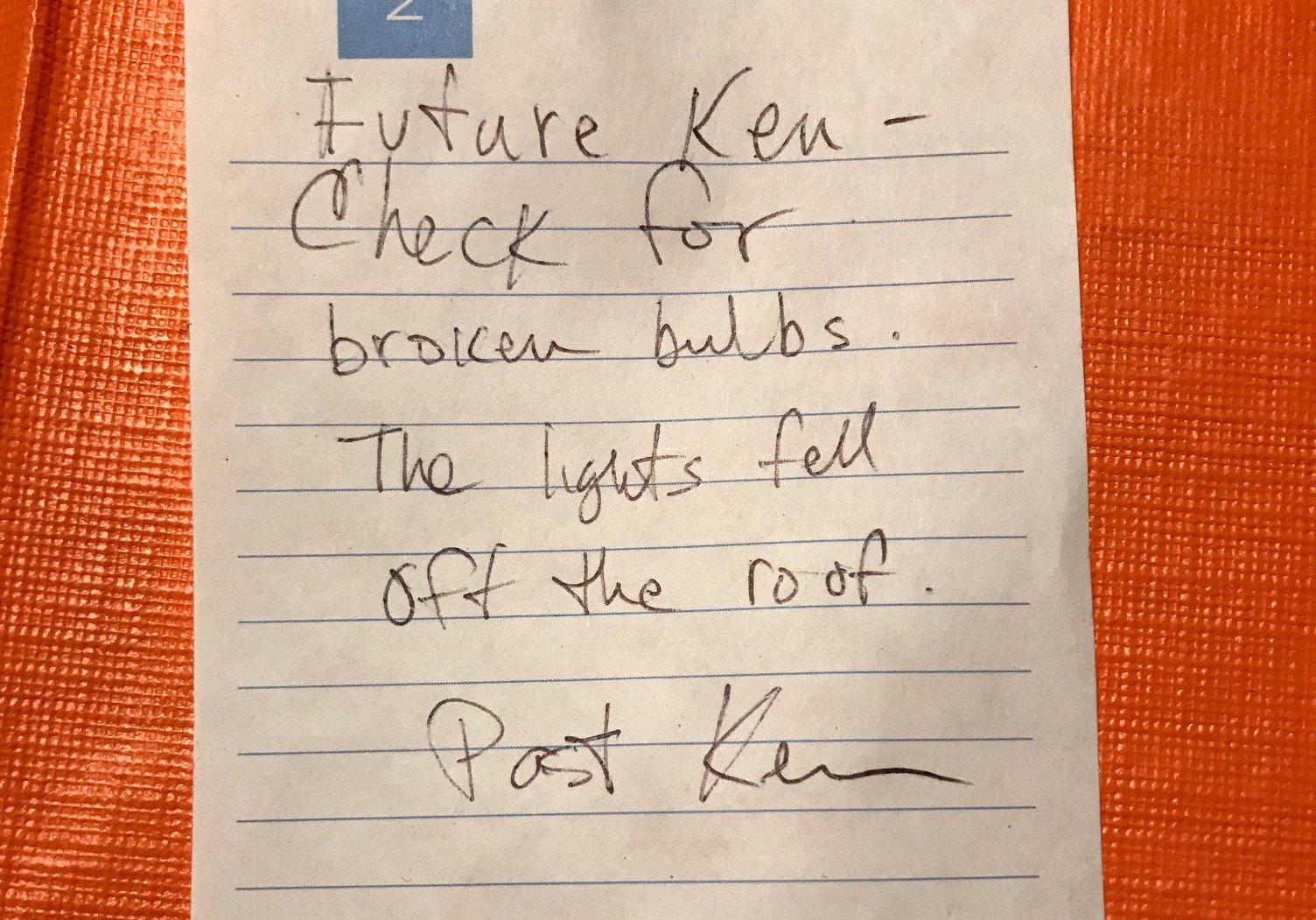
A couple of weeks ago, as I was preparing for my annual battle with putting Christmas lights on the roof of my house, I came across the note pictured above. It was a message from myself last spring, when I took the lights down, alerting me to a potential issue with some of the strings.
(By the way, a tip of the Hatlo Hat to the TV show How I Met Your Mother for the whole Future Ken/Past Ken thing.)
I had completely forgotten the lights had fallen off the roof (better them than me!), so I was glad I’d done it. I was also quite amused by the whole concept.
Then last week at the NFCA convention I heard a speaker talk about how players should do the exact same thing prior to their season, to be opened at the end. In her case it was to be opened upon winning an NCAA D1 championship (which didn’t happen), but the concept is still a good one.
For players who are serious about their game, what better way is there to end a season than to look at the perspective of their (slightly) younger selves to see how it matched up to reality?
Here’s the idea. Before the season, the player sits down and imagines what the season will be like. Not just the quantifiable goals, but maybe how things went, what the experience was like, what they accomplished, what they liked and disliked, etc.
It should be a personal letter from Past (Player) to Future (Player). It could include encouragement, consolation, congratulations or whatever the player happens to be feeling at the time.
Then seal it up and put it away, not to be opened until after the season. Now that they player has gone through the entire season experience, she can compare what she thought would happen, and how she thought she’d feel, to what actually happened.
An exercise like this can help put things into perspective. For example, if the player is on the fence about whether to stay with this team or look for another, she can compare what her expectations were to what actually happened.
If she had a tough season, she can look back on how hard she expected to work and compare that to how hard she actually worked. If she was feeling awkward around new teammates in the beginning, she can compare that to how she feels about her teammates now. Maybe she made some great new friends and is just grateful to have been part of such an awesome group.
There are so many things to be gained from this exercise. If you’re a parent, try having your favorite player do it. If you’re a coach, have your team do it and hold the envelopes until the end of the season banquet/party.
By the way, this isn’t just for players. Coaches can do the same exercise as well.
I’ve had great seasons where you hated to see them end, and I’ve had seasons where it all couldn’t end soon enough. If nothing else it would have been fun to see how my earlier self viewed what was coming and whether it matched up to what actually occurred.
In our hyper-fast world we tend to only look at what’s right in front of us. In doing so we miss the benefits of a longer-term view.
By taking the time to write out this letter to their future selves, players and coaches can gain a longer-term view, and perhaps use that to change their next future.
So what do you think of this idea? Have you ever tried it? If so, how did it turn out? Leave your experiences below in the comments.






 Life in the Fastpitch Lane